---
title: "Run the Race: Come to Me, All Who Are Weary"
category: "spiritual-disciplines"
description: "Jesus invites the weary to Himself and gives them rest under His yoke. Hebrews tells tired believers to run with endurance, looking to Him. Why Christians grow weary, what feeds the runner, and what weighs the runner down."
tags: ["matthew", "hebrews", "isaiah", "proverbs", "philippians", "discipleship", "grace", "prayer", "church", "parable", "method/word-study", "lang/greek", "lang/hebrew"]
draft: false
primary_passage: "Matthew 11:28-30; Hebrews 12:1-3"
bible_references: ["Matthew 11:19-27", "Matthew 12:1-7", "Matthew 13:1", "Matthew 13:22", "Mark 4:19", "Luke 8:14-15", "Matthew 23:4-5", "Luke 11:46", "Jeremiah 6:16", "Isaiah 40:29-31", "Isaiah 50:4-7", "Luke 9:51", "John 4:6", "Mark 8:3", "Matthew 15:32", "Hebrews 2:1", "Hebrews 3:1", "Hebrews 3:13", "Hebrews 4:15-16", "Hebrews 10:24-25", "Hebrews 10:32-36", "Hebrews 11:39-40", "Hebrews 12:5", "Hebrews 12:12", "Philippians 3:12-14", "Philippians 4:6-8", "Proverbs 3:5-6", "Proverbs 4:20-23", "Matthew 6:1", "Matthew 6:4", "Matthew 6:11", "Matthew 6:16", "Matthew 6:34", "Matthew 4:4", "Deuteronomy 8:3", "Acts 2:42", "Acts 15:10-11", "Luke 18:12-14", "Luke 21:34", "Luke 8:13", "John 10:28", "1 Peter 1:5", "Matthew 11:3", "Galatians 6:9", "1 Peter 5:7", "John 6:35-37", "1 John 5:3", "Hosea 6:6", "Proverbs 3:11-12", "Hebrews 12:14-15", "Psalm 55:12-14", "Acts 15:39", "2 Timothy 4:10-17", "Acts 20:29-30", "John 10:11-13", "Hebrews 9:9", "Hebrews 9:14", "Hebrews 10:1-3", "Hebrews 10:14", "Hebrews 10:22", "Hebrews 10:37-39", "Habakkuk 2:3", "Hebrews 12:4", "Hebrews 12:6", "1 John 3:20", "1 John 2:19", "Luke 8:12", "Mark 4:17", "2 Corinthians 11:32"]
date_created: 2026-10-02
date_modified: 2026-10-31
ai_provider_models:
- anthropic/claude-opus-5.5
---
# Run the Race: Come to Me, All Who Are Weary
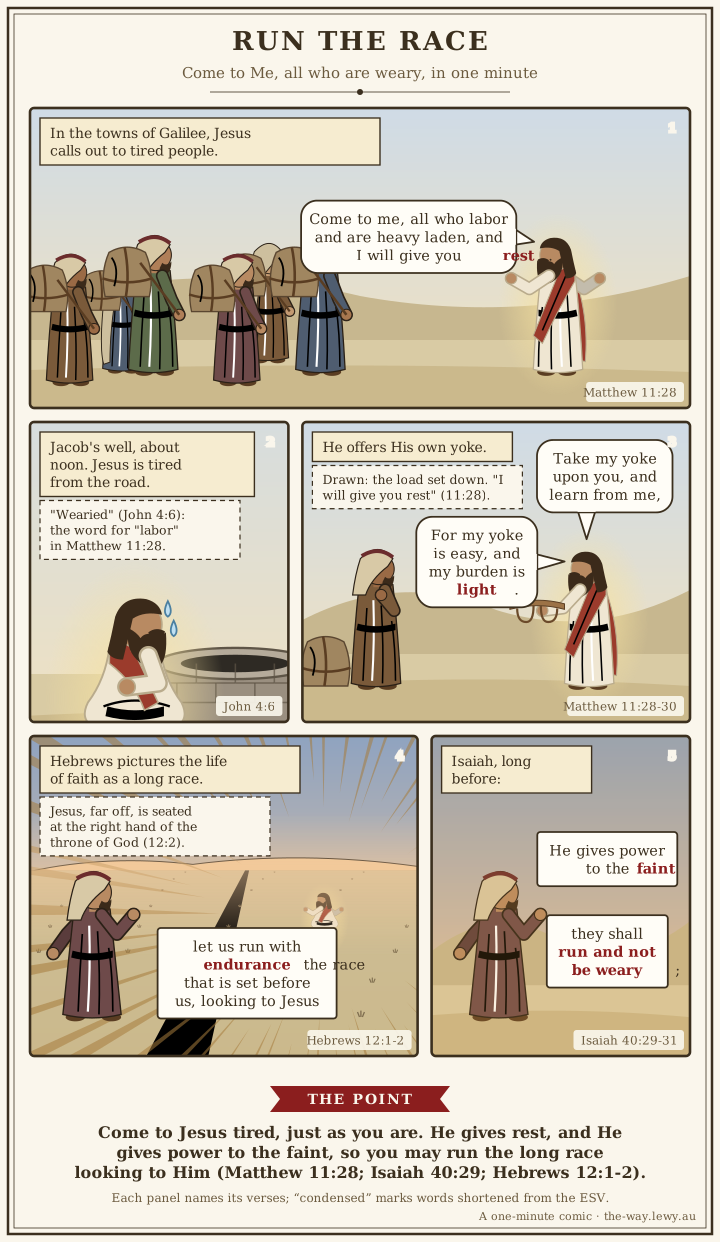
Jesus once stood in Galilee and called out to tired people. "Come to me, all who labor and are heavy
laden, and I will give you rest" (Matthew 11:28, ESV). Many Christians heard that call, came, and
found it true. Years later they are tired again. If that is you, the invitation still stands, and
it is addressed to the tired. Hebrews was written to people like you. They had
believed, suffered for it, and held on. Now their hands were drooping (Hebrews 12:12), and God
wrote to lift them.
**In one sentence:** Jesus calls you to come to Him tired, just as you are, and gives you rest by
yoking you to Himself; you run the long race on that same rest, looking to Jesus, fed by His word,
kept in prayer and stirred up by one another, and you may put down the loads He never gave you:
works done to be seen, discipline used to earn, and the cares of this age that choke the word.
[](https://the-way.lewy.au/assets/img/comics/run-the-race.svg)
Read the two passages side by side. The first is the invitation; the second is how to keep going.
> ✝️ Matthew 11:28-30 (ESV)
>
> 28 Come to me, all who labor and are heavy laden, and I will give you rest. 29 Take my yoke upon
> you, and learn from me, for I am gentle and lowly in heart, and you will find rest for your souls.
> 30 For my yoke is easy, and my burden is light.
> ✝️ Hebrews 12:1-3 (ESV)
>
> 1 Therefore, since we are surrounded by so great a cloud of witnesses, let us also lay aside every
> weight, and sin which clings so closely, and let us run with endurance the race that is set before
> us, 2 looking to Jesus, the founder and perfecter of our faith, who for the joy that was set before
> him endured the cross, despising the shame, and is seated at the right hand of the throne of God.
> 3 Consider him who endured from sinners such hostility against himself, so that you may not grow
> weary or fainthearted.
## Key Takeaways
*(This section follows the [Key Takeaways](https://the-way.lewy.au/about/key-takeaways/) format — see that page for what each part is for.)*
### Lessons about Jesus
- **He knows weariness from the inside.** John uses the same verb for Jesus at Jacob's well, "wearied
as he was from his journey" (John 4:6, ESV), that Jesus uses for the people He calls (Matthew
11:28).
- **He alone can give this rest.** No one knows the Father except the Son "and anyone to whom the Son
chooses to reveal him" (Matthew 11:27, ESV). The invitation comes from the only one who can bring
you to God.
- **He ran the race first.** He endured the cross for the joy set before Him, and He is seated at
God's right hand (Hebrews 12:2). Your faith starts with Him and He brings it to completion.
### Memory verses
> ✝️ Matthew 11:28 (ESV)
>
> 28 Come to me, all who labor and are heavy laden, and I will give you rest.
> ✝️ Hebrews 12:3 (ESV)
>
> 3 Consider him who endured from sinners such hostility against himself, so that you may not grow
> weary or fainthearted.
### Be Transformed
- **Think.** Your rest was given before you did anything (Matthew 11:28). Nothing you add to it will
make God more willing to keep you.
- **Attitude.** When you are tired, look at Jesus before you look at the race. Consider Him (Hebrews
12:3).
- **Do.** Name one weight you are carrying and "lay aside every weight" (Hebrews 12:1, ESV) this
week. Bring it to Jesus each morning in His own invitation, "Come to me, all who labor and are
heavy laden, and I will give you rest" (Matthew 11:28, ESV), and cut back the one thing that keeps
loading it on you.
### Prayer
Father, Lord of heaven and earth, thank you that you have revealed yourself to little children
through your Son Jesus. We come to Him tired. Thank you that He was wearied by the road, and that He
set His face to Jerusalem and endured the cross for us. Take from us the loads we were never asked to
carry: the need to be seen, the hope of earning your favour, the cares of this age. Yoke us to Him
again. Give us this day our daily bread, open our ears morning by morning to your word, and keep us
close to your people. Guard our hearts and minds in Christ Jesus, so that we run with endurance until
we see Him.
In Jesus' name. Amen.
## Study outline
- [Come to me](#come-to-me). Matthew 11:28-30 in its chapter: who is speaking, what loads the
hearers carried, and the rest Israel once refused.
- [Why believers grow weary](#why-believers-grow-weary). What wore down the church Hebrews was
written to, the weight of never feeling good enough, hurt from inside the church, Hebrews' two
words for tired, and Jesus' own weariness at Jacob's well, which shows that being tired is not
itself a sin.
- [Run with endurance, looking to Jesus](#run-with-endurance-looking-to-jesus). Hebrews 12:1-3
phrase by phrase, from whether the [cloud of witnesses](#the-cloud-of-witnesses) watches or
testifies (contested) to the cross, then Isaiah 40:31, the face like flint, and Philippians 3:12.
- [What feeds the runner](#what-feeds-the-runner). Gathering with the church, prayer as daily bread,
and living on the word.
- [What weighs the runner down](#what-weighs-the-runner-down). Works done to be seen, discipline
used to earn, the three soils of the sower and which hearers believed, the cares of this age, and
guarding the heart.
- [Discussion questions](#discussion-questions). Six, for a group or on your own.
## Come to me
### Who is speaking
Matthew 11 is a chapter of rejection. John the Baptist doubts (Matthew 11:3). The crowds call Jesus
"a glutton and a drunkard" (Matthew 11:19, ESV). The towns where He did most of His miracles do not
repent (Matthew 11:20). Then Jesus thanks His Father that these things are "revealed ... to little
children" (Matthew 11:25, ESV), and He says who He is:
> ✝️ Matthew 11:27 (ESV)
>
> 27 All things have been handed over to me by my Father, and no one knows the Son except the
> Father, and no one knows the Father except the Son and anyone to whom the Son chooses to reveal
> him.
The invitation follows straight on. The one who says "Come to me" is the Son who alone knows the
Father. That is why His rest is real. **He gives rest by bringing you to God.**
### Who was weary, and why
"Labor" is κοπιάω (*kopiaō*, G2872), to work until you are spent. "Heavy laden" is the perfect
passive of φορτίζω (*phortizō*, G5412): people who have had a load put on them and are still under
it. Someone loaded them.
Matthew and Luke name who. *Phortizō* occurs twice in the New Testament. One is here. The other is
Jesus' charge against the lawyers: "you load people with burdens hard to bear, and you yourselves do
not touch the burdens with one of your fingers" (Luke 11:46, ESV). Matthew uses the noun φορτίον
(*phortion*, G5413) the same way. Jesus' "burden is light" (Matthew 11:30), and the scribes and
Pharisees "tie up heavy burdens, hard to bear, and lay them on people's shoulders" (Matthew 23:4,
ESV). The ESV Study Bible draws the same line: in the immediate context the heavy-laden are those
under the legalism of the scribes and Pharisees.
The next scene opens "At that time" (Matthew 12:1, ESV), the same phrase
that opened Jesus' prayer (Matthew 11:25). His hungry disciples pluck grain on the Sabbath and the
Pharisees condemn them. Jesus answers with Hosea 6:6, and calls His disciples "the guiltless" (Matthew 12:7, ESV). If
others have loaded you with rules for earning God's favour, Jesus' verdict on His own still stands:
He desires mercy.
### The yoke
A yoke joined two animals to pull one load. Jewish teachers spoke of taking up the yoke of the
kingdom and the yoke of the law (NIV Cultural Backgrounds Study Bible on Matthew 11:29). Peter later
called the law's demands "a yoke ... that neither our fathers nor we have been able to bear" (Acts
15:10, ESV), and answered it: "we believe that we will be saved through the grace of the Lord
Jesus" (Acts 15:11, ESV).
Jesus calls ζυγός (*zygos*, G2218) "my yoke", and every line of the invitation points to Himself:
"Come to me." "Learn from me." The yoke you are offered is Jesus Himself.
A yoke is still a yoke. Rest under it is work done beside Someone who pulls the weight. He is
πραΰς (*praus*, G4239), gentle, and lowly in heart (Matthew 11:29). His yoke is χρηστός
(*chrēstos*, G5543), kind, comfortable to wear. His burden is ἐλαφρός (*elaphros*, G1645), light. John says
the same of His commands: "his commandments are not burdensome" (1 John 5:3, ESV).
### Given, then found
The rest comes twice. "I will give you rest" (Matthew 11:28) is a gift; ἀναπαύω (*anapauō*, G373)
is something He does. "You will find rest for your souls" (Matthew 11:29) uses the noun, ἀνάπαυσις
(*anapausis*, G372): rest you discover once
you are under the yoke and learning from Him.
That second phrase is Jeremiah's. God told Judah to ask for the ancient paths, "where the good way
is; and walk in it, and find rest for your souls. But they said, 'We will not walk in it.'"
(Jeremiah 6:16, ESV). Matthew follows the Hebrew מַרְגּוֹעַ (*margoaʿ*, H4771),
"rest", a word found nowhere else in the Hebrew Bible. The Greek translation of Jeremiah has
"purification" there instead. So Jesus took Jeremiah's own words and offered again what Judah
refused. He is the good way, and He walks it with you.
**This shows that God receives the weary as they are and gives them rest Himself.** Salvation is rest given by grace. You do not carry it.
## Why believers grow weary
### What wears a believer down
Hebrews was written to Christians who had started well. "Recall the former days when, after you were
enlightened, you endured a hard struggle with sufferings" (Hebrews 10:32, ESV). They were publicly
shamed, stood by prisoners, and "joyfully accepted the plundering of your property" (Hebrews 10:34,
ESV). Years later their hands were drooping (Hebrews 12:12). The letter names what wore them down:
- **Suffering that went on.** The struggle of Hebrews 10:32 had not ended, though "you have not yet
resisted to the point of shedding your blood" (Hebrews 12:4, ESV).
- **Waiting.** Jesus had not yet returned. The writer answers with Habakkuk 2:3: "Yet a little while,
and the coming one will come and will not delay" (Hebrews 10:37, ESV).
- **Sin left in place.** "Exhort one another every day ... that none of you may be hardened by the
deceitfulness of sin" (Hebrews 3:13, ESV). It is the sin that "clings so closely" to the runner
(Hebrews 12:1).
- **Hardship read as rejection.** Hebrews quotes Proverbs 3:11-12 so that hardship is read as a
Father's training: "the Lord disciplines the one he loves" (Hebrews 12:6, ESV).
- **Drifting and staying away.** "Lest we drift away from it" (Hebrews 2:1, ESV); some were
"neglecting to meet together" (Hebrews 10:25, ESV). Weariness produces both, and both feed it.
The writer's diagnosis is short: "you have need of endurance" (Hebrews 10:36, ESV).
### Never good enough
The heaviest of these loads is the sense that you are never good enough for God, and Hebrews was
written to lift it. Under the old covenant the same sacrifices were "continually offered every year"
and in them "there is a reminder of sins every year" (Hebrews 10:1, 3, ESV). They "cannot perfect the
conscience of the worshiper" (Hebrews 9:9, ESV). A conscience that keeps a running account against
you lives as though those sacrifices were still being offered.
Jesus' offering was made once: "by a single offering he has perfected for all time those who are
being sanctified" (Hebrews 10:14, ESV). His blood will "purify our conscience from dead works to serve
the living God" (Hebrews 9:14, ESV). So "let us draw near with a true heart in full assurance of
faith, with our hearts sprinkled clean from an evil conscience" (Hebrews 10:22, ESV). When your own
heart accuses you, "God is greater than our heart, and he knows everything" (1 John 3:20, ESV).
**You run as someone already accepted.** Your standing rests on Jesus' finished work, and the Father
and the Son hold those who are His; [Assurance of Salvation](https://the-way.lewy.au/salvation/assurance-of-salvation/)
sets out the ground. A runner who has stopped checking whether he is allowed in the race has his
breath for the race.
### When the church wears you out
Hebrews' readers were worn down from inside as well as outside. Straight after the race the writer
turns to the church: "Strive for peace with everyone ... See to it ... that no 'root of bitterness'
springs up and causes trouble, and by it many become defiled" (Hebrews 12:14-15, ESV). Friends wound
(Psalm 55:12-14), believers fall out (Acts 15:39), people desert (2 Timothy 4:16), and wolves come in
among the flock (Acts 20:29-30). Paul answered desertion with "May it not be charged against them!
But the Lord stood by me and strengthened me" (2 Timothy 4:16-17, ESV).
[Hurt by the Church](https://the-way.lewy.au/christian-life/hurt-by-the-church/) works through each kind of hurt, what Scripture says to
do with it, and the Good Shepherd who stays when hired hands run (John 10:11-13).
### Two words for tired
Hebrews 12:3 uses two words. κάμνω (*kamnō*, G2577) is to grow weary. ἐκλύω (*eklyō*, G1590) is to faint, to give out. It returns two verses later in the
quotation of Proverbs 3:11, "nor be weary when reproved by him" (Hebrews 12:5, ESV), and Paul uses it at
Galatians 6:9: "we will reap, if we do not give up" (ESV).
Its other two uses are about Jesus and a hungry crowd. "If I send them away hungry to their homes,
they will faint on the way" (Mark 8:3, ESV). Matthew adds, "I am unwilling to send them away hungry"
(Matthew 15:32, ESV). Then He fed them.
### Jesus was tired too
Jesus Himself was tired. At Jacob's well He was κεκοπιακώς, "wearied as he was from his journey"
(John 4:6, ESV), the same *kopiaō* as Matthew 11:28. He was tired, and He was "without sin"
(Hebrews 4:15, ESV), so your tiredness is not a sin to confess. It is a need to bring to Him. "We do
not have a high priest who is unable to sympathize with our weaknesses" (Hebrews 4:15, ESV). The writer's answer to the weak is an
invitation: "Let us then with confidence draw near to the throne of grace, that we may receive mercy
and find grace to help in time of need" (Hebrews 4:16, ESV).
Hebrews' concern is the runner who stops looking at Jesus and drops out. **God's answer to your weariness is His Son, and He does not send the
weary away hungry.**
## Run with endurance, looking to Jesus
### The cloud of witnesses
"Therefore" ties Hebrews 12 to the faithful of chapter 11. They are "so great a cloud of witnesses"
(Hebrews 12:1, ESV). Whether they *watch* us run or *testify* to us that faith holds is debated.
μάρτυς (*martys*, G3144, "witness") answers to "commended" in Hebrews 11:39, which supports the second reading, and
the ESV Study Bible notes that nowhere else does the New Testament picture saints in heaven watching
saints on earth. Either way, their lives say the race can be finished.
### Lay aside
Runners in the games stripped to run (NIV Cultural Backgrounds Study Bible on Hebrews 12:1). Two
things come off. ὄγκος (*onkos*, G3591) is bulk, weight; it is not called sin, and it occurs only
here. And there is "sin which clings so closely", εὐπερίστατος (*euperistatos*, G2139), also found
only here, sin that wraps around the legs. A weight may be harmless in itself and still slow you. The
sin has to go.
### Run with endurance
ὑπομονή (*hypomonē*, G5281) is endurance, holding out under hardship without giving way. Hebrews has the noun twice,
at Hebrews 10:36 and 12:1, and the verb ὑπομένω (*hypomenō*, G5278) four times. Twice it is Jesus
who "endured" (Hebrews 12:2, 3). The race, ἀγών (*agōn*, G73), is "set before us": God laid out the
course.
Isaiah had joined these ideas long before. "They who wait for the LORD shall renew their strength
... they shall run and not be weary; they shall walk and not faint" (Isaiah 40:31, ESV). The Greek
Old Testament the Hebrews read renders "wait for" with *hypomenō* and "be weary" with *kopiaō*. So
one verse holds the endurance of Hebrews 12, the running, and the weariness of Matthew 11. Hebrews
does not quote it; the shared words are an echo. Isaiah's endurance is waiting on the LORD, and He
gives the strength: "He gives power to the faint" (Isaiah 40:29, ESV). Your endurance is His gift
too.
### Looking to Jesus
ἀφοράω (*aphoraō*, G872) is to look away from everything else and fix your eyes on one thing. The
runner looks at Jesus, "the founder and perfecter of our faith" (Hebrews 12:2, ESV). He began it. He
brings it to its finish. He endured the cross "for the joy that was set before him", the same word
as the race "set before us". His course was laid out by the Father too, and He ran it to the throne.
"Consider him ... so that you may not grow weary or
fainthearted" (Hebrews 12:3, ESV). The Legacy Standard Bible footnotes the Greek as "souls": weary
in your souls. Jesus promised "rest for your souls" (Matthew 11:29), and the cure for soul-weariness
is the same Person.
### A face like flint
"Set our faces like flint" is a phrase believers often take for themselves. In Isaiah it is the
Servant's: "the Lord GOD helps me ... therefore I have set my face like a flint"
(כַּחַלָּמִישׁ, *kaḥallāmîš*, H2496; Isaiah 50:7, ESV). Luke shows Jesus
doing it: "he set his face to go to Jerusalem" (Luke 9:51, ESV). **Used of yourself the phrase is
fair as an echo, provided you hold its first meaning: the flint face is Christ's, and your
steadiness comes from looking at His.** The same Servant was taught "to sustain with a word him who
is weary" (Isaiah 50:4, ESV), יָעֵף (*yāʿēp*, H3287).
### Taking hold of what took hold of you
Paul writes the race from the runner's side:
> ✝️ Philippians 3:12-14 (ESV)
>
> 12 Not that I have already obtained this or am already perfect, but I press on to make it my own,
> because Christ Jesus has made me his own. 13 Brothers, I do not consider that I have made it my
> own. But one thing I do: forgetting what lies behind and straining forward to what lies ahead,
> 14 I press on toward the goal for the prize of the upward call of God in Christ Jesus.
καταλαμβάνω (*katalambanō*, G2638) is to seize, to lay hold of, and Paul uses it three times here.
Once it is passive: Christ Jesus laid hold of him. **The phrase "take hold of that for which Christ
took hold of me" is exact.** It puts the order where Paul puts it. Christ's grip came first; your
pressing on answers it. That is why it is not salvation by works. You run because you are already
held.
## What feeds the runner
Does the runner keep going by meeting together, by prayer, by living on the word? Scripture says yes to all three, and Luke puts them in one sentence about the first
church: "they devoted themselves to the apostles' teaching and the fellowship, to the breaking of
bread and the prayers" (Acts 2:42, ESV).
### Meeting together and encouraging one another
This is Hebrews' own remedy, and the writer pairs it with endurance:
> ✝️ Hebrews 10:24-25 (ESV)
>
> 24 And let us consider how to stir up one another to love and good works, 25 not neglecting to
> meet together, as is the habit of some, but encouraging one another, and all the more as you see
> the Day drawing near.
"Consider" here is κατανοέω (*katanoeō*, G2657), the verb of "consider Jesus" (Hebrews 3:1, ESV).
You look at Jesus, and you look at each other to stir one another up. The exhortation is daily, "as long as it is called 'today'"
(Hebrews 3:13, ESV). See
[Where Two or Three Are Gathered](https://the-way.lewy.au/israel-and-church/where-two-or-three-are-gathered/) for what
Jesus promises a gathered church.
### Prayer as communion and daily bread
Jesus taught you to ask for bread one day at a time: "Give us this day our daily bread"
(Matthew 6:11, ESV). Prayer is where tired people go first: "draw near to the throne of grace ... to
help in time of need" (Hebrews 4:16, ESV). It is also where worry goes to be exchanged:
> ✝️ Philippians 4:6-7 (ESV)
>
> 6 do not be anxious about anything, but in everything by prayer and supplication with thanksgiving
> let your requests be made known to God. 7 And the peace of God, which surpasses all understanding,
> will guard your hearts and your minds in Christ Jesus.
"Guard" is φρουρέω (*phroureō*, G5432), a military verb (2 Corinthians 11:32). Peter uses it of believers
"guarded through faith" by God's power (1 Peter 1:5, ESV). Peter also says where the anxieties go:
"casting all your anxieties on him, because he cares for you" (1 Peter 5:7, ESV).
[Prayer: Communion with God](https://the-way.lewy.au/christian-life/prayer-as-communion/) treats prayer at length.
### Living on the word
Israel learned in the wilderness "that man does not live by bread alone, but man lives by
every word that comes from the mouth of the LORD" (Deuteronomy 8:3, ESV). Jesus, hungry after forty
days, lived by that verse (Matthew 4:4). Isaiah's Servant was fed the same way: "Morning by morning
he awakens; he awakens my ear to hear as those who are taught" (Isaiah 50:4, ESV). He was taught
first, and then he sustained the weary with a word.
The word does what it says. Jesus called Himself the bread of life: "whoever comes to me shall not
hunger" (John 6:35, ESV). Read the Gospels, and you are reading the Person you are told to consider.
**This shows that God feeds His tired people Himself.** He gives you one another, He hears you at
His throne, and He speaks to you morning by morning in His word, so you may come to Him hungry and
go away fed.
## What weighs the runner down
The loads below are ones Jesus did not put on you.
### Works done to be seen
Jesus warned, "Beware of practicing your righteousness before other people in order to be seen by
them, for then you will have no reward from your Father who is in heaven" (Matthew 6:1, ESV). Of the
men who loaded others, He said, "They do all their deeds to be seen by others" (Matthew 23:5, ESV).
Good works are commanded (Hebrews 10:24). Works done for an audience become a second race, run
against other people's opinions, and it has no finish line. **Your Father sees in secret (Matthew 6:4), and He is
the only audience you run for.**
### Discipline used to earn
The Pharisee in the temple listed his record: "I fast twice a week; I give tithes of all that I get"
(Luke 18:12, ESV). It was the tax collector beside him who "went down to his house justified" (Luke
18:14, ESV). Fasting itself is good; Jesus says "when
you fast" (Matthew 6:16, ESV), assuming His disciples will. It goes wrong when it becomes a payment.
**Fasting to earn life is out of step with the gospel; fasting to humble yourself before God is a
gift.** Life is given in Jesus, and the yoke is easy because He carries it. See
[Fasting](https://the-way.lewy.au/christian-life/fasting/) for what a fast is for.
### What steals the word: the sower
In Matthew the parable of the sower follows close behind the invitation to rest and the Sabbath
quarrels (Matthew 13:1). Jesus names three ways the word is lost, and Luke's explanation says what
each soil did with it.
- **The path.** "The devil comes and takes away the word from their hearts, so that they may not
believe and be saved" (Luke 8:12, ESV). These hearers never believed.
- **The rocky ground.** "When they hear the word, receive it with joy. But these have no root; they
believe for a while, and in time of testing fall away" (Luke 8:13, ESV). Mark names the testing:
"tribulation or persecution ... on account of the word" (Mark 4:17, ESV). That was the pressure on
Hebrews' readers.
- **The thorns.** The word grows, and something else grows with it:
> ✝️ Mark 4:18-19 (ESV)
>
> 18 And others are the ones sown among thorns. They are those who hear the word, 19 but the cares
> of the world and the deceitfulness of riches and the desires for other things enter in and choke
> the word, and it proves unfruitful.
"Cares" is μέριμνα (*merimna*, G3308), anxiety, worry. The LSB footnotes "world" as "age":
the worries of this present age. Luke adds the journey: "as they go on their way they are choked by
the cares and riches and pleasures of life, and their fruit does not mature" (Luke 8:14, ESV). The
good soil "bear[s] fruit with patience" (Luke 8:15, ESV), ὑπομονή again, the endurance of Hebrews
12:1.
### The hard part: which hearers believed?
Luke says plainly that the path never believed (Luke 8:12). The rocky ground "believe[s] for a
while" (Luke 8:13), and the thorny ground grows without ripening (Luke 8:14). Whether those two were
ever true believers is contested. Some read "no root" as faith that was never real. Others, with the
ESV Study Bible on Luke 8:14, read the thorny ground as people who start out and do not persevere to
maturity.
This site holds that those who belong to Jesus are kept: "no one will snatch them out of my hand"
(John 10:28, ESV). John says of those who left, "They went out from us, but they were not of us"
(1 John 2:19, ESV). [Assurance of Salvation](https://the-way.lewy.au/salvation/assurance-of-salvation/#when-someone-walks-away)
works this through. Hebrews holds the same two things together: it warns against shrinking back,
then says, "we are not of those who shrink back and are destroyed, but of those who have faith and
preserve their souls" (Hebrews 10:39, ESV). The warnings are one of the means by which God keeps His
own running. **The fair use of this parable is to hear its warnings as meant for you, and to rest
your standing on Jesus.**
### The cares of this age
Jesus put the thorny-ground warning to His own disciples: "watch yourselves lest your hearts be
weighed down with dissipation and drunkenness and cares of this life" (Luke 21:34, ESV).
**Applying it to the news.** The text names anxieties of this age; it does not name a news feed. But
a constant intake of the world's troubles is one of the plainest channels the cares have today. It
fills the mind with what you cannot change, and it takes the morning that the word would have
filled. "Sufficient for the day is its own trouble" (Matthew 6:34, ESV). Know enough to pray for the
world. Then turn to "whatever is true, whatever is honorable, whatever is just, whatever is pure"
(Philippians 4:8, ESV).
### Guard your heart
Proverbs gives the instruction:
> ✝️ Proverbs 4:20-23 (ESV)
>
> 20 My son, be attentive to my words; incline your ear to my sayings. 21 Let them not escape from
> your sight; keep them within your heart. 22 For they are life to those who find them, and healing
> to all their flesh. 23 Keep your heart with all vigilance, for from it flow the springs of life.
"Keep" is נְצֹר (*nəṣōr*, H5341), guard. "With all vigilance" is
מִכָּל־מִשְׁמָר (*mikkol-mišmār*, H4929), literally "above every guarding": of
everything you watch, watch this most. The way to guard it is in the verses before: keep God's words
in your sight and in your heart. And you do not guard it alone. In Philippians 4:7 God's peace stands
garrison over your heart and mind in Christ Jesus. "Trust in the LORD with all your heart, and do not
lean on your own understanding" (Proverbs 3:5, ESV).
**So you may run without fainting:** come to Jesus, stay under His yoke, look at Him, eat His word,
pray, gather, and put down the loads He never handed you.
## Discussion questions
1. **The language.** *Phortizō* ("heavy laden") occurs in the New Testament only at Matthew 11:28 and
Luke 11:46. What
does the Luke verse tell you about the people Jesus was calling, and who might be loading you?
2. **The text in its context.** Matthew sets the invitation between the rejection of Matthew 11:20-24
and the Sabbath dispute of Matthew 12:1-8. How does that setting change what "rest" means?
3. **Christ.** Hebrews 12:2 says Jesus endured the cross "for the joy that was set before him". What
does it do to your own endurance to know the course was set before Him first?
4. **The hard part.** Mark 4:19 says the cares of the world choke the word, and Luke 21:34 aims that
warning at disciples. How do you hold that warning together with Jesus' promise of His sheep, "no
one will snatch them out of my hand" (John 10:28, ESV)?
5. **Feeding the runner.** Acts 2:42 names teaching, fellowship, the breaking of bread and prayer.
Which of these is thinnest in your week right now?
6. **Be transformed.** Name one load from "What weighs the runner down" that you are carrying. What
would it look like to put it down this week?
## References & Recommended Reading
- **ESV Study Bible** (Crossway) — verse text throughout; notes on Matthew 11:28-29, Hebrews 12:1-3,
Luke 8:14, Philippians 3:12 and Isaiah 50:4-9.
- **NIV Cultural Backgrounds Study Bible** (Zondervan) — notes on Matthew 11:29 (the yoke of the
kingdom and of the law) and Hebrews 12:1 (stripping to run).
- **NIV Biblical Theology Study Bible** (Zondervan) — note on Hebrews 12:1-3 as the hinge from faith
to endurance.
- **Legacy Standard Bible** (Lockman Foundation) — footnotes at Matthew 11:29 ("Lit lowly"), Mark
4:19 ("Or age") and Hebrews 12:3 ("Lit souls").
- **Septuagint** — Jeremiah 6:16 and Isaiah 40:31, via the LXX lemma data in this site's
reference database.
- **Macula Greek (SBLGNT)** and **Macula Hebrew (WLC)** — occurrence data for κοπιάω, φορτίζω,
φορτίον, ἀνάπαυσις, ἐλαφρός, κάμνω, ἐκλύω, ὄγκος, εὐπερίστατος, ἀφοράω, ὑπομονή, ὑπομένω, μέριμνα,
καταλαμβάνω and מַרְגּוֹעַ; unfoldingWord ULT interlinear for John 4:6, Philippians 3:12 and
Isaiah 50:4, 7.
### On this site
- [Where Two or Three Are Gathered](https://the-way.lewy.au/israel-and-church/where-two-or-three-are-gathered/) — the
church gathered in Jesus' name.
- [Prayer: Communion with God](https://the-way.lewy.au/christian-life/prayer-as-communion/) — prayer as a child's daily
conversation with the Father.
- [Fasting](https://the-way.lewy.au/christian-life/fasting/) — humbling yourself before God, and what a fast never promises.
- [In Humility](https://the-way.lewy.au/christian-life/humility/) — the gentle and lowly King of Matthew 11:29.
- [Assurance of Salvation](https://the-way.lewy.au/salvation/assurance-of-salvation/) — how the Father and the Son keep
those who are His.
- [Hurt by the Church](https://the-way.lewy.au/christian-life/hurt-by-the-church/) — wolves, weeds, wounded sheep and the Good Shepherd.
- [Partakers of the Divine Nature](https://the-way.lewy.au/christian-life/partakers-of-the-divine-nature/) — the virtues of 2 Peter 1 as the
fruit of a new nature, and commandments that are not burdensome.