---
title: "Salt, Light and the Aroma of Christ"
category: "spiritual-disciplines"
description: "Jesus told His disciples, \"You are the salt of the earth\" and \"You are the light of the world\"; Paul wrote, \"we are the aroma of Christ to God.\" What each picture meant to its first hearers, what it asks of one believer and of a whole church, and the churches Jesus calls lampstands."
tags: ["matthew", "2-corinthians", "revelation", "mark", "colossians", "philippians", "ephesians", "leviticus", "isaiah", "discipleship", "church", "witness", "sermon-on-the-mount", "method/word-study", "lang/greek", "lang/hebrew"]
questions: ["What does it mean to be the salt of the earth?", "What does it mean that Christians are the light of the world?", "What is the aroma of Christ?"]
draft: false
primary_passage: "Matthew 5:13-16; 2 Corinthians 2:14-16"
bible_references: ["Matthew 5:1-2", "Matthew 5:10-12", "Matthew 5:13-16", "Matthew 6:1", "Matthew 7:24-27", "Matthew 25:1-13", "Mark 4:21", "Mark 9:33-34", "Mark 9:49-50", "Luke 14:33-35", "Colossians 4:5-6", "Job 6:6", "Leviticus 1:9", "Leviticus 2:13", "Numbers 18:19", "2 Chronicles 13:5", "2 Kings 2:19-22", "Ezekiel 16:4", "Ezekiel 43:24", "John 1:4-5", "John 8:12", "John 9:5", "John 12:3", "Isaiah 42:6", "Isaiah 49:6", "Isaiah 60:1-3", "Acts 13:47", "2 Corinthians 4:6", "Ephesians 5:1-2", "Ephesians 5:8-9", "Philippians 2:14-16", "Philippians 4:18", "Deuteronomy 32:5", "Genesis 1:14", "1 Peter 2:9-12", "Revelation 1:12-13", "Revelation 1:20", "Revelation 2:1-5", "Revelation 2:19", "Revelation 3:1", "Revelation 3:8", "Revelation 3:15", "Revelation 4:5", "2 Corinthians 2:17", "2 Corinthians 3:5", "Colossians 2:15", "Genesis 8:21", "Ezekiel 20:41", "Romans 1:22", "1 Corinthians 1:20", "Matthew 7:28", "John 3:19-21", "Acts 13:45", "Luke 2:32", "Luke 8:16", "Luke 11:33", "Hebrews 9:2", "Revelation 11:4", "1 Corinthians 3:11-15", "Genesis 18:32", "Genesis 19:22", "2 Thessalonians 2:7-8"]
date_created: 2026-10-22
date_modified: 2026-10-31
ai_provider_models:
- anthropic/claude-opus-5.5
---
# Salt, Light and the Aroma of Christ
On a hillside in Galilee Jesus sat down, and His disciples came to Him. He told them who they were:
"You are the salt of the earth" and "You are the light of the world" (Matthew 5:13-14, ESV). About
twenty-five years later Paul wrote to the church in Corinth, "we are the aroma of Christ to God"
(2 Corinthians 2:15, ESV). The three pictures come from everyday life in Israel: the salt jar, the oil
lamp, the smoke of an offering. Each is said of people. Each is said to more than one of them at once.
**In one sentence:** Jesus calls His disciples salt, light and the aroma of Christ, so each believer
carries what is His, and together, as a city on a hill and as lampstands He walks among, His church
shows the world the Father, so that people see your good works and give glory to God.
[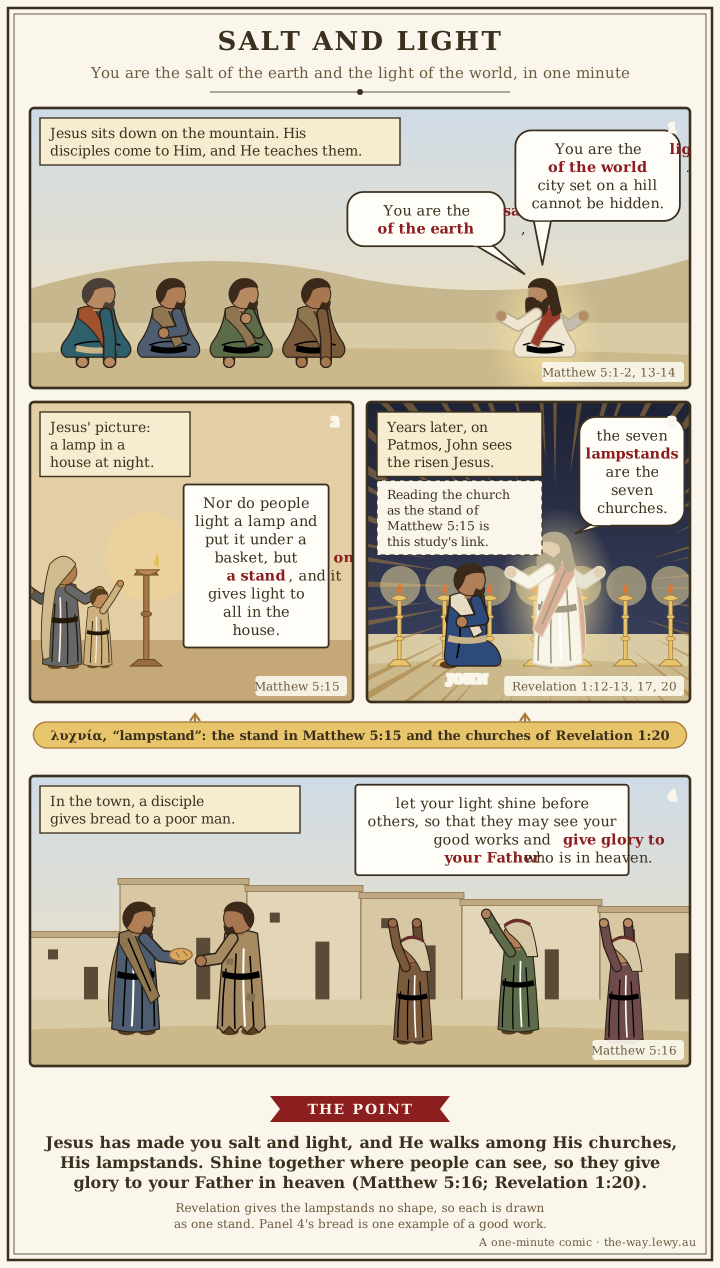](https://the-way.lewy.au/assets/img/comics/salt-light-and-aroma.svg)
> ✝️ Matthew 5:13-16 (ESV)
>
> 13 "You are the salt of the earth, but if salt has lost its taste, how shall its saltiness be
> restored? It is no longer good for anything except to be thrown out and trampled under people's
> feet. 14 "You are the light of the world. A city set on a hill cannot be hidden. 15 Nor do people
> light a lamp and put it under a basket, but on a stand, and it gives light to all in the house.
> 16 In the same way, let your light shine before others, so that they may see your good works and
> give glory to your Father who is in heaven.
## Key Takeaways
*(This section follows the [Key Takeaways](https://the-way.lewy.au/about/key-takeaways/) format — see that page for what each part is for.)*
### Types & Prophecy
- **Prophecy.** The LORD promised to give His Servant as "a light for the nations" (Isaiah 42:6,
ESV; Isaiah 49:6). Jesus is that light (John 8:12), and Paul and Barnabas took Isaiah 49:6 as the
Lord's command to them (Acts 13:47). Isaiah 60:1-3, the nations coming to Zion's light, is still
Israel's promise.
- **Type.** Every burnt offering rose to God as "a pleasing aroma" (Leviticus 1:9, ESV). Paul names
what they pictured: Christ "gave himself up for us, a fragrant offering and sacrifice to God"
(Ephesians 5:2, ESV).
- **Type.** The fire on Sodom waited for one righteous man: "I can do nothing till you arrive
there" (Genesis 19:22, ESV). On this site's reading, the church is salt kept in the earth, and when
she is caught up the restrainer comes to be "out of the midst" (2 Thessalonians 2:7) and the
lawless one is revealed (2 Thessalonians 2:8) (see [Salt kept in the earth](#salt-kept-in-the-earth)).
### Lessons about Jesus
- **He is the light He gives.** Jesus said of Himself, "I am the light of the world" (John 8:12,
ESV), and of His disciples, "You are the light of the world" (Matthew 5:14). The Greek is the same
four words, τὸ φῶς τοῦ κόσμου.
- **He walks among His churches.** John saw "in the midst of the lampstands one like a son of man"
(Revelation 1:13, ESV). He knows each church's works and keeps the right to remove a lampstand
(Revelation 2:5).
- **His self-giving is the aroma.** Before any Christian smells of Christ, Christ Himself was the
fragrant offering (Ephesians 5:2).
### Memory verses
> ✝️ Matthew 5:16 (ESV)
>
> 16 In the same way, let your light shine before others, so that they may see your good works and
> give glory to your Father who is in heaven.
> ✝️ 2 Corinthians 2:15-16 (ESV)
>
> 15 For we are the aroma of Christ to God among those who are being saved and among those who are
> perishing, 16 to one a fragrance from death to death, to the other a fragrance from life to life.
> Who is sufficient for these things?
### Be Transformed
- **Think.** Jesus said "you are" before He said "let your light shine." Your saltiness and your
light are His gift already given. The command is to let them be seen.
- **Attitude.** Keep peace with the believers around you. Jesus tied the two together: "Have salt in
yourselves, and be at peace with one another" (Mark 9:50, ESV). A quarrelling church loses its
taste.
- **Do.** Choose one good work this week that someone outside your church will see: a meal, a
repair, an hour with someone lonely. Do it in the open, and when you are thanked, name your
Father, so that they "may see your good works and give glory to your Father who is in heaven"
(Matthew 5:16, ESV).
### Prayer
Father, you are light, and you have shone in our hearts to give the light of the knowledge of your
glory in the face of your Son Jesus. He gave Himself up for us, a fragrant offering to you. Thank you
that you have made us salt and light in Him. Keep us from losing our taste. Keep our church a
lampstand that holds His light up in this town. Give us words seasoned with salt and works done in
the open, so that our neighbours give glory to you.
In Jesus' name. Amen.
## Study outline
- [Who Jesus is talking to](#who-jesus-is-talking-to). The disciples, all together, and the words
"you are."
- [The salt of the earth](#the-salt-of-the-earth). Salt in Israel's life, salt that turns foolish,
salt that preserves while it stays, read with Sodom and the restrainer, and salt among believers
and in their speech.
- [The light of the world](#the-light-of-the-world). Whose light it is, the Servant's light for the
nations, a city and a lamp, and the good works that bring glory to the Father.
- [Churches as lampstands](#churches-as-lampstands). Revelation 1-2: the same word, and the warning
to Ephesus.
- [The aroma of Christ](#the-aroma-of-christ). 2 Corinthians 2: the procession, the offering, and
one fragrance met two ways.
- [What this shows about God](#what-this-shows-about-god). The three pictures for one believer and
for a church, side by side.
## Who Jesus is talking to
Matthew sets the scene in two verses. "Seeing the crowds, he went up on the mountain, and when he sat
down, his disciples came to him. And he opened his mouth and taught them" (Matthew 5:1-2, ESV). The
crowd listens in (Matthew 7:28). The sermon is addressed to the disciples.
The verses just before salt and light are the last beatitude, and it is about persecution. "Blessed
are you when others revile you and persecute you and utter all kinds of evil against you falsely on
my account" (Matthew 5:11, ESV). Jesus compares them with "the prophets who were before you"
(Matthew 5:12, ESV). Then, with no break, "You are the salt of the earth." The people Jesus calls salt
and light are the people the world will revile. He sends them into it anyway.
### "You are"
Greek does not need a pronoun to say "you are"; the verb ἐστε already carries it. Jesus adds one,
Ὑμεῖς, and puts it first, twice: Ὑμεῖς ἐστε τὸ ἅλας τῆς γῆς, Ὑμεῖς ἐστε τὸ φῶς τοῦ κόσμου
(Matthew 5:13-14, NA28). *You* are the salt. *You* are the light.
Both statements are indicative. Jesus is telling them what they are, and the only command in the
paragraph comes last: "let your light shine" (Matthew 5:16). He makes them salt and light first,
and then tells them not to hide it.
Every "you" in the paragraph is plural, and so is every "your." Jesus is speaking to a group. That
plural shapes the rest of this study: each image belongs to every disciple, and each also describes
what they are together.
## The salt of the earth
### Salt in Israel's life
Salt, ἅλας (*halas*, HAL-as, G217), is in the New Testament seven times, in four passages: Matthew 5:13,
Mark 9:50, Luke 14:34 and Colossians 4:6. Jesus' hearers knew salt from the kitchen, from the
temple and from the covenant.
- **It gives food its taste.** "Can that which is tasteless be eaten without salt?" (Job 6:6, ESV).
- **It went on every offering.** "You shall not let the salt of the covenant with your God be missing
from your grain offering; with all your offerings you shall offer salt" (Leviticus 2:13, ESV).
Ezekiel's priests sprinkle salt on the burnt offerings (Ezekiel 43:24).
- **It stood for what lasts.** The LORD's gift to the priests is "a covenant of salt forever"
(Numbers 18:19, ESV), and He gave the kingship to David's sons "by a covenant of salt"
(2 Chronicles 13:5, ESV). The Hebrew is מֶלַח (*melach*, MEH-lakh, H4417).
- **It cleansed.** A newborn was rubbed with salt (Ezekiel 16:4), and Elisha threw salt into
Jericho's spring with the word, "I have healed this water" (2 Kings 2:21, ESV).
- **It kept food from spoiling.** The ancient world salted fish and meat to keep them. The *NIV
Cultural Backgrounds Study Bible* calls salt "a preserving and flavoring agent" (note on
Colossians 4:6).
Jesus does not say which use He means. Every one of them works the same way: salt does its good by
going into what it salts and staying different from it. The disciples are salt "of the earth," for
all of it, and they are salt only while they stay salt.
### Salt that turns foolish
Jesus' warning turns on one verb. "If salt has lost its taste" translates μωρανθῇ, from μωραίνω
(*mōrainō*, mo-RAI-no, G3471). The verb is built on μωρός (*mōros*, G3474), "foolish," and the New Testament uses it
four times. Twice it is salt losing its taste (Matthew 5:13; Luke 14:34). Twice it is people
becoming fools: "Claiming to be wise, they became fools" (Romans 1:22, ESV), and "Has not God made
foolish the wisdom of the world?" (1 Corinthians 1:20, ESV).
So the Greek hearer heard *salt that has turned foolish*. Matthew's sermon closes with the adjective,
μωρός.
"Everyone who hears these words of mine and does not do them will be like a foolish man who built
his house on the sand" (Matthew 7:26, ESV). The foolish man heard and did nothing. Salt goes foolish
the same way: it is still in the jar, and it no longer does what salt does. Later in Matthew the
five foolish virgins are the ones whose lamps go out (Matthew 25:2, 8).
Pure salt cannot stop being salt, and the question "how shall its saltiness be restored?" expects
the answer *it cannot*. The *Cultural Backgrounds Study Bible* reports commentators who note that
much ancient salt contained impurities, so the salt could wash out and leave the rest. Either way the end is the same: "It
is no longer good for anything except to be thrown out and trampled under people's feet" (Matthew
5:13, ESV). Luke adds, "It is of no use either for the soil or for the manure pile" (Luke 14:35,
ESV), and Luke places the saying straight after "any one of you who does not renounce all that he
has cannot be my disciple" (Luke 14:33, ESV).
### What gets salted: the salt or the earth
The Greek of Matthew 5:13 can be read two ways. ἐν τίνι ἁλισθήσεται is "with what will it be
salted?" and the subject may be the salt or the earth. The ESV takes the salt; the *CSB Ancient
Faith Study Bible* footnotes "Or *how can the earth be salted?*" Both readings arrive at the same
place. If the disciples lose their saltiness, nothing else salts the earth.
### Salt kept in the earth
If Jesus means the salt that keeps food from spoiling, the picture reaches to the end of the age.
Salt preserves only while it is in what it salts. Scripture shows God holding back judgment for the
sake of the righteous in a place. Over Sodom He said, "For the sake of ten I will not destroy it"
(Genesis 18:32, ESV), and the angel told Lot, "I can do nothing till you arrive there" (Genesis 19:22,
ESV). Paul describes a day when the one who restrains lawlessness comes to be "out of the midst"
(2 Thessalonians 2:7). [The Restrainer](https://the-way.lewy.au/last-things/the-restrainer/#out-of-the-midst) reads him as
the Holy Spirit present in the church, so that when the church is caught up His restraining presence
goes with her and the lawless one is revealed.
This connection is this site's reading. Matthew 5:13 names no single use of salt, and the saying
itself says nothing of salt being taken out. The salt "thrown out" in the verse is salt that has gone
foolish, and that warning is for disciples now.
**This shows that God preserves the world through the people He has made salt**, as He would have spared Sodom for ten (Genesis 18:32). Your faithfulness
where you are, at work, at home and in your church, is part of how He holds back evil until His time.
### Salt among yourselves, salt in your speech
Mark gives the saying a setting. On the road to Capernaum the disciples "had argued with one another
about who was the greatest" (Mark 9:34, ESV). Jesus ends the conversation: "Salt is good, but if the
salt has lost its saltiness, how will you make it salty again? Have salt in yourselves, and be at
peace with one another" (Mark 9:50, ESV). The salt here is kept by a group that is at peace. The
phrase ἐν ἑαυτοῖς can mean "in yourselves" or "among yourselves," and the next clause, "with one
another," makes it corporate in either case.
The verse before it, "everyone will be salted with fire" (Mark 9:49, ESV), is one of the hardest
sayings in Mark. It is read as the purifying fire of suffering, as the Holy Spirit, or as the fire of
judgment, and this study leaves it open.
Paul brings salt into the believer's mouth. "Walk in wisdom toward outsiders, making the best use of
the time. Let your speech always be gracious, seasoned with salt, so that you may know how you ought
to answer each person" (Colossians 4:5-6, ESV). "Seasoned" is ἀρτύω (*artyō*, ar-TOO-oh, G741), the verb Mark
9:50 and Luke 14:34 use for making salt salty again. Its only three New Testament uses are those
two salt sayings and this one. Paul takes Jesus' salt and puts it in what you say to your neighbour.
## The light of the world
### The light is His
"In him was life, and the life was the light of men. The light shines in the darkness, and the
darkness has not overcome it" (John 1:4-5, ESV). Jesus said, "I am the light of the world. Whoever
follows me will not walk in darkness, but will have the light of life" (John 8:12, ESV). He said it
again before He healed the man born blind: "As long as I am in the world, I am the light of the
world" (John 9:5, ESV).
The disciples' light is His, given to them. Paul says where it comes from: "For God, who said, 'Let
light shine out of darkness,' has shone in our hearts to give the light of the knowledge of the glory
of God in the face of Jesus Christ" (2 Corinthians 4:6, ESV). The God who made light on the first day
made it again in you. "At one time you were darkness, but now you are light in the Lord. Walk as
children of light" (Ephesians 5:8, ESV).
### A light for the nations
Israel's Scriptures had already given this calling to the LORD's Servant: "I will make you as a light
for the nations, that my salvation may reach to the end of the earth" (Isaiah 49:6, ESV; see Isaiah
42:6). Simeon held the baby Jesus and called Him "a light for revelation to the Gentiles" (Luke 2:32,
ESV). When the Jews of Pisidian Antioch turned against Paul (Acts 13:45), he and
Barnabas quoted Isaiah 49:6 as the Lord's command to them: "I have
made you a light for the Gentiles" (Acts 13:47, ESV). The church carries the Servant's light to the
nations in this age. Isaiah 60:1-3, where the nations come to Zion's light, remains Israel's promise,
and this study reads it as still to come.
### A city and a lamp
Jesus gives two pictures, one seen from far away and one seen close up.
**A city.** "A city set on a hill cannot be hidden" (Matthew 5:14, ESV). A city, πόλις, is many
houses and many people. Many ancient towns were built on hills, and the *Cultural Backgrounds Study
Bible* notes that their lamps could be seen against the horizon at night. No one in the town has to
try to be seen. The town is seen because it is lit and because it is high. This is the disciples
together, seen from far away.
**A lamp.** "Nor do people light a lamp and put it under a basket, but on a stand, and it gives light
to all in the house" (Matthew 5:15, ESV). The lamp, λύχνος (*lychnos*, LOOKH-nos, G3088), was a small clay oil
lamp that sat in the palm of a hand. The basket is a μόδιος (*modios*, MOD-ee-os, G3426), a grain measure; the
*Legacy Standard Bible* footnotes it as "peck-measure." Put over a lamp, it hides the flame and starves
it of air. The stand is a λυχνία (*lychnia*, lookh-NEE-ah, G3087), and on it one small flame lights the whole room.
This is a disciple at close range, in the house, at the table, among the people nearest.
The lamp is lit *in order to* be put on the stand. Hiding it defeats the reason it was lit.
### Your light is your good works
Then the command: "In the same way, let your light shine before others, so that they may see your
good works and give glory to your Father who is in heaven" (Matthew 5:16, ESV).
Read the Greek of "your light": τὸ φῶς ὑμῶν. "Light" is singular. "Your" is plural. A group of
disciples has one light between them, and every one of them shines it. The same is true of "your
Father": one Father, many children.
The light is named: "your good works." People see the works and give the glory to the Father. That
is how a disciple can do good in the open and still obey Matthew 6:1: "Beware of practicing your
righteousness before other people in order to be seen by them, for then you will have no reward from
your Father who is in heaven" (ESV). Both verses want the works seen. Matthew 5:16 wants the Father
to get the glory; Matthew 6:1 warns against wanting it for yourself.
The apostles kept this command. Peter wrote to believers being slandered, "Keep your conduct among
the Gentiles honorable, so that when they speak against you as evildoers, they may see your good
deeds and glorify God on the day of visitation" (1 Peter 2:12, ESV). Paul told the Philippians to be
"children of God without blemish in the midst of a crooked and twisted generation, among whom you
shine as lights in the world" (Philippians 2:15, ESV). His word for "lights" is φωστῆρες (*phōstēres*, foce-TAY-res, G5458), the word
the Greek Old Testament uses for the sun and moon set in the sky (Genesis 1:14, LXX), and "crooked
and twisted generation" is Moses' phrase from his song (Deuteronomy 32:5, LXX). The church shines
the way the lights of the sky shine, set where everyone below can see them.
## Churches as lampstands
### The stand of Matthew 5:15 in Revelation
The word for the stand in Matthew 5:15 comes back in the last book of the Bible. On Patmos John
"turned to see the voice that was speaking to me, and on turning I saw seven golden lampstands, and
in the midst of the lampstands one like a son of man" (Revelation 1:12-13, ESV). Then Jesus explains:
"the seven lampstands are the seven churches" (Revelation 1:20, ESV).
λυχνία appears twelve times in eleven New Testament verses. Five are outside Revelation: the lamp
saying in Matthew 5:15, Mark 4:21, Luke 8:16 and Luke 11:33, and the tabernacle's lampstand in
Hebrews 9:2. The other seven are in Revelation, where the lampstands are churches and, in Revelation
11:4, the two witnesses.
Revelation does not quote Matthew 5:15, so setting the two side by side is this study's reading and
should be held as one. What they share is the stand's job. In the house the stand holds one lamp up
so that everyone in the room has light. In Revelation each church stands in its own city, Ephesus,
Smyrna, Pergamum, and holds the light up there. A local church is where a town can see the light of
Christ in His people together.
### He walks among them and can remove one
Jesus is the one who keeps the lampstands. He "walks among the seven golden lampstands" (Revelation
2:1, ESV), and church after church hears Him say, "I know your works" (Revelation 2:2, 19; 3:1, 8,
15). To Ephesus He says more:
> ✝️ Revelation 2:4-5 (ESV)
>
> 4 But I have this against you, that you have abandoned the love you had at first. 5 Remember
> therefore from where you have fallen; repent, and do the works you did at first. If not, I will come
> to you and remove your lampstand from its place, unless you repent.
The warning has the same shape as the salt saying. Salt that has stopped being salty is "thrown out"
(Matthew 5:13). A lampstand whose church has left its first love and its first works is removed "from
its place." In both, what stops doing what it was made for loses its place. Ephesus is told the way
back in three verbs: remember, repent, do.
Some readers hear "thrown out" as a believer losing salvation. Both warnings are about use and place:
salt "no longer good for anything" (Matthew 5:13, ESV), and a church's lampstand moved "from its
place" (Revelation 2:5). The believer's foundation is Christ Himself, "For no one can lay a foundation
other than that which is laid, which is Jesus Christ" (1 Corinthians 3:11, ESV), and that foundation
is never at risk. What a believer can waste is the life built on it. Paul says of the one whose work
burns, "he will suffer loss, though he himself will be saved, but only as through fire" (1 Corinthians
3:15, ESV). [The Judgment Seat of Christ](https://the-way.lewy.au/last-things/judgment-seat-of-christ/) studies that
loss and the rewards beside it. [The Lampstand](https://the-way.lewy.au/jesus/the-heavenly-pattern/lampstand/#seven-lampstands-on-patmos)
studies these chapters in full: the High Priest's robe, the seven stars, what removal of a lampstand
means, and the seven torches before the throne, "the seven spirits of God" (Revelation 4:5, ESV).
## The aroma of Christ
### The procession and the offering
Paul uses a third picture, and this one is for the nose.
> ✝️ 2 Corinthians 2:14-16 (ESV)
>
> 14 But thanks be to God, who in Christ always leads us in triumphal procession, and through us
> spreads the fragrance of the knowledge of him everywhere. 15 For we are the aroma of Christ to God
> among those who are being saved and among those who are perishing, 16 to one a fragrance from death
> to death, to the other a fragrance from life to life. Who is sufficient for these things?
"Leads us in triumphal procession" is θριαμβεύω (*thriambeuō*, three-am-BYOO-oh, G2358). Its only other New Testament
use is Colossians 2:15, where God "disarmed the rulers and authorities and put them to open shame, by
triumphing over them in him" (ESV). Paul's readers knew the Roman triumph: a victorious general rode
through the city with his captives led in front of his chariot (*NIV Biblical Theology Study Bible*,
note on 2 Corinthians 2:14). The *ESV Study Bible* notes that some readers take Paul's "aroma" as
the incense spread along the streets during the procession. In Paul's sentence God is the victor, and
"us" is the object of the verb. Paul is in God's procession, led by Him.
Then the smell. Paul has two words: ὀσμή (*osmē*, os-MAY, G3744), a smell, and εὐωδία (*euōdia*, yoo-oh-DEE-ah, G2175), a
sweet one. Joined as ὀσμὴ εὐωδίας they are the Greek Old Testament's phrase for an offering's
"pleasing aroma." That is what God smelled after the flood: "when the LORD smelled the pleasing
aroma" (Genesis 8:21, ESV), Hebrew רֵיחַ הַנִּיחֹחַ (*reyach hannichoach*,
RAY-akh han-nee-KHO-akh, H7381, H5207). Every burnt offering went up the same way, "a food offering with a pleasing aroma to the
LORD" (Leviticus 1:9, ESV). So "the aroma of Christ to God" (2 Corinthians 2:15) carries both
scenes. The perfume of a victory march, and the smoke of a sacrifice that God accepts.
### A people as a pleasing aroma
In the Old Testament the aroma is usually an offering. Once God says it of a people. When He gathers
Israel from the nations, "As a pleasing aroma I will accept you" (Ezekiel 20:41, ESV). The Greek Old
Testament has ἐν ὀσμῇ εὐωδίας there too. Paul does not cite Ezekiel, and Ezekiel's promise belongs to
Israel's regathering. It shows Scripture already speaking of a whole people as an aroma God
accepts.
Paul's "we" in 2 Corinthians 2 is first himself and the men who preach with him: "we are not, like so
many, peddlers of God's word" (2 Corinthians 2:17, ESV). The same picture reaches every believer
in Ephesians. "Be imitators of God, as beloved children. And walk in love, as Christ loved us and gave
himself up for us, a fragrant offering and sacrifice to God" (Ephesians 5:1-2, ESV). Christ's
self-giving is the original aroma. A Christian who walks in that love carries it.
And it reaches a church's giving. When the Philippians sent money to Paul in prison, he called it
"a fragrant offering, a sacrifice acceptable and pleasing to God" (Philippians 4:18, ESV). εὐωδία
appears only three times in the New Testament: Christ's sacrifice, a church's gift, and "we are the
aroma of Christ." One act of love can fill a whole house. When Mary anointed Jesus' feet at Bethany,
"the house was filled with the fragrance of the perfume" (John 12:3, ESV), with the same word, ὀσμή.
### One fragrance, two responses
The aroma goes first "to God" (2 Corinthians 2:15). Before anyone else smells it, the Father smells
His Son in His people and is pleased.
Then it reaches people, and they meet it two ways: "to one a fragrance from death to death, to the
other a fragrance from life to life" (2 Corinthians 2:16, ESV). The fragrance is the same. Some breathe
it in and live. Others smell death in it and turn away. Salt and light work the same way: the same
light that draws one person exposes another (John 3:19-21).
Paul's question follows: "Who is sufficient for these things?" A few lines later he answers it: "Not
that we are sufficient in ourselves to claim anything as coming from us, but our sufficiency is from
God" (2 Corinthians 3:5, ESV). No believer makes the fragrance. God spreads it "through us," and He
leads the procession.
## What this shows about God
All three pictures say the same thing about God. **He puts His own life into His people and lets the
world meet Him there.** The light is Christ's light. The aroma is "the aroma of Christ." The salt is
the people He has called and sent. And He keeps the glory for Himself: the works are seen, and the
Father is praised (Matthew 5:16).
It also shows that **God works through one believer and through a whole church at once.** Each
picture has both, in the text:
| Picture | One believer | The church together |
|---|---|---|
| Salt | Speech "seasoned with salt" toward each person (Colossians 4:6) | "Have salt in yourselves, and be at peace with one another" (Mark 9:50) |
| Light | The lamp on the stand, lighting "all in the house" (Matthew 5:15) | "A city set on a hill" (Matthew 5:14); the churches as lampstands (Revelation 1:20) |
| Aroma | "Walk in love … a fragrant offering" (Ephesians 5:2) | A church's gift, "a fragrant offering" (Philippians 4:18); "through us" everywhere (2 Corinthians 2:14) |
So you belong in both columns. Your words at work, your table at home and your love for the person in
front of you are the salt, the lamp and the fragrance at close range. Your church, gathered and at
peace, is the city on the hill and the lampstand in your town. Jesus walks among it and knows its
works. You were made salt and light in Him. Let it be seen, together, so that your neighbours give
glory to your Father in heaven.
## Discussion questions
1. **The language.** The verb for salt losing its taste, μωραίνω, means "become foolish" in Romans
1:22, and Matthew's sermon ends with a foolish man who heard and did not do (Matthew 7:26). What
does "foolish salt" look like in a believer who still knows the right answers?
2. **The text in its context.** Jesus called His disciples salt and light straight after telling them
they would be reviled and persecuted (Matthew 5:11-12). How does that setting change what "you are
the light of the world" asks of them?
3. **Christ.** Jesus said "I am the light of the world" (John 8:12) and "You are the light of the
world" (Matthew 5:14) in the same Greek words. What does it mean for your light to be His?
4. **The hard part.** Matthew 5:16 says to let people see your good works, and Matthew 6:1 says not
to practise righteousness "in order to be seen." What in the wording of the two verses tells you
how they fit together?
5. **Be transformed.** Jesus told Ephesus to "do the works you did at first" or lose its lampstand
(Revelation 2:5). What works did your church do at first that it has stopped doing?
6. **Be transformed.** Paul calls a church's gift "a fragrant offering" (Philippians 4:18) and asks
that your speech be "seasoned with salt" (Colossians 4:6). Who is one person outside your church
who will meet Christ in your words or your giving this month, and what will you do?
## References & Recommended Reading
- **ESV Study Bible** (Crossway) — verse text throughout; notes on Matthew 5:13, 5:14 and 5:15,
2 Corinthians 2:14 and 2:15-16, Mark 9:49, Colossians 4:5-6 and Revelation 1:20.
- **NIV Cultural Backgrounds Study Bible** (Zondervan) — notes on Matthew 5:13 (impure salt), 5:14
(hill towns visible at night), 5:15 (hand-held oil lamps), 2 Corinthians 2:14-15 and Colossians 4:6.
- **NIV Biblical Theology Study Bible** (Zondervan) — notes on Matthew 5:13-16, 2 Corinthians 2:14-16
and Mark 9:49.
- **CSB Ancient Faith Study Bible** (Holman) — footnote on Matthew 5:13, "Or *how can the earth be
salted?*"
- **Legacy Standard Bible** (Lockman Foundation) — footnotes on Matthew 5:14 and 5:15.
- **Novum Testamentum Graece**, 28th edition (Deutsche Bibelgesellschaft) — Matthew 5:13-16.
- **SBL Greek New Testament** — 2 Corinthians 2:14-16, Ephesians 5:2, Mark 9:50, Revelation 1:20,
Philippians 2:15.
- **Brenton's Septuagint** (Greek text) — Genesis 1:14, Genesis 8:21, Deuteronomy 32:5, Ezekiel 20:41.
- **Westminster Leningrad Codex** (morphhb) — Leviticus 2:13, Numbers 18:19, Genesis 8:21, Ezekiel
20:41.
- **Macula Greek (SBLGNT)** — occurrence data for ἅλας, μωραίνω, μωρός, ἀρτύω, λυχνία, μόδιος, φωστήρ,
εὐωδία, ὀσμή and θριαμβεύω.
### On this site
- [The Lampstand](https://the-way.lewy.au/jesus/the-heavenly-pattern/lampstand/) — the tabernacle lampstand, Zechariah's
lampstand, and the seven lampstands of Revelation 1-2.
- [In Humility](https://the-way.lewy.au/christian-life/humility/) — Philippians 2, the passage around "shine as lights in the world."
- [The Restrainer](https://the-way.lewy.au/last-things/the-restrainer/) — the church in the midst of a crooked
generation (Philippians 2:15).