---
title: "Submission in Context"
category: "christian-life"
description: "The verses used to make women submit to men, read in their paragraphs and in the Greek: Genesis 3:16, Ephesians 5:21-33, 1 Corinthians 7:3-5, 1 Peter 3:1-7, and the contested texts on women in church, with plain pastoral guidance on where submission ends."
tags: ["women", "marriage", "submission", "abuse", "pastoral-care", "ephesians", "1-corinthians", "1-peter", "1-timothy", "genesis", "method/word-study", "lang/greek", "lang/hebrew"]
draft: false
primary_passage: "Ephesians 5:21-33"
bible_references: ["Genesis 1:27-28", "Genesis 3:16", "Genesis 4:7", "Psalm 11:5", "Proverbs 3:25-26", "Malachi 2:16", "Matthew 18:15-17", "Matthew 19:8-9", "Mark 10:42-45", "Luke 22:25-27", "Acts 5:29", "Acts 18:26", "Romans 13:3-4", "1 Corinthians 5:11", "1 Corinthians 6:12", "1 Corinthians 7:3-5", "1 Corinthians 7:10-11", "1 Corinthians 7:15", "1 Corinthians 11:3-12", "1 Corinthians 14:29-35", "2 Corinthians 5:17", "Ephesians 5:2", "Ephesians 5:11", "Ephesians 5:18-21", "Ephesians 6:4", "Colossians 3:18-19", "1 Thessalonians 2:7", "1 Timothy 2:11-15", "1 Timothy 3:2", "1 Timothy 5:13-15", "2 Timothy 3:6-7", "Titus 2:3-5", "1 Peter 2:21-23", "1 Peter 3:1-7", "1 John 1:9", "Genesis 2:24", "Deuteronomy 19:15-18", "1 Samuel 19:11-12", "Psalm 10:17-18", "Psalm 82:3-4", "Proverbs 18:17", "Proverbs 22:3", "Proverbs 31:8-9", "Matthew 26:41", "Luke 3:8", "Luke 4:29-30", "Acts 9:23-25", "Acts 22:2", "1 Corinthians 1:27", "1 Corinthians 12:22-23", "1 Corinthians 14:40", "2 Corinthians 4:7", "Ephesians 4:2", "Ephesians 4:25", "Ephesians 4:32", "Ephesians 5:31-33", "Ephesians 6:1-9", "2 Thessalonians 3:12", "1 Timothy 1:3-7", "1 Timothy 2:2", "1 Timothy 3:4-5", "1 Timothy 4:3"]
date_created: 2026-10-17
date_modified: 2026-10-31
ai_provider_models:
- anthropic/claude-opus-5.5
---
# Submission in Context
A handful of verses have been used to tell women to obey men, to stay silent, to give their bodies
on demand, and to remain where they are being hurt. Read in their paragraphs and in the Greek, those
same verses call husband and wife to give themselves to each other, measure every husband by the
cross, and give no one a licence to harm.
**In one sentence:** Every New Testament call to wives to submit is spoken to the wife herself, as
service to the Lord, beside a call to husbands to love, honour and give themselves up as Christ did,
so no text licenses control, coercion or abuse;
husband and wife hold authority over each other's bodies equally, and where a text's reach is
contested the church should say so and hold it with humility.
## Key Takeaways
*(This section follows the [Key Takeaways](https://the-way.lewy.au/about/key-takeaways/) format — see that page for what each part is for.)*
### Lessons about Jesus
- He forbade His people the world's kind of authority: "The kings of the Gentiles exercise lordship
over them ... But not so with you ... I am among you as the one who serves" (Luke 22:25-27).
- He is the measure of a husband: "Christ loved the church and gave himself up for her" (Ephesians
5:25). Headship in Ephesians is defined by the cross.
- He entrusted Himself to the Father when He suffered (1 Peter 2:23), and the Father judges justly.
A wife who suffers wrong is never told to hide it from Him or from His church.
### Memory verses
> ✝️ Ephesians 5:21, 25 (ESV)
>
> 21 submitting to one another out of reverence for Christ ... 25 Husbands, love your wives, as
> Christ loved the church and gave himself up for her,
> ✝️ 1 Corinthians 7:4 (ESV)
>
> 4 For the wife does not have authority over her own body, but the husband does. Likewise the
> husband does not have authority over his own body, but the wife does.
### Be Transformed
- **Think.** Read every verse about submission in its paragraph. Ephesians 5:22 cannot be read
without 5:21 and 5:25, and 1 Corinthians 7:4 cannot be read in one direction only.
- **Attitude.** Husbands, hold your authority the way Christ holds His: spent for your wife's good.
Wives, hold your submission as service to Christ, offered freely and never extracted by fear.
- **Do.** If anyone is being hurt in a marriage, act: make them safe, call the authorities when a
crime is committed, and bring the church's care and discipline to bear. "Take no part in the
unfruitful works of darkness, but instead expose them" (Ephesians 5:11, ESV). Silence protects the
one doing harm.
### Prayer
Father, your Son came to serve and gave His life for His bride. Make our marriages look like His
love. Keep husbands from ruling as the world rules, and give wives the freedom of those who fear
nothing but you. Where anyone is afraid in their own home, protect them, bring the truth into the
light, and make your church a refuge.
In Jesus' name. Amen.
## Study outline
1. **The ground** — [How these verses get used](#how-these-verses-get-used) · [Genesis 3:16: a consequence](#genesis-316-a-consequence). The test applied to every verse, and what the fall did to marriage.
2. **Marriage** — [Ephesians 5:21-33: one verb for everyone](#ephesians-521-33-one-verb-for-everyone) · [1 Corinthians 7:3-5: neither body is your own](#1-corinthians-73-5-neither-body-is-your-own) · [1 Peter 3:1-7 and Colossians 3:18-19](#1-peter-31-7-and-colossians-318-19). Submission spoken to the whole church, the cross as the husband's measure, one flesh, equal authority over bodies, and the wife who need not fear.
3. **The church** — [The contested texts](#the-contested-texts). 1 Corinthians 14:34-35 and 1 Timothy 2:11-15, with both readings.
4. **Pastoral guidance** — [Where submission ends](#where-submission-ends). What Scripture says to a wife, a husband and a pastor when there is harm.
5. [Discussion questions](#discussion-questions). Six, for a group or on your own.
## How these verses get used
The verses are familiar: "Wives, submit to your own husbands" (Ephesians 5:22), "he shall rule over
you" (Genesis 3:16), "the wife does not have authority over her own body" (1 Corinthians 7:4),
"the women should keep silent in the churches" (1 Corinthians 14:34). Quoted alone, each can be made
to say that a woman's place is under a man's control.
This study applies one test to each: read the verse in its paragraph, notice who is addressed, and
find the reason the text itself gives. That is how every passage of Scripture is read, and it is the
test Jesus applied when He was handed a verse about divorce: "from the beginning it was not so"
(Matthew 19:8). The companion study [Jesus and Women](https://the-way.lewy.au/jesus/jesus-and-women/) shows how He
treated women. Every reading of these texts has to fit with Him.
## Genesis 3:16: a consequence
> ✝️ Genesis 3:16 (ESV)
>
> 16 To the woman he said, "I will surely multiply your pain in childbearing; in pain you shall
> bring forth children. Your desire shall be contrary to your husband, but he shall rule over you."
Before the fall God gave dominion to "them," male and female together (Genesis 1:27-28). Rule of a
husband over his wife first appears here, after sin, in the same speech as pain in childbirth and
the ground cursed with thorns (3:17-18). God is describing what sin will do.
"Desire" is תְּשׁוּקָה (*tᵉšûqâ*, teh-shoo-KAH, H8669), and "rule" is
מָשַׁל (*māšal*, mah-SHAL, H4910). The same two words meet again in the next
chapter, where God warns Cain: "sin is crouching at the door. Its desire is contrary to you, but you
must rule over it" (Genesis 4:7, ESV). Translators differ over the sense of the woman's desire. The
ESV reads "contrary to your husband," a desire to master; the NLT footnote gives "though you will
have desire for your husband." Either way, the verse describes a marriage bent by sin into a
contest, with the husband ruling.
No one reads "in pain you shall bring forth children" as a command to withhold pain relief, or
"thorns and thistles" as a ban on weeding. The rule of 3:16 is the same kind of statement: part of
the sentence on sin, spoken beside the cursed ground (3:17). Readers who find an order of husband
and wife already in Genesis 2 (the reading the ESV Study Bible takes) agree on this much: what 3:16
adds is rule bent by sin into domination. "If anyone is in Christ, he is a new creation" (2
Corinthians 5:17, ESV). The church's calling is to live as the new creation, and a husband who rules
his wife by force is living out the fall.
## Ephesians 5:21-33: one verb for everyone
### Submitting to one another
Paul's household instructions begin with a command to the whole church: "be filled with the
Spirit" (Ephesians 5:18, ESV). Five participles follow (5:19-21); the last is "submitting to one
another out of reverence for Christ." In Greek, 5:21 reads ὑποτασσόμενοι ἀλλήλοις ἐν φόβῳ Χριστοῦ.
"Submitting" is ὑποτάσσω (*hypotassō*, hoo-poh-TAS-soh, G5293), and "to one another" is
ἀλλήλοις (*allēlois*, G240).
How far "one another" reaches is contested. Every other time Ephesians uses ἀλλήλοις it runs both
ways: "bearing with one another in love" (4:2), "we are members one of another" (4:25), "be kind to
one another" (4:32). On that reading every believer submits to every other. The ESV Study Bible
reads it as submission "according to the authority and order established by God," because the
examples that follow run one way: wives to husbands, children to parents, bondservants to masters
(5:22-6:9). Both readings agree on what matters for this study: the household instructions grow out
of a Spirit-filled church (5:18), and the wife's submission is one form of a submission asked of
every believer.
Then comes 5:22, and in the Greek it has no verb of its own:
> αἱ γυναῖκες τοῖς ἰδίοις ἀνδράσιν ὡς τῷ κυρίῳ
> "wives, to your own husbands, as to the Lord" (Ephesians 5:22, NA28; this study's translation)
The verb is supplied from 5:21. The CSB footnotes it: "Other mss omit *submit*." Paul then states
it in full: "as the church submits to Christ, so also wives should submit in everything to their
husbands" (5:24, ESV). "In everything" is the text's own word and is not to be softened. Its limit
is in the same sentence: as the church submits *to Christ*, and "as to the Lord" (5:22). A wife
submits as service to Christ, so nothing Christ forbids can be part of it (see
[Where submission ends](#where-submission-ends)). Paul addresses the wife herself, as one who gives
her submission. He gives husbands no instruction to make their wives submit, and no text in the New
Testament does.
### Headship measured by the cross
The husbands' instruction is longer (5:25-29, 33, against 5:22-24, 33), and it is measured by
the cross:
> ✝️ Ephesians 5:25-29 (ESV)
>
> 25 Husbands, love your wives, as Christ loved the church and gave himself up for her, 26 that he
> might sanctify her, having cleansed her by the washing of water with the word, 27 so that he might
> present the church to himself in splendor, without spot or wrinkle or any such thing, that she
> might be holy and without blemish. 28 In the same way husbands should love their wives as their
> own bodies. He who loves his wife loves himself. 29 For no one ever hated his own flesh, but
> nourishes and cherishes it, just as Christ does the church,
"The husband is the head of the wife even as Christ is the head of the church, his body, and is
himself its Savior" (5:23, ESV). "Head" is κεφαλή (*kephalē*, keh-fah-LAY, G2776). Paul shows what
Christ's headship does in the verses that follow: He saved, loved, gave Himself up, cleansed,
nourished and cherished. "Nourishes and cherishes," ἐκτρέφει καὶ θάλπει, are words for bringing up
a child (Ephesians 6:4) and a nursing mother's care (1 Thessalonians 2:7). Every instruction Paul
gives the head in this passage is a form of love and self-giving.
The study [The Bride of Christ](https://the-way.lewy.au/israel-and-church/bride-of-christ/) follows Christ's love for
His bride in full. A husband may claim Christ's headship only on Christ's
terms. Christ never forced His bride, never harmed her, and spent Himself for her good.
### The mystery of one flesh
Paul closes by quoting Genesis 2:24: "'Therefore a man shall leave his father and mother and hold
fast to his wife, and the two shall become one flesh.' This mystery is profound, and I am saying
that it refers to Christ and the church" (Ephesians 5:31-32, ESV). Two things follow from the text.
First, Paul builds marriage on Genesis 2, before the fall. The pattern for a Christian marriage
is the one God made, and Genesis 3:16 is the pattern it is rescued from.
Second, "one flesh" is why a husband's love is the love of his own body (5:28-29). A man who harms his wife harms his
own flesh. And because the marriage "refers to Christ and the church," a husband's conduct preaches
something about Christ to everyone who sees it. Paul's last word holds both callings together: "let
each one of you love his wife as himself, and let the wife see that she respects her husband"
(5:33, ESV).
### Christ's love made visible
[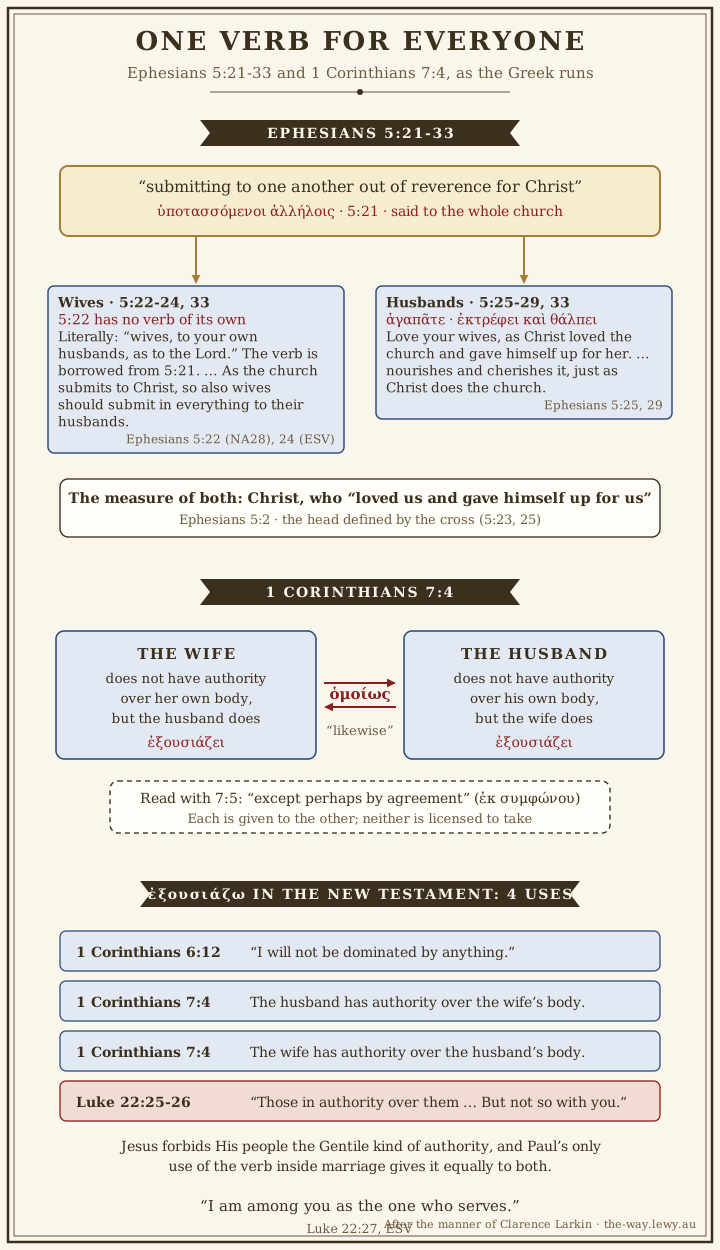](https://the-way.lewy.au/assets/img/submission-in-context/one-verb-for-everyone.svg)
This shows that God's design for marriage is Christ's love made visible. He asks the wife to serve
Christ by honouring her husband, and He asks the husband to die to himself for his wife, as Christ
died for His church.
## 1 Corinthians 7:3-5: neither body is your own
> ✝️ 1 Corinthians 7:3-5 (ESV)
>
> 3 The husband should give to his wife her conjugal rights, and likewise the wife to her husband.
> 4 For the wife does not have authority over her own body, but the husband does. Likewise the
> husband does not have authority over his own body, but the wife does. 5 Do not deprive one
> another, except perhaps by agreement for a limited time, that you may devote yourselves to prayer;
> but then come together again, so that Satan may not tempt you because of your lack of
> self-control.
These three verses are balanced with care. Verse 3 says
"likewise." Verse 4 uses the same verb for both partners, ἐξουσιάζει (*exousiazei*,
ex-oo-see-AD-zay), from ἐξουσιάζω (*exousiazō*, G1850), "to have authority over," and joins the two
halves with ὁμοίως (*homoiōs*, G3668), "likewise." Verse 5 says "one another" and "by agreement,"
ἐκ συμφώνου (*ek symphōnou*), from σύμφωνος (G4859).
Each gives his or her body to the other.
The verse describes a gift each has made, and it gives neither a right to seize. A husband who
demands sex against his wife's will reads 7:4 in one direction only: he claims her body, ignores
her authority over his, and sets aside the "agreement" of 7:5.
ἐξουσιάζω occurs four times in the New Testament: here twice; in 1 Corinthians 6:12, "I will not be
dominated by anything"; and in Luke 22:25, where Jesus describes the rulers of the Gentiles:
> ✝️ Luke 22:25-27 (ESV)
>
> 25 And he said to them, "The kings of the Gentiles exercise lordship over them, and those in
> authority over them are called benefactors. 26 But not so with you. Rather, let the greatest among
> you become as the youngest, and the leader as one who serves. 27 For who is the greater, one who
> reclines at table or one who serves? Is it not the one who reclines at table? But I am among you
> as the one who serves.
Jesus forbids His disciples the Gentile kind of authority. Paul's only use of the verb inside
marriage gives the authority to both, equally, as a trust held for the other's good.
## 1 Peter 3:1-7 and Colossians 3:18-19
Peter writes to wives whose husbands "do not obey the word" (1 Peter 3:1, ESV): believing women
married to unbelievers. His aim is
evangelistic: "they may be won without a word by the conduct of their wives." He sets their
conduct inside the example of Christ, who "when he suffered, he did not threaten, but continued
entrusting himself to him who judges justly" (2:23, ESV); 3:1 begins "Likewise," Ὁμοίως.
> ✝️ 1 Peter 3:6-7 (ESV)
>
> 6 as Sarah obeyed Abraham, calling him lord. And you are her children, if you do good and do not
> fear anything that is frightening. 7 Likewise, husbands, live with your wives in an understanding
> way, showing honor to the woman as the weaker vessel, since they are heirs with you of the grace
> of life, so that your prayers may not be hindered.
### The wife who does not fear
Two details in the Greek protect the wife. First, "do not fear anything that is frightening" is μὴ
φοβούμεναι μηδεμίαν πτόησιν. πτόησις (*ptoēsis*, PTOH-ay-sis, G4423), "terror, intimidation,"
occurs in the New Testament only here. It echoes the Septuagint of Proverbs 3:25, "you shall not
fear πτόησιν," where the reason follows: "the LORD will be your confidence" (Proverbs 3:26, ESV).
Peter commends a wife who does good and refuses to be ruled by fear. Submission that is extracted
by intimidation is a different thing from the one he describes.
### The weaker vessel, a fellow heir
Second, the husband's verse. In Greek it runs: συνοικοῦντες κατὰ γνῶσιν ὡς ἀσθενεστέρῳ σκεύει τῷ
γυναικείῳ, ἀπονέμοντες τιμὴν ὡς καὶ συγκληρονόμοις χάριτος ζωῆς (NA28), "living with them according
to knowledge, as with a weaker vessel, the feminine one; assigning honour, as also to fellow heirs
of the grace of life." Three things in it are plain from the text:
- **"Weaker" is a comparative**, ἀσθενεστέρῳ (*asthenesterō*, G772). A weaker vessel implies
another vessel. Scripture calls every believer a vessel: "we have this treasure in jars of clay"
(2 Corinthians 4:7, ESV), the same noun σκεῦος (*skeuos*, SKYOO-os, G4632). Husband and wife are
both clay; she is the more easily harmed.
- **Two "as" clauses stand side by side.** The weakness governs how he lives with her, "according
to knowledge." Her standing as a fellow heir, συγκληρονόμοις (*synklēronomois*, G4789), the word
Paul uses for believers as "fellow heirs with Christ" (Romans 8:17), governs the honour, τιμή
(*timē*, G5092), he gives her. The ESV joins "weaker vessel" to "showing honor"; the CSB, NASB and
LSB join it to "live with," as the Greek order runs.
- **Peter draws only understanding from the weakness.** Paul uses the
same comparative of the body's members: "the parts of the body that seem to be weaker are
indispensable," and on them "we bestow the greater honor" (1 Corinthians 12:22-23, ESV).
What kind of weakness Peter means he does not say. The adjective ἀσθενής covers the body, "the
flesh is weak" (Matthew 26:41, ESV), and low standing, "God chose what is weak in the world"
(1 Corinthians 1:27, ESV). Nothing in the verse makes it a weakness of
mind or of faith, since the same sentence makes her a fellow heir. Whichever is meant, the text
settles the husband's response: understanding and honour. The warning is severe: a husband who dishonours
his wife will find his prayers "hindered," ἐγκόπτεσθαι (*enkoptesthai*, G1465).
### Colossians 3:18-19: do not be harsh
Paul's shortest version says the same: "Wives, submit to your husbands, as is fitting in the Lord.
Husbands, love your wives, and do not be harsh with them" (Colossians 3:18-19, ESV). "Be harsh" is
πικραίνω (*pikrainō*, pik-RYE-noh, G4087), "to make bitter, to embitter." Bitterness, contempt and
harshness toward a wife are named as sin.
## The contested texts
Two passages restrict women's speech in the gathered church. Faithful readers who hold Scripture
as God's word read them differently, and the honest course is to give both readings and to state
what the readings share.
### 1 Corinthians 14:34-35
> ✝️ 1 Corinthians 14:33-35 (ESV)
>
> 33 For God is not a God of confusion but of peace. As in all the churches of the saints, 34 the
> women should keep silent in the churches. For they are not permitted to speak, but should be in
> submission, as the Law also says. 35 If there is anything they desire to learn, let them ask their
> husbands at home. For it is shameful for a woman to speak in church.
Three chapters earlier Paul assumes that women pray and prophesy aloud in the assembly: "every wife
who prays or prophesies with her head uncovered dishonors her head" (11:5, ESV). Whatever 14:34
forbids, it cannot be all speech.
The chapter itself shows what kind of silence Paul means. "Keep silent" is σιγάω (*sigaō*,
see-GAH-oh, G4601), and it occurs three times in 1 Corinthians, all in this paragraph. A tongue-speaker
with no interpreter is to "keep silent in church" (14:28); a prophet is to "be silent" when a
revelation comes to another (14:30); and the women are to "keep silent in the churches" (14:34). The
first two silences are limited to a circumstance, and both serve the rule that closes the chapter:
"all things should be done decently and in order" (14:40, ESV). The readings differ over the
circumstance of the third.
- **The first reading** takes it from the verses just before, where the church is to "weigh what is
said" by the prophets (14:29). The verb of 14:34, "should be in submission," ὑποτασσέσθωσαν, is the
verb of 14:32, "the spirits of prophets are subject to prophets." On this reading wives are not to
join the public weighing of prophecies, which could mean judging their own husbands.
- **The second reading** takes it from the verse just after: "If there is anything they desire to
learn, let them ask their husbands at home" (14:35). "Learn," μαθεῖν, echoes 14:31, where prophecy
is given "so that all may learn." On this reading the women's questions during the gathering were
the disorder, and Paul answers it: learn, and ask at home.
One textual fact bears on both. Some manuscripts place 14:34-35 after 14:40 (NLT footnote). Every
surviving manuscript contains the verses; some scholars read the displacement as a sign that they
began as a marginal note, and others hold them to be Paul's in either position.
### 1 Timothy 2:11-15
> ✝️ 1 Timothy 2:11-15 (ESV)
>
> 11 Let a woman learn quietly with all submissiveness. 12 I do not permit a woman to teach or to
> exercise authority over a man; rather, she is to remain quiet. 13 For Adam was formed first, then
> Eve; 14 and Adam was not deceived, but the woman was deceived and became a transgressor. 15 Yet
> she will be saved through childbearing—if they continue in faith and love and holiness, with
> self-control.
#### Four settled points
Four things in the text are settled.
- **"Let her learn" is a command**: μανθανέτω (*manthanetō*, G3129). Paul orders that women be taught.
- **"Quietly" is a different word from 1 Corinthians 14's "keep silent."** It is ἡσυχία
(*hēsychia*, hay-soo-KHEE-ah, G2271). It can mean silence (Acts 22:2) or a settled manner of life
(2 Thessalonians 3:12; the adjective in 1 Timothy 2:2).
- **"Exercise authority" is αὐθεντέω** (*authenteō*, ow-then-TEH-oh, G831). It occurs once in the
Bible, here, and nowhere in the Septuagint, so its sense has to come from Greek writers outside
Scripture. The ESV Study Bible cites over 80 examples there for the sense "exercise authority."
Others argue for a stronger sense, to dominate or to seize authority, which the NLT footnote gives
as "usurp their authority." The word alone cannot settle the question, so each reading rests its
case on the context.
- **Paul gives reasons**, introduced by "for," γάρ: Adam was formed first, and the woman was deceived
(2:13-14). Any reading has to explain why these are the reasons he gives.
#### The two readings
The two readings:
- **The first reading** holds that Paul reserves the teaching and governing office of elder to
qualified men. Its case: the first reason is from creation, before the fall, which no change of
culture undoes; the two verbs "teach" and "exercise authority" describe the overseer's work, who
must be "able to teach" (3:2) and who will "care for God's church" (3:5); and the same paragraph
calls the overseer "the husband of one wife" (3:2). On this reading women teach women and children (Titus
2:3-5; 2 Timothy 1:5), pray and prophesy, and serve in every ministry outside the elder's office.
- **The second reading** holds that Paul is answering a problem in Ephesus. Its case: the letter
opens with false teachers (1:3-7); they "forbid marriage" (4:3), and 2:15's "saved through
childbearing" answers them; younger widows were "saying what they should not," and "some have
already strayed after Satan" (5:13, 15, ESV); and in the same church false teachers "capture weak
women ... always learning" (2 Timothy 3:6-7, ESV). On this reading the remedy is verse 11, teach the women, and
Eve's deception (2:14) illustrates what happens to the untaught. Priscilla, who with Aquila
"explained to him the way of God more accurately" (Acts 18:26, ESV) to Apollos, shows what taught
women may do.
Each reading has a question to answer from the text. The first must explain Priscilla, and why Paul
adds Eve's deception if the ground is creation order alone. The second must explain why Paul grounds
the instruction in creation, "Adam was formed first," and not in the local trouble.
#### What both readings share
What both readings share is the larger part of the question. Neither forbids women to learn, pray,
prophesy, serve, give, lead in the church's ministries, teach other women and children, or tell
anyone the gospel. Neither gives any man in the church authority over any woman in it by virtue of
being male. And neither has anything to say about control inside a home: 1 Timothy 2 and
1 Corinthians 14 regulate the gathered church. A church may hold either reading in good conscience;
it may not use either to silence women where Scripture lets them speak.
## Where submission ends
Every human authority in Scripture is limited by God's. When the council ordered the apostles to
stop preaching, "Peter and the apostles answered, 'We must obey God rather than men'" (Acts 5:29,
ESV). A wife's submission is "as to the Lord" (Ephesians 5:22) and "as is fitting in the Lord"
(Colossians 3:18). Nothing that is sin is fitting in the Lord, and no husband can require it.
Scripture names harshness and violence toward a wife as sin. "The LORD tests the righteous, but
his soul hates the wicked and the one who loves violence" (Psalm 11:5, ESV). Paul forbids a husband
to be harsh (Colossians 3:19), Peter warns him that his prayers will be hindered (1 Peter 3:7), and
Paul tells the church not to share a table with a professing believer who is a "reviler," a man of
abusive speech (1 Corinthians 5:11, ESV).
Malachi 2:16 says the faithless husband "covers his garment with violence" (ESV),
חָמָס (*ḥāmās*, khah-MAHS, H2555). How the verse opens is contested (NASB "I
hate divorce"; the ESV, CSB and NIV make the husband the one who hates), and it is about a discarded
wife, not physical abuse. God names what was done to her violence.
### To a wife who is afraid
- **You may flee danger.** Scripture records God's servants escaping violence without a word of
rebuke. Michal let David down through a window (1 Samuel 19:12), Paul's disciples lowered him in
a basket (Acts 9:25), and Jesus passed through the crowd at Nazareth (Luke 4:30). "The prudent
sees danger and hides himself" (Proverbs 22:3, ESV).
- **Tell someone.** Tell your pastor or elders, and when a crime has been committed, tell the civil
authorities, whom God appoints for this (Romans 13:4).
- **What is happening to you is sin against you.** God's word does not ask you to hide it. "Take no
part in the unfruitful works of darkness, but instead expose them" (Ephesians 5:11, ESV).
### To a pastor or elder
- **Hear her, and act justly.** Scripture binds a church to two things at once. It must not
dismiss a charge: "Give justice to the weak and the fatherless; maintain the right of the
afflicted and the destitute" (Psalm 82:3, ESV), and "Open your mouth for the mute" (Proverbs 31:8,
ESV). And it must establish a charge by evidence, as the Law and Jesus require: "Only on the
evidence of two witnesses or of three witnesses shall a charge be established" (Deuteronomy 19:15,
ESV; Matthew 18:16), for "the one who states his case first seems right, until the other comes and
examines him" (Proverbs 18:17, ESV). "The judges shall inquire diligently" (Deuteronomy 19:18,
ESV). Make her safe while you inquire; her safety does not wait for the verdict.
- **Report crimes.** Assault, threats and sexual violence are crimes. God appoints the civil ruler
as "an avenger who carries out God's wrath on the wrongdoer" (Romans 13:4, ESV). Reporting is
obedience.
- **Hold the one doing harm to account.** Follow the steps Jesus gave (Matthew 18:15-17) and Paul's
instruction for a reviler (1 Corinthians 5:11). If he will not listen, "tell it to the church"
(Matthew 18:17).
- **Separation is allowed.** Paul anticipates a wife separating from her husband: "if she does, she
should remain unmarried or else be reconciled to her husband" (1 Corinthians 7:11, ESV).
Reconciliation looks for what John the Baptist asked for: "Bear fruits in keeping with
repentance" (Luke 3:8, ESV). Whether persistent abuse is grounds for divorce is contested. Some
read it as a form of the desertion of 1 Corinthians 7:15, where "God has called you to peace";
others hold to the grounds Jesus and Paul name and no others (Matthew 19:9; 1 Corinthians 7:15).
Decide it with the elders and with care, and never let the question delay her safety.
### To a husband
Read Ephesians 5:25-29 as your job description. If your wife is afraid of you, you are not leading
your home; you are living out Genesis 3:16. Confess it to God and to her, get help, submit to your
church's oversight, and accept the consequences. "If we confess our sins, he is faithful and just to
forgive us our sins and to cleanse us from all unrighteousness" (1 John 1:9, ESV).
This shows that God defends the vulnerable. He gave His Son for the church, He hears "the desire of
the afflicted" and does "justice to the fatherless and the oppressed" (Psalm 10:17-18, ESV), and He
has given His church the duty to protect those He loves.
## Discussion questions
1. **The language.** In the Greek, Ephesians 5:22 has no verb and borrows "submitting" from 5:21,
"submitting to one another." How does reading the two verses together change how 5:22 sounds?
2. **The text in its context.** Genesis 3:16 and 4:7 use the same pair of words, "desire" and
"rule." What does the comparison suggest about what the fall did to marriage?
3. **Christ.** Paul defines the husband's headship by what Christ did for His church (Ephesians
5:23-29). List the verbs. What would it look like for a husband to do each one this week?
4. **The language.** ἐξουσιάζω, "to have authority over," occurs in 1 Corinthians 7:4 in both
directions and in Luke 22:25 of the Gentile rulers Jesus told His disciples not to imitate. What
kind of authority does 7:4 give a husband or a wife?
5. **The hard part.** 1 Corinthians 14:34 and 1 Timothy 2:12 restrict women's speech, while 1
Corinthians 11:5 and Acts 18:26 show women praying, prophesying and teaching. Which reading of
the restrictions do you find more persuasive from the text, and what do both readings share?
6. **Be transformed.** Peter told wives, "do not fear anything that is frightening" (1 Peter 3:6,
ESV).
If someone in your church were afraid at home, what would you do, and who would you tell?
## References & Recommended Reading
- **ESV Bible** (Crossway) — the translation quoted throughout, per this site's conventions. All
quotations were verified against the ESV text rather than reproduced from memory. See
[Copyright](https://the-way.lewy.au/about/copyright/) for the full notice.
- **Novum Testamentum Graece**, 28th edition (Deutsche Bibelgesellschaft) — the Greek of Ephesians
5:18-29, 1 Corinthians 7:5, 1 Peter 3:1, 6-7, Colossians 3:19, Luke 22:25-27 and 1 Timothy 2:11.
The translation of Ephesians 5:22 is this study's own.
- **MACULA Greek Linguistic Datasets (SBLGNT)** and **MACULA Hebrew Linguistic Datasets (Westminster
Leningrad Codex)**, Clear Bible — Strong's numbers and counts, including the four uses of
ἐξουσιάζω and the single New Testament uses of σύμφωνος, πτόησις and αὐθεντέω.
- **Brenton's Septuagint** (eBible.org) — Proverbs 3:25, πτόησιν; Malachi 2:16.
- ***ESV Study Bible*** (Crossway) — consulted after the exegesis, as a check. Notes on Genesis 3:16
(an order of husband and wife before the fall, distorted by sin), Ephesians 5:21 (submission
"according to the authority and order established by God") and 1 Timothy 2:12 (αὐθεντέω outside
the New Testament).
- **CSB, LSB and NLT footnotes** — Ephesians 5:22 ("Other mss omit *submit*"), Ephesians 5:21 ("Lit
*being subject*"), Genesis 3:16 (NLT, "though you will have desire for your husband"),
1 Corinthians 14:35 (NLT, verses 34-35 placed after 14:40 in some manuscripts) and
1 Timothy 2:12 (NLT, "usurp their authority"). Malachi 2:16 is compared in the ESV, NASB, LSB, CSB
and NIV.
Related studies on this site: [Jesus and Women](https://the-way.lewy.au/jesus/jesus-and-women/) ·
[The Bride of Christ](https://the-way.lewy.au/israel-and-church/bride-of-christ/) ·
[Sin and Sexual Immorality](https://the-way.lewy.au/sin/sexual-immorality/)