---
title: "When Love Grows Cold: The Falling Away and the Remnant"
category: "spiritual-disciplines"
description: "Jesus said the love of the many would grow cold. For the believer watching a friend's faith fade, Scripture adds Elijah's seven thousand, Isaiah's remnant, the disciples who fell away and were called back, and the Lord who knows those who are His."
tags: ["matthew", "1-kings", "romans", "isaiah", "malachi", "2-timothy", "jude", "hebrews", "remnant", "perseverance", "person/elijah", "person/peter", "method/word-study", "lang/greek", "lang/hebrew"]
questions: ["My friend is falling away from the faith. What does the Bible say?", "What is the remnant?"]
draft: false
primary_passage: "Matthew 24:9-13; 1 Kings 19:9-18; Romans 11:1-6"
bible_references: ["Matthew 24:9-13", "Matthew 24:25", "Matthew 22:37-39", "Matthew 7:23", "Matthew 23:28", "1 Kings 18:4", "1 Kings 18:13", "1 Kings 19:10", "1 Kings 19:14", "1 Kings 19:18", "Romans 9:27-29", "Romans 11:1-6", "Isaiah 1:9", "Isaiah 6:13", "Isaiah 7:3", "Isaiah 10:20-22", "Malachi 3:16-18", "Matthew 26:31-35", "Matthew 28:7-10", "Matthew 28:16-17", "Luke 22:31-32", "John 21:15-17", "Matthew 12:20", "Isaiah 42:3", "Isaiah 61:3", "Acts 13:13", "Acts 15:37-39", "Colossians 4:10", "Colossians 4:14", "Philemon 24", "2 Timothy 4:10-11", "1 John 2:19", "2 Timothy 2:13", "2 Timothy 2:19", "2 Timothy 2:24-26", "Jude 20-24", "Jude 9", "Zechariah 3:1-5", "Hebrews 3:12-14", "Hebrews 10:23-25", "Galatians 6:1", "James 5:19-20", "Matthew 18:12-14", "Jeremiah 3:22"]
date_created: 2026-10-13
date_modified: 2026-10-31
ai_provider_models:
- anthropic/claude-opus-5.5
---
# When Love Grows Cold: The Falling Away and the Remnant
You may know the person. They sat beside you in a Bible study, prayed out loud, brought a meal when
your family needed one. Now they come once a month, then at Christmas, and when faith comes up in
conversation they change the subject. Some days it seems the whole circle you started with has
thinned out, and you wonder whether you are the one who has misjudged it.
Jesus saw this coming and told His disciples so, in one sentence on the Mount of Olives. The rest
of Scripture adds what God does while it happens.
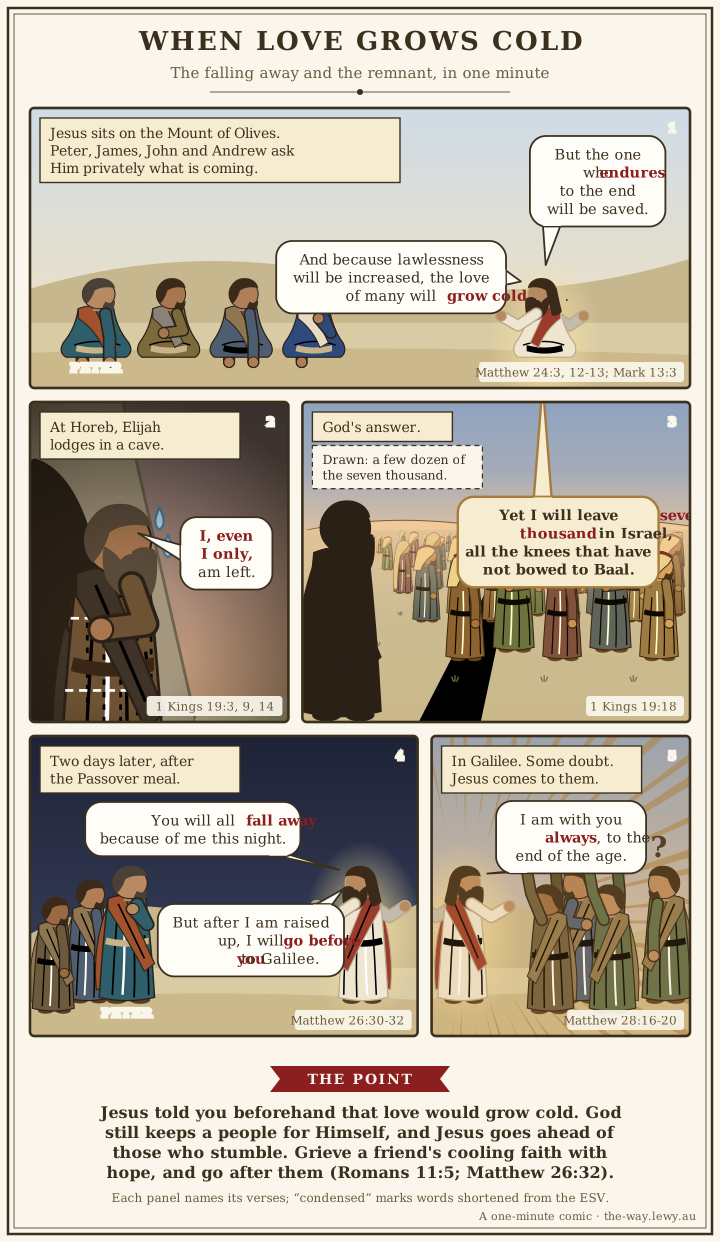
**In one sentence:** Jesus told His disciples beforehand that the love of the many would grow cold,
and the same Scripture records a God who has always kept a remnant for Himself by grace and who goes
after those who stumble, so you can grieve a friend's cooling faith without despair, keep yourself
in His love, and go after them in hope.
[](https://the-way.lewy.au/assets/img/comics/when-love-grows-cold.svg)
> ✝️ Matthew 24:12-13 (ESV)
>
> 12 And because lawlessness will be increased, the love of many will grow cold. 13 But the one who
> endures to the end will be saved.
## Key Takeaways
*(This section follows the [Key Takeaways](https://the-way.lewy.au/about/key-takeaways/) format — see that page for what each part is for.)*
### Types & Prophecy
- **Prophecy.** Jesus foretold that "many will fall away" and "the love of many will grow cold"
(Matthew 24:10, 12, ESV) and added, "See, I have told you beforehand" (Matthew 24:25, ESV). A
cooling church is a fulfilled word of His, and it says nothing against Him.
- **Prophecy.** Isaiah 42:3's Servant does not quench "a faintly burning wick" (ESV). Matthew 12:20
says Jesus is that Servant.
### Lessons about Jesus
- **He named the falling away to the men who would do it.** "You will all fall away because of me
this night" (Matthew 26:31, ESV) uses the same verb as Matthew 24:10, and in the next breath He
promised to meet them in Galilee (Matthew 26:32).
- **He called them brothers afterwards.** The first message the risen Jesus sent to the men who had
fled was "go and tell my brothers" (Matthew 28:10, ESV).
- **He prays for the one being sifted.** "I have prayed for you that your faith may not fail. And
when you have turned again, strengthen your brothers" (Luke 22:32, ESV).
### Memory verses
> ✝️ Romans 11:5 (ESV)
>
> 5 So too at the present time there is a remnant, chosen by grace.
> ✝️ Jude 21 (ESV)
>
> 21 keep yourselves in the love of God, waiting for the mercy of our Lord Jesus Christ that leads
> to eternal life.
### Be Transformed
- **Think.** Elijah counted himself the last one left, and God had seven thousand he had never
heard of (1 Kings 19:18). Your view of who still believes is partial too; God's is complete. "The
Lord knows those who are his" (2 Timothy 2:19, ESV).
- **Attitude.** Grieve the cooling as Jesus does, with hope. He went ahead of the men who fled and
waited for them in Galilee.
- **Do.** Pick one friend whose love has cooled, and "have mercy" on them, Jude's first word for the
doubting (Jude 22, ESV). Pray for them by name this week, and then make one contact that asks
nothing of them: a message, a meal, an invitation to coffee.
### Prayer
Father, you have never been left without a people. You kept seven thousand in Elijah's day when he
could see only himself, and you keep a remnant now, chosen by grace. Your Son Jesus told us that the
love of many would grow cold, and He told us beforehand so we would not lose heart. He went ahead of
the disciples who fled Him and called them His brothers. Keep my own love warm in your love. Give me
patience and gentleness toward the friends I see drifting, and give them repentance and a way home.
Do not quench the faint wick; fan it into flame.
In Jesus' name. Amen.
## Study outline
- [He told you beforehand](#he-told-you-beforehand). Matthew 24:9-13: what grows cold, why, and
Jesus' one instruction.
- [I, even I only, am left](#i-even-i-only-am-left). Elijah's count, and God's.
- [The remnant, from Isaiah to Paul](#the-remnant-from-isaiah-to-paul). Isaiah's stump and
returning remnant, Malachi's book of remembrance, Paul's remnant chosen by grace.
- [You will all fall away](#you-will-all-fall-away). The same word on the Eleven, the meeting in
Galilee, and the smouldering wick.
- [Two names on Paul's list](#two-names-on-pauls-list). Mark came back; Scripture leaves Demas
open.
- [The Lord knows those who are His](#the-lord-knows-those-who-are-his). 1 John 2:19 beside Peter and Mark.
- [While the love of many cools](#while-the-love-of-many-cools). Keep yourself, encourage daily,
go after the one who wanders.
- [Discussion questions](#discussion-questions).
## He told you beforehand
### On the Mount of Olives
Two days before Passover, Jesus sat on the Mount of Olives facing the Temple, and four disciples
asked Him privately when it would be destroyed and what the sign of His coming would be (Matthew
24:3; Mark 13:3). He answered first with a list of wars, famines and earthquakes, "the beginning of
the birth pains" (Matthew 24:8, ESV). Then He turned to the disciples themselves:
> ✝️ Matthew 24:9-13 (ESV)
>
> 9 "Then they will deliver you up to tribulation and put you to death, and you will be hated by all
> nations for my name's sake. 10 And then many will fall away and betray one another and hate one
> another. 11 And many false prophets will arise and lead many astray. 12 And because lawlessness
> will be increased, the love of many will grow cold. 13 But the one who endures to the end will be
> saved.
This site reads Matthew 24:4-14 as marking the whole age from the first century on, and, in its
final and fiercest form, opening Daniel's seventieth week ([The Olivet
Discourse](https://the-way.lewy.au/last-things/olivet-discourse/#the-abomination-of-desolation)). Either way the
words reach you. The cooling Jesus describes has been happening since the apostles' own day, and it
will be at its worst at the end.
### Three "many"s
Verses 10-12 use the word "many" four times, and three of them name a different way of leaving.
Many "will fall away", σκανδαλίζω (*skandalizō*, G4624), to be tripped up, to take offence and go
down. Many will be "led astray" by false prophets. And "the love of many will grow cold". The first
is a fall, the second a deception, the third a slow loss of heat. The person you are thinking of may
fit any one of the three.
### The love that grows cold
The last clause has two rare words in it. ψύχω (*psychō*, G5594), "grow cold", occurs nowhere else
in the New Testament. The Greek Old Testament uses it for a cistern keeping its water cool (Jeremiah
6:7, LXX): the temperature of something left standing. And ἀγάπη (*agapē*, G26), "love", appears in
Matthew's Gospel only here. Matthew uses the verb for the two great commandments, love for God "with
all your heart" and for "your neighbor as yourself" (Matthew 22:37-39, ESV). That is the love which
cools: toward God, and toward "one another" in the verse before.
The ASV keeps a small word the ESV drops: "the love of *the* many shall wax cold" (Matthew 24:12,
ASV). The Greek has the article, τῶν πολλῶν. Jesus is describing the bulk of the people in view, the
many He has just named twice. He prepared His disciples to be part of a minority.
### Why love cools: lawlessness
Jesus gives a cause: "because lawlessness will be increased." ἀνομία (*anomia*, G458) appears four
times in Matthew. At the harvest the angels gather "all law-breakers" out of the Son of Man's kingdom
(Matthew 13:41, ESV), and twice the word names people inside the religious community: the "workers of lawlessness" who prophesied in Jesus'
name (Matthew 7:22-23, ESV) and the scribes and Pharisees who were "full of hypocrisy and
lawlessness" within (Matthew 23:28, ESV). Matthew 24:12 does not say whose lawlessness, and the
surrounding verses put betrayal and false prophets inside the circle (Matthew 24:10-11), so both
sources are in view. Love is cooled by a climate. A warm thing left long enough in a cold room takes
the room's temperature.
### What Jesus asks: endure to the end
Then comes the answer, and it is a single instruction: "the one who endures to the end will be saved"
(Matthew 24:13, ESV). ὑπομένω (*hypomenō*, G5278) is to hold one's ground under pressure. The *ESV Study Bible*
notes that "the end" may be the end of the persecution at the Son of Man's return or the end of a
person's life (note on Matthew 24:13). Either way the command is the same, and it is addressed to
you, the one watching.
This shows that God forewarns His people. Jesus said it plainly, and said why:
"See, I have told you beforehand" (Matthew 24:25, ESV). When a friend's faith cools, it is the word of
Christ coming true, and one more reason to trust Him.
## I, even I only, am left
### Elijah at Horeb
Elijah had just seen fire fall on Mount Carmel and the prophets of Baal defeated (1 Kings 18:38-40).
One message from Jezebel and he ran for his life, past Beersheba, a day into the wilderness, and on
to Horeb (1 Kings 19:1-8). There God asked him twice, "What are you doing here, Elijah?" and twice he
gave the same answer:
> ✝️ 1 Kings 19:14 (ESV)
>
> 14 He said, "I have been very jealous for the LORD, the God of hosts. For the people of Israel have
> forsaken your covenant, thrown down your altars, and killed your prophets with the sword, and I,
> even I only, am left, and they seek my life, to take it away."
Everything in the first half of that answer was true. Israel had forsaken the covenant. Jezebel had
killed the prophets. The last clause was wrong, and Elijah had been told so. Obadiah, Ahab's own
steward, had met him on the road before Carmel and asked, "Has it not been told my lord what I
did when Jezebel killed the prophets of the LORD, how I hid a hundred men of the LORD's prophets by
fifties in a cave and fed them with bread and water?" (1 Kings 18:13, ESV). Elijah knew of a hundred
prophets in caves and still said "I only". Discouragement does arithmetic badly.
### God's count
God answered with a whisper, fresh work, and a number:
> ✝️ 1 Kings 19:18 (ESV)
>
> 18 Yet I will leave seven thousand in Israel, all the knees that have not bowed to Baal, and every
> mouth that has not kissed him.
The Hebrew verb is וְהִשְׁאַרְתִּי (*vehishʾarti*, H7604), "and I will
leave", from שָׁאַר (*shaʾar*, H7604), the root of the Old Testament's word for a
remnant. The subject is God. He had kept the seven thousand faithful and knew every name, and
Elijah knew none of them.
Paul quotes the verse nine centuries later, and his wording sharpens the point: κατέλιπον ἐμαυτῷ
(*katelipon emautō*), "I have kept for myself seven thousand men" (Romans 11:4, ESV). The Hebrew has
"I will leave"; the Septuagint reads "you will leave" (1 Kings 19:18, LXX);
Paul gives the divine first person in the past tense and adds "for myself". The seven thousand are
God's own possession, already set aside. The *NIV Biblical Theology Study Bible* reads seven thousand
as a round number for fullness, given to correct Elijah's "only me" (note on 1 Kings 19:18).
God then sent Elijah back to work: anoint two kings and a successor (1 Kings 19:15-16). The cure for
"I only am left" was a true count and a job. This shows that God's knowledge of His people is
complete where yours is partial, and that He keeps them Himself. You can stop counting, because He
has the count.
## The remnant, from Isaiah to Paul
### Isaiah: a stump and a son's name
Elijah's seven thousand is one instance of a pattern that runs through the prophets. Isaiah, a
century later, watched Judah's leaders refuse God while Assyria advanced, and wrote, "If the LORD of
hosts had not left us a few survivors, we should have been like Sodom" (Isaiah 1:9, ESV). The
survivors exist because God left them.
Isaiah's commission ended with a felled tree: "like a terebinth or an oak, whose stump remains when
it is felled. The holy seed is its stump" (Isaiah 6:13, ESV). Judgment would cut the nation down to
the ground. Life would stay in the root.
Isaiah even named a son after the idea. He took "Shear-jashub your son" to meet King Ahaz (Isaiah
7:3, ESV), and the name is a sentence: שְׁאָר יָשׁוּב (*sheʾar yashuv*, H7610),
"a remnant will return". Isaiah 10:21 spells it out: "A remnant will return, the remnant of Jacob, to
the mighty God" (ESV). The verb is שׁוּב (*shuv*, H7725), the Old Testament's word
for repentance. The remnant is people who turn back to God.
### Malachi: the book of remembrance
The Old Testament's last prophet wrote to a people who had come home from exile and grown cold
again: tired of worship (Malachi 1:13), robbing God (Malachi 3:8), saying "It is vain to serve God"
(Malachi 3:14, ESV). Then this:
> ✝️ Malachi 3:16-17 (ESV)
>
> 16 Then those who feared the LORD spoke with one another. The LORD paid attention and heard them,
> and a book of remembrance was written before him of those who feared the LORD and esteemed his
> name. 17 "They shall be mine, says the LORD of hosts, in the day when I make up my treasured
> possession, and I will spare them as a man spares his son who serves him.
In a cold generation the faithful did one thing: they talked to each other. God listened to those
conversations and had their names written down.
### Paul: chosen by grace
Paul reads his own generation through Isaiah's two remnant verses. In Romans 9:27-29 he quotes
Isaiah 10:22, "only a remnant of them will be saved", and Isaiah 1:9, "If the Lord of hosts had not
left us offspring, we would have been like Sodom" (ESV). The prophet's survivors and the believers
of Paul's day stand in one line, each left by the same God.
Two chapters on, when Paul quotes Elijah, he is answering the question, "has God rejected his people?" (Romans 11:1,
ESV), and his answer is himself, an Israelite who believes, and then this:
> ✝️ Romans 11:5-6 (ESV)
>
> 5 So too at the present time there is a remnant, chosen by grace. 6 But if it is by grace, it is no
> longer on the basis of works; otherwise grace would no longer be grace.
λεῖμμα (*leimma*, G3005), "remnant", occurs only here in the New Testament. Paul's remnant is Jewish
believers in Jesus, the faithful core of Israel in his own day, and God's purposes for the nation do
not end with it (Romans 11:25-29). The church is a different body, and Scripture does not rename it
"the remnant". What carries straight across is the character of the God who keeps one. In every
generation He has kept a people for Himself, and He has kept them by grace. This shows that the
existence of faithful people at any time is His work, which means a cold season can thin the crowd
and leave His purpose standing.
## You will all fall away
### The same word, on the Eleven
Two days later, after the Passover meal, Jesus took the disciples out to the Mount of Olives again
(Matthew 26:2, 30) and said:
> ✝️ Matthew 26:31-33 (ESV)
>
> 31 Then Jesus said to them, "You will all fall away because of me this night. For it is written, 'I
> will strike the shepherd, and the sheep of the flock will be scattered.' 32 But after I am raised
> up, I will go before you to Galilee." 33 Peter answered him, "Though they all fall away because of
> you, I will never fall away."
"Fall away" is σκανδαλίζω again, the verb of Matthew 24:10. Matthew uses it fourteen times, and its
last three are here, two of them in Peter's own boast. The men who heard "many will fall away" were
told two days later that they were the many. Within hours "all the disciples left him and fled"
(Matthew 26:56, ESV), and Peter denied Him three times.
Jesus' prediction carried its own promise: "after I am raised up, I will go before you to Galilee."
The angel at the tomb repeated it (Matthew 28:7), and then the risen Jesus Himself, with a new word
for the men who had run: "go and tell my brothers to go to Galilee, and there they will see me"
(Matthew 28:10, ESV). They went, and even then "some doubted" (Matthew 28:17, ESV). Jesus came to
them anyway and gave them the world to reach (Matthew 28:18-20).
Luke records what Jesus had done beforehand for the worst of them: "Simon, Simon, behold, Satan
demanded to have you, that he might sift you like wheat, but I have prayed for you that your faith
may not fail. And when you have turned again, strengthen your brothers" (Luke 22:31-32, ESV). Jesus
expected Peter's fall, prayed through it, and planned his return before it happened. John 21:15-17
records the return.
### The smouldering wick
Matthew gives the reason Jesus handles stumbling people this way. He quotes Isaiah's first Servant
Song and applies it to Jesus:
> ✝️ Matthew 12:20 (ESV)
>
> 20 a bruised reed he will not break, and a smoldering wick he will not quench, until he brings
> justice to victory;
Isaiah's word describing the wick is כֵהָה (*kehah*, H3544), "dim, faint" (Isaiah
42:3). A wick was flax fibre drawing oil to the flame, and the *NIV Cultural Backgrounds Study Bible*
notes that a smouldering one was normally pulled out and replaced (note on Isaiah 42:3). The same
word returns in Isaiah 61:3, where the Anointed One gives "the garment of praise instead of a faint
spirit" (ESV). Jesus read the start of that passage in Nazareth and said, "Today this Scripture has
been fulfilled in your hearing" (Luke 4:21, ESV).
This shows that God's way with a faith burning low is to tend it. Jesus foresaw His disciples'
falling away, prayed for them before it, went ahead of them after it, and called them brothers when
they came. A friend whose love has cooled is a wick He is still tending, and He gives you the same
work.
## Two names on Paul's list
Hurt and desertion among believers are treated at length in [Hurt by the
Church](https://the-way.lewy.au/christian-life/hurt-by-the-church/#brothers-who-fail-you). Two of Paul's companions belong here because
their stories end differently.
### Mark, who came back
John Mark left Paul and Barnabas in Pamphylia partway through their first journey (Acts 13:13). Paul
thought it serious enough to refuse him a second time, and the disagreement split Paul from Barnabas
(Acts 15:37-39). Years later Mark is with Paul during an imprisonment, and the churches are told to "welcome him"
(Colossians 4:10, ESV). At the very end Paul wrote, "Get Mark and bring him with you, for he is very
useful to me for ministry" (2 Timothy 4:11, ESV). Barnabas, whose name means "son of encouragement"
(Acts 4:36), had kept hold of him through the gap.
### Demas, who is left open
Demas appears with Mark as one of Paul's "fellow workers" (Philemon 24, ESV; Colossians 4:14). In
Paul's last letter, a few years later, he is gone: "Demas, in love with this present world, has
deserted me and gone to Thessalonica" (2 Timothy 4:10, ESV). Scripture says nothing more about him.
His love had shifted to "this present world", the age that is passing, and the record stops there.
The two stories sit in adjacent verses of 2 Timothy 4 (4:10-11). One friend had come back.
One had just left. Paul did not know how Demas's story would end, and you do not know how your
friend's will.
## The Lord knows those who are His
John wrote of people who had left his churches: "They went out from us, but they were not of us; for
if they had been of us, they would have continued with us" (1 John 2:19, ESV). This site reads that
verse with the security of those who are Christ's: a departure that lasts shows that some visible
professions were never the real thing ([Assurance of
Salvation](https://the-way.lewy.au/salvation/assurance-of-salvation/#when-someone-walks-away)). John could say it
because the departure was complete and the false teaching it carried was plain (1 John 2:22).
Peter and Mark show the other side. A believer can stumble badly and come back, and while they are
away no one on earth can see which story they are in. Paul gave Timothy the word that settles it:
"God's firm foundation stands, bearing this seal: 'The Lord knows those who are his'" (2 Timothy
2:19, ESV). He paired it with patience toward those who oppose the truth: "God may perhaps grant them
repentance leading to a knowledge of the truth, and they may come to their senses and escape from the
snare of the devil" (2 Timothy 2:25-26, ESV).
This shows that the sorting belongs to God, and He does it with perfect knowledge. You are spared the
work of deciding whether your friend was ever saved. Your part is to pray and to keep the door open.
God's part is the rest, and "if we are faithless, he remains faithful— for he cannot deny himself" (2
Timothy 2:13, ESV).
## While the love of many cools
### Keep yourself
Jude wrote to churches where false teachers had crept in (Jude 4) and some were wavering. His first
instruction is to the faithful about themselves:
> ✝️ Jude 20-23 (ESV)
>
> 20 But you, beloved, building yourselves up in your most holy faith and praying in the Holy Spirit,
> 21 keep yourselves in the love of God, waiting for the mercy of our Lord Jesus Christ that leads to
> eternal life. 22 And have mercy on those who doubt; 23 save others by snatching them out of the
> fire; to others show mercy with fear, hating even the garment stained by the flesh.
Love grows cold in a cold climate, so you keep yourself near the fire: built up in the faith, praying,
and kept in the love of God. Then Jude turns outward to three kinds of people, and his first word and
his last is mercy. The fire and the stained garment come from Zechariah 3, which Jude has already
quoted once ("The Lord rebuke you", Jude 9): there the LORD calls Joshua the high priest "a brand plucked
from the fire", strips off his filthy garments and says, "I have taken your iniquity away from
you" (Zechariah 3:2-4, ESV). You go after the wavering as God went after Joshua. Jude's letter closes on the one who does the keeping: "him who is able to keep you
from stumbling" (Jude 24, ESV).
### Encourage one another daily
Hebrews names how hearts cool, and the remedy, in two verses: "Take care, brothers, lest there be in
any of you an evil, unbelieving heart, leading you to fall away from the living God. But exhort one
another every day, as long as it is called 'today,' that none of you may be hardened by the
deceitfulness of sin" (Hebrews 3:12-13, ESV). The cooling is gradual and deceitful, and the remedy is
daily and mutual. Hebrews 10:24-25 adds meeting together, "all the more as you see the Day drawing
near" (ESV). Malachi's faithful did the same: they "spoke with one another", and God wrote down their
names (Malachi 3:16).
### Go after the one who wanders
The New Testament sends someone after the wanderer. "If anyone is caught in any transgression,
you who are spiritual should restore him in a spirit of gentleness" (Galatians 6:1, ESV). "If anyone
among you wanders from the truth and someone brings him back, let him know that whoever brings back
a sinner from his wandering will save his soul from death and will cover a multitude of sins" (James
5:19-20, ESV).
Jesus' parable of the lost sheep, in Matthew, is told about "one of these little ones" inside the
flock: the shepherd leaves the ninety-nine and goes after the one, "so it is not the will of my
Father who is in heaven that one of these little ones should perish" (Matthew 18:12-14, ESV). The
Father's will is that the strayed one comes home, and you can pray in line with it with confidence.
God's invitation through Jeremiah to a faithless people still stands: "Return, O faithless sons; I
will heal your faithlessness" (Jeremiah 3:22, ESV).
### Endure
Jesus' one instruction in Matthew 24:13 comes back at the end. You cannot hold a friend's faith for
them. You can stay, keep warm, and keep the door open. The *ESV Study Bible*'s reading of "the end"
as either Christ's return or the end of a life cuts both ways for you: your own endurance is
measured over a lifetime, and so is your friend's story.
This shows that God has made His people a means of His keeping. He keeps you in His love through the
Word, through prayer, and through brothers and sisters who exhort you daily, and He reaches the
wanderer the same way. So you may grieve the cooling without fear, stay warm in His love, and go
after your friend with the patience of the Shepherd who went after you.
## Discussion questions
1. **The language.** ψύχω, "grow cold", is a temperature word, used in the Greek Old Testament of
water kept cool in a cistern. What does picturing love as something that takes the temperature of
its surroundings tell you about how your own love is kept warm?
2. **The text in its context.** Elijah said "I only am left" weeks after Obadiah told him about a
hundred hidden prophets (1 Kings 18:13; 19:14). Why do you think discouragement made him forget
what he knew, and where have you done the same?
3. **Christ.** Jesus told the disciples they would all fall away and, in the same sentence, promised
to go ahead of them to Galilee (Matthew 26:31-32). What does that order tell you about how He
regards a believer who stumbles?
4. **The hard part.** 1 John 2:19 says those who left "were not of us"; Peter and Mark left and came
back. How do you hold both, without deciding for God which story your friend is in?
5. **Be transformed.** Jude's first word for the doubting is mercy (Jude 22). Who is the one friend
you will pray for by name this week, and what is one contact you can make that asks nothing of
them?
## References & Recommended Reading
- **ESV Study Bible** (Crossway) — verse text throughout; notes on Matthew 24:1-14 and 24:13,
1 Kings 19:15-18, Romans 11:3-5 and 2 Timothy 4:10.
- **NIV Biblical Theology Study Bible** (Zondervan) — notes on 1 Kings 19:18 and 2 Timothy 4:10.
- **NIV Cultural Backgrounds Study Bible** (Zondervan) — note on Isaiah 42:3.
- **American Standard Version** (1901) — Matthew 24:12, for the article.
- **Brenton's Septuagint** (Greek text) — 1 Kings 19:18 and Jeremiah 6:7.
- **Macula Greek (SBLGNT)** and **Macula Hebrew (WLC)** — occurrence data for ψύχω, ἀγάπη, ἀνομία,
σκανδαλίζω, λεῖμμα and כֵּהֶה; unfoldingWord ULT alignment for the interlinear.
### On this site
- [The Olivet Discourse](https://the-way.lewy.au/last-things/olivet-discourse/) — the whole of Matthew 24-25, and
where Matthew 24:9-13 falls in it.
- [Hurt by the Church](https://the-way.lewy.au/christian-life/hurt-by-the-church/) — brothers who fail you, shepherds who harm, and the
Good Shepherd who stays.
- [Assurance of Salvation](https://the-way.lewy.au/salvation/assurance-of-salvation/) — the security of those who are
Christ's, and what 1 John 2:19 means.
- [Run the Race](https://the-way.lewy.au/christian-life/run-the-race/) — endurance in the Christian life.
- [Those Who Sigh and Groan](https://the-way.lewy.au/christian-life/those-who-sigh-and-groan/) — the faithful marked and spared in
Ezekiel 9, and the Lord who knows those who are His (2 Timothy 2:19).