---
title: "The Names of God"
category: "theology"
description: "A study of the names God gave Himself in the Old Testament, from \"I AM WHO I AM\" at the burning bush to the LORD our righteousness: where each was spoken, to whom, what it promised, and how all of them meet in the name of Jesus."
tags: ["names-of-god", "exodus", "genesis", "isaiah", "lang/hebrew", "lang/greek", "method/word-study", "deity-of-christ"]
draft: false
primary_passage: "Exodus 3:13-15"
bible_references: ["Exodus 3:11-15", "Exodus 6:2-8", "Exodus 33:18-19", "Exodus 34:5-7", "Genesis 14:18-22", "Genesis 15:2", "Genesis 15:7", "Genesis 16:13", "Genesis 17:1-2", "Genesis 22:7-14", "Exodus 15:23-26", "Exodus 17:15", "Judges 6:22-24", "1 Samuel 1:10-11", "Ruth 1:20", "Isaiah 7:14", "Isaiah 9:6", "Isaiah 10:21", "Jeremiah 23:5-6", "Jeremiah 33:16", "Numbers 13:16", "Matthew 1:21-23", "Matthew 27:46", "John 8:58", "John 17:11", "Philippians 2:9-11", "Isaiah 45:23", "Joel 2:32", "Romans 10:13", "Matthew 28:19", "Genesis 4:26", "Isaiah 42:8", "1 Samuel 1:3", "Numbers 21:8-9", "Isaiah 11:10", "John 1:29", "John 3:14", "2 Corinthians 5:21", "1 Corinthians 1:30", "Exodus 17:9-11", "Genesis 49:25", "Numbers 14:17-19", "Genesis 1:1", "Isaiah 6:1", "Judges 6:12"]
date_created: 2026-10-18
date_modified: 2026-10-19
ai_provider_models:
- anthropic/claude-opus-5.5
---
# The Names of God
Moses asked God His name, and the answer has filled the rest of the Bible. Almost every time God
gave Himself a name, He gave it to someone in trouble, in the middle of what He was doing for them.
**In one sentence:** God names Himself by what He does: almost every name He gave was spoken to
someone at the end of their own resources, each is a promise He has kept, and all of them meet in Jesus, whose
name means "the LORD saves".
This study is the theology behind the [Names of God word cards](https://the-way.lewy.au/hebrew/names-of-god-cards/),
which teach the same names as Hebrew vocabulary, one letter at a time. Its second half, [The Names
of Jesus](https://the-way.lewy.au/jesus/names-of-jesus/), begins where this study ends, at the name of Jesus, and [The
Names of the Holy Spirit](https://the-way.lewy.au/holy-spirit/names-of-the-holy-spirit/) completes the three.
## Key Takeaways
### Types & Prophecy
- **Type.** On Mount Moriah Abraham told Isaac, "God will provide for himself the lamb" (Genesis
22:8, ESV), and named the place "The LORD will provide" (Genesis 22:14, ESV). John the Baptist
pointed at Jesus: "Behold, the Lamb of God" (John 1:29, ESV).
- **Type (this study's reading).** The banner Moses named in Exodus 17:15 is a
נֵס (*nes*), the same word as the pole that held up the bronze serpent
(Numbers 21:8), which Jesus applied to His cross (John 3:14). No verse joins Exodus 17 to the
cross; the type rests on the shared word and on what each *nes* did, and is set out in [The LORD
is my banner](#the-lord-is-my-banner-over-the-battle-with-amalek).
- **Prophecy.** Isaiah and Jeremiah gave the coming King divine names: Immanuel, "God with us"
(Isaiah 7:14), "Mighty God" (Isaiah 9:6) and "The LORD is our righteousness" (Jeremiah 23:6).
### Lessons about Jesus
- Jesus bears the name He was given as its meaning: *Yeshua*, "the LORD saves", "for he will save his
people from their sins" (Matthew 1:21, ESV).
- Jesus spoke the burning bush's "I am" of Himself: "before Abraham was, I am" (John 8:58, ESV).
- The apostles gave Jesus verses about the LORD's own name: the oath the LORD swore by Himself that
every knee will bow to Him (Isaiah 45:23; Philippians 2:10-11), and Joel's promise that everyone
who calls on the name of the LORD will be saved (Joel 2:32; Romans 10:13).
### Memory verses
> ✝️ Exodus 3:15 (ESV)
>
> 15 This is my name forever, and thus I am to be remembered throughout all generations.
> ✝️ Philippians 2:9-10 (ESV)
>
> 9 Therefore God has highly exalted him and bestowed on him the name that is above every name,
> 10 so that at the name of Jesus every knee should bow, in heaven and on earth and under the earth
### Be Transformed
- **Think.** God's names are promises with His character behind them. When you read "the LORD", read
the God of Exodus 34:6, who said what He is like and has kept His word.
- **Attitude.** Most of these names were given to someone with nothing left: a childless couple, a
runaway slave, a frightened farmer, a people with bitter water. Your own empty place is where God
has always made Himself known.
- **Do.** Learn one name this week with the [word cards](https://the-way.lewy.au/hebrew/names-of-god-cards/), read the
passage where God gave it, and pray it back to Him by name, as Moses prayed Exodus 34:6-7 back to
God when Israel had sinned again (Numbers 14:17-19).
### Prayer
LORD, You told Moses Your name and kept every promise it carried. You saw Hagar, You provided the
lamb, You healed the water and You gave Gideon peace. You have given Your name to Your Son Jesus,
and every knee will bow to Him. I call on that name now: save me, see me, and be my righteousness.
In Jesus' name. Amen.
## Study outline
- ["What is his name?"](#what-is-his-name) God answers Moses at the burning bush, and the answer is
a promise to be with him: [I will be](#i-will-be) · [The LORD](#the-lord).
- [The name explained](#the-name-explained) and [Known by name, known by
deed](#known-by-name-known-by-deed). God's own commentary on His name in Exodus 34, and what
Exodus 6:3 means when it says the patriarchs did not know it, with the [contested
reading](#contested-one-story-or-separate-sources) set out on both sides.
- [Names given in the hard places](#names-given-in-the-hard-places). Nine names from Genesis to
1 Samuel, each in the scene where it was given: [God Almighty](#god-almighty-to-the-childless) ·
[Lord](#lord-from-a-man-with-no-heir) · [God Most High](#god-most-high-served-by-melchizedek) ·
[the God who sees and the LORD who will provide](#the-god-who-sees-and-the-lord-who-will-see-to-it)
· [the LORD your healer](#the-lord-your-healer-at-bitter-water) · [the LORD is my
banner](#the-lord-is-my-banner-over-the-battle-with-amalek) · [the LORD is
peace](#the-lord-is-peace-to-gideon) · [the LORD of hosts](#the-lord-of-hosts-on-hannahs-lips).
- [Names the prophets gave the coming King](#names-the-prophets-gave-the-coming-king).
[Immanuel](#immanuel) · [Mighty God](#mighty-god) · [The LORD is our
righteousness](#the-lord-is-our-righteousness).
- [The name above every name](#the-name-above-every-name). How the New Testament gives the names to
Jesus: [Jesus: the LORD saves](#jesus-the-lord-saves) · [The Son speaks the Father's
names](#the-son-speaks-the-fathers-names) · [Every knee, and everyone who
calls](#every-knee-and-everyone-who-calls) · [One name](#one-name).
## "What is his name?"
God called Moses from a burning bush and sent him back to Egypt, where Israel was enslaved and
Moses was wanted for murder. Moses objected twice. The first objection was about himself:
> ✝️ Exodus 3:11-15 (ESV)
>
> 11 But Moses said to God, "Who am I that I should go to Pharaoh and bring the children of Israel
> out of Egypt?" 12 He said, "But I will be with you, and this shall be the sign for you, that I have
> sent you: when you have brought the people out of Egypt, you shall serve God on this mountain."
> 13 Then Moses said to God, "If I come to the people of Israel and say to them, 'The God of your
> fathers has sent me to you,' and they ask me, 'What is his name?' what shall I say to them?"
> 14 God said to Moses, "I AM WHO I AM." And he said, "Say this to the people of Israel: 'I AM has
> sent me to you.'" 15 God also said to Moses, "Say this to the people of Israel: 'The LORD, the God
> of your fathers, the God of Abraham, the God of Isaac, and the God of Jacob, has sent me to you.'
> This is my name forever, and thus I am to be remembered throughout all generations.
### I will be
[](https://the-way.lewy.au/assets/img/names-of-god/ehyeh.svg)
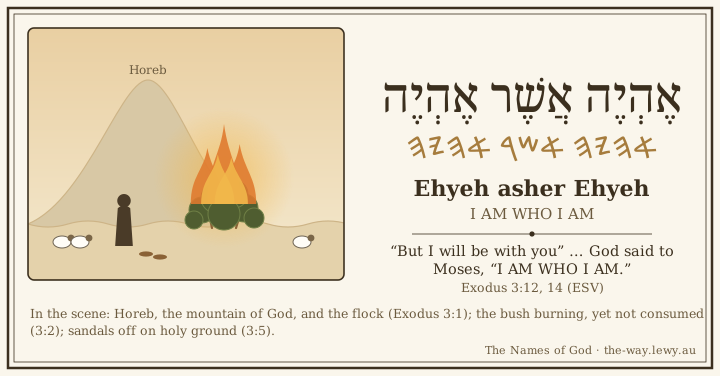
The answer to "Who am I?" is "I will be with you", and the Hebrew verb there is
אֶהְיֶה (*ehyeh*, eh-YEH, H1961), "I will be" or "I am". Two verses later God
gives His name with the same word in the same form: אֶהְיֶה אֲשֶׁר אֶהְיֶה
(*ehyeh asher ehyeh*), "I AM WHO I AM" (Exodus 3:14). So God's name first reaches Moses as an answer
to his fear. Before it tells him what God is in Himself, it tells him God will go with him.
The Hebrew verb covers both "I am" and "I will be". The ESV prints "I AM WHO I AM"; the NLT
footnotes "I WILL BE WHAT I WILL BE" and the CSB "I WILL BE WHO I WILL BE"; the choice between them
is open. The Greek translators of the Septuagint chose being:
ἐγώ εἰμι ὁ ὤν (*egō eimi ho ōn*), "I am the one who is" (Exodus 3:14,
Brenton LXX). The two readings belong together. The God who simply is, owing His existence to no one,
is the God who can promise to be with Moses in Egypt.
### The LORD
[](https://the-way.lewy.au/assets/img/names-of-god/yhwh.svg)
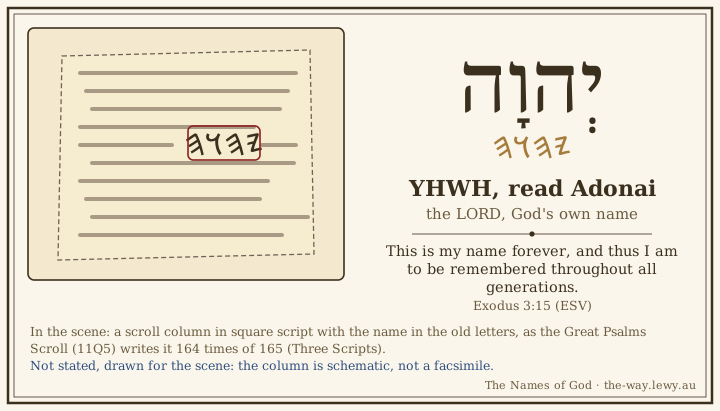
Verse 15 turns the first person into a name: יְהוָה (YHWH, H3068), the
four letters English Bibles print as "the LORD" in small capitals. It is God's personal name, used
6,513 times in the Hebrew Old Testament (WLC), and He says of it, "This is my name forever". God
explains it with the verb *to be* in Exodus 3:14, and the LSB's footnote there says the name is
derived from that verb, הָיָה (*hayah*, H1961).
Pronunciation is a separate question: by the time of Jesus, Jews read it aloud as *Adonai*,
"Lord", and [How Hebrew Is Pronounced](https://the-way.lewy.au/hebrew/pronunciation/#the-name-of-god) tells
that story.
The word for God in general, אֱלֹהִים (*elohim*, H430), can be used of
angels and of human judges; [Those Called Gods](https://the-way.lewy.au/spiritual-beings/those-called-gods/#the-names-never-given-away)
shows that range and the two names God keeps to Himself. *The LORD* is one of them: "I am the
LORD; that is my name; my glory I give to no other" (Isaiah 42:8, ESV).
## The name explained
After the golden calf, Moses asked to see God's glory. God answered, "I will make all my goodness
pass before you and will proclaim before you my name 'The LORD'" (Exodus 33:19, ESV). Then He did:
> ✝️ Exodus 34:5-7 (ESV)
>
> 5 The LORD descended in the cloud and stood with him there, and proclaimed the name of the LORD.
> 6 The LORD passed before him and proclaimed, "The LORD, the LORD, a God merciful and gracious,
> slow to anger, and abounding in steadfast love and faithfulness, 7 keeping steadfast love for
> thousands, forgiving iniquity and transgression and sin, but who will by no means clear the
> guilty, visiting the iniquity of the fathers on the children and the children's children, to the
> third and the fourth generation."
This is God's own commentary on His name. He is רַחוּם (*rachum*, H7349,
"merciful") and חַנּוּן (*chanun*, H2587, "gracious"), and He abounds in
חֶסֶד (*chesed*, H2617, "steadfast love") and
אֱמֶת (*emet*, H571, "faithfulness"). [Know the Truth](https://the-way.lewy.au/christian-life/know-the-truth/)
traces *emet* through the Bible. He is also just: the same proclamation says He "will by no means
clear the guilty".
He said it to a people who had just broken the covenant at the foot of the mountain. So when God
proclaims His name, He describes His mercy to sinners, and He told it to the people who needed it
most. Most of the later names in this study show one strand of Exodus 34:6-7 in a person's life: mercy
to Hagar, grace to Gideon, faithfulness to Abraham.
## Known by name, known by deed
Exodus 6 is the hard verse on God's name.
> ✝️ Exodus 6:2-3 (ESV)
>
> 2 God spoke to Moses and said to him, "I am the LORD. 3 I appeared to Abraham, to Isaac, and to
> Jacob, as God Almighty, but by my name the LORD I did not make myself known to them.
Read at face value, the verse says the patriarchs never heard the name. But in Genesis God says to
Abram, "I am the LORD who brought you out from Ur of the Chaldeans" (Genesis 15:7, ESV), and Abram
swears by "the LORD, God Most High" (Genesis 14:22, ESV) and names a mountain "The LORD will
provide" (Genesis 22:14). As early as Seth's son, "people began to call upon the name of the LORD"
(Genesis 4:26, ESV).
The verb answers it. "Make myself known" is נוֹדַעְתִּי (*nodati*), from
יָדַע (*yada*, H3045, "to know"), the word for knowing by experience. What
follows in Exodus 6:6-8 is seven things God will do, framed by "I am the LORD": bring out, deliver,
redeem, take as His people, be their God, bring into the land, give it. Then "you shall know that I
am the LORD your God, who has brought you out" (Exodus 6:7, ESV). The patriarchs had the name and
the promise. Israel in Egypt would see it kept. The ESV Study Bible reads the verse the same way.
So God's name is learned by what He does. Abraham knew it as a promise, and his descendants knew it
as a rescue.
### Contested: one story or separate sources
This reading is contested, and the *NIV Biblical Theology Study Bible* sets out four approaches
(note on Exodus 6:3). Two take the name as new to Moses. Source critics assign the Genesis passages
using the name to a different source that did not share Exodus 6's view. Others say Genesis uses
the name to show that the patriarchs' God is Israel's God. Two take the name as known before Moses.
One is the reading above, which that study Bible calls the traditional solution. The other is
grammatical: it reads the verse as a question, "by my name the LORD was I not known to them?" The
source-critical case depends on dividing Genesis into sources. Read as one story, Genesis and Exodus have
the patriarchs using the name and Israel learning what it meant. This study takes the reading that
keeps the two books together, and it is a judgement.
## Names given in the hard places
The names below were given in a scene, and almost every scene is someone with nothing left. Some
God spoke of Himself; some were spoken back to Him by the person He had just met. Each section
gives the scene and what the name promised; the [word cards](https://the-way.lewy.au/hebrew/names-of-god-cards/) teach
each one in Hebrew.
### God Almighty, to the childless
[](https://the-way.lewy.au/assets/img/names-of-god/shaddai.svg)
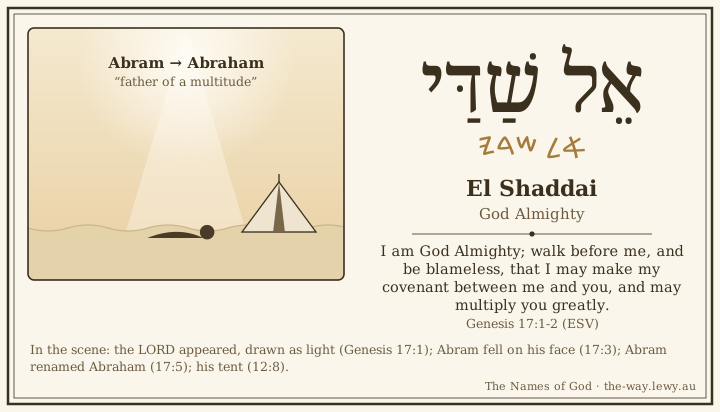
אֵל שַׁדַּי (*El Shaddai*, H7706) is the name of Exodus 6:3, the one the
patriarchs knew. God first speaks it to Abram at ninety-nine, still without a son by Sarah: "I am
God Almighty; walk before me, and be blameless, that I may make my covenant between me and you, and
may multiply you greatly" (Genesis 17:1-2, ESV). Genesis uses *Shaddai* six times, and five are about
children: four come with being fruitful or multiplying (Genesis 17:1-2; 28:3; 35:11; 48:3-4), and
the fifth promises "blessings of the breasts and of the womb" (Genesis 49:25, ESV).
What *Shaddai* means is contested. The Greek translators did not agree on it: "your God" at Genesis
17:1, "the Sufficient One" (*ho hikanos*) at Ruth 1:20 and "the Almighty" (*pantokratōr*) at Job
5:17 (Brenton LXX). The *Theological Wordbook of the Old Testament* (TWOT 2333) gives "sufficient".
What Genesis shows is clearer than the etymology: *El Shaddai* is the name God gave to people who could not have children, as He promised
them nations.
The same name is on the lips of the grieving. Naomi, widowed and childless, said, "the Almighty has
dealt very bitterly with me" (Ruth 1:20, ESV), and the book of Job uses it 31 times. Scripture
lets them say it. The God who promised Abraham descendants is the one to whom the bereaved bring
their complaint, and in Naomi's story He answers it with a grandson in the line of David (Ruth 4:17).
### Lord, from a man with no heir
[](https://the-way.lewy.au/assets/img/names-of-god/adonai.svg)
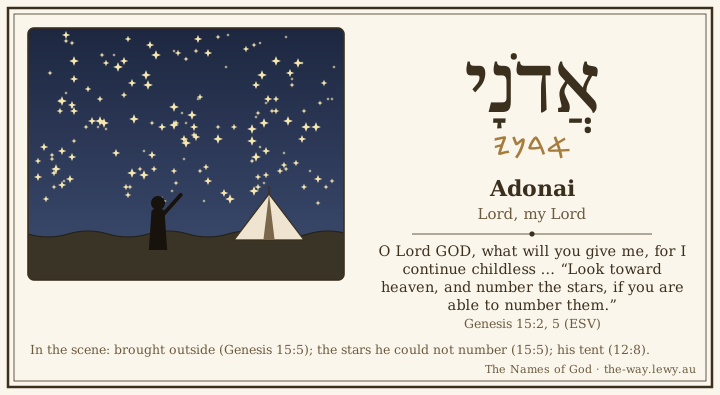
אֲדֹנָי (*Adonai*, H136), "Lord", is first spoken to God by Abram: "O Lord
GOD, what will you give me, for I continue childless" (Genesis 15:2, ESV). It is the form of
אָדוֹן (*adon*, H113), a servant's word for his master, that is kept for God,
and the Old Testament uses it 438 times. It is also the word Jews say aloud for the name *YHWH*,
so Abram's word for his Master became Israel's way of reading the name.
The two common words for God do different work. *Elohim* names Him as God, the Creator over all:
"In the beginning, God created the heavens and the earth" (Genesis 1:1, ESV). *Adonai* is how a
servant speaks to his Master, and it is the word on the lips of Abram, Gideon (Judges 6:22) and
Isaiah, who "saw the Lord sitting upon a throne" (Isaiah 6:1, ESV). When the name stands next to
*Adonai*, as in Abram's "Lord GOD", אֲדֹנָי יֱהוִה, the Masoretes gave
the name the vowels of *Elohim* so that the reader says *Adonai Elohim* and avoids saying "Lord" twice.
That is why the ESV prints "Lord GOD" there. [How Hebrew Is
Pronounced](https://the-way.lewy.au/hebrew/pronunciation/#the-name-of-god) has the history of the custom.
### God Most High, served by Melchizedek
[](https://the-way.lewy.au/assets/img/names-of-god/elyon.svg)
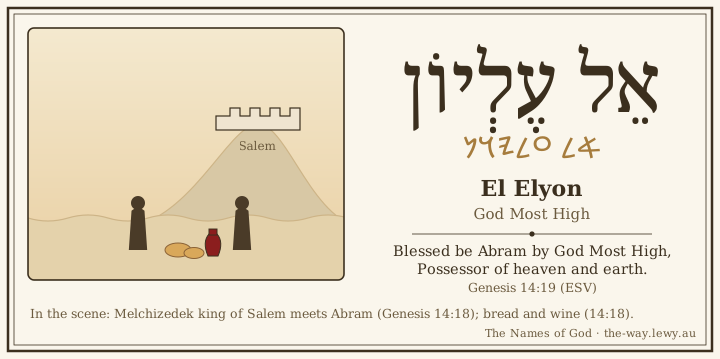
אֵל עֶלְיוֹן (*El Elyon*, H5945), "God Most High", is the God Melchizedek
served, "Possessor of heaven and earth" (Genesis 14:19, ESV). Abram identified Him with the LORD
three verses later (Genesis 14:22). [Jesus, Priest in the Order of
Melchizedek](https://the-way.lewy.au/jesus/melchizedek-priesthood/#genesis-14-a-priest-without-a-genealogy) treats the
scene and what Hebrews makes of it.
### The God who sees, and the LORD who will see to it
[](https://the-way.lewy.au/assets/img/names-of-god/roi.svg)
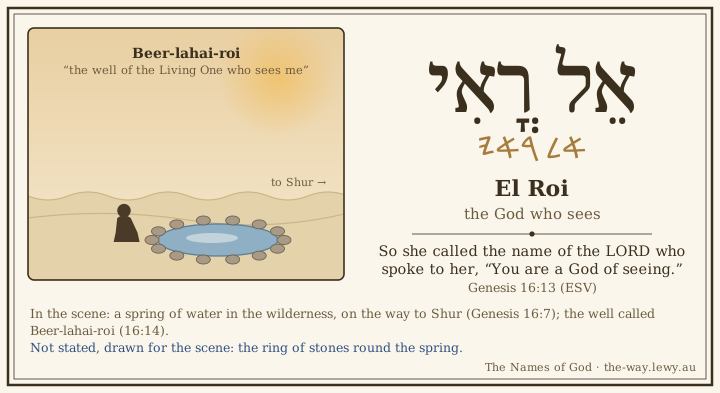
Hagar was Sarai's Egyptian slave, pregnant by Abram, and she ran from her mistress into the
wilderness. The angel of the LORD found her by a spring and told her to name her son Ishmael, "God
hears". Then she named God:
> ✝️ Genesis 16:13 (ESV)
>
> 13 So she called the name of the LORD who spoke to her, "You are a God of seeing," for she said,
> "Truly here I have seen him who looks after me."
אֵל רֳאִי (*El Roi*, H7210) comes from רָאָה
(*raah*, H7200), "to see". A runaway slave, with no one to protect her, found that God had been
watching her.
[](https://the-way.lewy.au/assets/img/names-of-god/yireh.svg)
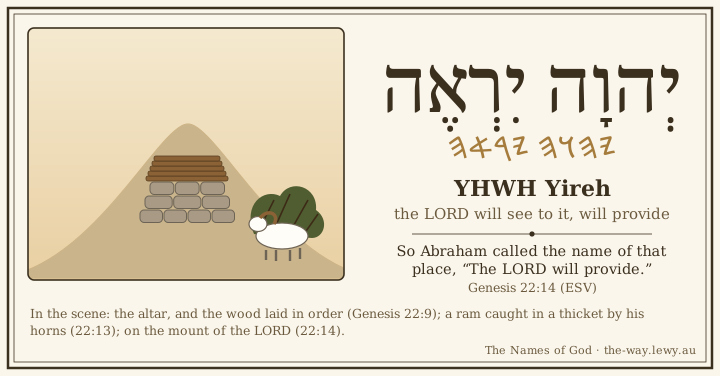
The same verb gives the name on Mount Moriah. Isaac asked, "where is the lamb for a burnt offering?"
and Abraham answered, "God will provide for himself the lamb for a burnt offering, my son" (Genesis
22:7-8, ESV). The Hebrew of "will provide" is *yireh*, "will see": God will see to the lamb. When
the ram was caught in the thicket, "Abraham called the name of that place, 'The LORD will provide'"
(Genesis 22:14, ESV), יְהוָה יִרְאֶה (*YHWH yireh*).
So the God who sees your need is the God who sees to it. On Moriah He provided a ram in Isaac's
place. Centuries later John the Baptist saw Jesus coming and said, "Behold, the Lamb of
God, who takes away the sin of the world!" (John 1:29, ESV). The lamb Abraham promised is the one
God provided in His Son.
### The LORD your healer, at bitter water
[](https://the-way.lewy.au/assets/img/names-of-god/rofekha.svg)
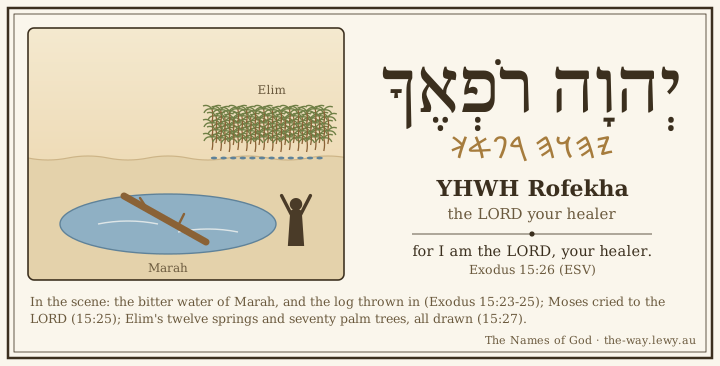
Three days after the Red Sea, Israel came to Marah and "could not drink the water of Marah because
it was bitter" (Exodus 15:23, ESV). Moses cried to the LORD, the LORD showed him a log, and the water
became sweet (Exodus 15:25). Then God named Himself:
> ✝️ Exodus 15:26 (ESV)
>
> 26 saying, "If you will diligently listen to the voice of the LORD your God, and do that which is
> right in his eyes, and give ear to his commandments and keep all his statutes, I will put none of
> the diseases on you that I put on the Egyptians, for I am the LORD, your healer."
יְהוָה רֹפְאֶךָ (*YHWH rofekha*, H7495), "the LORD your healer". Popular
books spell it "Jehovah Rapha". God gave it to a thirsty, grumbling people, and He healed the water
before He set them the statute and rule of Marah (Exodus 15:25).
### The LORD is my banner, over the battle with Amalek
[](https://the-way.lewy.au/assets/img/names-of-god/nissi.svg)
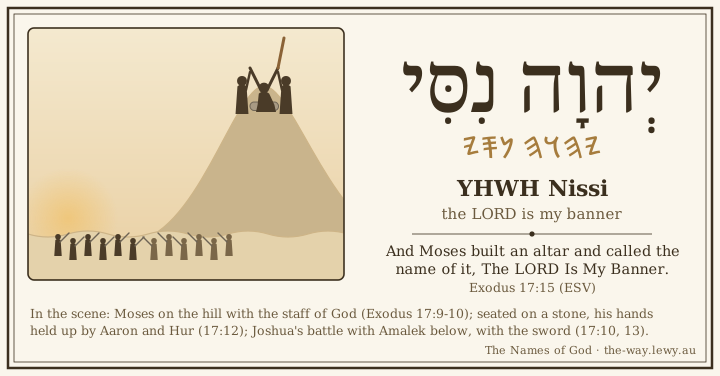
When Amalek attacked Israel at Rephidim, Israel prevailed whenever Moses held up his hand,
and Amalek whenever he lowered it (Exodus 17:11). After the battle "Moses built an altar and called the name of
it, The LORD Is My Banner" (Exodus 17:15, ESV): יְהוָה נִסִּי
(*YHWH nissi*), from נֵס (*nes*, H5251), a pole or standard raised where an
army can see it.
The same word is the pole Moses set the bronze serpent on: "Make a fiery serpent and set it on a
pole, and everyone who is bitten, when he sees it, shall live" (Numbers 21:8, ESV). Isaiah uses it of
the coming King, "the root of Jesse, who shall stand as a signal for the peoples" (Isaiah 11:10,
ESV). [As the Snake Was Lifted
Up](https://the-way.lewy.au/jesus/as-the-snake-was-lifted/#the-hebrew-words-serpent-bronze-burning-one-banner) traces
the word from the pole to the cross.
Reading the three together as one picture of Christ is this study's own reading. No verse cites
another, and Jesus names only the serpent (John 3:14). The reading rests on the text. Each *nes* is
raised where people in danger can see it: over a battle Israel could not win alone, over a camp
dying of snakebite, and over the nations. Each time, what is lifted up saves those who look to it.
In Exodus 17 the battle was fought by Joshua (Exodus 17:9), the first man in Scripture to bear the
name Jesus was later given, while Moses stood on the hill with "the staff of God" (Exodus 17:9, ESV). Israel's banner over that battle was God
Himself, and the pole God told Moses to raise in the camp foreshadowed His Son lifted up for all to
see.
### The LORD is peace, to Gideon
[](https://the-way.lewy.au/assets/img/names-of-god/shalom.svg)
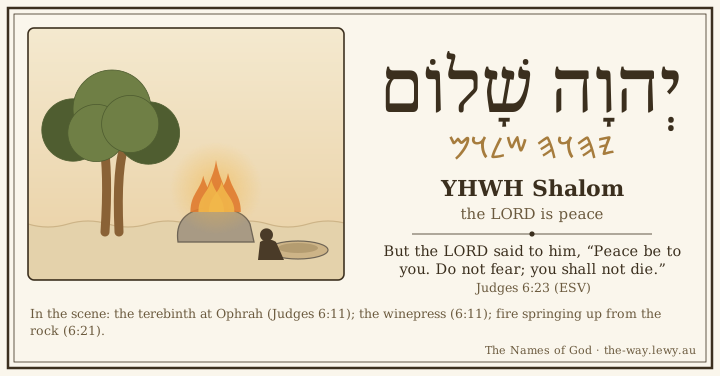
Gideon was threshing wheat in a winepress to hide it from the Midianites when the angel of the LORD
called him a mighty man of valour. When Gideon realised who had been speaking with him, he
expected to die:
> ✝️ Judges 6:22-24 (ESV)
>
> 22 Then Gideon perceived that he was the angel of the LORD. And Gideon said, "Alas, O Lord GOD!
> For now I have seen the angel of the LORD face to face." 23 But the LORD said to him, "Peace be to
> you. Do not fear; you shall not die." 24 Then Gideon built an altar there to the LORD and called
> it, The LORD Is Peace. To this day it still stands at Ophrah, which belongs to the Abiezrites.
יְהוָה שָׁלוֹם (*YHWH shalom*, H7965). A frightened man who had seen God and
expected to die was given peace, and he named the altar after what God had said.
### The LORD of hosts, on Hannah's lips
[](https://the-way.lewy.au/assets/img/names-of-god/tsevaot.svg)
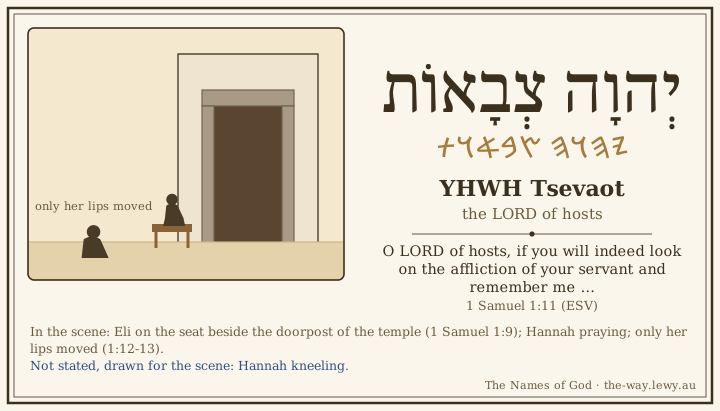
יְהוָה צְבָאוֹת (*YHWH tsevaot*, H6635), "the LORD of hosts", is the
title of the God who commands the armies of heaven. The two words stand together 240 times in one
Hebrew text (WLC), 261 counting "the LORD God of hosts". The first is 1 Samuel 1:3, where Elkanah goes
up to worship the LORD of hosts at Shiloh. The second is the first time anyone speaks it to God, and
it is a barren woman praying:
> ✝️ 1 Samuel 1:10-11 (ESV)
>
> 10 She was deeply distressed and prayed to the LORD and wept bitterly. 11 And she vowed a vow and
> said, "O LORD of hosts, if you will indeed look on the affliction of your servant and remember me
> and not forget your servant, but will give to your servant a son, then I will give him to the
> LORD all the days of his life, and no razor shall touch his head."
Hannah, mocked for years by her husband's other wife, appealed to the Commander of heaven's armies
for one son. He gave her Samuel. The seraphim cry the same name in Isaiah's vision: "Holy, holy,
holy is the LORD of hosts" (Isaiah 6:3, ESV).
## Names the prophets gave the coming King
The prophets, writing as Judah's kings failed, gave the King God promised to send names that belong
to God.
### Immanuel
[](https://the-way.lewy.au/assets/img/names-of-god/immanuel.svg)
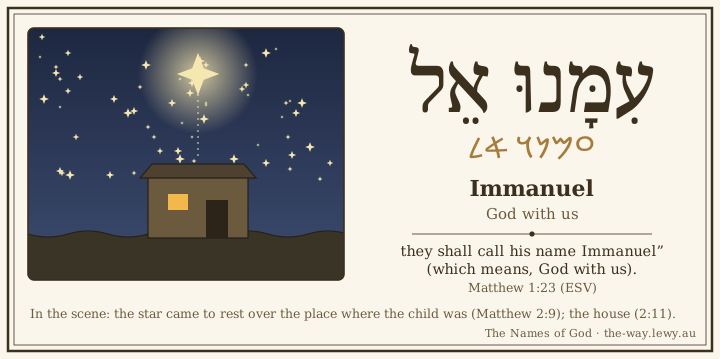
"Behold, the virgin shall conceive and bear a son, and shall call his name Immanuel"
(Isaiah 7:14, ESV): עִמָּנוּ אֵל (*immanu el*, H6005), "with us is God".
Matthew quotes it of Jesus' birth and translates it, "God with us" (Matthew 1:23, ESV). The promise
of Exodus 3:12, "I will be with you", took flesh.
### Mighty God
[](https://the-way.lewy.au/assets/img/names-of-god/gibbor.svg)
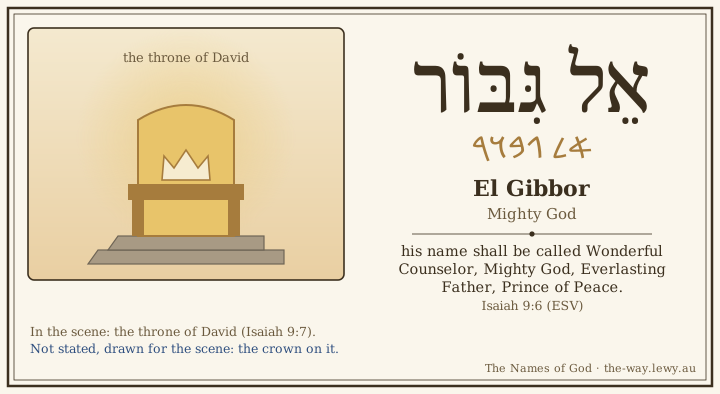
Isaiah gave the child born to the house of David four names: "Wonderful Counselor,
Mighty God, Everlasting Father, Prince of Peace" (Isaiah 9:6, ESV). "Mighty God" is
אֵל גִּבּוֹר (*El gibbor*, H1368). Isaiah's next use of the phrase is about
the LORD Himself: "A remnant will return, the remnant of Jacob, to the mighty God" (Isaiah 10:21,
ESV). So Isaiah gave the child a title he uses for God, one chapter later.
### The LORD is our righteousness
[](https://the-way.lewy.au/assets/img/names-of-god/tsidkenu.svg)
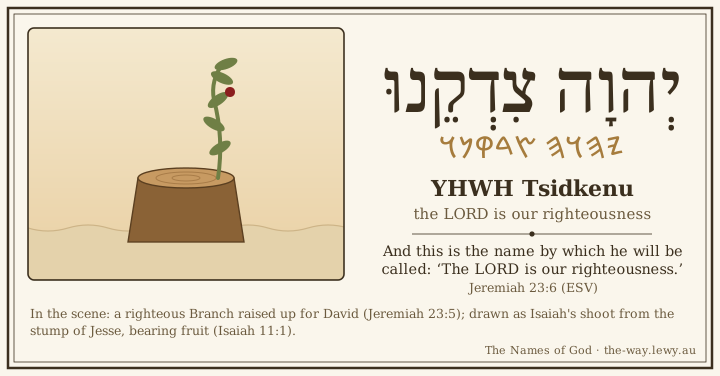
> ✝️ Jeremiah 23:5-6 (ESV)
>
> 5 "Behold, the days are coming, declares the LORD, when I will raise up for David a righteous
> Branch, and he shall reign as king and deal wisely, and shall execute justice and righteousness in
> the land. 6 In his days Judah will be saved, and Israel will dwell securely. And this is the name
> by which he will be called: 'The LORD is our righteousness.'
יְהוָה צִדְקֵנוּ (*YHWH tsidkenu*, H6664). The Branch from David's line bears
the divine name. Ten chapters later Jeremiah gives the same name to the city: "this is the name by
which it will be called: 'The LORD is our righteousness'" (Jeremiah 33:16, ESV). The King's
righteousness becomes His people's. Paul says how: God "made him to be sin who knew no sin, so that
in him we might become the righteousness of God" (2 Corinthians 5:21, ESV), and Christ Jesus "became
to us wisdom from God, righteousness and sanctification and redemption" (1 Corinthians 1:30, ESV).
This is justification, God counting His Son's righteousness as yours.
## The name above every name
### Jesus: the LORD saves
[](https://the-way.lewy.au/assets/img/names-of-god/yeshua.svg)
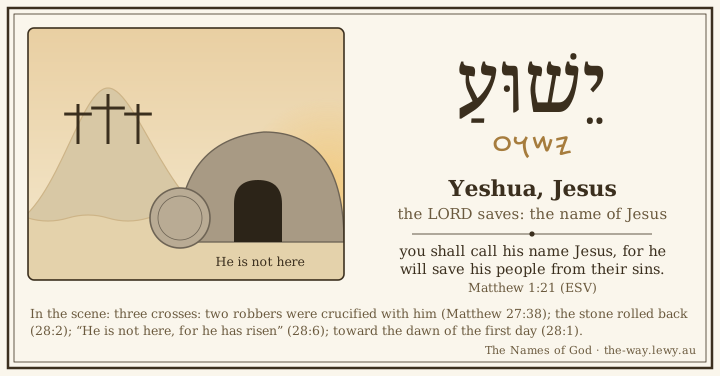
Moses renamed his assistant: "Moses called Hoshea the son of Nun Joshua" (Numbers 13:16, ESV). He
added God's name to the front of it. הוֹשֵׁעַ (*Hoshea*, H1954), "salvation",
became יְהוֹשֻׁעַ (*Yehoshua*, H3091), "the LORD saves". After the exile the
name was shortened to יֵשׁוּעַ (*Yeshua*, H3442; Nehemiah 8:17), and the
Septuagint writes Joshua's name in Greek as Ἰησοῦς (*Iēsous*, G2424), the
name the New Testament gives Jesus.
The angel told Joseph to give Mary's son that name and said what it meant: "you shall call his name
Jesus, for he will save his people from their sins" (Matthew 1:21, ESV). Every name in this study is
something God did for someone. This one says what the Son of God came to do for you.
### The Son speaks the Father's names
On the cross Jesus prayed the first word on the word cards: "Eli, Eli, lema sabachthani?" that is,
"My God, my God, why have you forsaken me?" (Matthew 27:46, ESV), the opening of Psalm 22. He took
the psalm of the forsaken as His own prayer.
He also spoke the name of the burning bush of Himself: "Truly, truly, I say to you, before Abraham
was, I am" (John 8:58, ESV). The Greek is ἐγὼ εἰμί (*egō eimi*, G1510), the
words the Septuagint used at Exodus 3:14, and His hearers picked up stones (John 8:59). [The Woman
at the Well](https://the-way.lewy.au/jesus/woman-at-well/#i-am-the-one-speaking-to-you) traces the "I am" sayings
through John. Jesus also says the Father has given Him the name: "Holy Father, keep them in your
name, which you have given me" (John 17:11, ESV).
### Every knee, and everyone who calls
Through Isaiah the LORD swore by Himself that every knee would bow to Him:
> ✝️ Isaiah 45:23 (ESV)
>
> 23 By myself I have sworn; from my mouth has gone out in righteousness a word that shall not
> return: 'To me every knee shall bow, every tongue shall swear allegiance.'
Paul quotes those words of Jesus:
> ✝️ Philippians 2:9-11 (ESV)
>
> 9 Therefore God has highly exalted him and bestowed on him the name that is above every name,
> 10 so that at the name of Jesus every knee should bow, in heaven and on earth and under the earth,
> 11 and every tongue confess that Jesus Christ is Lord, to the glory of God the Father.
The confession is κύριος Ἰησοῦς Χριστός, "Jesus Christ is Lord", and
*kyrios* (G2962) is the word the Septuagint uses for the name *YHWH*. The name above every name is
the LORD's own, given to the Son who humbled Himself; [In Humility](https://the-way.lewy.au/christian-life/humility/#therefore-god-exalted-him)
studies that passage. Paul does the same with Joel: "everyone who calls on the name of the LORD shall
be saved" (Joel 2:32, ESV) becomes "everyone who calls on the name of the Lord will be saved"
(Romans 10:13, ESV), and the Lord in Romans 10:9 is Jesus. In 1 Corinthians 8:6 he finds Jesus
inside the Shema itself; [Read Your First Verse](https://the-way.lewy.au/hebrew/the-shema/#how-jesus-and-paul-read-it)
shows how.
### One name
Jesus sent the apostles out "baptizing them in the name of the Father and of the Son and of the Holy
Spirit" (Matthew 28:19, ESV). "Name" is singular, εἰς τὸ ὄνομα (*eis to
onoma*, G3686): one name, shared by the Father, the Son and the Holy Spirit. The God who told Moses
"This is my name forever" is the Trinity, and believers are baptised into His name.
So every name meets in Jesus. In Him God is with us (Immanuel), sees and provides the Lamb (El Roi,
YHWH Yireh), heals, is lifted up as the banner, gives peace, is our righteousness, and saves. The
names were promises, and He has kept them. Call on Him by name, and you will be saved. [The Names
of Jesus](https://the-way.lewy.au/jesus/names-of-jesus/) follows the names the rest of Scripture gives Him.
## Discussion questions
1. **The language.** God answers "Who am I?" with *ehyeh*, "I will be with you" (Exodus 3:12), and
gives His name with the same word two verses later (Exodus 3:14). What does it tell you about
God that His name first reaches Moses as an answer to his fear?
2. **The text in its context.** God proclaimed His name in Exodus 34:6-7 to a people who had just
made the golden calf. Why do you think He chose that moment to say what He is like?
3. **The hard part.** Exodus 6:3 says the patriarchs did not know God "by my name the LORD", yet
Genesis 15:7 has God saying "I am the LORD" to Abram. Which reading of Exodus 6:3 do you find
stronger, and why?
4. **Christ.** Jeremiah gives the name "The LORD is our righteousness" to the King (Jeremiah 23:6)
and then to His city (Jeremiah 33:16). How does 2 Corinthians 5:21 explain how one name can belong
to both?
5. **Christ.** Paul applies Isaiah 45:23, where the LORD swears that every knee will bow to Him, to
Jesus (Philippians 2:10-11). What does that tell you about who Paul believed Jesus is?
6. **Be transformed.** Hagar, Hannah and Gideon each met God at the point where they had nothing
left. Which of His names speaks to the place you are in now, and how will you pray it this week?
## References & Recommended Reading
- **Hebrew text and counts.** Westminster Leningrad Codex via MACULA Hebrew (Clear Bible), and
STEPBible TAHOT (CC BY) for the pointed forms. Counts are for one Hebrew text (WLC): YHWH (H3068)
6,513; *Adonai* (H136) 438; *Shaddai* (H7706) 48; *YHWH tsevaot* 240 as adjacent words, 261 with
"the LORD God of hosts".
- **Greek.** Brenton's Septuagint (Exodus 3:14; Numbers 13:16; Genesis 17:1; Ruth 1:20; Job 5:17;
Isaiah 45:23; Joel 3:5); SBL Greek New Testament.
- **Lexicons.** *Theological Wordbook of the Old Testament* (Moody), entry 2333 on *Shaddai*;
Strong's numbers as tagged.
- **Study Bibles consulted.** *ESV Study Bible* (Crossway), notes on Exodus 3:13-15 and 6:2-8;
footnotes in the CSB, LSB and NLT at Exodus 3:14.
- **Translation.** Scripture quotations are from the ESV® Bible unless marked. Septuagint quotations
are Brenton's.
### On this site
- [The Names of God word cards](https://the-way.lewy.au/hebrew/names-of-god-cards/): the same names to learn in Hebrew.
- [How Hebrew Is Pronounced](https://the-way.lewy.au/hebrew/pronunciation/): how the divine name is read aloud.
- [Read Your First Verse: the Shema](https://the-way.lewy.au/hebrew/the-shema/): Deuteronomy 6:4 word by word.
- [Those Called Gods](https://the-way.lewy.au/spiritual-beings/those-called-gods/): the range of *elohim*.
- [Know the Truth](https://the-way.lewy.au/christian-life/know-the-truth/): *emet*, the faithfulness of Exodus 34:6.
- [The Lord's Prayer](https://the-way.lewy.au/christian-life/lords-prayer/#hallowed-be-your-name): "Hallowed be your
name".
- [Jesus, Priest in the Order of Melchizedek](https://the-way.lewy.au/jesus/melchizedek-priesthood/): God Most High.
- [As the Snake Was Lifted Up](https://the-way.lewy.au/jesus/as-the-snake-was-lifted/): the *nes* and the cross.
- [The Woman at the Well](https://the-way.lewy.au/jesus/woman-at-well/): the first "I am" in John.
- [In Humility](https://the-way.lewy.au/christian-life/humility/): Philippians 2 and the name above every name.
- [The Names of Jesus](https://the-way.lewy.au/jesus/names-of-jesus/): the names the prophets, the apostles and Jesus
Himself give the Son.
- [The Names of the Holy Spirit](https://the-way.lewy.au/holy-spirit/names-of-the-holy-spirit/): the names of the
Spirit, by whom you call God "Abba! Father!"