---
title: "The Names of the Holy Spirit"
category: "theology"
description: "A study of the names the Bible gives the Holy Spirit, from the Spirit of God over the waters to the Helper Jesus promised: whose Spirit He is, what each name says He brings, and how by Him you call God Father and Jesus Lord."
tags: ["names-of-god", "trinity", "deity-of-the-spirit", "john", "romans", "isaiah", "lang/hebrew", "lang/greek", "method/word-study"]
draft: false
primary_passage: "John 14:15-18"
bible_references: ["Genesis 1:2", "Job 33:4", "1 Samuel 16:13-14", "Isaiah 11:1-3", "Isaiah 61:1", "Luke 4:18", "Psalm 51:11", "Isaiah 63:10-11", "Psalm 139:7", "Nehemiah 9:20", "Psalm 143:10", "Joel 2:28-29", "Ezekiel 36:26-27", "Ezekiel 37:9-14", "Zechariah 4:6", "Zechariah 12:10", "John 3:5-8", "John 7:37-39", "John 14:15-18", "John 14:26", "John 15:26", "John 16:7-8", "John 16:13-14", "John 20:22", "1 John 2:1", "Acts 1:4-5", "Acts 2:33", "Acts 5:3-4", "Acts 16:7", "Matthew 28:19", "2 Corinthians 13:14", "Romans 8:2", "Romans 8:9-11", "Romans 8:14-16", "Romans 8:26", "Galatians 4:6", "1 Corinthians 3:16", "1 Corinthians 12:3", "2 Corinthians 1:22", "2 Corinthians 3:17-18", "2 Corinthians 5:5", "Ephesians 1:13-14", "Ephesians 1:17", "Ephesians 4:30", "Philippians 1:19", "Hebrews 9:14", "Hebrews 10:29", "1 Peter 1:11", "1 Peter 4:14", "Revelation 1:4-5", "Revelation 22:17"]
date_created: 2026-10-18
date_modified: 2026-10-31
ai_provider_models:
- anthropic/claude-opus-5.5
---
# The Names of the Holy Spirit
> ✝️ John 14:16-18 (ESV)
>
> 16 And I will ask the Father, and he will give you another Helper, to be with you forever, 17 even
> the Spirit of truth, whom the world cannot receive, because it neither sees him nor knows him. You
> know him, for he dwells with you and will be in you. 18 "I will not leave you as orphans; I will
> come to you.
**In one sentence:** The night before the cross Jesus promised "another Helper", and every name the
Bible gives the Holy Spirit says whose He is and what He brings: He is the Spirit of God and of the
LORD, of the Father and of the Son, God Himself present with His people, promised by the prophets
and given to live in you forever, and He is the one by whom you call God "Abba! Father!" and say
"Jesus is Lord", so the God whose names you have learned now lives in you.
## Key Takeaways
### Types & Prophecy
- **Prophecy.** The prophets promised a day when God would give His Spirit to all His people: "I
will pour out my Spirit on all flesh" (Joel 2:28, ESV); "I will put my Spirit within you"
(Ezekiel 36:27, ESV). Jesus promised the same Spirit in the upper room (John 14:16-17), and
poured Him out at Pentecost (Acts 2:33).
- **Prophecy.** Isaiah saw "the Spirit of the LORD" resting on the Branch from Jesse's stump
(Isaiah 11:1-2) and on the Anointed sent to the poor (Isaiah 61:1). In Nazareth Jesus read the
second and said, "Today this Scripture has been fulfilled in your hearing" (Luke 4:21, ESV).
- **Picture.** *Ruach* and *pneuma* both mean breath and wind. The breath that stood the slain
army on its feet (Ezekiel 37:10) pictures the new birth Jesus described with the same word
(John 3:8), and He breathed on His disciples when He said "Receive the Holy Spirit" (John 20:22,
ESV).
### Lessons about Jesus
- Jesus calls the Spirit "another Helper" (John 14:16). The word, παράκλητος (*paraklētos*, G3875), is
used five times in the New Testament: four times by Jesus of the Spirit in John 14-16, and once of
Jesus Himself: "we have an advocate with the Father,
Jesus Christ the righteous" (1 John 2:1, ESV). The Spirit does for His people on earth what the
Son does for them before the Father.
- God gives Jesus the Spirit "without measure" (John 3:34, ESV), as Isaiah promised: "I have put my
Spirit upon him" (Isaiah 42:1, ESV). The next verse names the giver: "The Father loves the Son and
has given all things into his hand" (John 3:35, ESV). Peter says the same: "God anointed Jesus of
Nazareth with the Holy Spirit and with power" (Acts 10:38, ESV). The Spirit is also named after
Him: "the Spirit of Christ" (Romans 8:9), "the Spirit of Jesus" (Acts 16:7), "the Spirit of his
Son" (Galatians 4:6).
- The Spirit's work is to make Jesus known: "He will glorify me, for he will take what is mine and
declare it to you" (John 16:14, ESV).
### Memory verses
> ✝️ John 14:16-17 (ESV)
>
> 16 And I will ask the Father, and he will give you another Helper, to be with you forever, 17 even
> the Spirit of truth, whom the world cannot receive, because it neither sees him nor knows him. You
> know him, for he dwells with you and will be in you.
> ✝️ Romans 8:15 (ESV)
>
> 15 For you did not receive the spirit of slavery to fall back into fear, but you have received
> the Spirit of adoption as sons, by whom we cry, "Abba! Father!"
### Be Transformed
- **Think.** The Holy Spirit is a person and He is God. Lying to Him is lying to God (Acts 5:3-4),
and He can be grieved (Ephesians 4:30). Speak of Him as "He", the way Jesus did.
- **Attitude.** You are not an orphan. The Spirit of adoption lives in you, and He is given
"forever" (John 14:16, ESV).
- **Do.** Each morning this week, ask your Father for His Holy Spirit, taking Jesus at His word:
"How much more will the heavenly Father give the Holy Spirit to those who ask him!" (Luke 11:13,
ESV). Then pray to Him as the Spirit teaches you to, "Abba! Father!" (Romans 8:15, ESV).
### Prayer
Abba, Father, You promised Your Spirit by the prophets and gave Him through Your Son. Thank You that
I am not left an orphan, that the Spirit of truth lives in me and will not leave. By Your Spirit
teach me what Jesus said, show me His glory, and let Your good Spirit lead me. Keep me from grieving
Your Holy Spirit. Let me call You Father and Jesus Lord with all my heart. In Jesus' name. Amen.
## Study outline
- ["I will not leave you as orphans"](#i-will-not-leave-you-as-orphans). The upper room, and the
three names Jesus gives the Spirit in one sentence.
- [Breath, wind and Spirit](#breath-wind-and-spirit). The Hebrew and Greek words, and why most of
His names begin "Spirit of".
- [Names in the Old Testament](#names-in-the-old-testament). The Spirit of God, the Spirit of the
LORD on David, on the Branch and on the Anointed, your Holy Spirit, your good Spirit, the Spirit
God promised to pour out, and Zechariah's contested "spirit of grace".
- [Names Jesus gave Him](#names-jesus-gave-him). The Helper, the Spirit of truth, the pronouns John
uses for Him, and the promise of the Father.
- [Names that say He is God](#names-that-say-he-is-god). The Spirit of God and of Christ, the Lord
who is the Spirit, and the one name.
- [Names for what He does in you](#names-for-what-he-does-in-you). Life, adoption, the seal and the
guarantee, wisdom, glory, and the eternal Spirit.
- [Names at the end](#names-at-the-end). The seven spirits before the throne, and the Spirit who
says "Come".
- [The Spirit teaches you the other names](#the-spirit-teaches-you-the-other-names). By Him you say
"Abba! Father!" and "Jesus is Lord". **The heart of the study:** every name of God you have learned
you speak by the Spirit, who lives in you.
## "I will not leave you as orphans"
[](https://the-way.lewy.au/assets/img/names-of-the-holy-spirit/parakletos.svg)
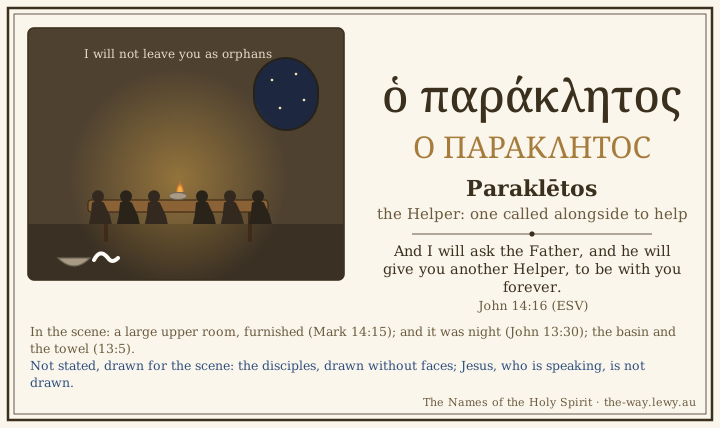
It was the last night before the cross. Jesus had washed His disciples' feet, Judas had gone out,
and Jesus had told the rest that He was going where they could not follow (John 13:33). Thomas
asked how they could know the way (John 14:5), and Philip asked to see the Father (John 14:8). Then
Jesus made a promise, in the verses that open this study, and named the one He would send three
ways in a single sentence.
- **"Another Helper."** ἄλλον παράκλητον (*allon paraklēton*, G243, G3875).
A *paraklētos* is one called alongside to help: the *Legacy Standard Bible* footnotes it "one
called alongside as a helper", and the CSB offers "advocate" or "comforter". Jesus had been that
for three years. The Spirit is "another" of the same kind.
- **"The Spirit of truth."** He comes from the God who cannot lie, and He leads into "all the
truth" (John 16:13, ESV).
- **"He dwells with you and will be in you."** God had lived among His people in a tent and a
temple. Now He would live in them, and "forever".
Then Jesus said why it mattered: "I will not leave you as orphans; I will come to you" (John 14:18,
ESV). In the Spirit, Jesus Himself comes to His people.
Moses asked God, "What is his name?" (Exodus 3:13), and [The Names of
God](https://the-way.lewy.au/god/names-of-god/#what-is-his-name) follows God's answer. At Caesarea Philippi Jesus asked,
"Who do you say that I am?", and [The Names of
Jesus](https://the-way.lewy.au/jesus/names-of-jesus/#who-do-you-say-that-i-am) follows the answers. In the upper room
nobody asked about the Spirit. Jesus named Him unasked, to frightened men about to lose their
teacher.
## Breath, wind and Spirit
The Hebrew word is רוּחַ (*ruach*, ROO-akh, H7307), and it occurs 378 times
in the Hebrew Old Testament. It means breath, wind and spirit, and a reader often has to choose.
Ezekiel's vision of the valley of dry bones uses it in all three senses in one scene: "Come from the
four winds, O breath, and breathe on these slain, that they may live" (Ezekiel 37:9, ESV), "and the
breath came into them, and they lived" (Ezekiel 37:10, ESV), and then God explains, "I will put my
Spirit within you, and you shall live" (Ezekiel 37:14, ESV).
The Greek word is πνεῦμα (*pneuma*, PNYOO-mah, G4151), 379 times in the
Greek New Testament, and it carries the same range. Jesus used both senses together when He told
Nicodemus about the new birth: "The wind blows where it wishes, and you hear its sound, but you do
not know where it comes from or where it goes. So it is with everyone who is born of the Spirit"
(John 3:8, ESV). "Wind" and "Spirit" in that verse are the one word.
Most of the Spirit's names are built the same way: "the Spirit of" something. Some say whose He is:
the Spirit of God, of the LORD, of Christ. Others say what He brings: wisdom, truth, life, adoption,
grace, glory. Read the names below in those two groups and they answer two questions, *whose is He?*
and *what does He bring?*
## Names in the Old Testament
### The Spirit of God
[](https://the-way.lewy.au/assets/img/names-of-the-holy-spirit/ruach-elohim.svg)
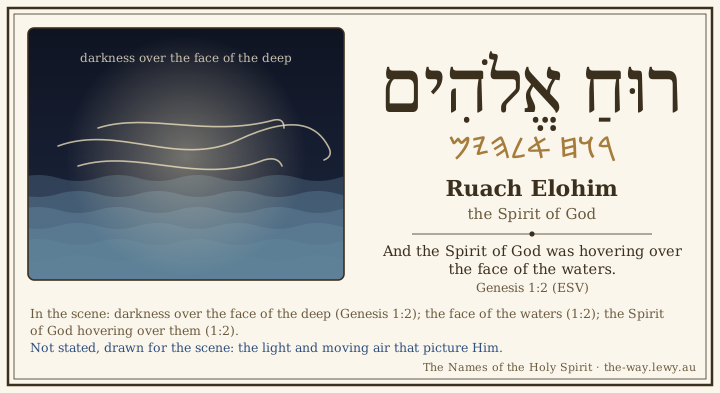
The Spirit is in the Bible's second verse: "And the Spirit of God was hovering over the face of the
waters" (Genesis 1:2, ESV). רוּחַ אֱלֹהִים (*ruach Elohim*, H7307, H430)
was present before light, over a world "without form and void". Elihu said it of himself: "The
Spirit of God has made me, and the breath of the Almighty gives me life" (Job 33:4, ESV). The God
who made the world by His word made it in the presence of His Spirit, and every breath you take is
His gift.
### The Spirit of the LORD
[](https://the-way.lewy.au/assets/img/names-of-the-holy-spirit/ruach-yhwh.svg)
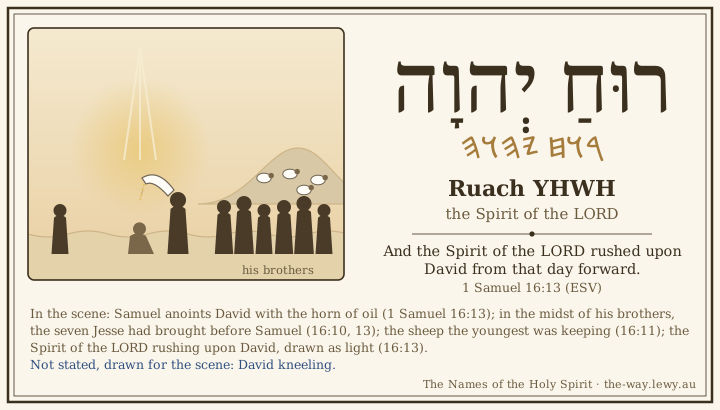
רוּחַ יְהוָה (*ruach YHWH*, H7307, H3068) joins the Spirit to God's own
name. In the Old Testament the Spirit of the LORD came on particular people for a particular task:
on judges, on prophets, and on the king. When Samuel anointed David, "the Spirit of the LORD rushed
upon David from that day forward" (1 Samuel 16:13, ESV). The next verse is the sorrow of it: "Now
the Spirit of the LORD departed from Saul" (1 Samuel 16:14, ESV).
### The Spirit resting on the Branch
Isaiah saw the Spirit of the LORD resting on one King for good. From the stump of Jesse's cut-down
line a Branch would grow (Isaiah 11:1), the Branch of [The Names of
Jesus](https://the-way.lewy.au/jesus/names-of-jesus/#the-branch), and:
> ✝️ Isaiah 11:2 (ESV)
>
> 2 And the Spirit of the LORD shall rest upon him, the Spirit of wisdom and understanding, the
> Spirit of counsel and might, the Spirit of knowledge and the fear of the LORD.
The verse names Him four times, and the last three come in pairs:
רוּחַ חָכְמָה וּבִינָה (*ruach chokhmah uvinah*, H2451, H998), "wisdom and
understanding"; רוּחַ עֵצָה וּגְבוּרָה (*ruach ʿetsah ugevurah*, H6098,
H1369), "counsel and might"; and רוּחַ דַּעַת וְיִרְאַת יְהוָה
(*ruach daʿat veyirʾat YHWH*, H1847, H3374), "knowledge and the fear of the LORD". The verb is
נָחָה (*nachah*, H5117), "rest", the word for settling and staying. The
Septuagint renders the last "fear" as εὐσέβεια (*eusebeia*, G2150),
"godliness", then has "the spirit of the fear of God" in Isaiah 11:3, so the Greek counts seven
gifts where the Hebrew counts six. That Greek count is one source of the church's phrase "the
sevenfold Spirit".
### The Spirit of the Lord GOD upon the Anointed
Isaiah heard the same King speak: "The Spirit of the Lord GOD is upon me, because the LORD has
anointed me to bring good news to the poor" (Isaiah 61:1, ESV). רוּחַ אֲדֹנָי
יְהוִה (*ruach Adonai YHWH*, H136, H3069) is on Him, and the anointing is the name
*Mashiach*, [the Anointed](https://the-way.lewy.au/jesus/names-of-jesus/#the-anointed). In the synagogue at Nazareth
Jesus read this passage, "The Spirit of the Lord is upon me, because he has anointed me" (Luke 4:18,
ESV), and told the room it was fulfilled that day. The Spirit who came and went on Israel's leaders
rested on Jesus and stayed.
### Your Holy Spirit
[](https://the-way.lewy.au/assets/img/names-of-the-holy-spirit/ruach-qodshekha.svg)
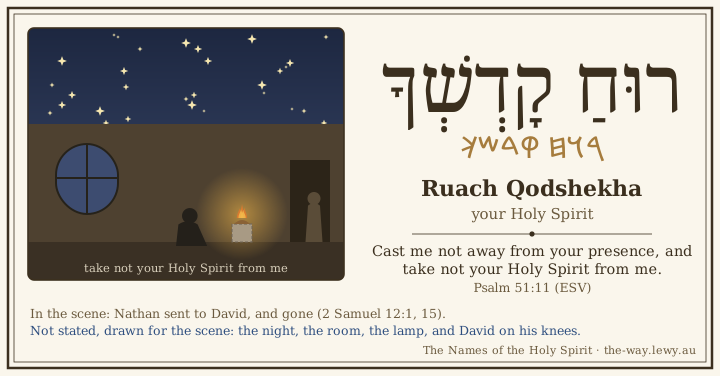
The name "Holy Spirit" occurs three times in the whole Old Testament, and two of them are about
losing Him. David prayed after his sin with Bathsheba: "Cast me not away from your presence, and
take not your Holy Spirit from me" (Psalm 51:11, ESV). He had seen it happen to Saul.
רוּחַ קָדְשְׁךָ (*ruach qodshekha*, H7307, H6944) is literally "the Spirit of
your holiness", and the NLT footnotes "your spirit of holiness". The other two are in Isaiah's prayer, looking
back on the wilderness:
> ✝️ Isaiah 63:10-11 (ESV)
>
> 10 But they rebelled and grieved his Holy Spirit; therefore he turned to be their enemy, and
> himself fought against them. 11 Then he remembered the days of old, of Moses and his people.
> Where is he who brought them up out of the sea with the shepherds of his flock? Where is he who
> put in the midst of them his Holy Spirit,
"Grieved" is עִצְּבוּ (*ʿitsevu*, from H6087), to hurt or pain. Only a
person can be grieved. Paul wrote, "do not grieve the Holy Spirit of God" (Ephesians 4:30, ESV), and
his verb, λυπέω (*lypeō*, G3076), is the Hebrew sense of Isaiah 63:10. The
Septuagint has "provoked" (παροξύνω, *paroxynō*, G3947) at that verse, so
Paul is following the Hebrew. David asked, "Where shall I go from your Spirit? Or where shall I flee
from your presence?" (Psalm 139:7, ESV). The Holy Spirit is God present, and the parallel lines of
the psalm say so.
### Your good Spirit
[](https://the-way.lewy.au/assets/img/names-of-the-holy-spirit/ruchakha-hatovah.svg)
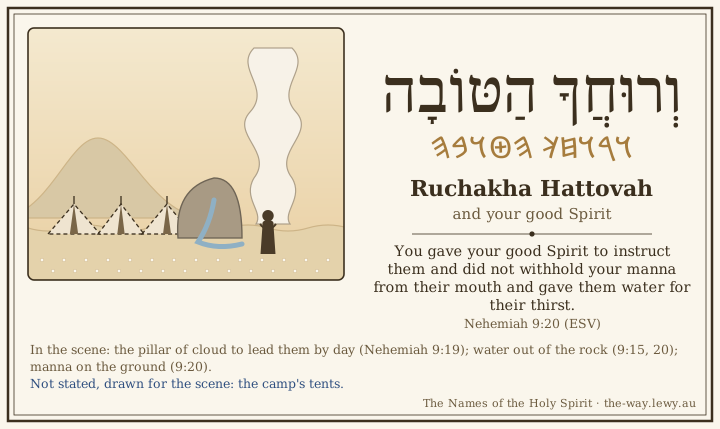
Nehemiah's Levites prayed through Israel's history and remembered the wilderness: "You gave your
good Spirit to instruct them and did not withhold your manna from their mouth" (Nehemiah 9:20, ESV).
רוּחֲךָ הַטּוֹבָה (*ruchakha hattovah*, H7307, H2896). The Spirit was given
with the manna and the water from the rock, as daily as bread. David prayed for the same: "Teach me
to do your will, for you are my God! Let your good Spirit lead me on level ground!"
(Psalm 143:10, ESV). God's Spirit is good, and He teaches and leads.
### My Spirit, poured out
[](https://the-way.lewy.au/assets/img/names-of-the-holy-spirit/ruchi.svg)
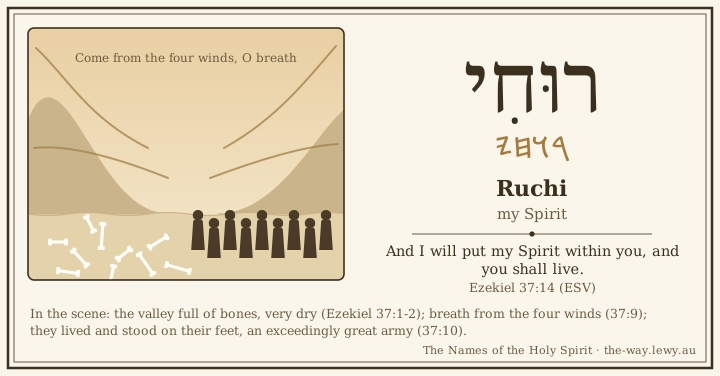
The prophets promised more than a Spirit who came on a few. God would pour Him out on everyone who
belongs to Him:
> ✝️ Joel 2:28-29 (ESV)
>
> 28 "And it shall come to pass afterward, that I will pour out my Spirit on all flesh; your sons
> and your daughters shall prophesy, your old men shall dream dreams, and your young men shall see
> visions. 29 Even on the male and female servants in those days I will pour out my Spirit.
רוּחִי (*ruchi*, H7307), "my Spirit", is God speaking of His own Spirit.
Joel names sons and daughters, old and young, slaves male and female: no category of Israel is left
out. Peter stood up at Pentecost and said, "this is what was uttered through the prophet Joel"
(Acts 2:16, ESV). [Weeks](https://the-way.lewy.au/feasts/weeks/#the-day-of-pentecost) follows the feast it fell on,
and [Dreams and Visions](https://the-way.lewy.au/holy-spirit/dreams-and-visions/) the dreams Joel names.
Ezekiel heard the promise as a new heart. God would "remove the heart of stone" (Ezekiel 36:26,
ESV), and He said, "I will put my Spirit within you, and cause you to walk in my statutes"
(Ezekiel 36:27, ESV). The Spirit within does what Paul says the law, "weakened by the flesh, could
not do" (Romans 8:3, ESV). To Zerubbabel, rebuilding the temple with the 42,360 who had come back
from exile (Ezra 2:64), God said, "Not by might, nor
by power, but by my Spirit, says the LORD of hosts" (Zechariah 4:6, ESV). Both prophets spoke to
Israel first, and both promises still stand for Israel; [Israel's Regathering and
Refining](https://the-way.lewy.au/israel-and-church/israels-regathering-and-refining/) follows Ezekiel 36-37 for the
nation.
### A spirit of grace and pleas for mercy
Zechariah's last promise is a Spirit poured out on Jerusalem in mourning: "I will pour out on the
house of David and the inhabitants of Jerusalem a spirit of grace and pleas for mercy, so that, when
they look on me, on him whom they have pierced, they shall mourn for him" (Zechariah 12:10, ESV).
רוּחַ חֵן (*ruach chen*, H7307, H2580) is "a spirit of grace". The ESV
prints a small *s*, and the NLT and CSB footnote "Or *the Spirit*". The Hebrew has no capital
letters, so the case rests on the verse. It is God who pours, and in Joel and Ezekiel what God pours
out and puts within is His Spirit. Against that, "a spirit of grace and pleas for mercy" can be read
as a disposition He gives, a heart that pleads. Hebrews likely points the New Testament reader to
the first reading. The Septuagint renders the phrase πνεῦμα χάριτος
(*pneuma charitos*, G4151, G5485), and Hebrews 10:29 warns against having "outraged the Spirit of
grace", τὸ πνεῦμα τῆς χάριτος, the same words. Hebrews does not cite
Zechariah, and the cross-reference lists do not join the two verses, so the echo is likely and not
certain.
## Names Jesus gave Him
[](https://the-way.lewy.au/assets/img/names-of-the-holy-spirit/to-pneuma-to-hagion.svg)
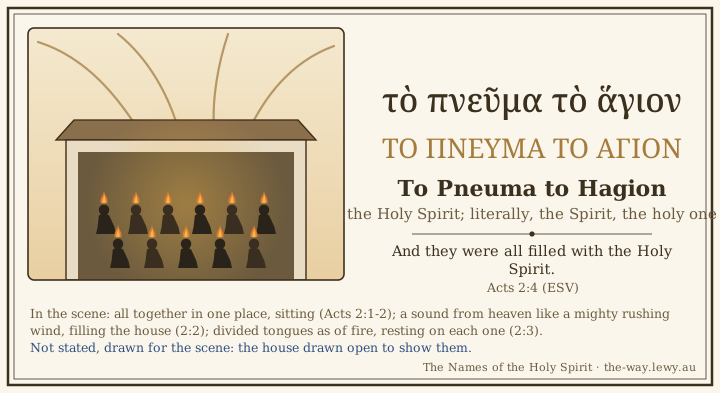
In the upper room Jesus named the Spirit more fully than any prophet had. He called Him the Helper
four times (John 14:16, 26; 15:26; 16:7), and the Spirit of truth three times (John 14:17; 15:26;
16:13). He said where the Spirit comes from and what He does:
- **The Holy Spirit, sent in Jesus' name.** "The Helper, the Holy Spirit, whom the Father will send
in my name, he will teach you all things and bring to your remembrance all that I have said to
you" (John 14:26, ESV). The Gospels you read are the disciples' memory of Jesus, kept by the
Spirit.
- **Who proceeds from the Father.** "When the Helper comes, whom I will send to you from the Father,
the Spirit of truth, who proceeds from the Father, he will bear witness about me" (John 15:26,
ESV). The Father sends Him (John 14:26) and the Son sends Him (John 16:7).
- **Who convicts.** "When he comes, he will convict the world concerning sin and righteousness and
judgment" (John 16:8, ESV). [The Restrainer](https://the-way.lewy.au/last-things/the-restrainer/#the-spirit-dwells-in-the-church)
follows that work through the church.
- **Who glorifies Jesus.** "He will glorify me, for he will take what is mine and declare it to you"
(John 16:14, ESV). [Know the Truth](https://the-way.lewy.au/christian-life/know-the-truth/) studies the Spirit who
guides "into all the truth".
### John's pronouns for the Spirit
John's Greek gives the Spirit both kinds of name in one sentence. *Pneuma* is a neuter noun, so
John 14:26 says "the Holy Spirit, ὃ" (*ho*, G3739), with a neuter relative
pronoun, as the grammar requires. *Paraklētos*, "Helper", is masculine, and after the relative
clause the sentence takes it up with ἐκεῖνος (*ekeinos*, G1565),
masculine: "*he* will teach you". In John 16:13 the masculine stands directly beside the neuter
name: ἐκεῖνος, τὸ πνεῦμα τῆς ἀληθείας, "he, the Spirit of truth". [The
Restrainer](https://the-way.lewy.au/last-things/the-restrainer/#from-what-to-he) follows the same shift in
2 Thessalonians 2.
The masculine pronoun follows the masculine *paraklētos*, so the grammar alone does not prove that
the Spirit is a person. What He does proves it. He speaks in the first person: "the Holy Spirit
said, 'Set apart for me Barnabas and Saul for the work to which I have called them'" (Acts 13:2,
ESV). He chooses, giving gifts "to each one individually as he wills" (1 Corinthians 12:11, ESV).
He has a mind, and He prays: God "knows what is the mind of the Spirit, because the Spirit
intercedes for the saints according to the will of God" (Romans 8:27, ESV). The apostles wrote, "it
has seemed good to the Holy Spirit and to us" (Acts 15:28, ESV). The Spirit who lives in you is
Someone who speaks, chooses, and prays for you.
### The promise of the Father
After the resurrection Jesus called Him **the promise of the Father**: "wait for the promise of the
Father, which, he said, 'you heard from me; for John baptized with water, but you will be baptized
with the Holy Spirit not many days from now'" (Acts 1:4-5, ESV). About ten days after the ascension, Peter
explained what Jerusalem was seeing: Jesus, "having received from the Father the promise of the Holy
Spirit, he has poured out this that you yourselves are seeing and hearing" (Acts 2:33, ESV). The
Father promised, the Son received and poured, and the Spirit came.
## Names that say He is God
The New Testament gives the Spirit names that join Him to the Father and to the Son, and it uses
them interchangeably.
- **The Spirit of God and the Spirit of Christ.** Paul uses both in one verse for the same Spirit:
"You, however, are not in the flesh but in the Spirit, if in fact the Spirit of God dwells in you.
Anyone who does not have the Spirit of Christ does not belong to him" (Romans 8:9, ESV). He is
also "the Spirit of Jesus" (Acts 16:7), "the Spirit of his Son" (Galatians 4:6), "the Spirit of
Jesus Christ" (Philippians 1:19), and "the Spirit of Christ" in the prophets who foretold His
sufferings (1 Peter 1:11).
- **The Lord.** "Now the Lord is the Spirit, and where the Spirit of the Lord is, there is freedom"
(2 Corinthians 3:17, ESV). The verse before, "when one turns to the Lord, the veil is removed"
(2 Corinthians 3:16, ESV), takes its words from Moses, who removed his veil "whenever Moses went
in before the LORD" (Exodus 34:34, ESV). Paul shares four words with the Septuagint of
that verse: ἡνίκα (*hēnika*, G2259), "whenever",
κύριος (*kyrios*, G2962), "Lord", and
περιαιρέω τὸ κάλυμμα (*periaireō to kalymma*, G4014, G2571), "take away the
veil". "The Lord" here is the LORD of Sinai, and the Spirit is that Lord. The New Testament says
the same elsewhere. The LORD's words to Isaiah (Isaiah 6:8-9) are what "the Holy Spirit was right
in saying to your fathers through Isaiah the prophet" (Acts 28:25, ESV), and Psalm 95, where the
LORD speaks of "your fathers" who "put me to the test", is what "the Holy Spirit says"
(Hebrews 3:7, ESV). Some take "the Lord" in 3:17 as Christ, since the veil is lifted "only through
Christ" (2 Corinthians 3:14, ESV). The words Paul borrows from Exodus favour the LORD of Sinai.
- **God.** Ananias kept back part of the price of his land and claimed to give it all. Peter said
to him, "why has Satan filled your heart to lie to the Holy Spirit?", and then, "You have not lied
to man but to God" (Acts 5:3-4, ESV).
- **One name.** "Baptizing them in the name of the Father and of the Son and of the Holy Spirit"
(Matthew 28:19, ESV). "Name" is singular, ὄνομα (*onoma*, G3686), and the
Spirit shares it with the Father and the Son. Paul's blessing names the three together: "The grace
of the Lord Jesus Christ and the love of God and the fellowship of the Holy Spirit be with you all"
(2 Corinthians 13:14, ESV).
These verses are why the church confesses one God in three persons. The Spirit is a person, and He
is God, the third person, equal with the Father and the Son, as the [Statement of
Faith](https://the-way.lewy.au/about/statement-of-faith/#god-the-holy-spirit) sets out.
## Names for what He does in you
The second group of names says what the Spirit brings. Paul gives most of them, and he gives them to
ordinary believers.
### The Spirit of life
"The law of the Spirit of life has set you free in Christ Jesus from the law of sin and death"
(Romans 8:2, ESV). The breath that raised Ezekiel's army raises you. "If the Spirit of him who
raised Jesus from the dead dwells in you, he who raised Christ Jesus from the dead will also give
life to your mortal bodies through his Spirit who dwells in you" (Romans 8:11, ESV).
### The Spirit of adoption
"You have received the Spirit of adoption as sons, by whom we cry, 'Abba! Father!'"
(Romans 8:15, ESV). πνεῦμα υἱοθεσίας (*pneuma huiothesias*, G4151, G5206)
is "the Spirit of son-placing", the legal act that made someone a son and heir. "The Spirit himself
bears witness with our spirit that we are children of God" (Romans 8:16, ESV). This is the doctrine
of **adoption**: God the Father takes you as His child, and the Spirit inside you is the proof and
the voice of it. Jesus promised it in the upper room: no orphans.
### The seal and the guarantee
> ✝️ Ephesians 1:13-14 (ESV)
>
> 13 In him you also, when you heard the word of truth, the gospel of your salvation, and believed
> in him, were sealed with the promised Holy Spirit, 14 who is the guarantee of our inheritance until
> we acquire possession of it, to the praise of his glory.
"The promised Holy Spirit" is in Greek "the Holy Spirit of promise", the promise of the Father
again. A seal (σφραγίζω, *sphragizō*, G4972) marked ownership and protected
what it closed. The guarantee is ἀρραβών (*arrabōn*, G728), a first payment
that binds the payer to pay the rest. The New Testament uses the word three times, and all three
are of the Spirit (2 Corinthians 1:22; 5:5; Ephesians 1:14). [Assurance of
Salvation](https://the-way.lewy.au/salvation/assurance-of-salvation/) and [The Bride of
Christ](https://the-way.lewy.au/israel-and-church/bride-of-christ/) study the word; in modern Greek
αρραβώνας is an engagement, the pledge of a marriage.
### The Spirit of wisdom and of revelation
Paul prayed "that the God of our Lord Jesus Christ, the Father of glory, may give you the Spirit of
wisdom and of revelation in the knowledge of him" (Ephesians 1:17, ESV). The Spirit of wisdom who
rested on the Branch (Isaiah 11:2) is given to those who belong to the Branch.
### The Spirit of glory
"If you are insulted for the name of Christ, you are blessed, because the Spirit of glory and of God
rests upon you" (1 Peter 4:14, ESV). Peter's verb is ἀναπαύεται
(*anapauetai*, G373), "rests", and it is the Septuagint's verb in Isaiah 11:2, "the Spirit of God
shall rest upon him". The Spirit who rested on Jesus rests on the people insulted for His name.
### The eternal Spirit
Christ, "who through the eternal Spirit offered himself without blemish to God", purifies "our
conscience from dead works to serve the living God" (Hebrews 9:14, ESV). πνεῦμα
αἰώνιον (*pneuma aiōnion*, G4151, G166). The Spirit was there at the cross, as He was over
the waters at creation.
### Upon, and within forever
Read the Old Testament names beside the New and one difference stands out. The Spirit of the LORD
came upon Israel's judges and kings for a task, and could depart, as He did from Saul
(1 Samuel 16:14); David prayed that He would not be taken from him (Psalm 51:11). Jesus promised a
Helper "to be with you forever" who "dwells with you and will be in you" (John 14:16-17, ESV),[^estai] and
John says why the change waited: "as yet the Spirit had not been given, because Jesus was not yet
glorified" (John 7:39, ESV). Since Pentecost the Spirit indwells every believer and seals each one
"for the day of redemption" (Ephesians 4:30, ESV), and "God's Spirit dwells in you"
(1 Corinthians 3:16, ESV). This is the dispensational reading of these verses, which takes the
indwelling of John 14 as new with the church. Others read David's prayer as showing the Spirit
already indwelt Old Testament believers, and take Psalm 51:11 as a king afraid of losing the anointing
for office. Both readings agree on the promise you hold: He is given to you forever.
## Names at the end
### The seven spirits before the throne
John greets the seven churches with grace "from him who is and who was and who is to come, and from
the seven spirits who are before his throne, and from Jesus Christ the faithful witness"
(Revelation 1:4-5, ESV). The CSB footnotes "Or *the sevenfold Spirit*". Placed between the Father
and Jesus Christ as a source of grace, the seven spirits are best read as the Holy Spirit in His
fullness, with the "seven torches of fire, which are the seven spirits of God" (Revelation 4:5, ESV) and Isaiah 11:2's
names behind it. Some read them as seven angels of the presence. This one is contested, and [The
Lampstand](https://the-way.lewy.au/jesus/the-heavenly-pattern/lampstand/#seven-torches-before-the-throne) sets out the
case.
### The Spirit and the Bride
The Bible's last invitation is spoken by the Spirit: "The Spirit and the Bride say, 'Come.' And let
the one who hears say, 'Come.' And let the one who is thirsty come; let the one who desires take the
water of life without price" (Revelation 22:17, ESV). Jesus had cried in the temple, "If anyone
thirsts, let him come to me and drink", and John explained, "this he said about the Spirit"
(John 7:37-39, ESV). The Spirit's last word in Scripture is the invitation He has been speaking
through the church since Pentecost.
## The Spirit teaches you the other names
The first study in this series ended with the name Jesus, and the second with the names He will
wear when He returns. This one ends where the Spirit's work does: in your mouth.
> ✝️ Galatians 4:6 (ESV)
>
> 6 And because you are sons, God has sent the Spirit of his Son into our hearts, crying, "Abba!
> Father!"
Αββα (*Abba*, G5) is the Aramaic word Jesus prayed in Gethsemane
(Mark 14:36), kept untranslated. The Spirit cries it in you. And "no one can say 'Jesus is Lord'
except in the Holy Spirit" (1 Corinthians 12:3, ESV). Every name you learned in [The Names of
God](https://the-way.lewy.au/god/names-of-god/) and [The Names of Jesus](https://the-way.lewy.au/jesus/names-of-jesus/) you speak by the
Spirit. The Father gave His names, the Son came with His, and the Spirit lives in you to say them:
so you may call God "Abba! Father!", and call Jesus "Lord", and know that God Himself is with you.
## Discussion questions
1. **The language.** *Ruach* and *pneuma* each mean breath, wind and spirit. Read Ezekiel 37:9-14
and John 3:8. What does the choice of one word for all three teach you about the Spirit's work?
2. **The text in its context.** Jesus named the Spirit "another Helper" on the night before the
cross (John 14:16-18). What were the disciples afraid of, and how does each of the three names
answer it?
3. **Christ.** Isaiah saw the Spirit resting on the Branch (Isaiah 11:2), and Peter says the Spirit
of glory rests on you (1 Peter 4:14). What does it mean that the Spirit who rested on Jesus is
the Spirit who lives in you?
4. **The hard part.** In the Old Testament the Spirit could depart (1 Samuel 16:14; Psalm 51:11).
Since Pentecost He is given "forever" (John 14:16). What changed at Pentecost, and how should
Ephesians 4:30 shape the way you live, if He will not leave?
5. **Be transformed.** Romans 8:15 says the Spirit is the one "by whom we cry, 'Abba! Father!'" When
did you last pray to God as Father? What would change this week if you believed you were never
an orphan?
[^estai]: Some manuscripts of John 14:17 read ἐστίν (*estin*, G2076), "is in you",
where the SBL Greek New Testament reads ἔσται (*estai*, G2071), "will be in you";
the CSB and NLT footnote it. The NA28, the SBL text, the unfoldingWord Greek New Testament,
Tischendorf, the Byzantine text and the Textus Receptus all print *estai*; of the Greek texts
checked, only the Statistical Restoration Greek New Testament prints *estin*. Both nineteenth-century
Hebrew New Testaments read the future: Delitzsch has אף יהיה בתוככם
(*af yihyeh betokhekhem*), "will also be in your midst", and Salkinson-Ginsburg doubles the verb,
וְאַף־הָיֹה יִהְיֶה בְּתוֹכְכֶם (*ve'af hayoh yihyeh betokhekhem*), "will
surely be". They are translations of the Greek, so they show how two Hebrew scholars read the
verse; they cannot show which word John wrote. The context supports the future: "he will give
you another Helper" (John 14:16, ESV), and "if I do not go away, the Helper will not come to you"
(John 16:7, ESV).
## References & Recommended Reading
- **Hebrew text:** Westminster Leningrad Codex, with MACULA Hebrew morphology and glosses (Clear
Bible, CC BY 4.0), for every Hebrew form and the counts of *ruach*.
- **Greek text:** SBL Greek New Testament, with MACULA Greek morphology, for every Greek form and the
counts of *pneuma*, *paraklētos* and *arrabōn*.
- **Septuagint:** Brenton's edition, for Genesis 1:2, Isaiah 11:2-3, Isaiah 63:10 and
Zechariah 12:10.
- **English:** ESV verse text throughout, checked against the ESV in study-notes.db; footnotes from
the CSB Ancient Faith Study Bible, the NLT and the Legacy Standard Bible, quoted briefly.
### On this site
This is the third of three studies. [The Names of God](https://the-way.lewy.au/god/names-of-god/) follows the names God
gave Himself, and [The Names of Jesus](https://the-way.lewy.au/jesus/names-of-jesus/) the names given to God the Son.
This one follows the names of the Spirit, by whom both are known. The names are also printable word
cards, in [Hebrew](https://the-way.lewy.au/hebrew/names-of-the-holy-spirit-cards/) and in
[Greek](https://the-way.lewy.au/greek/names-of-the-holy-spirit-cards/), ordered to teach each alphabet a few letters at a
time.
- [Learn Greek](https://the-way.lewy.au/greek/) for the alphabet.
- [Weeks: Fifty Days to Pentecost](https://the-way.lewy.au/feasts/weeks/), the day the Spirit was poured out.
- [The Restrainer](https://the-way.lewy.au/last-things/the-restrainer/), the Spirit dwelling in the church.
- [Assurance of Salvation](https://the-way.lewy.au/salvation/assurance-of-salvation/) and [The Bride of
Christ](https://the-way.lewy.au/israel-and-church/bride-of-christ/), the seal and the guarantee.
- [The Lampstand](https://the-way.lewy.au/jesus/the-heavenly-pattern/lampstand/), the seven spirits before the throne.
- [Dreams and Visions](https://the-way.lewy.au/holy-spirit/dreams-and-visions/), Joel 2:28's dreams and visions.
- [Know the Truth](https://the-way.lewy.au/christian-life/know-the-truth/), the Spirit of truth.
- [Test the Spirits](https://the-way.lewy.au/christian-life/test-the-spirits/), 1 John 4 and 1 Corinthians 12:3.
- [Those Who Sigh and Groan](https://the-way.lewy.au/christian-life/those-who-sigh-and-groan/), the Spirit who seals
and can be grieved (Ephesians 4:30), and the mark of Ezekiel 9.