---
title: "Hebrew Roots of Christianity"
category: "theology"
description: "Christianity as the faith of Israel followed through to its Messiah: how Jesus meets what Israel's Scriptures required of the Messiah, what His return completes, and why the Old Testament's types, Torah, feasts, creation and prophecy still shape how the church reads Christ."
tags: ["method/typology", "lang/hebrew", "lang/greek", "torah", "feasts", "messianic-prophecy"]
draft: false
primary_passage: "Colossians 2:16-17"
bible_references: ["2 Timothy 3:16-17", "2 Timothy 3:8", "Luke 24:25-27", "Luke 24:44", "Matthew 5:17-18", "Hebrews 10:1", "1 Corinthians 5:7-8", "Leviticus 23:2-4", "Genesis 2:2-3", "Psalm 119:105", "Romans 15:4", "Acts 17:11", "Galatians 5:1-4", "Acts 15:10-11", "Romans 5:14", "John 2:13", "John 7:10", "Jude 1:9", "Jude 1:14-15", "Deuteronomy 34:5-7", "Acts 24:14", "John 1:41", "John 4:22", "John 4:25", "Acts 17:2-3", "Luke 1:32-33", "Acts 1:6-11", "Acts 2:30-36", "Acts 3:18-22", "Acts 8:32-35", "Romans 9:4-5", "Romans 15:8-9", "Romans 1:3", "Galatians 3:16", "Hebrews 7:14", "Matthew 1:1", "Matthew 1:22-23", "Matthew 2:5-6", "Matthew 21:4-5", "Mark 1:2-3", "2 Corinthians 1:20", "Micah 5:2", "Isaiah 7:14", "Isaiah 53:7-8", "Zechariah 9:9", "Zechariah 14:4", "Psalm 2:2", "Psalm 16:10", "Psalm 110:1", "Daniel 9:25-26", "Leviticus 4:3", "1 Samuel 24:6"]
date_created: 2025-05-21
date_modified: 2026-10-31
ai_provider_models:
- anthropic/claude-opus-5
- anthropic/claude-opus-5.5
- anthropic/claude-sonnet-5
---
# Hebrew roots of Christianity
Christianity began inside the faith of Israel. Paul, on trial before the Roman governor Felix,
described his faith in one sentence: "according to the Way, which they call a sect, I worship the God
of our fathers, believing everything laid down by the Law and written in the Prophets" (Acts 24:14,
ESV). He worshipped the God of Abraham, Isaac and Jacob, he believed the whole of Israel's
Scriptures, and the Jesus he preached was the Messiah those Scriptures had promised.
**Christianity is the faith God gave Israel, followed through to its Messiah: Jesus of Nazareth is
the Messiah Israel's Scriptures promised, and the New Testament shows Him meeting what they required
of Him, in His line, His birth, His ministry, His suffering and His rising, with His reign on David's
throne kept for His return.**
Jesus's Bible, and the apostles' Bible, was the Hebrew Scriptures. Paul tells Timothy that "all
Scripture is breathed out by God and profitable for teaching, for reproof, for correction, and for
training in righteousness" (2 Timothy 3:16). The "Scripture" he has first in view there is the Old
Testament. The New Testament was still being written, and no collection of it yet existed. When the
risen Christ explained Himself to two confused disciples on the Emmaus road, He opened the Scriptures
they already had (Luke 24:27, below), and the Old Testament still does that job for the church today.
## Key Takeaways
*(This section follows the [Key Takeaways](https://the-way.lewy.au/about/key-takeaways/) format — see that page for what each part is for.)*
### Types & Prophecy
**Messiah.** "We have found the Messiah" (which means Christ) (John 1:41). The apostles preached
Jesus from Israel's own Scriptures, "explaining and proving that it was necessary for the Christ to
suffer and to rise from the dead" (Acts 17:3).
**Type.** The Old Testament's institutions function as **σκιά** (*skia*, skee-AH, G4639), shadow:
its sacrifices, its priesthood, its appointed feasts (Hebrews 10:1; Colossians 2:17).
A shadow is cast by something real. It becomes recognisable once you see the object casting it,
which is why the New Testament keeps reaching back into the Old to say what Christ fulfils.
**Prophecy.** Direct prediction is a different thing from the type-shadow relationship. Jesus told
His disciples that everything written about Him in the Law, the Prophets and the Psalms must be
fulfilled (Luke 24:27, 44).
### Lessons about Jesus
- He is "the son of David, the son of Abraham" (Matthew 1:1), the Messiah from Israel's own line,
and God will yet give Him "the throne of his father David" (Luke 1:32).
- He treated the Old Testament as the authoritative text He had come to fulfil (Matthew 5:17).
- He read Himself out of it, in His own words, on the day of His resurrection (Luke 24:27).
- He kept its appointed feasts (John 2:13; 7:10), and the apostles read His death and resurrection
through the one they were keeping when He died (1 Corinthians 5:7).
### Memory verses
> ✝️ Colossians 2:16-17 (ESV)
>
> 16 Therefore let no one pass judgment on you in questions of food and drink, or with regard to a
> festival or a new moon or a Sabbath. 17 These are a shadow of the things to come, but the substance
> belongs to Christ.
> ✝️ Luke 24:27 (ESV)
>
> 27 And beginning with Moses and all the Prophets, he interpreted to them in all the Scriptures the
> things concerning himself.
> ✝️ Romans 15:4 (ESV)
>
> 4 For whatever was written in former days was written for our instruction, that through endurance
> and through the encouragement of the Scriptures we might have hope.
### Be Transformed
- **Think.** The Old Testament is the Scripture Jesus called authoritative and the apostles preached
from.
- **Attitude.** Read like the Bereans, who "received the word with all eagerness, examining the
Scriptures daily to see if these things were so" (Acts 17:11). They searched the Old Testament to
test a message about Jesus.
- **Do.** This week, take one Old Testament text a New Testament writer quotes and read it in its
own chapter. Then pray the promise it carries over the thing you are enduring, since "whatever was
written in former days was written for our instruction, that through endurance and through the
encouragement of the Scriptures we might have hope" (Romans 15:4, ESV).
### Prayer
Father, long before Bethlehem you wrote your Son Jesus into the Scriptures your people carried for
more than a thousand years, so that when He came He had a witness. Thank you that the book He opened
on the Emmaus road is a book I can still open. Give me the Bereans' eagerness to search what was
written for my instruction, and to recognise in it the substance your Son told me it was pointing to.
In Jesus' name. Amen.
## Study outline
- [Jesus, the Messiah Israel was promised](#jesus-the-messiah-israel-was-promised). The word, what
the Scriptures required of Him, what His return completes, and the line from Israel to the nations.
- [Cautions](#cautions). The "Hebrew Roots" movement, and binding Gentile believers to the Torah.
- [Key features](#key-features). Shadows and types, Torah, the festivals, creation, prophecy, and
extra-biblical Jewish texts.
- [Why this still matters for the church today](#why-this-still-matters-for-the-church-today).
Romans 15:4.
- [Discussion questions](#discussion-questions). Six, for a group or on your own.
## Jesus, the Messiah Israel was promised
### The word
**Messiah** is a Hebrew title. מָשִׁיחַ (*mashiach*, mah-SHEE-akh, H4899)
means "anointed one". It names the anointed priest (Leviticus 4:3) and the anointed king (1 Samuel
24:6, Hebrew 24:7), and Daniel uses it of an anointed one still to come (Daniel 9:25-26). The
Septuagint translates it **Χριστός** (*Christos*, khris-TOS, G5547), as in "against the LORD and
against his Anointed" (Psalm 2:2). The New Testament also carries the Hebrew over as **Μεσσίας**
(*Messias*, mes-SEE-as, G3323). John keeps that form twice and glosses it himself: "We have found the Messiah" (which
means Christ) (John 1:41; compare John 4:25). So "Jesus Christ" is a confession in two words: Jesus
is the Messiah.
### What the Scriptures required of Him
Jesus set the standard Himself: "everything written about me in the Law of Moses and the Prophets and
the Psalms must be fulfilled" (Luke 24:44, ESV). The apostles preached by that standard. In the
Thessalonian synagogue Paul "reasoned with them from the Scriptures, explaining and proving that it
was necessary for the Christ to suffer and to rise from the dead, and saying, 'This Jesus, whom I
proclaim to you, is the Christ'" (Acts 17:2-3, ESV).
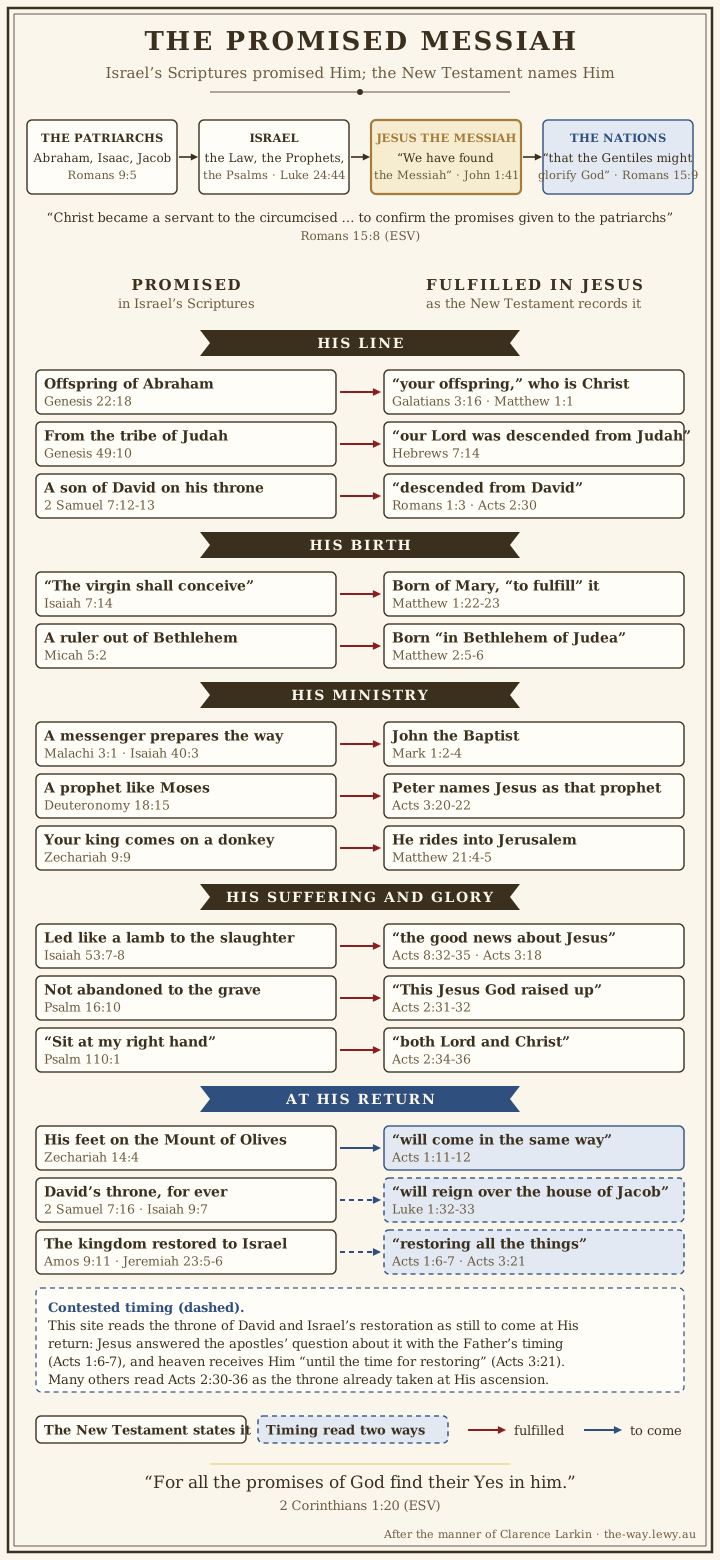
The Scriptures fixed His line: the offspring of Abraham (Galatians 3:16), from the tribe of Judah
(Hebrews 7:14), a son of David (Romans 1:3). They named His birthplace, Bethlehem (Micah 5:2;
Matthew 2:5-6), and a messenger to go before Him (Malachi 3:1; Mark 1:2-3). They described a king
coming to Jerusalem on a donkey (Zechariah 9:9; Matthew 21:4-5), a servant led like a lamb to the
slaughter (Isaiah 53:7-8, which Philip read as "the good news about Jesus", Acts 8:35), one God would
not abandon to the grave (Psalm 16:10; Acts 2:31), and one seated at God's right hand (Psalm 110:1;
Acts 2:34-35). Peter's conclusion to the crowd at Pentecost is the conclusion of the whole list: "God
has made him both Lord and Christ, this Jesus whom you crucified" (Acts 2:36, ESV).
[](https://the-way.lewy.au/assets/img/israel-and-church/promised-messiah.svg)
### What His return will complete
The New Testament leaves part of the list open, and says so. Gabriel promised Mary that "the Lord God
will give to him the throne of his father David, and he will reign over the house of Jacob forever"
(Luke 1:32-33, ESV). After the resurrection the apostles asked, "Lord, will you at this time restore
the kingdom to Israel?", and Jesus answered with the timing: "It is not for you to know times or
seasons that the Father has fixed by his own authority" (Acts 1:6-7, ESV). Peter told Jerusalem that
heaven must receive Jesus "until the time for restoring all the things about which God spoke by the
mouth of his holy prophets long ago" (Acts 3:21, ESV).
When that reign begins is contested. Many read Peter at Pentecost (Acts 2:30-36) as announcing David's
throne already taken at the ascension, and the reign as Christ's present rule from heaven. This site
reads it as future: Jesus sits now at the Father's right hand, and takes David's throne over a
restored Israel when He returns "in the same way as you saw him go into heaven" (Acts 1:11, ESV; see
[Israel and the Church](https://the-way.lewy.au/israel-and-church/israel-and-the-church/)). Both readings agree on the Person. Jesus has met
every qualification the Scriptures set for the Messiah, and the promises still outstanding rest on
Him: "all the promises of God find their Yes in him" (2 Corinthians 1:20, ESV).
### From Israel to the nations
Paul lists what God gave Israel: "to them belong the adoption, the glory, the covenants, the giving of
the law, the worship, and the promises. To them belong the patriarchs, and from their race, according
to the flesh, is the Christ" (Romans 9:4-5, ESV). Jesus told a Samaritan woman the same thing in five
words: "salvation is from the Jews" (John 4:22).
Paul names both purposes of Christ's coming in one sentence: "Christ became a servant to the
circumcised to show God's truthfulness, in order to confirm the promises given to the patriarchs, and
in order that the Gentiles might glorify God for his mercy" (Romans 15:8-9, ESV). **This shows that
God keeps His word.** He swore to Abraham and to David, and He kept it in Jesus, in the open, in a
form His people could check against what He had written. A Gentile believer worships the God of
Israel through Israel's Messiah and reads Israel's Scriptures as their own instruction (Romans 15:4).
So you may trust the promises God has not yet completed on the strength of the ones He already has.
## Cautions
Two different things share the phrase "Hebrew roots," and this study is about the first.
1. **Studying the Old Testament's shadows and types, its Torah, its feasts, and its prophecy**, the
subject of the rest of this page, is what Jesus and the apostles did, and it is what this section
of the site is for.
2. **"Hebrew Roots" as a theological movement** teaches things this site does not hold, chiefly that
the Church *is* Israel, or that Gentile believers are a scattered tribe of Israel rediscovering its
identity. Scripture sends the gospel to the nations *as* nations. [Israel and the
Church](https://the-way.lewy.au/israel-and-church/israel-and-the-church/) sets out why Scripture keeps the two distinct, and nothing below
blurs that line.
A related error runs the other direction: treating study of the Torah as grounds for requiring
Gentile believers to keep it. Paul's warning against it is some of his sharpest language: "if you
accept circumcision, Christ will be of no advantage to you… you are severed from Christ, you who
would be justified by the law" (Galatians 5:2-4). The Jerusalem council reached the same conclusion
by a gentler route, refusing to place on Gentile disciples "a yoke… that neither our fathers nor we
have been able to bear" (Acts 15:10). Studying what the Torah reveals about God's character, and what
it foreshadows in Christ, is this page's subject; binding Gentile believers to keep it is the error
both texts are written against.
## Key features
Six things repay a church's attention, each a different angle on the same Old Testament.
### Shadows and types
An Old Testament person, object, or ritual can pattern Christ or the gospel without saying so in
words. The New Testament's word for this is **τύπος** (*typos*, TOO-pos, G5179; Romans 5:14). The
tabernacle's sacrifices are the clearest case: they covered sin repeatedly and never finally, "since
the law has but a shadow of the good things to come instead of the true form of these realities"
(Hebrews 10:1). Recognising the shadow is what lets a reader recognise the substance when it arrives.
This site's [Melchizedek priesthood](https://the-way.lewy.au/jesus/melchizedek-priesthood/) study works one such type
through in full.
### Torah
**Torah**, תּוֹרָה (*torah*, toh-RAH, H8451), is usually rendered "law" in
English. TWOT glosses it *direction*, a noun from יָרָה (*yarah*, yah-RAH,
H3384), a verb that can mean to point out or to teach. Jesus held every letter of it in place: "Not
an iota, not a dot, will pass from the Law until all is accomplished" (Matthew 5:18). The psalmist
had already called God's word a lamp to walk by (Psalm 119:105).
### Festivals
**Moed**, מוֹעֵד (*moed*, moh-ED, H4150, "appointed time"), is the word behind
"the appointed feasts of the LORD" (Leviticus 23:4). Each one is a holy convocation, kept on its own
calendar date every year, and the New Testament reads at least one of them as already fulfilled:
"Christ, our Passover lamb, has been sacrificed. Let us therefore celebrate the festival… with the
unleavened bread of sincerity and truth" (1 Corinthians 5:7-8). The [Feasts](https://the-way.lewy.au/feasts/feasts/)
section works through all seven in full. This page makes a narrower point: a church unfamiliar with
what a feast was foreshadowing cannot recognise it being fulfilled.
### Creation
The seven-day pattern is set at creation, before Israel receives a single command. "On the seventh
day God finished his work… and he rested on the seventh day" (Genesis 2:2).
[A Day Is a Thousand Years](https://the-way.lewy.au/last-things/day-is-a-thousand-years/#six-days-of-history) follows
that week through the whole of history, and [The Zadok Calendar](https://the-way.lewy.au/feasts/zadok-calendar/) traces
the same seven-based structure under Israel's appointed times, sabbatical years and jubilees included.
### Prophecy
The Old Testament also predicts, and Jesus read its predictions as being about Himself (Luke 24:44).
The [promised Messiah](#jesus-the-messiah-israel-was-promised) section above sets the main ones
beside their fulfilment, and [Bible Prophecy Essentials](https://the-way.lewy.au/last-things/prophecy-essentials/)
checks several of them against source in detail. Prophecy is where a reader should expect to find
Christ.
### Extra-biblical Jewish texts
Not everything the New Testament's first readers knew was inside the canon, and the New Testament
authors sometimes name their sources. Jude names his. "Enoch, the seventh from Adam, prophesied,
saying, 'Behold, the Lord comes with ten thousands of his holy ones'" (Jude 14) quotes 1 Enoch 1:9, a
Jewish apocalyptic work the *ESV Study Bible* dates to the second or first century BC. That date is
debated for the part Jude quotes: 1:9 opens the Book of the Watchers (chapters 1–36), which many
scholars place earlier, and copies of 1 Enoch survive among the Dead Sea Scrolls.
Quoting it does not make 1 Enoch Scripture (*ESV Study Bible*, note on Jude 14-16). Jude writes to
readers who knew the book, and he draws on it as a true example on this one point.
Five verses earlier he alludes to another non-biblical work without naming it. The archangel Michael
"disputing about the body of Moses" (Jude 9) has no source in the Old Testament's account of Moses's
death (Deuteronomy 34:5-7). Which work Jude drew on is contested. Two study Bibles name the
*Assumption of Moses*; the *ESV Study Bible* suggests "perhaps a lost section of a work called
Testament of Moses." The Jewish work that survives under those titles (R. H. Charles published it as
the *Assumption of Moses*) breaks off before Moses dies (12:8), so the dispute is not in what
remains. Origen names the book: "The Ascension of Moses (a little treatise, of which the Apostle Jude
makes mention in his Epistle)" (*De Principiis* 3.2.1). Either way, Jude expects his readers to
recognise a story his letter does not stop to explain.
Paul does the same with names. "Jannes and Jambres opposed Moses" (2 Timothy 3:8) names Pharaoh's
magicians from Exodus 7, who go unnamed in Exodus. The names come from early extrabiblical Jewish
writings (*ESV Study Bible*, note on 2 Timothy 3:8), and Paul expects Timothy to recognise them
without explanation.
The Mishnah is a different case. It was redacted around AD 200, after the New Testament, so no New
Testament author quotes it the way Jude quotes 1 Enoch.
Some of what it documents is older than its redaction date: it records the liturgical practice of the
feasts, and how much of that a first-century Jew would already have known is debated. This site
therefore cites it as background: the four cups of the Passover Seder in [The Last Supper and the
Cups of Passover](https://the-way.lewy.au/feasts/last-supper-four-cups/), and the shofar procedure behind [the Feast of
Trumpets](https://the-way.lewy.au/feasts/trumpets/).
## Why this still matters for the church today
Paul says why. "Whatever was written in former days was written for our instruction" (Romans 15:4).
He writes that of the Old Testament, to a church centuries after it was first written, and he calls
it instruction.
A church that treats the Old Testament as solved background reading loses what Paul says you still
need for endurance and hope.
## Discussion questions
1. **The language.** Colossians 2:17 calls food and drink, festivals, new moons and Sabbaths "a
shadow of the things to come, but the substance belongs to Christ." Paul's word is σκιά (*skia*),
the word Hebrews 10:1 uses of the law's sacrifices. What changes about how you read an Old
Testament ritual once you look for what it is a shadow *of*?
2. **The text in its context.** Paul writes that "Christ became a servant to the circumcised to show
God's truthfulness, in order to confirm the promises given to the patriarchs, and in order that
the Gentiles might glorify God for his mercy" (Romans 15:8-9). How does that sentence place a
Gentile believer in relation to the promises God made to Israel's patriarchs?
3. **Christ.** Jesus opened the Hebrew Scriptures to explain Himself on the Emmaus road (Luke 24:27)
before a single Gospel had been written. What does that say about how much of the church's
Christology was already available before the New Testament existed?
4. **The law.** Jesus said that "not an iota, not a dot, will pass from the Law until all is
accomplished" (Matthew 5:18). At the Jerusalem council Peter refused to place "a yoke on the neck
of the disciples that neither our fathers nor we have been able to bear" (Acts 15:10). What place
does the Torah have in a Gentile believer's life when both texts are read together?
5. **The hard part.** At Pentecost Peter says God swore to David "that he would set one of his
descendants on his throne" and that Jesus is now "exalted at the right hand of God" (Acts 2:30,
33). Weeks earlier Jesus left the question of restoring the kingdom to Israel with "times or
seasons that the Father has fixed" (Acts 1:6-7), and Peter later says heaven must receive Jesus
"until the time for restoring all the things about which God spoke by the mouth of his holy
prophets" (Acts 3:21). How do you read Acts 2:30-36 alongside Acts 1:6-7 and Acts 3:21?
6. **Be transformed.** Paul says the Old Testament "was written for our instruction, that through
endurance and through the encouragement of the Scriptures we might have hope" (Romans 15:4).
Which Old Testament promise do you need for the endurance you are being asked for right now?
## References & Recommended Reading
**Scripture and original-language data**
- ESV Bible (Crossway) — primary translation quoted throughout.
- MACULA Hebrew (WLC) Linguistic Dataset, via this repo's `references/build/bible-text.db` — Hebrew
forms above.
- *Theological Wordbook of the Old Testament* (Moody, 1980) — root glosses for תּוֹרָה (*torah*,
H8451, "direction") and מוֹעֵד (*moed*, H4150, "appointed time"), via this repo's TWOT lookup tools.
- Mishnah, Sefaria Community Translation (CC0), via [sefaria.org](https://www.sefaria.org) — the
source behind the Mishnah citations on the Feasts pages linked above.
**Commentaries consulted**
- *ESV Study Bible* (Crossway, 2016) — notes on Jude 8-10 (the Michael/devil story "lost to
history"), Jude 14-16 (1 Enoch as an extrabiblical source Jude cites as true on one point without
treating it as Scripture), and 2 Timothy 3:8 (Jannes and Jambres as names from early extrabiblical
Jewish writing, not from Exodus itself).
- *CSB Ancient Faith Study Bible* (Holman) — book introduction to Jude, naming the *Assumption of
Moses* as Jude's likely source at v. 9 alongside its quotation of 1 Enoch at vv. 14-15.
- *NLT Life Application Study Bible*, third edition (Tyndale, 2019) — note on Jude 9, concurring on
*The Assumption of Moses*.
**Extra-biblical witnesses**
- Origen, *De Principiis* 3.2.1, in *Ante-Nicene Fathers* vol. 4 — names "The Ascension of Moses" as
the treatise Jude mentions.
- *Assumption of Moses* 12:8, trans. R. H. Charles, as held in the scrollmapper deuterocanonical
dataset — the surviving text breaks off before Moses's death. Cited as history, never as Scripture.
**Related studies on this site**
- [Israel and the Church](https://the-way.lewy.au/israel-and-church/israel-and-the-church/) — why Scripture keeps Israel and the Church
distinct; read alongside the Cautions section above.
- [Jesus, Priest in the Order of Melchizedek](https://the-way.lewy.au/jesus/melchizedek-priesthood/) — a single Old
Testament type worked through in full.
- [The Appointed Times](https://the-way.lewy.au/feasts/feasts/) and [The Zadok Calendar](https://the-way.lewy.au/feasts/zadok-calendar/)
— the fuller treatment of the appointed feasts and the calendar behind them.
- [A Day Is a Thousand Years](https://the-way.lewy.au/last-things/day-is-a-thousand-years/) — the creation week as the
shape of history.
- [Bible Prophecy Essentials](https://the-way.lewy.au/last-things/prophecy-essentials/) — fulfilled prophecy verified
against source rather than assumed.