---
title: "Jesus and Women"
category: "jesus"
description: "How Jesus treated women against the customs of His day: as disciples He taught, followers who funded His work, people He defended, and the first witnesses of His resurrection, read with the women God sent in the Old Testament and the women of the early church."
tags: ["women", "discipleship", "marriage", "luke", "john", "mark", "genesis", "romans", "method/word-study", "lang/greek", "lang/hebrew", "person/mary-magdalene"]
draft: false
primary_passage: "Luke 8:1-3"
bible_references: ["Genesis 1:27-28", "Genesis 2:18-24", "Genesis 3:16", "Exodus 15:20", "Judges 4:4-5", "2 Kings 22:14-15", "Micah 6:4", "Psalm 121:1-2", "Matthew 5:28", "Matthew 19:3-10", "Matthew 28:5-10", "Mark 10:42-45", "Mark 14:3-9", "Mark 15:40-41", "Luke 2:36-38", "Luke 7:36-50", "Luke 10:38-42", "Luke 13:10-17", "Luke 22:25-27", "Luke 24:10-11", "John 4:9", "John 4:27", "John 4:39", "John 11:25-27", "John 20:15-18", "Acts 1:14", "Acts 2:17-18", "Acts 18:26", "Acts 21:9", "Acts 22:3", "Romans 16:1-7", "Galatians 3:28", "Ephesians 5:25-29", "Philippians 4:2-3", "1 Peter 3:7", "Revelation 19:7-8", "Matthew 5:29", "Matthew 16:16", "Mark 10:11-12", "Luke 7:39", "Luke 19:9", "Galatians 3:26-29"]
date_created: 2026-10-17
date_modified: 2026-10-31
ai_provider_models:
- anthropic/claude-opus-5.5
---
# Jesus and Women
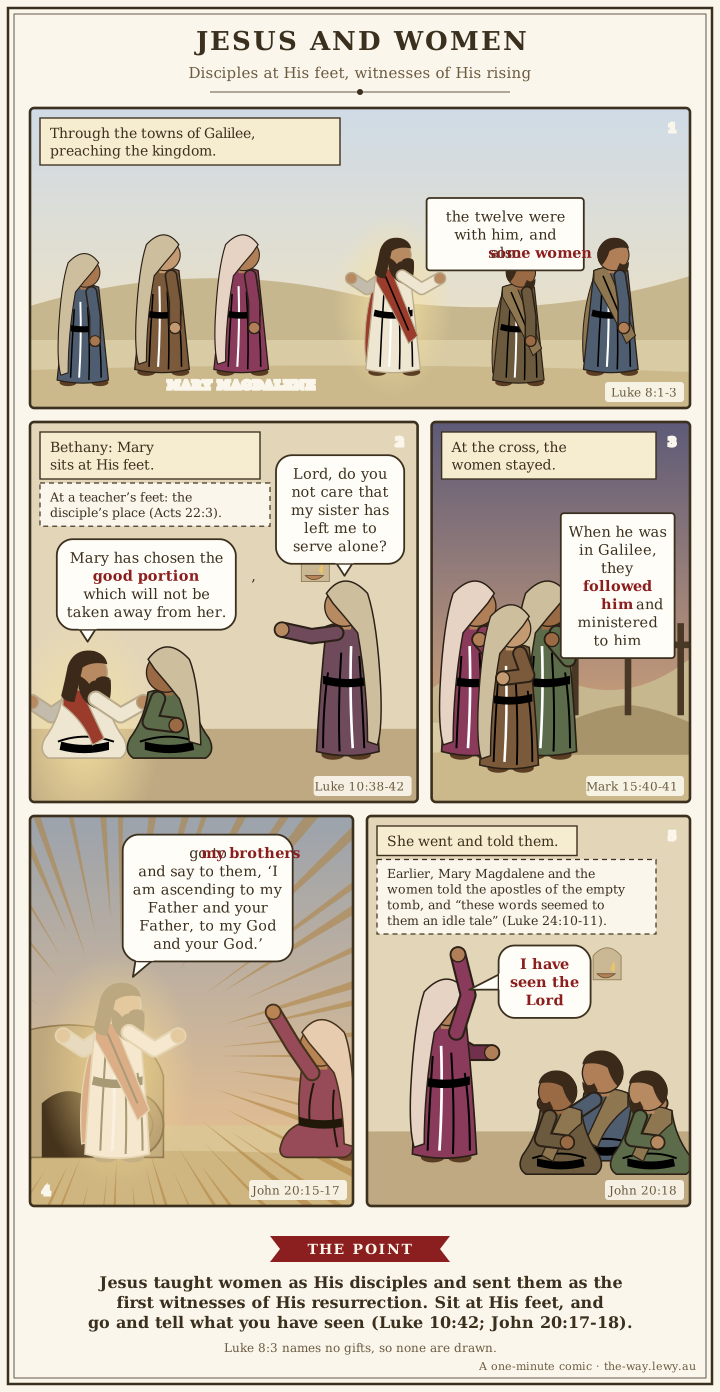
Jesus taught women at His feet, took their support, defended them in public, and chose them to be the first witnesses of His resurrection.
**In one sentence:** Jesus treated women as disciples: He taught them, was followed and funded by
them, defended them, and sent them as the first witnesses of His resurrection, because God made
male and female alike in His image, and the bride He gave Himself for is made of daughters and sons
alike.
[](https://the-way.lewy.au/assets/img/comics/jesus-and-women.svg)
## Key Takeaways
*(This section follows the [Key Takeaways](https://the-way.lewy.au/about/key-takeaways/) format — see that page for what each part is for.)*
### Lessons about Jesus
- He taught women as disciples. Mary of Bethany sat "at the Lord's feet," the posture Paul uses of
his own training "at the feet of Gamaliel" (Luke 10:39; Acts 22:3), and Jesus defended her place.
- He used one word for the women's service and His own. The women "provided for" Him, διηκόνουν
(Luke 8:3), and He said, "the Son of Man came not to be served but to serve," διακονῆσαι (Mark
10:45).
- He made women the first witnesses of His resurrection and sent them to the men: "go to my
brothers" (John 20:17).
### Memory verses
> ✝️ Genesis 1:27 (ESV)
>
> 27 So God created man in his own image, in the image of God he created him; male and female he
> created them.
> ✝️ Luke 10:41-42 (ESV)
>
> 41 But the Lord answered her, "Martha, Martha, you are anxious and troubled about many things,
> 42 but one thing is necessary. Mary has chosen the good portion, which will not be taken away from
> her."
### Be Transformed
- **Think.** A woman in Christ is a disciple, a witness and an heir with full standing. Measure
every teaching about women against how Jesus Himself treated them in the Gospels.
- **Attitude.** Honour the women in your church the way Jesus did: by name, as learners, as
partners in the work, and as people whose word you believe.
- **Do.** If you are a woman, take your place at His feet as Mary did (Luke 10:39), study the
Scriptures, and tell what you have seen, as Mary Magdalene did: "I have seen the Lord" (John
20:18, ESV). If you lead, make room for women to learn, serve and speak, and listen when they do.
### Prayer
Lord Jesus, you called Mary by her name in the garden and sent her to tell your brothers you were
alive. You let women sit at your feet, you received their gifts, and you defended them when others
despised them. Make your church treat your daughters as you treated them. Teach every one of us to
choose the good portion, and give us courage to go and say, "I have seen the Lord."
In Jesus' name. Amen.
## Study outline
1. **Before Jesus** — [Made alike in His image](#made-alike-in-his-image) · [Women God sent before Jesus came](#women-god-sent-before-jesus-came) · [The world He walked into](#the-world-he-walked-into). Creation, the fall, the women God sent in Israel, and the customs of the first century.
2. **In the Gospels** — [Followers and funders](#followers-and-funders) · [A disciple at His feet](#a-disciple-at-his-feet) · [He defended them](#he-defended-them) · [First witnesses of the resurrection](#first-witnesses-of-the-resurrection). What Jesus did with women, scene by scene, and the word that joins their service to His.
3. **After the Gospels** — [The church He built](#the-church-he-built) · [The bride He gave Himself for](#the-bride-he-gave-himself-for). The women of Acts and Paul's letters, and Christ's love for His bride.
4. [Discussion questions](#discussion-questions). Six, for a group or on your own.
## Made alike in His image
The first thing Scripture says about women it says in the same breath as men:
> ✝️ Genesis 1:27-28 (ESV)
>
> 27 So God created man in his own image, in the image of God he created him; male and female he
> created them. 28 And God blessed them. And God said to them, "Be fruitful and multiply and fill
> the earth and subdue it, and have dominion over the fish of the sea and over the birds of the
> heavens and over every living thing that moves on the earth."
"Male and female," זָכָר וּנְקֵבָה (*zāḵār ûnᵉqēḇâ*, zah-KHAR oo-neh-kay-VAH,
H2145, H5347), both bear the image of God. Both receive the blessing, and both receive the
commission to rule the earth. The command to "have dominion" is given to "them."
Genesis 2 tells the same creation close up. God says, "It is not good that the man should be alone;
I will make him a helper fit for him" (Genesis 2:18, ESV). "Helper" is עֵזֶר
(*ʿēzer*, AY-zer, H5828). It occurs 21 times in the Hebrew Bible, and most of the others name God as
the help of His people: "My help comes from the LORD, who made heaven and earth" (Psalm 121:2, ESV;
also Exodus 18:4; Deuteronomy 33:7, 26, 29; Psalm 33:20; 146:5). "Fit for him" is כְּנֶגְדּוֹ
(*kᵉnegdô*, keh-neg-DOH), "corresponding to him," literally "as opposite him": his counterpart. Adam's first words over her say so: "This at last is bone of my bones and flesh of my flesh"
(Genesis 2:23, ESV).
Then came the fall: "he shall rule over you" (Genesis 3:16, ESV). The companion study
[Submission in Context](https://the-way.lewy.au/christian-life/submission-in-context/) reads this verse.
This shows that God made women for the same glory and the same work as men. Whatever the fall broke
between them, He made them one in His image, and Jesus treated women as people who bear it.
## Women God sent before Jesus came
Women spoke for God throughout Israel's history, and Scripture names them without apology.
- **Miriam.** "Miriam the prophetess" led Israel's women in song after the Red Sea (Exodus 15:20,
ESV). Through Micah God counted her among the three He sent: "I brought you up from the land of
Egypt ... and I sent before you Moses, Aaron, and Miriam" (Micah 6:4, ESV).
- **Deborah.** "Now Deborah, a prophetess, the wife of Lappidoth, was judging Israel at that time
... and the people of Israel came up to her for judgment" (Judges 4:4-5, ESV). She summoned Barak
and gave him God's command (4:6-7).
- **Huldah.** When the Book of the Law was found in the temple, Josiah sent the high priest Hilkiah
and his officials to ask the LORD. They went to "Huldah the prophetess," and she answered, "Thus
says the LORD, the God of Israel" (2 Kings 22:14-15, ESV).
- **Anna.** At the other end of the story, "a prophetess, Anna," a widow until she was eighty-four
(or for eighty-four years; the Greek allows both), met the infant Jesus in the temple and "began to give thanks to God and to speak of him to all who were
waiting for the redemption of Jerusalem" (Luke 2:36-38, ESV).
These women were exceptions in a society led by men, and Scripture records them as God's own
choices. Jesus did more than continue the line. He opened His company to women as a group.
## The world He walked into
The Gospels themselves record how the people around Jesus regarded women.
- **His disciples were surprised He spoke with one.** "They marveled that he was talking with a
woman" (John 4:27, ESV). The Samaritan woman was surprised too: "How is it that you, a Jew, ask
for a drink from me, a woman of Samaria?" (John 4:9, ESV). The study [The Woman at the
Well](https://the-way.lewy.au/jesus/woman-at-well/) tells that meeting in full. Many in her town "believed in him because of
the woman's testimony" (John 4:39, ESV).
- **A Pharisee judged Him for letting a woman touch Him.** "If this man were a prophet, he would
have known who and what sort of woman this is who is touching him, for she is a sinner" (Luke
7:39, ESV).
- **Divorce was debated as a husband's right.** The Pharisees asked, "Is it lawful to divorce one's
wife for any cause?" (Matthew 19:3, ESV).
Sources outside Scripture confirm the picture, and they are background only. Josephus records that
Jewish courts did not accept a woman's testimony (*Antiquities* 4.219), and the Mishnah preserves the
debate behind "for any cause": the school of Hillel allowed a man to divorce his wife "even if she
has merely burnt his dish" (*Gittin* 9:10, Kulp translation).
## Followers and funders
> ✝️ Luke 8:1-3 (ESV)
>
> 1 Soon afterward he went on through cities and villages, proclaiming and bringing the good news of
> the kingdom of God. And the twelve were with him, 2 and also some women who had been healed of
> evil spirits and infirmities: Mary, called Magdalene, from whom seven demons had gone out, 3 and
> Joanna, the wife of Chuza, Herod's household manager, and Susanna, and many others, who provided
> for them out of their means.
Luke sets the women in the same sentence as the Twelve: οἱ δώδεκα σὺν αὐτῷ, καὶ γυναῖκές τινες,
"the twelve with him, and some women." He names three of them, and the range is wide: a woman freed
from seven demons, the wife of a senior official in Herod Antipas's household, and a woman known
only by name. "Many others" and "who" are feminine in the Greek; the ESV Study Bible notes that they
refer to women who supported Jesus and the disciples.
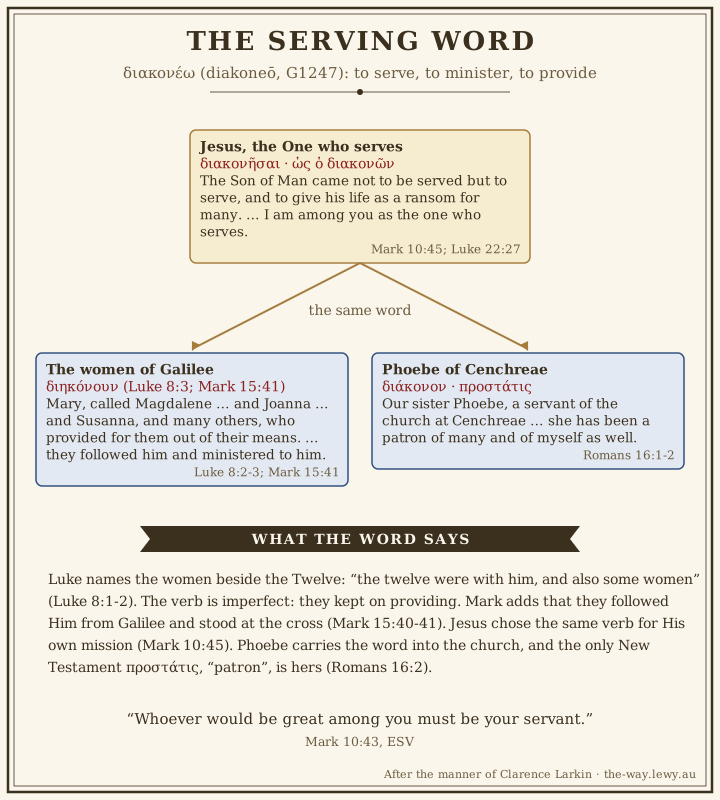
"Provided for them" is διηκόνουν (*diēkonoun*, dee-ay-KOH-noon), the imperfect of διακονέω
(*diakoneō*, dee-ah-koh-NEH-oh, G1247), "to serve, to minister." The imperfect describes a continuing
practice: they kept on providing, "out of their means," ἐκ τῶν ὑπαρχόντων αὐταῖς, from what
belonged to them. Jesus' travelling ministry was paid for, in part, by women.
Mark uses the same verb when the women reappear at the cross: "When he was in Galilee, they followed
him and ministered to him," ἠκολούθουν αὐτῷ καὶ διηκόνουν αὐτῷ (Mark 15:41, ESV). "Followed" is
ἀκολουθέω (*akoloutheō*, ak-oh-loo-THEH-oh, G190), the Gospels' word for discipleship: "Follow me"
(Mark 2:14; 8:34). These women followed Jesus in the full sense, from Galilee to Golgotha. When the
disciples "all left him and fled" (Mark 14:50, ESV), "there were also women looking on from a distance" (15:40).
### One verb for their service and His
Jesus used the same verb for His own mission:
> ✝️ Mark 10:45 (ESV)
>
> 45 For even the Son of Man came not to be served but to serve, and to give his life as a ransom
> for many.
"Not to be served but to serve" is οὐκ ἦλθεν διακονηθῆναι ἀλλὰ διακονῆσαι. At the Last Supper He
said it again: "I am among you as the one who serves," ὡς ὁ διακονῶν (Luke 22:27). The Gospels
name the women's service with the word Jesus chose for His own.
[](https://the-way.lewy.au/assets/img/jesus-and-women/the-serving-word.svg)
## A disciple at His feet
> ✝️ Luke 10:38-42 (ESV)
>
> 38 Now as they went on their way, Jesus entered a village. And a woman named Martha welcomed him
> into her house. 39 And she had a sister called Mary, who sat at the Lord's feet and listened to
> his teaching. 40 But Martha was distracted with much serving. And she went up to him and said,
> "Lord, do you not care that my sister has left me to serve alone? Tell her then to help me." 41
> But the Lord answered her, "Martha, Martha, you are anxious and troubled about many things, 42 but
> one thing is necessary. Mary has chosen the good portion, which will not be taken away from her."
"Sat at the Lord's feet" is παρακαθεσθεῖσα πρὸς τοὺς πόδας τοῦ κυρίου. Sitting at a teacher's feet
was the posture of a disciple. Paul describes his own training the same way: "educated at the feet
of Gamaliel," παρὰ τοὺς πόδας Γαμαλιήλ (Acts 22:3, ESV). Mary "listened to his teaching," ἤκουεν
τὸν λόγον αὐτοῦ, literally "was hearing his word." She took the disciple's place, and Jesus kept her
in it.
Martha's complaint uses the serving word again, διακονία and διακονεῖν (10:40). Martha was doing a
good thing, and Jesus did not despise it. He named "one thing" as necessary and gave it to Mary:
"Mary has chosen the good portion." The ESV Study Bible hears the Old Testament language of the
Lord as His people's "portion" (Psalm 16:5; 73:26). Jesus defended a woman's place as His learner,
and He promised that no one would take it from her.
Martha was a disciple too. At her brother's tomb Jesus taught her, "I am the resurrection and the
life," and she answered with one of the great confessions of the Gospels: "Yes, Lord; I believe
that you are the Christ, the Son of God, who is coming into the world" (John 11:25-27, ESV). She
gives Him the two titles Peter confessed at Caesarea Philippi: "You are the Christ, the Son of the
living God" (Matthew 16:16, ESV).
## He defended them
Again and again in the Gospels, Jesus stood between a woman and the people who would push her
aside.
### Marriage and lust
**Against disposable marriage.** To the question "for any cause?" (Matthew 19:3) Jesus answered
from creation: "from the beginning it was not so" (19:8), and "What therefore God has joined
together, let not man separate" (19:6). He named Moses' concession as a concession to "your hardness
of heart" (19:8). In Mark He says the man who divorces his wife and marries another "commits
adultery against her," μοιχᾶται ἐπ᾽ αὐτήν (Mark 10:11, ESV): the wife sent away is the one wronged.
His disciples felt it: "If such is the case of a man with his wife, it is
better not to marry" (Matthew 19:10, ESV).
**Against blaming women for men's lust.** "Everyone who looks at a woman with lustful intent has
already committed adultery with her in his heart" (Matthew 5:28, ESV). Jesus put responsibility for
lust on the man who looks, and the remedy He gives is the man's own: "If your right eye causes you
to sin, tear it out and throw it away" (5:29, ESV).
### The overlooked and the despised
**For a woman everyone overlooked.** In a synagogue on the Sabbath He saw a woman bent over for
eighteen years, "called her over," and laid His hands on her (Luke 13:12-13). When the ruler of the
synagogue objected, Jesus named her: "ought not this woman, a daughter of Abraham whom Satan bound
for eighteen years, be loosed from this bond on the Sabbath day?" (13:16, ESV). "Daughter of
Abraham," θυγατέρα Ἀβραάμ, names her as one of God's covenant people. Jesus gives Zacchaeus the same
standing in the same words: "he also is a son of Abraham" (Luke 19:9, ESV). To the woman who
touched His garment He said, "Daughter, your faith has made you well; go in peace" (Mark 5:34,
ESV); the study [The Woman Who Touched the Fringe](https://the-way.lewy.au/jesus/woman-with-the-issue-of-blood/) traces that
healing.
**For a woman others despised.** A sinful woman wept over His feet in a Pharisee's house. Jesus
turned to His host: "Do you see this woman? ... her sins, which are many, are forgiven—for she loved
much" (Luke 7:44, 47, ESV). When the disciples scolded the woman who poured ointment on His head at
Bethany, He said, "Leave her alone. ... She has done a beautiful thing to me,"
and promised, "wherever the gospel is proclaimed in the whole world, what she has done will be told
in memory of her" (Mark 14:6, 9, ESV).
This shows that God sees the people others overlook.
## First witnesses of the resurrection
The women stayed at the cross (Mark 15:40-41), watched where He was laid (15:47), and came first to
the tomb. God gave them the first news of the resurrection.
> ✝️ Matthew 28:5-10 (ESV)
>
> 5 But the angel said to the women, "Do not be afraid, for I know that you seek Jesus who was
> crucified. 6 He is not here, for he has risen, as he said. Come, see the place where he lay. 7
> Then go quickly and tell his disciples that he has risen from the dead, and behold, he is going
> before you to Galilee; there you will see him. See, I have told you." 8 So they departed quickly
> from the tomb with fear and great joy, and ran to tell his disciples. 9 And behold, Jesus met them
> and said, "Greetings!" And they came up and took hold of his feet and worshiped him. 10 Then Jesus
> said to them, "Do not be afraid; go and tell my brothers to go to Galilee, and there they will
> see me."
John tells it of Mary Magdalene alone. She did not recognise Jesus until He spoke her name: "Jesus
said to her, 'Mary.' She turned and said to him in Aramaic, 'Rabboni!' (which means Teacher)" (John
20:16, ESV). She called Him Teacher, the word a disciple used. Then He sent her: "go to my brothers
and say to them, 'I am ascending to my Father and your Father, to my God and your God'" (20:17,
ESV). "Mary Magdalene went and announced to the disciples, 'I have seen the Lord'" (20:18, ESV).
"Announced" is ἀγγέλλουσα (*angellousa*, ang-GEL-loo-sah), "bringing word." In John's account she
is the first person to see the risen Lord and the first sent to tell it.
The men did not believe it at first: "these words seemed to them an idle tale, and they did not
believe them" (Luke 24:11, ESV). God chose as His first witnesses the people
whose word the apostles themselves set aside, and He proved them right.
## The church He built
After the ascension the women were in the upper room: "All these with one accord were devoting
themselves to prayer, together with the women and Mary the mother of Jesus, and his brothers" (Acts
1:14, ESV). At Pentecost Peter announced from Joel 2:28-29 that the Spirit had come on both:
> ✝️ Acts 2:17-18 (ESV)
>
> 17 "'And in the last days it shall be, God declares, that I will pour out my Spirit on all flesh,
> and your sons and your daughters shall prophesy, and your young men shall see visions, and your
> old men shall dream dreams; 18 even on my male servants and female servants in those days I will
> pour out my Spirit, and they shall prophesy.
### Women in the work of the church
The women of the early church served in every part of its life:
- **Priscilla** and her husband Aquila heard Apollos preach, "took him aside and explained to him
the way of God more accurately" (Acts 18:26, ESV). Luke names her first there, and Paul calls the
couple "my fellow workers in Christ Jesus, who risked their necks for my life" (Romans 16:3-4,
ESV).
- **Philip's daughters.** "He had four unmarried daughters, who prophesied" (Acts 21:9, ESV).
- **Phoebe** carried Paul's letter to Rome. He calls her "a servant of the church at Cenchreae,"
διάκονον (*diakonon*, G1249), the noun of the serving word, and asks the church to help her, "for
she has been a patron of many and of myself as well" (Romans 16:1-2, ESV). "Patron" is προστάτις
(*prostatis*, pros-TAH-tis, G4368), a benefactor who stood behind others with her means; it occurs
in the New Testament only here. Translators differ over διάκονον: the CSB footnote lists "deacon,
or deaconess, or minister, or courier," and the LSB footnote "deaconess."
- **Junia.** "Greet Andronicus and Junia, my kinsmen and my fellow prisoners. They are well known to
the apostles, and they were in Christ before me" (Romans 16:7, ESV). Junia, Ἰουνίαν, is a
feminine Latin name (NIV Cultural Backgrounds Study Bible), probably Andronicus's wife (ESV Study
Bible; NIV Biblical Theology Study Bible). The phrase
ἐπίσημοι ἐν τοῖς ἀποστόλοις is contested: "well known to the apostles" (ESV) or "noteworthy among
the apostles" (CSB footnote). If the second, "apostles" likely means accredited missionaries, as
in 2 Corinthians 8:23 and Philippians 2:25 (ESV Study Bible; NIV Biblical Theology Study Bible). Either way Paul
honours her as a fellow prisoner for Christ.
- **Euodia and Syntyche** "labored side by side with me in the gospel" (Philippians 4:2-3, ESV).
### One standing in Christ
Paul sums up the standing of every believer in one sentence: "There is neither Jew nor Greek, there
is neither slave nor free, there is no male and female, for you are all one in Christ Jesus"
(Galatians 3:28, ESV). The first two pairs are joined by "nor," οὐδέ. The third changes the
pattern: οὐκ ἔνι ἄρσεν καὶ θῆλυ, "there is no male *and* female." The three words ἄρσεν καὶ θῆλυ are
the Septuagint's words in Genesis 1:27, "male and female he made them." The verse's own context says
what the oneness is: "in Christ Jesus you are all sons of God, through faith" (3:26), and "if you are
Christ's, then you are Abraham's offspring, heirs according to promise" (3:29). Paul is speaking of
standing before God: every believer, man or woman, is a son and an heir. Peter tells husbands to show their wives honour "as the
weaker vessel, since they are heirs with you of the grace of life" (1 Peter 3:7, ESV); the companion
study reads that verse closely.
What these texts settle is the standing of women before God: image-bearers, disciples, witnesses,
servants of the church and joint heirs. Two passages about women speaking in church (1 Corinthians
14:34-35; 1 Timothy 2:11-15) are read differently by faithful interpreters, and the companion study
[Submission in Context](https://the-way.lewy.au/christian-life/submission-in-context/) gives both cases.
## The bride He gave Himself for
Scripture's picture of Christ and His people is a marriage, and how Christ treats His bride is how
He treated women in Galilee.
Christ "gave himself up for her" (Ephesians 5:25-29, ESV), ἑαυτὸν παρέδωκεν ὑπὲρ αὐτῆς. He cleanses her, presents her "in
splendor," and "nourishes and cherishes" her, ἐκτρέφει καὶ θάλπει (*ektrephei kai thalpei*). At the end of the age "his Bride has made herself
ready," and "it was granted her to clothe herself with fine linen, bright and pure" (Revelation
19:7-8, ESV). The church that Christ washes, honours and clothes is made of His daughters and sons
alike. The study [The Bride of Christ](https://the-way.lewy.au/israel-and-church/bride-of-christ/) follows the
betrothal from purchase to the wedding, and [The Wife of the Lamb](https://the-way.lewy.au/israel-and-church/wife-of-the-lamb/)
reads Revelation 19 and 21.
The Jesus who let Mary sit at His feet, who received
Joanna's support, who called a bent woman "daughter of Abraham" and sent Mary Magdalene to His
brothers, is the Bridegroom who gave Himself for His church. Any teaching that treats women as less
than He treated them has left His example.
This shows that God honours women as fully as He honours men. He made them in His image, His Son
called them to His feet and sent them with His news, and His Spirit fills them for His work.
## Discussion questions
1. **The language.** Luke 8:3 says the women διηκόνουν, "provided for" Jesus, and in Mark 10:45
Jesus says He came διακονῆσαι, "to serve." What does it mean that the Gospels use one verb for
the women's work and His own?
2. **The text in its context.** Luke records that the apostles thought the women's report "an idle
tale" (Luke 24:11). Why is it significant that all four Gospels make women the first witnesses of
the empty tomb (Matthew 28:1-10; Mark 16:1-8; Luke 24:1-11; John 20:1-18)?
3. **Christ.** Jesus defended Mary's place at His feet: "Mary has chosen the good portion, which will
not be taken away from her" (Luke 10:42). What would it look like for your church to defend that
place for every woman in it?
4. **The language.** Galatians 3:28 breaks its own pattern to say "no male and female," the words of
Genesis 1:27. What is Paul claiming by quoting creation?
5. **The hard part.** Scripture records women as prophets, judges, patrons and fellow workers, and
it also contains texts about women's silence in church (1 Corinthians 14:34-35; 1 Timothy 2:12).
How do you hold them together without explaining away either?
6. **Be transformed.** Mary Magdalene went and said, "I have seen the Lord" (John 20:18). Who has
Jesus sent you to tell, and what will you say?
## References & Recommended Reading
- **ESV Bible** (Crossway) — the translation quoted throughout, per this site's conventions. All
quotations were verified against the ESV text rather than reproduced from memory. See
[Copyright](https://the-way.lewy.au/about/copyright/) for the full notice.
- **Novum Testamentum Graece**, 28th edition (Deutsche Bibelgesellschaft) — the Greek wording quoted
for Luke 8:1-3, 10:39, 13:16, 22:25-27; Mark 10:45; 15:41; John 20:18; Acts 22:3; Romans 16:1-7;
Galatians 3:28; Ephesians 5:25-29.
- **MACULA Hebrew Linguistic Datasets (Westminster Leningrad Codex)** and **MACULA Greek Linguistic
Datasets (SBLGNT)**, Clear Bible — Hebrew and Greek forms, Strong's numbers and counts, including
the 21 occurrences of *ʿēzer* and the single New Testament occurrence of προστάτις.
- **Brenton's Septuagint** (eBible.org) — Genesis 1:27, ἄρσεν καὶ θῆλυ.
- ***ESV Study Bible*** (Crossway) — consulted after the exegesis, as a check. Notes on Luke 8:1-3
(the range of the women, the feminine forms in 8:3), Luke 10:42 ("the good portion"), and Romans
16:7 (Junia).
- ***NIV Cultural Backgrounds Study Bible*** (Zondervan), ed. John H. Walton and Craig S. Keener —
women's testimony (on Matthew 28:7, citing Josephus, *Antiquities* 4.219); the Hillel/Shammai
divorce debate (on Matthew 19:3, citing *Gittin* 9:10); Junia's name (on Romans 16:7).
- ***NIV Biblical Theology Study Bible*** (Zondervan), gen. ed. D. A. Carson — Luke 8:3 (the women's
support as participation in gospel ministry); Romans 16:7 ("apostles" as accredited messengers).
- **CSB and LSB footnotes** — Romans 16:1 (διάκονος) and 16:7 ("noteworthy among the apostles").
- **Flavius Josephus, *Antiquities of the Jews* 4.219**, and **the Mishnah**, *Gittin* 9:10 (Joshua
Kulp's *Mishnah Yomit* translation, CC-BY, via Sefaria) — background only; no step of the study
rests on them.
Related studies on this site: [Submission in Context](https://the-way.lewy.au/christian-life/submission-in-context/) ·
[The Bride of Christ](https://the-way.lewy.au/israel-and-church/bride-of-christ/) ·
[The Wife of the Lamb](https://the-way.lewy.au/israel-and-church/wife-of-the-lamb/) ·
[Sin and Sexual Immorality](https://the-way.lewy.au/sin/sexual-immorality/) ·
[The Woman at the Well](https://the-way.lewy.au/jesus/woman-at-well/) ·
[The Woman Who Touched the Fringe](https://the-way.lewy.au/jesus/woman-with-the-issue-of-blood/)