---
title: "The Almond"
category: "theology"
description: "Numbers 17 to Hebrews 7: the almond, whose Hebrew name sounds like 'watching', in the lampstand's gold blossoms and in Aaron's dead staff that budded, flowered and bore ripe almonds overnight to show whom God had chosen to come near Him, and the High Priest He appointed by the power of an indestructible life."
tags: ["numbers", "exodus", "jeremiah", "psalms", "romans", "hebrews", "temple", "priesthood", "resurrection", "person/aaron", "method/typology", "method/word-study", "lang/hebrew", "lang/greek"]
draft: false
primary_passage: "Numbers 17:1-13"
bible_references: ["Numbers 17:1-13", "Numbers 16:3", "Numbers 16:5", "Numbers 16:10", "Numbers 16:46-48", "Numbers 18:1-7", "Numbers 20:8-11", "Exodus 25:31-36", "Exodus 28:36-38", "Exodus 39:30", "Leviticus 8:9", "Numbers 8:4", "Jeremiah 1:11-12", "Jeremiah 31:28", "Ecclesiastes 12:5", "Genesis 43:11", "Genesis 30:37", "Psalm 110:2", "Psalm 110:4", "1 Kings 8:9", "Romans 1:4", "Hebrews 5:4-6", "Hebrews 7:15-16", "Hebrews 9:4", "Exodus 37:17-20", "Exodus 27:21", "Numbers 16:41", "Numbers 16:49", "Hebrews 7:20-25", "Psalm 2:7", "Jeremiah 1:6-8", "2 Chronicles 5:10"]
date_created: 2026-10-09
date_modified: 2026-10-10
ai_provider_models:
- anthropic/claude-opus-5.5
---
# The Almond
*The tree that watches, and the staff that lived*
Moses laid the chiefs' staffs in the tent overnight, one for each tribe, with Aaron's among them.
Each was a dead stick with a name written on it. In the morning he went back in:
> ✝️ Numbers 17:8 (ESV)
>
> 8 On the next day Moses went into the tent of the testimony, and behold, the staff of Aaron for the
> house of Levi had sprouted and put forth buds and produced blossoms, and it bore ripe almonds.
{ loading=lazy }
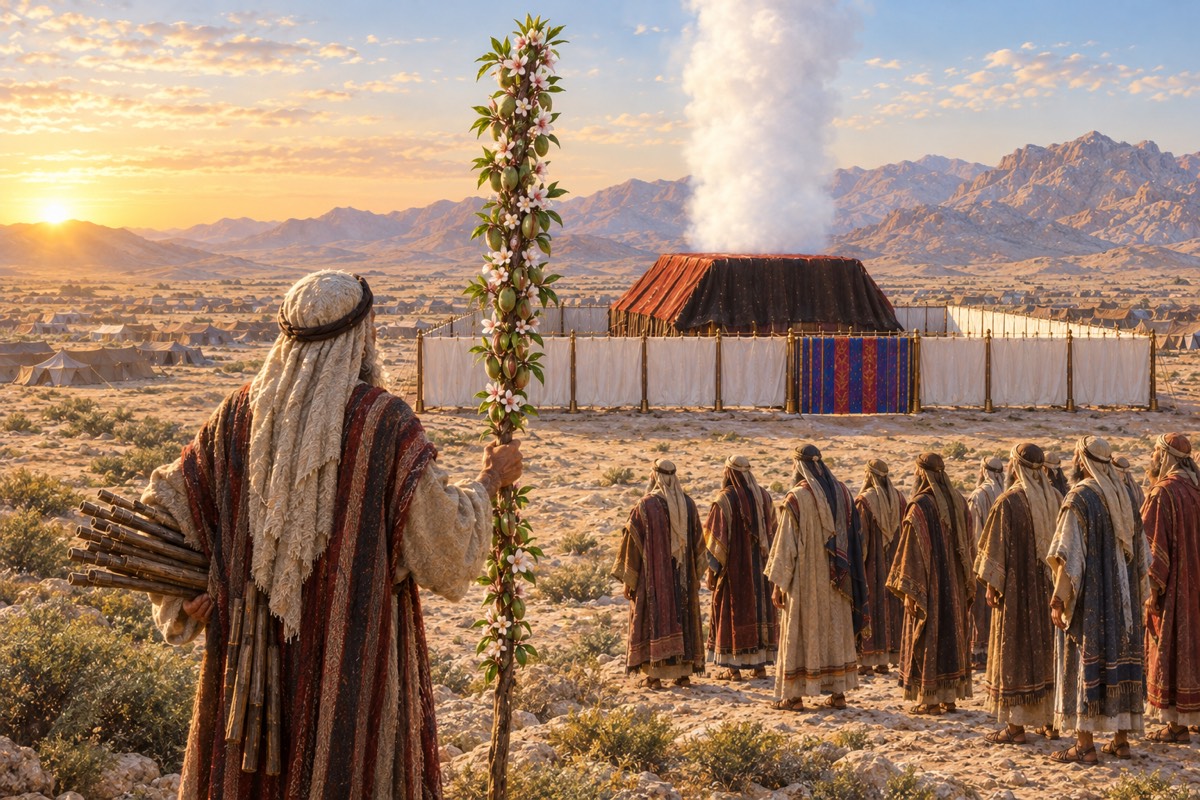
*Moses brings out the staffs: "and they looked, and each man took his staff" (Numbers 17:9, ESV).
AI-generated illustration; Numbers does not describe how the scene was arranged.*
In one night a dead branch went through a whole season, from bud to blossom to fruit. The fruit was
the almond, which was already in the tent: the golden lampstand was shaped as an almond tree in
flower.
**In one sentence:** God put the almond, whose Hebrew name sounds like "watching," into His tent
twice: as the lampstand's gold blossoms, and as Aaron's dead staff that budded, flowered and bore
ripe almonds in one night to end the argument over whom He had chosen to come near Him. Both show
the God who watches over His word to perform it, and who settled the priesthood for good by raising
Jesus, the High Priest appointed "by the power of an indestructible life" (Hebrews 7:16, ESV).
This page belongs to [The Heavenly Pattern](https://the-way.lewy.au/jesus/the-heavenly-pattern/). It takes up the almond where [The
Lampstand](https://the-way.lewy.au/jesus/the-heavenly-pattern/lampstand/#the-almond-a-tree-that-watches) leaves it.
## Key Takeaways
*(This section follows the [Key Takeaways](https://the-way.lewy.au/about/key-takeaways/) format — see that page for
what each part is for.)*
### Types & Prophecy
- **Aaron's staff is a type of the risen Priest, by resemblance.** God answered "whom have I
chosen?" by giving life to dead wood (Numbers 17:5, 8). He declared Jesus His Son "by his
resurrection from the dead" (Romans 1:4, ESV), and Hebrews says Jesus became a priest "by the power
of an indestructible life" (Hebrews 7:16, ESV). No New Testament writer connects the staff to the
resurrection in so many words. The pattern is in the two texts, and the connection is ours.
- **Hebrews states the principle the staff proved.** "No one takes this honor for himself, but only
when called by God, just as Aaron was. So also Christ" (Hebrews 5:4-5, ESV).
### Lessons about Jesus
- **The Father chose Jesus as High Priest.** Jesus "did not exalt himself to be made a high priest,
but was appointed by him" (Hebrews 5:5, ESV).
- **His priesthood rests on His life.** Aaron's sons served until they died. Jesus serves because He
lives and cannot die again (Hebrews 7:23-24).
### Memory verses
> ✝️ Jeremiah 1:12 (ESV)
>
> 12 Then the LORD said to me, "You have seen well, for I am watching over my word to perform it."
> ✝️ Hebrews 7:16 (ESV)
>
> 16 who has become a priest, not on the basis of a legal requirement concerning bodily descent, but
> by the power of an indestructible life.
### Be Transformed
- **Think.** God chooses who brings you near to Him, and He has chosen His Son Jesus. Your access to
God rests on that choice.
- **Attitude.** When God's word seems slow, remember the almond. He is awake, and He is watching over
that word to do it.
- **Do.** Read Numbers 17:1-11 and Hebrews 7:23-25 together this week, and thank God by name for the
Priest who always lives to intercede for you.
### Prayer
Faithful Father, You never sleep. You watch over every word You have spoken until it is done, and
You choose who may come near You. Thank You for choosing Your Son Jesus as our High Priest, and for
raising Him from the dead, so that His priesthood can never end. When we grumble against Your ways,
as Israel did, show us again the staff that blossomed and the tomb that is empty. Bring us near to
You through Him.
In Jesus' name. Amen.
## Study outline
- [The tree that watches](#the-tree-that-watches). The almond's name, Jeremiah's pun, and every
other almond in the Old Testament.
- [An almond tree of gold](#an-almond-tree-of-gold). The lampstand's blossoms, in brief.
- [Whom God chooses](#whom-god-chooses). Korah's challenge and the test of the staffs (Numbers
16-17).
- [One night, a whole season](#one-night-a-whole-season). Four verbs, and two of the words they share
with the lampstand and the high priest's turban.
- [A sign kept before the testimony](#a-sign-kept-before-the-testimony). Why God kept the staff, and
where it went.
- [The Priest God chose](#the-priest-god-chose). Hebrews 5 and 7, and the type.
- [What the almond shows about God](#what-the-almond-shows-about-god). Each connection sorted by how
firmly Scripture makes it.
- [Discussion Questions](#discussion-questions). Five, for a group or on your own.
## The tree that watches
### The name
The Hebrew for almond is שָׁקֵד (*shaqed*, shah-KAID, H8247). The verb
שָׁקַד (*shaqad*, shah-KAHD, H8245) means "to watch, be wakeful." The
*Theological Wordbook of the Old Testament* files both under one root (entry 2451), and the NIV
*Cultural Backgrounds Study Bible* notes that they share the same consonants (note on Jeremiah 1:11).
The almond is the first tree to blossom after winter, which is why, the *ESV Study Bible* says, it
"was said to 'watch for spring'" (note on Jeremiah 1:11-12).
### Jeremiah's almond branch
God made the pun Himself when He called Jeremiah:
> ✝️ Jeremiah 1:11-12 (ESV)
>
> 11 And the word of the LORD came to me, saying, "Jeremiah, what do you see?" And I said, "I see an
> almond branch." 12 Then the LORD said to me, "You have seen well, for I am watching over my word to
> perform it."
Jeremiah saw *shaqed*; God said He was *shoqed*, "watching." The vision gave a young prophet who was
afraid to speak (Jeremiah 1:6, 8) a promise: the words God put in his mouth would come true. God uses
the same verb later in the book for both halves of Jeremiah's message: "as I have watched over them
to pluck up and break down ... so I will watch over them to build and to plant" (Jeremiah 31:28,
ESV). He watched over judgment, and He watches over restoration just as closely.
### The other almonds
The noun occurs four times in the Hebrew Bible. Besides Jeremiah's branch and Aaron's staff, Jacob
sends almonds to Egypt among "the choice fruits of the land" (Genesis 43:11, ESV), and the Preacher
describes old age as the time when "the almond tree blossoms" (Ecclesiastes 12:5, ESV). The *NIV
Biblical Theology Study Bible* reads the pale blossom as white hair (note on Ecclesiastes 12:5). The
Hebrew verb in that clause is disputed. The Open Scriptures morphology tags it as
נָאַץ (*naʾats*, H5006, "despise"); MACULA reads
נָצַץ (*natsats*, H5340, "blossom"), as do the Septuagint's ἀνθέω (*antheō*,
"to blossom") and most English versions. A second word, לוּז (*luz*, H3869), names the almond once, among
the rods Jacob peeled (Genesis 30:37).
These verses hold the two sides of the tree. The almond blossoms first, and so it watches for spring.
On the majority reading of Ecclesiastes 12:5 it also blossoms white, and so marks a life near its
end. The *ESV Study Bible* hears a third note in the white: in Aaron's staff the blossoms "symbolize
purity, holiness, and God himself, which are all associated with the priesthood" (note on Numbers
17:1-13). In Aaron's staff God put the almond on the side of life.
## An almond tree of gold
The lampstand's cups were מְשֻׁקָּדִים (*meshuqqadim*, H8246), "made like
almond blossoms":
> ✝️ Exodus 25:33 (ESV)
>
> 33 three cups made like almond blossoms, each with calyx and flower, on one branch, and three cups
> made like almond blossoms, each with calyx and flower, on the other branch—so for the six branches
> going out of the lampstand.
The word occurs six times, every one of them in the lampstand's description (Exodus 25 and 37). Each
cup had a calyx and a "flower," פֶּרַח (*perach*, PEH-rakh, H6525).
[The Lampstand](https://the-way.lewy.au/jesus/the-heavenly-pattern/lampstand/) follows the furnishing from Sinai to Revelation and draws it from the
text. Before Aaron's staff ever budded, a golden almond tree in flower stood in the same tent, and Aaron tended its lamps "from evening to morning" (Exodus 27:21, ESV).
## Whom God chooses
### Korah's challenge
Numbers 17 answers a question Numbers 16 asked. Korah the Levite, with Dathan, Abiram and two hundred
and fifty chiefs, came against Moses and Aaron:
> ✝️ Numbers 16:3 (ESV)
>
> 3 They assembled themselves together against Moses and against Aaron and said to them, "You have
> gone too far! For all in the congregation are holy, every one of them, and the LORD is among them.
> Why then do you exalt yourselves above the assembly of the LORD?"
Moses saw what the Levites were after: "would you seek the priesthood also?" (Numbers 16:10, ESV).
He put the matter in God's hands: "In the morning the LORD will show who is his, and who is holy, and
will bring him near to him. The one whom he chooses he will bring near to him" (Numbers 16:5, ESV).
God answered with judgment. The ground swallowed Korah's household, fire consumed the two hundred
and fifty, and a plague broke out against the people who blamed Moses and Aaron for it (Numbers 16:41). Aaron ran into the
crowd with his censer and "stood between the dead and the living, and the plague was stopped"
(Numbers 16:48, ESV). [The Golden Altar of
Incense](https://the-way.lewy.au/jesus/the-heavenly-pattern/incense-altar/#aaron-between-the-dead-and-the-living) takes up that scene.
### The test of the staffs
After the judgment came a sign. God told Moses to take a staff from each tribe's chief, write each
man's name on his staff, and write Aaron's name on Levi's (Numbers 17:2-3). Then:
> ✝️ Numbers 17:4-5 (ESV)
>
> 4 Then you shall deposit them in the tent of meeting before the testimony, where I meet with you.
> 5 And the staff of the man whom I choose shall sprout. Thus I will make to cease from me the
> grumblings of the people of Israel, which they grumble against you."
The word for staff is מַטֶּה (*matteh*, mah-TEH, H4294). It is also the
ordinary word for "tribe": of its 111 occurrences in Numbers, most mean the tribes. Each chief laid down the emblem of his tribe, and the tribe's name was on the wood.
The chapter says "twelve staffs" and adds that "the staff of Aaron was among their staffs" (Numbers
17:6, ESV). Whether Aaron's makes twelve or thirteen is not settled. The *ESV Study Bible* thinks the
twelve "probably do not include Aaron's," since the census lists of Numbers 1 and 7 already have
twelve tribes without Levi, which makes thirteen (note on Numbers 17:6). Read the other way, Aaron's
staff is one of the twelve. The test works the same way on either count.
The question Korah raised was who may come near to God. God's answer was to choose, and to show His
choice where everyone could see it, in a way no man could fake.
## One night, a whole season
[](https://the-way.lewy.au/assets/img/sanctuary-almond.svg)
### Four verbs
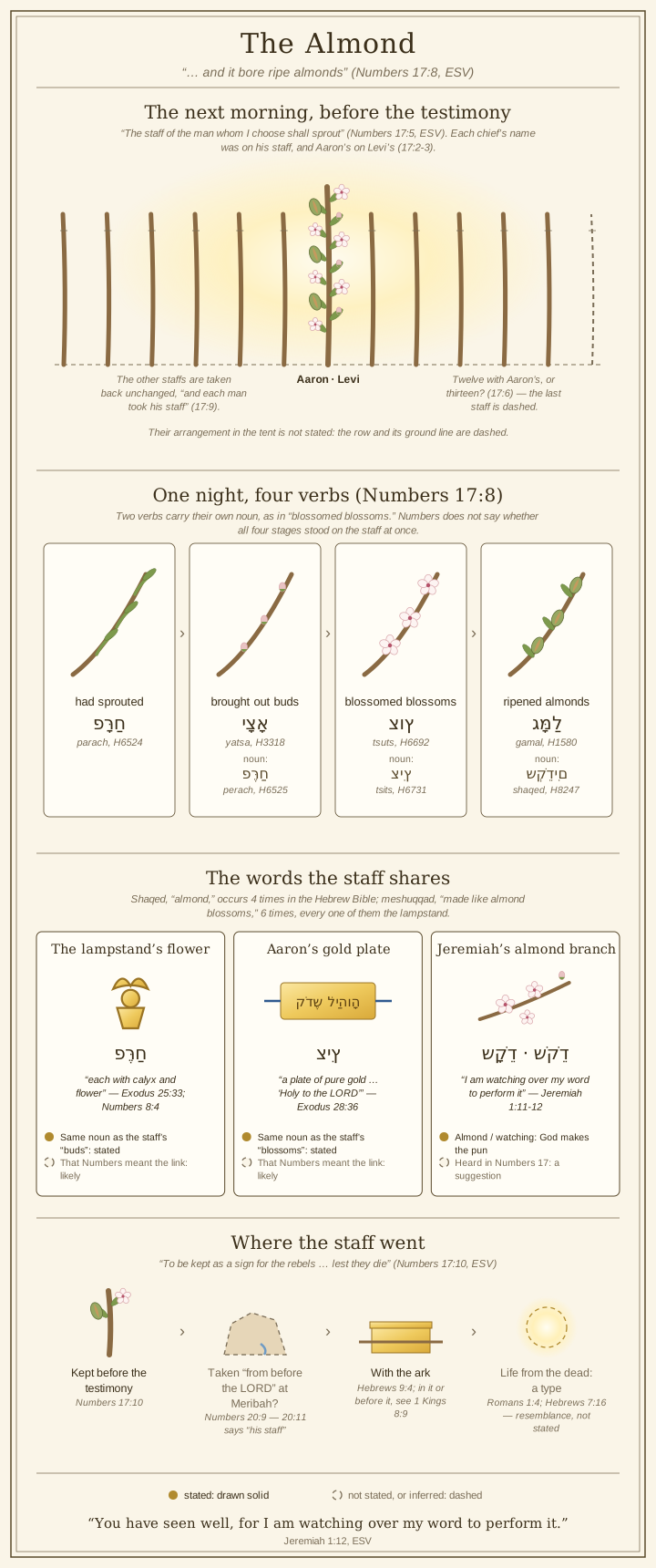
Numbers 17:8 piles up four verbs, and two of them carry their own noun. The staff "had sprouted"
(פָּרַח, *parach*, H6524); it "brought out buds" (יָצָא,
*yatsa*, H3318, with the noun פֶּרַח, *perach*); it "blossomed blossoms"
(צוּץ, *tsuts*, H6692, with the noun צִיץ, *tsits*,
H6731); and it "ripened almonds" (גָּמַל, *gamal*, H1580, "to bring to full
ripeness"). The ESV smooths these into "put forth buds and produced blossoms, and it bore ripe
almonds." The Hebrew lets the verb and its noun echo each other, as English does with "blossomed
blossoms. The *NIV Biblical
Theology Study Bible* observes that budding or even blossoming might happen in a night, but ripe
fruit cannot (note on Numbers 17:8). The other staffs were taken back unchanged
(Numbers 17:9). Only the staff with Aaron's name on it showed life.
### The words it shares
Two of those nouns reach into the rest of the tent.
- **The lampstand's flower.** *Perach* is the "flower" on every cup of the lampstand (Exodus 25:31,
33-34; 37:17-20) and the "flowers" Numbers 8:4 says were hammered work. The staff put out what the
lampstand was made to show.
- **The high priest's plate.** *Tsits* is the word for the gold plate on Aaron's turban: "You shall
make a plate of pure gold and engrave on it, like the engraving of a signet, 'Holy to the LORD'"
(Exodus 28:36, ESV; also Exodus 39:30; Leviticus 8:9). It shone on his forehead "that they may be
accepted before the LORD" (Exodus 28:38, ESV). The staff blossomed with the same word Aaron wore.
The shared words are certain. *Perach* and *tsits* are also ordinary Hebrew for a bud and a flower, and Numbers 17:8 may use them only
because they describe a branch in bloom. Taken with the almond itself, three things in the tent bore
one picture: the tree of light Aaron tended, the plate he wore, and the staff that bore his name. It
is likely, and not stated, that Israel was meant to see the three together.
### The almond's own word
The *NIV Biblical Theology Study Bible* hears Jeremiah's pun in Numbers 17 too. The almond, *shaqed*,
may point to the priests' duty of watching over the tent so that no outsider came near (note on
Numbers 17:8; Numbers 18:1-7). That reading is attractive and remains a suggestion: Numbers 18 uses a
different verb for the priests' guard duty, שָׁמַר (*shamar*, H8104). The tree whose name sounds like "watching" still marked the man God appointed to keep watch over
His house.
## A sign kept before the testimony
### Why God kept it
The other staffs went back to their owners. Aaron's went back into the tent:
> ✝️ Numbers 17:10 (ESV)
>
> 10 And the LORD said to Moses, "Put back the staff of Aaron before the testimony, to be kept as a
> sign for the rebels, that you may make an end of their grumblings against me, lest they die."
God kept it as mercy. The people had just watched 14,700 die in the plague (Numbers 16:49),
and the next rebellion would end the same way. The blossoming staff told every generation who could
come near without dying. The people understood the danger: "Everyone who comes near, who comes near
to the tabernacle of the LORD, shall die. Are we all to perish?" (Numbers 17:13, ESV).
Numbers 18 is God's answer to that cry. He gave Aaron and his sons charge of the sanctuary "that
there may never again be wrath on the people of Israel," and called the priesthood itself His gift:
"I give your priesthood as a gift" (Numbers 18:5, 7, ESV). The staff showed whom God had chosen; the
next chapter shows what He chose him for, which was to stand between a holy God and a sinful people
so that the people could live. [Before Aaron](https://the-way.lewy.au/jesus/priesthood-before-sinai/) traces how priesthood
was always God's appointment, from the fathers at their altars to the sons of Aaron.
### Where it went
The staff appears once more, possibly. At Meribah, "Moses took the staff from before the LORD, as he
commanded him" (Numbers 20:9, ESV), and then "struck the rock with his staff twice" (Numbers 20:11,
ESV). The *NIV Biblical Theology Study Bible* thinks the staff "from before the LORD" is most likely
the one that budded (note on Numbers 20:9). Verse 11 calls it "his staff," which suggests Moses' own
rod, so the identification is uncertain.
Hebrews lists "Aaron's staff that budded" (Hebrews 9:4, ESV) with the manna and the tablets in the
ark, where Numbers says "before the testimony" and 1 Kings 8:9 says the ark held only the tablets by
Solomon's day. [The Ark of the Covenant](https://the-way.lewy.au/jesus/the-heavenly-pattern/ark/#what-was-in-it) sets out the readings that keep all
three texts true. Hebrews' word for "budded," βλαστάνω (*blastanō*, G985), comes from the Greek of Numbers itself:
the Septuagint uses it twice in Numbers 17:8, for the sprouting and for the almonds. Hebrews names
the staff by the verb of its miracle.
## The Priest God chose
### Called, as Aaron was
Hebrews draws the principle that Numbers 17 proved and applies it to Jesus:
> ✝️ Hebrews 5:4-6 (ESV)
>
> 4 And no one takes this honor for himself, but only when called by God, just as Aaron was. 5 So
> also Christ did not exalt himself to be made a high priest, but was appointed by him who said to
> him, "You are my Son, today I have begotten you"; 6 as he says also in another place, "You are a
> priest forever, after the order of Melchizedek."
Korah's company tried to take the priesthood for themselves. Jesus received it from the Father, who
spoke Psalm 2:7 over Him and swore Psalm 110:4 (Hebrews 7:20-21). Psalm 110 has its own *matteh*: "The LORD
sends forth from Zion your mighty scepter" (Psalm 110:2, ESV), the staff of the priest-king two
verses before he is sworn "a priest forever." The shared word is real. Whether the psalmist meant
Aaron's staff to be heard in it, the text does not say. [Jesus, Priest in the Order of
Melchizedek](https://the-way.lewy.au/jesus/melchizedek-priesthood/) works through how Hebrews reads that psalm.
### By the power of an indestructible life
Hebrews then names what qualifies Jesus. Aaron's priesthood passed from father to son because every
priest died (Hebrews 7:23). Jesus' rests on something else:
> ✝️ Hebrews 7:15-16 (ESV)
>
> 15 This becomes even more evident when another priest arises in the likeness of Melchizedek, 16 who
> has become a priest, not on the basis of a legal requirement concerning bodily descent, but by the
> power of an indestructible life.
"Indestructible" is ἀκατάλυτος (*akatalytos*, G179), used only here in the New Testament.
### The type, and its limits
God settled Aaron's
priesthood by bringing life out of dead wood overnight, in the presence of the testimony. God settled
His Son's priesthood by raising Him from the dead, and Jesus "was declared to be the Son of God in
power ... by his resurrection from the dead" (Romans 1:4, ESV). Both times the sign was life where
there had been none, and both times it ended the argument over whom God had chosen.
That resemblance is what makes Aaron's staff a type. Hebrews names the staff (Hebrews 9:4) and states
the principle (Hebrews 5:4), but it never says "the staff pictured the resurrection," so the connection is a likely reading
and an unstated one. The early church made it. Justin Martyr wrote that "Aaron's rod, which
blossomed, declared him to be the high priest" (*Dialogue with Trypho* 86), and the *Apostolic
Constitutions* argue from it to the resurrection itself: "He that made Aaron's dry rod put forth
buds, will raise us up in glory" (5.7). [We Shall All Be
Changed](https://the-way.lewy.au/last-things/we-shall-all-be-changed/) follows the resurrection God has promised to
everyone who belongs to Jesus.
## What the almond shows about God
Each connection, sorted by how directly Scripture makes it:
| Connection | Where | How firm |
|---|---|---|
| The almond's name sounds like "watching," and God uses the pun | Jeremiah 1:11-12 | Stated |
| A priest must be called by God, as Aaron was, and Jesus was | Hebrews 5:4-6 | Stated |
| Jesus is priest by an indestructible life | Hebrews 7:16 | Stated |
| Aaron's staff was kept with the ark | Hebrews 9:4; Numbers 17:10 | Stated; inside the ark or before it is debated |
| The staff, the lampstand and Aaron's plate share *perach* and *tsits* | Exodus 25:33; 28:36; Numbers 17:8 | The words are stated; the intended link is likely |
| The almond in Numbers 17 recalls "watching" | Numbers 17:8; 18:1-7 | A suggestion (NIV BTSB); the guard verb differs |
| Moses struck the rock with Aaron's staff | Numbers 20:9-11 | Possible; verse 11 says "his staff" |
| The staff pictures the resurrection of Jesus | Numbers 17:8; Romans 1:4 | A type by resemblance; not stated in the New Testament |
God is awake. He watches over His word to perform it, for judgment and for restoration, and He can
make a dead branch bloom in a night. God also chooses who may come near Him, and He shows His
choice by giving life. He did it once with a stick of almond wood in the tent. He did it for all time
when He raised His Son Jesus and made Him a priest forever.
So you may come near. Come through the Priest God chose and raised, who "always lives to make
intercession" for those who "draw near to God through him" (Hebrews 7:25, ESV).
## Discussion Questions
1. **The language.** Jeremiah saw an almond, *shaqed*; God said He was *shoqed*, "watching over my
word to perform it" (Jeremiah 1:12). What did that pun give a prophet afraid to speak (Jeremiah
1:6-8)?
2. **The text in its context.** After the plague of Numbers 16, why did God keep the staff "lest
they die" (Numbers 17:10)?
3. **Christ.** Aaron's staff and Jesus' resurrection both show God's choice by giving life (Numbers
17:8; Romans 1:4); no New Testament writer joins them. What does Jesus' "indestructible life"
(Hebrews 7:16) hold that the staff never could?
4. **The hard part.** The staff's *perach* is the lampstand's "flower" (Exodus 25:33); its *tsits*
names Aaron's gold plate (Exodus 28:36). Both are also ordinary words for bud and flower. What in
Numbers 17 would show whether the echo was meant?
5. **Be transformed.** Israel cried, "Are we all to perish?" (Numbers 17:13). How would you answer
that for someone today, from Hebrews 7:25?
## References & Recommended Reading
- ***ESV Study Bible*** (Crossway, 2016) — notes on Numbers 17:1-13, 17:6 and 17:10, Jeremiah
1:11-12, Ecclesiastes 12:2-7 and Hebrews 9:4. ESV verse text throughout. Quoted briefly with
attribution.
- ***NIV Biblical Theology Study Bible*** (Zondervan, 2018), gen. ed. D. A. Carson — notes on
Numbers 17:8, Numbers 20:9, Ecclesiastes 12:5 and Jeremiah 1:11.
- ***NIV Cultural Backgrounds Study Bible*** (Zondervan, 2016), eds. Craig S. Keener and John H.
Walton — notes on Jeremiah 1:11 and Hebrews 9:4.
- ***Theological Wordbook of the Old Testament***, eds. R. Laird Harris, Gleason L. Archer Jr. and
Bruce K. Waltke (Moody, 1980) — entries 2451 (*shaqad*) and 2451a (*shaqed*), 1090b (*luz*).
- ***Legacy Standard Bible*** (Lockman, 2021) and ***NLT Life Application Study Bible*** — footnotes
on Numbers 17:1 giving the Hebrew numbering (English 17:1-13 is Hebrew 17:16-28, so Aaron's
almonds are Hebrew 17:23).
- Original-language data from this project's `bible-text.db` — unfoldingWord interlinear (UHB/ULT/UGNT)
for Numbers 17:2, 17:8, Exodus 28:36, Psalm 110:2, Ecclesiastes 12:5 and Hebrews 9:4; MACULA
concordance for שָׁקֵד (H8247), שָׁקַד (H8245),
מְשֻׁקָּד (H8246), לוּז (H3869),
מַטֶּה (H4294), פֶּרַח (H6525) and
צִיץ (H6731); WEB verse text.
- ***The Septuagint***, Brenton's edition (public domain) — Numbers 17:23 (English 17:8), for
βλαστάνω.
- Justin Martyr, ***Dialogue with Trypho*** 86, and the ***Constitutions of the Holy Apostles***
5.7, in the *Ante-Nicene Fathers* (vols. 1 and 7; public domain). Extra-biblical; cited as the
early church's reading, never as Scripture.
### On this site
- [The Heavenly Pattern](https://the-way.lewy.au/jesus/the-heavenly-pattern/) — the series this page belongs to.
- [The Lampstand](https://the-way.lewy.au/jesus/the-heavenly-pattern/lampstand/) — the almond tree of gold.
- [The Ark of the Covenant](https://the-way.lewy.au/jesus/the-heavenly-pattern/ark/) — where the staff was kept.
- [The Golden Altar of Incense](https://the-way.lewy.au/jesus/the-heavenly-pattern/incense-altar/) — Aaron's censer between the dead and the living.
- [Before Aaron: Who Offered Sacrifice?](https://the-way.lewy.au/jesus/priesthood-before-sinai/) — priesthood as God's
appointment.
- [Jesus, Priest in the Order of Melchizedek](https://the-way.lewy.au/jesus/melchizedek-priesthood/) — the Priest who holds
His office forever.
- [We Shall All Be Changed](https://the-way.lewy.au/last-things/we-shall-all-be-changed/) — the resurrection body.