---
title: "The Lampstand"
category: "theology"
description: "Exodus 25:31-40 to Revelation 1-2: the golden lampstand God showed Moses, hammered from one talent of gold as an almond tree in flower and kept burning every night, and the seven lampstands the risen Jesus walks among as High Priest of His churches."
tags: ["exodus", "leviticus", "numbers", "zechariah", "revelation", "temple", "priesthood", "holy-spirit", "method/typology", "method/word-study", "lang/hebrew", "lang/greek"]
draft: false
primary_passage: "Exodus 25:31-40"
bible_references: ["Exodus 25:31-40", "Exodus 26:35", "Exodus 27:20-21", "Exodus 28:4", "Exodus 37:17-24", "Exodus 40:24-25", "Leviticus 24:1-4", "Leviticus 26:12", "Numbers 8:1-4", "Numbers 17:8", "Numbers 17:10", "1 Samuel 3:3", "1 Kings 7:49", "1 Chronicles 28:15", "1 Chronicles 28:19", "2 Chronicles 4:7", "2 Chronicles 13:11", "Jeremiah 1:11-12", "Jeremiah 52:19", "Zechariah 3:4", "Zechariah 4:1-14", "Daniel 10:5", "Matthew 5:14-16", "John 8:12", "2 Corinthians 6:16", "Hebrews 8:5", "Hebrews 9:2", "Revelation 1:4", "Revelation 1:12-20", "Revelation 2:1-7", "Revelation 4:5", "Revelation 5:6", "Revelation 11:3-8", "Revelation 21:22-23", "Revelation 22:5", "Revelation 1:10", "Exodus 30:7", "Ezekiel 1:13", "Isaiah 22:21", "Zechariah 4:9", "Revelation 11:2", "Luke 9:28-33", "Malachi 4:4-5"]
date_created: 2026-09-28
date_modified: 2026-10-31
ai_provider_models:
- anthropic/claude-opus-5.5
---
# The Lampstand
*A tree of light before God, and the churches Jesus walks among*
John was on Patmos, "in the Spirit on the Lord's day" (Revelation 1:10, ESV), when a voice spoke behind him. He turned to
see who it was:
> ✝️ Revelation 1:12-13 (ESV)
>
> 12 Then I turned to see the voice that was speaking to me, and on turning I saw seven golden
> lampstands, 13 and in the midst of the lampstands one like a son of man, clothed with a long robe
> and with a golden sash around his chest.
The first thing John sees is a piece of tabernacle furniture. God had shown it to Moses on Sinai
centuries before, and Jesus explains it to John at the end of the chapter.
**In one sentence:** God told Moses to hammer one lampstand out of a single talent of gold, shaped as
an almond tree in flower and kept burning before Him every night on oil His people brought;
Revelation shows what it pictured, as the risen Jesus, robed most likely as High Priest, walks among
His churches as their lampstands, keeps them alight by His Spirit, and keeps the right to remove one
that stops shining.
This is the first furnishing in [The Heavenly Pattern](https://the-way.lewy.au/jesus/the-heavenly-pattern/), a series on the things God told
Moses to make "after the pattern for them, which is being shown you on the mountain" (Exodus 25:40,
ESV).
## Key Takeaways
*(This section follows the [Key Takeaways](https://the-way.lewy.au/about/key-takeaways/) format — see that page for
what each part is for.)*
### Types & Prophecy
- **The New Testament names this type itself.** "The seven lampstands are the seven churches"
(Revelation 1:20, ESV). Jesus gives the meaning of the lampstands in Revelation Himself.
- **Zechariah's lampstand is a prophecy with its interpretation attached.** A lampstand fed by olive
trees, with no priest pouring, means "Not by might, nor by power, but by my Spirit, says the LORD
of hosts" (Zechariah 4:6, ESV). Its two anointed ones return in Revelation 11 as the two
witnesses, whom this study takes to be Moses and Elijah.
### Lessons about Jesus
- **Jesus does the priest's work at the lamps.** Aaron kept the lampstand burning "from evening to
morning" (Exodus 27:21, ESV). Jesus "walks among the seven golden lampstands" (Revelation 2:1,
ESV), and He knows each church's works. His robe is most likely the high priest's; the reading is
argued below and marked as likely.
- **Jesus keeps the right to remove a lampstand.** "I will come to you and remove your lampstand from
its place, unless you repent" (Revelation 2:5, ESV).
- **In the city to come, the Lamb is the lamp.** "The glory of God gives it light, and its lamp is
the Lamb" (Revelation 21:23, ESV).
### Memory verses
> ✝️ Zechariah 4:6 (ESV)
>
> 6 Then he said to me, "This is the word of the LORD to Zerubbabel: Not by might, nor by power, but
> by my Spirit, says the LORD of hosts.
> ✝️ Revelation 21:23 (ESV)
>
> 23 And the city has no need of sun or moon to shine on it, for the glory of God gives it light, and
> its lamp is the Lamb.
### Be Transformed
- **Think.** Your church is a lampstand. Jesus walks among His churches and sees what He finds there.
- **Attitude.** Depend on the Holy Spirit for your light. Israel's lamp burned on oil the people
brought, and Zechariah saw it burn on oil God supplied.
- **Do.** Pray this week for the light of one church by name, your own or another, and ask Jesus,
who "walks among the seven golden lampstands" (Revelation 2:1, ESV), to keep it burning.
### Prayer
Father, You kept a light burning before You through every night in the wilderness, and You showed
Moses how to make it. Thank You that Your Son Jesus walks among His churches as our great High
Priest, and that You give us Your Holy Spirit as the oil we cannot supply ourselves. Keep our church
burning. Where we have left our first love, turn us back before our lampstand is taken away. Make us
shine in a dark place until we see the city whose lamp is the Lamb.
In Jesus' name. Amen.
## Study outline
- [Made after the pattern](#made-after-the-pattern). Exodus 25:31-40: one piece of gold, a count of
cups and lamps, and no measurements. The plate draws what the text gives.
- [The almond, a tree that watches](#the-almond-a-tree-that-watches). The lampstand's own word for
its cups, Jeremiah's almond branch and Aaron's rod.
- [Tended every night](#tended-every-night). Oil from the people, the priest at the lamps from evening
to morning, and where the light fell.
- [From one lampstand to ten, and to none](#from-one-lampstand-to-ten-and-to-none). Solomon's ten,
the lampstands Babylon carried off, Zechariah's vision and Ezekiel's temple.
- [Seven lampstands on Patmos](#seven-lampstands-on-patmos). Revelation 1-2: the churches as
lampstands, the High Priest's robe, and the warning to Ephesus.
- [Before the throne and in the city](#before-the-throne-and-in-the-city). The seven torches, the two
witnesses as Zechariah's olive trees, and the city with no lamp.
- [What the lampstand shows about God](#what-the-lampstand-shows-about-god). Each connection sorted
by how firmly Scripture makes it.
- [Discussion Questions](#discussion-questions). Six, for a group or on your own.
## Made after the pattern
The instructions for the lampstand come third in Exodus 25, after the ark and the table. They end with
the sentence Hebrews 8:5 quotes of the whole tabernacle:
> ✝️ Exodus 25:31-40 (ESV)
>
> 31 "You shall make a lampstand of pure gold. The lampstand shall be made of hammered work: its base,
> its stem, its cups, its calyxes, and its flowers shall be of one piece with it. 32 And there shall
> be six branches going out of its sides, three branches of the lampstand out of one side of it and
> three branches of the lampstand out of the other side of it; 33 three cups made like almond
> blossoms, each with calyx and flower, on one branch, and three cups made like almond blossoms, each
> with calyx and flower, on the other branch—so for the six branches going out of the lampstand.
> 34 And on the lampstand itself there shall be four cups made like almond blossoms, with their
> calyxes and flowers, 35 and a calyx of one piece with it under each pair of the six branches going
> out from the lampstand. 36 Their calyxes and their branches shall be of one piece with it, the whole
> of it a single piece of hammered work of pure gold. 37 You shall make seven lamps for it. And the
> lamps shall be set up so as to give light on the space in front of it. 38 Its tongs and their trays
> shall be of pure gold. 39 It shall be made, with all these utensils, out of a talent of pure gold.
> 40 And see that you make them after the pattern for them, which is being shown you on the
> mountain.
### One piece of gold
The word is מְנוֹרָה (*menorah*, meh-no-RAH, H4501), "lampstand," from the
root for light. Twice the text says it is מִקְשָׁה (*miqshah*, H4749),
"hammered work" (Exodus 25:31, 36), and three times that its parts are "of one piece with it"
(Exodus 25:31, 35, 36). The base,
the shaft, six branches and every cup were beaten out of one block of gold. The gold weighed a talent, about 34 kg, with the tongs and trays included (Exodus 25:39).
Most of its parts have plant names. The branches are קָנֶה (*qaneh*, H7070),
"stalks" or "reeds," and the cups have calyxes and flowers. The base is
יָרֵךְ (*yarekh*, H3409), literally "thigh," the part it stands on.
### Counts and no measurements
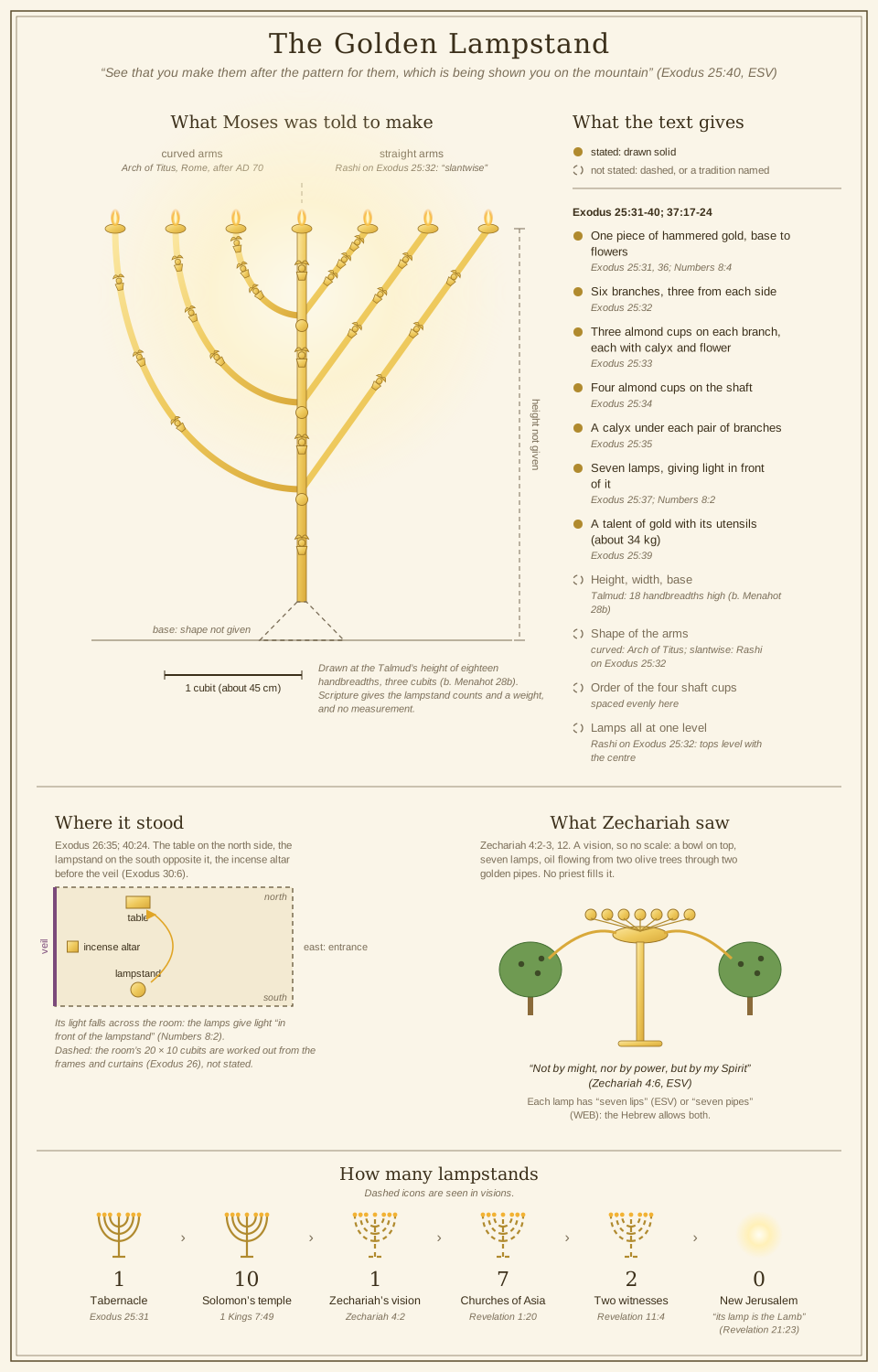
Exodus gives the lampstand's numbers exactly: six branches, seven lamps, three cups on each branch,
four on the shaft, a calyx under each pair of branches, twenty-two cups in all. It gives no height,
no width and no shape for the base. The ark has its cubits (Exodus 25:10), and so does the table
(Exodus 25:23). The lampstand has a weight.
So any drawing of it depends on tradition for its size and shape, and the plate below says which
parts come from where. The Talmud gives its height as eighteen handbreadths, about three cubits
(b. *Menahot* 28b). The shape of the arms has two witnesses that disagree. The Arch of Titus in Rome,
carved after the temple fell in AD 70, shows curved arms. Rashi, the eleventh-century Jewish
commentator, says the branches went out "slantwise," their tops level with the centre.[^rashi]
Straight arms are the natural reading of "slantwise," though Rashi does not say "straight." The plate
draws the curved arms on the left and the straight ones on the right, since Scripture settles
neither. It also draws the seven lamps at one level, which is Rashi's reading; Exodus does not say.
### "Being shown you"
The last verse puts the whole description under the pattern. The verb in Exodus 25:40 is a passive
participle, מָרְאֶה (*mor'eh*, from H7200, "being shown"). The ESV keeps it
as "which is being shown you on the mountain." Moses is seeing the pattern while God describes the
lampstand to him. When Numbers comes to light it, the text points back to that sight again: "according
to the pattern that the LORD had shown Moses, so he made the lampstand" (Numbers 8:4, ESV). The
Hebrew word there is מַרְאֶה (*mar'eh*, H4758), "appearance" or "vision."
Hebrews quotes Exodus 25:40 to say the tabernacle was "a copy and shadow of the heavenly things"
(Hebrews 8:5, ESV). The lampstand was made to match something Moses saw. Revelation shows John what
it matched.
## The almond, a tree that watches
Each cup is מְשֻׁקָּדִים (*meshuqqadim*, meh-shoo-kah-DEEM, H8246), "made
like almond blossoms." The word occurs six times in the Hebrew Bible, all of them in Exodus 25 and
37 and all of them of this lampstand.
It comes from שָׁקֵד (*shaqed*, shah-KAID, H8247), "almond." The *Theological
Wordbook of the Old Testament* files that noun under the same root as the verb
שָׁקַד (*shaqad*, H8245), "to watch, be wakeful." Jeremiah's call turns on the
pair:
> ✝️ Jeremiah 1:11-12 (ESV)
>
> 11 And the word of the LORD came to me, saying, "Jeremiah, what do you see?" And I said, "I see an
> almond branch." 12 Then the LORD said to me, "You have seen well, for I am watching over my word to
> perform it."
The almond is the first tree to bloom in the spring, which is why it was said to "watch for spring"
(*ESV Study Bible*, note on Jeremiah 1:11-12). The pun is certain in Jeremiah, where God makes it. It
is not stated in Exodus. What can be said is that the one furnishing lit through the night was
shaped as the tree whose name sounds like "watching."
The almond appears once more in the same tent. When Israel disputed Aaron's priesthood, God had a
staff from each tribe laid before the testimony, and Aaron's "had sprouted and put forth buds and
produced blossoms, and it bore ripe almonds" (Numbers 17:8, ESV). God told Moses to put it back
"before the testimony, to be kept as a sign" (Numbers 17:10, ESV). The priest God chose was marked by
an almond branch in flower, and he tended an almond tree of gold. [The Almond](https://the-way.lewy.au/jesus/the-heavenly-pattern/almond/) follows
the staff, the words it shares with this lampstand, and the Priest it points to.
Several study Bibles also read the lampstand as a stylised tree recalling the tree of life in Eden
(*ESV Study Bible* and *NIV Cultural Backgrounds Study Bible*, notes on Exodus 25:31-40). That reading
is widely held and fits the plant words. Exodus never names the tree of life, so this study holds the
reading loosely. Revelation does set the two side by side once: the letter that threatens to remove
Ephesus's lampstand (Revelation 2:5) closes with the promise "I will grant to eat of the tree of life"
(Revelation 2:7, ESV).
## Tended every night
The people supplied the oil. God told Moses:
> ✝️ Exodus 27:20-21 (ESV)
>
> 20 "You shall command the people of Israel that they bring to you pure beaten olive oil for the
> light, that a lamp may regularly be set up to burn. 21 In the tent of meeting, outside the veil
> that is before the testimony, Aaron and his sons shall tend it from evening to morning before the
> LORD. It shall be a statute forever to be observed throughout their generations by the people of
> Israel.
The whole nation brought the oil. Aaron kept the lamps. "Regularly" in verse 20 is
תָּמִיד (*tamid*, H8548), "continually," and Leviticus 24:2-4 repeats the
charge with the same word in each of its three verses. The lamp burned every night of the wilderness
years, "before the LORD."
The verb for setting up the lamps is the Hebrew for "going up." The *Legacy Standard Bible* notes
"Lit raise up" at Exodus 25:37 and Numbers 8:2. The same causative verb, עָלָה
(*alah*, H5927), is what Noah does with his burnt offerings (Genesis 8:20). The shared verb invites
the comparison: each evening the priest made the lamps go up before God, as offerings went up from the
altar. Exodus does not draw it, so hold it as a reading of the words.
### Where the light fell
The lampstand stood on the south side of the Holy Place, "opposite the table," with the table on the
north (Exodus 26:35; 40:24). God told Aaron, "the seven lamps shall give light in front of the
lampstand" (Numbers 8:2, ESV). The *ESV Study Bible* takes that to mean the light fell across the room
onto the table and its twelve loaves, one for each tribe (note on Numbers 8:1-4). The placement is in
the text; that the light was aimed at the bread is a sound inference from it.
### Keeping the lamp was keeping faith
Abijah makes the lamp a measure of Israel's faithfulness. The night God called Samuel, "the lamp of
God had not yet gone out" (1 Samuel 3:3, ESV), which tells the hour, before dawn; many readers also
hear in it the dimming of Eli's house, and that is a reading of the verse. Centuries later King Abijah stood on a mountain and told the northern tribes that Judah
still cared "for the golden lampstand that its lamps may burn every evening. For we keep the charge of
the LORD our God, but you have forsaken him" (2 Chronicles 13:11, ESV).
This shows that God wanted His house lit before Him every night, and that He gave the whole people a
share in keeping it lit. The priest trimmed the lamps; the people's olives filled them.
## From one lampstand to ten, and to none
### Solomon's temple
David handed Solomon the plan for the temple, including "the weight of the golden lampstands and
their lamps... the weight of silver for a lampstand and its lamps" (1 Chronicles 28:15, ESV). The
tabernacle had one lampstand and no silver ones. David says the plan came "in writing from the hand of
the LORD" (1 Chronicles 28:19, ESV), so the pattern grew with the house.
Solomon "made ten golden lampstands as prescribed, and set them in the temple, five on the south side
and five on the north" (2 Chronicles 4:7, ESV; 1 Kings 7:49). When Babylon burned the temple, the
captain of the guard carried off "the lampstands" with the other vessels, "what was of gold... as
gold" (Jeremiah 52:19, ESV).
### Zechariah's lampstand
After the exile, with the second temple half built (Zechariah 4:9), an angel woke the prophet
Zechariah in the night and showed him a lampstand:
> ✝️ Zechariah 4:2-3 (ESV)
>
> 2 And he said to me, "What do you see?" I said, "I see, and behold, a lampstand all of gold, with a
> bowl on the top of it, and seven lamps on it, with seven lips on each of the lamps that are on the
> top of it. 3 And there are two olive trees by it, one on the right of the bowl and the other on its
> left."
The oil runs from the trees to the lamps through "two golden pipes" (Zechariah 4:12, ESV). No priest
carries a jar. The angel gives the meaning: "Not by might, nor by power, but by my Spirit, says the
LORD of hosts" (Zechariah 4:6, ESV). The seven lamps are "the eyes of the LORD, which range through
the whole earth" (Zechariah 4:10, ESV). God keeps His own light burning, by His Spirit.
Zechariah then asks about the trees, and the angel names them: "These are the two anointed ones who
stand by the Lord of the whole earth" (Zechariah 4:14, ESV), literally "sons of fresh oil." Who they
were is contested: Zerubbabel the governor and Joshua the high priest (*ESV Study Bible*, note on
Zechariah 4:14), or the prophets Haggai and Zechariah (*NIV Biblical Theology Study Bible*). The
shape of the picture is not contested. God shows two men, anointed by Him, standing before the Lord of
the whole earth, and through them the Spirit keeps the light burning. That is the type Revelation 11
takes up (see [Two witnesses in Jerusalem](#two-witnesses-in-jerusalem) below).
### Ezekiel's temple
Ezekiel 40-48 describes a temple in great detail, with its altar measured to the handbreadth. The
lampstand is absent from it. A concordance search finds the word for "lampstand" nowhere in Ezekiel.
The series will take up what that absence means when it reaches Ezekiel's temple; here it is enough
to note that the light moves elsewhere.
## Seven lampstands on Patmos
Revelation uses the Greek word for "lampstand," λυχνία (*lychnia*, lookh-NEE-ah, G3087), seven times.
The rest of the New Testament has it five times: once for the tabernacle (Hebrews 9:2), and four times
in Jesus' saying about a lamp set "on a stand" (Matthew 5:15; Mark 4:21; Luke 8:16; 11:33).
### The churches are lampstands
Jesus Himself interprets what John saw:
> ✝️ Revelation 1:20 (ESV)
>
> 20 As for the mystery of the seven stars that you saw in my right hand, and the seven golden
> lampstands, the seven stars are the angels of the seven churches, and the seven lampstands are the
> seven churches.
Each church is a whole lampstand. Moses' one lampstand held seven lamps; John sees seven lampstands,
one for each congregation in Asia. The *Cultural Backgrounds Study Bible* notes that the seven-branched
lampstand was the most common symbol of Judaism across the Mediterranean world (note on Revelation
1:12). John's first readers would have recognised it at once as the lamp of God's house.
This is the lampstand's clearest meaning in Scripture, and it is given in Jesus' words. A church is
what God set in His house to give light before Him. Jesus had already used the same word of His
disciples. "You are the light of the world," He told them, and a lamp is set "on a stand, and it gives
light to all in the house" (Matthew 5:14-15, ESV), where the stand is λυχνία. Revelation does not quote
the saying, so joining the two is a reading; [Salt, Light and the Aroma of
Christ](https://the-way.lewy.au/christian-life/salt-light-and-aroma/#churches-as-lampstands) sets them side by side.
### The High Priest's robe
The one among the lampstands is "clothed with a long robe" (Revelation 1:13, ESV). The Greek is
ποδήρης (*podērēs*, po-DAY-race, G4158), "reaching to the feet," and this is its only use in the New
Testament. In the Greek Old Testament it is the word for the high priest's robe (Exodus 28:4, 31;
29:5). It is what Joshua the high priest is clothed in when his filthy garments are taken away
(Zechariah 3:4), one chapter before Zechariah's lampstand. It also dresses the man in linen of
Ezekiel 9:2.
Whether John means a priestly robe is contested. The *NIV Biblical Theology Study Bible* says the robe
and golden sash suggest a king, a high priest, or both. The *Cultural Backgrounds Study Bible* notes
the high-priestly reading and points to Daniel 10:5, "a man clothed in linen, with a belt of fine
gold" (ESV); the linen there is itself priestly dress. The case for the priestly reading is what the
robed figure does next.
### He walks among them
To Ephesus Jesus introduces Himself as "him who holds the seven stars in his right hand, who walks
among the seven golden lampstands" (Revelation 2:1, ESV). In the tabernacle only a priest went among
the lamps, and he went to tend them, "from evening to morning" (Exodus 27:21, ESV).
God had promised Israel, "I will make my dwelling among you... And I will walk among you and will be
your God" (Leviticus 26:11-12, ESV). Paul applies that promise to the church: "we are the temple of the
living God; as God said, 'I will make my dwelling among them and walk among them'" (2 Corinthians 6:16,
ESV). Revelation's verb is a close relative of the Greek Leviticus uses, and the echo is likely,
though John does not quote it.
### Remove your lampstand
Aaron came to the lamps "every morning when he dresses the lamps" (Exodus 30:7, ESV). Jesus comes to
each church and tells it what He finds: "I know your works, your toil and your patient endurance"
(Revelation 2:2, ESV). He finds a fault: "you have abandoned the love you had
at first" (Revelation 2:4, ESV). And He warns:
> ✝️ Revelation 2:5 (ESV)
>
> 5 Remember therefore from where you have fallen; repent, and do the works you did at first. If not,
> I will come to you and remove your lampstand from its place, unless you repent.
The lampstand is the church (Revelation 1:20), so to lose the lampstand is to stop being one of His
churches, whatever the congregation might go on doing (*ESV Study Bible* and *Cultural Backgrounds
Study Bible*, notes on Revelation 2:5). The priest dressed the
lamps; Jesus has the authority to take one away.
This shows that Jesus is present with His churches, sees each of them, and keeps them burning. He
walks among them now. He calls a failing church back before He acts, and He has the right to act.
## Before the throne and in the city
### Seven torches before the throne
When John is taken up into the throne room, "before the throne were burning seven torches of fire,
which are the seven spirits of God" (Revelation 4:5, ESV). The Lamb has "seven eyes, which are the
seven spirits of God sent out into all the earth" (Revelation 5:6, ESV). Zechariah's seven lamps were
"the eyes of the LORD, which range through the whole earth" (Zechariah 4:10, ESV), and the *Cultural
Backgrounds Study Bible* reads Revelation 4:5 as an allusion to Zechariah 4. The *NIV Biblical
Theology Study Bible* points instead to the torches among the living creatures of Ezekiel 1:13. John
sees torches here, and no lampstand.
The "seven spirits" are the Holy Spirit. John sends grace "from him who is and who was and who is to
come, and from the seven spirits who are before his throne," and from Jesus Christ (Revelation 1:4-5,
ESV), so the seven spirits stand beside the Father and the Son as the source of grace. The *ESV Study
Bible* reads the number as the Spirit's perfection, and the torches and eyes as His presence and
knowledge everywhere (note on Revelation 1:4-6). Some interpreters take the seven spirits as seven
angels, but that reading struggles to explain angels sending grace alongside the Father and the Son.
So heaven has its lamps too. The lamps before God's throne are the Holy Spirit, and the lampstands on
earth are the churches He fills.
### Two witnesses in Jerusalem
In Revelation 11 the nations "trample the holy city for forty-two months" (Revelation 11:2, ESV), and
God sends two prophets into it:
> ✝️ Revelation 11:3-4 (ESV)
>
> 3 And I will grant authority to my two witnesses, and they will prophesy for 1,260 days, clothed in
> sackcloth." 4 These are the two olive trees and the two lampstands that stand before the Lord of the
> earth.
This is Zechariah 4. The Greek has the article, "*the* two olive trees," the pair the reader already
knows, and they "stand before the Lord of the earth" as Zechariah's anointed ones "stand by the Lord of
the whole earth" (Zechariah 4:14, ESV). John makes one change: Zechariah saw one lampstand fed by two
trees, and John sees two of each, and both are the witnesses. They are the anointed ones and the light
at once, and God supplies their power as He supplied Zechariah's oil: "I will grant authority to my two
witnesses."
Who the two are is contested. Their powers are Moses' and Elijah's (Revelation 11:6), and this site
takes them to be Moses and Elijah, the two who stood with Jesus on the mountain of transfiguration and
spoke of His departure at Jerusalem (Luke 9:30-31). [The Two Witnesses](https://the-way.lewy.au/last-things/two-witnesses/)
sets out that case, the early church's Enoch-and-Elijah reading, the other answers, and the whole of
Revelation 11:1-14.
### The city has no lamp
The New Jerusalem has no temple (Revelation 21:22), and it has no lampstand either:
> ✝️ Revelation 22:5 (ESV)
>
> 5 And night will be no more. They will need no light of lamp or sun, for the Lord God will be their
> light, and they will reign forever and ever.
The lamp was made for the night. Aaron tended it "from evening to morning," and the city has no
evening. "The glory of God gives it light, and its lamp is the Lamb" (Revelation 21:23, ESV). The
light God kept burning in one room of a tent becomes the light of a whole city, and the Lamb is its
lamp. [The New
Jerusalem](https://the-way.lewy.au/last-things/new-jerusalem/) covers the city itself.
## What the lampstand shows about God
This table sorts the study's connections by how directly Scripture makes each one.
| Connection | Where | How firm |
|---|---|---|
| The lampstands are the churches | Revelation 1:20 | Stated by Jesus |
| The seven torches before the throne are the seven spirits | Revelation 4:5 | Stated in the vision; the link to the lampstand is an allusion (Zechariah 4 or Ezekiel 1:13) |
| Zechariah's lampstand runs on the Spirit | Zechariah 4:6 | Stated by the angel |
| The two witnesses are two lampstands and Zechariah's two olive trees | Revelation 11:4; Zechariah 4:3, 14 | Stated; a firm allusion to Zechariah |
| The two witnesses are Moses and Elijah | Revelation 11:6; Luke 9:30-31 | This site's reading ([The Two Witnesses](https://the-way.lewy.au/last-things/two-witnesses/)); the text names neither |
| Jesus is dressed as High Priest | Revelation 1:13 (*podērēs*) | Likely; others read the robe as royal (Isaiah 22:21) or as the heavenly man's of Daniel 10:5 |
| He walks among them as God walked among Israel | Revelation 2:1; Leviticus 26:12 | An echo |
| Jesus as "the light of the world" fulfils the lampstand | John 8:12 | An echo (spoken in the temple, John 8:20) |
| The almond cups recall God's watching | Jeremiah 1:11-12 | An inference from a pun |
| The lampstand is a tree of life | Exodus 25 (plant words) | A commentators' reading |
| Curved or straight arms; 18 handbreadths high | Arch of Titus; Rashi; Talmud | Tradition |
God wants a light burning before Him in the dark, and He gives His people the work of keeping it.
He gave Israel the oil to bring and a priest to tend it. He showed Zechariah that the oil is His Spirit.
And Jesus told John that the lampstands are churches, so the light God wants before Him now is your
congregation.
That means Jesus is among you. He walks among His churches today, as the priest went among the lamps.
He knows what your church does, where it is faithful and where it has let its first love go cold, and
He tells it so before He acts. He gives the Holy Spirit, so no church has to burn on its own strength.
So look after the light where you are. Bring what you have to the people and work of your church, as
Israel brought oil. When Jesus calls you back to the love you had at first, repent and do the first
works. Pray for your church by name. The night will end, and in the city that comes down from God the
Lamb is the lamp. Until then He has set your church in the dark to shine.
## Discussion Questions
1. **The language.** The cups are *meshuqqadim*, "made like almond blossoms," a word used only of
this lampstand, and Jeremiah's almond branch means "I am watching over my word" (Jeremiah 1:12).
What does it add to picture the lamp burning through the night in that shape?
2. **The text in its context.** The people brought the oil, and Aaron tended the lamps (Exodus
27:20-21). What does that division of labour say about the whole nation's part in God's house?
3. **The text in its context.** In Zechariah 4 the oil flows from the olive trees with no priest
pouring it. How does "Not by might, nor by power, but by my Spirit" (Zechariah 4:6) change the way
you read Exodus 27:20?
4. **Christ.** Aaron tended the lamps "from evening to morning" (Exodus 27:21), and the risen Jesus
"walks among the seven golden lampstands" (Revelation 2:1). How does seeing Him do the priest's
work at the lamps shape the way you hear His warning to Ephesus in Revelation 2:5?
5. **The hard part.** Revelation 1:20 calls the churches lampstands, and Revelation 11:4 calls two
witnesses lampstands. How do you hold those two identifications together?
6. **Be transformed.** Jesus warned Ephesus, "I will come to you and remove your lampstand"
(Revelation 2:5). What would "the works you did at first" look like in your church this year?
## References & Recommended Reading
- ***ESV Study Bible*** (Crossway, 2016) — notes on Exodus 25:31-40 (the lampstand as a stylised tree),
Numbers 8:1-4 (the light falling on the table), Jeremiah 1:11-12 (the almond pun), Zechariah 4:14,
Revelation 1:4-6 (the seven spirits), 2:4-5 and 11:3-14. ESV verse text throughout. Quoted briefly
with attribution.
- ***NIV Biblical Theology Study Bible*** (Zondervan, 2018), gen. ed. D. A. Carson — notes on Exodus
25:31-40 (the Arch of Titus form), Zechariah 4:14 (Haggai and Zechariah as the olive trees) and
Revelation 1:13 (the robe and sash).
- ***NIV Cultural Backgrounds Study Bible*** (Zondervan, 2016), eds. Craig S. Keener and John H.
Walton — notes on Exodus 25:31-40, Revelation 1:12 (the menorah as the common symbol of Judaism),
1:13 (the high priest and Daniel 10:5) and 4:5 (the allusion to Zechariah 4).
- ***Legacy Standard Bible*** (Lockman, 2021) and ***CSB Ancient Faith Study Bible*** (Holman, 2019)
— translators' footnotes on Exodus 25:37, 25:39, Numbers 8:2, Zechariah 4:2 and 4:14.
- ***Theological Wordbook of the Old Testament***, eds. R. Laird Harris, Gleason L. Archer Jr. and
Bruce K. Waltke (Moody, 1980) — root 2451, *shaqad*/*shaqed*.
- ***Babylonian Talmud*** *Menahot* 28b, via Sefaria — the lampstand's height of eighteen handbreadths,
in Samuel's name from an elder (Aramaic: גובהה של מנורה שמנה עשר טפחים).
Paraphrased from the original, not quoted from a translation.
- **Rashi** on Exodus 25:32, trans. M. Rosenbaum and A. M. Silbermann (public domain), via Sefaria — the
branches "slantwise," their tops level with the centre.
- Original-language data from this project's `bible-text.db` — unfoldingWord interlinear (UHB/ULT) for
Exodus 25:31-40, 27:20, Numbers 8:4, 17:8, Jeremiah 1:11-12, Zechariah 4:14, Genesis 8:20 and
Revelation 1:13 and 4:5; morphology concordance for מְנוֹרָה,
מְשֻׁקָּדִים, λυχνία and ποδήρης; WEB verse text.
### On this site
- [The Heavenly Pattern](https://the-way.lewy.au/jesus/the-heavenly-pattern/) — the series this page belongs to.
- [The Almond](https://the-way.lewy.au/jesus/the-heavenly-pattern/almond/) — Aaron's staff that budded, and the almond's name, "watching."
- [The Two Witnesses](https://the-way.lewy.au/last-things/two-witnesses/) — Revelation 11 and the case for Moses and Elijah.
- [Salt, Light and the Aroma of Christ](https://the-way.lewy.au/christian-life/salt-light-and-aroma/) — the lamp on
its stand (Matthew 5:15), where the stand is the same word as Revelation's lampstands.
- [Jesus, Priest in the Order of Melchizedek](https://the-way.lewy.au/jesus/melchizedek-priesthood/) — Hebrews' "copy and
shadow" argument, and Christ's priesthood in the true tabernacle.
- [The New Jerusalem](https://the-way.lewy.au/last-things/new-jerusalem/) — the city whose lamp is the Lamb.
[^rashi]: Rashi on Exodus 25:32, trans. M. Rosenbaum and A. M. Silbermann, via Sefaria.