---
title: "The Table and the Bread of the Presence"
category: "theology"
description: "Exodus 25:23-30 to Luke 22:30: the gold table in God's tent and the twelve loaves kept on it before His face every Sabbath, the holy bread David ate at Nob, Jesus' answer about it in the grainfields, the table of the Lord, and the table He promises in His kingdom."
tags: ["exodus", "leviticus", "1-samuel", "matthew", "luke", "1-corinthians", "hebrews", "temple", "priesthood", "sabbath", "method/typology", "method/word-study", "lang/hebrew", "lang/greek"]
draft: false
primary_passage: "Exodus 25:23-30"
bible_references: ["Exodus 24:9-11", "Exodus 25:23-30", "Exodus 26:35", "Exodus 33:14-15", "Exodus 37:10-16", "Exodus 40:22-23", "Leviticus 24:5-9", "Numbers 4:7", "1 Samuel 21:1-6", "1 Chronicles 9:32", "1 Chronicles 28:16", "2 Chronicles 4:8", "2 Chronicles 4:19", "Ezekiel 41:22", "Malachi 1:7", "Malachi 1:12", "Matthew 12:1-8", "Mark 2:23-28", "Luke 6:1-5", "Luke 22:29-30", "John 6:31-35", "1 Corinthians 10:21", "Hebrews 9:2", "Hebrews 9:5", "Exodus 25:10", "Leviticus 24:2-4", "1 Chronicles 9:2", "Numbers 28:9-10", "Hosea 6:6", "Psalm 23:5", "Psalm 50:12-13", "2 Samuel 9:7", "Exodus 24:8", "1 Kings 7:48", "2 Chronicles 29:18", "Luke 13:29", "Luke 22:20", "Matthew 26:28", "1 Corinthians 10:16-18"]
date_created: 2026-10-22
date_modified: 2026-10-22
ai_provider_models:
- anthropic/claude-opus-5.5
---
# The Table and the Bread of the Presence
*Bread set before God's face, and the table Jesus promises*
The last thing that happens on Sinai before God gives Moses the plan of His tent is a meal:
> ✝️ Exodus 24:9-11 (ESV)
>
> 9 Then Moses and Aaron, Nadab, and Abihu, and seventy of the elders of Israel went up, 10 and they
> saw the God of Israel. There was under his feet as it were a pavement of sapphire stone, like the
> very heaven for clearness. 11 And he did not lay his hand on the chief men of the people of Israel;
> they beheld God, and ate and drank.
Then God begins the pattern. After the ark that holds His covenant, the next thing He orders is a
table, with bread on it "before me regularly" (Exodus 25:30, ESV).
**In one sentence:** God set a table in His tent and kept twelve loaves of Israel's bread on it
before His face every Sabbath, then gave them to His priests to eat in a holy place; the New
Testament never explains the table, but Jesus defended His hungry disciples with its bread, the
church eats at the table of the Lord, and Jesus promises a place at His table in His kingdom, so
through His blood of the new covenant you are fed in God's presence now and will eat with Him there.
[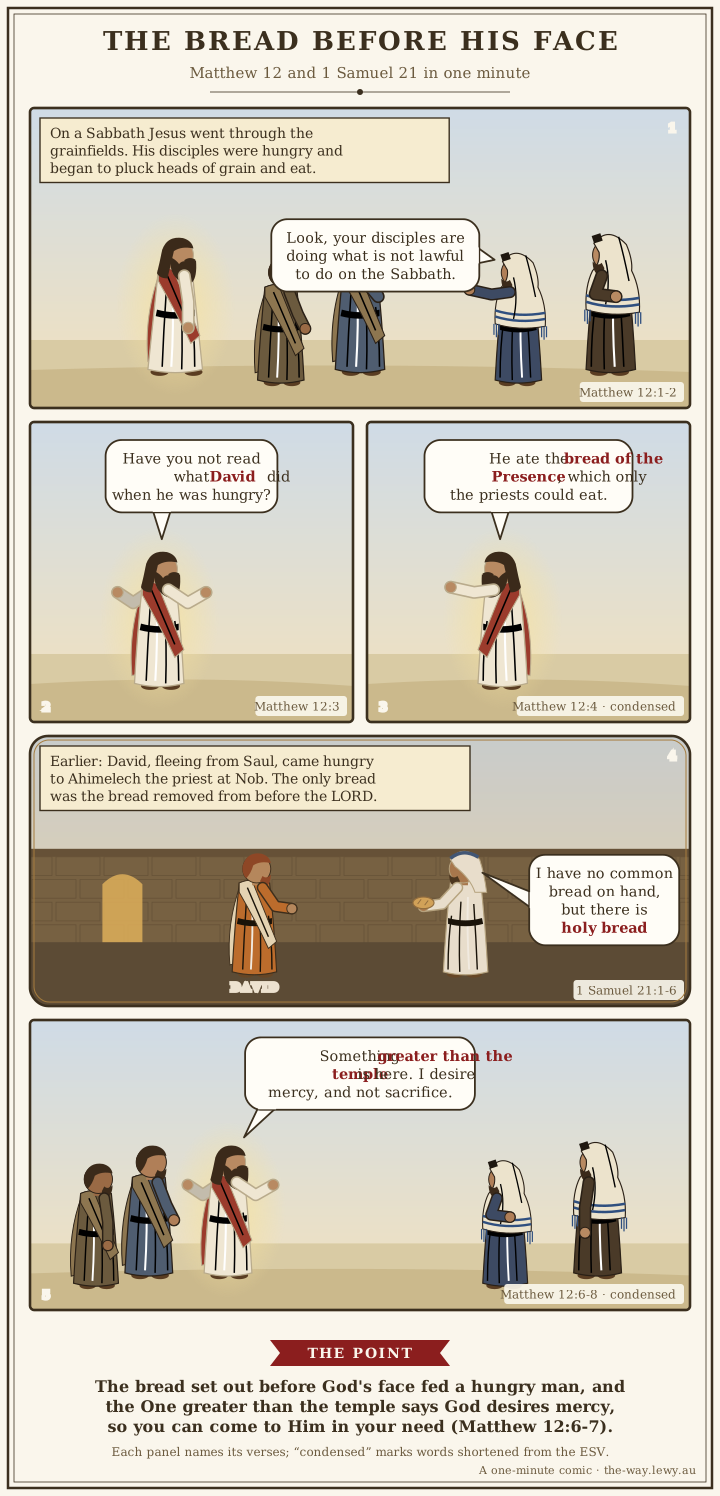](https://the-way.lewy.au/assets/img/comics/table.svg)
This is the fifth page of [The Heavenly Pattern](https://the-way.lewy.au/jesus/the-heavenly-pattern/), after [The Lampstand](https://the-way.lewy.au/jesus/the-heavenly-pattern/lampstand/),
[The Golden Altar of Incense](https://the-way.lewy.au/jesus/the-heavenly-pattern/incense-altar/), [The Ark of the Covenant](https://the-way.lewy.au/jesus/the-heavenly-pattern/ark/) and [The
Almond](https://the-way.lewy.au/jesus/the-heavenly-pattern/almond/).
## Key Takeaways
*(This section follows the [Key Takeaways](https://the-way.lewy.au/about/key-takeaways/) format — see that page for
what each part is for.)*
### Types & Prophecy
- **The New Testament names the table and does not interpret it.** Hebrews lists "the lampstand and
the table and the bread of the Presence" in the first tent (Hebrews 9:2, ESV), and stops: "Of these
things we cannot now speak in detail" (Hebrews 9:5, ESV). Every connection from the table to Christ
on this page is an echo or an inference, and the last section sorts them.
- **Jesus promises a table in His kingdom.** "I assign to you, as my Father assigned to me, a
kingdom, that you may eat and drink at my table in my kingdom" (Luke 22:29-30, ESV). He promises
it beyond the Twelve: "people will come from east and west, and from north and south, and recline
at table in the kingdom of God" (Luke 13:29, ESV).
### Lessons about Jesus
- **Jesus is greater than the temple.** When the authorities charged His hungry disciples, He pointed
them to David eating the bread of the Presence and said, "something greater than the temple is
here" (Matthew 12:6, ESV). The Greek is neuter, μεῖζον (*meizon*, G3187, "something
greater"); it is read of Jesus Himself, who goes on to call Himself "lord of the Sabbath" (Matthew
12:8, ESV), and some read it of the kingdom present in Him.
- **Jesus defends the hungry with mercy.** "I desire mercy, and not sacrifice" (Matthew 12:7, ESV).
The bread kept before God's face fed a hungry man, and the Son of Man, Lord of the Sabbath, defends
the hungry who follow Him.
- **Jesus is the host of the table.** Paul calls it "the table of the Lord" (1 Corinthians 10:21,
ESV), and Jesus calls it "my table" (Luke 22:30, ESV).
### Memory verses
> ✝️ Exodus 25:30 (ESV)
>
> 30 And you shall set the bread of the Presence on the table before me regularly.
> ✝️ Luke 22:29-30 (ESV)
>
> 29 and I assign to you, as my Father assigned to me, a kingdom, 30 that you may eat and drink at my
> table in my kingdom and sit on thrones judging the twelve tribes of Israel.
### Be Transformed
- **Think.** God set bread before His own face every week, and He wants His people near Him and fed.
- **Attitude.** Come to God hungry. The One greater than the temple is merciful to the hungry who
follow Him.
- **Do.** The next time you take the Lord's Supper, read Luke 22:29-30 first, and thank Jesus by name
for the place He has given you at His table.
### Prayer
Father, You fed Your people in Your presence on the mountain and kept bread before Your face in Your
tent, week after week. Thank You for Your Son Jesus, greater than the temple, who defended the hungry
with the holy bread, gave His blood for the new covenant and set His own table for us. Feed us from Your hand, keep us at the table of the Lord
alone, and bring us to eat with Him in His kingdom.
In Jesus' name. Amen.
## Study outline
- [Made after the pattern](#made-after-the-pattern). Exodus 25:23-30: a gold table with a rim, rings
and gold vessels. The plate draws it to scale, and where it stood in the tent.
- [The bread of the Face](#the-bread-of-the-face). What "bread of the Presence" says in Hebrew, the
twelve loaves, and the Sabbath when they were changed.
- [From the wilderness to the temple](#from-the-wilderness-to-the-temple). The table on the march, in
Solomon's temple and after the exile, in Ezekiel's vision, and in Hebrews 9.
- [David ate the holy bread](#david-ate-the-holy-bread). 1 Samuel 21 at Nob, and Jesus' reading of
it in Matthew 12.
- [The table of the Lord](#the-table-of-the-lord). Malachi, Paul, and the table in the kingdom.
- [What the table shows about God](#what-the-table-shows-about-god). Each connection sorted by how
firmly Scripture makes it.
- [Discussion Questions](#discussion-questions). Five, for a group or on your own.
## Made after the pattern
The table is the second thing God describes, straight after the ark and before the lampstand:
> ✝️ Exodus 25:23-30 (ESV)
>
> 23 "You shall make a table of acacia wood. Two cubits shall be its length, a cubit its breadth, and
> a cubit and a half its height. 24 You shall overlay it with pure gold and make a molding of gold
> around it. 25 And you shall make a rim around it a handbreadth wide, and a molding of gold around the
> rim. 26 And you shall make for it four rings of gold, and fasten the rings to the four corners at its
> four legs. 27 Close to the frame the rings shall lie, as holders for the poles to carry the table.
> 28 You shall make the poles of acacia wood, and overlay them with gold, and the table shall be
> carried with these. 29 And you shall make its plates and dishes for incense, and its flagons and
> bowls with which to pour drink offerings; you shall make them of pure gold. 30 And you shall set the
> bread of the Presence on the table before me regularly.
### A table
The word is שֻׁלְחָן (*shulchan*, shool-KHAHN, H7979), the ordinary Hebrew
word for a table, used 71 times in the Old Testament. It is the king's table where Mephibosheth ate
(2 Samuel 9:7) and the table God prepares "in the presence of my enemies" (Psalm 23:5, ESV). God asked
for a piece of household furniture in His house, the place where a household eats.
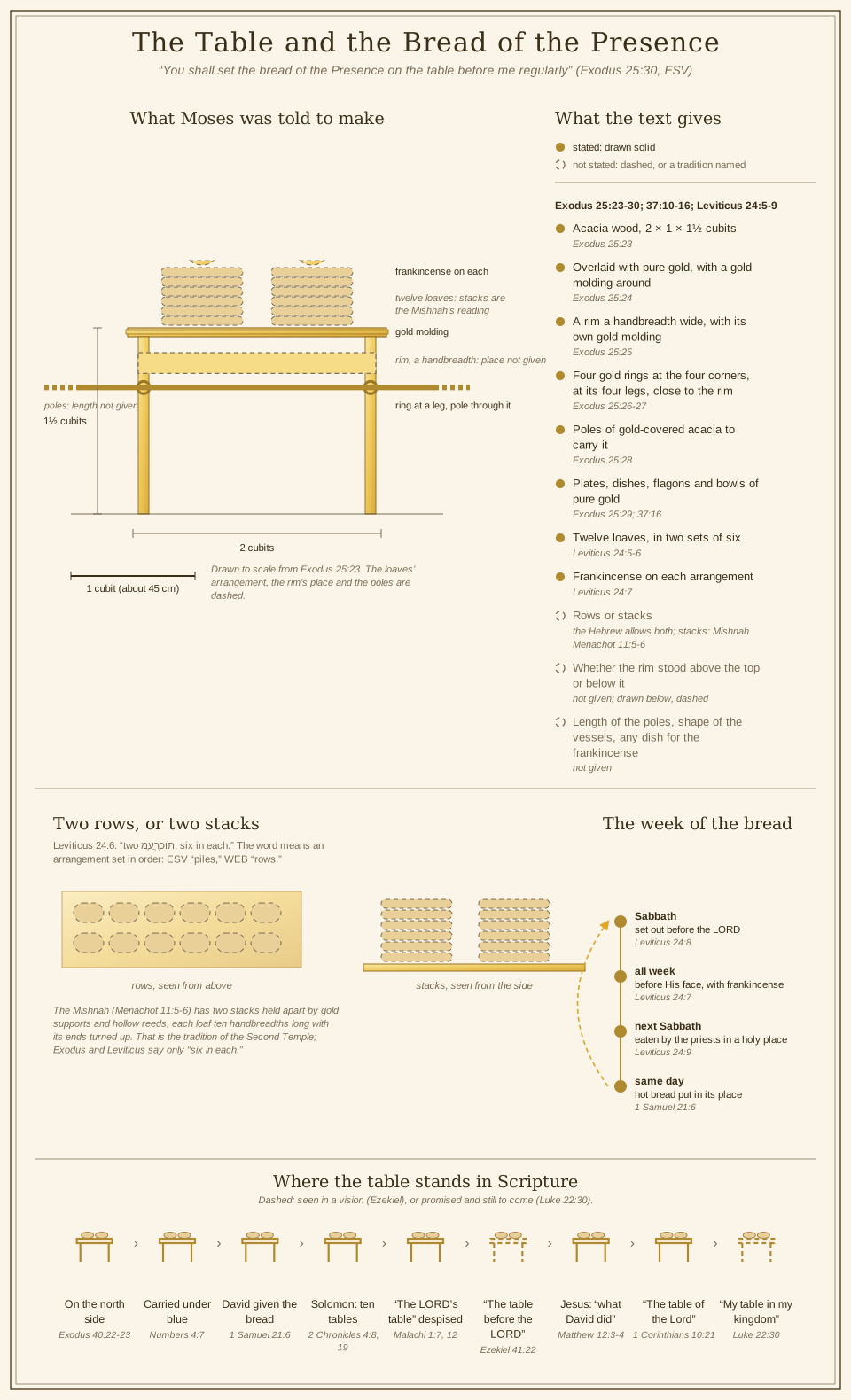
Its size is about 90 cm long, 45 cm wide and 68 cm high, the same height as the ark (Exodus 25:10). It had a rim a
handbreadth wide, about 7.5 cm, with its own gold molding (Exodus 25:25), and the rings for its poles
lay "close to the frame" (Exodus 25:27). The same word, מִסְגֶּרֶת
(*misgeret*, H4526), is "rim" in verse 25 and "frame" in verse 27, so the rings sat at the rim, at the
level of the legs where they joined it. Whether the rim stood up around the top or ran between the
legs below it, the text does not say.
The vessels went on the table, and every one was pure gold: plates, dishes for incense, flagons and
bowls "with which to pour drink offerings" (Exodus 25:29, ESV). The Legacy Standard Bible gives the
first as "dishes" with the footnote "Or platters". The Bible names them and gives no shapes.
### Drawn to scale
The plate draws the table at Exodus 25:23's measurements, with everything the text leaves out drawn
dashed: the place of the rim, the length of the poles, and how the twelve loaves were laid out.
### On the north side, facing the lampstand
The table stood "on the north side of the tabernacle, outside the veil" (Exodus 40:22, ESV), with the
lampstand opposite it on the south (Exodus 26:35). [The Lampstand](https://the-way.lewy.au/jesus/the-heavenly-pattern/lampstand/#where-the-light-fell)
covers how its light fell across the room onto the bread.
## The bread of the Face
### "Before me"
"Bread of the Presence" is לֶחֶם פָּנִים (*lechem panim*, LEH-khem
pah-NEEM, H3899, H6440), and *panim* is the Hebrew word for "face". The Legacy Standard Bible's
footnote on Exodus 25:30 says so plainly: "Lit Face". The verse uses the word twice. Read word for
word, God says, "you shall set bread of the Face on the table before My face, continually." The Greek
Old Testament keeps the thought with ἄρτους ἐνωπίους (*artous enōpious*, G740, "loaves of the presence"). The KJV's "shewbread"
names the bread for being set out on show; the Hebrew names whose face it was set before.
When God promised to go with Israel after the golden calf, He used the same word: "My presence will
go with you, and I will give you rest" (Exodus 33:14, ESV), where "my presence" is *panai*, "My
face". Moses answered, "If your presence will not go with me, do not bring us up from here" (Exodus
33:15, ESV). The bread was kept where God's presence was.
"Regularly" is תָּמִיד (*tamid*, H8548), "continually", the word used of the
lamps that burned every night (Leviticus 24:2-4); the Legacy Standard Bible reads "at all times" and
footnotes "Or continually". Every day of the year the table held bread before God.
### Twelve loaves every Sabbath
Leviticus gives the bread's recipe and its week:
> ✝️ Leviticus 24:5-9 (ESV)
>
> 5 "You shall take fine flour and bake twelve loaves from it; two tenths of an ephah shall be in each
> loaf. 6 And you shall set them in two piles, six in a pile, on the table of pure gold before the
> LORD. 7 And you shall put pure frankincense on each pile, that it may go with the bread as a memorial
> portion as a food offering to the LORD. 8 Every Sabbath day Aaron shall arrange it before the LORD
> regularly; it is from the people of Israel as a covenant forever. 9 And it shall be for Aaron and
> his sons, and they shall eat it in a holy place, since it is for him a most holy portion out of the
> LORD's food offerings, a perpetual due."
"Before the LORD" in verses 6 and 8 is again "before the face of the LORD". The bread was Israel's:
it came "from the people of Israel as a covenant forever" (Leviticus 24:8, ESV), twelve loaves of
their own fine flour. The frankincense went up to God as the memorial portion, and the bread came back
to God's priests, who ate it in a holy place.
Israel's neighbours kept food before their gods' statues to feed them, and the *NIV Cultural
Backgrounds Study Bible* notes that bread laid out before a god is attested in Egypt, Mesopotamia and
Anatolia, set out daily where this bread was set out weekly (note on Exodus 25:30).
The ESV's "two piles" and the WEB's "two rows" translate one word,
מַעֲרָכָה (*ma'arakhah*, H4634), an arrangement set in order, from the verb
"arrange" in verse 8. The Hebrew allows either, and the plate draws both. The Mishnah, written down
about AD 200, describes the Second Temple's practice: two stacks of six, held apart by gold supports
and hollow reeds so the air could pass between them (Mishnah *Menachot* 11:5-6). It also records Ben
Zoma reading Exodus 25:30's "bread of the Face" to mean the loaves "must have faces" (Mishnah
*Menachot* 11:4), so the shape of the loaf was drawn from the name. That is the tradition of the
Second Temple, and Scripture says only "six in a pile."
### Bread kept for God's priests
God takes His people's bread before His face and gives it to those who serve Him, Aaron and his sons,
as "a most holy portion" (Leviticus 24:9, ESV). He says through Asaph why: "If I were hungry, I would not tell you, for the world and its
fullness are mine. Do I eat the flesh of bulls or drink the blood of goats?" (Psalm 50:12-13, ESV).
In His presence God is the one who feeds.
## From the wilderness to the temple
On the march the table was covered "with a cloth of blue" and carried with its vessels and "the
regular showbread also" on it (Numbers 4:7, ESV), so the bread stayed before God even on the road.
### In Solomon's temple and after the exile
David gave Solomon "the weight of gold for each table for the showbread, the silver for the silver
tables" (1 Chronicles 28:16, ESV), and Solomon made ten tables for the temple, "five on the south side
and five on the north" (2 Chronicles 4:8, ESV), among them "the tables for the bread of the Presence"
(2 Chronicles 4:19, ESV). One table became ten, as one lampstand did. Kings names a single "golden
table for the bread of the Presence" (1 Kings 7:48, ESV), and so does Chronicles in Hezekiah's day
(2 Chronicles 29:18), so whether the bread lay on one of Solomon's ten tables or on all of them is
left open.
After the exile, the Chronicler's list of those who served again at God's house records that "some
of their kinsmen of the Kohathites had charge of the showbread, to prepare it every Sabbath"
(1 Chronicles 9:32, ESV; the list opens at 9:2). The Chronicler's "showbread" there is
*lechem hamma'arekhet*, "bread of the arrangement", from the root of Leviticus 24:6's two "piles".
### Ezekiel's table before the LORD
Ezekiel's vision of the temple has an altar of wood, three cubits high and two long, and his guide
tells him, "This is the table that is before the LORD" (Ezekiel 41:22, ESV). The table is named
again, and again it stands "before the face of" the LORD. (What Ezekiel's temple is, and when, is the
question the series sets aside for the bronze altar.)
### Listed in Hebrews 9
Hebrews lists the table in the first room of the tent, "in which were the lampstand and the table and
the bread of the Presence" (Hebrews 9:2, ESV). The Greek for "the bread of the Presence" is "the
setting out of the loaves", ἡ πρόθεσις τῶν ἄρτων, with πρόθεσις (*prothesis*, G4286, "presentation,
setting out").
## David ate the holy bread
### At Nob
Fleeing from Saul, David came hungry to Ahimelech the priest at Nob and asked for five loaves:
> ✝️ 1 Samuel 21:4-6 (ESV)
>
> 4 And the priest answered David, "I have no common bread on hand, but there is holy bread— if the
> young men have kept themselves from women." 5 And David answered the priest, "Truly women have been
> kept from us as always when I go on an expedition. The vessels of the young men are holy even when
> it is an ordinary journey. How much more today will their vessels be holy?" 6 So the priest gave him
> the holy bread, for there was no bread there but the bread of the Presence, which is removed from
> before the LORD, to be replaced by hot bread on the day it is taken away.
The narrator says the bread was "removed from before the LORD", literally "from before the face of
the LORD", the old loaves taken off on the day the hot ones went on. Leviticus gave that bread to the
priests (Leviticus 24:9). Ahimelech gave it to a hungry man, and the narrator of 1 Samuel does not
condemn him for it.
### "Have you not read?"
A thousand years later, on a Sabbath, Jesus' disciples were hungry and plucked heads of grain as they
walked through a field (Matthew 12:1). The Pharisees said, "Look, your disciples are doing what is
not lawful to do on the Sabbath" (Matthew 12:2, ESV). Jesus answered from 1 Samuel 21:
> ✝️ Matthew 12:3-8 (ESV)
>
> 3 He said to them, "Have you not read what David did when he was hungry, and those who were with
> him: 4 how he entered the house of God and ate the bread of the Presence, which it was not lawful for
> him to eat nor for those who were with him, but only for the priests? 5 Or have you not read in the
> Law how on the Sabbath the priests in the temple profane the Sabbath and are guiltless? 6 I tell
> you, something greater than the temple is here. 7 And if you had known what this means, 'I desire
> mercy, and not sacrifice,' you would not have condemned the guiltless. 8 For the Son of Man is lord
> of the Sabbath."
Jesus builds the argument in steps. The bread of the Face belonged to the priests, and Scripture
records it going to the hungry David without blame. The priests work in the temple every Sabbath, offering
the Sabbath sacrifices (Numbers 28:9-10) and setting out this very bread (Leviticus 24:8), and are
guiltless. Then He says that something greater
than the temple is standing in the field. If the temple's service set the Sabbath's rule aside, the
One greater than the temple may feed His own on it. And God, through Hosea, has already said what He
wants: "I desire mercy, and not sacrifice" (Matthew 12:7, ESV, quoting Hosea 6:6, where the ESV
renders חֶסֶד, *chesed*, "steadfast love"). Mark adds that
"the Sabbath was made for man, not man for the Sabbath" (Mark 2:27, ESV), and Luke tells the same
account (Luke 6:1-5).
The point Jesus draws is about Himself and the Sabbath, and it shows the God the bread belonged to:
the bread set before His face fed a hungry man, and the Lord of the Sabbath is merciful to the hungry
who follow Him.
## The table of the Lord
### The LORD's table in Malachi
Malachi charged the priests of his day with despising God's table. They offered "polluted food upon
my altar", saying "that the LORD's table may be despised" (Malachi 1:7, ESV), and profaned it "when
you say that the Lord's table is polluted, and its fruit, that is, its food may be despised" (Malachi
1:12, ESV). Malachi sets "my altar" and "the LORD's table" side by side, the place where God received His
people's gifts.
### The table of the Lord at Corinth
Paul uses the phrase of the church's meal: "You cannot drink the cup of the Lord and the cup of
demons. You cannot partake of the table of the Lord and the table of demons" (1 Corinthians 10:21,
ESV). The Greek is τράπεζα (*trapeza*, G5132), "table", and Paul's "table of the Lord" is the Greek
Old Testament's own wording at Malachi 1:7 and 12. The two passages share the phrase without Paul
quoting Malachi, and he sets it against the idol feasts of Corinth. His comparison is Israel eating
at the altar: "are not those who eat the sacrifices participants in the altar?" (1 Corinthians
10:18, ESV). [The Lord's Supper](https://the-way.lewy.au/feasts/lords-supper/#the-table-of-the-lord-alone)
works through what that means for the church.
### "My table in my kingdom"
Then, at the Last Supper, Jesus promised His disciples:
> ✝️ Luke 22:29-30 (ESV)
>
> 29 and I assign to you, as my Father assigned to me, a kingdom, 30 that you may eat and drink at my
> table in my kingdom and sit on thrones judging the twelve tribes of Israel.
In the tent, priests ate the bread of the Face in a holy place. In the kingdom, Jesus seats His own at
His table. [The Last Supper and the Cups of Passover](https://the-way.lewy.au/feasts/last-supper-four-cups/) takes up
the cup Jesus vowed to drink new in that kingdom.
## What the table shows about God
This table sorts the study's connections by how directly Scripture makes each one.
| Connection | Where | How firm |
|---|---|---|
| Jesus cites the bread of the Presence to defend His hungry disciples | Matthew 12:3-8 | Stated |
| Hebrews lists the table in the first tent | Hebrews 9:2 | Stated, and left uninterpreted (Hebrews 9:5) |
| Jesus promises His own a table in His kingdom | Luke 22:29-30 | Stated, as promise; its link to the tent's table is an echo |
| "The table of the Lord" | Malachi 1:7, 12; 1 Corinthians 10:21 | A shared phrase, the Septuagint's τράπεζα κυρίου; Paul does not quote Malachi |
| The tent's table carries on the meal of Exodus 24:11 | Exodus 24:11; 25:23-30 | Inferred from the order of Exodus |
| The twelve loaves stand for the twelve tribes | Leviticus 24:5-8 | Inferred: twelve loaves "from the people of Israel"; the text pairs no loaf with a tribe |
| Jesus is the bread before God's face | John 6:35 | Read in: John 6 draws on the manna (John 6:31-33), and no text joins it to the table |
| Two stacks of six, with faces | Mishnah *Menachot* 11:4-6 | Tradition, outside Scripture |
God wants His people near Him and fed. On Sinai the elders "beheld God, and ate and drank" (Exodus
24:11, ESV), and in His tent He kept twelve loaves of His people's bread before His face every
Sabbath, and gave them to His priests to eat. When David came hungry, the bread fed him. When the
disciples were hungry, the One greater than the temple defended them with that bread and with God's
own word, "I desire mercy" (Matthew 12:7, ESV).
That nearness is bought with blood. The Sinai meal came after Moses threw "the blood of the
covenant" on the people (Exodus 24:8, ESV), and the loaves were set out "as a covenant forever"
(Leviticus 24:8, ESV). At the Last Supper the cup is "the new covenant in my blood" (Luke 22:20, ESV)
before Jesus promises His table (Luke 22:29-30). Scripture states the order in both; that the second
meal answers the first is an echo, carried by Jesus' words "my blood of the covenant" (Matthew 26:28,
ESV). This is communion with God: the bread and cup of the Lord's table are "a participation in the
blood of Christ" and "in the body of Christ" (1 Corinthians 10:16, ESV).
So come to Jesus hungry. By His blood you are brought near and fed in God's presence. He is the Lord
of the Sabbath and the host of the table of the Lord, and He has promised that you will eat and drink
at His table in His kingdom.
## Discussion Questions
1. **The language.** *Lechem panim* is "bread of the Face", set "before My face" (Exodus 25:30).
What does that name say about where the bread was, and for whom?
2. **The text in its context.** Exodus 24:11 ends with the elders eating and drinking before God,
and Exodus 25 begins the tent with an ark and a table. What does that order suggest God was making
room for?
3. **Christ.** In Matthew 12:3-8 Jesus says "something greater than the temple is here." How does the
bread of the Presence make that claim sharper?
4. **The hard part.** Leviticus 24:9 gave the bread to the priests, and Ahimelech gave it to David.
Jesus says the priests profane the Sabbath and are guiltless (Matthew 12:5). How does He hold the
law and mercy together without setting the law aside?
5. **Be transformed.** Jesus promises His own a place at His table in His kingdom (Luke 22:29-30).
How will that change the way you come to the Lord's Supper next time?
## References & Recommended Reading
- ***ESV Study Bible*** (Crossway, 2016) — notes on Exodus 24:9-11, Exodus 25:23-30, Leviticus
24:1-9 and 24:5-9, and Matthew 12:4. ESV verse text throughout. Quoted briefly with attribution.
- ***NIV Cultural Backgrounds Study Bible*** (Zondervan, 2016), eds. Craig S. Keener and John H.
Walton — note on Exodus 25:30 (bread before the gods in the ancient Near East).
- ***NIV Biblical Theology Study Bible*** (Zondervan, 2018), gen. ed. D. A. Carson — notes on Exodus
24:11, Exodus 25:30 and 1 Samuel 21:6.
- ***Legacy Standard Bible*** (Lockman, 2021) — footnotes on Exodus 25:29, 25:30 and Matthew 12:4.
- ***Mishnah*** *Menachot* 11:4-6, Sefaria Community Translation (CC0), via Sefaria — the arrangement
of the loaves in the Second Temple. Extra-biblical; cited as tradition, never as Scripture.
- Original-language data from this project's `bible-text.db` — unfoldingWord interlinear (UHB/ULT/UGNT)
for Exodus 25:29-30, 33:14, Leviticus 24:6, 8, 1 Samuel 21:6, Ezekiel 41:22, Malachi 1:7 and Luke
22:30; morphology concordance for שֻׁלְחָן, πρόθεσις and τράπεζα; WEB verse
text.
### On this site
- [The Heavenly Pattern](https://the-way.lewy.au/jesus/the-heavenly-pattern/) — the series this page belongs to.
- [The Lampstand](https://the-way.lewy.au/jesus/the-heavenly-pattern/lampstand/) — the light across the Holy Place from the table.
- [The Lord's Supper](https://the-way.lewy.au/feasts/lords-supper/) — the table of the Lord.
- [Bread of Life](https://the-way.lewy.au/jesus/bread-of-life-feeding-the-multitudes/) — John 6 and the feedings.
- [The Last Supper and the Cups of Passover](https://the-way.lewy.au/feasts/last-supper-four-cups/) — the cup Jesus
will drink new in the kingdom.