---
title: "A Day Is a Thousand Years"
category: "prophecy"
description: "The creation week as the shape of history: what 2 Peter 3:8 says, what Second Temple Judaism and the early church already did with it, how each thousand-year day has run, and why 'the last days' means the last days of that week."
tags: ["sabbath", "creation", "last-days", "chronology", "dispensationalism", "talmud", "jubilees", "enoch", "2-peter", "method/typology", "method/word-study", "lang/hebrew", "lang/greek"]
draft: false
primary_passage: "2 Peter 3:3-9; Genesis 2:1-3"
bible_references: ["Psalm 90:4", "Genesis 1:1-31", "Genesis 2:17", "Exodus 20:8-11", "Hebrews 1:2", "Hebrews 4:1-13", "Revelation 20:1-7", "Genesis 49:1", "Matthew 24:44", "Romans 13:12", "Hebrews 10:25", "Ezekiel 12:22", "Matthew 24:46", "2 Timothy 3:16", "2 Peter 3:14", "Exodus 31:13", "Colossians 2:16"]
date_created: 2026-08-12
date_modified: 2026-10-31
ai_provider_models:
- anthropic/claude-opus-5
- anthropic/claude-opus-5.5
- anthropic/claude-sonnet-5
---
# A day is a thousand years
Peter wrote one sentence about time that his readers would have recognised instantly. Most readers
since have lost the frame he was writing into — a frame in which the six days of Genesis 1 were already
understood as six thousand years of human history, and the seventh day as the reign still to
come.
!!! warning "Extra-biblical sources: useful, and not Scripture"
This study quotes the book of Jubilees, 1 and 2 Enoch, the Babylonian Talmud, and a line of
early church writers from Barnabas to Lactantius. None of them is Scripture. "All Scripture is
breathed out by God" (2 Timothy 3:16) is said of the canon and of nothing else — not of the
apocryphal and pseudepigraphal books, not of the rabbinic material, not of the church fathers,
however early or however many of them agree.
What these sources establish is what people believed, and when. That Jubilees read Genesis
2:17 through a thousand-year day two centuries before Peter wrote is a fact about
second-century-BC Judaism, and it bears on how a first-century reader would have heard
2 Peter 3:8. It is not evidence that the reading is true.
So treat them as you would any human commentary: useful, capable of being wrong, and always
answerable to Scripture rather than the reverse. Where they agree with the text they
corroborate; where they conflict with it, the text governs and they are simply mistaken. The
arguments in this study that carry weight are the ones built from Scripture — the rest is
context.
## Key Takeaways
**In one sentence:** God measured history before He set it running — six thousand-year days of labour and a seventh of rest, which Revelation numbers as the thousand-year reign of Jesus — so the delay the scoffers mock is His patience inside a week He has already fixed, and you can wait for His Son with confidence.
*(This section follows the [Key Takeaways](https://the-way.lewy.au/about/key-takeaways/) format — see that page for what each part is for.)*
### Types & Prophecy
**Type.** The creation week is the pattern history runs on. God worked six days and rested on
the seventh (Genesis 2:1-3; Exodus 20:11), and Paul says the Sabbath built on that rest is "a
shadow of the things to come" (Colossians 2:17, ESV). The type is the *shape*: labour under a curse for a fixed span, then rest, with the length of the
week fixed in advance by the one who made it.
**Prophecy.** Revelation numbers the rest. Six times in six verses (Revelation 20:2-7) John gives
the coming reign of Christ a duration — χίλια ἔτη, *chilia etē*, a thousand years. It is the only
place in Scripture where the length of that reign is stated.
### Lessons about Jesus
- He arrived at the hinge of the week. Hebrews says that "in these last days he has spoken to us
by his Son" (1:2) — the incarnation marks the beginning of the last days.
- He is the one whose day it is. The Sabbath type resolves in a person: "the Son of Man is lord
even of the Sabbath" (Mark 2:28), and the rest that remains is entered by faith in him
(Hebrews 4:3, 10).
- He kept the day and hour to himself deliberately (Mark 13:32; Acts 1:7). The framework below
gives history a shape; it never yields a date, and the reason is that he withheld one.
### Memory verses
Three verses in the order the argument runs — the week, the ratio, the rest.
> ✝️ Genesis 2:3 (ESV)
>
> 3 So God blessed the seventh day and made it holy, because on it God rested from all his work
> that he had done in creation.
> ✝️ 2 Peter 3:8 (ESV)
>
> 8 But do not overlook this one fact, beloved, that with the Lord one day is as a thousand years,
> and a thousand years as one day.
> ✝️ Hebrews 4:9 (ESV)
>
> 9 So then, there remains a Sabbath rest for the people of God,
### Be Transformed
- **Think.** God published the shape of history, and then spent the rest of Scripture calling his
people to attention because of it — "the night is far gone; the day is at hand" (Romans 13:12),
"all the more as you see the Day drawing near" (Hebrews 10:25), "you also must be ready, for the
Son of Man is coming at an hour you do not expect" (Matthew 24:44). The pattern was given to
make you ready. Its question is how He finds you.
- **Attitude.** A long wait erodes expectation. Israel had a
proverb for it — "The days grow long, and every vision comes to nothing" (Ezekiel 12:22) — and
God answered by promising to abolish the proverb: "The days are near, and the fulfillment of
every vision" (12:23). Jesus put the same sentence in a servant's mouth, "My master is delayed"
(Matthew 24:48), and Peter's scoffers say it outright (3:4). Six thousand years is long enough
to make that thought feel reasonable. Watch for it in yourself.
- **Do.** Keep a Sabbath this week: one day of stopping, as God rested on the seventh day (Genesis
2:2-3), so the rest you are waiting for is not unfamiliar when it arrives. Spend part of it
reading 2 Peter 3:8-14 aloud and asking God where He would find you at your post (2 Peter 3:14).
### Prayer
Father, you made the week and you made time, and you set an end to it before you set it running.
You are not slow, and you are not absent. Teach me to read the days the way you wrote them — six
of labour and a seventh of rest — and to want your rest more than I want to know its date. Keep
me from the arrogance of calculating what your Son Jesus declined to know, and from the dullness of
living as though the seventh day were not coming. In Jesus' name. Amen.
## Study outline
This study covers the length and shape of that week: its thousand-year days, the Talmud's three ages
of two thousand years, and "the last days". The line the New Testament draws between this age and
the next is [The End of the Age](https://the-way.lewy.au/last-things/end-of-the-age/); the eighth day beyond the week is
[A New Heaven and a New Earth](https://the-way.lewy.au/last-things/new-heaven-and-new-earth/); the calendar and jubilees the years are
counted in are [The Zadok Calendar](https://the-way.lewy.au/feasts/zadok-calendar/).
- [The verse, in its own argument](#the-verse-in-its-own-argument). 2 Peter 3:3-9, the scoffers' premise, and the chiasm of verse 8.
- [Where Peter got it](#where-peter-got-it). Psalm 90:4 and the two changes Peter made to it.
- [What Peter's readers already believed](#what-peters-readers-already-believed). Jubilees, the Talmud, the Temple psalms and 2 Enoch on the thousand-year day.
- [The week's own grammar](#the-weeks-own-grammar). The day numerals of Genesis 1, the open seventh day, and the three verbs of Genesis 2:1-3.
- [The church took it up immediately](#the-church-took-it-up-immediately). Barnabas, Irenaeus and Lactantius.
- [Six days of history](#six-days-of-history). Each creation day matched to a millennium, then the seventh and the eighth.
- [The last days are the last of the days](#the-last-days-are-the-last-of-the-days). *Acharit hayamim*, Hebrews 1:2, and the last two of the six days.
- [Why nobody has got the date right](#why-nobody-has-got-the-date-right). Five calculated years 6000, and Scripture's refusal of a date.
- [The Sabbath's two layers](#the-sabbaths-two-layers). The sign given to Israel, and the creation pattern that carries over.
- [Discussion questions](#discussion-questions). Four, for a group or on your own.
## The verse, in its own argument
2 Peter is one side of an argument, and we see the other side only through Peter's reply.
> ✝️ 2 Peter 3:3-9 (ESV)
>
> 3 knowing this first of all, that scoffers will come in the last days with scoffing, following
> their own sinful desires. 4 They will say, "Where is the promise of his coming? For ever since
> the fathers fell asleep, all things are continuing as they were from the beginning of
> creation." 5 For they deliberately overlook this fact, that the heavens existed long ago, and
> the earth was formed out of water and through water by the word of God, 6 and that by means of
> these the world that then existed was deluged with water and perished. 7 But by the same word
> the heavens and earth that now exist are stored up for fire, being kept until the day of
> judgment and destruction of the ungodly. 8 But do not overlook this one fact, beloved, that
> with the Lord one day is as a thousand years, and a thousand years as one day. 9 The Lord is
> not slow to fulfill his promise as some count slowness, but is patient toward you, not wishing
> that any should perish, but that all should reach repentance.
Peter is answering an argument, and he builds his answer as a matched pair. Verse 5 opens
**λανθάνει γὰρ αὐτοὺς τοῦτο θέλοντας** (*lanthanei gar autous touto thelontas*) — "for this
escapes their notice, willingly." Verse 8 opens **Ἓν δὲ τοῦτο μὴ λανθανέτω ὑμᾶς** (*hen de touto
mē lanthanetō hymas*) — "but let this one thing not escape your notice." Same verb
(**λανθάνω**, *lanthanō*, G2990), same demonstrative, opposite polarity.
The fact the scoffers refuse is that the world has already been destroyed once (3:5-6). Their
premise — "all things are continuing as they were from the beginning of creation" — is an
assumption, and the Flood falsifies it. The fact the beloved must not miss is the ratio.
This shows that God's word acts across whole ages. It made the world, judged it by water, and now
keeps it for fire (3:5-7). A long wait is no evidence against a God who has already acted once.
Verse 8 is a chiasm in Greek: **μία ἡμέρα παρὰ κυρίῳ ὡς χίλια ἔτη καὶ χίλια ἔτη ὡς ἡμέρα μία** (*mia
hēmera para kyriō hōs chilia etē kai chilia etē hōs hēmera mia*) — one day … a thousand years / a
thousand years … one day. The clause runs both directions. Peter's source does not.
## Where Peter got it
Peter's source is Psalm 90:4, a prayer of Moses.
> ✝️ Psalm 90:4 (ESV)
>
> 4 For a thousand years in your sight are but as yesterday when it is past, or as a watch in
> the night.
Psalm 90's own vocabulary, its place in the Psalter, and the Sabbath psalm (Psalm 92) are traced in
a separate study, [A Thousand Years in Your Sight](https://the-way.lewy.au/last-things/a-thousand-years-in-your-sight/).
### The two changes Peter made to the quotation
The Septuagint renders the opening clause Ὅτι χίλια ἔτη ἐν ὀφθαλμοῖς σου — *chilia etē*, the exact
phrase Peter uses and the exact phrase John uses six times in Revelation 20. Peter changes it in two
ways, and both point the same direction: he drops the watch in the night, and he adds the converse.
Moses said a long time looks short to God. Peter says that, and then says a short time can be a long
one, which makes it a correspondence between two units.
Read as consolation alone, "one day is as a thousand years" answers nothing the scoffers asked. They
asked *where is the promise* — a complaint about elapsed time. "God experiences time differently" is
true and does not touch the question. What does touch the question is a frame in which the elapsed
time is measurable and the reader can be told where in it he stands. Peter's readers had exactly such
a frame, and they did not get it from him.
Readers divide over whether verse 8 is a measure or a statement of scale, and verse 9 stands on
either reading: the Lord "is patient toward you, not wishing that any should perish." The wait
shows you God's patience at work inside a span He has measured. Every year of it is time He gives
for repentance.
## What Peter's readers already believed
The reading of Genesis 1 as six thousand years is older than Christianity. It is attested in
Jewish literature roughly two centuries before Peter wrote, in the rabbinic material afterwards,
and in the liturgy of the Temple itself.
### Jubilees: Adam died inside the day
The book of Jubilees, a second-century BC retelling of Genesis, hits the problem of Genesis 2:17
head-on.
> ✝️ Genesis 2:17 (ESV)
>
> 17 but of the tree of the knowledge of good and evil you shall not eat, for in the day that you
> eat of it you shall surely die."
Adam ate and then lived 930 years (Genesis 5:5). Jubilees explains the gap with the ratio:
> And at the close of the nineteenth jubilee, in the seventh week in the sixth year thereof, Adam
> died… And he lacked seventy years of one thousand years; for one thousand years are as one day
> in the testimony of the heavens and therefore was it written concerning the tree of knowledge:
> "On the day that ye eat thereof ye shall die." For this reason he did not complete the years of
> this day; for he died during it.
> — *Jubilees* 4:29-30, trans. R. H. Charles
Jubilees is doing exegesis here. It has a problem in Genesis 2:17 — a sentence saying Adam will die
in a day, and a narrative in which he lives 930 years — and it solves the problem by taking the
thousand-year day as the text's plain sense.
### The Talmud: the world runs on a Sabbatical cycle
The Babylonian Talmud preserves the same reckoning in three separate places, and in one of them
it shows its working.
> § Rav Ketina says: Six thousand years is the duration of the world, and it is in ruins for one
> thousand years… and the day of God lasts one thousand years.
> — b. *Sanhedrin* 97a, William Davidson Edition
The baraita that follows derives the arithmetic explicitly. Just as the Sabbatical year
(*shemittah*) releases debts once in seven, "so too, the world abrogates its typical existence for
one thousand years in every seven thousand years" — proved from Psalm 92:1, "A psalm, a song for
the Shabbat day," read as naming "a day, i.e., one thousand years, that is entirely Shabbat," and
then from Psalm 90:4, quoted in full as the warrant for equating one day with a thousand years
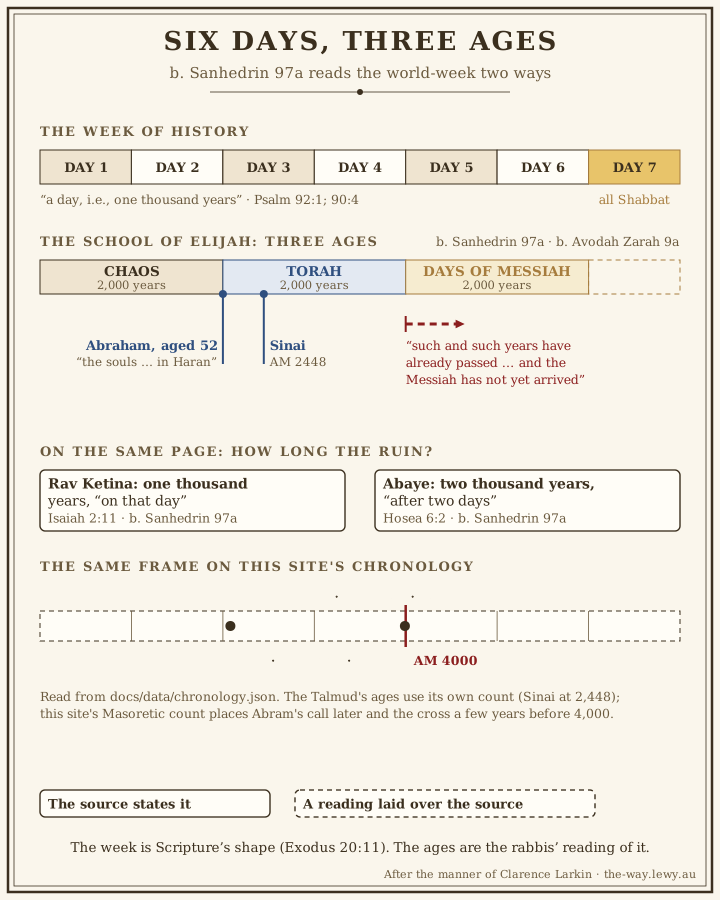
(b. *Sanhedrin* 97a). The same page records the school of Elijah's division of the six thousand
into two thousand years of chaos, two thousand of Torah, and two thousand of the days of Messiah
— a baraita repeated at b. *Avodah Zarah* 9a, where the Gemara notes that whoever taught it would
insert the years elapsed in his own day. The jubilee arithmetic these counts rest
on, and the open question of whether a jubilee cycle is 49 years or 50, is set out in
[The Zadok Calendar](https://the-way.lewy.au/feasts/zadok-calendar/#the-enoch-wheels-140-jubilees).
[](https://the-way.lewy.au/assets/img/last-things/six-days-three-ages.svg)
The chain is the one the church later used:
seven-day week → seven-year Sabbatical cycle → seven-millennium world-week, with Psalm 90:4
supplying the conversion factor and the Sabbath psalm supplying the character of the seventh.
### The Temple: the creation week sung every week
The Temple ran on it. The Levites sang a fixed psalm each day, and the Mishnah's list (Tamid 7:4) is
expounded in the Talmud by mapping each psalm onto the corresponding day of creation:
> On the first day of the week, Sunday, what psalm would the Levites recite? The psalm beginning
> with the phrase: "The earth is the Lord's, and its fullness" (Psalms 24:1), in commemoration of
> the first day of Creation… On the second day… because on the second day of Creation He separated
> His works, dividing between the upper waters and the lower waters… On the third day… because on
> the third day of Creation He revealed the land in His wisdom… On the fourth day… because on the
> fourth day of Creation He created the sun and the moon, and in the future He will punish and take
> vengeance upon those who worship them… On the fifth day… because on the fifth day of Creation He
> created birds and fish… On the sixth day… because on that day He completed His labor and ruled
> over all of creation in full glory. On the seventh day of the week, Shabbat, they would recite
> the psalm beginning: "A psalm, a song for the day of Shabbat" (Psalms 92:1), as the future world
> will be a day that is all Shabbat.
> — b. *Rosh HaShanah* 31a, William Davidson Edition (abridged)
Six days pointing backwards to creation and the seventh pointing forwards to the age to come. The
same passage records Rabbi Neḥemya objecting that all seven should be read as past. The
forward-looking reading of the seventh was the majority position, held against a stated alternative.
### 2 Enoch: and then an eighth
> And I appointed the eighth day also, that the eighth day should be the first-created after my
> work, and that (the first seven) revolve in the form of the seventh thousand, and that at the
> beginning of the eighth thousand there should be a time of not-counting, endless, with neither
> years nor months nor weeks nor days nor hours.
> — *2 Enoch* 33:1
The seven millennia are treated as a closed system; what follows is the end of counting.
### Standard commentary agrees
The *NIV Cultural Backgrounds Study Bible*, commenting on 2 Peter
3:8, states that Peter appeals to Psalm 90:4 "as did many other Jewish writers of his day (who
sometimes took 'the day as a thousand years' literally and applied it to the days of creation)."
## The week's own grammar
Genesis 1-2 is narrative built out of repetition, the same formulas recurring day after day.
Where a pattern that strong *breaks*, the author is pointing, and three breaks shape how the week
is meant to be read. All three are
visible in Hebrew and mostly invisible in English.
**The last two days are marked; the first five are not.** Every day closes with the same formula —
"and there was evening and there was morning" — followed by a numeral. The numerals do not behave
the same way:
| Verse | Hebrew | Literally |
|---|---|---|
| Genesis 1:5 | י֥וֹם אֶחָֽד | day one *(cardinal)* |
| Genesis 1:8 | י֥וֹם שֵׁנִֽי | a second day |
| Genesis 1:13 | י֥וֹם שְׁלִישִֽׁי | a third day |
| Genesis 1:19 | י֥וֹם רְבִיעִֽי | a fourth day |
| Genesis 1:23 | י֥וֹם חֲמִישִֽׁי | a fifth day |
| Genesis 1:31 | י֥וֹם הַשִּׁשִּֽׁי | **the** sixth day |
| Genesis 2:2-3 | הַיּ֣וֹם הַשְּׁבִיעִ֔י | **the** seventh day |
Day one is a cardinal, not an ordinal — "day one," the day by which the rest will be counted.
Days two through five carry bare ordinals with no article. The definite article arrives at day six
and stays for day seven.
**The seventh day never closes.** Genesis 2:1-3 has no "and there was evening and there was
morning." Every other day in the week is bounded at both ends; the seventh is left open.
**The seventh day is the only one God sanctifies.**
> ✝️ Genesis 2:1-3 (ESV)
>
> 1 Thus the heavens and the earth were finished, and all the host of them. 2 And on the seventh
> day God finished his work that he had done, and he rested on the seventh day from all his work
> that he had done. 3 So God blessed the seventh day and made it holy, because on it God rested
> from all his work that he had done in creation.
Three verbs carry it: וַיְכַל (*vaykhal*, "he completed," H3615),
וַיִּשְׁבֹּת (*vayyishbot*, "he ceased"), from
שָׁבַת (*shavat*, H7673, TWOT root 2323), the root behind
שַׁבָּת (*shabbat*, H7676); and וַיְקַדֵּשׁ (*vayqaddesh*,
"he set apart as holy," H6942). God blesses creatures on day five and man on day six; he sanctifies
only the seventh day. A day is the first holy thing in Scripture.
Exodus 20:11 uses two different Hebrew roots for God's rest: וַיָּנַח (*vayyanach*, "he rested," from נוּחַ, *nuach*, H5117) describes the act, and שַׁבָּת (*shabbat*, "Sabbath," H7676) names the day set apart because of it.
This shows that God made creation to end in rest with Him. The first thing He made holy was the day
He rested, and Hebrews says a Sabbath rest "remains" for His people (4:9). The week you live in is
moving toward a day He has already blessed.
## The church took it up immediately
Within a generation or two of Peter, Christian writers are using the same frame, citing the same two
verses, and reaching the same conclusion. The *Epistle of Barnabas*, which cannot be later than the
early second century, is the earliest:
> Attend, my children, to the meaning of this expression, "He finished in six days." This implieth
> that the Lord will finish all things in six thousand years, for a day is with Him a thousand
> years… Therefore, my children, in six days, that is, in six thousand years, all things will be
> finished. "And He rested on the seventh day." This meaneth: when His Son, coming again, shall
> destroy the time of the wicked man, and judge the ungodly… then shall He truly rest on the
> seventh day.
> — *Epistle of Barnabas* 15 (ANF vol. 1)
The others follow the same line:
- **Irenaeus** (late second century) states it as a rule of reading: "For in as many days as this
world was made, in so many thousand years shall it be concluded… For the day of the Lord is as a
thousand years; and in six days created things were completed: it is evident, therefore, that
they will come to an end at the sixth thousand year" (*Against Heresies* 5.28.3). He calls
Genesis 2:1-2 "an account of the things formerly created, as also… a prophecy of what is to
come."
- **Lactantius** (early fourth century) gives the fullest statement: "since all the works of God
were completed in six days, the world must continue in its present state through six ages, that
is, six thousand years… at the end of the six thousandth year all wickedness must be abolished
from the earth, and righteousness reign for a thousand years" (*Divine Institutes* 7.14), citing
Psalm 90:4 as his warrant.
## Six days of history
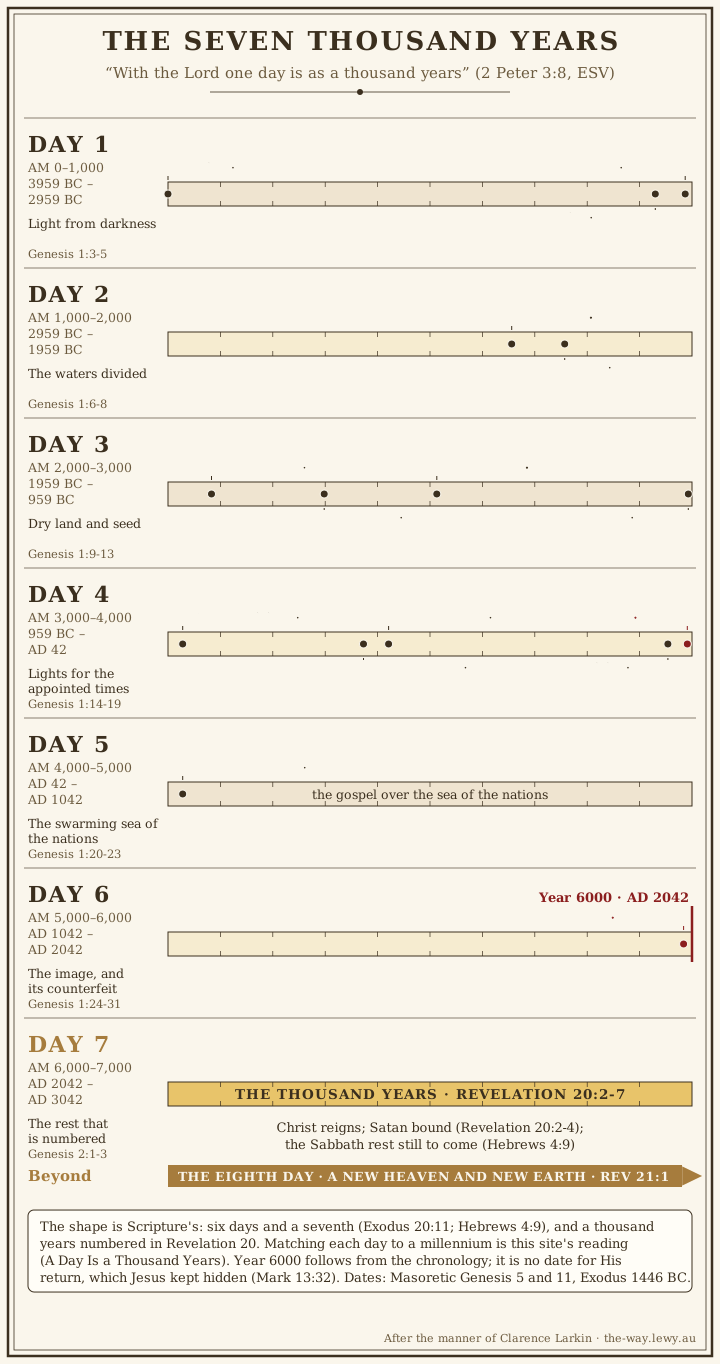
Exegesis ends and typology begins here. That the creation week runs six-then-seven, that Scripture
ties the Sabbath to a rest still to come, and that Revelation numbers that rest at a thousand years
— all of that is in the text. Matching each creation day to a millennium of history is a further
step: the day-by-day scheme has ancient precedent in the Temple's psalm cycle above, and mapping it
onto specific millennia is this site's construction. The readings of days one to six are worked through in a separate
study, [Six Days of History](https://the-way.lewy.au/last-things/six-days-of-history/).
[](https://the-way.lewy.au/assets/img/last-things/seven-thousand-years.svg)
On the site's epoch Christ is born about AM 3954 and crucified in AM 3991, at the close of the
fourth millennium, the day of the lights for appointed times. Ussher's 4004 BC epoch, used here
until 2026-10-01, put AM 4000 at 4 BC, beside the traditional Nativity, and that fit has held
attention for centuries. It was never independent confirmation. Ussher dated the Nativity from
Herod's death in 4 BC, and four thousand years from Adam to Christ was a widely held expectation
before he counted.
### Day seven — the rest that is numbered
> ✝️ Hebrews 4:9-10 (ESV)
>
> 9 So then, there remains a Sabbath rest for the people of God, 10 for whoever has entered God's
> rest has also rested from his works as God did from his.
Hebrews 4 uses **κατάπαυσις** (*katapausis*, G2663, "rest") throughout — verses 1, 3, 5, 10, 11 —
and switches once, at verse 9, to **σαββατισμός** (*sabbatismos*, G4520), "Sabbath-keeping," a word
that appears nowhere else in the New Testament. The switch names the rest specifically as a
*Sabbath* rest and ties the argument back to Genesis 2:2, which the author quotes at 4:4.
Hebrews 4 continues the author's exposition of Psalm 95 (Hebrews 3:7-11; 4:3, 7), whose own word for what the wilderness generation forfeited by unbelief is "rest".
Here is what Hebrews 4 argues on its own terms. This rest is available to believers *now* — "we who
have believed enter that rest" (4:3). It is entered by faith rather than by further works (4:2-3,
10). And it still requires present diligence, "strive to enter" (4:11), because the possibility of
failing to reach it through the same disobedience Israel showed remains real.
Hebrews leaves the rest open. Revelation numbers it.
Revelation is apocalyptic, so its Old Testament imagery comes first: the thrones of 20:4 are read
against Daniel 7:9, and the bound dragon against Genesis 3's serpent, "that ancient serpent" in the
verse itself. In John's sequence, Christ
returns on a white horse (Revelation 19:11) and the beast and the false prophet are thrown into the lake of
fire (19:20). Chapter 20 opens with the dragon, the third of them, seized and confined, and closes
with him joining the other two (20:10) before the great white throne (20:11-15). The thousand years sit inside that sequence, after the
return and before the final judgment.
> ✝️ Revelation 20:2-7 (ESV)
>
> 2 And he seized the dragon, that ancient serpent, who is the devil and Satan, and bound him for
> a thousand years, 3 and threw him into the pit, and shut it and sealed it over him, so that he
> might not deceive the nations any longer, until the thousand years were ended. After that he must
> be released for a little while. 4 Then I saw thrones, and seated on them were those to whom the
> authority to judge was committed. Also I saw the souls of those who had been beheaded for the
> testimony of Jesus and for the word of God, and those who had not worshiped the beast or its
> image and had not received its mark on their foreheads or their hands. They came to life and
> reigned with Christ for a thousand years. 5 The rest of the dead did not come to life until the
> thousand years were ended. This is the first resurrection. 6 Blessed and holy is the one who
> shares in the first resurrection! Over such the second death has no power, but they will be
> priests of God and of Christ, and they will reign with him for a thousand years. 7 And when the
> thousand years are ended, Satan will be released from his prison
**χίλια ἔτη** appears six times in these six verses. Read plainly, this is a bounded period with a
start and an end, containing a binding that is later reversed (Revelation 20:3, 20:7), a resurrection described
as "the first" and therefore implying a second (20:5-6), and named individuals reigning. A symbol
for the present church age does not need a stated duration, does not need Satan released at its
close, and does not distinguish two resurrections. The seventh day of the week is the one rest
Scripture counts, and it is counted in thousands of years.
Amillennial readers take the thousand years as the present church age; the features above are this
study's case against that. On the reading argued here, this shows that God will give His Son Jesus
the kingdom the whole week has been moving toward. Jesus reigns, and those who belong to Him reign
with Him (Revelation 20:4, 6). If you are His, "blessed and holy" (20:6) is spoken over you.
### And the eighth
The seventh day of Genesis has no evening. Revelation's account of what follows the thousand years
is a new heaven and a new earth (21:1) in a city with no night at all (21:25; 22:5). [A New Heaven and a New Earth](https://the-way.lewy.au/last-things/new-heaven-and-new-earth/#the-eighth-day) works
through the eighth day and the new creation it points to.
## The last days are the last of the days
The phrase the New Testament uses for the present age names a position in a sequence.
The Hebrew idiom is אַחֲרִית הַיָּמִים (*acharit hayamim*) —
אַחֲרִית (*acharit*, H319) is the after-part, the remainder, the tail end of
something, and הַיָּמִים (*hayamim*) is "the days," definite and plural. Its
first appearance is Jacob gathering his sons to tell them "what shall happen to you in
*acharit hayamim*" (Genesis 49:1), and it runs through the prophets from there (Isaiah 2:2; Hosea
3:5; Micah 4:1; Daniel 10:14).
The Septuagint renders Genesis 49:1 **ἐπ' ἐσχάτων τῶν ἡμερῶν** (*ep' eschatōn tōn hēmerōn*) — "at
the last of the days." That is, word for word, the phrase Peter uses at 2 Peter 3:3 for when the
scoffers come, and all but a demonstrative from the phrase Hebrews uses:
> ✝️ Hebrews 1:1-2 (ESV)
>
> 1 Long ago, at many times and in many ways, God spoke to our fathers by the prophets, 2 but in
> these last days he has spoken to us by his Son, whom he appointed the heir of all things, through
> whom also he created the world.
**ἐπ' ἐσχάτου τῶν ἡμερῶν τούτων** — "at the last of these days." The incarnation happens in them. Peter says the same at Pentecost, quoting
Joel: "in the last days it shall be, God declares, that I will pour out my Spirit" (Acts 2:17),
about an event happening as he speaks. And of Christ: "he was foreknown before the foundation of
the world but was made manifest in the last times for the sake of you" (1 Peter 1:20).
This shows that God has already begun the end. In sending Jesus He opened the last days, and you
are living in them. The New Testament's other phrase for the same span, "the end of the ages"
(Hebrews 9:26; 1 Corinthians 10:11), is traced in [The End of the Age](https://the-way.lewy.au/last-things/end-of-the-age/#the-end-has-already-come).
### The last two of the six days
If history runs six thousand-year days and Christ came at the hinge,
then "the last days" names the last two of the six — day five and day six — which is why the
apostles could say they were living in them, and why the phrase has stayed accurate for two
thousand years. The last days are long
because they are days.
## Why nobody has got the date right
Everyone who has run this arithmetic has landed on a year in his own near future or recent past,
and every one of those years that has arrived has passed without the end.
| Who | Epoch | Year 6000 lands at |
|---|---|---|
| Hippolytus (early third century) | Nativity at AM 5500, on a Septuagint chronology | c. AD 500 |
| Ussher (this site's convention until 2026-10-01) | Creation at 4004 BC | AD 1997 |
| **This site:** the Masoretic chain on a 1446 BC Exodus | Creation at 3959 BC | AD 2042 |
| dsscalendar.org (Ken Johnson) | Creation at ~3925 BC | AD 2075 |
| Seder Olam / the Hebrew calendar | Creation at 3761 BC | AD 2240 |
The spread comes from the creation epoch: the manuscript traditions of Genesis 5 and 11 put the
Flood up to 880 years apart ([Bible Chronology & Genealogical Time](https://the-way.lewy.au/chronology/genealogy-times/)). This site
works to one line, the Masoretic numbers on a 1446 BC Exodus ([The Flood and the King
Lists](https://the-way.lewy.au/chronology/flood-and-the-king-lists/#why-this-site-follows-the-masoretic-numbers);
[Chronology Anchors](https://the-way.lewy.au/chronology/chronology-anchors/)), which puts the year 6000 in AD 2042, give or take
five years. That is a chronological result, and it is not a date for the end: nothing in Scripture
says the six days began at Adam's creation, or that the transitions are sharp.
### Scripture's own refusal of a date
Jesus put the day and hour outside even his own stated knowledge
during his earthly ministry (Mark 13:32) and told the disciples directly that "it is not for you to
know times or seasons that the Father has fixed by his own authority" (Acts 1:7). The rabbis
reached the same conclusion from the other side: "May those who calculate the end of days be
cursed, as they would say once the end of days that they calculated arrived and the Messiah did not
come, that he will no longer come at all" (b. *Sanhedrin* 97b).
The week tells you the shape of history and
that it has an end; it withholds the date. That is the same combination Jesus gives in the Olivet
Discourse — signs enough to know the season, and a stated refusal to give the day — and it is the
combination Peter gives here, moving from the ratio in verse 8 straight to patience in verse 9 and
holiness in verse 11.
This shows that God keeps the date in His own authority (Acts 1:7) and gives you what you need to
be ready: the shape of history, its end, and a call to holiness while you wait.
## The Sabbath's two layers
The Sabbath arrives in Scripture wearing two layers, and they do not carry over together.
One layer is covenant-specific: "a sign forever between me and the people of Israel" (Exodus
31:17; also 31:13 and Ezekiel 20:12). A sign between two named parties is not a general ordinance, and the New
Testament treats it accordingly — "let no one pass judgment on you … with regard to a festival or a
new moon or a Sabbath" (Colossians 2:16; compare Romans 14:5). The seventh-day observance, with its calendar and its
penalties, belongs to Israel under that covenant.
The other layer predates Israel by the whole of Genesis. God rested, blessed and sanctified the
seventh day at creation (Genesis 2:1-3), long before there was a Sinai or a nation to sign a
covenant with, and Exodus 20:11 grounds the commandment in that fact rather than the other way
round. What carries over is the pattern and its destination — six of labour, then rest, with the
rest still open (Hebrews 4:9).
God has set His rest as the destination of history, and Hebrews says it is entered by faith in
Jesus (4:3, 10). The One who fixed the week will finish it, so you can rest in Him now.
## Discussion questions
1. Genesis marks the seventh day as holy before anything else in Scripture is called holy — before
a place, a person, or an object. What does it change about the Sabbath to notice that the first
sanctified thing God makes is a stretch of time?
2. Jubilees, the Talmud and the early church all read "a day is a thousand years" and applied it to
the same seven days. What weight should the agreement of Jewish and Christian sources that
disagreed about almost everything else carry when reading 2 Peter 3:8?
3. If "the last days" began at the incarnation rather than in some still-future crisis, what does
that do to the way "the last days" is normally used in preaching about current events?
4. Every year 6000 calculated before this century has passed. Does that discredit the framework,
refine it, or only discredit the calculating?
## References & Recommended Reading
**Scripture and original-language data**
- ESV Bible (Crossway) — primary translation quoted throughout, per this repo's conventions.
- Westminster Leningrad Codex and Brenton's Septuagint, via this repo's
`references/build/bible-text.db` — source of the Hebrew day formulas and the ἐπ' ἐσχάτων τῶν
ἡμερῶν rendering of Genesis 49:1.
- MACULA Greek (SBLGNT) and MACULA Hebrew (WLC) Linguistic Datasets — all Strong's numbers,
morphology and word counts cited above.
- *Theological Wordbook of the Old Testament* (Archer, Harris & Waltke, Moody) — root 2323 for
שָׁבַת.
**Second Temple and rabbinic sources**
- *The Book of Jubilees* 4:29-30, trans. R. H. Charles (1913), public domain.
- *2 Enoch* 32:4-33:1.
- Babylonian Talmud, *Sanhedrin* 97a-b, *Avodah Zarah* 9a, *Rosh HaShanah* 31a, and *Tamid* 33b
(Mishnah Tamid 7:4) — William Davidson Edition, Koren Publishers, via Sefaria, CC BY-NC.
- 1 Enoch 91-93, the "Apocalypse of Weeks" — treated in
[The Zadok Calendar](https://the-way.lewy.au/feasts/zadok-calendar/).
**Patristic sources** (all *Ante-Nicene Fathers*, Roberts & Donaldson, public domain; see
[Patristic Sources](https://the-way.lewy.au/resources/patristic-sources/) for how this site grades them)
- *Epistle of Barnabas* 15 (ANF 1).
- Irenaeus, *Against Heresies* 5.28.3 (ANF 1).
- Hippolytus, *On Daniel*, fragment II — "the visions of Daniel and Nebuchadnezzar, taken in
conjunction" (ANF 5).
- Lactantius, *Divine Institutes* 7.14 and *Epitome* 70 (ANF 7).
**Commentaries consulted**
- *ESV Study Bible* (Crossway, 2016) — notes on 2 Peter 3:8-10, Hebrews 4:1-13, Psalm 90
and Revelation 20:1-6.
- *NIV Cultural Backgrounds Study Bible* (Zondervan, ed. Walton & Keener) — note on 2 Peter 3:8,
the independent confirmation that Jewish writers of Peter's day applied the thousand-year day to
the days of creation.
- *NKJV Cultural Backgrounds Study Bible* (Zondervan, ed. Walton & Keener) — note on Genesis 4:26,
the caution against reading that verse as restricting the calling on the LORD's name to Seth's
line. Its note on 2 Peter 3:8 is the same text as the NIV edition's, the two sharing editors, so
the two are one witness rather than two.
**Related studies on this site**
- [The Day Is Near](https://the-way.lewy.au/last-things/day-is-near/) — the companion question: why the timing is hidden and what to
do while it is.
- [Charting End Times](https://the-way.lewy.au/last-things/prophecy-chart/) — Clarence Larkin's "Seven Thousand Years of Human
History" chart, the same framework in diagram form.
- [Bible Chronology & Genealogical Time](https://the-way.lewy.au/chronology/genealogy-times/) — the manuscript variants behind the
creation-epoch problem.
- [The Zadok Calendar](https://the-way.lewy.au/feasts/zadok-calendar/) — the Enochic seven-thousand-year scheme and
the sabbatical calendar it runs on.
- [Bible Prophecy Essentials](https://the-way.lewy.au/last-things/prophecy-essentials/) — where the millennium sits in the wider
dispensational order of events.
- [The End of the Age](https://the-way.lewy.au/last-things/end-of-the-age/) — the close of this age, Matthew's συντέλεια, opened at
the cross and closed at Christ's return.
- [A New Heaven and a New Earth](https://the-way.lewy.au/last-things/new-heaven-and-new-earth/) — the eighth day, and the age to come.