---
title: "Bible Prophecy Essentials"
category: "prophecy"
description: "A framework for reading biblical prophecy: why it matters, fulfilled prophecies checked against source, and the road still ahead -- Daniel's seventieth week, the rapture, and the millennial reign."
tags: ["hermeneutics", "audience/teaching", "apologetics"]
draft: false
primary_passage: "Luke 24:27"
bible_references: ["Micah 5:2", "Matthew 2:1-6", "2 Samuel 5:2", "Isaiah 53:5", "Isaiah 53:9", "Psalm 22:16-18", "John 19:23-24", "Matthew 27:57-60", "Daniel 9:24-27", "Luke 19:41-44", "Matthew 24:1-2", "Matthew 24:33-34", "Matthew 24:14-15", "Matthew 24:21", "Matthew 24:34", "Mark 13:1-8", "Mark 13:14-27", "Mark 13:32", "1 Thessalonians 4:16-17", "1 Thessalonians 5:9", "Revelation 19:11-16", "Revelation 20:1-6", "Colossians 2:16-17"]
date_created: 2026-07-24
date_modified: 2026-10-31
ai_provider_models:
- anthropic/claude-opus-5
- anthropic/claude-opus-5.5
- anthropic/claude-sonnet-5
---
# Bible prophecy essentials
Two very different readers pick up this page. One already believes and wants to know why prophecy
is worth her time beyond curiosity about the future. The other doesn't believe yet, and has heard
"Bible prophecy" used as a synonym for reading tea leaves. Both get the same material here, because
the case for both is the same case: prophecy already kept and checked against source, then a plain statement of what Scripture says is still to come.
**In one sentence:** God has already kept specific, checkable prophecies about Jesus — His birthplace, His death and burial, the week of His entry as king, and Jerusalem's fall — and the same God has said what is still ahead: Daniel's seventieth week, the rapture of the church and Christ's thousand-year reign.
## Key Takeaways
*(This section follows the [Key Takeaways](https://the-way.lewy.au/about/key-takeaways/) format — see that page for what each part is for.)*
### Types & Prophecy
**Prophecy.** Every example below is prophecy in the strict sense. A specific, verbal prediction, made in one
text, and checked against a fulfilment recorded later and independently.
Micah names Bethlehem as the Messiah's birthplace roughly 700 years early. Isaiah and the Psalms
describe the manner of His death centuries before Rome existed to crucify anyone. Daniel's angel
gives Israel a countable number of years to "an anointed one". And Jesus predicts the temple's fall,
which came within His hearers' own lifetime. [Historically fulfilled prophecy](#historically-fulfilled-prophecy) below
checks each one against its source.
### Lessons about Jesus
- Every Old Testament prophecy this study checks converges on Him: His birthplace, the manner of His death,
and the very week of His public presentation as king, all named centuries before He was born
(Luke 24:27).
- He predicted Jerusalem's fall plainly enough that a first-century reader could act on it, and it
happened within His hearers' lifetime (Luke 19:41-44).
- God has already kept a specific word once, in full. Scripture asks you to trust the same God for
what hasn't happened yet.
### Memory verses
> ✝️ Luke 24:27 (ESV)
>
> 27 And beginning with Moses and all the Prophets, he interpreted to them in all the Scriptures
> the things concerning himself.
> ✝️ Micah 5:2 (ESV)
>
> 2 But you, O Bethlehem Ephrathah, who are too little to be among the clans of Judah, from you
> shall come forth for me one who is to be ruler in Israel, whose coming forth is from of old, from
> ancient days.
> ✝️ Daniel 9:27 (ESV)
>
> 27 And he shall make a strong covenant with many for one week, and for half of the week he shall
> put an end to sacrifice and offering.
### Be Transformed
- **Think.** Notice the difference between a prophecy that's *checked* against an independent
fulfillment and one that's merely *asserted*. A reader who has never verified this for themselves
is trusting someone else's homework. The primary texts are below: check them yourself.
- **Attitude.** Jesus's own instruction for a future no one can calculate the timing of is
readiness (Matthew 24:42-44, already studied in depth in
[The Olivet Discourse](https://the-way.lewy.au/last-things/olivet-discourse/#what-ready-actually-means)). The same posture applies to everything below that hasn't
happened yet.
- **Do.** Check one fulfilled case below for yourself this week, the prophecy and its fulfilment
side by side. Then open it with someone who does not yet believe, as Jesus did on the Emmaus road
when "he interpreted to them in all the Scriptures the things concerning himself" (Luke 24:27,
ESV).
### Prayer
Father, you named Bethlehem before there was a road to it worth naming, and you kept your word to
the week. You've already shown your hand once, in the open, checkable by anyone willing to look,
so I can trust what you've said about what's still ahead. Give me the same readiness you asked of the first disciples: not
calculating a date, but living each day as though the King who kept every word so far is the same
King who's coming. In Jesus' name. Amen.
## Study outline
- [Why prophecy matters](#why-prophecy-matters). Payne's 27% count, and four reasons prophecy carries weight.
- [Jesus is the key to all prophecy](#jesus-is-the-key-to-all-prophecy). Luke 24:27 on the Emmaus road.
- [Historically fulfilled prophecy](#historically-fulfilled-prophecy). Micah 5:2, Isaiah 53, Psalm 22, Daniel's seventy weeks and Jerusalem's fall in AD 70.
- [The two Gospel accounts of the end of the age](#the-two-gospel-accounts-of-the-end-of-the-age). The Olivet Discourse in Mark 13 and Matthew 24.
- [Prophecy yet to come](#prophecy-yet-to-come). Daniel's seventieth week, the pretribulational rapture and the millennial reign.
- [Larkin's chart](#larkins-chart-the-whole-shape-at-a-glance). The whole framework on one page.
- [Discussion questions](#discussion-questions). Four, for a group or on your own.
## Why prophecy matters
J. Barton Payne's *Encyclopedia of Biblical Prophecy*
(1973) counted 8,352 verses containing predictive material out of the Bible's roughly 31,000,
about 27%. More than a quarter of Scripture is concerned with
telling readers what God is going to do before He does it.
That matters for four reasons:
- **It's how the Bible authenticates itself.** A book that gets specific, checkable predictions right
(names, places and time spans) is making
a claim no other ancient religious text makes at the same scale. [Historically fulfilled
prophecy](#historically-fulfilled-prophecy) below gives the evidence for that claim.
- **It gives believers a future to encourage each other with.** Paul tells the
Thessalonians to comfort one another with the specifics of the resurrection and the rapture
(1 Thessalonians 4:18). The details matter because they are what is promised.
- **It's the test Jesus Himself pointed to.** "Beginning with Moses and all the Prophets, he
interpreted to them in all the Scriptures the things concerning himself" (Luke 24:27, ESV).
Jesus treats His own identity as something the Hebrew Bible had already been telling readers to
expect.
- **It warns against deception.** Jesus treats "many will come... and will lead many astray"
(Matthew 24:5) as itself a predicted feature of the last days. Knowing the real pattern in advance
lets you recognize a counterfeit.
## Jesus is the key to all prophecy
> ✝️ Luke 24:27 (ESV)
>
> 27 And beginning with Moses and all the Prophets, he interpreted to them in all the Scriptures the
> things concerning himself.
This is Jesus Himself, on the road to Emmaus, the same day He rose. He claims that Moses and *all*
the Prophets, read rightly, were already telling this story. That claim is testable, and the next
section tests it with specific, verifiable predictions checked against source.
## Historically fulfilled prophecy
A skeptical reader is right to distrust "fulfilled prophecy" lists that work by vague resemblance:
a psalm about anyone's suffering "could" describe anyone's suffering. The cases below were chosen
and checked differently: each rests on a specific, dated prediction, an independently verifiable
Hebrew or Greek text, and a
fulfillment that doesn't require squinting to see.
### The Messiah's birthplace, named roughly 700 years early
> ✝️ Micah 5:2 (ESV)
>
> 2 But you, O Bethlehem Ephrathah, who are too little to be among the clans of Judah, from you
> shall come forth for me one who is to be ruler in Israel, whose coming forth is from of old, from
> ancient days.
Micah prophesied in the 8th century BC, under Hezekiah, roughly seven centuries before the
event. **Ruler** translates מוֹשֵׁל (*moshel*, H4910, from the verb "to
rule"). Micah calls Bethlehem **too little**
(צָעִיר, *tsa'ir*, H6810) among Judah's clans, the small town passed over
for Jerusalem in every ordinary political calculation. **From of old, from ancient days**
(מִקֶּדֶם מִימֵי עוֹלָם) needs precision here. TWOT glosses עוֹלָם (*olam*, H5769, root 1631a) conservatively, as "long duration" rather than
"eternity" outright. The phrase marks this ruler's origin as extraordinarily ancient. That is
suggestive alongside everything else Scripture says about the Messiah's deity. But the deity claim
rests on other texts.
> ✝️ Matthew 2:5-6 (ESV)
>
> 5 They told him, "In Bethlehem of Judea, for so it is written by the prophet: 6 'And you,
> O Bethlehem, in the land of Judah, are by no means least among the rulers of Judah; for from you
> shall come a ruler who will shepherd my people Israel.'"
Matthew's quotation joins Micah 5:2 to a second verse. "Who will shepherd my people Israel" comes from
the LORD's word to David, as the tribes recalled it at Hebron, "you shall be shepherd of my people Israel, and you shall be
prince over Israel" (2 Samuel 5:2, ESV). The chief priests and scribes (Matthew 2:4-6) are shown
deliberately reading Micah's birthplace prophecy together with David's own shepherd-king language,
a standard first-century Jewish exegetical move (linking two texts sharing a common phrase or theme,
later formalized as *gezerah shavah*), not a misquotation. The prediction being fulfilled is still
Micah's: an identifiable, small, named town, centuries in advance. The religious authorities laid
David's shepherd language alongside it themselves, and they had every incentive not to hand Herod a
location if they could avoid it (Matthew 2:16).
### The manner of His suffering, written before crucifixion existed as a punishment for a Jew
Isaiah wrote in the 8th century BC; the Psalm below is traditionally Davidic, 10th century BC.
Crucifixion as the Romans practiced it on provincial subjects didn't exist yet in either writer's
world. Rome's rise, and its adoption of that particular Persian/Carthaginian-derived punishment,
was still centuries away.
#### Isaiah 53: pierced, and buried with a rich man
> ✝️ Isaiah 53:5 (ESV)
>
> 5 But he was pierced for our transgressions; he was crushed for our iniquities; upon him was the
> chastisement that brought us peace, and with his wounds we are healed.
**Pierced** translates מְחֹלָל (*mecholal*, H2490a), from a Hebrew root that Strong's number H2490
happens to share with a completely different word, "to profane." TWOT splits the homonyms into
separate roots: **660**, "bore, pierce," is the one active here, and **661** is "pollute".
So this is a real, physical wounding.
> ✝️ Isaiah 53:9 (ESV)
>
> 9 And they made his grave with the wicked and with a rich man in his death, although he had done
> no violence, and there was no deceit in his mouth.
A specific, checkable detail: an innocent man's grave shared with **a rich man**
(עָשִׁיר, *ashir*). The Gospels record it. "There came a rich man from Arimathea, named Joseph... and laid it
in his own new tomb" (Matthew 27:57, 60, ESV). Jesus was buried in a wealthy disciple's tomb.
Isaiah had no need to include that detail if he was describing generic suffering.
#### Psalm 22: pierced hands and feet, and lots cast for clothing
> ✝️ Psalm 22:16-18 (ESV)
>
> 16 For dogs encompass me; a company of evildoers encircles me; they have pierced my hands and
> feet — 17 I can count all my bones — they stare and gloat over me; 18 they divide my garments
> among them, and for my clothing they cast lots.
A real textual difficulty sits at the centre of this case. In the Masoretic Text (WLC), the Hebrew consonants at
verse 17 (Hebrew numbering; English v. 16) read כָּ֝אֲרִ֗י (*ka'ari*), "like
a lion". That leaves the clause with no verb ("like a lion, my hands and my feet"), an awkward,
incomplete sentence on its own terms. Checked against the Greek Septuagint
(Brenton's edition) at the parallel verse: **ὤρυξαν
χεῖράς μου, καὶ πόδας**, "they have pierced my hands and feet," a complete, sensible clause. That
Greek translation existed roughly two hundred years before crucifixion was ever inflicted on a Jew,
which rules out the charge that Christians edited the text after the fact to fit Jesus's death. The
ESV follows this reading, "they have pierced my hands and feet". That is a translator's decision, made
in favor of the sense that gives a working sentence.
Verse 18 is more specific still. Soldiers **casting lots** for a victim's clothing is what
John's Gospel records at the crucifixion, and records independently. "They took his garments and divided them into
four parts... they said to one another, 'Let us not tear it, but cast lots for it
to see whose it shall be.' This was to fulfill the Scripture which says, 'They divided my garments
among them, and for my clothing they cast lots'" (John 19:23-24, ESV, quoting Psalm 22:18 directly).
#### Psalm 22 as lament: a contested reading
Not every scholar reads Psalm 22 as a direct, predictive prophecy of the
crucifixion. The ESV Study Bible's own note treats it primarily as an individual lament from an
innocent sufferer, with the Gospels applying its language to Jesus as the innocent sufferer *par
excellence* rather than the psalm being written as a forecast in the first place. Both readings leave the same hard evidence on the table. A specific method of execution. A specific
detail about divided clothing. Both named centuries before either could have been invented after the
fact. You do not have to settle the "was this meant as prediction" question to see that the details
are real and checkable.
### Daniel's seventy weeks: the countdown to the exact week
This is worked out in full in [Prophecy, calendar, and the anchors of biblical
history](https://the-way.lewy.au/last-things/prophecy-events-times/), with independently-dated Persian court records as the anchor. A
decree in Artaxerxes' twentieth year (Nehemiah 2:1-8), a reign the Elephantine papyri date
independently, run through Daniel 9:25's stated 69 "weeks" of years, lands within days of the week
Jesus rode into Jerusalem as king: AD 33 on Harold Hoehner's reckoning from 444 BC, which this site
follows (Sir Robert Anderson's from 445 BC reaches AD 32). That page gives the full case, including where the
calculation is disputed (the exact day) and where it isn't (the shape of the result). See [Prophecy yet to come](#prophecy-yet-to-come) below for the
seventieth week that page stops short of, which is still future.
### Jesus's own prophecy, fulfilled within His hearers' lifetime
This last case is Jesus's own prediction, checked against secular history.
> ✝️ Luke 19:41-44 (ESV)
>
> 41 And when he drew near and saw the city, he wept over it, 42 saying, "Would that you, even you,
> had known on this day the things that make for peace! But now they are hidden from your eyes.
> 43 For the days will come upon you, when your enemies will set up a barricade around you and
> surround you and hem you in on every side 44 and tear you down to the ground, you and your
> children within you. And they will not leave one stone upon another in you, because you did not
> know the time of your visitation."
> ✝️ Matthew 24:1-2 (ESV)
>
> 1 Jesus left the temple and was going away, when his disciples came to point out to him the
> buildings of the temple. 2 But he answered them, "You see all these, do you not? Truly, I say to
> you, there will not be left here one stone upon another that will not be thrown down."
It happened in AD 70, within the lifetime of people who heard Him say it. Titus's legions besieged
Jerusalem, breached the walls, and burned the temple to the ground. Josephus watched it from the
Roman side, and records the fire and the systematic dismantling of the city that followed
(*The Jewish War*, Book 6). A common objection: the Western Wall still stands today, so wasn't the "not one stone" prediction
falsified? No. The Western Wall is a *retaining wall* for the platform the temple stood on. The
temple building Jesus and His disciples were looking at (Matthew 24:1) was torn down stone by stone,
as predicted. The temple fell about forty
years after He spoke, while many who had heard Him were still alive.
Later in the same discourse Jesus says, "Truly, I say to you, this generation will not pass away until
all these things take place" (Matthew 24:34, ESV). This site reads that as a separate promise. "All
these things" are the signs of Matthew 24:4-25, the same phrase as the verse before, where they are
what you see before He comes (24:33). Those signs include a tribulation "such as has not been from the
beginning of the world until now, no, and never will be" (24:21, ESV), followed "immediately" by His
coming (24:29), so they are still future, and "this generation" is the generation alive when they
begin. AD 70 was the discourse's near fulfilment and a pattern of that far one, the way Antiochus's
desecration of 167 BC had been before it. Some read 24:34 as fulfilled in AD 70 instead. [The Fig Tree and This
Generation](https://the-way.lewy.au/last-things/fig-tree-and-this-generation/#this-generation-whose-and-of-what) sets out both readings
and the case for this one.
## The two Gospel accounts of the end of the age
Two Gospels record Jesus's own extended teaching on the future: the Olivet Discourse, named for
where He gave it (Matthew 24:3; Mark 13:3, "on the Mount of Olives"). They're parallel accounts of
the same conversation.
> ✝️ Mark 13:1-2 (ESV)
>
> 1 And as he came out of the temple, one of his disciples said to him, "Look, Teacher, what
> wonderful stones and what wonderful buildings!" 2 And Jesus said to him, "Do you see these great
> buildings? There will not be left here one stone upon another that will not be thrown down."
Mark's account runs shorter than Matthew's and keeps the same shape. False messiahs and wars come
first, "the beginning of the birth pains" (Mark 13:8, paralleling Matthew 24:8). Then a specific
marker:
> ✝️ Mark 13:14 (ESV)
>
> 14 "But when you see the abomination of desolation standing where he ought not to be (let the
> reader understand), then let those who are in Judea flee to the mountains."
Matthew names the source of that image directly: "the abomination of desolation spoken of by the
prophet Daniel, standing in the holy place" (Matthew 24:15, ESV).
So Jesus treats Daniel 9:27 as still future from where He stands (see
[Prophecy yet to come](#prophecy-yet-to-come) below). Nothing in His hearers' past had used it up. What follows in both accounts is a severity neither account claims had already happened. "Great
tribulation, such as has not been from the beginning of the world until now, no, and never will be"
(Matthew 24:21, ESV; Mark 13:19 nearly verbatim). The AD 70 siege was severe in its own right. This
is not describing it. Both Gospels close the same way. No one knows the day or hour, "not even the angels in heaven, nor
the Son, but only the Father" (Mark 13:32, ESV). [The Day Is Near](https://the-way.lewy.au/last-things/day-is-near/) works that out
word by word.
## Prophecy yet to come
Everything above is checkable against events that already happened. What follows is this site's
reading of what Scripture says is still ahead: the dispensational, pretribulational reading argued
in depth elsewhere here. Bible-believing Christians disagree over it.
### Daniel's seventieth week: the tribulation
[Prophecy, calendar, and the anchors of biblical history](https://the-way.lewy.au/last-things/prophecy-events-times/) works out
Daniel's first 69 "weeks" (483 years) landing on the Triumphal Entry. Daniel 9:27 describes a
seventieth week that didn't follow immediately:
> ✝️ Daniel 9:27 (ESV)
>
> 27 And he shall make a strong covenant with many for one week, and for half of the week he shall
> put an end to sacrifice and offering. And on the wing of abominations shall come one who makes
> desolate, until the decreed end is poured out on the desolator.
**Week** translates שָׁבוּעַ (*shavu'a*, H7620, "seven"), the same word Daniel's angel used for
the first 69, already shown by that page's own case to run on literal years, not days. Nearly two thousand years now separate week 69 from week 70. The text names no duration for that
gap. This site reads it as the still-continuing church age, following [The Zadok
Calendar](https://the-way.lewy.au/feasts/zadok-calendar/) and [A Day Is a Thousand Years](https://the-way.lewy.au/last-things/day-is-a-thousand-years/). The Old
Testament prophets did not foresee that age, which is Paul's point in calling it a "mystery" (Ephesians
3:4-6). This seventieth week *is* the seven-year tribulation: a coming leader confirming
a covenant, sacrifice halted at its midpoint, and "the abomination of desolation" Jesus names directly in
Matthew 24:15. [The Rapture of the Church](https://the-way.lewy.au/last-things/rapture/) works that whole period out verse by verse. It covers the
Bema and Great White Throne judgments, and why this site reads the church as removed before the
period starts rather than preserved through it.
### The pretribulational rapture
> ✝️ 1 Thessalonians 4:16-17 (ESV, quoted in full in [The Rapture of the Church](https://the-way.lewy.au/last-things/rapture/))
>
> 16 For the Lord himself will descend from heaven with a cry of command... 17 Then we who are
> alive, who are left, will be caught up together with them in the clouds to meet the Lord in the
> air, and so we will always be with the Lord.
This site's own position, argued at length in [The Rapture of the Church](https://the-way.lewy.au/last-things/rapture/): the Church is
gathered to Christ *before* the tribulation begins, not partway through it or at its end alongside
the visible second coming. The case there rests on three things. The Greek word behind "rapture":
**ἁρπάζω** (*harpazo*, G726), "seized" or "caught away", used elsewhere only of real, physical, sudden
removals to heaven. The absence of any preceding sign for this event specifically, unlike the second
coming's named sequence. And Scripture's own promise that believers are "not destined for wrath" (1
Thessalonians 5:9). That page also gives post-tribulational, mid-tribulational, and pre-wrath views
a fair hearing. Read it in full and weigh the case yourself.
### The millennial reign
After the tribulation, Christ returns visibly, with
"the armies of heaven... following him on white horses" (Revelation 19:11-16), and reigns on earth
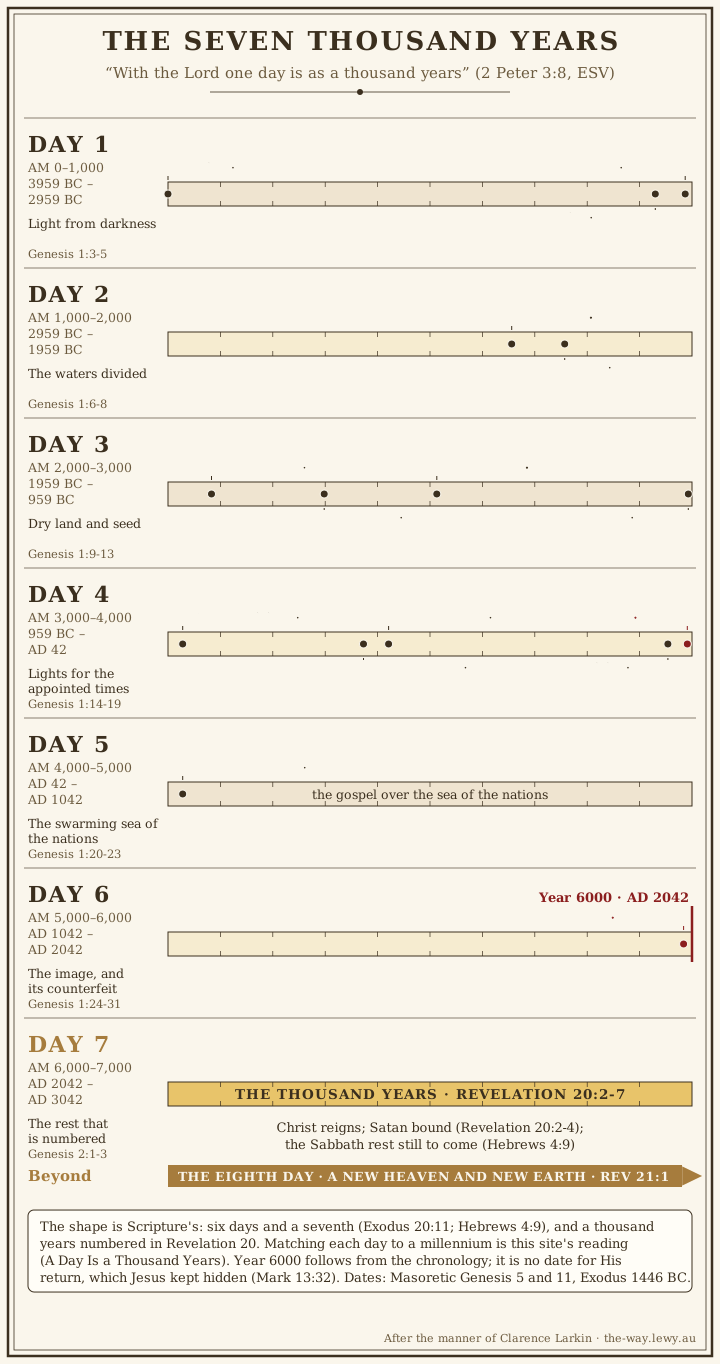
for a literal thousand years (Revelation 20:1-6). [A Day Is a Thousand Years](https://the-way.lewy.au/last-things/day-is-a-thousand-years/) traces this forward. It begins with the creation week's own
six-days-then-a-seventh pattern. It runs through the Sabbath as "a shadow of the things to come"
(Colossians 2:16-17) and Hebrews 4's still-open Sabbath rest. It ends at Revelation 20's numbered
thousand years.
Read it there in full. That page also flags that the date arithmetic built on the pattern
does not yet reconcile cleanly with this site's other chronology studies.
## Larkin's chart: the whole shape at a glance
Clarence Larkin's dispensational charts (first published in the 1910s-20s; now public domain) are
the classic visual summary of everything above, from creation through the millennium, laid out as one
continuous picture. [Charting End Times](https://the-way.lewy.au/last-things/prophecy-chart/) rebuilds
that chart as a finished diagram for this site, with the whole framework on one page.
[](https://the-way.lewy.au/assets/img/last-things/seven-thousand-years.svg)
## Discussion questions
1. Psalm 22:16 turns on a textual decision: the Masoretic Text reads "like a lion," the Septuagint
"they pierced." How much weight can a fulfilled-prophecy argument carry when its key word depends
on which manuscript tradition you follow, and what would settle it?
2. Matthew 2:6 joins Micah 5:2 to 2 Samuel 5:2. Does
understanding *why* (a recognized Jewish exegetical practice) change how you read
other New Testament Old Testament citations that don't look like exact quotations?
3. Prophecies already fulfilled can be checked against history; those still ahead cannot. What kind
of confidence is appropriate to each, and does fulfilment in the first category earn any credit
for readings in the second?
4. If someone you know doesn't believe yet, which single case above would you show them
first, and why that one?
## References & Recommended Reading
- ESV Bible (Crossway) -- primary translation quoted throughout; verified against the ESV Study
Bible's own verse text (`study-notes.db`), not quoted from memory, per this repo's translation
conventions.
- American Standard Version (ASV) and World English Bible (WEB) -- used for translation comparison.
- Westminster Leningrad Codex (WLC) and Brenton's Septuagint (LXX), queried via this repo's
`references/build/bible-text.db` -- source of the Hebrew/Greek text and morphology cited above,
including the Psalm 22:16-17 textual comparison.
- *Theological Wordbook of the Old Testament* (Archer, Harris & Waltke, Moody Publishers) -- TWOT
roots 660/661 (*chalal*, pierce vs. profane) and 1631a (*olam*, "long duration").
- J. Barton Payne, *Encyclopedia of Biblical Prophecy* (1973) -- source of the ~27%-predictive-verses
figure cited above.
- *ESV Study Bible* (Crossway, 2016) -- notes on Psalm 22 and Daniel 9, consulted as an independent
check on this study's own reading; see the Psalm 22 section above.
- Flavius Josephus, *The Jewish War*, Book 6 -- eyewitness (Roman-side) account of Jerusalem's fall
and the temple's destruction in AD 70.
- Clarence Larkin, *Dispensational Truth* and accompanying charts (public domain) -- see
[Charting End Times](https://the-way.lewy.au/last-things/prophecy-chart/).
- [Prophecy, calendar, and the anchors of biblical history](https://the-way.lewy.au/last-things/prophecy-events-times/) -- Daniel's 69
weeks to the Triumphal Entry, with the external Persian-era anchors behind it.
- [The Rapture of the Church](https://the-way.lewy.au/last-things/rapture/) -- the pretribulational rapture case in full.
- [The Day Is Near](https://the-way.lewy.au/last-things/day-is-near/) -- the Olivet Discourse's "day and hour," and how to wait for it.
- [A Day Is a Thousand Years](https://the-way.lewy.au/last-things/day-is-a-thousand-years/) -- the millennium and the six-then-seventh
chronological pattern.
- [The Zadok Calendar](https://the-way.lewy.au/feasts/zadok-calendar/) -- this site's chronological framework.