---
title: "They Were Given White Robes"
category: "prophecy"
description: "Every white garment God's people wear in Scripture, from the garments of skins in Eden to the robes washed in the Lamb's blood and the Bride's fine linen: who wears them, what makes them white, and why every one of them is God's gift."
tags: ["revelation", "genesis", "isaiah", "zechariah", "daniel", "white-robes", "fine-linen", "grace", "imputed-righteousness", "dispensationalism", "method/word-study", "lang/greek", "lang/hebrew"]
draft: false
primary_passage: "Revelation 6:11; Revelation 7:9-14; Revelation 19:7-8"
bible_references: ["Genesis 3:7-10", "Genesis 3:21", "Psalm 51:7", "Isaiah 1:18", "Isaiah 55:1", "Isaiah 61:10", "Isaiah 64:6", "Zechariah 3:3-5", "Daniel 7:9", "Daniel 12:1", "Daniel 12:10", "Matthew 17:2", "Matthew 22:11-13", "Matthew 24:21", "Matthew 28:3", "Mark 9:2-3", "Mark 16:5", "Luke 15:21-22", "John 20:12", "Acts 1:10", "Romans 5:18", "Romans 8:1", "Romans 8:4", "Galatians 3:27", "Ephesians 2:8-10", "Ephesians 4:1", "Colossians 3:12", "1 John 1:7", "Jude 1:23", "Revelation 1:14", "Revelation 3:4-5", "Revelation 3:17-18", "Revelation 4:4", "Revelation 4:10-11", "Revelation 5:9", "Revelation 6:9-11", "Revelation 7:9-17", "Revelation 12:11", "Revelation 15:4", "Revelation 16:15", "Revelation 18:16", "Revelation 19:7-8", "Revelation 19:14", "Revelation 20:11", "Revelation 21:27", "Revelation 22:14"]
date_created: 2026-10-15
date_modified: 2026-10-22
ai_provider_models:
- anthropic/claude-opus-5.5
---
# They Were Given White Robes
> ✝️ Revelation 7:13-14 (ESV)
>
> 13 Then one of the elders addressed me, saying, "Who are these, clothed in white robes, and from
> where have they come?" 14 I said to him, "Sir, you know." And he said to me, "These are the ones
> coming out of the great tribulation. They have washed their robes and made them white in the blood
> of the Lamb.
White clothing runs from the first chapters of the Bible to the last. Revelation alone puts God's people
in eight scenes of white robes and bright linen. The elder's question is the one this study asks: who are
they, and where did the white come from?
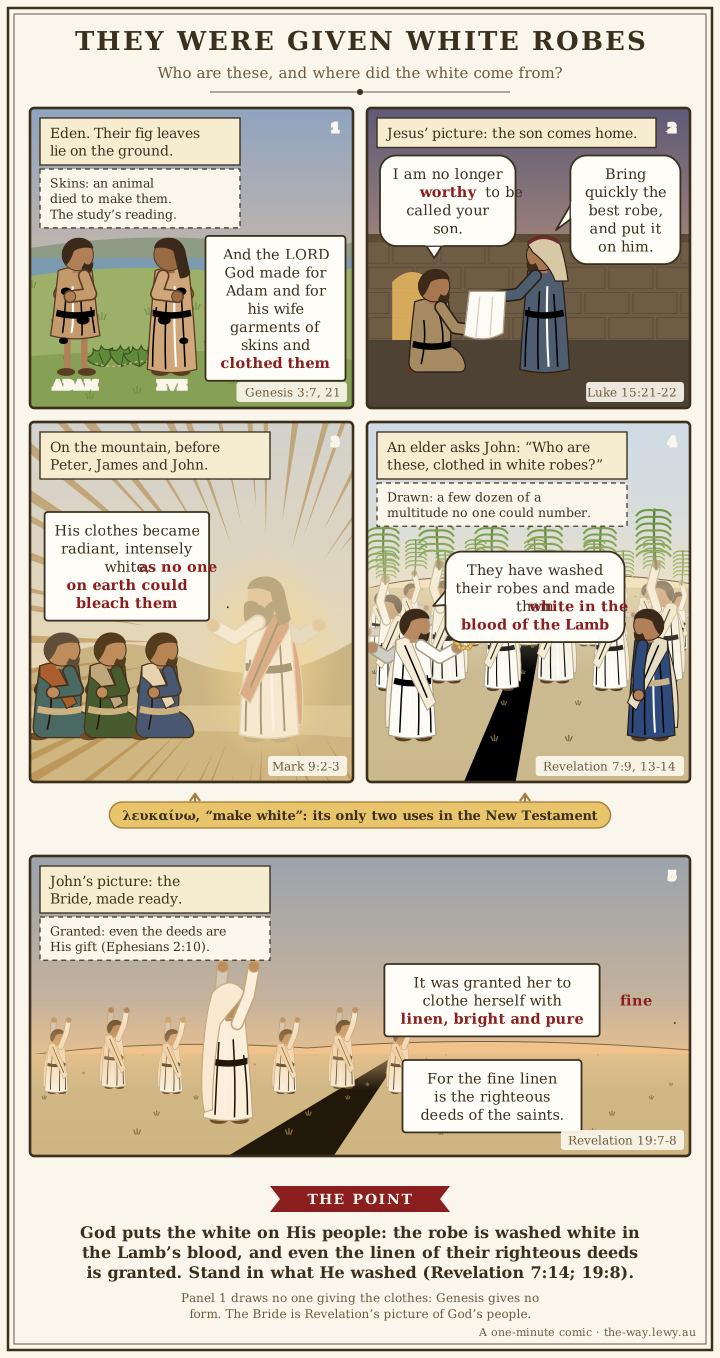
**In one sentence:** God puts the white garment on His people: the robe is given and made white in
the Lamb's blood, whiter than any launderer on earth could make it, and even the fine linen of the
saints' righteous deeds is granted, so you stand in what He washed and wear what He worked in you.
[](https://the-way.lewy.au/assets/img/comics/they-were-given-white-robes.svg)
## Key Takeaways
*(This section follows the [Key Takeaways](https://the-way.lewy.au/about/key-takeaways/) format — see that page for what each part is for.)*
### Types & Prophecy
- **A type, held as a reading.** The first clothes God made covered two people who had sewn their
own and still hid (Genesis 3:7-10, 21). Scripture never calls the garments of skins a type, so
this study reads them as a pattern the later texts fill in: God provides the covering, and the
covering costs a life.
- **Prophecy fulfilled.** "Though your sins are like scarlet, they shall be as white as snow"
(Isaiah 1:18, ESV). John sees it done, in a crowd no one could number (Revelation 7:9, 14).
### Lessons about Jesus
- Jesus' own clothes became "radiant, intensely white, as no one on earth could bleach them"
(Mark 9:3, ESV). The white His people wear is His colour first.
- The robes are made white "in the blood of the Lamb" (Revelation 7:14, ESV). What whitens them is
His death.
- He gives the garments. To a church that thought itself rich, He said, "I counsel you to buy from
me... white garments" (Revelation 3:18, ESV).
### Memory verses
> ✝️ Isaiah 61:10 (ESV)
>
> 10 I will greatly rejoice in the LORD; my soul shall exult in my God, for he has clothed me with
> the garments of salvation; he has covered me with the robe of righteousness, as a bridegroom decks
> himself like a priest with a beautiful headdress, and as a bride adorns herself with her jewels.
> ✝️ Revelation 7:14 (ESV)
>
> 14 They have washed their robes and made them white in the blood of the Lamb.
### Be Transformed
- **Think.** Your standing before God is a robe He put on you, washed in Jesus' blood. Nothing you
sew adds to it.
- **Attitude.** Come back to the blood every day. "Blessed are those who wash their robes"
(Revelation 22:14, ESV) uses a present participle, which fits a washing that goes on, and "the
blood of Jesus his Son cleanses us from all sin" (1 John 1:7, ESV).
- **Do.** "Put on then, as God's chosen ones, holy and beloved, compassionate hearts, kindness,
humility, meekness, and patience" (Colossians 3:12, ESV). Choose one of those to wear on purpose
this week, and ask God for it, since the linen is granted too.
### Prayer
Father, You clothed Adam and Eve when they had only fig leaves, and You have clothed me with the
garments of salvation. Thank You for the robe washed white in the blood of Your Son Jesus, whiter
than anything I could make. Keep me from soiling what You have given, and work in me the righteous
deeds You prepared for me, so that what I wear on the day of the wedding is Your gift from first to
last. In Jesus' name. Amen.
## Study outline
- **[The clothes God makes](#the-clothes-god-makes)** and **[Whiter than snow](#whiter-than-snow)**:
the Old Testament pattern, with the verbs for clothing and for making white.
- **[As no one on earth could bleach them](#as-no-one-on-earth-could-bleach-them)**: the two New
Testament uses of "make white".
- **[Every white garment in Revelation](#every-white-garment-in-revelation)** and
**[Given, washed, granted](#given-washed-granted)**: the eight scenes in a table, then the verbs
that say where each garment came from.
- **[The fine linen of righteous deeds](#the-fine-linen-of-righteous-deeds)**: why deeds can be
clothing God grants.
- **[Who wears them](#who-wears-them)**: each group Revelation names, and the step to every believer.
- **[Worthy, soiled, and the wedding garment](#worthy-soiled-and-the-wedding-garment)**: the verses
that sound as if the garment is earned or can be lost.
## The clothes God makes
### Fig leaves and garments of skins
The first clothing in the Bible is homemade. "They sewed fig leaves together and made themselves
loincloths" (Genesis 3:7, ESV). It failed. When God came, Adam said, "I was afraid, because I
was naked, and I hid myself" (Genesis 3:10, ESV). The loincloths were on, and he still called
himself naked.
Then God made clothes: "And the LORD God made for Adam and for his wife garments of skins and
clothed them" (Genesis 3:21, ESV). The verb is לָבַשׁ (*labash*, H3847), in
the form that means to clothe someone else, with God as its subject: וַיַּלְבִּשֵׁם,
"and He clothed them". The garments were skins, so an animal died to make them. Genesis does not
explain that detail, and this study holds it as a reading: the covering God provides costs a life.
### The same verb, the same Giver
The same verb, in the same causative stem, clothes God's people twice more in the prophets.
Isaiah sings, "he has clothed me with the garments of salvation; he has covered me with the robe of
righteousness" (Isaiah 61:10, ESV): הִלְבִּישַׁנִי, "He has clothed me". And
in Zechariah's vision Joshua the high priest stands "clothed with filthy garments" (Zechariah 3:3,
ESV) until the angel says, "Remove the filthy garments from him," and to Joshua, "Behold, I have
taken your iniquity away from you, and I will clothe you with pure vestments" (Zechariah 3:4, ESV).
The speaker is the angel of the LORD (Zechariah 3:1), and the one who rebukes Satan in Zechariah 3:2
is called "the LORD"; reading the angel as the LORD Himself is a common view, and a contested one.
The iniquity goes first, then the clothes. [Saved as Through Fire](https://the-way.lewy.au/salvation/saved-as-through-fire/)
reads Joshua as the brand plucked from the fire.
### Two garments in Isaiah
Isaiah uses one noun, righteousness, for two very different garments. Confessing Israel's sin, he says, "all our
righteous deeds are like a polluted garment" (Isaiah 64:6, ESV). "Righteous deeds" there is
צִדְקֹתֵינוּ (*tsidqotenu*), the plural of צְדָקָה
(*tsedaqah*, H6666). The robe God puts on him in Isaiah 61:10 is a
מְעִיל צְדָקָה, a "robe of righteousness", the same word. The righteousness Israel
produced is a polluted garment; the righteousness God puts on is a robe.
This shows that God clothes His people while they are still unpresentable. He takes off what
they made, deals with their iniquity, and dresses them Himself.
## Whiter than snow
### The verb "make white"
Hebrew has a verb for making white, לָבַן (*laban*, H3835), and the prophets
use it for sin removed. "Though your sins are like scarlet, they shall be as white as snow"
(Isaiah 1:18, ESV). David prays, "Purge me with hyssop, and I shall be clean; wash me, and I shall be
whiter than snow" (Psalm 51:7, ESV). The Greek Old Testament makes God the subject in Isaiah 1:18:
ὡς χιόνα λευκανῶ, "I will make them white as snow".
The Greek of Psalm 51:7 matters for Revelation. It reads πλυνεῖς με καὶ ὑπὲρ χιόνα λευκανθήσομαι,
"You will wash me, and I will be made whiter than snow". Those are the two verbs of Revelation 7:14,
πλύνω (*plynō*, G4150), wash, and λευκαίνω (*leukainō*, G3021), make white. John does not quote the
psalm, so this is an echo held as a reading, and the *ESV Study Bible* points to the same psalm at
Revelation 7:13-14.
### Made white in the time of trouble
Daniel uses the verb for the end. He is told of "a time of trouble, such as never has been"
(Daniel 12:1, ESV), and then that "many shall purify themselves and make themselves white and be
refined" (Daniel 12:10, ESV). Theodotion's Greek of Daniel, the one Brenton prints, has
θλῖψις (*thlipsis*, G2347) for the trouble and ἐκλευκανθῶσι, "made white", for the many. Jesus took up Daniel's words:
"then there will be great tribulation, such as has not been from the beginning of the world"
(Matthew 24:21, ESV). And John's multitude are "the ones coming out of the great tribulation", with
robes "made white" (Revelation 7:14, ESV). Daniel was told the many would be made white in the time of
trouble, and John names what makes them white: the Lamb's blood. John quotes neither Daniel nor the
psalm, so these links are echoes, held as a reading.
### White is His colour
In the visions the white belongs to God first. The Ancient of Days sits in judgment, "his clothing was
white as snow, and the hair of his head like pure wool" (Daniel 7:9, ESV). John sees the risen Son of
Man the same way: "The hairs of his head were white, like white wool, like snow" (Revelation 1:14,
ESV). Revelation uses λευκός (*leukos*, G3022), white, sixteen times, for His hair, the white stone
(Revelation 2:17), the white horses, the white cloud (Revelation 14:14) and the great white throne
(Revelation 20:11) as well as for the saints' clothing.
## As no one on earth could bleach them
The verb λευκαίνω, make white, appears twice in the New Testament.
### On the mountain
The first is the Transfiguration. "Jesus took with him Peter and James and John, and led them up a
high mountain by themselves. And he was transfigured before them, and his clothes became radiant,
intensely white, as no one on earth could bleach them" (Mark 9:2-3, ESV). Mark's Greek names the trade:
οἷα γναφεὺς ἐπὶ τῆς γῆς οὐ δύναται οὕτως λευκᾶναι, "as no fuller on earth is able to whiten
them". A fuller bleached cloth for a living, and no fuller could do this. Matthew says His clothes "became white as light"
(Matthew 17:2, ESV). The white was His own, shining out of Him.
### The multitude's robes
The second is Revelation 7:14: "They have washed their robes and made them white in the blood of the
Lamb." Those are the only two. The white no launderer on earth could make is the white of Jesus'
glory, and the robes of the multitude are made white by His blood. Blood stains cloth. In this verse
it makes cloth white, because the blood is the Lamb's.
### Heaven's messengers in white
Heaven's messengers wear the same colour. The young man in the empty tomb is "dressed in a white robe"
(Mark 16:5, ESV), a στολή (*stolē*, G4749), the very word for the saints' robes in Revelation; two
men in white robes stand by at the Ascension (Acts 1:10; see Matthew 28:3; John 20:12).
This shows that God dresses His people in His own colour. The white robe is a share in Jesus' purity,
made theirs at the cost of His blood.
## Every white garment in Revelation
In six of Revelation's eight scenes the text says how the garment was come by: it is promised,
offered, given, washed or granted.
| Scene | Who wears it | Garment | How they come by it |
| --- | --- | --- | --- |
| Revelation 3:4-5 | The few in Sardis "who have not soiled their garments", and the one who conquers | ἱμάτια λευκά, white garments | Promised: "will be clothed thus in white garments" |
| Revelation 3:18 | The church in Laodicea, "naked" (Revelation 3:17) | ἱμάτια λευκά | Offered: "buy from me" |
| Revelation 4:4 | The twenty-four elders | ἱμάτια λευκά | Not said |
| Revelation 6:11 | The souls under the altar, "slain for the word of God" (Revelation 6:9) | στολὴ λευκή, a white robe | ἐδόθη, "given" |
| Revelation 7:9-14 | A great multitude from every nation, out of the great tribulation | στολαὶ λευκαί, white robes | Washed and made white in the blood of the Lamb |
| Revelation 19:7-8 | The Bride of the Lamb | βύσσινον λαμπρὸν καθαρόν, fine linen, bright and pure | ἐδόθη, "granted" |
| Revelation 19:14 | The armies of heaven following Him | βύσσινον λευκὸν καθαρόν, fine linen, white and pure | Not said |
| Revelation 22:14 | "Those who wash their robes" | στολαί | Washed |
Three words carry the clothing. στολή, a long robe, appears nine times in the New Testament, five of
them in Revelation (Revelation 6:11; 7:9, 13, 14; 22:14). ἱμάτιον (*himation*, G2440) is the common
word for an outer garment. βύσσινος (*byssinos*, G1039), fine linen, appears five times in four verses,
all in Revelation: Babylon trades in it and wears it (Revelation 18:12, 16), the Bride is granted it
(Revelation 19:8), and the armies ride out in it (Revelation 19:14). [The Rapture](https://the-way.lewy.au/last-things/rapture/#the-fabric-linking-the-armies-and-the-bride)
shows how the armies' linen matches the Bride's.
## Given, washed, granted
### Given
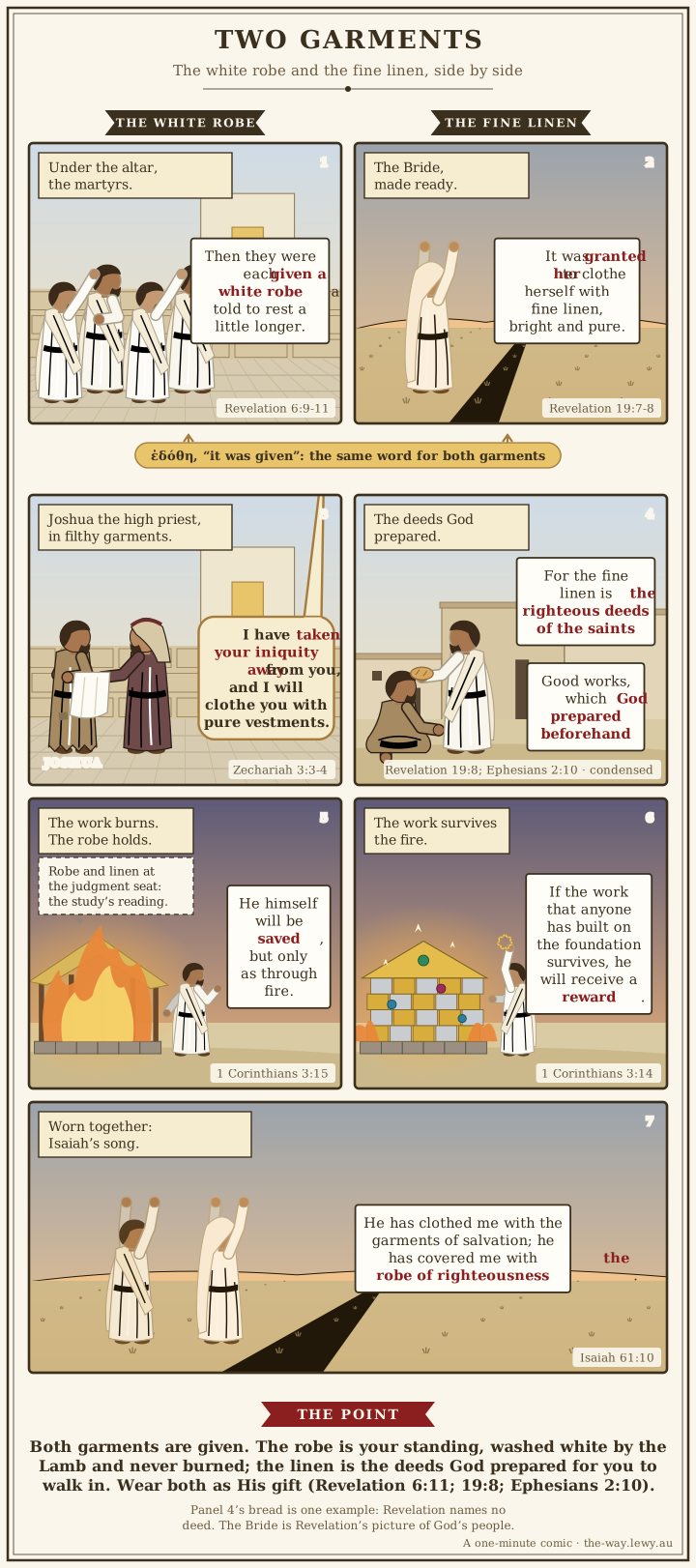
The martyrs under the altar cry "how long?", and "then they were each given a white robe and told to
rest a little longer" (Revelation 6:11, ESV). The verb is ἐδόθη (*edothē*, from δίδωμι, G1325), "it was
given", with no giver named, the form Revelation uses throughout for what God gives or permits. In
this scene the whole act is the Giver's: they had died for the word of God, and the robe came to them
as a gift while they waited.
### Washed in the blood
The multitude's robes are described differently: "They have washed their robes and made them white in
the blood of the Lamb" (Revelation 7:14, ESV). Here the verbs are active, ἔπλυναν and ἐλεύκαναν: they
washed, they made white. What did the whitening is named, ἐν τῷ αἵματι τοῦ ἀρνίου, "in the blood of
the Lamb". They brought their robes to His blood; His blood made them white. Revelation says the same
of the brothers who overcame the accuser: "they have conquered him by the blood of the Lamb and by the
word of their testimony" (Revelation 12:11, ESV). Their part is to come to the blood. The blood does
the cleansing.
### Still washing
The book closes on the same robe: "Blessed are those who wash their robes, so that they may have the
right to the tree of life and that they may enter the city by the gates" (Revelation 22:14, ESV).
οἱ πλύνοντες is a present participle. It can simply name a group, "the washers"; its present tense
also fits people who keep washing, which is how this study reads it. The city is open to "those who are
written in the Lamb's book of life" (Revelation 21:27, ESV), and the robe is how they enter.
#### The text of Revelation 22:14
At Revelation 22:14 the Byzantine Textform and the Textus Receptus read "who do his commandments",
which is what the KJV prints. The text of Tischendorf and the SBLGNT, followed by the ESV, reads "wash
their robes", and the *CSB Ancient Faith Study Bible* footnotes the other reading. On that text,
entry to the city depends on a robe washed in the Lamb's blood.
### Granted
The Bride "has made herself ready; it was granted her to clothe herself with fine linen, bright and
pure" (Revelation 19:7-8, ESV). Her readiness is described as her own act, and the clause still opens
with ἐδόθη αὐτῇ, "it was granted her". [The Bride of Christ](https://the-way.lewy.au/israel-and-church/bride-of-christ/)
works through that verse and what the Bride's readiness means.
This shows that every white garment in Revelation comes from God's side. Some are given outright,
some are washed in the Lamb's blood, and the linen is granted.
## The fine linen of righteous deeds
### What the linen is
Revelation explains the linen itself: "for the fine linen is the righteous deeds of the saints"
(Revelation 19:8, ESV). The word is δικαιώματα (*dikaiōmata*, G1345), righteous acts. Revelation uses
it twice. The first time it is God's: "your righteous acts have been revealed" (Revelation 15:4, ESV).
The second time it is the saints', worn as clothing.
### Isaiah's garment and John's linen
Set this beside Isaiah 64:6. Isaiah said "all our righteous deeds are like a polluted garment"; John
says the righteous deeds of the saints are fine linen, bright and pure. Both pictures dress righteous
deeds as clothing, and the verdicts are opposite. Isaiah's are the deeds of a people who confess, in
the same verse, "We have all become like one who is unclean" (Isaiah 64:6, ESV). The saints' deeds
come from God. Paul says the righteous requirement of the law is "fulfilled in us, who walk not according to the flesh but
according to the Spirit" (Romans 8:4, ESV), and the word there is δικαίωμα too. The saints' deeds are
the works "which God prepared beforehand, that we should walk in them" (Ephesians 2:10, ESV), done in
people already saved "by grace... through faith... not a result of works" (Ephesians 2:8-9, ESV). So
the linen is granted twice over: God prepared the deeds, and God gives the garment they make.
### Robe and linen together
The robe and the linen answer different questions. The robe, washed in blood, answers whether a person
may stand before God and enter the city (Revelation 7:14; 22:14). The linen, the righteous deeds,
shows what was done with what was given. [The Judgment Seat of Christ](https://the-way.lewy.au/last-things/judgment-seat-of-christ/)
takes up that second question, where each believer's work is tested for reward or loss. That the two
garments answer two questions is this study's reading of the text's own explanations: blood for the
one, deeds for the other. The *ESV Study Bible* reads the linen as "her groom's gift of grace" and
links it to the robes of Revelation 6:11 and 7:14 (note on Revelation 19:7-8), which agrees that both
are gifts.
[](https://the-way.lewy.au/assets/img/comics/two-garments.svg)
## Who wears them
### The groups Revelation names
In Revelation's own scenes the white robe is worn by the martyrs under the altar (Revelation 6:11)
and by the multitude "coming out of the great tribulation" (Revelation 7:14). On this site's reading
those are people who come to Christ during the tribulation, after the Church has been caught up (see
[The Restrainer](https://the-way.lewy.au/last-things/the-restrainer/)); the *ESV Study Bible* notes that others take "the great
tribulation" to mean the sufferings of the church throughout history (note on Revelation 7:13-14).
White garments are promised to the faithful in Sardis (Revelation 3:4-5), offered to Laodicea
(Revelation 3:18), and the Bride is granted her linen (Revelation 19:8).
### The twenty-four elders
The elders "clothed in white garments, with golden crowns on their heads" (Revelation 4:4, ESV) are
contested. One case reads them as the redeemed: their white garments and crowns are what Revelation
promises the faithful and the conquerors (Revelation 2:10; 3:5), and twenty-four matches the twelve tribes and
twelve apostles of the city (Revelation 21:12, 14); on a pre-tribulation reading they represent the
Church already in heaven. The other case reads them as angels, a heavenly council, noting that in
Revelation 5:8-10 they do not plainly include themselves among the people the Lamb purchased. The
*ESV Study Bible* gives both (note on Revelation 4:4). This study does not need to settle it.
### Every believer
Giving the robe to every believer is a step beyond Revelation's scenes, and the text supports it.
Revelation 22:14 ties the robe to entering the city, which is open to everyone in the Lamb's book of
life (Revelation 21:27). Jesus promises white garments to the one who conquers in a church of this
age (Revelation 3:5). Isaiah and Zechariah give the same clothing to God's people in general
(Isaiah 61:10; Zechariah 3:4). And Paul uses clothing for every believer: "as many of you as were
baptized into Christ have put on Christ" (Galatians 3:27, ESV).
### The robe and the resurrection body
The martyrs are given robes while they are still waiting to be raised, so the robe is a different
gift from the resurrection body; [We Shall All Be Changed](https://the-way.lewy.au/last-things/we-shall-all-be-changed/#the-white-robes-are-a-different-gift)
sets the two side by side. Both are clothing, and both are God's gift.
## Worthy, soiled, and the wedding garment
### "For they are worthy"
Some verses sound as if the white is earned. Jesus says of Sardis, "you have still a few names in
Sardis, people who have not soiled their garments, and they will walk with me in white, for they are
worthy" (Revelation 3:4, ESV). Revelation uses ἄξιος (*axios*, G514), worthy, seven times. Five ask
or answer who is worthy before the throne, and the answer is God and the Lamb (Revelation 4:11; 5:2,
4, 9, 12); one says the persecutors have got what they deserve (Revelation 16:6); and one is Sardis'
few. The Lamb is worthy because "you were slain, and by your blood you ransomed people for God"
(Revelation 5:9, ESV). The few in Sardis are worthy in the sense Paul gives when he urges believers
"to walk in a manner worthy of the calling to which you have been called" (Ephesians 4:1, ESV): they
kept clean what they had been given. The prodigal son said "I am no longer worthy" (Luke 15:21) and
was handed the best robe, a στολή (Luke 15:22). The robe went to a son who called himself unworthy;
worthiness is how a given robe is worn.
### Garments that can be soiled
The garments are given, and they can be soiled. In Sardis all but "a few names" had soiled theirs (Revelation 3:4). Jude
tells believers to show mercy while "hating even the garment stained by the flesh" (Jude 1:23, ESV).
Jesus warns, "Blessed is the one who stays awake, keeping his garments on, that he may not go about
naked and be seen exposed" (Revelation 16:15, ESV). And He tells the lukewarm, "buy from me... white
garments so that you may clothe yourself and the shame of your nakedness may not be seen" (Revelation
3:18, ESV). Isaiah had already priced what God sells: "come, buy... without money and without price"
(Isaiah 55:1, ESV); whether Jesus echoes it is a reading, and the counsel is the same either way. The
remedy for soiled clothes is to come back to Him for clean ones. What is soiled is the walk; the
standing holds, since "there is therefore now no condemnation for those who are in Christ Jesus"
(Romans 8:1, ESV), and the promise beside the warning stands: "I will never blot his name out of the book of life" (Revelation 3:5, ESV).
### The wedding garment
In Jesus' parable of the wedding feast, the king finds "a man who had no wedding garment" and asks,
"Friend, how did you get in here without a wedding garment?" The man "was speechless" and is thrown
out (Matthew 22:11-13, ESV). Whether the host supplied the garments is contested. The *ESV Study Bible*
gives two readings, a garment the king provided, pointing to imputed righteousness, or a clean
garment standing for righteous works; the *NIV Cultural Backgrounds Study Bible* notes that some
scholars think the host supplied the clothes and others that soiled clothing simply insulted him
(notes on Matthew 22:11). The text itself says three things: the man had no wedding garment, he had
no answer, and the king had him thrown out. Coming to the wedding means coming dressed as the King
requires, and on this study's reading the rest of Scripture names what He requires: a robe He gives
and linen He grants.
## Discussion questions
1. **The language.** Revelation 7:14 uses two verbs, "washed" and "made white", and the Greek of
Psalm 51:7 uses the same pair. What changes when you read the multitude's robes as David's prayer
answered?
2. **The text in its context.** The martyrs are given robes and told to wait (Revelation 6:11); the
multitude washed theirs (Revelation 7:14). Why might Revelation describe the same gift with a
passive verb in one scene and an active one in the next?
3. **Christ.** The only other New Testament use of "make white" is Jesus' clothing at the
Transfiguration (Mark 9:3). What does it tell you about Jesus that the white of His glory and the
white of your robe are described with the same word?
4. **The hard part.** Jesus calls the few in Sardis "worthy" (Revelation 3:4) and warns others to keep
their garments on (Revelation 16:15). How do those verses sit with a robe that is given and washed
in His blood?
5. **Be transformed.** Isaiah called his people's righteous deeds a polluted garment (Isaiah 64:6),
and John calls the saints' righteous deeds fine linen (Revelation 19:8). Where are you still sewing
fig leaves, and what would it look like to ask God for the linen instead?
## References & Recommended Reading
- *ESV Study Bible* (Crossway, 2008): notes on Revelation 3:4-5, 4:4, 7:13-14, 19:7-8 and Matthew
22:11. Quoted briefly with attribution.
- *NIV Cultural Backgrounds Study Bible* (Zondervan, 2016) and *NIV Biblical Theology Study Bible*
(Zondervan, 2018): notes on Matthew 22:11-13.
- *CSB Ancient Faith Study Bible* (Holman, 2019): textual footnote on Revelation 22:14.
- Greek: SBL Greek New Testament, with the Textus Receptus, the Byzantine Textform and Tischendorf
compared at Revelation 22:14; word counts from the MACULA Greek SBLGNT morphology.
- Septuagint: Brenton's edition (Codex Vaticanus; its Daniel is Theodotion's) for Genesis 3:21,
Psalm 50:9 (51:7 in English Bibles), Isaiah 1:18, 61:10, 64:5 and Daniel 12:1, 10.
- Hebrew: Westminster Leningrad Codex with the MACULA Hebrew morphology and the unfoldingWord ULT
interlinear for Genesis 3:21, Isaiah 1:18, 61:10, 64:6 and Zechariah 3:4.
### On this site
- [The Judgment Seat of Christ](https://the-way.lewy.au/last-things/judgment-seat-of-christ/): the linen's question, reward or loss.
- [The Bride of Christ](https://the-way.lewy.au/israel-and-church/bride-of-christ/) and
[The Wife of the Lamb](https://the-way.lewy.au/israel-and-church/wife-of-the-lamb/): who the Bride is and how she is made
ready.
- [The Rapture](https://the-way.lewy.au/last-things/rapture/#the-fabric-linking-the-armies-and-the-bride): the armies dressed as the
Bride.
- [We Shall All Be Changed](https://the-way.lewy.au/last-things/we-shall-all-be-changed/#the-white-robes-are-a-different-gift): the
robes beside the resurrection body.
- [Saved as Through Fire](https://the-way.lewy.au/salvation/saved-as-through-fire/): Joshua the brand plucked from the fire,
and the garment stained by the flesh.
- [Partakers of the Divine Nature](https://the-way.lewy.au/christian-life/partakers-of-the-divine-nature/): the righteous
deeds as the fruit of the nature God gives.