---
title: "We Shall All Be Changed"
category: "prophecy"
description: "The body God has promised believers. At the last trumpet He raises the body that was buried and changes it, and the living with it, into a body like the risen Jesus' own: imperishable, glorious, powerful and filled with the Holy Spirit. A study of 1 Corinthians 15:35-58."
tags: ["1-corinthians", "philippians", "romans", "1-john", "genesis", "isaiah", "hosea", "resurrection", "glorification", "rapture", "person/adam", "method/word-study", "lang/greek", "lang/hebrew"]
draft: false
primary_passage: "1 Corinthians 15:35-58"
bible_references: ["1 Corinthians 15:12", "1 Corinthians 15:20-26", "Genesis 2:7", "Isaiah 25:8", "Isaiah 26:19", "Hosea 13:14", "Job 14:7-14", "Job 19:25-27", "Job 33:24-28", "Job 42:17", "Psalm 102:26", "Acts 2:27", "1 Corinthians 2:14-15", "Romans 5:14", "Philippians 3:20-21", "Romans 8:11", "Romans 8:23", "Romans 8:29", "1 John 3:2", "1 Thessalonians 4:16-17", "2 Corinthians 5:1-4", "Luke 24:36-43", "John 20:19-27", "1 Timothy 6:16", "Hebrews 1:12", "Revelation 6:11", "Daniel 12:2-3", "Job 19:25-27", "1 Corinthians 15:8", "Acts 26:13", "Revelation 1:16", "Luke 24:26", "1 Timothy 3:16", "Acts 1:3", "Matthew 17:2"]
date_created: 2026-09-28
date_modified: 2026-10-22
ai_provider_models:
- anthropic/claude-opus-5.5
---
# We Shall All Be Changed
Some in Corinth were laughing at the resurrection. "How can some of you say that there is no
resurrection of the dead?" Paul asks (1 Corinthians 15:12, ESV). Then he gives their objection in
their own words: "How are the dead raised? With what kind of body do they come?" (1 Corinthians
15:35, ESV). A body rots. How can God raise it, and what would He raise?
Paul answers both questions. His answer is the body you will live in for ever.
**In one sentence:** At the last trumpet God raises the body that was buried and changes it, and
changes the living with it, into a body like the risen Jesus' own — imperishable, glorious, strong
and filled with the Holy Spirit — so that death, swallowed up, never touches you again.
## Key Takeaways
*(This section follows the [Key Takeaways](https://the-way.lewy.au/about/key-takeaways/) format — see that page for what each part is for.)*
### Types & Prophecy
- **The seed.** "What you sow does not come to life unless it dies" (1 Corinthians 15:36, ESV). A
seed is Paul's picture of the resurrection body. The kernel goes into the ground, and God gives it
the body He has chosen. What comes up is the same plant, and more than the seed ever looked like.
- **Adam, a type of Christ.** Paul calls Adam "a type of the one who was to come" (Romans 5:14, ESV) and
Jesus "the last Adam" (1 Corinthians 15:45). Adam was the
pattern of every body now alive. Jesus is the pattern of every body that will be raised.
- **Prophecy fulfilled at the resurrection.** Isaiah 25:8 ("He will swallow up death forever") and
Hosea 13:14 ("O Death, where are your plagues?") are both fulfilled on the day the dead are
raised (1 Corinthians 15:54-55).
### Lessons about Jesus
- **Jesus' risen body is the model.** He "will transform our lowly body to be like his glorious
body" (Philippians 3:21, ESV). What He showed the disciples in Luke 24 and John 20 is what you
will be given.
- **Jesus is the one who changes you.** He does it "by the power that enables him even to subject
all things to himself" (Philippians 3:21, ESV). The last Adam is "a life-giving spirit"
(1 Corinthians 15:45).
- **The victory is His.** "Thanks be to God, who gives us the victory through our Lord Jesus
Christ" (1 Corinthians 15:57, ESV).
### Memory verses
> ✝️ 1 Corinthians 15:51-52 (ESV)
>
> 51 Behold! I tell you a mystery. We shall not all sleep, but we shall all be changed, 52 in a
> moment, in the twinkling of an eye, at the last trumpet. For the trumpet will sound, and the dead
> will be raised imperishable, and we shall be changed.
> ✝️ Philippians 3:21 (ESV)
>
> 21 who will transform our lowly body to be like his glorious body, by the power that enables him
> even to subject all things to himself.
### Be Transformed
- **Think.** Your body is part of what Jesus redeemed. The Christian hope is the redemption of the
body (Romans 8:23). Heaven without a body is the waiting room.
- **Attitude.** Hold your weakness lightly and your hope firmly. What is "sown in weakness" is
"raised in power" (1 Corinthians 15:43). Illness, age and disability belong to the body that is
sown.
- **Do.** Paul's own application is work: "be steadfast, immovable, always abounding in the work of
the Lord" (1 Corinthians 15:58, ESV). Pick one piece of the Lord's work you have let go, and pick
it up this week.
### Prayer
Father, You alone have immortality, and You have promised to clothe us with it. Thank You that
Your Son Jesus was raised in the body, the firstfruits of all who belong to Him. We groan in these
bodies, and we wait for their redemption. Keep us steadfast in Your work until the trumpet sounds,
and give us courage at every graveside, because death has already lost. In Jesus' name. Amen.
## Study outline
- [The question Corinth asked](#the-question-corinth-asked). Why a Greek city found a raised body
absurd, and how Paul splits the objection into two questions.
- [The seed: the same body, changed](#the-seed-the-same-body-changed). Continuity. What is raised
is what was sown.
- [Four contrasts](#four-contrasts). What changes: perishable to imperishable, dishonour to glory,
weakness to power, natural to spiritual.
- [Two Adams](#two-adams). The pattern: you will bear the image of the risen Jesus.
- [The mystery: changed in a moment](#the-mystery-changed-in-a-moment). When: at the last trumpet,
the dead raised and the living changed together.
- [Death swallowed up](#death-swallowed-up). Isaiah 25:8 and Hosea 13:14, the question Job asked
first, and why death's sting is sin.
- [Therefore](#therefore). What Paul tells you to do with this now.
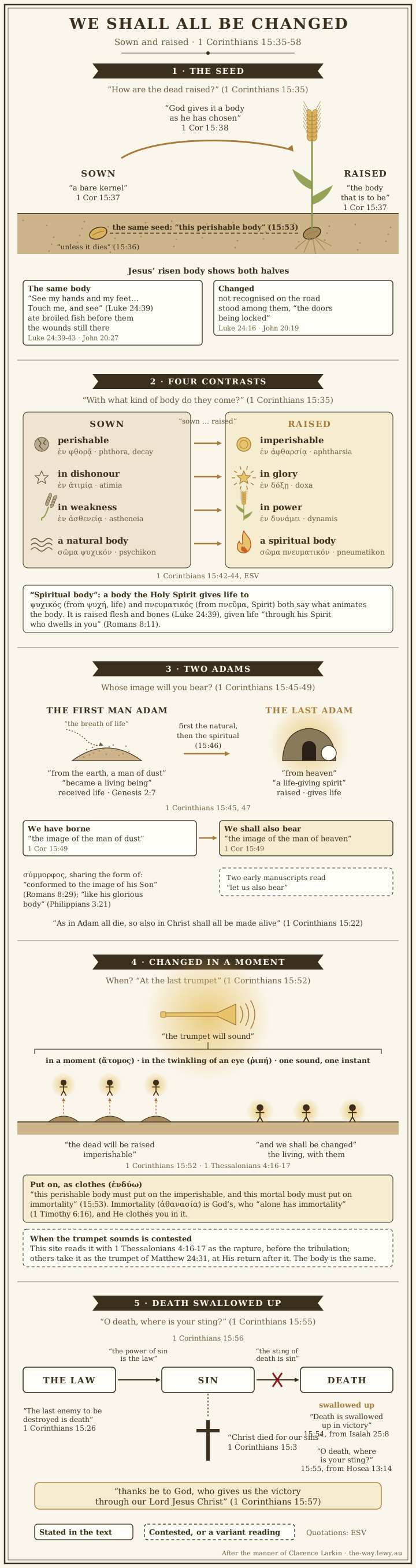
The whole answer is drawn as one plate, in five panels, one for each of Paul's questions. Each
panel stands again beside the section it pictures.
??? abstract "The plate: sown and raised"
[](https://the-way.lewy.au/assets/img/last-things/sown-and-raised.svg)
## The question Corinth asked
### The occasion
Paul wrote 1 Corinthians from Ephesus, in the spring of about AD 53-55 (1 Corinthians 16:8). The
church had written to him with questions (1 Corinthians 7:1), and the resurrection seems to have
been one of them. The *ESV Study Bible* notes that educated Greeks thought an embodied life after
death "laughable," a thing of popular fables. Many held that death ended life or led to a shadowy
existence in the underworld. A Christian raised in that culture could believe Jesus rose and still
balk at his own body rising.
Jewish hope was the other way round. The *Cultural Backgrounds Study Bible* observes that for Jews
resurrection "by definition meant the restoration of the body" (note on Philippians 3:21). Daniel
had written that "many of those who sleep in the dust of the earth shall awake" (Daniel 12:2, ESV),
and Job had said, "in my flesh I shall see God" (Job 19:26, ESV). Paul was a Jew writing to a
mostly Gentile church, and he meets them with the Jewish hope, explained.
### The shape of the passage
1 Corinthians 15 has two halves. Verses 1-34 argue *that* the dead are raised: Christ was raised,
and He is "the firstfruits of those who have fallen asleep" (1 Corinthians 15:20). Verses 35-58
answer *how*. The two questions in 1 Corinthians 15:35 set the plan:
| Question | Paul's answer | Verses |
|---|---|---|
| "How are the dead raised?" | God gives a body to what is sown | 1 Corinthians 15:36-41 |
| "With what kind of body?" | Imperishable, glorious, powerful, spiritual, like Christ's | 1 Corinthians 15:42-49 |
| When? | At the last trumpet, the living changed with the dead | 1 Corinthians 15:50-57 |
| So what? | Your labour in the Lord is not in vain | 1 Corinthians 15:58 |
Paul's tone at the start is sharp: "You foolish person!" (1 Corinthians 15:36, ESV). The *Cultural
Backgrounds Study Bible* notes that ancient speakers answered an ignorant objector this way. Paul
treats the objection as foolish because the farmer's field already answers it.
## The seed: the same body, changed
> ✝️ 1 Corinthians 15:36-38 (ESV)
>
> 36 You foolish person! What you sow does not come to life unless it dies. 37 And what you sow is
> not the body that is to be, but a bare kernel, perhaps of wheat or of some other grain. 38 But God
> gives it a body as he has chosen, and to each kind of seed its own body.
The verb is σπείρω (*speirō*, G4687), "sow." Paul uses it four times in 1 Corinthians 15:42-44
for burial. A funeral is a sowing.
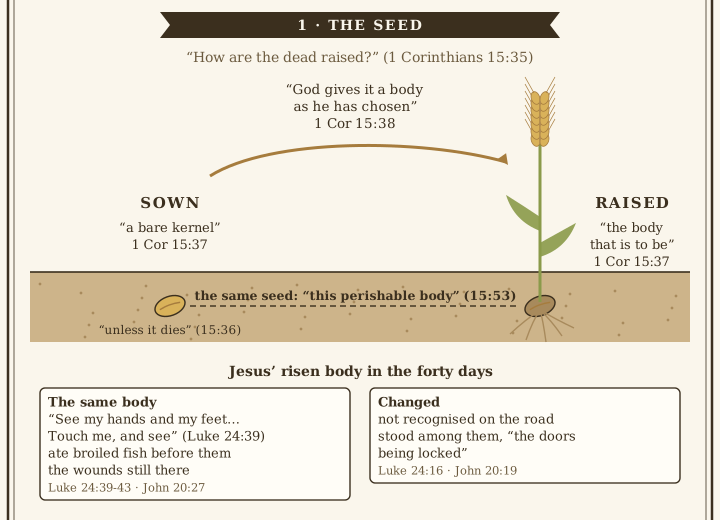
**The seed holds both halves of the answer.** A wheat kernel and a wheat plant look nothing alike.
Yet the plant grows from that kernel and no other, and it is wheat. The body raised is the body
buried, and it is changed past recognition.
Paul makes the continuity explicit in 1 Corinthians 15:53: "*this* perishable body must put on the
imperishable, and *this* mortal body must put on immortality" (ESV, emphasis added). The
demonstrative τοῦτο (*touto*, G5124, "this") appears twice in the verse. The body that puts on immortality is this one.
The *Cultural Backgrounds Study Bible* sets Paul beside later rabbis, who answered the same
objection by claiming an indestructible neck bone would seed the new body (note on 1 Corinthians
15:37). Paul needs no bone. God "gives it a body as he has chosen" (1 Corinthians 15:38). The
continuity rests on God's choice and God's power.
### In the forty days
**Jesus' own body shows both halves.** It was the same body. "See my hands and my feet, that it is
I myself. Touch me, and see. For a spirit does not have flesh and bones as you see that I have"
(Luke 24:39, ESV). He ate broiled fish in front of them (Luke 24:42-43). He told Thomas to put his
hand in His side (John 20:27). The wounds were still there.
It was also changed. The two on the road to Emmaus did not recognise Him (Luke 24:16). He came and
stood among the disciples with "the doors being locked" (John 20:19, ESV). The *NIV Biblical
Theology Study Bible* draws on exactly these passages to explain Philippians 3:21's "glorious
body": physical and touchable, and "not limited by being material."
[](https://the-way.lewy.au/assets/img/last-things/changed-seed.svg)
*From the plate: the kernel and the plant are one seed, and in the forty days before the ascension Jesus' risen body was the same body, changed.*
This shows that God keeps what He made. He raises the body He formed from the dust, and it stays
yours. The person you are rises in the body you had, made new.
### After the ascension
**The forty days show His risen body before the ascension.** Afterwards Scripture shows a glory those
days never did. Paul, who counts the Damascus road among the resurrection appearances (1 Corinthians
15:8), saw "a light from heaven, brighter than the sun" (Acts 26:13, ESV), and John saw a face "like
the sun shining in full strength" (Revelation 1:16, ESV). The *ESV Study Bible* places Christ's
glory "at his resurrection and then more fully at his ascension" (note on Luke 24:26), and the
"glorious body" of Philippians 3:21 is the ascended Lord's.
**How the ascension bears on His body is contested.** Either the body was further glorified when He
was "taken up in glory" (1 Timothy 3:16, ESV), or it was raised glorious (1 Corinthians 15:43) and
the glory was held back through forty days of "many proofs" (Acts 1:3, ESV), as it once shone
through the same body at the transfiguration (Matthew 17:2). Revelation 1 is a vision in symbols
and cannot settle it. [At Home with the Lord](https://the-way.lewy.au/last-things/at-home-with-the-lord/#the-body-god-has-promised)
leans to the first. Either way, the pattern for your body is Christ as He is now: "we shall be like
him, because we shall see him as he is" (1 John 3:2, ESV).
## Four contrasts
> ✝️ 1 Corinthians 15:42-44 (ESV)
>
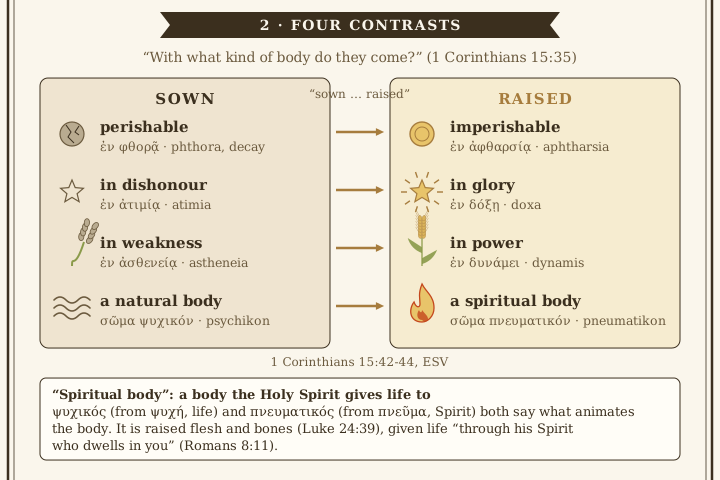
> 42 So is it with the resurrection of the dead. What is sown is perishable; what is raised is
> imperishable. 43 It is sown in dishonor; it is raised in glory. It is sown in weakness; it is
> raised in power. 44 It is sown a natural body; it is raised a spiritual body. If there is a
> natural body, there is also a spiritual body.
Paul repeats "sown... raised" four times. The *Cultural Backgrounds Study Bible* notes that orators
used repetition like this to build intensity.
| Sown | Raised | The Greek |
|---|---|---|
| perishable | imperishable | ἐν φθορᾷ → ἐν ἀφθαρσίᾳ |
| in dishonour | in glory | ἐν ἀτιμίᾳ → ἐν δόξῃ |
| in weakness | in power | ἐν ἀσθενείᾳ → ἐν δυνάμει |
| a natural body | a spiritual body | σῶμα ψυχικόν → σῶμα πνευματικόν |
### Perishable and imperishable
φθορά (*phthora*, G5356) is decay, the rotting that begins at death. Its opposite, ἀφθαρσία
(*aphtharsia*, G861), is "incorruption." The LSB footnotes both words as literally "in corruption"
and "in incorruption." The *ESV Study Bible* glosses "imperishable" as "no longer subject to
physical decay or aging." Nothing in the raised body wears out.
### Natural and spiritual
**"Spiritual body" means a body animated by the Holy Spirit.** The phrase has often been read as a
body made of spirit, a ghost. Luke 24:39 rules that out, and the Greek explains why.
ψυχικός (*psychikos*, G5591) is the adjective from ψυχή (*psychē*, G5590), "soul" or "life." A
σῶμα ψυχικόν is a body animated by natural life, the life Adam received when God breathed into him.
πνευματικός (*pneumatikos*, G4152) is the adjective from πνεῦμα (*pneuma*, G4151), "spirit." A
σῶμα πνευματικόν is a body animated by the Spirit. Both adjectives describe what powers the body.
Neither describes what it is made of.
Paul used the same pair a few chapters earlier. "The natural person does not accept the things of
the Spirit of God" (1 Corinthians 2:14, ESV). The natural person there is flesh and blood, and so
is the spiritual person of 1 Corinthians 2:15; what differs is who governs them. The *ESV Study
Bible* concludes that by "spiritual body" Paul "does not mean an immaterial body but a body animated
and empowered by the Holy Spirit."
Romans 8:11 names the agent: "he who raised Christ Jesus from the dead will also give life to your
mortal bodies through his Spirit who dwells in you" (ESV). The Holy Spirit who lives in you now is
the one who will raise you.
[](https://the-way.lewy.au/assets/img/last-things/changed-contrasts.svg)
*From the plate: the four contrasts of 1 Corinthians 15:42-44, sown and raised.*
### What "glory" and "power" promise
The *ESV Study Bible* reads "dishonor … glory" of outward appearance, and says the raised body will
be beautiful "beyond anything imaginable" (note on 1 Corinthians 15:43). "Weakness … power" speaks
of strength. Illness and age are weakness. The raised body has none.
Daniel 12:3 had already said the wise "shall shine like the brightness of the sky above" (ESV), and
Paul's analogy of sun, moon and stars points the same way: "star differs from star in glory"
(1 Corinthians 15:41, ESV).
## Two Adams
> ✝️ 1 Corinthians 15:45-49 (ESV)
>
> 45 Thus it is written, "The first man Adam became a living being"; the last Adam became a
> life-giving spirit. 46 But it is not the spiritual that is first but the natural, and then the
> spiritual. 47 The first man was from the earth, a man of dust; the second man is from heaven.
> 48 As was the man of dust, so also are those who are of the dust, and as is the man of heaven, so
> also are those who are of heaven. 49 Just as we have borne the image of the man of dust, we shall
> also bear the image of the man of heaven.
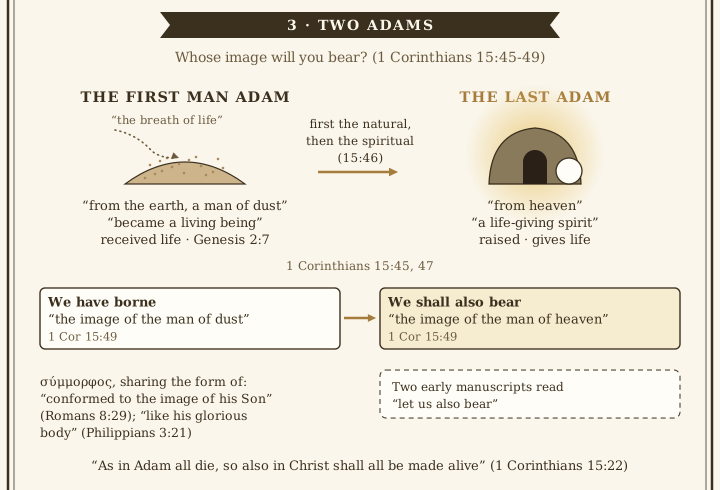
Two early manuscripts read "let us also bear" in 1 Corinthians 15:49 (LSB footnote). The ESV
follows the future, "we shall," and Romans 8:29 and Philippians 3:21 make the same promise with no
variant.
Paul quotes Genesis 2:7 from the Greek Old Testament, whose ψυχὴν ζῶσαν (*psychēn zōsan*, "a
living soul") he reproduces word for word. He adds two words of his own: "first" and "Adam." The
Hebrew behind it is נֶפֶשׁ חַיָּה (*nephesh chayyah*, H5315, "a living
creature"). "The LORD God formed the man of dust from the ground and breathed into his nostrils the
breath of life" (Genesis 2:7, ESV).
So the natural body is the Genesis 2 body: dust, animated by breath. Every human being has carried
that pattern. "We have borne the image of the man of dust" (1 Corinthians 15:49, ESV).
**The last Adam gives a different life.** Adam *received* life. Jesus, raised, *gives* it: He
"became a life-giving spirit" (1 Corinthians 15:45, ESV). He is the head of a new humanity the way
Adam was head of the old. "As in Adam all die, so also in Christ shall all be made alive"
(1 Corinthians 15:22, ESV).
**You will bear His image.** The same promise runs through Paul and John:
- Romans 8:29 — God "predestined [us] to be conformed to the image of his Son" (ESV).
- Philippians 3:21 — Jesus "will transform our lowly body to be like his glorious body" (ESV).
- 1 John 3:2 — "when he appears we shall be like him, because we shall see him as he is" (ESV).
The word for "conformed" in Romans 8:29 and "like" in Philippians 3:21 is the same, σύμμορφος
(*symmorphos*, G4832), "sharing the form of." Paul uses it only in these two verses. One is the
purpose God set before time; the other is the day it is done to your body.
[](https://the-way.lewy.au/assets/img/last-things/changed-adams.svg)
*From the plate: the image you have borne, and the image you will bear.*
This is the doctrine of glorification, and it shows that God finishes His work. The image of God in
which Adam was made (Genesis 1:27) is restored in Christ and completed in your body at His coming.
God set out to make a humanity in His image, and the resurrection is the day that purpose is
complete.
## The mystery: changed in a moment
> ✝️ 1 Corinthians 15:50-53 (ESV)
>
> 50 I tell you this, brothers: flesh and blood cannot inherit the kingdom of God, nor does the
> perishable inherit the imperishable. 51 Behold! I tell you a mystery. We shall not all sleep, but
> we shall all be changed, 52 in a moment, in the twinkling of an eye, at the last trumpet. For the
> trumpet will sound, and the dead will be raised imperishable, and we shall be changed. 53 For this
> perishable body must put on the imperishable, and this mortal body must put on immortality.
### Flesh and blood
"Flesh and blood" is a Jewish expression for mere humans, which Paul applies to humanity in its
present mortal form (*Cultural Backgrounds Study Bible*, note on 1 Corinthians 15:50). It describes the body in its present, dying condition. The *ESV Study Bible*
puts it plainly: corruptible bodies cannot inherit the kingdom. "Hence, the need for resurrection."
The change of 1 Corinthians 15:51 answers the problem 1 Corinthians 15:50 names.
### The living are changed too
**The mystery is about the believers still alive.** A μυστήριον (*mystērion*, G3466) in Paul is
something God had kept hidden and now reveals. The Old Testament promised the dead would rise
(Daniel 12:2). What it did not say is what happens to the believers who are alive when He comes.
Paul's answer: "We shall not all sleep, but we shall all be changed" (1 Corinthians 15:51, ESV).
ἀλλάσσω (*allassō*, G236), "change," occurs six times in the New Testament, and only 1 Corinthians
15:51-52 uses it of believers being changed. Hebrews 1:12, quoting Psalm 102:26, uses it of the
heavens: "like a garment they will be changed" (ESV). The same God who will
change the creation like clothing changes you.
The change takes no time. ἄτομος (*atomos*, G823) is a moment too small to cut, and ῥιπή (*rhipē*,
G4493) is the flick of an eye. Each occurs in the New Testament only here, in 1 Corinthians 15:52.
### At the last trumpet
"The last trumpet" ties this passage to 1 Thessalonians 4:16-17, where "the trumpet of God" sounds,
"the dead in Christ will rise first," and "we who are alive" are caught up together with them
(ESV). The *ESV Study Bible* makes the same connection in its note on 1 Corinthians 15:51-53. In
both passages the dead are raised and the living are changed at one sound, in one moment.
This site reads that event as the rapture of the Church, before the tribulation. [The rapture of
the Church](https://the-way.lewy.au/last-things/rapture/#the-mystery-of-1-corinthians-1551-53) sets out the case. **The timing is
contested.** The *NIV Biblical Theology Study Bible* lists Matthew 24:31 and the trumpets of
Revelation among the texts behind "last trumpet." Readers who take Paul's trumpet and Matthew's as
one place the change at Christ's visible return after the tribulation. [The Trumpet Call of God](https://the-way.lewy.au/last-things/trumpet/#at-the-last-trumpet-three-texts-not-automatically-one-event)
reads the three trumpet texts one at a time and argues that "last" need not mean the same trumpet
in each. On every reading the body is the same: raised imperishable, and the living changed with
the dead.
[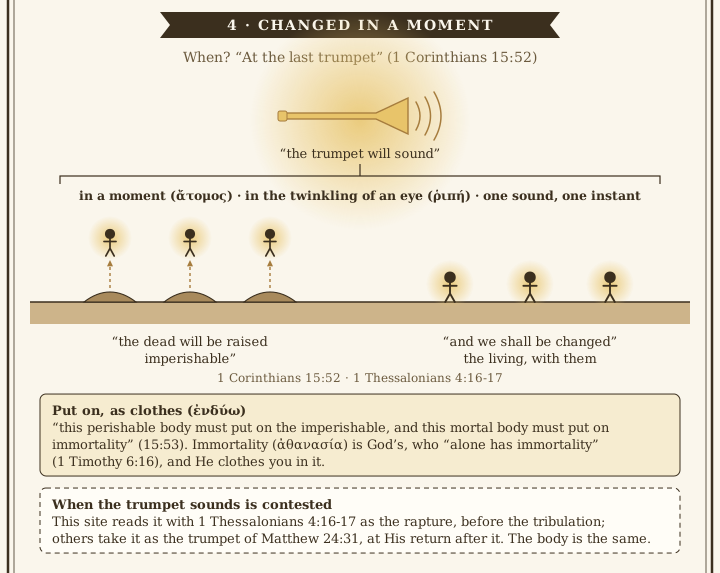](https://the-way.lewy.au/assets/img/last-things/changed-moment.svg)
*From the plate: one trumpet, one instant, the dead raised and the living changed.*
### Putting on immortality
ἐνδύω (*endyō*, G1746) is the verb for putting on clothes. Paul uses it four times in
1 Corinthians 15:53-54. The raised body is dressed in ἀθανασία (*athanasia*, G110), "immortality."
That word occurs three times in the New Testament: twice here and once of God, "who alone has
immortality" (1 Timothy 6:16, ESV). Immortality belongs to God by nature. At the resurrection He
clothes you in what is His.
Paul uses the same clothing picture in 2 Corinthians 5:4. He longs "not that we would be unclothed,
but that we would be further clothed, so that what is mortal may be swallowed up by life" (ESV).
[At Home with the Lord](https://the-way.lewy.au/last-things/at-home-with-the-lord/#the-body-god-has-promised) traces the other half of this
promise: a believer who dies goes at once to be with the Lord Jesus, and waits there for this body.
### The white robes are a different gift
The martyrs under the altar "were each given a white robe and told to rest a little longer"
(Revelation 6:11, ESV). They are clothed and they are still waiting. The robe is given *before* the
resurrection, to people who are not yet raised, so it cannot be the resurrection body. Both are
clothing, and both are God's gift. What the robes mean is the subject of
[They Were Given White Robes](https://the-way.lewy.au/last-things/they-were-given-white-robes/).
## Death swallowed up
> ✝️ 1 Corinthians 15:54-57 (ESV)
>
> 54 When the perishable puts on the imperishable, and the mortal puts on immortality, then shall
> come to pass the saying that is written: "Death is swallowed up in victory." 55 "O death, where is
> your victory? O death, where is your sting?" 56 The sting of death is sin, and the power of sin is
> the law. 57 But thanks be to God, who gives us the victory through our Lord Jesus Christ.
### Isaiah 25:8
Paul quotes Isaiah 25:8, where the LORD "will swallow up death forever" (ESV). The Hebrew verb is
בִּלַּע (*billaʿ*, H1104), "He will swallow up." Isaiah 25 sets the promise
at a feast God spreads "on this mountain" for all peoples (Isaiah 25:6). The next chapter says,
"Your dead shall live; their bodies shall rise" (Isaiah 26:19, ESV). The *Cultural Backgrounds Study Bible* notes that Isaiah
25:8 refers to God's triumph over death "at the time of the end, at Israel's final restoration."
Paul's wording differs from the Hebrew in two places. His verb is passive, κατεπόθη (*katepothē*,
G2666), "is swallowed up," where the Hebrew has God as the one who swallows. And where the Hebrew
has לָנֶצַח (*lanetsach*, H5331), "forever," Paul has εἰς νῖκος (*eis
nikos*, G3534), "in victory." The Septuagint has neither reading; it makes death the one that
swallows. The *Cultural Backgrounds Study Bible* notes that "victory" appears in one Greek version
of Isaiah other than the Septuagint, so Paul may be quoting a Greek form known in his day.
### Hosea 13:14
Then Paul turns to Hosea: "O Death, where are your plagues? O Sheol, where is your sting?" (Hosea
13:14, ESV). The Greek Old Testament there reads δίκη (*dikē*, G1349), "punishment," where Paul has
νῖκος, "victory." The *Cultural Backgrounds Study Bible* suggests the two quotations are joined by a
shared key word in the Jewish manner, with "victory" carried from Isaiah into Hosea. In Hosea the
line follows "I shall ransom them from the power of Sheol; I shall redeem them from Death" (Hosea
13:14, ESV). The verb "redeem" is אֶגְאָלֵם (*egʾalem*, H1350), the
kinsman-redeemer's verb.
**How Hosea meant the line is contested.** The ESV, NIV and CSB read the ransom lines as a
promise. The NASB and LSB read them as questions, "Shall I ransom them … ?", and the NLT turns the
next lines into a summons, "O death, bring on your terrors!" The verse ends "Compassion is hidden
from my eyes" (Hosea 13:14, ESV), and Hosea 13:15-16 is judgment on Ephraim. The *ESV Study Bible*
reads it as God's promise to rescue Ephraim, which Israel was refusing. Paul reads it on the far
side of the resurrection, where death's power is already broken.
### Job asked first
Paul does not quote Job, but Job asked the question this chapter answers. "If a man dies, shall he
live again? All the days of my service I would wait, till my renewal should come" (Job 14:14, ESV).
"Renewal" is חֲלִיפָה (*chalipah*, H2487), and eight of its twelve
occurrences are changes of clothing (Genesis 45:22; Judges 14:12-13, 19; 2 Kings 5:5, 22-23). Its
verb, חָלַף (*chalaph*, H2498), is Psalm 102:26's "you will change them like
a robe," and the Greek Old Testament renders it with ἀλλάσσω, Paul's "we shall all be changed." Job
waited for a change of clothes, and Paul says the dead will put on immortality. In Job 14 the hope is
still a question: two verses earlier Job says a man "rises not again" (Job 14:12, ESV).
**Job 19 turns the question into confidence.** "I know that my Redeemer lives… in my flesh I shall
see God… my eyes shall behold, and not another" (Job 19:25-27, ESV). "My Redeemer" is
גֹּאֲלִי (*goʾali*, H1350), the root of Hosea's "I shall redeem them."
"Not another" is Paul's "this perishable body": the one who rises is the one who died. **The Hebrew
of Job 19:26 is contested.** "From my flesh" can mean "in my flesh" or "apart from my flesh." The
Greek Old Testament reads a resurrection there: "may He raise up (ἀναστῆσαι) my skin."
Elihu uses Hosea's other verb. "He has redeemed (פָּדָה, *padah*, H6299) my
soul from going down into the pit" (Job 33:28, ESV), because "I have found a ransom" (Job 33:24,
ESV). Elihu is describing a sick man rescued before death. The Greek Old Testament renders "the pit"
as διαφθορά (*diaphthora*, G1312), "corruption," the word of Psalm 16:10 that Peter applies to Jesus'
resurrection (Acts 2:27).
The Greek Old Testament also adds a line after Job 42:17 that the Hebrew lacks: "it is written that
he will rise again with those whom the Lord raises up" (Job 42:17, Septuagint, our translation
from Brenton's Greek text). It is not Scripture. It shows that Jews read
Job as a man who would be raised before Paul wrote.
This shows that God answers the oldest question of the suffering. Job waited for his change.
Hosea heard God promise to ransom and redeem. In Jesus, the Redeemer Job knew, you receive both.
### Why death stings
"The sting of death is sin, and the power of sin is the law" (1 Corinthians 15:56, ESV). Death hurts
because it is the wage of sin. The law gives sin its power, because the law pronounces the sentence.
Jesus took that sentence. "Christ died for our sins in accordance with the Scriptures"
(1 Corinthians 15:3, ESV). This is the atonement, and it is why the resurrection is a victory
*given*: "thanks be to God, who gives us the victory through our Lord Jesus Christ" (1 Corinthians
15:57, ESV). The *NIV Biblical Theology Study Bible* says the same: God carried out the death
sentence when Jesus died in the place of sinners, and so broke death's power.
[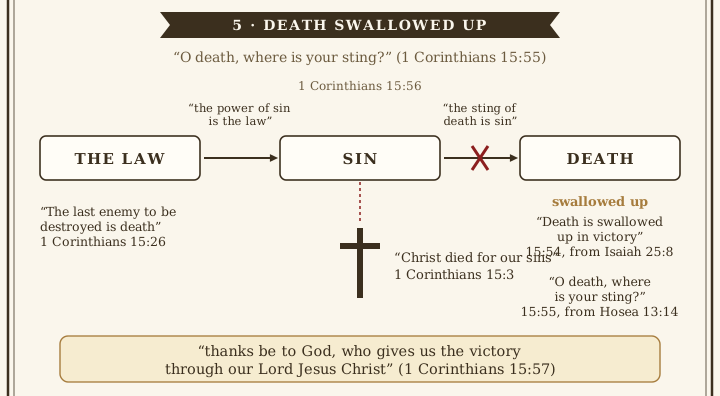](https://the-way.lewy.au/assets/img/last-things/changed-swallowed.svg)
*From the plate: the chain of law, sin and death, broken at the cross.*
This shows that God removes death's cause along with death. Your sins were paid for at the cross, so death has nothing left to charge you with. When your body is raised, death has lost its
last hold on you. "The last enemy to be destroyed is death" (1 Corinthians 15:26, ESV).
## Therefore
> ✝️ 1 Corinthians 15:58 (ESV)
>
> 58 Therefore, my beloved brothers, be steadfast, immovable, always abounding in the work of the
> Lord, knowing that in the Lord your labor is not in vain.
Paul ends fifty-seven verses of doctrine with a word about work. "Therefore" joins the two. If the
body is raised, what you do in the body counts.
The body you pray in, serve in, grow tired in and suffer in is the body God will raise. Nothing you
give to the Lord's work in it is lost. The labour is "in the Lord," and He is risen.
So you may stand at a grave in Christ with grief and with hope together. The one you loved was
sown. They will be raised imperishable. And if you are alive on the day the trumpet sounds, you will
be changed with them, in the twinkling of an eye.
## Discussion questions
1. **The language.** Paul calls burial "sowing" four times in 1 Corinthians 15:42-44. What does that
word change about how you think of a funeral?
2. **The text in its context.** Educated Greeks found a raised body laughable. Which parts of Paul's
answer in 1 Corinthians 15:36-44 speak to that objection most directly?
3. **Christ.** The risen Jesus could be touched and could eat (Luke 24:39-43), yet He was not
recognised on the Emmaus road (Luke 24:16). What does each tell you about the body you will be
given?
4. **The hard part.** "Spiritual body" (1 Corinthians 15:44) is often heard as "a body made of
spirit." How do Luke 24:39 and Romans 8:11 correct that?
5. **Be transformed.** Paul's conclusion to the resurrection is "be steadfast … always abounding in
the work of the Lord" (1 Corinthians 15:58). What would change in your week if you believed your
labour in the body is not in vain?
## References & Recommended Reading
- **ESV Study Bible** (Crossway) — introduction to 1 Corinthians; notes on 1 Corinthians 15:1-58,
15:35-58, 15:42, 15:43, 15:44-47, 15:50 and 15:51-53, and on Hosea 13:14.
- **NIV Cultural Backgrounds Study Bible** (Zondervan) — notes on 1 Corinthians 15:36, 15:37,
15:42-44, 15:50, 15:53-54 and 15:55, and on Philippians 3:21.
- **NIV Biblical Theology Study Bible** (Zondervan) — notes on 1 Corinthians 15:52 and 15:53-56, and
on Philippians 3:21.
- **Legacy Standard Bible** (Three Sixteen Publishing) — translator footnotes at 1 Corinthians 15:42 and 15:49, and its rendering of Hosea 13:14, compared with the NASB, NIV, NLT and CSB.
- **Macula Greek (SBLGNT)** and **Macula Hebrew (WLC)** — lemma, gloss and occurrence data for
ἀλλάσσω, ἄτομος, ῥιπή, ἀφθαρσία, ἀθανασία, ψυχικός, σύμμορφος and ἐνδύω, and for the Hebrew of
Isaiah 25:8 and Hosea 13:14.
- **Septuagint lemmas** — the Greek of Genesis 2:7, Isaiah 25:8 and Hosea 13:14.
- **Brenton's Septuagint** (public domain, Greek text via eBible) — Job 14:14, 19:26, 33:28 and the
addition after 42:17, and Psalm 101:27 (English Psalm 102:26).
### On this site
- [At Home with the Lord](https://the-way.lewy.au/last-things/at-home-with-the-lord/) — where the believer is between death and this
resurrection.
- [The rapture of the Church](https://the-way.lewy.au/last-things/rapture/) — the event at which the dead are raised and the living
changed.
- [The Trumpet Call of God](https://the-way.lewy.au/last-things/trumpet/) — "the last trumpet" read beside the other trumpet texts.
- [Firstfruits: The Sheaf Waved on the Third Day](https://the-way.lewy.au/feasts/firstfruits/) — the feast behind "Christ
the firstfruits" (1 Corinthians 15:20, 23).
- [Heaven and Earth Will Pass Away](https://the-way.lewy.au/last-things/heaven-and-earth-will-pass-away/) — the same verb "change"
applied to the creation.
- [They Were Given White Robes](https://the-way.lewy.au/last-things/they-were-given-white-robes/) — the robe given before the
resurrection, and the fine linen of the saints.