---
title: "Those Called Gods: Judges, Angels and the Powers Over the Nations"
category: "spiritual-beings"
description: "Scripture lends the word אֱלֹהִים, \"gods\", to judges, to Moses, to heavenly beings and to the powers behind the nations, and Paul names the principalities and powers. Every one of them is \"by nature not gods\": God keeps His names and His glory to Himself, creates every power through His Son, and has disarmed them at the cross."
tags: ["psalms", "deuteronomy", "daniel", "ephesians", "colossians", "divine-council", "spiritual-warfare", "demons", "satan", "authority", "method/word-study", "lang/hebrew", "lang/greek"]
draft: false
primary_passage: "Psalm 82:1-8; Deuteronomy 32:8-9"
bible_references: ["Psalm 82:1-8", "Deuteronomy 32:8-9", "Deuteronomy 32:17", "Deuteronomy 32:43", "Deuteronomy 4:19-20", "Deuteronomy 10:17", "Exodus 4:16", "Exodus 7:1", "Exodus 12:12", "Exodus 21:6", "Exodus 22:8-9", "Exodus 22:28", "Exodus 3:15", "Genesis 1:1", "Genesis 20:13", "Genesis 35:7", "Psalm 8:5", "Hebrews 2:6-7", "Psalm 89:5-8", "Psalm 89:27", "Psalm 96:4-5", "1 Samuel 28:13", "1 Kings 22:19", "Job 1:6", "Daniel 1:7", "Daniel 10:13", "Daniel 10:20-21", "Isaiah 24:21-22", "Isaiah 42:8", "1 Corinthians 8:5-6", "1 Corinthians 10:20", "Galatians 4:8", "1 Corinthians 8:4", "Hebrews 1:4-14", "2 Corinthians 4:4", "John 12:31", "Ephesians 2:2", "Colossians 1:16", "Ephesians 1:20-22", "Ephesians 3:10", "Ephesians 6:10-13", "Colossians 2:15", "1 Peter 3:22", "1 Corinthians 15:24-25", "Romans 8:38-39", "Psalm 45:6-7", "Hebrews 1:8-9", "John 10:34-36"]
date_created: 2026-10-11
date_modified: 2026-10-31
ai_provider_models:
- anthropic/claude-opus-5.5
---
# Those Called Gods: Judges, Angels and the Powers Over the Nations
Psalm 82 opens with God standing in an assembly and judging "in the midst of the gods" (Psalm 82:1,
ESV). Paul tells the Corinthians that "there may be so-called gods in heaven or on earth" (1
Corinthians 8:5, ESV), and the Galatians that they were once "enslaved to those that by nature are
not gods" (Galatians 4:8, ESV). Scripture uses the word for God of many who are not God: judges, a
prophet, angels and the spirits behind the idols. Paul adds the powers he calls "rulers" and
"authorities", and calls Satan "the god of this world". This study follows the word through them.
**In one sentence:** Scripture lends the word אֱלֹהִים to those God appoints,
from Israel's judges and Moses to the heavenly powers over the nations, and Paul names the
principalities and powers; every one of them was created through the Son, answers to God, and is "by nature not gods", and God keeps
His names and His glory to Himself.
[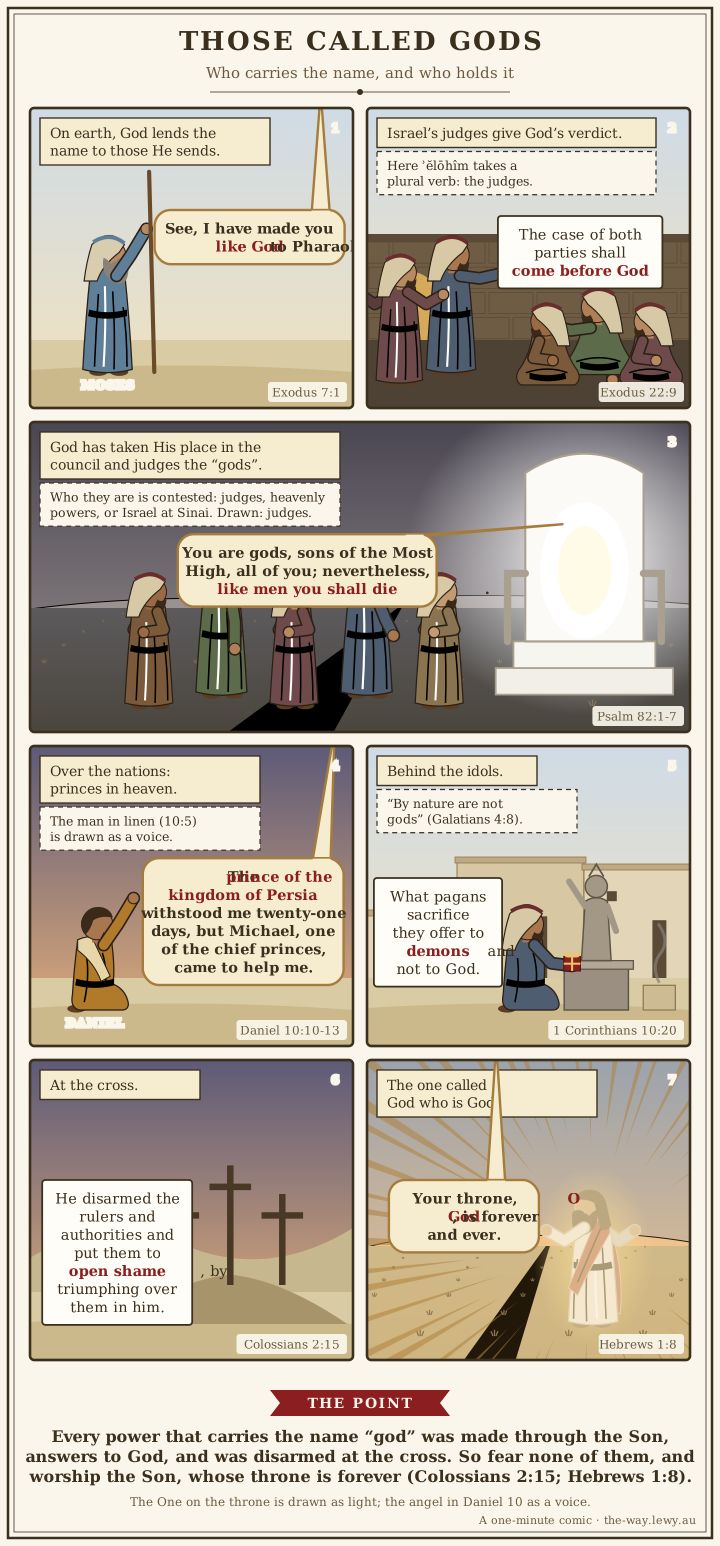](https://the-way.lewy.au/assets/img/comics/those-called-gods.svg)
[You Are Gods](https://the-way.lewy.au/jesus/you-are-gods/) studies what Jesus did with Psalm 82 in John 10. This
study is the background: who the psalm's "gods" could be, and who else in Scripture carries the
name.
## Key Takeaways
### Lessons about Jesus
- **Every power was made through Him.** "By him all things were created, in heaven and on earth,
visible and invisible, whether thrones or dominions or rulers or authorities" (Colossians 1:16,
ESV).
- **He is seated above them all.** God "seated him at his right hand in the heavenly places, far
above all rule and authority and power and dominion" (Ephesians 1:20-21, ESV).
- **He disarmed them at the cross.** "He disarmed the rulers and authorities and put them to open
shame, by triumphing over them in him" (Colossians 2:15, ESV).
- **He is the one called God who is God.** "Of the Son he says, 'Your throne, O God, is forever and
ever'" (Hebrews 1:8, ESV).
### Memory verses
> ✝️ 1 Corinthians 8:5-6 (ESV)
>
> 5 For although there may be so-called gods in heaven or on earth—as indeed there are many "gods"
> and many "lords"— 6 yet for us there is one God, the Father, from whom are all things and for whom
> we exist, and one Lord, Jesus Christ, through whom are all things and through whom we exist.
### Be Transformed
- **Think.** Every authority over you, human or spiritual, is a creature that answers to God. None
of them holds His name.
- **Attitude.** Fear none of them. Nothing "in all creation" can separate you from the love of God
in Christ Jesus (Romans 8:38-39, ESV).
- **Do.** Name one thing that has had a god's hold on you. Bring it to Jesus in prayer each day this
week, and pray Colossians 2:15 over it by name: He "disarmed the rulers and authorities and put
them to open shame, by triumphing over them in him" (ESV).
### Prayer
Father, You are the Most High and the LORD; Your name and Your glory are Yours alone. You made every
throne and ruler in heaven and on earth through Your Son Jesus, and You seated Him far above them.
Thank You that He disarmed the powers at the cross and that nothing in all creation can separate me
from Your love in Him. Keep me from serving what by nature is not God, and teach me to stand in Your
strength. In Jesus' name. Amen.
## Study outline
1. **[One word, many holders](#one-word-many-holders)** — אֱלֹהִים used of God, of judges, of Moses
and of heavenly beings; how the grammar marks the difference; the names never given away.
2. **[Gods over the nations](#gods-over-the-nations)** — Deuteronomy 32, the princes of Daniel 10, the
heavenly court, and the demons behind the idols.
3. **[Principalities and powers](#principalities-and-powers)** — Paul's names for them, "the god of
this world", and what Christ has done and will do to them.
4. **[The one called God who is God](#the-one-called-god-who-is-god)** — Psalm 45:6 and Hebrews
1:8.
## One word, many holders
### What אֱלֹהִים covers
אֱלֹהִים (*ʾĕlōhîm*, el-oh-HEEM, H430) occurs 2,601 times in the Hebrew Bible.
Most of the time it means God. The *NIV Biblical Theology Study Bible* names judges, Moses, angels
and the gods of the nations among its other holders (note on Psalm 82:1), and 1 Samuel 28:13 adds a
spirit from the dead:
| Who | Text | What the word does there |
|---|---|---|
| The judges of Israel | Exodus 22:8-9, 28 | Cases "shall come before God" and "the one whom God condemns" pays double (ESV). The LSB footnotes Exodus 21:6, "Or the judges who acted in God's name." "You shall not revile God, nor curse a ruler of your people" (Exodus 22:28, ESV) pairs *ʾĕlōhîm* with a ruler, and the CSB footnotes it, "Or judges." |
| Moses | Exodus 4:16; 7:1 | "You shall be as God to him"; "I have made you like God to Pharaoh" (ESV). |
| Heavenly beings | Psalm 8:5 | "A little lower than the heavenly beings" (ESV), where the Hebrew has *ʾĕlōhîm* and the Septuagint "angels" (CSB footnote). Hebrews 2:7 quotes the Septuagint: "lower than the angels" (ESV). |
| A spirit from the dead | 1 Samuel 28:13 | "I see a god coming up out of the earth" (ESV). |
| The gods of the nations | Exodus 12:12; Psalm 96:5 | "On all the gods of Egypt I will execute judgments" (ESV). |
The word names a rank: one who stands above others and acts with authority that comes from beyond
them. Moses was "as God" to Pharaoh because he carried God's word with God's power behind it. The
judges were *ʾĕlōhîm* because the verdict they gave was God's verdict. **This shows that God shares
His work with those He appoints, and puts His own name on the office while they hold it.**
### How the grammar marks the difference
*ʾĕlōhîm* is plural in form. When it means the one God, the verb that goes with it is normally
singular: "God created" in Genesis 1:1 is בָּרָא (*bara*, H1254), third masculine
singular. When it means a group, the verb is plural. Exodus 22:9 is the clearest case: "the one whom
*ʾĕlōhîm* condemns" uses יַרְשִׁיעֻן (*yarshiʿun*, H7561), a plural verb, which is
why the NLT footnotes Exodus 22:8, "Or before the judges."
Psalm 82:1 puts both uses in one line:
> ✝️ Psalm 82:1 (ESV)
>
> 1 A Psalm of Asaph. God has taken his place in the divine council; in the midst of the gods he
> holds judgment:
The first *ʾĕlōhîm* takes a singular participle, נִצָּב (*nitsav*, H5324, "has
taken his place"), and a singular verb, יִשְׁפֹּט (*yishpot*, H8199, "he
judges"). The second is the crowd He stands among. The assembly itself is עֲדַת
אֵל (*ʿadat ʾEl*, "the assembly of God"), with the singular אֵל (*ʾEl*,
H410). The LSB footnotes it, "Heb El; the one true God." The Septuagint reads 82:1 as "the assembly
of gods" (*synagōgē theōn*), plural, where the Hebrew has "the assembly of God."
**The rule is general, and it has exceptions.** In Genesis a plural verb sometimes goes with
*ʾĕlōhîm* where the subject is God: "when God caused me to wander" (Genesis 20:13, ESV) and "there
God had revealed himself to him" (Genesis 35:7, ESV), with הִתְעוּ (*hitʿu*,
H8582) and נִגְלוּ (*niglu*, H1540), both plural. The context decides; the
grammar usually agrees with it.
### Who are the gods of Psalm 82?
**What the psalm meant when it was first sung is contested, and good readers hold each of three
views.** The translators record the fork themselves: the CSB footnotes the gods of 82:1, "Or the
heavenly beings, or the earthly rulers," and the LSB, "Or rulers."
- **Human judges.** These gods "judge" (Psalm 82:2), their work is justice for the weak (Psalm
82:3-4), and they "die like men" (Psalm 82:7). Exodus 22:8-9 uses *ʾĕlōhîm* of Israel's judges.
Jesus' own gloss points this way: "he called them gods to whom the word of God came" (John 10:35,
ESV).
- **Heavenly powers.** The ESV renders 82:1 "the divine council," and Psalm 89:5-7, 1 Kings 22:19 and
Job 1:6 show God among heavenly beings. "Like men you shall die" can be read as a sentence on beings
who would otherwise not die. Verse 8's "all the nations" fits Deuteronomy 32:8, where the ESV,
following the Septuagint and a Dead Sea Scroll, has the nations divided "according to the number of the sons of
God."
- **Israel at Sinai.** The *NIV Cultural Backgrounds Study Bible* reports that "some ancient Jewish
interpreters" applied the psalm "to Israel receiving the law at Mount Sinai" (note on John 10:34).
That reading fits "to whom the word of God came" (John 10:35) closely.
The heavenly reading and the human reading can stand together. Isaiah 24:21 has the LORD punishing
"the host of heaven, in heaven, and the kings of the earth, on the earth" together. On either reading the point stands:
God gave the title, the holders abused it, and God revokes it.
In John 10, Jesus settles it for His own use of the psalm: the gods are those to whom God's word
came, and His accusers stood among them. [Who are the gods?](https://the-way.lewy.au/jesus/you-are-gods/#who-are-the-gods)
traces that.
### The names never given away
Two names are never given as titles. The judges are called "gods" and "sons of the Most High" (Psalm
82:6), and the Most High, עֶלְיוֹן (*ʿElyon*, el-YOHN, H5945), is the one who
calls them that. The adjective *ʿelyon* can describe people, as when David's heir is made "the
highest of the kings of the earth" (Psalm 89:27, ESV), but as a name it belongs to God alone. The
covenant name, יְהוָה (YHWH, H3068), rendered "the LORD", is God's own: "This is
my name forever" (Exodus 3:15, ESV). "I am the LORD; that is my name; my glory I give to no other"
(Isaiah 42:8, ESV). Deuteronomy 10:17 says it in one phrase: "the LORD your God is God of gods and
Lord of lords" (ESV). **So God lends the title for the work, and keeps His name and His glory to
Himself.** [The Names of God](https://the-way.lewy.au/god/names-of-god/) follows the names He gave Himself.
## Gods over the nations
Scripture also uses this vocabulary for heavenly powers set over the peoples of the earth. Psalm 82
points that way itself: it ends with God inheriting "all the nations" (Psalm 82:8, ESV).
### The nations divided
> ✝️ Deuteronomy 32:8-9 (ESV)
>
> 8 When the Most High gave to the nations their inheritance, when he divided mankind, he fixed the
> borders of the peoples according to the number of the sons of God. 9 But the LORD's portion is his
> people, Jacob his allotted heritage.
The Masoretic Text reads "sons of Israel" in Deuteronomy 32:8. The ESV follows a Dead Sea Scroll,
4Q37, which reads "sons of God", and the Septuagint, which reads "angels of God" (*angelōn theou*);
the NLT, CSB and LSB footnotes all record the split. Only two words of that verse survive in the
scroll, so the reading rests on the Septuagint as much as on the scroll. On the ESV's reading, the
Most High assigned the nations to heavenly beings and kept Israel for Himself. Deuteronomy 4:19-20
says something close: the sun, moon and stars are "things that the LORD your God has allotted to all
the peoples," but "the LORD has taken you" (ESV). The phrase "sons of God" is itself debated in
Genesis 6; [The Nephilim](https://the-way.lewy.au/spiritual-beings/nephilim/#sons-of-god) weighs it.
### Princes in heaven
Daniel 10 names such powers. The angel sent to Daniel was held back: "The prince of the kingdom of
Persia withstood me twenty-one days, but Michael, one of the chief princes, came to help me" (Daniel
10:13, ESV). Next comes "the prince of Greece" (Daniel 10:20), and Michael is "your prince" (Daniel
10:21), Israel's. The *ESV Study Bible* calls the prince of Persia "an evil angel associated with
the Persian Empire" (note on Daniel 10:13). The word is שַׂר (*sar*, SAR,
H8269), the same word Psalm 82:7 uses: "fall like any prince," literally "like one of the
שָׂרִים (*sarim*, H8269)." Daniel also uses *sar* for human officials (Daniel
1:7), so the word alone does not decide who is meant.
Other texts show God among a heavenly court: "the host of heaven standing beside him" (1 Kings
22:19, ESV); "the sons of God came to present themselves before the LORD" (Job 1:6, ESV); "Who among
the heavenly beings is like the LORD, a God greatly to be feared in the council of the holy ones"
(Psalm 89:6-7, ESV), where "heavenly beings" is בְּנֵי אֵלִים (*bene ʾelim*).
### What the nations worshipped
Scripture holds two things together about the gods of the nations. They are nothing: "all the gods
of the peoples are worthless idols, but the LORD made the heavens" (Psalm 96:5, ESV), a pun on
*ʾĕlōhîm* and אֱלִילִים (*ʾelilim*, H457, "worthless things"). And there is
something behind them: "They sacrificed to demons that were no gods" (Deuteronomy 32:17, ESV). Paul
says both: "there may be so-called gods in heaven or on earth" (1 Corinthians 8:5, ESV), and "what
pagans sacrifice they offer to demons and not to God" (1 Corinthians 10:20, ESV). He gives their
nature in one phrase: "those that by nature are not gods" (Galatians 4:8, ESV).
## Principalities and powers
### Paul's names for them
The older English "principalities and powers" (KJV, Ephesians 6:12) translates Paul's commonest
pair, ἀρχαί (*archai*, ar-KHAI, G746, "rulers", a word that also means "beginning") and ἐξουσίαι
(*exousiai*, ex-oo-SEE-ai, G1849, "authorities"). He adds "powers", "dominions" and "thrones" in
other lists (Ephesians 1:21; Colossians 1:16), and in Ephesians 6:12 "the cosmic powers over this
present darkness", κοσμοκράτορας (*kosmokratoras*, kos-mo-KRAT-or-as, G2888, "world-rulers"), a word
used only there in the New Testament. The *ESV Study Bible* reads these as "the current Jewish terms
for various rankings of angels" (note on Colossians 1:16), and Ephesians 6:12 as "the devil's
allies, the spiritual forces of evil" (note on Ephesians 6:12). Paul names ranks without ranking
them, and the ranks themselves are not explained anywhere in Scripture.
### The god of this world
The plainest case of one called god who is not God is Satan. "The god of this world has blinded the
minds of the unbelievers, to keep them from seeing the light of the gospel of the glory of Christ"
(2 Corinthians 4:4, ESV). The word is θεός (*theos*, G2316), the ordinary word for God, and the
*ESV Study Bible* says plainly that it "refers to Satan" (note on 2 Corinthians 4:3-5). Jesus calls
him "the ruler of this world" (John 12:31, ESV), and Paul "the prince of the power of the air, the
spirit that is now at work in the sons of disobedience" (Ephesians 2:2, ESV). He has a god's
reach over those who follow him, and he is a creature under sentence: "now will the ruler of this
world be cast out" (John 12:31, ESV).
### What Christ has done to them
The New Testament places every one of these powers under Christ, in time order:
| When | What Scripture says | Text |
|---|---|---|
| **At creation** | "by him all things were created… whether thrones or dominions or rulers or authorities" | Colossians 1:16 |
| **At the cross** | "He disarmed the rulers and authorities and put them to open shame" | Colossians 2:15 |
| **At His ascension** | Seated "far above all rule and authority and power and dominion"; "angels, authorities, and powers having been subjected to him" | Ephesians 1:20-21; 1 Peter 3:22 |
| **Now, through the church** | "the manifold wisdom of God might now be made known to the rulers and authorities in the heavenly places" | Ephesians 3:10 |
| **Now, in the struggle** | "we do not wrestle against flesh and blood, but against the rulers, against the authorities" | Ephesians 6:12 |
| **At the end** | "he delivers the kingdom to God the Father after destroying every rule and every authority and power" | 1 Corinthians 15:24 |
Quotations are ESV. Disarmed and still struggled with: the *ESV Study Bible* holds the two together.
At the cross the demonic powers "were stripped of their power to accuse Christians before God", yet
"these demons continue to exist and to exercise power to incite evil, so Christians must continue to
struggle with them" (note on Colossians 2:15). So Paul's command in the struggle is to "be strong in
the Lord and in the strength of his might" (Ephesians 6:10, ESV), and the confidence he gives is
that "neither death nor life, nor angels nor rulers, nor things present nor things to come, nor
powers… will be able to separate us from the love of God in Christ Jesus our Lord" (Romans 8:38-39,
ESV).
God judges these powers as He judges human rulers. "On that day the LORD will punish the host of
heaven, in heaven, and the kings of the earth, on the earth" (Isaiah 24:21, ESV). **This shows that
God gives authority in heaven as well as on earth, that every holder of it was made through His Son
and answers to Him, and that He has already disarmed the ones who rebelled.** So you need not fear
any of them: stand in the Lord's strength, and nothing they do can separate you from His love.
## The one called God who is God
One text may address a king of David's line as אֱלֹהִים, and the New Testament
reads it of the Son:
> ✝️ Psalm 45:6-7 (ESV)
>
> 6 Your throne, O God, is forever and ever. The scepter of your kingdom is a scepter of uprightness;
> 7 you have loved righteousness and hated wickedness. Therefore God, your God, has anointed you with
> the oil of gladness beyond your companions;
**Whom the psalm addresses is contested.** Psalm 45 is a royal wedding song. The *ESV Study Bible*'s
note on the psalm thinks it "better to think that the song speaks to God about his throne", the
throne the heir of David sits on, because a direct address to the king as God "does not easily fit
this context" (note on Psalm 45:6-7). The CSB footnotes the line, "Or Your divine throne is, or
Your throne is God's." Others read it as the king addressed as *ʾĕlōhîm*, the way
the judges were, and the *NIV Biblical Theology Study Bible* lists Psalm 45:6 among the word's
other holders (note on Psalm 82:1).
Hebrews settles what the verse means of Christ: "But of the Son he says, 'Your throne, O God, is
forever and ever'" (Hebrews 1:8, ESV). The *ESV Study Bible*'s note on Hebrews: "The messianic Son is
rightfully also called God, in this case by God the Father" (note on Hebrews 1:8-9). Hebrews quotes
it to show the Son above the angels (Hebrews 1:4-14), the beings the Septuagint reads behind the
*ʾĕlōhîm* of Psalm 8:5.
Two verses earlier Hebrews quotes the Song of Moses: "Let all God's angels worship him" (Hebrews 1:6,
ESV). The Masoretic text of Deuteronomy 32:43 lacks that line. A Dead Sea Scroll of Deuteronomy (4Q44)
has it in Hebrew, and the ESV follows the scroll in its own text: "Rejoice with him, O heavens; bow
down to him, all gods" (Deuteronomy 32:43, ESV), where "gods" is אֱלֹהִים. The
Septuagint reads "angels of God". It is the same Song that sets the nations under the sons of God
(Deuteronomy 32:8) and says Israel "sacrificed to demons that were no gods" (Deuteronomy 32:17, ESV).
The Song that names the powers behind the idols ends by commanding every one called *ʾĕlōhîm* to bow
down, and Hebrews says the One they bow to is the Son. [True
Worship](https://the-way.lewy.au/christian-life/true-worship/#hebrews-16-and-the-song-of-moses) follows that line
through Hebrews.
**This shows that every other holder of the title received it from God, and the Son holds it by nature.**
Judges die like men (Psalm 82:7), the powers are disarmed (Colossians 2:15), and of the Son the
Father says, "Your throne, O God, is forever and ever." So worship Him alone, and fear none of the
others.
## Discussion questions
1. **The language.** In Exodus 22:9 *ʾĕlōhîm* takes a plural verb, and in Psalm 82:1 the first
*ʾĕlōhîm* takes singular verbs. What does reading the verb tell you that the noun alone could not?
2. **The text in its context.** Paul agrees that "an idol has no real existence" (1 Corinthians
8:4), and two chapters later says pagan sacrifices are offered "to demons" (1 Corinthians 10:20).
How can both be true?
3. **Christ.** Colossians 1:16 says the rulers and authorities were created through Christ, and
Colossians 2:15 says He disarmed them. What does the first verse add to the comfort of the second?
4. **The hard part.** Psalm 45:6 may address a human king as *ʾĕlōhîm*, and Hebrews 1:8 applies it
to the Son. How does Hebrews keep the Son from being one more "god" among the judges and angels?
5. **The powers.** Daniel 10:13 shows a prince of Persia resisting God's messenger, and Colossians
2:15 says Christ "disarmed the rulers and authorities." What does the second verse change about
how you read the first?
6. **Be transformed.** Galatians 4:8 speaks of being "enslaved to those that by nature are not
gods." What has held that kind of grip on you, and what would it look like to stand against it
"in the strength of his might" (Ephesians 6:10) this week?
## References & Recommended Reading
Scripture quotations are from the ESV unless marked. Hebrew morphology from MACULA Hebrew and the
unfoldingWord Hebrew Bible; Greek New Testament from SBLGNT and MACULA Greek; Septuagint from
Brenton's text.
- *ESV Study Bible* (Crossway, 2016): notes on Psalm 45:6-7; Daniel 10:13; 2 Corinthians 4:3-5;
Colossians 1:16, 2:15; Ephesians 6:12; Hebrews 1:8-9.
- *NIV Biblical Theology Study Bible* (Zondervan, 2018): note on Psalm 82:1.
- *NIV Cultural Backgrounds Study Bible* (Zondervan, 2016): note on John 10:34.
- *Legacy Standard Bible* (Lockman Foundation, 2021) and *CSB Ancient Faith Study Bible* (Holman,
2019): footnotes on Psalm 82:1, Psalm 8:5, Exodus 21:6, Exodus 22:8, Exodus 22:28, Deuteronomy 32:8.
- *NLT Life Application Study Bible* (Tyndale, 3rd ed.): footnotes on Exodus 22:8 and Deuteronomy 32:8.
- Dead Sea Scroll 4Q37 (Deuteronomy 32:8), via this site's Dead Sea Scroll comparison.
- Dead Sea Scroll 4Q44 (Deuteronomy 32:43), via the same comparison; Septuagint text from Brenton's
edition.
### On this site
- [The Names of God](https://the-way.lewy.au/god/names-of-god/): the names God gave Himself, from the burning bush to
Jesus.
- [You Are Gods](https://the-way.lewy.au/jesus/you-are-gods/): Psalm 82 in John 10, and the contested question of who
the psalm's gods are.
- [The Nephilim](https://the-way.lewy.au/spiritual-beings/nephilim/): the "sons of God" of Genesis 6.
- [True Worship](https://the-way.lewy.au/christian-life/true-worship/): why worship belongs to God alone, and why angels
refuse it while the Son receives it.
- [Melchizedek in Second Temple Judaism](https://the-way.lewy.au/scripture/melchizedek-in-second-temple-judaism/): how
the Dead Sea Scroll 11Q13 read Psalm 82.