Simon Peter
He is first in every list of the Twelve, he speaks more often than all the others combined, and he is the only man Jesus ever called Satan. Peter is the most fully drawn of the apostles because he was the most willing to be wrong out loud.
Key Takeaways
(This section follows the Key Takeaways format — see that page for what each part is for.)
Lessons about Jesus
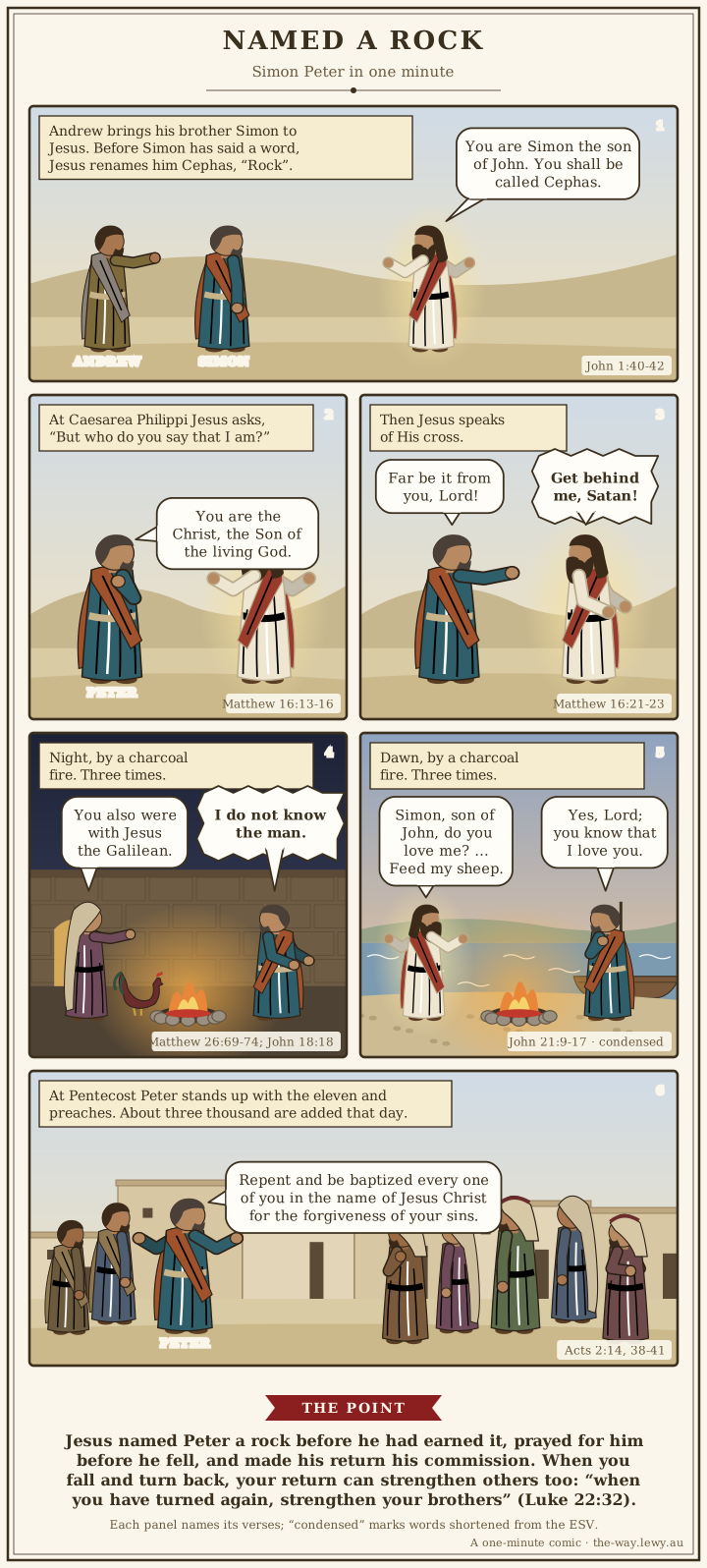
Jesus gave Peter his new name at their first meeting, before Peter had said or done anything (John 1:42). The name was not a reward for becoming rocklike. It was a statement of what Jesus intended to make of him, issued years before the evidence supported it — and it survived the denial.
Memory verse
✝️ Luke 22:31-32 (ESV)
31 "Simon, Simon, behold, Satan demanded to have you, that he might sift you like wheat, 32 but I have prayed for you that your faith may not fail. And when you have turned again, strengthen your brothers."
Be transformed
Peter's failure was not the end of his usefulness, and Jesus said so before the failure happened — "when you have turned again" assumes both the fall and the return. If you are treating a past collapse as a permanent disqualification, you are holding a stricter standard than the one Jesus applied to the man who denied him to his face.
Prayer
Lord, you named Peter a rock while he was still sand. Thank you that you speak to us in terms of what you intend to make of us, and not only what we currently are. When we fail, turn us back, and make our turning useful to somebody else.
The name
Simon — Σίμων (Simōn, G4613), from Hebrew שִׁמְעוֹן (Shimʿon, shim-OWN, H8095), "he has heard," the name of one of Jacob's sons and his tribe.
Peter — Πέτρος (Petros, PET-ross, G4074), "a rock, a stone." Jesus actually gave him the Aramaic form: Κηφᾶς (Kēphas, kay-FAHS, G2786), from Aramaic כֵּיפָא (kepha), "rock." John translates it for his Greek readers, and shows Jesus doing the renaming on the spot:
✝️ John 1:42 (ESV)
42 He brought him to Jesus. Jesus looked at him and said, "You are Simon the son of John. You shall be called Cephas" (which means Peter ).
The New Testament keeps using both names, sometimes in the same breath — "Simon Peter." Paul's usual name for him is Cephas (1 Corinthians 1:12; Galatians 2:9).
Background
A fisherman on the Sea of Galilee, working in a partnership with his brother Andrew and with James and John (Luke 5:10). Originally from Bethsaida (John 1:44), later based at Capernaum, where his mother-in-law's house appears in the narrative (Mark 1:29-31) — Peter was married, and was still travelling with his wife decades later (1 Corinthians 9:5).
He was brought to Jesus by Andrew — a fact easily lost whenever Peter is treated as the natural leader: he arrived as somebody's younger-brother introduction.
What Scripture records
Peter is the disciple who steps forward, and the pattern is consistent — a real insight followed by a real collapse, usually within the same chapter.
- He names Jesus rightly and is told the insight was not his own: "You are the Christ, the Son of the living God" (Matthew 16:16), to which Jesus responds that "flesh and blood has not revealed this to you, but my Father who is in heaven" (16:17). The Names of Jesus gathers the Bible's other answers to the question Peter answered. Verses later, Peter rebukes Jesus for predicting the cross and is answered "Get behind me, Satan" (16:23).
- He walks on water and sinks (Matthew 14:28-31) — the only disciple who got out of the boat, and the only one who needed pulling out of the lake.
- He denies Jesus three times (Mark 14:66-72), having sworn hours earlier that he would not.
- He is restored three times on the beach, question matched to denial: "Simon, son of John, do you love me?" (John 21:15-17). Jesus does not extract an apology; he issues a commission — feed my sheep.
- He preaches at Pentecost (Acts 2:14-41), and is the one who first takes the gospel to a Gentile household (Acts 10).
- He is publicly corrected by Paul at Antioch for withdrawing from Gentile believers (Galatians 2:11-14). The New Testament does not tidy this away.
Two letters bear his name (1 and 2 Peter), written to scattered believers under pressure.
From the rebuke to the restoration
Matthew links the rebuke at Caesarea Philippi to the denial in the courtyard with the same words. Reading the two as one failure, a mind set on the things of man, is an inference from those links, and a strong one.
The rebuke. When Jesus said He must suffer and be killed, Peter answered, "This shall never happen to you" (Matthew 16:22, ESV), with οὐ μή, the strongest negative in Greek. Jesus said Peter was "not setting your mind on the things of God, but on the things of man" (Matthew 16:23, ESV), and called him a σκάνδαλον (skandalon, G4625), a stone that trips. Then He told the disciples to "deny himself and take up his cross and follow me" (Matthew 16:24, ESV).
The boast. At the Last Supper Peter said, "Though they all fall away (σκανδαλισθήσονται) because of you, I will never fall away" (Matthew 26:33, ESV), the verb from the same root as σκάνδαλον. "Even if I must die with you, I will not deny you!" (Matthew 26:35, ESV) uses οὐ μή again. Peter set himself above the others, and he trusted his own resolve.
The denial. He "was following him at a distance" (Matthew 26:58, ESV). Then he denied Him three times, the second and third with "I do not know the man" (Matthew 26:70-74, ESV). "Deny" in Jesus' warning (Matthew 26:34) is ἀπαρνέομαι (aparneomai, G533), the verb of "let him deny himself". In Matthew it occurs only in that call and in Peter's denial. Told to deny himself, Peter denied Jesus and saved himself.
The repentance. "Peter remembered the saying of Jesus ... And he went out and wept bitterly" (Matthew 26:75, ESV). Luke records that "the Lord turned and looked at Peter" (Luke 22:61, ESV).
The restoration. Jesus asked three times, "do you love me?", gave Peter his charge three times, foretold his death, and said, "Follow me" (John 21:15-19, ESV), the call Peter first heard (Matthew 4:19). Peter's letters show what he learned: "Clothe yourselves, all of you, with humility ... Humble yourselves, therefore, under the mighty hand of God" (1 Peter 5:5-6, ESV), and "Christ also suffered for you, leaving you an example, so that you might follow in his steps" (1 Peter 2:21, ESV). The full study of the rebuke and the call that followed it is Take Up Your Cross.
What tradition says
The earliest witness is 1 Clement, written from Rome to Corinth around AD 96 — within living memory, and to readers assumed to know the story already:
Let us set before our eyes the good apostles: Peter, who because of unrighteous jealousy endured not one or two but many trials, and having thus borne witness went to the place of glory that was his due.
— 1 Clement 5.3-4 (translated from the Greek; the verb is μαρτυρήσας, martyrēsas, "having borne witness," from which "martyr" comes)
Note carefully what that does not say. It attests Peter's death as a witness; it does not name Rome, and it says nothing about crucifixion. Those come later — from Origen, quoted by Eusebius:
And at last, having come to Rome, he was crucified head-downwards; for he had requested that he might suffer in this way.
— Eusebius, Church History 3.1, citing Origen
So the layers are: martyrdom (c. AD 96, near-contemporary), then Rome and the inverted cross (3rd century). Both are early by the standards of apostolic tradition, but they are not equally early, and collapsing them into one confident sentence overstates the case. See Patristic Sources.
Scripture itself gestures at the manner of his death without describing it: after the restoration, Jesus tells him he will one day stretch out his hands and be carried where he does not wish to go — and John adds the note "this he said to show by what kind of death he was to glorify God" (John 21:18-19).
Takeaway
Peter is in the Bible in this much detail for a reason. A version of him with the failures edited out would be useless to the people the New Testament was written for. What is offered is not a man who never fell, but a man whose falling was anticipated, prayed for in advance, and made the raw material of his commission to strengthen everyone else.
References
Scripture quotations marked ESV are from the English Standard Version (Crossway). Name etymologies from Strong's Greek Dictionary (public domain), G4613 Simōn, G4074 Petros, G2786 Kēphas. The list-position observation is developed in The Twelve: Disciples and Apostles.