The Way
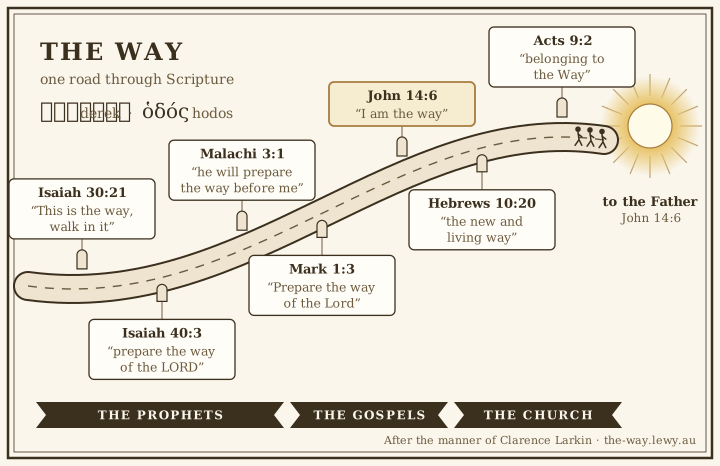
✝️ Isaiah 30:21 (ESV)
And your ears shall hear a word behind you, saying, "This is the way, walk in it."
✝️ John 14:6 (ESV)
I am the way, and the truth, and the life. No one comes to the Father except through me.
Isaiah told Israel to walk in the way seven centuries before Bethlehem. When Jesus claimed to be that way, He was fulfilling what the Old Testament had foreshadowed of the Messiah.
Jesus' earliest followers heard it that way too: before anyone called them Christians, they called themselves the Way — Greek ὁδός (hodos, G3598), the ordinary word for a road (Acts 9:2). That's this site's name, and its subject.
See the full word study for how it traces from Isaiah's "way of the LORD" through John 14:6 and into the book of Acts.
What these studies cover
These are personal Bible study notes — written to make sure I learn, and shared in case they help someone else. The Bible is one integrated message about God's dealings with humanity, and it repays close study. I hope that study moves me from milk to solid food (Hebrews 5:12-14).
They are personal study notes, so test them. Question and check what you read here, as the Bereans did (Acts 17:11).
The studies have a focus on:
- Building practical knowledge and wisdom of God. Each study asks first what it teaches about Jesus, then how that changes the way I think, my attitude and what I do.
- Understanding faith in God as described in the Old and New Testaments of the Bible, in order to be prepared to explain the truth in love.
- Exegetical and expository original-language studies. That is using source texts to elicit meaning sometimes lost in just one or more English translations.
- Bible end times. Scripture says we are in the last days, and it matters to know where we stand with God before hard days arrive.
- Starting the journey of learning biblical Hebrew.
- Answering little side quests that come up.
- Keeping a tidy house.
On using AI in these studies
One of the tools I use in the development of these studies is AI. That may well put you off: how can AI be of use when it is trained on all the wisdom of man? True. Its biggest gift to me is the original languages. I am not trained in Hebrew, Aramaic or Greek, yet with AI I can work through a passage word by word: its grammar, its root, where else the word is used, and how the Septuagint and the English translations render it. That depth of original-language study would otherwise be out of my reach. The models also question some of the positions I take, and that sends me back to Scripture to test them, the same Berean check I ask of you, "examining the Scriptures daily to see if these things were so" (Acts 17:11, ESV). A challenge shows where a case is weak, and Scripture tells me to test what I hold (Proverbs 18:17; 1 Thessalonians 5:21). In doing that, I learn, and train my mind and heart to defend the truth of Christ.
AI also makes mistakes. It can invent a word's meaning, misquote a verse, or cite a book that does not exist (see failure modes and guardrails). So the AI works inside deterministic tooling: databases of the Hebrew and Greek text, lexicons and cross-references that give the same answer every time they are asked. A word study has to resolve to an entry in that data, and a quotation is checked against the translation's own text, never recalled from memory. Some AI terminology does slip through, and it annoys me too. By publishing, I am accountable to review these studies (2 Timothy 2:15), remember what I learned, fix errors I did not pick up earlier, and refine a position left with an itch.
The gospel
All of these studies point to the one core truth of Jesus and the way.
You are made by God, and He loves you. But every one of us has sinned and fallen short of who He made us to be (Romans 3:23), and that sin separates us from Him and earns us death (Romans 6:23).
God did not leave it there. He sent His own Son, Jesus Christ, to live the sinless life none of us could live, to die on the cross carrying the punishment for our sin, and to rise bodily from the grave three days later, defeating death itself (1 Corinthians 15:3-4).
You do not earn this by being good enough. It is a gift, received by grace through faith in Christ alone (Ephesians 2:8-9). Whoever calls on the name of the Lord will be saved (Romans 10:13). That includes you, today.
See my full Statement of Faith for how this fits together.
Why I believe
Faith in Christ rests on evidence that can be examined. Here is what convinces me.
-
Creation testifies
The order, fine-tuning, and existence of the universe point to a Creator: "the heavens declare the glory of God" (Psalm 19:1, ESV), and what can be known of God is plain from what He made (Romans 1:20). See how I understand the creation account itself.
-
Archaeology testifies
Discoveries in the ground keep confirming the biblical record. See Ancient Texts, Manuscripts, and Inscriptions Validating Scripture for specific examples, the Dead Sea Scrolls among them.
-
The documents themselves testify
The Bible is the best-attested document to survive from the ancient world, with more manuscripts, closer to the original writing, than any other ancient text we treat as reliable history. The same manuscript evidence study sets out the case.
-
Prophecy testifies
Scripture named the Messiah's birthplace (Micah 5:2), described a death by piercing of hands and feet (Psalm 22:16-18), and said He would suffer and die in the place of others (Isaiah 53:5). All of it was written centuries before Jesus was born, in documents datable well before His lifetime.
Daniel pins down the era itself, counting out the years to the Messiah's coming and being "cut off" (Daniel 9:25-26, ESV); see Prophecy Events and Times for how that count lands on Christ's own ministry. Many such prophecies converge on one person, written centuries ahead of the fact.
A textual question in Psalm 22:16
Psalm 22:16 carries a textual question. The Masoretic Text reads כָּאֲרִי (ka'ari), "like a lion," while the Septuagint has ὤρυξαν, "they pierced." The ESV follows the Septuagint reading. See Bible Prophecy Essentials for the evidence on both sides.
-
Salvation rests on God's grace
No one is good enough to earn it, and I am saved by the grace of God in Christ (Ephesians 2:8-9). See Salvation for the fuller statement.
-
I have seen it myself
I know the work of Christ and the Holy Spirit because I have seen lives transformed by it, my own among them. Anyone who is in Christ is a new creation; the old has gone, the new has come (2 Corinthians 5:17).
Interactive tools
Three of these studies are charts you can explore.
-
Scripture Links
Look up a verse and see what it quotes, what quotes it, and what it echoes, with the shared wording highlighted in the original Greek or Hebrew. Every link is derived from the wording of the texts themselves, so you can see why it was made.
-
Prophetic Timeline
The millennial week, charted: creation to the millennial reign across seven thousand-year "days", with the dated anchors of history, and zoomable down to AD 33 hour by hour against the feasts it fell on.
-
Genealogy
Adam to Jesus, a row per person on the same timeline: Hebrew name studies, lifespans in both calendars, family, the events each took part in, and who was alive at the same time as whom.
Drawn from the studies
Charts and plates drawn to what the text states, in the tradition of Clarence Larkin's dispensational charts. Each one opens the study it belongs to.
-
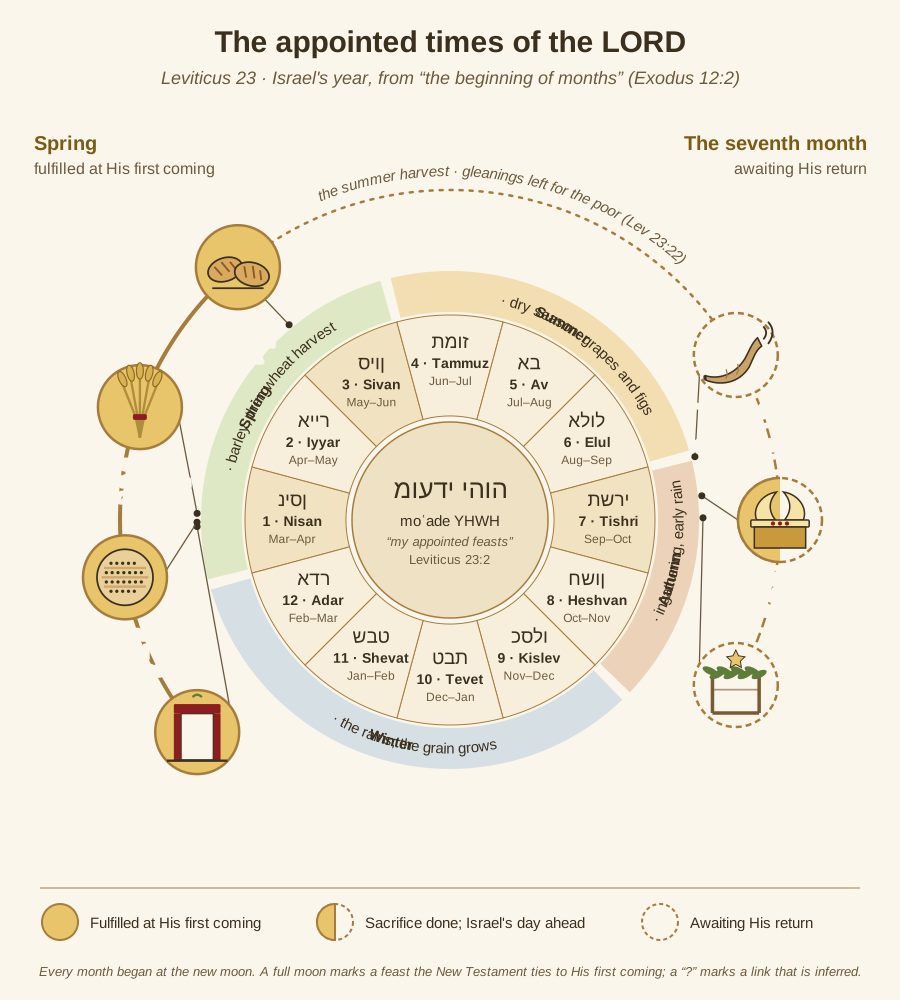
The appointed times · the seven feasts of Leviticus 23 around Israel's year, the spring feasts fulfilled and the autumn feasts ahead.
-
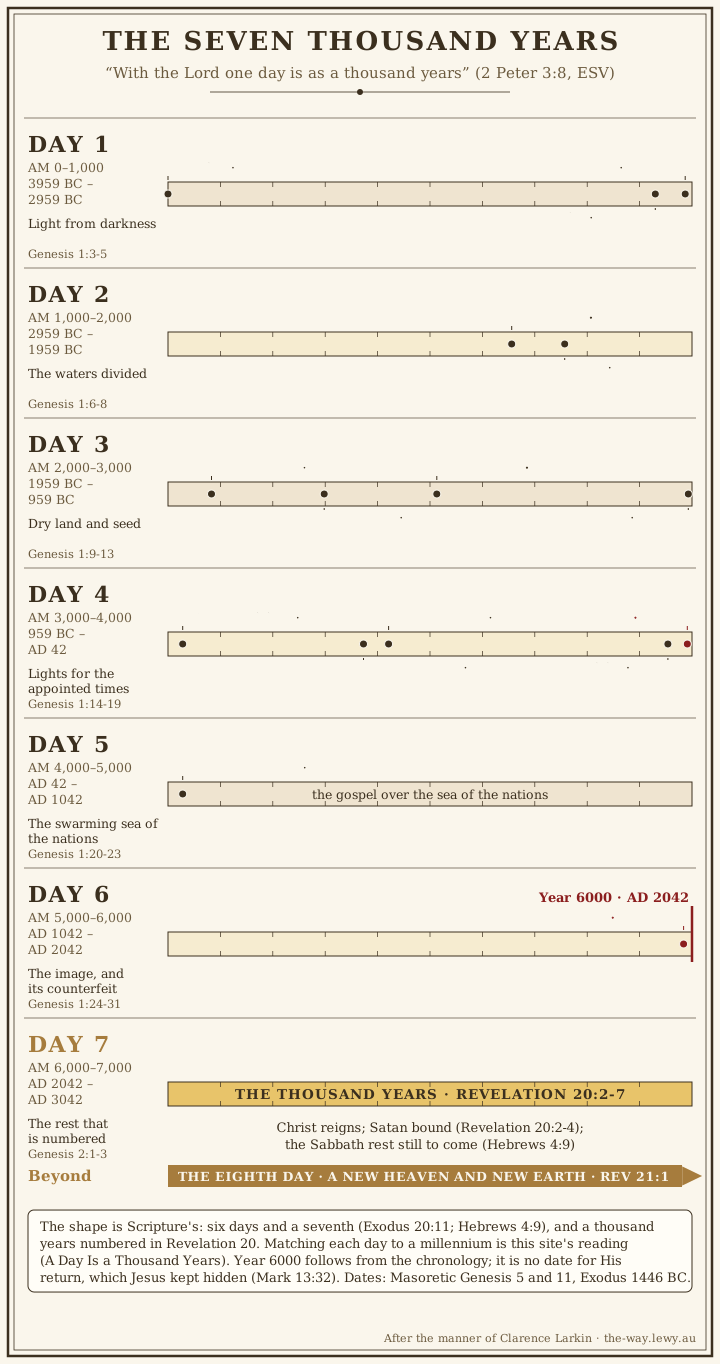
Seven thousand years · creation to the thousand-year reign, on this site's chronology.
-
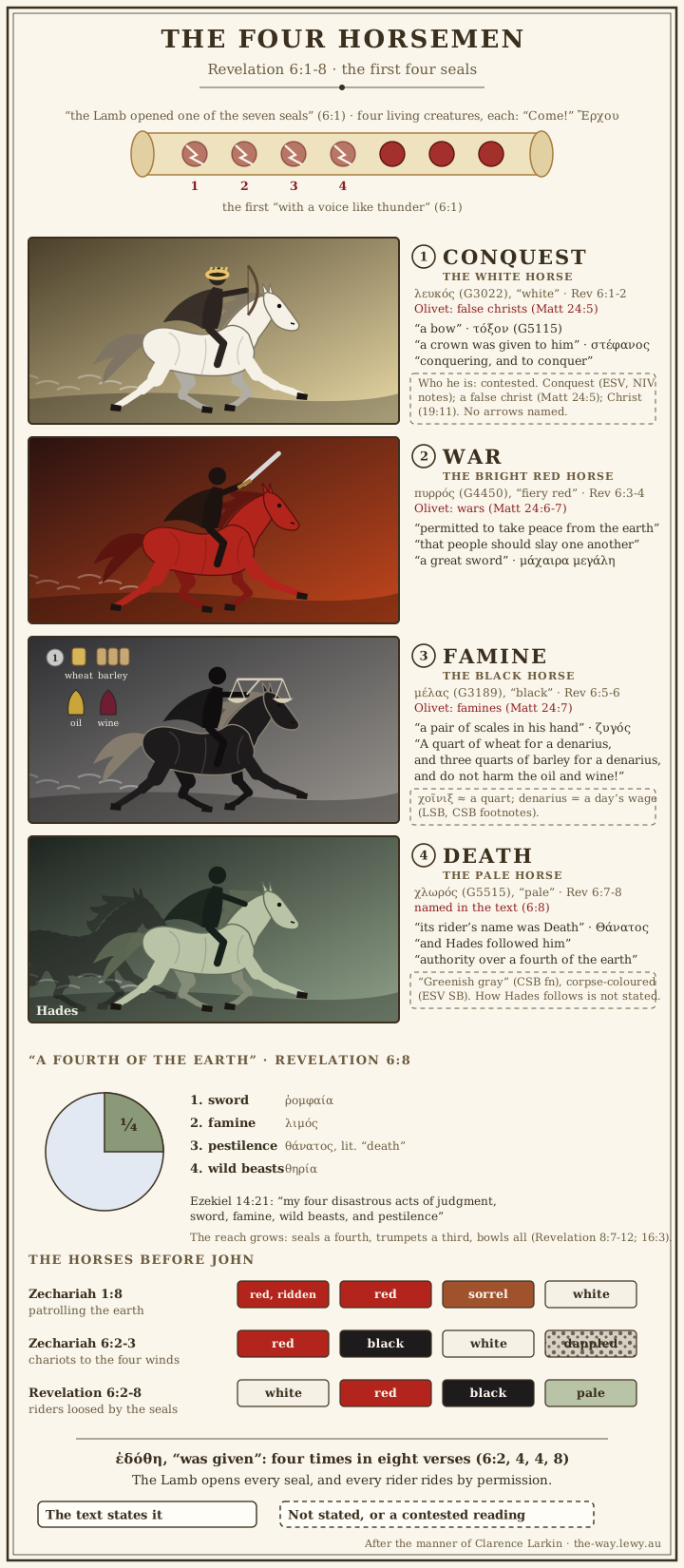
The four horsemen · Revelation 6:1-8, every detail numbered against its verse.
-
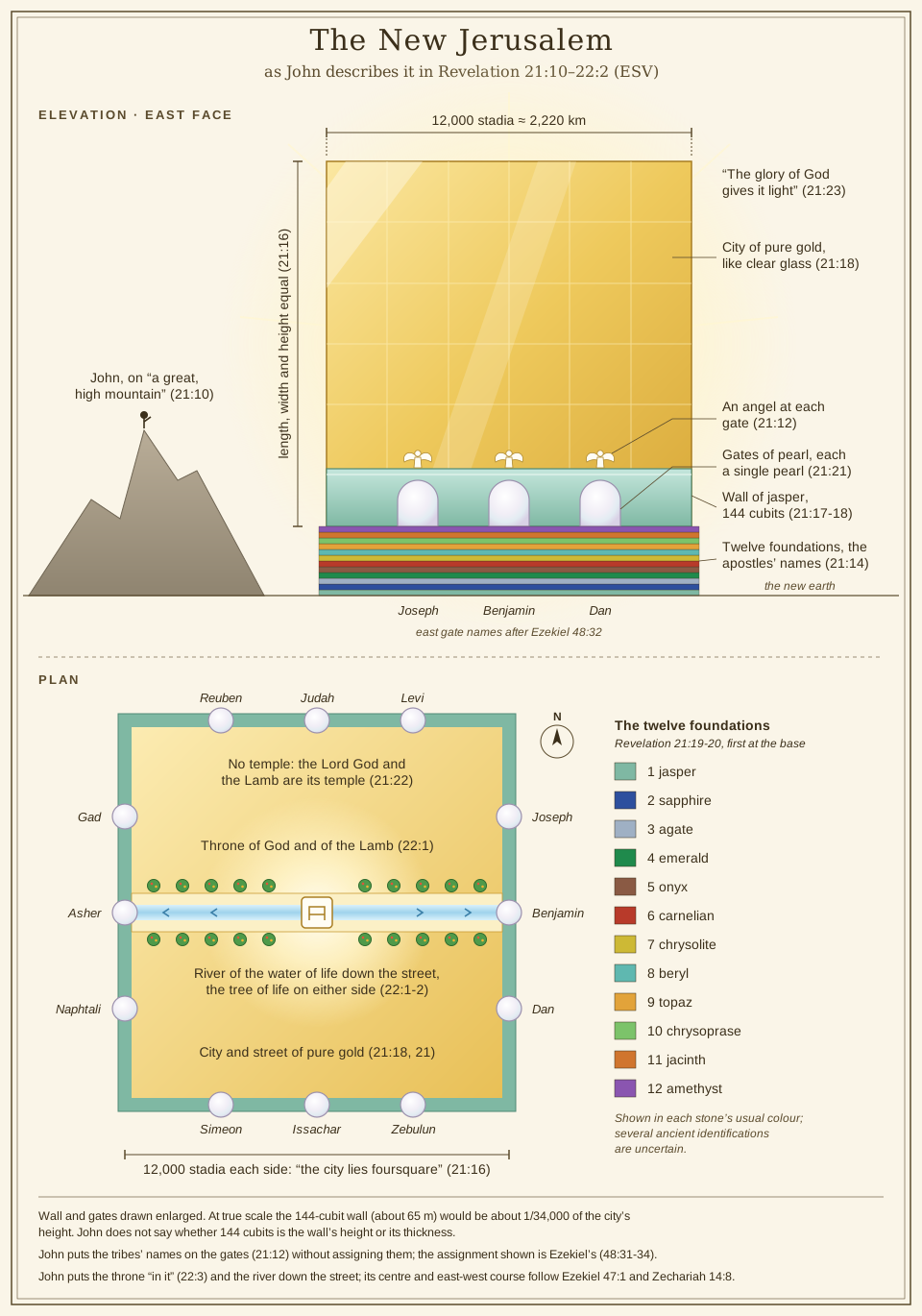
The New Jerusalem · the city of Revelation 21, drawn to its measures.
-
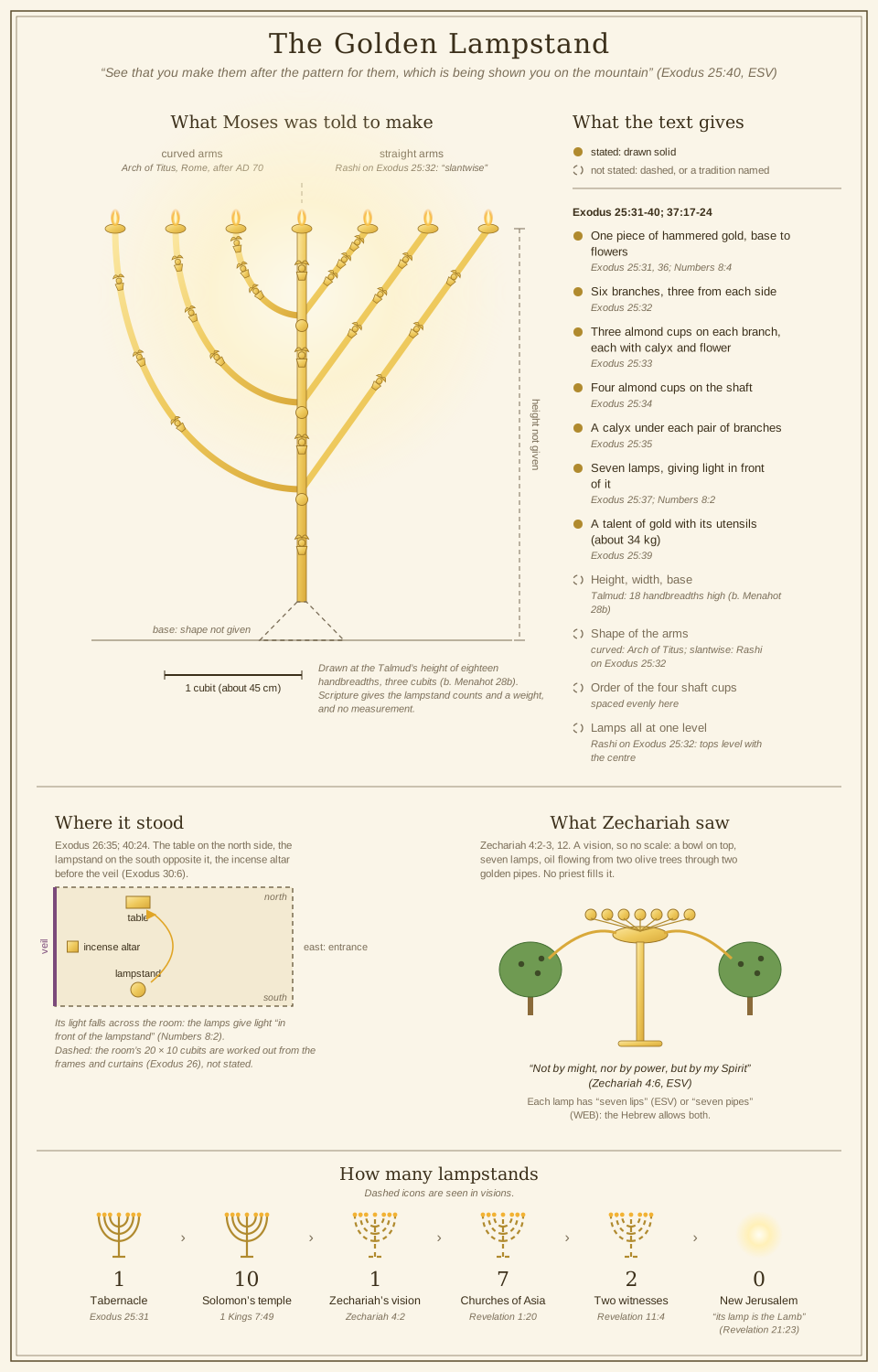
The lampstand · Exodus 25 drawn to the pattern shown to Moses on the mountain.
-
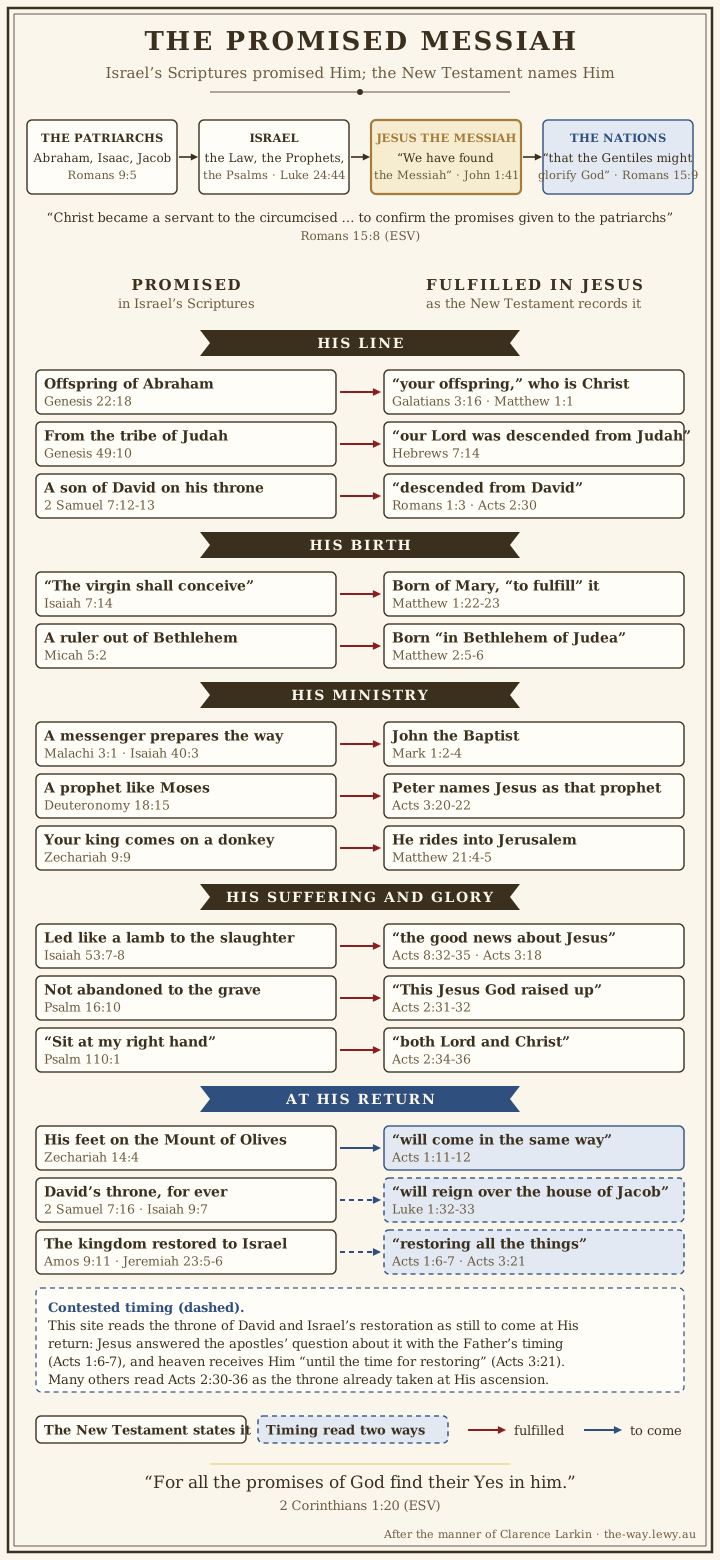
The promised Messiah · the line the promises travel, from the patriarchs to Jesus.
Explore
-
The Way
The word study behind this site's name: hodos from its Old Testament roots to Jesus's claim in John 14:6 and the name believers wore in Acts.
-
How to Read the Bible
The method behind every study here: genre, context, and original audience before application.
-
Statement of Faith
What I believe, and why, built out one doctrine at a time with Scripture behind each.
-
Study Series
Studies in an order for a group to take one a week, each with a printable group sheet: End Times Fundamentals, The Nature of God, Learning to Pray and more.
-
Commentaries
Chapter-by-chapter notes, book by book, from Genesis through Revelation.
-
FAQ
Who writes this, how AI is used, what I believe, which translation and why, and how to check any claim here for yourself.
-
Glossary
Lemma, MACULA, pericope, Septuagint: short definitions of the terms these studies use, each linked to the page that explains it in full.
-
Recommended resources
The sites, tools and channels I use alongside these studies, from Got Questions and Blue Letter Bible to Joel Kramer's biblical archaeology on location.
New this month
-
The Cups Jesus Drank
From the wine at Cana to the sour wine at Golgotha: the cup Jesus named as His death, the cup He refused on arrival at the cross and the one He received at the end, why He took the second, what the Talmud, Josephus and the early church add, and the cup still to come.
Published 31 October 2026 · Read
-
Prayer: Communion with God
The prayer Jesus taught, for young readers aged 8-16: God's child talking with the Father, asking for His will first and for today's bread.
Published 30 October 2026 · Read
-
The Woman at the Well
John 4 for young readers aged 8-16: a deep hole, a spring, and the Holy Spirit Jesus gives to anyone who asks.
Published 30 October 2026 · Read
-
Precious Stones in Scripture
Why Ezekiel and John describe God's throne and the New Jerusalem in gemstones: what each stone was, how the breastpiece, Ezekiel 28 and Revelation 21 share one list, and what a stone's light (lustre, dispersion, asterism, pleochroism) shows about the glory of God.
Published 29 October 2026, revised 30 October 2026 · Read
-
Psalms, Hymns and Spiritual Songs
What Paul meant by psalms, hymns and spiritual songs in Ephesians 5:19 and Colossians 3:16, where the three words come from, the songs Israel and the first church sang, and why a Spirit-filled church sings.
Published 26 October 2026, revised 31 October 2026 · Read
-
The Songbook
A body of psalms, hymns and spiritual songs to remember: the songs of Scripture, the songs Jesus sang and quoted, and the earliest Christian songs, with who first sang each and when to sing it.
Published 26 October 2026 · Read
Recently updated
- Sin and Sexual Immorality — Updated 1 November 2026
- The Lord's Prayer: What Jesus Taught Us About How to Pray — Updated 1 November 2026
- "I Will Not Drink Again": The Last Supper and the Cups of Passover — Updated 31 October 2026
- A Day Is a Thousand Years — Updated 31 October 2026
- A Thousand Years in Your Sight — Updated 31 October 2026
See the full Recently Updated page for more.