The Lord's Prayer: What Jesus Taught Us About How to Pray
Week 2 of 4 in Learning to Pray · next: How God Answers Prayer
Week 2 of 5 in The Sermon on the Mount · next: Your Kingdom Come: The Kingdom Already Here and Not Yet Complete
The disciples watched Jesus pray, and when He finished one of them asked, "Lord, teach us to pray" (Luke 11:1, ESV). What He gave them is short enough to learn by heart, and each line of it teaches something about who God is and what you may ask Him for.
In one sentence: Jesus teaches His disciples to pray as a child to a Father, putting God's name, kingdom, and will ahead of their own needs, and trusting Him plainly for daily bread, mutual forgiveness, and deliverance from evil in this time before His kingdom fully arrives.
Key Takeaways
(This section follows the Key Takeaways format — see that page for what each part is for.)
Lessons about Jesus
- He puts "Father" first, and He is how you get to say it. Israel already called God Father; Jesus makes it the prayer's very first word. And He is the Son through whom you are adopted: "God sent forth his Son… so that we might receive adoption as sons" (Galatians 4:4-5, ESV). You pray to someone who is already your Father because of Jesus.
- He brought the kingdom He taught you to pray for. "If it is by the Spirit of God that I cast out demons, then the kingdom of God has come upon you" (Matthew 12:28, ESV). You pray from within a kingdom Jesus Himself began, toward the day its reign is finished and visible to everyone.
- He lived the prayer He taught. He prayed "Father, glorify your name" (John 12:28). He prayed "not as I will, but as you will" (Matthew 26:39). Hungry in the wilderness, He lived "by every word that comes from the mouth of God" (Matthew 4:4). On the cross He prayed for the men killing Him, "Father, forgive them" (Luke 23:34, a sentence some early manuscripts lack). And He was tested "in every respect… as we are, yet without sin" (Hebrews 4:15). And He died to pay the debts it asks the Father to forgive.
Memory verses
✝️ Matthew 6:9-13 (ESV)
9 Pray then like this: "Our Father in heaven, hallowed be your name. 10 Your kingdom come, your will be done, on earth as it is in heaven. 11 Give us this day our daily bread, 12 and forgive us our debts, as we also have forgiven our debtors. 13 And lead us not into temptation, but deliver us from evil.
✝️ Matthew 6:33 (ESV)
33 But seek first the kingdom of God and his righteousness, and all these things will be added to you.
✝️ 1 Peter 5:7 (ESV)
7 casting all your anxieties on him, because he cares for you.
Be Transformed
- Think. God forgives at His own cost. The record of debt that stood against you He "set aside, nailing it to the cross" (Colossians 2:14, ESV). That is the atonement, and it stands behind every "forgive us" you pray. And He is never the one who tempts you (James 1:13); He is the one you ask to keep you.
- Attitude. Pray it as "us". Every first-person word in the prayer is plural, so even alone you are praying for your household, your church and the brother who wronged you. And let go of needing an audience or a word count: this prayer is short, and it is prayed to a Father who sees in secret (Matthew 6:6).
- Do. Pray in the moment. "Pray without ceasing" (1 Thessalonians 5:17, ESV; Prayer as Communion works through it), and the prayer Jesus taught is short enough to pray anywhere, to a Father who already knows what you need (Matthew 6:8). This week, when God puts a person or a need on your heart, pray there and then, in a sentence. When you tell someone "I'll pray for you", pray for them right then: aloud with them if they are willing, or silently before you walk away.
Prayer
Father, thank You that we may call You Father, because You sent Your Son Jesus to make us Your children. Your name is holy; let our home honour it. Your kingdom is coming, already begun in Jesus and not yet finished; let Your will matter more to us today than our own comfort. Give us what we need for today, no more and no less. Forgive us, because Jesus paid what we owed, and make us quick to forgive one another. Keep us from the testing that would turn us from You, and deliver us from the evil one. In Jesus' name. Amen.
Study outline
- Where Jesus taught it — Luke's occasion, Matthew's setting, and what each Gospel does with the prayer.
- The prayer, line by line — each petition, the word behind it, and a line to pray it with: Our Father in heaven · Hallowed be your name · Your kingdom come, your will be done · Our daily bread · Forgive us our debts · Lead us not into temptation.
- What the prayer teaches — the shape underneath the words, where else Scripture teaches it, and praying it in Jesus' name.
- Annex: the two Gospel accounts — why some Bibles end differently (the doxology and Luke's shorter text), and one occasion or two?
Where Jesus taught it
Luke: the disciples asked
✝️ Luke 11:1-4 (ESV)
1 Now Jesus was praying in a certain place, and when he finished, one of his disciples said to him, "Lord, teach us to pray, as John taught his disciples." 2 And he said to them, "When you pray, say: "Father, hallowed be your name. Your kingdom come. 3 Give us each day our daily bread, 4 and forgive us our sins, for we ourselves forgive everyone who is indebted to us. And lead us not into temptation."
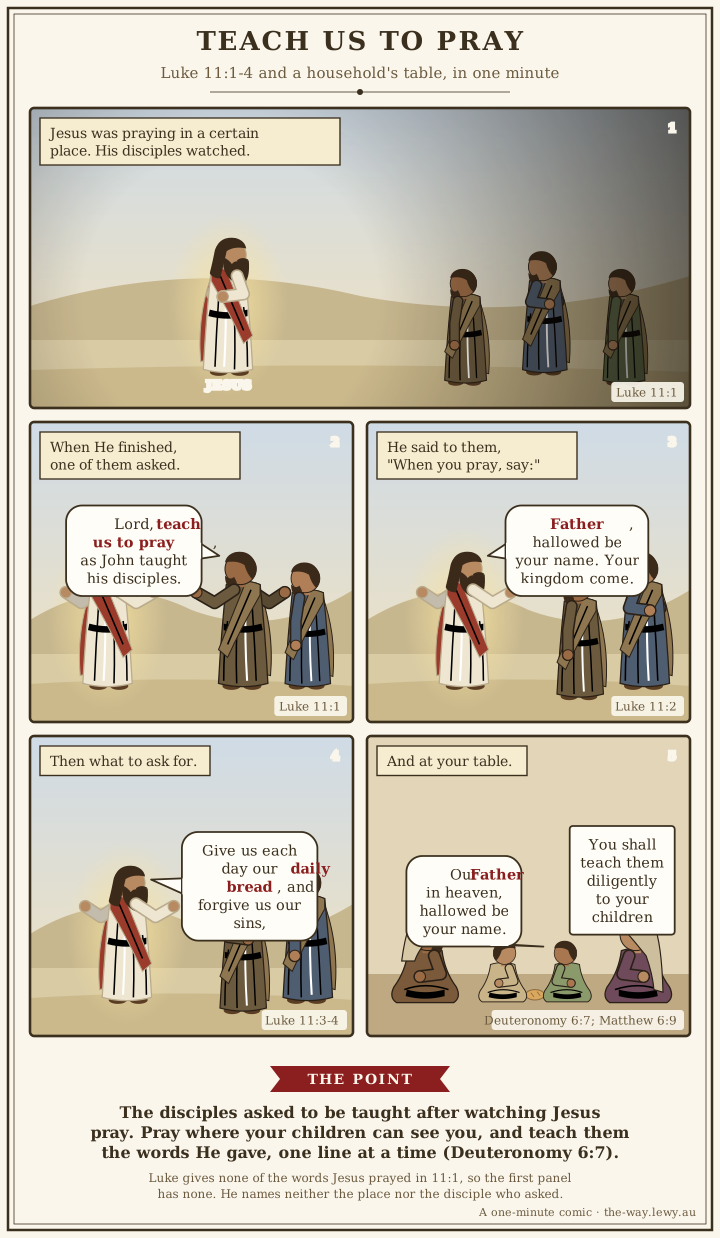
The disciples had just watched Jesus pray, and one of them asked for what John the Baptist had apparently already given his own followers: a distinctive, identifying prayer. Luke 5:33 already shows John's disciples known for fasting often and offering prayers. The ESV Study Bible reads the request the same way, as a prayer "that they can pray as his disciples" (note on Luke 11:1). They are asking to be given their prayer, the way John's followers had one.
Luke continues directly from the prayer into the Friend at Midnight parable (Luke 11:5-8) and the "ask, seek, knock" teaching (Luke 11:9-13), which climaxes: "how much more will the heavenly Father give the Holy Spirit to those who ask him!" (Luke 11:13, ESV). Luke's point for this whole unit is bold, persistent asking. Prayer as Communion works through those two parables.
Matthew: prayer without an audience
Matthew 6:9-13 sits inside Matthew 6:1-18, three parallel warnings against practicing righteousness "to be seen by others": almsgiving, prayer, fasting. Each follows the same pattern: don't do it for show; do it in secret; your Father who sees in secret will reward you.
The first warning targets hypocrites who "love to stand and pray in the synagogues and at the street corners, that they may be seen by others" (Matthew 6:5, ESV). Public prayer "in the morning, afternoon, and evening" was common (ESV Study Bible, note on Matthew 6:5-15), so anyone wanting to be seen praying could simply arrange to be somewhere visible when the hour came. Jesus is naming an exploitable feature of ordinary Jewish piety.
The second targets the Gentiles, who "heap up empty phrases" and "think that they will be heard for their many words" (Matthew 6:7, ESV). The verb, βατταλογέω (battalogeō, bat-tah-log-EH-oh, G945), occurs only here in the New Testament, so its exact sense (babbling, heaping up empty phrases) is inferred partly from context. The concrete referent is pagan prayer: piling up names and formulas to compel a capricious god to listen, like the prophets of Baal who "cried aloud and cut themselves… and raved" from morning past noon (1 Kings 18:26-29). Jesus sets His own brief prayer against that noise.
Matthew then follows the prayer with a coda on just one petition, forgiveness (Matthew 6:14-15), a sign that this clause was thought to need reinforcing. The third warning, on fasting (Matthew 6:16-18), is worked through in Fasting.
The prayer, line by line
Matthew's fuller form is the one most people know, so the sections below follow it.
✝️ Matthew 6:9-13 (ESV)
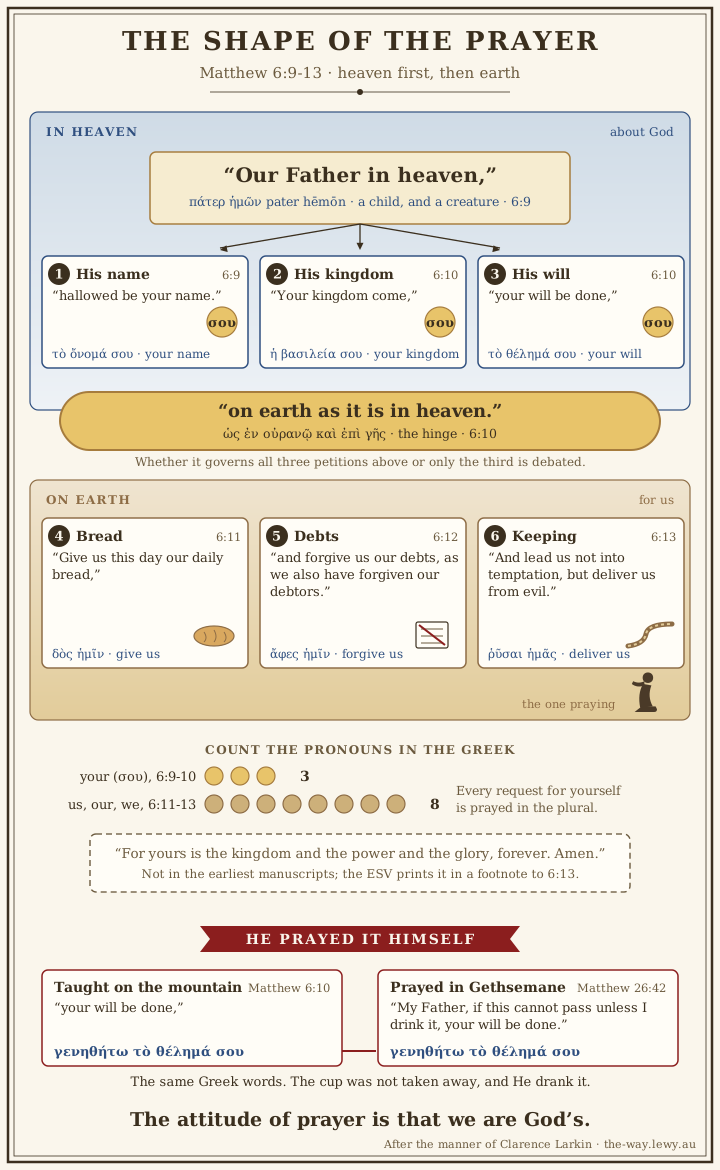
9 Pray then like this: "Our Father in heaven, hallowed be your name. 10 Your kingdom come, your will be done, on earth as it is in heaven. 11 Give us this day our daily bread, 12 and forgive us our debts, as we also have forgiven our debtors. 13 And lead us not into temptation, but deliver us from evil.
Our Father in heaven
Πάτερ (Patēr, PAH-tair, "Father," G3962). Matthew's "our Father in heaven" and Luke's bare "Father" both address God with family language. Israel already addressed God corporately as Father: "you, O LORD, are our Father, our Redeemer from of old is your name" (Isaiah 63:16, ESV); "But now, O LORD, you are our Father; we are the clay, and you are our potter" (Isaiah 64:8, ESV); compare also Deuteronomy 32:6 and Malachi 2:10. What Jesus intensifies is placing that address as the prayer's very first word, before any petition follows. This shows that God is a Father before He is anything you ask of Him: relationship precedes request.
Who may say it. Jesus gave this prayer to disciples: "to all who did receive him, who believed in his name, he gave the right to become children of God" (John 1:12, ESV). That is adoption, and the Spirit of the Son gives you the word, "Abba! Father!" (Galatians 4:6). Prayer as Communion works this through, and Assurance of Salvation answers how you can know you are His.
A Father near, above, and better than ours
Our. The word is plural, and so is every first-person word that follows: give us, forgive us, lead us. Cyprian of Carthage made the point in the 250s: "we say not 'My Father, which art in heaven,' nor 'Give me this day my daily bread'… Our prayer is public and common" (On the Lord's Prayer 8, ANF 5). Even prayed alone, it puts you in a family; see Personal and corporate.
In heaven. The Father who is near is also above everything. "God is in heaven and you are on earth. Therefore let your words be few" (Ecclesiastes 5:2, ESV), which is the posture Jesus has just asked for in Matthew 6:7-8. You come close, and you come with reverence.
When "father" is a hard word. For anyone whose earthly father was absent or harmful, the Psalms give a promise: "my father and my mother have forsaken me, but the LORD will take me in" (Psalm 27:10, ESV). The prayer shows you the Father your father should have been.
Pray it: "Father, thank You that because of Jesus we are Yours."
Hallowed be your name
ἁγιασθήτω (hagiasthētō, hah-gee-as-THAY-toh, "let it be hallowed," G37). It is a request that God Himself act, and the underlying Old Testament idea is Hebrew קָדַשׁ (qadash, kah-DAHSH, H6942, TWOT root 1990, "be set apart, sacred"). The closest parallel is Ezekiel 36:23, where God says He Himself will vindicate ("sanctify") His own name, profaned among the nations, by acting on Israel's behalf. So the petition asks God to do for His own name what only He can do, and to make you someone who honours it.
The verses just before show how the name had been profaned. Israel, scattered in exile, "profaned my holy name, in that people said of them, 'These are the people of the LORD, and yet they had to go out of his land'" (Ezekiel 36:20, ESV). The nations judged God by His people. A family that carries His name is read the same way by its neighbours, so this petition lands on the one praying it. Peter uses the same verb for the believer's own part: "in your hearts honor Christ the Lord as holy" (1 Peter 3:15, ESV), ἁγιάσατε (hagiasate, hah-gee-AH-sah-teh, G37).
This shows that God guards His own name and has made it known in His Son: "I have manifested your name to the people whom you gave me" (John 17:6, ESV). The Names of God follows the names He has made known. Cyprian read the petition this way: "not that we wish for God that He may be hallowed by our prayers, but that we beseech of Him that His name may be hallowed in us" (On the Lord's Prayer 12, ANF 5).
Pray it: "Father, show Your holiness in our home today, and let nothing we say or do give anyone a reason to think less of You."
Your kingdom come, your will be done
βασιλεία (basileia, bah-see-LAY-ah, "kingdom," G932). It is an act of ruling, a reign, more than a plot of land. Daniel's visions supply the clearest Old Testament background for a future, God-established kingdom: "The God of heaven will set up a kingdom that shall never be destroyed… it shall break in pieces all these kingdoms and bring them to an end, and it shall stand forever" (Daniel 2:44, ESV).
The New Testament holds that kingdom as already here and not yet complete. Jesus states plainly that it has already arrived in His ministry: "But if it is by the Spirit of God that I cast out demons, then the kingdom of God has come upon you" (Matthew 12:28, ESV; Luke 11:20 has "the finger of God"). Yet the same Gospels look to a still-future consummation: "inherit the kingdom prepared for you from the foundation of the world" (Matthew 25:34), and after the resurrection the apostles are corrected only on the timing of restoring "the kingdom to Israel" (Acts 1:6-7).
"Your kingdom come" asks for God's reign to be established in full, and the next clause states the same request a second way, "your will be done, on earth as it is in heaven." This shows that God has not given up the earth. The King has come once, and on the dispensational reading this site holds He will come again to reign on it, a future, literal kingdom; amillennial readers take the reign as present and spiritual. Until then, praying "your will be done" hands your own will over to His, as Jesus did in Gethsemane: "not as I will, but as you will" (Matthew 26:39, ESV). Your will handed over in Prayer as Communion follows that prayer to its answer.
The fuller study of this petition, on basileia, "kingdom of heaven" and the grammar of the request, is Your Kingdom Come.
Pray it: "Father, bring Your kingdom, and bring Jesus back. Until then, where our will and Yours disagree today, let Yours be done."
Give us this day our daily bread
ἐπιούσιος (epiousios, ep-ee-OO-see-os, "daily," G1967). Across the Greek New Testament it occurs in exactly two verses, Matthew 6:11 and its parallel Luke 11:3, and it is barely found anywhere outside them. Origen remarked it looked coined by the Gospel writers themselves. Jerome rendered it two different ways in the same Vulgate: supersubstantialem ("super-substantial") in Matthew, cotidianum ("daily") in Luke. The uncertainty over its meaning is ancient.
The live options are "daily", "for today", "for the coming day", or "necessary for existence". All of them ask God for today's or tomorrow's sufficiency, not a stockpile. The Old Testament background fits that shape. Manna could not be hoarded beyond its day, except the day before the Sabbath (Exodus 16:4, 19-26): a built-in, day-by-day dependence. And Proverbs 30:8's prayer, "feed me with the food that is needful for me" (literally "the bread of my portion", Hebrew לֶחֶם חֻקִּי lechem chuqqi, LEH-khem khook-KEE, H2706, TWOT root 728a), asks for enough, without either poverty or riches. This shows that God wants to be asked again tomorrow, and that He means to provide.
The Father who feeds, in plenty and in want
The same sermon goes on to read like this petition preached. A few verses on, Jesus says: "do not be anxious, saying, 'What shall we eat?'… your heavenly Father knows that you need them all" (Matthew 6:31-32, ESV). The birds and the lilies of Matthew 6:25-30 make the same point. Jesus lived it first, answering the tempter with what Moses said of the manna (Matthew 4:4; Deuteronomy 8:3), and the day after feeding five thousand He said, "I am the bread of life" (John 6:35, ESV). Prayer as Communion works through the manna; Bread of Life traces the line from the manna to Him, and In Humility shows why depending on God one day at a time is itself humbling.
Two things this means at a family table. It is our bread, so asking for it includes the household that has less than yours. And it is asked of a Father who sometimes lets the cupboard run low. Habakkuk prayed through that: "Though the fig tree should not blossom… and the fields yield no food… yet I will rejoice in the LORD" (Habakkuk 3:17-18, ESV), and Paul had "learned the secret of facing plenty and hunger" (Philippians 4:12, ESV). The petition asks for bread and trusts the Father with the answer.
Pray it: "Father, give us what we need for today, and show us who we can share it with. We trust You with tomorrow."
Forgive us our debts
ὀφειλήματα (opheilēmata, oh-fay-LAY-mah-tah, "debts," G3783). Matthew has Jesus ask forgiveness for "debts", financial language used for sin. Luke's parallel uses "sins" (ἁμαρτίας, hamartias, hah-mar-TEE-as, G266) for what God forgives, but keeps the debt word (opheilonti, oh-fay-LON-tee, G3784, "indebted") for what we forgive others. Israel practised an actual sabbatical-year debt release (shemittah, Deuteronomy 15:1-2), a periodic, covenant-mandated cancellation of debts that could not otherwise be repaid, so the prayer borrows a category its hearers lived under.
How the debt was cancelled. A debt that is forgiven is paid by someone. Paul names who paid this one: God "canceling the record of debt that stood against us with its legal demands. This he set aside, nailing it to the cross" (Colossians 2:14, ESV). Jesus told a parable about the same debt. A servant owed "ten thousand talents" (Matthew 18:24, ESV); a talent was about twenty years' wages for a labourer (ESV Study Bible, note on Matthew 18:24), so the debt could never be paid, and the king released it. This shows that God forgives at His own cost: the atonement Jesus made on the cross is what stands behind every "forgive us" you pray. Forgive Us Our Debts works this through, and The Day of Atonement shows the picture Israel was given of it.
Forgiven, and forgiving others
Does God's forgiveness depend on mine? Matthew makes the link explicit: "if you forgive others their trespasses, your heavenly Father will also forgive you, but if you do not forgive others their trespasses, neither will your Father forgive your trespasses" (Matthew 6:14-15, ESV). Read alone, that sounds as though forgiving earns forgiveness. Jesus' parable puts the order the other way: "I forgave you all that debt because you pleaded with me. And should not you have had mercy on your fellow servant, as I had mercy on you?" (Matthew 18:32-33, ESV). Mercy comes first; forgiving is what mercy received does in you. Christians read verse 15 two ways, either as a believer's fellowship with the Father clouded by a grudge, or as an unforgiving heart showing it was never changed, and both keep justification secure. What Matthew 6:15 warns a believer about sets out both readings. Forgiveness received and forgiveness given belong in one breath: "forgiving one another, as God in Christ forgave you" (Ephesians 4:32, ESV).
In a household this petition is prayed most days. Brothers and sisters, husbands and wives, sin against each other, and when Peter asked how often he must forgive, Jesus answered, "seventy-seven times" (Matthew 18:22, ESV). Forgiving releases the debt; it does not require pretending the wrong was small or trusting someone who is still doing harm. For hurt that comes from other believers, see Hurt by the Church.
Pray it: "Father, forgive us for ______. And we let go of what ______ owes us, as You have let go of what we owed You."
Lead us not into temptation, but deliver us from evil
πειρασμός (peirasmos, pay-ras-MOS, "temptation, testing," G3986). James 1:13 states plainly, "God cannot be tempted with evil, and he himself tempts no one." So how can Jesus have you ask God not to "lead us into temptation"?
The word covers both "trial" or "testing" and "enticement to sin"; compare Revelation 3:10's "hour of trial". The ESV Study Bible reads the petition as "Allow us to be spared from difficult circumstances that would tempt us to sin" (note on Matthew 6:13), and points to Jesus' own words in Gethsemane: "pray that you may not enter into temptation" (Matthew 26:41, ESV). Some take "lead us not into" as a Semitic idiom for "do not let us fall into". Either reading keeps James 1:13 intact: God is never the source of your temptation, and He is the one you ask to keep you out of it.
τοῦ πονηροῦ (tou ponērou, too pon-ay-ROO, "evil / the evil one," G4190). The Greek can mean "evil" in general or "the evil one", Satan. Elsewhere the same word with the article plainly denotes Satan (Matthew 13:19, 38; 1 John 2:13-14; 3:12; 5:18-19), which inclines many interpreters toward "deliver us from the evil one". English translations split on it (the ESV and NASB have "evil"; the NIV, CSB and WEB "the evil one"), and either is grammatically defensible. Either way, the prayer ends by admitting you cannot keep yourself, and asking the Father who can.
Christ's testing and God's faithfulness
Jesus went in first. "Jesus was led up by the Spirit into the wilderness to be tempted by the devil" (Matthew 4:1, ESV). He entered the testing this petition asks to be spared, and came out without sin, so "we do not have a high priest who is unable to sympathize with our weaknesses, but one who in every respect has been tempted as we are, yet without sin" (Hebrews 4:15, ESV). Fasting walks through those forty days. And He prays this petition for you. The night before the cross He asked the Father "that you keep them from the evil one" (John 17:15, ESV), and told Peter, "Satan demanded to have you… but I have prayed for you that your faith may not fail" (Luke 22:31-32, ESV).
What God promises in answer. "God is faithful, and he will not let you be tempted beyond your ability, but with the temptation he will also provide the way of escape, that you may be able to endure it" (1 Corinthians 10:13, ESV). This shows that God is a Father who keeps His children: He sets the limit on the test and supplies the way through it. The "hour of trial" of Revelation 3:10 carries the petition to the end of the age; whether that promise keeps the church from the hour or through it is contested, and Kept from the hour gives the case.
Pray it: "Father, keep us out of what we cannot stand up to today, show us the way of escape when it comes, and guard us from the evil one."
What the prayer teaches
Jesus teaches that prayer is the address of a child to a Father whose name, kingdom, and will take priority over the child's own needs, and that once that priority is fixed, asking for daily provision, mutual forgiveness, and protection from testing is the expected pattern of a trusting relationship. It requires neither public display (Matthew 6:5-6) nor verbal accumulation (Matthew 6:7-8) to be heard.
The particulars are first-century and Jewish: the Aramaic and Greek wording, the synagogue prayer-hours, the sabbatical debt-economy behind "debts". What carries into every culture is the shape underneath them: God's name, kingdom, and will named before any personal request; provision asked for one day at a time; forgiveness sought and extended together; protection from evil asked in humility. It is a template for prayer's priorities. You do not have to recite it word for word for it to "count", which is Matthew 6:7's own warning, turned back on the prayer that follows it.
The rest of the New Testament teaches the same shape. The priority order is stated a few verses later in the same sermon: "seek first the kingdom of God and his righteousness, and all these things will be added to you" (Matthew 6:33). Forgiveness is taught the same way in Ephesians 4:32 and Colossians 3:13, and confidence about provision in 1 Peter 5:7 and Philippians 4:6.
After the cross the same prayer is prayed in Jesus' name. "Whatever you ask in my name, this I will do, that the Father may be glorified in the Son" (John 14:13, ESV). You pray to the Father as His adopted child, through the Son who opened the way, with the Spirit who cries "Abba" in you (Galatians 4:6); Whom to pray to in Prayer as Communion sets out each Person's part. The church kept praying it in that way from the start: the Didache, a church manual probably from about AD 100, gives the prayer and then says, "Thrice in the day thus pray" (Didache 8:3, ANF 7).
To use the prayer as a pattern for your own words, step by step, see A pattern to pray by in Prayer as Communion. To teach it to a household one line a week, see Teaching the Lord's Prayer at Home.
Annex: the two Gospel accounts
Why some Bibles end differently
The familiar ending, "For thine is the kingdom, and the power, and the glory, for ever. Amen" (KJV), has no corresponding Greek words at Matthew 6:13 in the earliest manuscripts. It is printed in the WEB and absent from the ASV, and the ESV prints it only as a footnote. It is attested from the Didache onward as a liturgical addition, first in a shorter form without "the kingdom": "for Thine is the power and the glory for ever" (Didache 8:2, ANF 7). It is probably drawn from David's prayer: "Yours is the kingdom, O LORD, and you are exalted as head above all" (1 Chronicles 29:11, ESV).
Luke's text was expanded the same way. Some manuscript traditions, followed by the WEB and YLT, fill out Luke 11:2 with Matthew's wording ("Our Father in heaven… May your will be done"). The earlier, shorter reading, followed by the ASV and the ESV quoted above, has simply "Father, hallowed be your name. Your kingdom come." Later scribes harmonised Luke toward Matthew.
One occasion or two?
Luke gives a concrete occasion that Matthew lacks, the wording differs, and each Gospel uses the prayer to make a different point. That fits a teacher repeating a core teaching at different points in a multi-year ministry. Source-critical scholarship often treats the two instead as one saying preserved in two forms; this study takes Luke's narrative claim of a distinct occasion as historical. Either way, read each account first in its own setting before blending the two.
Discussion questions
- The language. The Greek word behind "daily", ἐπιούσιος (epiousios), occurs only in this prayer (Matthew 6:11; Luke 11:3), and every proposed meaning asks for enough for today or tomorrow, like the manna Moses said to "leave any of it over till the morning" (Exodus 16:19). What would change in your own asking if you prayed for "enough for today"?
- The text in its context. One of the disciples, having just watched Jesus pray, asked, "Lord, teach us to pray, as John taught his disciples" (Luke 11:1). What would a prayer of their own have meant to the men who asked for it?
- Christ. The night before the cross Jesus asked the Father "that you keep them from the evil one" (John 17:15), and told Peter, "I have prayed for you that your faith may not fail" (Luke 22:32). What changes when you pray "deliver us from evil" knowing He has already prayed it for you?
- The hard part. Jesus says "the kingdom of God has come upon you" (Matthew 12:28), yet He teaches you to pray "Your kingdom come" (Matthew 6:10). Where in your own week can you see a reign that has begun and is not yet finished?
- The hard part. Jesus teaches you to pray "lead us not into temptation" (Matthew 6:13), and James says God "himself tempts no one" (James 1:13). How do those two sentences fit together?
- Be transformed. Matthew repeats one petition straight after the prayer: "if you do not forgive others their trespasses, neither will your Father forgive your trespasses" (Matthew 6:15). What would it take for you to pray this line honestly about the person you find hardest to forgive?
Group study sheet for a 40-minute group: two A4 sheets, or one with the guided path
The point, the passage, the questions and the response, from this study. Print on both sides of two A4 sheets, flipping on the long edge. While this block is open, printing the page prints the sheet; close it to print the study.
The Lord's Prayer: What Jesus Taught Us About How to Pray
Matthew 6:9-13; Luke 11:2-4The point Jesus teaches His disciples to pray as a child to a Father, putting God's name, kingdom, and will ahead of their own needs, and trusting Him plainly for daily bread, mutual forgiveness, and deliverance from evil in this time before His kingdom fully arrives.
Ask: How did Jesus teach us to pray?
Hear a few answers before anyone reads.
Matthew 6:9-13 9So then, this is how you should pray: ‘Our Father in heaven, hallowed be Your name. 10Your kingdom come, Your will be done, on earth as it is in heaven. 11Give us this day our daily bread. 12And forgive us our debts, as we also have forgiven our debtors. 13And lead us not into temptation, but deliver us from the evil one.’
Luke 11:2-4 2So Jesus told them, “When you pray, say: ‘Father, hallowed be Your name. Your kingdom come. 3Give us each day our daily bread. 4And forgive us our sins, for we also forgive everyone who sins against us. And lead us not into temptation.’”
Also read:
The Lord's Prayer: What Jesus Taught Us About How to Pray
- Where Jesus taught it — Luke's occasion, Matthew's setting, and what each Gospel does with the prayer.
- The prayer, line by line — each petition, the word behind it, and a line to pray it with: Our Father in heaven · Hallowed be your name · Your kingdom come, your will be done · Our daily bread · Forgive us our debts · Lead us not into temptation.
- What the prayer teaches — the shape underneath the words, where else Scripture teaches it, and praying it in Jesus' name.
- Annex: the two Gospel accounts — why some Bibles end differently (the doxology and Luke's shorter text), and one occasion or two?
The Lord's Prayer: What Jesus Taught Us About How to Pray
1The language. The Greek word behind "daily", ἐπιούσιος (epiousios), occurs only in this prayer (Matthew 6:11; Luke 11:3), and every proposed meaning asks for enough for today or tomorrow, like the manna Moses said to "leave any of it over till the morning" (Exodus 16:19). What would change in your own asking if you prayed for "enough for today"?
2The text in its context. One of the disciples, having just watched Jesus pray, asked, "Lord, teach us to pray, as John taught his disciples" (Luke 11:1). What would a prayer of their own have meant to the men who asked for it?
3Christ. The night before the cross Jesus asked the Father "that you keep them from the evil one" (John 17:15), and told Peter, "I have prayed for you that your faith may not fail" (Luke 22:32). What changes when you pray "deliver us from evil" knowing He has already prayed it for you?
4The hard part. Jesus says "the kingdom of God has come upon you" (Matthew 12:28), yet He teaches you to pray "Your kingdom come" (Matthew 6:10). Where in your own week can you see a reign that has begun and is not yet finished?
5The hard part. Jesus teaches you to pray "lead us not into temptation" (Matthew 6:13), and James says God "himself tempts no one" (James 1:13). How do those two sentences fit together?
The Lord's Prayer: What Jesus Taught Us About How to Pray
6Be transformed. Matthew repeats one petition straight after the prayer: "if you do not forgive others their trespasses, neither will your Father forgive your trespasses" (Matthew 6:15). What would it take for you to pray this line honestly about the person you find hardest to forgive?
- Think. God forgives at His own cost. The record of debt that stood against you He "set aside, nailing it to the cross" (Colossians 2:14, ESV). That is the atonement, and it stands behind every "forgive us" you pray. And He is never the one who tempts you (James 1:13); He is the one you ask to keep you.
- Attitude. Pray it as "us". Every first-person word in the prayer is plural, so even alone you are praying for your household, your church and the brother who wronged you. And let go of needing an audience or a word count: this prayer is short, and it is prayed to a Father who sees in secret (Matthew 6:6).
- Do. Pray in the moment. "Pray without ceasing" (1 Thessalonians 5:17, ESV; Prayer as Communion works through it), and the prayer Jesus taught is short enough to pray anywhere, to a Father who already knows what you need (Matthew 6:8). This week, when God puts a person or a need on your heart, pray there and then, in a sentence. When you tell someone "I'll pray for you", pray for them right then: aloud with them if they are willing, or silently before you walk away.
Pray then like this: "Our Father in heaven, hallowed be your name. Your kingdom come, your will be done, on earth as it is in heaven. Give us this day our daily bread, and forgive us our debts, as we also have forgiven our debtors. And lead us not into temptation, but deliver us from evil.
Matthew 6:9-13 (ESV)Father, thank You that we may call You Father, because You sent Your Son Jesus to make us Your children. Your name is holy; let our home honour it. Your kingdom is coming, already begun in Jesus and not yet finished; let Your will matter more to us today than our own comfort. Give us what we need for today, no more and no less. Forgive us, because Jesus paid what we owed, and make us quick to forgive one another. Keep us from the testing that would turn us from You, and deliver us from the evil one. In Jesus' name. Amen.
The Lord's Prayer: What Jesus Taught Us About How to Pray
Matthew 6:9-13; Luke 11:2-4Open Ask: How did Jesus teach us to pray?
Hear a few answers before anyone reads.
Read it aloud Matthew 6:9-13; Luke 11:2-4
1The language. The Greek word behind "daily", ἐπιούσιος (epiousios), occurs only in this prayer (Matthew 6:11; Luke 11:3), and every proposed meaning asks for enough for today or tomorrow, like the manna Moses said to "leave any of it over till the morning" (Exodus 16:19). What would change in your own asking if you prayed for "enough for today"?
2The text in its context. One of the disciples, having just watched Jesus pray, asked, "Lord, teach us to pray, as John taught his disciples" (Luke 11:1). What would a prayer of their own have meant to the men who asked for it?
3Christ. The night before the cross Jesus asked the Father "that you keep them from the evil one" (John 17:15), and told Peter, "I have prayed for you that your faith may not fail" (Luke 22:32). What changes when you pray "deliver us from evil" knowing He has already prayed it for you?
4The hard part. Jesus says "the kingdom of God has come upon you" (Matthew 12:28), yet He teaches you to pray "Your kingdom come" (Matthew 6:10). Where in your own week can you see a reign that has begun and is not yet finished?
5The hard part. Jesus teaches you to pray "lead us not into temptation" (Matthew 6:13), and James says God "himself tempts no one" (James 1:13). How do those two sentences fit together?
6Be transformed. Matthew repeats one petition straight after the prayer: "if you do not forgive others their trespasses, neither will your Father forgive your trespasses" (Matthew 6:15). What would it take for you to pray this line honestly about the person you find hardest to forgive?
- Think. God forgives at His own cost. The record of debt that stood against you He "set aside, nailing it to the cross" (Colossians 2:14, ESV). That is the atonement, and it stands behind every "forgive us" you pray. And He is never the one who tempts you (James 1:13); He is the one you ask to keep you.
- Attitude. Pray it as "us". Every first-person word in the prayer is plural, so even alone you are praying for your household, your church and the brother who wronged you. And let go of needing an audience or a word count: this prayer is short, and it is prayed to a Father who sees in secret (Matthew 6:6).
- Do. Pray in the moment. "Pray without ceasing" (1 Thessalonians 5:17, ESV; Prayer as Communion works through it), and the prayer Jesus taught is short enough to pray anywhere, to a Father who already knows what you need (Matthew 6:8). This week, when God puts a person or a need on your heart, pray there and then, in a sentence. When you tell someone "I'll pray for you", pray for them right then: aloud with them if they are willing, or silently before you walk away.
The Lord's Prayer: What Jesus Taught Us About How to Pray
The point Jesus teaches His disciples to pray as a child to a Father, putting God's name, kingdom, and will ahead of their own needs, and trusting Him plainly for daily bread, mutual forgiveness, and deliverance from evil in this time before His kingdom fully arrives.
References & Recommended Reading
- ESV Bible (Crossway) -- primary translation quoted throughout, per this repo's translation conventions.
- ESV Study Bible (Crossway) -- notes on Matthew 6:5-15, Matthew 6:13 and Luke 11:1, cited above.
- World English Bible (WEB), American Standard Version (ASV, 1901), and Young's Literal Translation (YLT) -- used for direct textual/translation comparison, especially the Matthew 6:13 doxology and the Luke 11:2 shorter-text question.
- MACULA Greek Linguistic Datasets (SBLGNT) and MACULA Hebrew Linguistic Datasets (WLC), queried via this repo's
references/build/bible-text.db-- source of all morphology, Strong's numbers, and occurrence counts cited above. - Theological Wordbook of the Old Testament (TWOT), ed. R. Laird Harris, Gleason L. Archer Jr., and Bruce K. Waltke (Moody Publishers) -- root entries for qadash/"be set apart" (root 1990) and choq/"something prescribed" (root 728a), consulted via this repo's committed TWOT Strong's-number map.
- Cyprian of Carthage, On the Lord's Prayer 8 and 12, and the Didache 8:2-3, both quoted from Ante-Nicene Fathers vols. 5 and 7 (public domain).
- Origen and Jerome on epiousios -- the ancient uncertainty over this word's derivation (including Jerome's two different Vulgate renderings of the same Greek word in Matthew and Luke) is widely discussed in NT lexical scholarship; consult a critical Matthew or Luke commentary (e.g., W. D. Davies and Dale C. Allison's Matthew [ICC], or Joel B. Green's Luke [NICNT]) for the fuller textual history.