The rapture of the Church
Week 4 of 7 in End Times Fundamentals · next: We Shall All Be Changed
The blessed hope is the Church's expectation of being gathered to Christ before the world's final judgment falls.
One view holds that the rapture — the harpazo, "catching up" — is a distinct event from the second coming, separated by the seven-year tribulation; another holds that they are one event described in different terms. This study makes the case for the first, the pretribulational reading. It follows from reading God's promises to Israel and His purpose for the Church as two distinct threads, which is what "dispensational" means here: Daniel's seventieth week is "decreed about your people and your holy city" (Daniel 9:24, ESV), so it resumes for Israel once the Church has been gathered. The tribulation sets that out, and Israel and the Church makes the wider case. The one-event reading gets its hearing under Other end-times views.
In one sentence: God will send His Son Jesus to catch His Church up bodily to Himself before the tribulation's wrath falls, a sudden and real rescue He has promised in His own word, so that you can meet grief and waiting with comfort.
Key Takeaways
(This section follows the Key Takeaways format — see that page for what each part is for.)
Types & Prophecy
Type. Enoch was taken before the Flood (Genesis 5:24; Hebrews 11:5), and Lot was brought out of Sodom before the fire fell (Genesis 19:16, 24): the righteous placed out of reach before judgment, while Noah was kept through it. As types they illustrate what other texts teach directly; Taken Before Judgment works them through.
Prophecy. 1 Thessalonians 4:16-17 is a first-time revelation. Paul gives it as "a word from the Lord" (1 Thessalonians 4:15), and he calls the change of the living "a mystery" (1 Corinthians 15:51), his word for a truth God kept hidden until the apostles' day.
Lessons about Jesus
- He comes for His own Himself — "I will come again and will take you to myself" (John 14:3).
- His two comings serve two purposes: gathering the Church to meet Him in the air, and a visible, public arrival with "the armies of heaven" (Revelation 19:11-16). The same person, two comings, two aims.
Memory verses
✝️ John 14:3 (ESV)
3 And if I go and prepare a place for you, I will come again and will take you to myself, that where I am you may be also.
✝️ 1 Thessalonians 4:17 (ESV)
17 Then we who are alive, who are left, will be caught up together with them in the clouds to meet the Lord in the air, and so we will always be with the Lord.
✝️ 1 Thessalonians 5:9 (ESV)
9 For God has not destined us for wrath, but to obtain salvation through our Lord Jesus Christ.
Be Transformed
- Think. Notice any temptation to treat the rapture's timing as more settled than Scripture presents it. The counter-argument named below, Revelation 3:10's ambiguity, is a live one, and a conclusion is only as strong as its handling of it.
- Attitude. 1 Thessalonians 4:18's whole point is comfort, not anxious calculation — "encourage one another with these words" is a command to bring grieving people hope, not to trade date-guesses.
- Do. Paul's own application is "Therefore encourage one another with these words" (1 Thessalonians 4:18, ESV). This week, read 1 Thessalonians 4:13-18 aloud with a believer who is grieving or afraid, and tell them who is coming for them.
Prayer
Lord Jesus, you promised to come again and take your own to yourself. Thank you that the hope of being with you is a specific promise, tied to your own word. Where I've let questions about timing turn into anxiety, give me the comfort this promise was meant to bring. Keep me ready the way the wise virgins were ready, with oil in hand and eyes on the door, until you come. In Jesus' name. Amen.
Study outline
- The word behind "rapture". The Greek verb behind "caught up", and its fourteen New Testament uses.
- The promise. John 14:1-4, Jesus coming for His own.
- The call to rapture. 1 Thessalonians 4:15-18 and 1 Corinthians 15:51-53: the dead raised, the living changed.
- The imminence of the rapture. Matthew 24:36-44 as the second coming, the contested turn at verse 36, the letters' sign-free waiting, "one taken, one left", and the ten virgins.
- Two comings. The shared vocabulary and the contested apantēsis, the features that sort, whether the Church rides out with Him in Revelation 19, and what the sequence markers say.
- The restrainer and his going. 2 Thessalonians 2:1-7, "out of the midst", and who restrains.
- The tribulation. Whose week Daniel's seventieth is, 1 Thessalonians 5:9, and the contested Revelation 3:10.
- The judgments. The Bema seat and the Great White Throne, and what bēma means.
- The marriage of the Lamb. Revelation 19:7-9: where the supper sits and what the bride wears.
- The whole sequence in one view. A diagram of the events in order, on earth and in heaven.
- Other end-times views. Post-tribulation and its four strongest arguments, mid-tribulation and pre-wrath, and amillennialism.
- Discussion questions. Three, for a group or on your own.
The word behind "rapture": ἁρπάζω
The English word "rapture" doesn't translate anything directly — it comes from the Latin Vulgate's rapiemur ("we will be caught up"), itself a translation of the Greek verb used in 1 Thessalonians 4:17: ἁρπάζω (harpazō, har-PAD-zo, G726), "to seize, snatch, or catch away by force."
Where the word comes from. In classical and koine Greek, ἁρπάζω is ordinary language for forcible seizure — a wolf snatching prey, a robber seizing goods, a kidnapper taking a person against their will. Its core sense is sudden, forceful removal, and the New Testament keeps that sense.
How the New Testament uses it. The word occurs 14 times. Most describe ordinary forceful seizure, such as a wolf snatching sheep (John 10:12). No one can seize the Father's sheep out of His hand (John 10:28-29) — the same force, turned into a promise of security.
Five occurrences, in four passages, describe something more specific: a person suddenly carried off by God's power.
- 2 Corinthians 12:2-4 (ESV) — Paul describes himself (guardedly, in the third person) being "caught up" to the third heaven (12:2) and into paradise (12:4): a real, involuntary experience whose manner he leaves open, "whether in the body or out of the body I do not know" (12:2).
- Acts 8:39 (ESV) — after baptizing the Ethiopian eunuch, "the Spirit of the Lord carried Philip away," and Philip "found himself at Azotus" (8:40): an abrupt, physical relocation on earth.
- Revelation 12:5 (ESV) — the male child (Christ) is "caught up to God and to his throne," His ascension described with the same verb.
- 1 Thessalonians 4:17 (ESV) — "we who are alive, who are left, will be caught up together with them in the clouds to meet the Lord in the air."
Conclusion. Every time ἁρπάζω describes God taking a person, the taking is sudden and real, and the person taken does nothing to bring it about. Paul could not say whether his own experience was bodily. 1 Thessalonians 4 settles that question for the rapture from its context: the dead are raised first (4:16) and the living are changed (1 Corinthians 15:51-53). The verb supplies the suddenness and the resurrection supplies the body, so the rapture is what it sounds like: a real, sudden, bodily gathering of the Church.
Each half of that sentence has its own study. We Shall All Be Changed works through 1 Corinthians 15:35-58 on the body the dead are raised in and the living are changed into. At Home with the Lord covers where the believing dead are until that trumpet sounds. The Bride of Christ covers the Church as the one gathered: a betrothed bride taken to the place prepared for her.
This shows that God gathers His people with the whole force the word carries: no one can snatch you out of His hand (John 10:28-29), and one day He will snatch you up to be with Jesus Himself.
The promise: Christ returns for His own
✝️ John 14:1-4 (ESV)
1 "Let not your hearts be troubled. Believe in God; believe also in me. 2 In my Father's house are many rooms. If it were not so, would I have told you that I go to prepare a place for you? 3 And if I go and prepare a place for you, I will come again and will take you to myself, that where I am you may be also. 4 And you know the way to where I am going."
Christ is coming back for His own, personally, to take them where He is — stated as a promise before any sequence of events is worked out. Chuck Missler begins his own treatment of the "blessed hope" here for that reason.
This shows that God has tied your hope to a person: Jesus Himself is coming for you, so your heart need not be troubled (John 14:1).
The call to rapture
Paul is answering a grief. Some Thessalonian believers had died since he taught the church about Christ's return, and the church seemed unsure whether they would share in it. The paragraph opens by naming exactly that concern: "we do not want you to be uninformed... about those who are asleep, that you may not grieve as others do who have no hope" (1 Thessalonians 4:13, ESV).
✝️ 1 Thessalonians 4:15-18 (ESV)
15 For this we declare to you by a word from the Lord, that we who are alive, who are left until the coming of the Lord, will not precede those who have fallen asleep. 16 For the Lord himself will descend from heaven with a cry of command, with the voice of an archangel, and with the sound of the trumpet of God. And the dead in Christ will rise first. 17 Then we who are alive, who are left, will be caught up together with them in the clouds to meet the Lord in the air, and so we will always be with the Lord. 18 Therefore encourage one another with these words.
- The dead in Christ rise first — the rapture is a resurrection as well as a catching up of the living.
- A cry of command, an archangel's voice, a trumpet — three distinct signals, none of them subtle or secret.
- "Encourage one another with these words" — whatever the mechanics, the pastoral purpose of this text is comfort.
This shows that God answers grief with the resurrection of the body: those you have buried in Christ rise first, and you will be with them and with the Lord always.
The mystery of 1 Corinthians 15:51-53
✝️ 1 Corinthians 15:51-53 (ESV)
51 Behold! I tell you a mystery. We shall not all sleep, but we shall all be changed, 52 in a moment, in the twinkling of an eye, at the last trumpet. For the trumpet will sound, and the dead will be raised imperishable, and we shall be changed. 53 For this perishable body must put on the imperishable, and this mortal body must put on immortality.
- "I tell you a mystery" — something not previously revealed in the Old Testament, disclosed here for the first time.
- "In a moment, in the twinkling of an eye" — about as fast as language can describe, reinforcing the sudden, ἁρπάζω-consistent nature of the event.
- The trumpet appears again, tying this passage to 1 Thessalonians 4 and to The Trumpet Call of God.
- Imperishable, immortal — the goal is the body transformed.
This is glorification, the last stage of your salvation, and God will complete it in you in the twinkling of an eye.
The imminence of the rapture
✝️ Matthew 24:36-44 (ESV)
36 "But concerning that day and hour no one knows, not even the angels of heaven, nor the Son, but the Father only. 37 For as were the days of Noah, so will be the coming of the Son of Man. 38 For as in those days before the flood they were eating and drinking, marrying and giving in marriage, until the day when Noah entered the ark, 39 and they were unaware until the flood came and swept them all away, so will be the coming of the Son of Man. 40 Then two men will be in the field; one will be taken and one left. 41 Two women will be grinding at the mill; one will be taken and one left. 42 Therefore, stay awake, for you do not know on what day your Lord is coming. 43 But know this, that if the master of the house had known in what part of the night the thief was coming, he would have stayed awake and would not have let his house be broken into. 44 Therefore you also must be ready, for the Son of Man is coming at an hour you do not expect."
Matthew 24:36-44 describes Christ's coming after the tribulation. Its word for the coming is παρουσία (parousia, G3952) at 24:37 and 39, the word Matthew used at 24:27 for the coming that flashes like lightning at the end of the distress, and Matthew sets the paragraph after 24:29-31. The Olivet Discourse and One Taken, One Left read it the same way. On verse 36's "nor the Son", and what it does and does not say about Christ's knowledge, see The Day No One Knows.
- The point of comparison is being unprepared (Matthew 24:38-39). Noah is preserved through the flood, which is why the ark is not a picture of the rapture.
- "You also must be ready" (24:44) — readiness is the point of the passage, and the date stays with the Father.
Some pretribulational teachers read a turn to the rapture at verse 36, and the reading is contested. Verse 36 opens Περὶ δὲ (peri de, "but concerning"), the phrase Paul uses to turn to a new subject at 1 Thessalonians 5:1. They add that a coming which follows Daniel's abomination by a numbered span of days (Daniel 12:11) could be calculated, where "no one knows" this one. Against that, verses 37 and 39 keep the word parousia from 24:27, and the Noah illustration pictures the coming in judgment. This study reads the paragraph as the second coming. Those who take the other view reach the same pretribulational conclusion by it.
The imminence of the rapture comes from setting this chapter beside the letters to the Church. Matthew 24:4-31 gives a sequence of signs before the second coming: the abomination, the distress, the darkened sun. The letters give the Church a person to wait for, with no sign in between: "to wait for his Son from heaven, whom he raised from the dead, Jesus who delivers us from the wrath to come" (1 Thessalonians 1:10, ESV), "waiting for our blessed hope, the appearing of the glory of our great God and Savior Jesus Christ" (Titus 2:13, ESV). That contrast is itself an argument for two distinct comings. It also gives Matthew 24:42-44 more force for the Church: a coming that follows signs will still find people unprepared, and a coming that follows none calls for readiness every day.
This shows that God keeps the day in His own hand and asks you for readiness: watch for Jesus Himself every day, because He is coming at an hour you do not expect (Matthew 24:44).
Why "one taken, one left" is not part of this case
"One will be taken and one left" (Matthew 24:40-41) is regularly quoted as proof of a pretribulational rapture. It will not carry that weight; One Taken, One Left works this through.
The ten virgins
The virgins go out "to meet" the bridegroom: "Here is the bridegroom! Come out to meet him" (Matthew 25:6, ESV). The noun is apantēsis, the word Paul uses in 1 Thessalonians 4:17, and the vocabulary table below weighs what that shared word means.
This parable sits third in a run of four that Matthew groups together; The Parables of the Olivet Discourse reads all four against their setting.
Two comings, sorted by their own language
The pretribulational case needs the rapture and the visible second coming to be two events. The usual way that gets argued is from vocabulary — different words, therefore different events. Laid out against the corpus, that argument mostly fails, and a different one takes its place.
The vocabulary does not sort
| Greek term | In the rapture passages | In the visible-coming passages | Separates them? |
|---|---|---|---|
| παρουσία (parousia, G3952, "arrival, presence") | 1 Thess 4:15; 1 Cor 15:23; 2 Thess 2:1 | Matt 24:27, 37, 39; 2 Thess 2:8 | No |
| ἀποκάλυψις (apokalypsis, G602, "unveiling") | 1 Cor 1:7; 1 Pet 1:7, 13 | 2 Thess 1:7 | No |
| ἐπιφάνεια (epiphaneia, G2015, "appearing") | Titus 2:13 | 2 Thess 2:8 | No |
| ἐπισυνάγω / ἐπισυναγωγή ("gather together", G1997) | 2 Thess 2:1 | Matt 24:31; Mark 13:27 | No |
| σάλπιγξ (salpinx, G4536, "trumpet") | 1 Thess 4:16; 1 Cor 15:52 | Matt 24:31 | No |
| ἄγγελος / ἀρχάγγελος ("angel", G32; "archangel") | 1 Thess 4:16 — an archangel's voice | Matt 24:31; 2 Thess 1:7 — angels sent, and accompanying | Partly |
| ἁρπάζω (harpazō, "snatch away") | 1 Thess 4:17 | — | Yes |
| ἀπάντησις (apantēsis, G529, "meeting") | 1 Thess 4:17 | — (but Matt 25:6, the bridegroom's arrival) | Contested |
Five of the eight terms appear on both sides. Only harpazō is confined to the rapture passages, so the vocabulary argument reduces to a single verb in a single sentence of Paul's. The trumpet shows it most clearly: it ties 1 Thessalonians 4 to 1 Corinthians 15, and Matthew 24:31 has one too.
Apantēsis is the word for going out to meet an arriving dignitary, and it occurs three times: here, of the virgins meeting the bridegroom (Matthew 25:6), and of the Roman believers walking out to the Forum of Appius to meet Paul (Acts 28:15). A welcoming party went out and escorted the visitor back to the city, and the NIV Biblical Theology Study Bible concludes from this that the Church, once caught up, escorts Christ to earth. That is the post-tribulational reading in one word: the Church meets the Lord in the air and returns with Him at once. The word names the meeting and leaves the direction afterward to context. In Acts 28 the party does turn back with Paul to Rome; in John 14:3 Jesus says where He takes His own: "to myself, that where I am you may be also." This study reads 1 Thessalonians 4:17 with John 14, and marks the point as contested.
The features do sort
| Rapture passages 1 Thess 4:15-17 · 1 Cor 15:51-53 · John 14:1-3 |
Visible-coming passages Matt 24:29-31 · 2 Thess 1:7-10 · Rev 1:7 · Rev 19:11-16 |
|
|---|---|---|
| Which way the saints move | up — "caught up… to meet the Lord in the air" (1 Thess 4:17) | not stated of them; angels gather the elect as He descends (Matt 24:31) |
| Who comes with Him | the dead in Christ — "God will bring with him those who have fallen asleep" (1 Thess 4:14) | "his mighty angels" (2 Thess 1:7); the armies of heaven on white horses (Rev 19:14) — and the Church is plausibly among them, see below |
| Who sees it | not stated | "every eye" (Rev 1:7); "all the tribes of the earth… will see" (Matt 24:30) |
| How the nations react | not stated | they mourn — κόψονται, the same verb and the same phrase "all the tribes of the earth" in both Matt 24:30 and Rev 1:7 |
| Signs beforehand | none; "in the twinkling of an eye" (1 Cor 15:52), and the day of the Lord that follows comes "like a thief" on those in darkness (1 Thess 5:2-4) | sun, moon and stars, "immediately after the tribulation of those days" (Matt 24:29) |
| Judgment on the wicked | absent | flaming fire, vengeance, eternal destruction (2 Thess 1:8-9); the sword and the winepress (Rev 19:15) |
| Resurrection and transformation | central — the dead raised, the living changed, mortality putting on immortality (1 Cor 15:52-53) | absent |
| Stated purpose in context | comfort for the grieving (1 Thess 4:18); "the blessed hope" (Titus 2:13) | "to judge and make war" (Rev 19:11); recompense (2 Thess 1:8) |
Seven of the eight rows set the columns apart. Two do it by what each side states (signs, purpose); five do it by what one side describes and the other never mentions, which is an argument from silence, weighed below. Together they carry what the vocabulary could not: two events described in overlapping words with almost nothing in common in direction, visibility, consequence or purpose. The eighth row, who comes with Him, is shared, and the next section takes it up.
Does the Church ride out with Him?
"And so we will always be with the Lord" (1 Thessalonians 4:17). πάντοτε (pantote, G3842) — always, with no period carved out of it. If the Church is caught up to Him before the tribulation, then the Church is with Him when He returns at the end of it, and the company that rides out in Revelation 19:14 should include her. Four lines of evidence say it does.
The fabric linking the armies and the bride
The fabric. The armies wear βύσσινον λευκὸν καθαρόν, "fine linen, white and pure" (Revelation 19:14). Six verses earlier the bride is granted βύσσινον λαμπρὸν καθαρόν, "fine linen, bright and pure" (19:8) — two of the three words identical. When John dresses angels he reaches for a different noun: the seven angels of Revelation 15:6 wear λίνον καθαρὸν λαμπρόν, same participle ἐνδεδυμένοι, different cloth. So the armies are dressed as the bride is. Every white garment in Revelation, and who gives it, is set out in They Were Given White Robes. (A few manuscripts of 15:6 read λίθον, "stone", for λίνον; the SBLGNT and the ESV read linen, and either way the angels' noun differs from the bride's.)
The company at the Lamb's war
The company at the Lamb's war. Running up to this scene, Revelation 17:14 says of those who fight beside Him that "those with him are called and chosen and faithful" — κλητοὶ καὶ ἐκλεκτοὶ καὶ πιστοί. The New Testament once calls angels "elect" (1 Timothy 5:21), but "called" and "faithful" are its words for believers, and the three together describe people who answered a call and kept faith.
Paul's own testimony
Paul says it directly. "When Christ who is your life appears, then you also will appear with him in glory" (Colossians 3:4) — one verb, φανερόω (phaneroō, G5319), for both, and σὺν αὐτῷ joining them. And he prays for hearts blameless "at the coming of our Lord Jesus with all his saints" (1 Thessalonians 3:13). That phrase can mean angels; Zechariah 14:5 and Jude 14 both use "holy ones" that way, and 3:13 may be echoing Zechariah. But in these two letters Paul's substantive οἱ ἅγιοι occurs only here and at 2 Thessalonians 1:10, where it unambiguously means believers — "glorified in his saints, and marveled at among all who have believed."
Why this strengthens the pretribulational case
This strengthens the pretribulational case. The Church can only come with Him if she was already taken to Him, so a second coming accompanied by the bride requires a prior gathering — which is the reading argued above. It also explains the one shared row in the features table: the two events differ in almost everything, but the same people are present at both, on opposite sides of the journey. Caught up to meet Him in the air, and riding out behind Him in the linen of the Bema (The judgments, below).
This shows that God means always in 1 Thessalonians 4:17: once you are caught up to Jesus you stay at His side, and when He appears in glory, you appear with Him (Colossians 3:4).
What the sequence markers do and do not say
One asymmetry cuts against the tidy reading. Only the visible-coming passages carry an explicit time-stamp. Matthew 24:29 opens εὐθέως δὲ μετὰ τὴν θλῖψιν τῶν ἡμερῶν ἐκείνων — "immediately after the tribulation of those days" — placing that coming after the tribulation in so many words. 1 Thessalonians 4 gives an order within the event (the dead rise, then the living are caught up) and none for the event itself.
So the second coming's position is stated; the rapture's is inferred. The inference is drawn from the features table above and from 1 Thessalonians 5:9 — a gathering with no signs, no visibility, no judgment and a stated purpose of comfort does not fit after the tribulation it never mentions. That is an argument from silence about timing, which is why careful interpreters land in different places on it.
One sequence marker does run the other way, and it is the strongest of them: Revelation 19 reports the marriage of the Lamb as already come two verses before heaven opens (19:7-11). Where the supper sits works that through.
The restrainer and his going
✝️ 2 Thessalonians 2:1-7 (ESV)
1 Now concerning the coming of our Lord Jesus Christ and our being gathered together to him, we ask you, brothers, 2 not to be quickly shaken in mind or alarmed, either by a spirit or a spoken word, or a letter seeming to be from us, to the effect that the day of the Lord has come. 3 Let no one deceive you in any way. For that day will not come, unless the rebellion comes first, and the man of lawlessness is revealed, the son of destruction, 4 who opposes and exalts himself against every so-called god or object of worship, so that he takes his seat in the temple of God, proclaiming himself to be God. 5 Do you not remember that when I was still with you I told you these things? 6 And you know what is restraining him now so that he may be revealed in his time. 7 For the mystery of lawlessness is already at work. Only he who now restrains it will do so until he is out of the way.
- "Our being gathered together to him" — Paul opens by naming the very event 1 Thessalonians 4 described, then uses it as the reference point for everything that follows.
- "That day will not come unless the rebellion comes first" — "that day" is the day of the Lord (2:2), which on the reading argued here opens with the tribulation and ends at the second coming, and Paul ties it to events that must come first. The gathering of verse 1 carries no such precondition: in 1 Thessalonians 5:2-4, the paragraph after the catching up of 4:17, the same day comes "like a thief" on those in darkness.
What verse 7 actually says about the going
"Until he is out of the way" is ἕως ἐκ μέσου γένηται (heōs ek mesou genētai), "until he comes to be out of the midst." The verb is γίνομαι (ginomai, G1096), "become, come to be," in the aorist middle subjunctive, and the clause names no one who removes him: the construction is intransitive. The restrainer comes to be out of the midst. The Restrainer follows Paul's phrase through his letters.
Who is the restrainer?
This site reads the restrainer as the Holy Spirit dwelling in the Church, the body of believers. Paul's neuter "what is restraining" (τὸ κατέχον, 2:6) and masculine "he who restrains" (ὁ κατέχων, 2:7) fit the Spirit, who in John's Gospel carries a neuter name and a masculine title (John 14:26; 16:13). When the Church is caught up (1 Thessalonians 4:17), His restraining presence in her comes to be out of the midst, and the lawless one is revealed. The Spirit still saves in the tribulation (Revelation 7:9-14); what ends is His restraining presence in the Church. Interpreters divide over the identification — Rome, human government, the gospel and the archangel Michael have all been proposed — and The Restrainer sets out the case and answers each.
This shows that God rules the timing of evil in His providence: the lawless one is revealed only "in his time" (2:6), so you need not be shaken or alarmed (2:2).
The tribulation
The tribulation is a specific seven-year period. It is Daniel's seventieth "week" of years (Daniel 9:27; see The Zadok Calendar for how this site reckons that kind of chronology). During it God's judgment falls on a world that has rejected Him. At its midpoint the man of lawlessness takes his seat in the temple (2 Thessalonians 2:4), the abomination of desolation (Matthew 24:15).
Whose week it is
The seventy weeks are "decreed about your people and your holy city" (Daniel 9:24, ESV): Daniel's people, Israel, and Jerusalem. The Church is a body Paul calls a mystery "not made known to the sons of men in other generations" (Ephesians 3:5, ESV), in which Gentiles are "fellow heirs, members of the same body" (3:6). That is the dispensational reason for expecting the Church to be gone before the seventieth week: the weeks were decreed about Israel, the first sixty-nine ran their course before the Church existed, and the last resumes God's dealings with Israel after the Church age closes. The argument rests on whom the prophecy addresses, so it persuades a reader who holds Israel and the Church distinct, as this site does (see What Scripture means by a mystery). A reader who takes the Church as Israel's continuation will not find it persuasive, which is why the two texts below matter.
Not destined for wrath
"For God has not destined us for wrath, but to obtain salvation through our Lord Jesus Christ" (1 Thessalonians 5:9, ESV). Revelation describes the tribulation's judgments as "the wrath of the Lamb" (Revelation 6:16) and says that with the last plagues "the wrath of God is finished" (15:1). Whether Paul's "wrath" means that period or final condemnation is debated; his context is the day of the Lord bringing "sudden destruction" (1 Thessalonians 5:3), which points to the end-time day.
This shows that God has already settled your destiny: He appointed you to obtain salvation through your Lord Jesus Christ, and on the reading argued here He will gather you before that week of wrath begins.
Kept from the hour
To the church in Philadelphia: "I will keep you from the hour of trial that is coming on the whole world, to try those who dwell on the earth" (Revelation 3:10, ESV). That reads best as a promise to be kept from the hour itself.
The underlying Greek is contested, though. Standard commentary treats ἐκ τῆς ὥρας ("out of the hour") as ambiguous between "keep you from undergoing" and "keep you through," with serious interpreters on both sides. The reading above is defensible, and the pretribulational case leans on more than this verse.
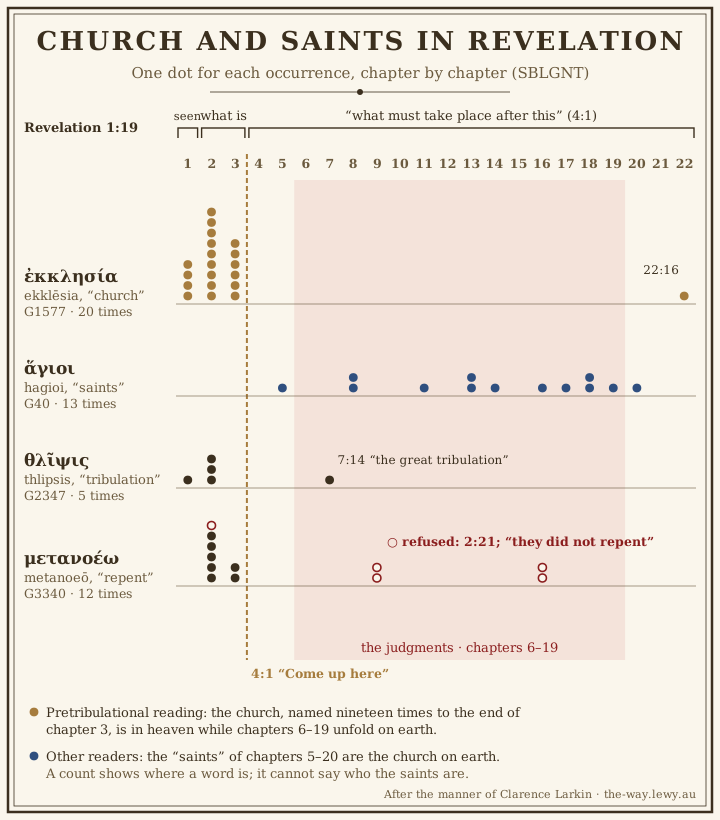
One more piece of evidence can be counted. ἐκκλησία (ekklēsia, G1577, "church") occurs twenty times in Revelation, nineteen of them in chapters 1-3 and the last in Revelation 22:16; ἅγιοι (hagioi, G40, "saints") occurs thirteen times, all in chapters 5-20. The chart shows both, because each side of the debate reads one of the two rows.
The judgments
Two judgments bear on this study, for two groups, at two times.
| Judgment | Who | When | Basis |
|---|---|---|---|
| The Bema seat | Believers | At Christ's coming for His people (1 Corinthians 4:5); on this reading, in heaven during the tribulation | Works tested for reward, not for salvation — 2 Corinthians 5:10; 1 Corinthians 3:11-15 |
| The Great White Throne | The unsaved dead | After the millennium | Judged "according to what they had done," ending in the second death — Revelation 20:11-15 (ESV) |
Bēma (βῆμα) is commonly glossed as "a Greek athletic term for the judge's stand at the games." The New Testament uses it for a court. Eleven of its twelve occurrences are judicial or civic: Pilate's judgment seat (Matthew 27:19; John 19:13), Herod's throne (Acts 12:21), Gallio's tribunal at Corinth (Acts 18:12, 16-17), Festus's tribunal (Acts 25:6, 10, 17), and "the judgment seat of God/Christ" itself (Romans 14:10; 2 Corinthians 5:10). The twelfth is the word's plain sense of a step: God gave Abraham "not even a foot's length" of the land (Acts 7:5, ESV). The ESV Study Bible's note on 2 Corinthians 5:10 identifies it as "the tribunal bench in the Roman courtroom, where the governor sat while rendering judicial verdicts".
The Bema is a judgment of reward, not of condemnation. A believer's salvation was settled at the cross; what is evaluated here is what was built on that foundation (1 Corinthians 3:12-13). The Great White Throne is where those never covered by Christ's righteousness are judged by their own deeds, and found wanting.
The marriage of the Lamb
Where the supper sits, and what the bride is wearing
Revelation puts the wedding at a specific point.
✝️ Revelation 19:7-9 (ESV)
7 Let us rejoice and exult and give him the glory, for the marriage of the Lamb has come, and his Bride has made herself ready; 8 it was granted her to clothe herself with fine linen, bright and pure"— for the fine linen is the righteous deeds of the saints. 9 And the angel said to me, "Write this: Blessed are those who are invited to the marriage supper of the Lamb." And he said to me, "These are the true words of God."
Two verses later heaven opens and the rider on the white horse goes out (Revelation 19:11). So in Revelation's own order the marriage has come — ἦλθεν, aorist — and the bride has made herself ready — ἡτοίμασεν, aorist — before the visible return. Both verbs report completed action. The supper is announced while the King is still in heaven.
The bride's garment "is the righteous deeds of the saints." The word is δικαιώματα (dikaiōmata, G1345), which Louw-Nida puts at 88.14, "righteous acts" — the same sense as Revelation 15:4. Those deeds are what the Bema seat assesses. Paul ties the Bema to the Lord's coming (1 Corinthians 4:5) without dating it further, so its timing has to be read from passages like this one. Here the bride is already dressed in the outcome of that assessment before the rider appears, which places the Bema in heaven before the visible return. That is an inference from Revelation 19's order, and it is the one this study's sequence rests on; a post-tribulational reader places the Bema at the return itself.
One guard against reading that as merit. The linen is ἐδόθη αὐτῇ, "it was granted her" (Revelation 19:8), a divine passive: given, and consisting of deeds, at the same time. That is the Bema's own logic — reward for what was built on a foundation already laid, never the foundation itself (1 Corinthians 3:11-15).
This shows that God clothes the bride by grace from first to last: Jesus is the foundation already laid, and the linen is His gift, so you can build on Jesus now knowing that what He assesses at the Bema He first gave you.
The bride imagery runs much wider than this study's use of it, from Hosea and Isaiah through Paul to the new Jerusalem. The Bride of Christ works through the whole thread, including where the identification is argued rather than assumed.
The whole sequence in one view
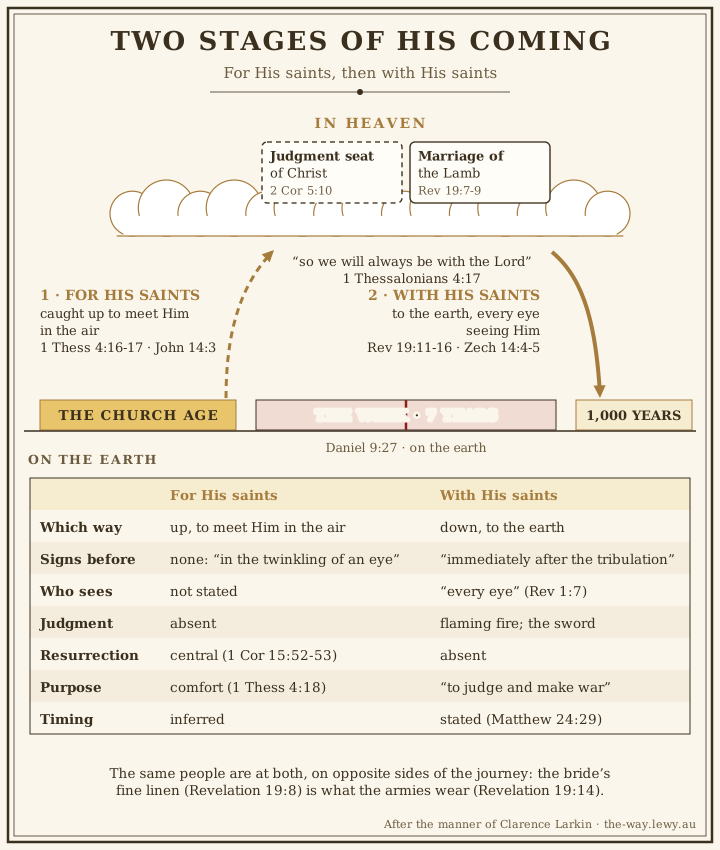
Select the chart to open it full size. The rising arc is dashed because the rapture's timing is inferred; the descending arc is solid because Matthew 24:29 states it.
On the pretribulational reading the events fall in this order. The branch below the rapture is the whole Church leaving. Two tracks then run in parallel through the tribulation years: one on earth, which the Church has been removed from, and one in heaven, where she is. They converge at the second coming, when she returns with Him.
flowchart TD
    A["The Church age<br/>continues today"] -->|"no sign to wait on"| B["The rapture<br/>the whole Church<br/>is caught up<br/>1 Thess 4:16-17<br/>1 Cor 15:51-53"]
    B -->|"on earth,<br/>the Church removed"| C["Tribulation begins<br/>seven years<br/>covenant confirmed<br/>Dan 9:27"]
    C --> D["Midpoint<br/>abomination of desolation<br/>Matt 24:15<br/>lawless one seated<br/>in the temple<br/>2 Thess 2:4"]
    D -->|"after the tribulation<br/>Matt 24:29"| E["The second coming<br/>every eye sees Him<br/>Rev 19:11-16; Matt 24:30"]
    E --> F["The millennium<br/>Christ reigns, 1000 years<br/>Rev 20:1-6"]
    F --> G["Great White Throne<br/>the unsaved judged<br/>Rev 20:11-15"]
    G --> H["Eternity<br/>new heaven, new earth<br/>Rev 21:1-4"]
    B -->|"in heaven,<br/>the Church with Christ"| X["Bema seat<br/>believers' works assessed<br/>2 Cor 5:10; 1 Cor 3:11-15"]
    X -->|"clothed in her<br/>righteous deeds<br/>Rev 19:8"| Y["Marriage of the Lamb<br/>and the supper<br/>Rev 19:7-9"]
    Y -->|"returns with Him<br/>Rev 19:14; Col 3:4"| E
Other end-times views
Serious, Bible-believing Christians hold other views.
- Post-tribulationism holds that the rapture and the second coming are the same event, at the end of the tribulation, with 1 Thessalonians 4 and Matthew 24 describing one arrival. Its strongest arguments, and where this study answers them:
- The meeting. Apantēsis is a welcoming party that escorts the king back to the city (see the vocabulary table).
- The trumpet and the gathering. Matthew 24:31 has both, "after the tribulation" (24:29), and so does 1 Thessalonians 4:16-17. The features table above shows how little else the two passages share.
- "Keep you from." The only other place John writes tēreō ek is Jesus' prayer, "I do not ask that you take them out of the world, but that you keep them from the evil one" (John 17:15, ESV): protection while remaining. That is the best case for reading Revelation 3:10 as "kept through", and it is why this study leans on more than that verse.
- Relief at the revelation. Paul promises the afflicted Thessalonians "relief … when the Lord Jesus is revealed from heaven with his mighty angels" (2 Thessalonians 1:7, ESV), which sounds like the Church's relief coming at the visible return. The pretribulational answer is that the verse sets the time of the persecutors' repayment (1:6), and relief for believers who have already been gathered is not excluded by it; this is the passage where the post-tribulational case is strongest.
- Mid-tribulationism and pre-wrath views place the rapture partway through the seven years, typically before the specifically wrath-pouring judgments of Revelation's later chapters, while still holding to a real, distinct catching-up event.
- Amillennialism rejects a future literal thousand-year reign altogether, reading Revelation 20 symbolically of the present Church age. This affects the millennium more than the rapture question itself, though the two are often held together.
Whichever of these is correct, the outcome for the believer is the same: Christ returns, the dead in Him are raised, and His people are with Him forever. That shared hope outweighs the disagreement over its timing.
Conclusion
Whatever the exact timing, the promise underneath it doesn't move: "and so we will always be with the Lord" (1 Thessalonians 4:17).
This is the blessed hope: God will send Jesus for you Himself, raise those who have died in Him, and keep you with Him forever, so encourage one another with these words (1 Thessalonians 4:18).
Discussion questions
- Matthew 24 gives detailed signs for the second coming and none for the rapture. How much weight can that silence carry, and what would it take to change your mind about it?
- Identifying "the restrainer" in 2 Thessalonians 2:6-7 is an open question among careful interpreters. Does not knowing the answer for certain change anything about how you'd live in light of this passage?
- Paul's stated purpose in 1 Thessalonians 4 is comfort for people grieving specific deaths. How well does the way you usually hear the rapture discussed match that purpose?
Group study sheet for a 40-minute group: two A4 sheets, or one with the guided path
The point, the passage, the questions and the response, from this study. Print on both sides of two A4 sheets, flipping on the long edge. While this block is open, printing the page prints the sheet; close it to print the study.
The Rapture of the Church
1 Thessalonians 4:15-18The point God will send His Son Jesus to catch His Church up bodily to Himself before the tribulation's wrath falls, a sudden and real rescue He has promised in His own word, so that you can meet grief and waiting with comfort.
Ask: What is the rapture?
Hear a few answers before anyone reads.
1 Thessalonians 4:15-18 15By the word of the Lord, we declare to you that we who are alive and remain until the coming of the Lord will by no means precede those who have fallen asleep. 16For the Lord Himself will descend from heaven with a loud command, with the voice of an archangel, and with the trumpet of God, and the dead in Christ will be the first to rise. 17After that, we who are alive and remain will be caught up together with them in the clouds to meet the Lord in the air. And so we will always be with the Lord. 18Therefore encourage one another with these words.
Also read:
The Rapture of the Church
- The word behind "rapture". The Greek verb behind "caught up", and its fourteen New Testament uses.
- The promise. John 14:1-4, Jesus coming for His own.
- The call to rapture. 1 Thessalonians 4:15-18 and 1 Corinthians 15:51-53: the dead raised, the living changed.
- The imminence of the rapture. Matthew 24:36-44 as the second coming, the contested turn at verse 36, the letters' sign-free waiting, "one taken, one left", and the ten virgins.
- Two comings. The shared vocabulary and the contested apantēsis, the features that sort, whether the Church rides out with Him in Revelation 19, and what the sequence markers say.
- The restrainer and his going. 2 Thessalonians 2:1-7, "out of the midst", and who restrains.
- The tribulation. Whose week Daniel's seventieth is, 1 Thessalonians 5:9, and the contested Revelation 3:10.
- The judgments. The Bema seat and the Great White Throne, and what bēma means.
- The marriage of the Lamb. Revelation 19:7-9: where the supper sits and what the bride wears.
- The whole sequence in one view. A diagram of the events in order, on earth and in heaven.
- Other end-times views. Post-tribulation and its four strongest arguments, mid-tribulation and pre-wrath, and amillennialism.
The Rapture of the Church
1Paul's stated purpose in 1 Thessalonians 4 is comfort for people grieving specific deaths. How well does the way you usually hear the rapture discussed match that purpose?
2Matthew 24 gives detailed signs for the second coming and none for the rapture. How much weight can that silence carry, and what would it take to change your mind about it?
3Identifying "the restrainer" in 2 Thessalonians 2:6-7 is an open question among careful interpreters. Does not knowing the answer for certain change anything about how you'd live in light of this passage?
The Rapture of the Church
- Think. Notice any temptation to treat the rapture's timing as more settled than Scripture presents it. The counter-argument named below, Revelation 3:10's ambiguity, is a live one, and a conclusion is only as strong as its handling of it.
- Attitude. 1 Thessalonians 4:18's whole point is comfort, not anxious calculation — "encourage one another with these words" is a command to bring grieving people hope, not to trade date-guesses.
- Do. Paul's own application is "Therefore encourage one another with these words" (1 Thessalonians 4:18, ESV). This week, read 1 Thessalonians 4:13-18 aloud with a believer who is grieving or afraid, and tell them who is coming for them.
And if I go and prepare a place for you, I will come again and will take you to myself, that where I am you may be also.
John 14:3 (ESV)Lord Jesus, you promised to come again and take your own to yourself. Thank you that the hope of being with you is a specific promise, tied to your own word. Where I've let questions about timing turn into anxiety, give me the comfort this promise was meant to bring. Keep me ready the way the wise virgins were ready, with oil in hand and eyes on the door, until you come. In Jesus' name. Amen.
The Rapture of the Church
1 Thessalonians 4:15-18Open Ask: What is the rapture?
Hear a few answers before anyone reads.
Read it aloud 1 Thessalonians 4:15-18
1Paul's stated purpose in 1 Thessalonians 4 is comfort for people grieving specific deaths. How well does the way you usually hear the rapture discussed match that purpose?
2Matthew 24 gives detailed signs for the second coming and none for the rapture. How much weight can that silence carry, and what would it take to change your mind about it?
3Identifying "the restrainer" in 2 Thessalonians 2:6-7 is an open question among careful interpreters. Does not knowing the answer for certain change anything about how you'd live in light of this passage?
- Think. Notice any temptation to treat the rapture's timing as more settled than Scripture presents it. The counter-argument named below, Revelation 3:10's ambiguity, is a live one, and a conclusion is only as strong as its handling of it.
- Attitude. 1 Thessalonians 4:18's whole point is comfort, not anxious calculation — "encourage one another with these words" is a command to bring grieving people hope, not to trade date-guesses.
- Do. Paul's own application is "Therefore encourage one another with these words" (1 Thessalonians 4:18, ESV). This week, read 1 Thessalonians 4:13-18 aloud with a believer who is grieving or afraid, and tell them who is coming for them.
The Rapture of the Church
The point God will send His Son Jesus to catch His Church up bodily to Himself before the tribulation's wrath falls, a sudden and real rescue He has promised in His own word, so that you can meet grief and waiting with comfort.
References & Recommended Reading
- Chuck Missler, Blessed Hope teaching series — starting point for The promise: Christ returns for His own.
- ESV Study Bible (Crossway, 2016) — notes on Revelation 3:10, 1 Thessalonians 4:17, 2 Thessalonians 2:6-7, and 2 Corinthians 5:10, consulted as an independent check; source of the corrected Bēma etymology and the acknowledged ambiguity on Revelation 3:10 and the restrainer's identity.
- NIV Biblical Theology Study Bible (Zondervan, 2018) — notes on 1 Thessalonians 4:17 (the apantēsis civic-welcome sense) and 2 Thessalonians 2:6-7 (the scholarly proposals for the restrainer), consulted independently of the ESV Study Bible above.
- Robert L. Thomas, cited in Thomas Ice, The Holy Spirit and the Pretribulational Rapture — source of the τὸ κατέχον / ὁ κατέχων gender-shift argument at 2 Thessalonians 2:6-7, confirmed against this repo's own Greek text (SBLGNT).
- The Trumpet Call of God — the trumpet imagery shared between 1 Thessalonians 4:16 and 1 Corinthians 15:52, and this site's model for tracing Revelation's imagery to its Old Testament source.
- The Parables of the Olivet Discourse — the readiness Matthew 25's parable calls for, worked out in full.
- The Zadok Calendar — the chronological framework behind the seven-year tribulation reckoning above.