The Harlot and the Bride
Week 2 of 4 in The Bride · next: The Wife of the Lamb
New, published 17 October 2026. What else is new
Near the end of Revelation an angel shows John two women. One is a prostitute who rides a beast and drinks the blood of the saints. The other is the Bride, the wife of the Lamb. Scripture has been setting these two women before God's people since Proverbs, and Revelation shows where each of them ends.
In one sentence: Scripture sets two women before every person, the harlot, who seduces with luxury and sorcery and is devoured by the beast she rides, and the Bride, whom the Lamb washes, clothes and marries, and God calls His people to come out of the one and make ready for the other.
Key Takeaways
(This section follows the Key Takeaways format — see that page for what each part is for.)
Types & Prophecy
- Babylon in Revelation carries Old Testament words forward: the golden cup of Jeremiah 51:7, the widow's boast of Isaiah 47:8 and the silenced wedding of Jeremiah 25:10 all have echoes in Revelation 17-18.
- The harlot falls in the last of the bowl judgments (Revelation 16:19), and the marriage of the Lamb follows (Revelation 19:7).
Lessons about Jesus
- The Lamb conquers the beast and the kings who serve it, "for he is Lord of lords and King of kings, and those with him are called and chosen and faithful" (Revelation 17:14, ESV).
- He nourishes and cherishes His bride (Ephesians 5:29). The beast hates the woman it carries and devours her (Revelation 17:16).
- He gives His people His name and His Father's name on their foreheads (Revelation 14:1; 22:4).
Memory verses
✝️ Revelation 18:4 (ESV)
4 Then I heard another voice from heaven saying, "Come out of her, my people, lest you take part in her sins, lest you share in her plagues;
✝️ Revelation 19:7 (ESV)
7 Let us rejoice and exult and give him the glory, for the marriage of the Lamb has come, and his Bride has made herself ready;
Be Transformed
- Think. Every invitation in your life comes from one of two women. Learn to tell the harlot's voice from the Bride's: luxury, flattery and secrecy on one side; the Spirit's plain "Come" on the other (Revelation 22:17).
- Attitude. Hold the world's glamour lightly. The harlot's purple and gold do not last: the beast that carries her will leave her "desolate and naked" (Revelation 17:16).
- Do. Hear the voice from heaven: "Come out of her, my people, lest you take part in her sins" (Revelation 18:4, ESV). Name one place where you share Babylon's table, its luxury, its flattery or its secrecy, and walk away from it this week. Then answer the Spirit's "Come" (Revelation 22:17) in prayer.
Prayer
Father, you have called us out of the darkness to be the Bride of your Son Jesus. Open our eyes to the harlot's cup, however golden it looks, and give us the courage to come out of her. Wash us, clothe us in what you grant, and keep us ready for the marriage of the Lamb. Let our lives say "Come" with your Spirit to everyone who is thirsty.
In Jesus' name. Amen.
Study outline
- Two women — The angel's two invitations · A harlot, never a wife. How Revelation introduces both women, and what the harlot is to the beast.
- The pattern before Revelation — Two women in Proverbs · Jezebel and the harlot cities · The wife who played the harlot. Proverbs, Jezebel, Nineveh, Tyre and Babylon, and Israel's unfaithfulness and restoration.
- The harlot's pull on the bride — The serpent and the betrothed virgin. Satan's deception of the church, and Jezebel in Thyatira.
- Two peoples — Two names on the forehead · Come out of her · The end of each woman. Who follows each woman, the call to leave Babylon (with when she falls and who she is), and the two endings.
- Discussion questions. Six, for a group or on your own.
The angel's two invitations
✝️ Revelation 17:1-6 (ESV)
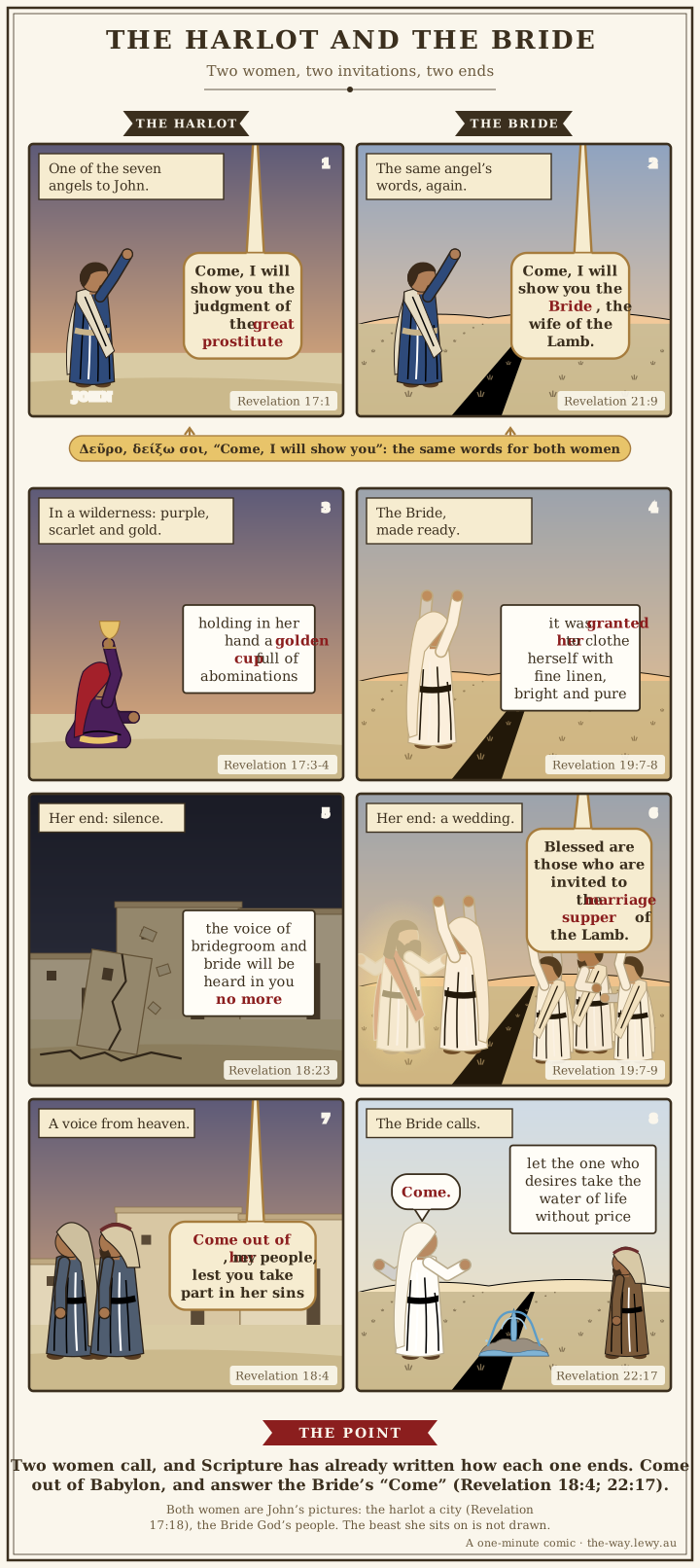
1 Then one of the seven angels who had the seven bowls came and said to me, "Come, I will show you the judgment of the great prostitute who is seated on many waters, 2 with whom the kings of the earth have committed sexual immorality, and with the wine of whose sexual immorality the dwellers on earth have become drunk." 3 And he carried me away in the Spirit into a wilderness, and I saw a woman sitting on a scarlet beast that was full of blasphemous names, and it had seven heads and ten horns. 4 The woman was arrayed in purple and scarlet, and adorned with gold and jewels and pearls, holding in her hand a golden cup full of abominations and the impurities of her sexual immorality. 5 And on her forehead was written a name of mystery: "Babylon the great, mother of prostitutes and of earth's abominations." 6 And I saw the woman, drunk with the blood of the saints, the blood of the martyrs of Jesus. When I saw her, I marveled greatly.
Four chapters later "one of the seven angels who had the seven bowls" comes again with the same words: "Come, I will show you the Bride, the wife of the Lamb" (Revelation 21:9, ESV). In Greek the two invitations are identical up to what is shown: δεῦρο, δείξω σοι, "Come, I will show you," then τὸ κρίμα τῆς πόρνης, "the judgment of the prostitute" (Revelation 17:1), or τὴν νύμφην, "the Bride" (Revelation 21:9). The study The New Jerusalem sets the two visions side by side in a table. This study follows the pattern behind them.
"Prostitute" is πόρνη (pornē, POR-nay, G4204), and Revelation uses it five times, all of Babylon (Revelation 17:1, 5, 15, 16; 19:2). "Bride" is νύμφη (nymphē, NOOM-fay, G3565), and it occurs four times in the book. The first is at Babylon's fall (Revelation 18:23); the other three are the New Jerusalem (Revelation 21:2, 9; 22:17).
A harlot, never a wife
The harlot is never called anyone's wife. She has lovers: "the kings of the earth have committed sexual immorality" with her (Revelation 17:2), and "the merchants of the earth have grown rich from the power of her luxurious living" (Revelation 18:3, ESV). She belongs to no one, and she is joined to many.
She sits on the beast (Revelation 17:3, 7), and the beast's power comes from the dragon: "to it the dragon gave his power and his throne and great authority" (Revelation 13:2, ESV). Revelation names the dragon plainly: "that ancient serpent, who is called the devil and Satan, the deceiver of the whole world" (Revelation 12:9, ESV). So Satan stands behind the harlot as the power that carries her. Scripture never makes him her bridegroom, and no covenant joins them.
The end of the harlot shows it. "The ten horns that you saw, they and the beast will hate the prostitute. They will make her desolate and naked, and devour her flesh and burn her up with fire" (Revelation 17:16, ESV). The power that carried her turns and eats her. Set that beside what Paul says of Christ and His bride: "no one ever hated his own flesh, but nourishes and cherishes it, just as Christ does the church" (Ephesians 5:29, ESV).
Even this destruction serves God: "for God has put it into their hearts to carry out his purpose ... until the words of God are fulfilled" (Revelation 17:17, ESV). This shows that God rules over the harlot and the beast alike. Evil devours its own, and God uses even that to bring His word to pass.
Two women in Proverbs
Proverbs has already drawn the two women. Wisdom builds a house, sets her table, and sends out her young women "to call from the highest places in the town": "Whoever is simple, let him turn in here!" (Proverbs 9:3-4, ESV). Her offer is life: "Leave your simple ways, and live" (Proverbs 9:6).
Folly sits at the door of her house, "on the highest places of the town," and calls with Wisdom's very words: "Whoever is simple, let him turn in here!" (Proverbs 9:14, 16, ESV). Her offer is secrecy: "Stolen water is sweet, and bread eaten in secret is pleasant." And her house has a cellar the guest cannot see: "he does not know that the dead are there, that her guests are in the depths of Sheol" (Proverbs 9:17-18, ESV).
The two women of Proverbs are personifications of wisdom and folly. Revelation does not quote them, and this study does not make Folly a figure for Babylon. What Proverbs gives is the shape the pattern keeps: two women, two invitations in the same words, and two houses, one of life and one of death.
Jezebel and the harlot cities
Before Revelation, Scripture gives the harlot's name to a queen and to two cities: Jehu charges Jezebel with whorings, Nahum calls Nineveh a prostitute, and Isaiah calls Tyre one. The city that carries the name in Revelation already bears the same marks in the prophets.
- Jezebel. Ahab "took for his wife Jezebel the daughter of Ethbaal king of the Sidonians, and went and served Baal" (1 Kings 16:31, ESV), and "there was none who sold himself to do what was evil ... like Ahab, whom Jezebel his wife incited" (1 Kings 21:25, ESV). Jehu named her sins: "the whorings and the sorceries of your mother Jezebel" (2 Kings 9:22, ESV).
- Nineveh. Nahum calls the Assyrian capital "the prostitute, graceful and of deadly charms, who betrays nations with her whorings, and peoples with her charms" (Nahum 3:4, ESV).
- Tyre. Isaiah pictures the merchant city as a "forgotten prostitute" singing to be remembered, who "will prostitute herself with all the kingdoms of the world" (Isaiah 23:16-17, ESV).
- Babylon. Jeremiah: "Babylon was a golden cup in the LORD's hand, making all the earth drunken; the nations drank of her wine" (Jeremiah 51:7, ESV). Isaiah gives her boast: "I shall not sit as a widow" (Isaiah 47:8, ESV), and calls her "the mistress of kingdoms" (Isaiah 47:5). Widowhood comes on her "in one day," "in spite of your many sorceries" (Isaiah 47:9, ESV), and there the Septuagint has φαρμακεία, the word Revelation 18:23 uses.
Two marks: sorcery and commerce
Two marks recur. The first is sorcery beside harlotry. The Septuagint of 2 Kings 9:22 pairs Jezebel's πορνεῖαι, "whorings," with her φάρμακα, "sorceries," and the Septuagint of Nahum 3:4 pairs the same two words for Nineveh. Revelation gives Babylon both: she is the πόρνη, and "all nations were deceived by your sorcery," φαρμακείᾳ (pharmakeia, far-mah-KAY-ah, G5331; Revelation 18:23, ESV). The second is commerce: Tyre's trade with the kingdoms, and Babylon's merchants grown rich (Revelation 18:3).
Babylon's cup and boast, carried into Revelation
Revelation also echoes the Old Testament's words about Babylon. The "golden cup" in the harlot's hand (Revelation 17:4) recalls Jeremiah's: the Septuagint reads ποτήριον χρυσοῦν (Jeremiah 28:7 in its numbering), and Revelation has the same two words. The picture has moved: in Jeremiah Babylon is the cup in the LORD's hand, and in Revelation the harlot holds it. Her boast, "I sit as a queen, I am no widow" (Revelation 18:7, ESV), echoes Babylon's boast in Isaiah 47:8, "I shall not sit as a widow"; the two share the verb "sit" and the word "widow" (χήρα in both Greek texts).
The wife who played the harlot
One woman in the prophets is a wife: Israel, married to the LORD. When the prophets call her a harlot, the charge is unfaithfulness. "How the faithful city has become a whore, she who was full of justice!" (Isaiah 1:21, ESV). "You trusted in your beauty and played the whore because of your renown" (Ezekiel 16:15, ESV). "Adulterous wife, who receives strangers instead of her husband!" (Ezekiel 16:32, ESV). Hosea's marriage was a living sermon on it: "the land commits great whoredom by forsaking the LORD" (Hosea 1:2, ESV).
The difference between Israel and Babylon is the covenant. Israel has a Husband who comes after her: "Therefore, behold, I will allure her, and bring her into the wilderness, and speak tenderly to her" (Hosea 2:14, ESV). The study The Bride of Christ follows that restoration, and the reading this site holds: Israel remains the wife of the LORD, restored, and the church is the Bride of Christ.
This shows that God does not leave His covenant people in their unfaithfulness. He judges harlotry, and He goes after His own.
The serpent and the betrothed virgin
The harlot's pull works inside the church. Paul writes to the Corinthians:
✝️ 2 Corinthians 11:2-3 (ESV)
2 For I feel a divine jealousy for you, since I betrothed you to one husband, to present you as a pure virgin to Christ. 3 But I am afraid that as the serpent deceived Eve by his cunning, your thoughts will be led astray from a sincere and pure devotion to Christ.
The church is betrothed, and the danger Paul names is seduction: the serpent's cunning leading the bride's thoughts away from her husband. He adds that the deception comes dressed in light: "even Satan disguises himself as an angel of light" (2 Corinthians 11:14, ESV).
The risen Jesus said the same to the church at Thyatira: "you tolerate that woman Jezebel, who calls herself a prophetess and is teaching and seducing my servants to practice sexual immorality and to eat food sacrificed to idols" (Revelation 2:20, ESV). The name is Jezebel's, and so is the pattern: a woman inside God's house teaching His servants the harlot's ways. James uses the prophets' word for believers who love the world: "You adulterous people! Do you not know that friendship with the world is enmity with God?" (James 4:4, ESV).
Her voice reaches the bride now, and the bride is warned to know it. The study Sin and Sexual Immorality traces the same seduction in the body.
Two names on the forehead
Revelation divides humanity by whom they follow, and it marks the division on the forehead.
| The harlot's people | The Bride's people | |
|---|---|---|
| The name | the beast's mark "on the right hand or the forehead" (Revelation 13:16); the harlot's own name on hers (Revelation 17:5) | "his name and his Father's name written on their foreheads" (Revelation 14:1); "his name will be on their foreheads" (Revelation 22:4) |
| Who they are | "the dwellers on earth whose names have not been written in the book of life" (Revelation 17:8) | "called and chosen and faithful" (Revelation 17:14); "those who are written in the Lamb's book of life" (Revelation 21:27) |
| Where they end | "Outside are the dogs and sorcerers and the sexually immoral and murderers and idolaters" (Revelation 22:15) | they "enter the city by the gates" (Revelation 22:14) |
The harlot's two marks follow her people to the end. Revelation 22:15 puts φάρμακοι, "sorcerers" (pharmakoi, G5333), and πόρνοι, "the sexually immoral" (pornoi, G4205), outside the Bride's city, the same two sins that marked Jezebel, Nineveh and Babylon.
Come out of her
✝️ Revelation 18:4-5 (ESV)
4 Then I heard another voice from heaven saying, "Come out of her, my people, lest you take part in her sins, lest you share in her plagues; 5 for her sins are heaped high as heaven, and God has remembered her iniquities.
God's people are inside Babylon when the voice calls them out. The words echo the prophets'. To the exiles in the first Babylon, Jeremiah said, "Go out of the midst of her, my people!" (Jeremiah 51:45, ESV), and Isaiah, "Depart, depart, go out from there; touch no unclean thing; go out from the midst of her" (Isaiah 52:11, ESV). The Septuagint of Isaiah 52:11 reads ἐξέλθατε ἐκ μέσου αὐτῆς, "go out from the midst of her," and Revelation 18:4 has ἐξέλθατε ... ἐξ αὐτῆς, "come out of her."
When Babylon falls
When Babylon falls is a question of the prophetic timeline. Revelation places it in the seventh bowl: "God remembered Babylon the great, to make her drain the cup of the wine of the fury of his wrath" (Revelation 16:19, ESV). This site reads the bowls as part of the coming tribulation and holds that the church is caught up before it begins (see the Statement of Faith), so the voice of Revelation 18:4 speaks to God's people on earth in those days. The call itself is already the church's. Paul quotes Isaiah 52:11 to the Corinthians: "Therefore go out from their midst, and be separate from them, says the Lord, and touch no unclean thing; then I will welcome you, and I will be a father to you, and you shall be sons and daughters to me" (2 Corinthians 6:17-18, ESV).
Who Babylon is: a contested identification
Who Babylon is in Revelation is contested. The angel calls her "the great city that has dominion over the kings of the earth" (Revelation 17:18) and places her on "seven mountains" (Revelation 17:9), which many read as Rome. The angel goes on to make the mountains "also seven kings" (Revelation 17:10), and the name she bears is Babylon, so the text itself resists a reading by map alone. The ESV Study Bible lists the futurist readings: a great religious entity supporting the Antichrist, a rebuilt Babylon, or a revived Roman Empire (note on Revelation 17:1-19:10). The call to come out does not wait on the answer. Whatever city carries her name, God's people are to leave her sins before her plagues fall.
The end of each woman
The harlot's end is silence. "The light of a lamp will shine in you no more, and the voice of bridegroom and bride will be heard in you no more" (Revelation 18:23, ESV). Jeremiah had spoken the same words over Judah and its neighbours, with Babylon's king as God's instrument (Jeremiah 25:9): "I will banish from them the voice of mirth and the voice of gladness, the voice of the bridegroom and the voice of the bride, the grinding of the millstones and the light of the lamp" (Jeremiah 25:10, ESV). Revelation keeps the mill and the lamp too (Revelation 18:22-23). Heaven answers her fall with praise: "he has judged the great prostitute who corrupted the earth with her immorality" (Revelation 19:2, ESV).
The Bride's end is a wedding:
✝️ Revelation 19:7-9 (ESV)
7 Let us rejoice and exult and give him the glory, for the marriage of the Lamb has come, and his Bride has made herself ready; 8 it was granted her to clothe herself with fine linen, bright and pure"— for the fine linen is the righteous deeds of the saints. 9 And the angel said to me, "Write this: Blessed are those who are invited to the marriage supper of the Lamb." And he said to me, "These are the true words of God."
The two women are dressed for what they are. The harlot wears purple and scarlet, gold and jewels, and holds a cup "full of abominations" (Revelation 17:4). The Bride wears linen "bright and pure," and "it was granted her" (Revelation 19:8): her clothing is a gift.
The book closes with the Bride's own voice: "The Spirit and the Bride say, 'Come.' And let the one who hears say, 'Come.' And let the one who is thirsty come; let the one who desires take the water of life without price" (Revelation 22:17, ESV). The harlot made the nations drink her wine (Revelation 14:8). The Bride offers the water of life free.
This shows that God finishes what He began. He judges the harlot who corrupted the earth, He clothes the Bride with what He grants, and He sends her out with His Spirit to call the thirsty. So you may leave Babylon's table without fear, because a better one is set.
Discussion questions
- The language. Revelation introduces both women with the same words, δεῦρο, δείξω σοι, "Come, I will show you" (Revelation 17:1; 21:9). What does the matching introduction ask the reader to do with the two visions?
- The text in its context. The harlot is never called a wife, and the beast that carries her ends by devouring her (Revelation 17:16). What does that say about what Satan offers those who follow him?
- Christ. The Lamb "nourishes and cherishes" His bride (Ephesians 5:29) and grants her linen "bright and pure" (Revelation 19:8). How does what Christ gives His bride differ from what the harlot gives her lovers?
- The hard part. Revelation 18:4 calls God's people out of Babylon, and Babylon's identity is contested. Why might the call be clearer than the identification, and what does Paul's use of Isaiah 52:11 (2 Corinthians 6:17) add?
- The text in its context. Harlotry and sorcery appear together for Jezebel, Nineveh and Babylon (2 Kings 9:22; Nahum 3:4; Revelation 18:23), and both kinds of people are outside the city in Revelation 22:15. What do the two sins have in common?
- Be transformed. Folly calls with Wisdom's very words (Proverbs 9:4, 16). Where does the harlot's invitation sound like the Bride's in your own life, and how will you tell them apart?
Group study sheet for a 40-minute group: two A4 sheets, or one with the guided path
The point, the passage, the questions and the response, from this study. Print on both sides of two A4 sheets, flipping on the long edge. While this block is open, printing the page prints the sheet; close it to print the study.
The Harlot and the Bride
Revelation 17:1-6The point Scripture sets two women before every person, the harlot, who seduces with luxury and sorcery and is devoured by the beast she rides, and the Bride, whom the Lamb washes, clothes and marries, and God calls His people to come out of the one and make ready for the other.
Ask: what comes to mind when you hear The Harlot and the Bride
? Hear a few answers before anyone reads.
Revelation 17:1-6 1Then one of the seven angels with the seven bowls came and said to me, “Come, I will show you the punishment of the great prostitute, who sits on many waters. 2The kings of the earth were immoral with her, and those who dwell on the earth were intoxicated with the wine of her immorality.” 3And the angel carried me away in the Spirit into a wilderness, where I saw a woman sitting on a scarlet beast that was covered with blasphemous names and had seven heads and ten horns. 4The woman was dressed in purple and scarlet, and adorned with gold and precious stones and pearls. She held in her hand a golden cup full of abominations and the impurities of her sexual immorality. 5And on her forehead a mysterious name was written: BABYLON THE GREAT, THE MOTHER OF PROSTITUTES AND OF THE ABOMINATIONS OF THE EARTH. 6I could see that the woman was drunk with the blood of the saints and witnesses for Jesus. And I was utterly amazed at the sight of her.
Also read:
The Harlot and the Bride
- Two women — The angel's two invitations · A harlot, never a wife. How Revelation introduces both women, and what the harlot is to the beast.
- The pattern before Revelation — Two women in Proverbs · Jezebel and the harlot cities · The wife who played the harlot. Proverbs, Jezebel, Nineveh, Tyre and Babylon, and Israel's unfaithfulness and restoration.
- The harlot's pull on the bride — The serpent and the betrothed virgin. Satan's deception of the church, and Jezebel in Thyatira.
- Two peoples — Two names on the forehead · Come out of her · The end of each woman. Who follows each woman, the call to leave Babylon (with when she falls and who she is), and the two endings.
The Harlot and the Bride
1The language. Revelation introduces both women with the same words, δεῦρο, δείξω σοι, "Come, I will show you" (Revelation 17:1; 21:9). What does the matching introduction ask the reader to do with the two visions?
2The text in its context. The harlot is never called a wife, and the beast that carries her ends by devouring her (Revelation 17:16). What does that say about what Satan offers those who follow him?
3The text in its context. Harlotry and sorcery appear together for Jezebel, Nineveh and Babylon (2 Kings 9:22; Nahum 3:4; Revelation 18:23), and both kinds of people are outside the city in Revelation 22:15. What do the two sins have in common?
4Christ. The Lamb "nourishes and cherishes" His bride (Ephesians 5:29) and grants her linen "bright and pure" (Revelation 19:8). How does what Christ gives His bride differ from what the harlot gives her lovers?
5The hard part. Revelation 18:4 calls God's people out of Babylon, and Babylon's identity is contested. Why might the call be clearer than the identification, and what does Paul's use of Isaiah 52:11 (2 Corinthians 6:17) add?
The Harlot and the Bride
6Be transformed. Folly calls with Wisdom's very words (Proverbs 9:4, 16). Where does the harlot's invitation sound like the Bride's in your own life, and how will you tell them apart?
- Think. Every invitation in your life comes from one of two women. Learn to tell the harlot's voice from the Bride's: luxury, flattery and secrecy on one side; the Spirit's plain "Come" on the other (Revelation 22:17).
- Attitude. Hold the world's glamour lightly. The harlot's purple and gold do not last: the beast that carries her will leave her "desolate and naked" (Revelation 17:16).
- Do. Hear the voice from heaven: "Come out of her, my people, lest you take part in her sins" (Revelation 18:4, ESV). Name one place where you share Babylon's table, its luxury, its flattery or its secrecy, and walk away from it this week. Then answer the Spirit's "Come" (Revelation 22:17) in prayer.
Then I heard another voice from heaven saying, "Come out of her, my people, lest you take part in her sins, lest you share in her plagues;
Revelation 18:4 (ESV)Father, you have called us out of the darkness to be the Bride of your Son Jesus. Open our eyes to the harlot's cup, however golden it looks, and give us the courage to come out of her. Wash us, clothe us in what you grant, and keep us ready for the marriage of the Lamb. Let our lives say "Come" with your Spirit to everyone who is thirsty.
In Jesus' name. Amen.
References & Recommended Reading
- ESV Bible (Crossway) — the translation quoted throughout, per this site's conventions. All quotations were verified against the ESV text rather than reproduced from memory. See Copyright for the full notice.
- Novum Testamentum Graece, 28th edition (Deutsche Bibelgesellschaft) — the Greek of Revelation 17:1, 4, 16; 18:3-7, 23; 21:9; 22:15.
- MACULA Greek Linguistic Datasets (SBLGNT) and MACULA Hebrew Linguistic Datasets (Westminster Leningrad Codex), Clear Bible — Strong's numbers and counts: πόρνη five times in Revelation, νύμφη four times.
- Brenton's Septuagint (eBible.org) — 2 Kings 9:22, Isaiah 47:8-9, Isaiah 52:11, Jeremiah 28:7 (Hebrew 51:7) and Nahum 3:4.
- ESV Study Bible (Crossway) — consulted after the exegesis, as a check. Note on Revelation 17:1-19:10 (the futurist readings of Babylon).
Related studies on this site: The New Jerusalem · The Bride of Christ · The Wife of the Lamb · Sin and Sexual Immorality