The Two Witnesses
Two prophets in Jerusalem, and the story of their Lord told again
In the middle of Revelation, between the sixth trumpet and the seventh, God names two people and gives them a work to do:
✝️ Revelation 11:3-4 (ESV)
3 And I will grant authority to my two witnesses, and they will prophesy for 1,260 days, clothed in sackcloth." 4 These are the two olive trees and the two lampstands that stand before the Lord of the earth.
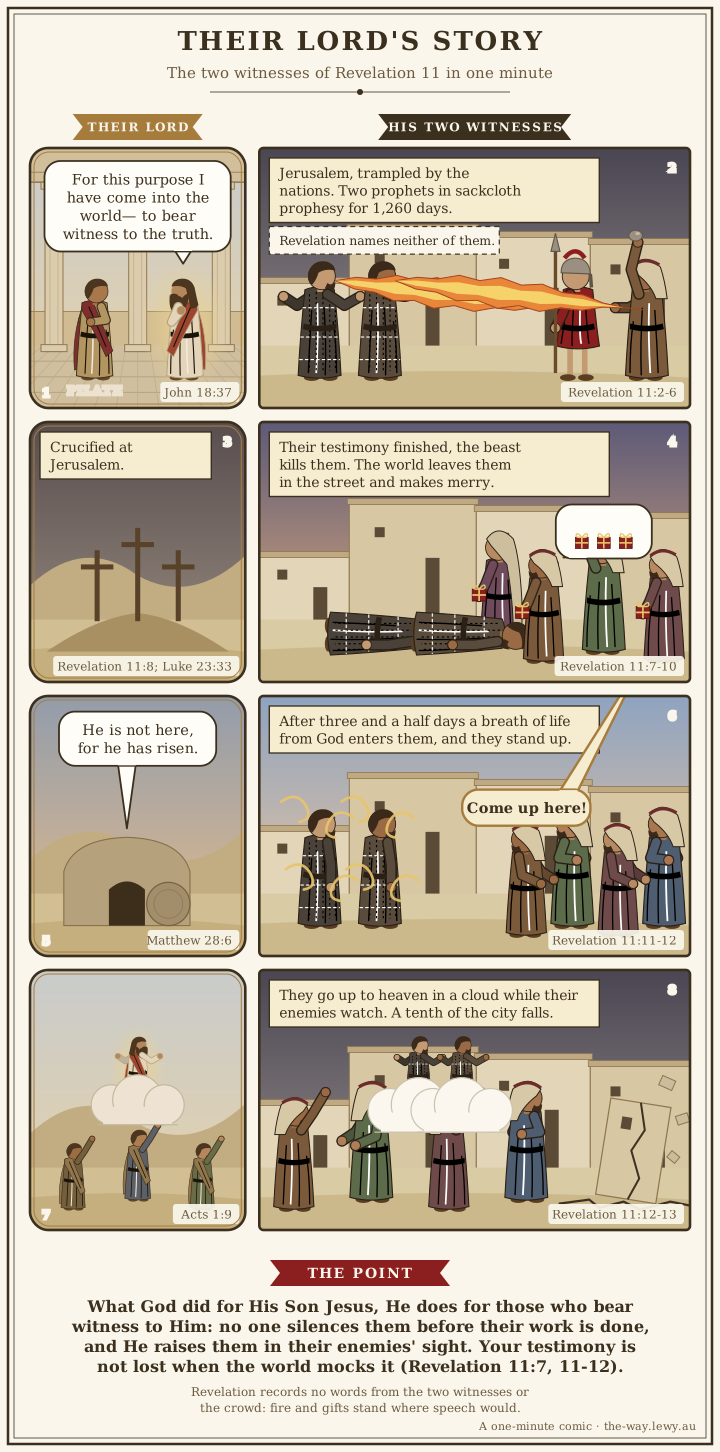
They preach in Jerusalem while the nations trample it. They cannot be harmed until their work is done. Then they are killed, left in the street, raised, and taken up to heaven in a cloud while their enemies watch.
In one sentence: During Daniel's seventieth week, while the nations trample Jerusalem, God sends two prophets whom Revelation draws from Zechariah's two anointed olive trees and clothes in the powers of Moses and Elijah; they testify for 1,260 days, are killed in the city where their Lord was crucified, and are raised and taken up in a cloud before their enemies' eyes, so God keeps a witness in the world's darkest hour, and the witnesses' story follows their Lord's.
Who the two are is contested, and this study says so where it matters. It holds that they are Moses and Elijah, and gives the case for the other readings. The Lampstand covers the lampstands of Revelation 1 and Zechariah 4 from which this passage draws.
Key Takeaways
(This section follows the Key Takeaways format — see that page for what each part is for.)
Types & Prophecy
- Zechariah's vision supplies the picture. The two witnesses are "the two olive trees and the two lampstands" (Revelation 11:4, ESV), Zechariah's two anointed ones who "stand by the Lord of the whole earth" (Zechariah 4:14, ESV).
- Malachi names Moses and sends Elijah. "Remember the law of my servant Moses... Behold, I will send you Elijah the prophet before the great and awesome day of the LORD comes" (Malachi 4:4-5, ESV). Only Elijah is promised; the expectation of a prophet like Moses rests on Deuteronomy 18:15, which Acts 3:22 applies to Jesus. This study reads Moses and Elijah as the two witnesses; the text names neither man.
Lessons about Jesus
- The witnesses belong to Jesus. God calls them "my two witnesses," and Revelation calls Jesus "the faithful witness" (Revelation 1:5, ESV). The word is the same.
- Their story follows His. They testify, are killed in the city "where their Lord was crucified" (Revelation 11:8, ESV), are raised after three and a half days, and go up to heaven "in a cloud" (Revelation 11:12, ESV), as He was taken up in a cloud (Acts 1:9).
Memory verses
✝️ Revelation 11:11 (ESV)
11 But after the three and a half days a breath of life from God entered them, and they stood up on their feet, and great fear fell on those who saw them.
✝️ Revelation 12:11 (ESV)
11 And they have conquered him by the blood of the Lamb and by the word of their testimony, for they loved not their lives even unto death.
Be Transformed
- Think. No witness of Jesus dies before the work God gave is finished. The two could not be harmed until they had "finished their testimony" (Revelation 11:7, ESV).
- Attitude. Expect the world to celebrate when the truth goes quiet, and expect God to raise it.
- Do. Tell one person this week what Jesus has done for you, as plainly as these two prophesied (Revelation 11:3).
Prayer
Lord God, You have never left the world without a witness. Thank You for Your Son Jesus, the faithful witness, who died in Jerusalem and rose and went up in the cloud, and who will send His two prophets into the city where He was crucified. Make us faithful witnesses now, not loving our lives more than Your word. Keep us from fear of those who mock, and raise us up on the last day.
In Jesus' name. Amen.
Study outline
- Where the passage sits. John is sent to prophesy again, between the sixth and seventh trumpets.
- The measured temple and the trampled city. Revelation 11:1-2 and the temple of the tribulation.
- One period counted three ways. 42 months, 1,260 days, and "a time, and times, and half a time," and which half of the week the witnesses fill.
- Two witnesses in sackcloth. The word "witness," the law's two witnesses, and Zechariah's olive trees.
- Fire, drought and plagues. Revelation 11:5-6 and the prophets it recalls.
- Who the two are. Four readings from the early church and today, and the case for Moses and Elijah.
- Killed, left in the street, raised, taken up. Revelation 11:7-13.
- What the two witnesses show about God. Each connection sorted by how firmly Scripture makes it.
- Discussion Questions. Six, for a group or on your own.
Where the passage sits
Revelation 11 is part of a pause. Six trumpets have sounded (Revelation 8-9), and the seventh waits until 11:15. In between, an angel gives John a little scroll to eat, "sweet as honey" in his mouth and bitter in his stomach (Revelation 10:9-10, ESV), and a new commission: "You must again prophesy about many peoples and nations and languages and kings" (Revelation 10:11, ESV).
Chapter 11 shows what that bittersweet prophecy looks like. The ESV Study Bible reads the chapter as God's protection "interwoven with the darker thread of physical suffering" (note on Revelation 11:1-14). It ends with "the second woe has passed" (Revelation 11:14, ESV), and then the seventh trumpet announces: "The kingdom of the world has become the kingdom of our Lord and of his Christ, and he shall reign forever and ever" (Revelation 11:15, ESV). The story of the two witnesses leads straight into it.
The measured temple and the trampled city
✝️ Revelation 11:1-2 (ESV)
1 Then I was given a measuring rod like a staff, and I was told, "Rise and measure the temple of God and the altar and those who worship there, 2 but do not measure the court outside the temple; leave that out, for it is given over to the nations, and they will trample the holy city for forty-two months.
Measuring is a prophet's act from Ezekiel, who saw "a man... with a linen cord and a measuring reed in his hand" at the temple (Ezekiel 40:3, ESV), and from Zechariah, who saw a man going "to measure Jerusalem" (Zechariah 2:2, ESV). The NIV Biblical Theology Study Bible reads it as a sign that "God protects and owns his people" (note on Revelation 11:1).
What temple John measures is contested. Both the ESV Study Bible and the NIV Biblical Theology Study Bible note that many dispensational interpreters read it as a temple rebuilt in Jerusalem during the tribulation, where the lawless one "takes his seat in the temple of God, proclaiming himself to be God" (2 Thessalonians 2:4, ESV). Others read the temple as God's people, as the ESV Study Bible does. This study takes the first reading, with the site's other studies: The Restrainer places that seating at the midpoint of Daniel's seventieth week, and Jesus calls it "the abomination of desolation... standing in the holy place" (Matthew 24:15, ESV).
The outer court and "the holy city" are given to the nations for forty-two months. Jesus had said, "Jerusalem will be trampled underfoot by the Gentiles, until the times of the Gentiles are fulfilled" (Luke 21:24, ESV). Into that city God sends His witnesses.
One period counted three ways
Revelation measures this time three ways and gets one span:
| Revelation | What happens | Measure |
|---|---|---|
| 11:2 | The nations trample the holy city | 42 months |
| 11:3 | The two witnesses prophesy | 1,260 days |
| 12:6 | The woman is nourished in the wilderness | 1,260 days |
| 12:14 | The woman is nourished | "a time, and times, and half a time" |
| 13:5 | The beast exercises authority | 42 months |
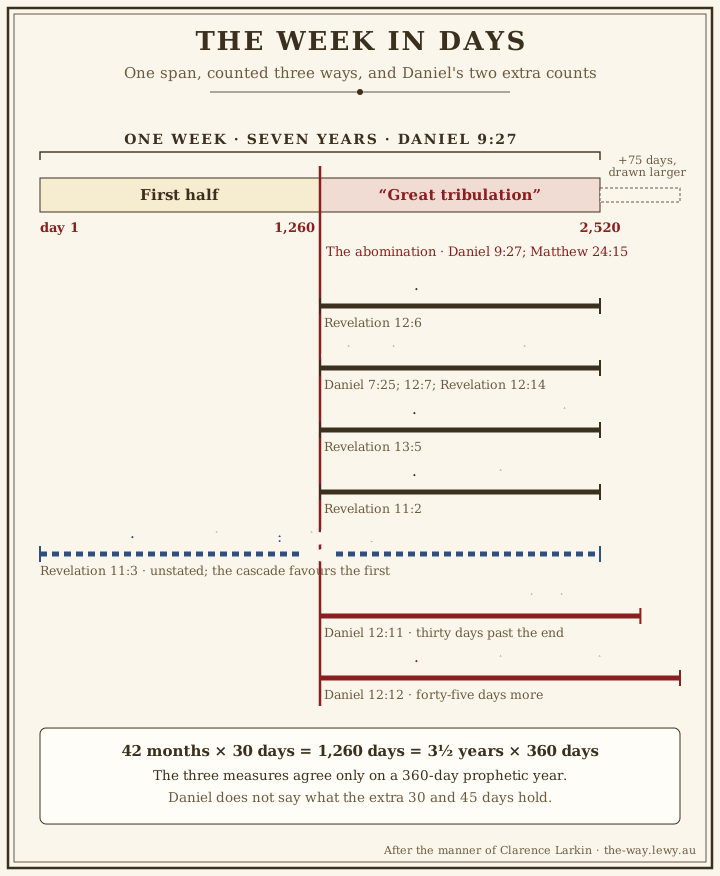
Forty-two months of thirty days is 1,260 days, and "a time, and times, and half a time" is three and a half years. Daniel uses the same phrase for the time the saints are given into the little horn's hand (Daniel 7:25; 12:7), and Daniel 9:27 divides the last "week" of seven years at its middle. Prophecy Events and Times shows why the three measures only agree on a 360-day prophetic year.
Which half do the witnesses fill? Scripture does not say, and both answers are held.
- The first half. The witnesses finish their testimony before the beast "rises from the bottomless pit" to kill them (Revelation 11:7, ESV), and the beast's own forty-two months come in chapter 13. Victorinus of Pettau, an early commentator on Revelation, read it this way: "their preaching is three years and six months, and the kingdom of Antichrist as much again" (Commentary on the Apocalypse on 11:3).
- The second half. The witnesses' 1,260 days run alongside the trampling of the city (Revelation 11:2-3), which follows the abomination at the midpoint, and their death is followed directly by the seventh trumpet and the kingdom (Revelation 11:14-15).
The rest of this study does not depend on the answer.
Two witnesses in sackcloth
"Witness" is μάρτυς (martys, MAR-toos, G3144). Revelation uses it five times. It names Jesus "the faithful witness" (Revelation 1:5; 3:14), Antipas, "my faithful witness, who was killed among you" (Revelation 2:13, ESV), these two (Revelation 11:3), and the martyrs whose blood the harlot drinks (Revelation 17:6). A witness in Revelation is one who tells the truth about Jesus and is often killed for it.
There are two because the law required two: "Only on the evidence of two witnesses or of three witnesses shall a charge be established" (Deuteronomy 19:15, ESV). Read that way, their testimony against the world is complete in law.
They wear sackcloth, which "symbolizes mourning over sin and judgment and possibly a message of repentance" (NIV Biblical Theology Study Bible, note on Revelation 11:3). Elijah was known by "a garment of hair" (2 Kings 1:8, ESV); whether John intends that echo is uncertain.
And they are "the two olive trees and the two lampstands that stand before the Lord of the earth" (Revelation 11:4, ESV). The Greek has the article, "the two olive trees": the pair the reader already knows from Zechariah, where two olive trees fed a golden lampstand and were named "the two anointed ones who stand by the Lord of the whole earth" (Zechariah 4:14, ESV). John makes one change. Zechariah saw one lampstand and two trees; John sees two of each, and both are the witnesses. The Lampstand sets out Zechariah's vision. Its word for Zerubbabel carries over: "Not by might, nor by power, but by my Spirit, says the LORD of hosts" (Zechariah 4:6, ESV). God grants the witnesses their authority (Revelation 11:3).
Fire, drought and plagues
✝️ Revelation 11:5-6 (ESV)
5 And if anyone would harm them, fire pours from their mouth and consumes their foes. If anyone would harm them, this is how he is doomed to be killed. 6 They have the power to shut the sky, that no rain may fall during the days of their prophesying, and they have power over the waters to turn them into blood and to strike the earth with every kind of plague, as often as they desire.
Each power recalls a prophet.
- Fire from their mouth. God told Jeremiah, "I am making my words in your mouth a fire, and this people wood, and the fire shall consume them" (Jeremiah 5:14, ESV). Fire consuming the enemies of a prophet is Elijah, who called fire down on the soldiers sent to seize him (2 Kings 1:10). The NIV Cultural Backgrounds Study Bible sees both (note on Revelation 11:5).
- Shutting the sky. Elijah told Ahab, "there shall be neither dew nor rain these years, except by my word" (1 Kings 17:1, ESV).
- Water to blood and every plague. Moses struck the Nile, "and it shall turn into blood" (Exodus 7:17, ESV), and after it came the plagues on Egypt.
The study Bibles read these powers differently. The Cultural Backgrounds Study Bible says the drought "evokes Elijah" and the blood "evokes Moses" (note on Revelation 11:6); the NIV Biblical Theology Study Bible calls the witnesses "modeled after Moses and Elijah" (note on Revelation 11:3); the ESV Study Bible names both prophets but reads the witnesses as fulfilling "the church's prophetic role" (note on Revelation 11:5-6).
Who the two are
The text calls them "these two prophets" (Revelation 11:10, ESV) and does not name them. Five answers have been given.
The witnessing church
Revelation 1:20 has already said that lampstands are churches. The beast "will make war on them and conquer them" (Revelation 11:7, ESV), the same verbs used of the saints at Revelation 13:7, and the ESV Study Bible suggests the two "may symbolize the saints" (note on Revelation 11:3-14). It adds that Zechariah's olive trees were a king and a priest, so the witnesses "aptly represent all whom the Lamb has redeemed to serve as priests and rule as kings" (note on Revelation 11:4; Revelation 1:6). The Cultural Backgrounds Study Bible notes that the witnesses depart from the Old Testament models at points, such as fire coming from the mouth, which leads some to read them as God's people in general (note on Revelation 11:3-6). On this reading the two stand for the church's whole witness until Christ returns.
Enoch and Elijah
Two men in Scripture did not die. "Enoch walked with God, and he was not, for God took him" (Genesis 5:24, ESV), "so that he should not see death" (Hebrews 11:5, ESV). Elijah "went up by a whirlwind into heaven" (2 Kings 2:11, ESV). Since "it is appointed for man to die once" (Hebrews 9:27, ESV), these two are still owed a death, and the witnesses die. Enoch was also a prophet of the end: "Behold, the Lord comes with ten thousands of his holy ones, to execute judgment on all" (Jude 1:14-15, ESV).
The reading is old. A Jewish apocalypse, 4 Ezra (2 Esdras in the Apocrypha), spoke of "the men that are received... who have not tasted death from their birth" seeing the end (2 Esdras 6:26, KJV). It names no one; the Cultural Backgrounds Study Bible reads it as the tradition behind the Enoch reading (note on Revelation 11:3-6). Tertullian wrote that Enoch and Elijah "are reserved for the suffering of death, that by their blood they may extinguish Antichrist" (A Treatise on the Soul 50). Hippolytus wrote that "the two prophets Enoch and Elias" would preach "1,260 days clothed in sackcloth" in the last week, as two forerunners of Christ's second coming, just as John the Baptist went before His first, and that their 1,260 days are "the half of the week whereof Daniel spake" (Treatise on Christ and Antichrist 43-47). The Cultural Backgrounds Study Bible adds Jerome to their number (note on Revelation 11:3-6).
Elijah and Jeremiah
Victorinus knew another answer. After listing the view that the second witness is "Elisha, or Moses," he objects that "both of these died," and says "all our ancients" held that Elijah's companion was Jeremiah (Commentary on the Apocalypse on 11:5). His reasons are that Scripture records no death for Jeremiah (the English of the Ante-Nicene Fathers reads "Elijah" at that point, apparently a slip), and that God had appointed Jeremiah "a prophet unto the nations" (Jeremiah 1:5, as Victorinus quotes it), which he had not yet been. Jeremiah also carries the fire image: God made His "words in your mouth a fire" (Jeremiah 5:14, ESV), and the Cultural Backgrounds Study Bible says the fire from the witnesses' mouth points to Jeremiah (note on Revelation 11:5). God promised Jeremiah, "you shall stand before me" (Jeremiah 15:19, ESV).
In the spirit and power of Moses and Elijah
John the Baptist came "in the spirit and power of Elijah" (Luke 1:17, ESV) without being Elijah himself. Two future prophets could come the same way, in the mould of Moses and Elijah. The NIV Biblical Theology Study Bible says "figures modeled upon them are expected to appear in the final age" (note on Luke 9:30), and the Cultural Backgrounds Study Bible that Jewish people "expected future prophets like Elijah... and Moses" (note on Revelation 11:6).
Moses and Elijah
Victorinus's own words show this reading was already current: "Many think that there is Elisha, or Moses, with Elijah." This study holds it. Elijah is in almost every reading, so the question is his companion. Two of the reasons below point to Moses in particular, the plagues and the transfiguration; the others support Elijah or the pairing.
Their powers
The witnesses shut the sky, as Elijah did (1 Kings 17:1), and turn water to blood and strike the earth "with every kind of plague," as Moses did in Egypt (Exodus 7:17). Of the other candidates, none is remembered for plagues.
Elijah's drought is the witnesses' term
Jesus said the heavens were "shut up three years and six months" in Elijah's day (Luke 4:25, ESV), and James says the same (James 5:17). 1 Kings says the rain returned "in the third year" (1 Kings 18:1, ESV); the usual explanation is that Kings counts from a later starting point, such as Elijah's stay at Zarephath, and the New Testament gives the whole span. The witnesses prophesy 1,260 days, three and a half years.
The Old Testament ends with both names
"Remember the law of my servant Moses... Behold, I will send you Elijah the prophet before the great and awesome day of the LORD comes" (Malachi 4:4-5, ESV). Malachi sends only Elijah; Moses is named for his law. Jesus said Elijah had come in John the Baptist (Matthew 17:12-13), and in the same breath, "Elijah does come, and he will restore all things" (Matthew 17:11, ESV). A coming of Elijah before the great and awesome day is still promised.
They have already stood with Jesus
On the mountain of transfiguration "two men were talking with him, Moses and Elijah, who appeared in glory and spoke of his departure, which he was about to accomplish at Jerusalem" (Luke 9:30-31, ESV). The disciples "saw his glory and the two men who stood with him" (Luke 9:32, ESV). Elijah had called the LORD the one "before whom I stand" (1 Kings 17:1, ESV). The two who stood with Jesus on the mountain and spoke of what He would accomplish at Jerusalem match the two who "stand before the Lord of the earth" and finish their testimony in the city "where their Lord was crucified."
Sinai, and two unusual departures
The NIV Biblical Theology Study Bible notes that both "witnessed God's glory" at Sinai (Exodus 24:12-18; 1 Kings 19:8) and both "had unusual departures from their earthly lives": God buried Moses, and "no one knows the place of his burial to this day" (Deuteronomy 34:6, ESV), and Elijah was taken up alive (note on Luke 9:30). The same note says "figures modeled upon them are expected," which fits the spirit-and-power reading as well as this one.
The objection from Hebrews 9:27
The objection is Hebrews 9:27. Moses died, and "it is appointed for man to die once." That is the Enoch reading's strength. The verse states the ordinary course of things, and Scripture names exceptions to it. Believers alive when Christ comes for His church will never die: "We shall not all sleep, but we shall all be changed" (1 Corinthians 15:51, ESV). The dead Jesus raised, Lazarus among them (John 11:43-44), were raised to a life that would end again. So Hebrews 9:27 does not settle the question either way, and the same point weakens the Enoch reading's claim that its two are owed a death. The text names neither man, and this reading is held with that marked.
On the site's dispensational reading of the end, set out in its statement of faith, the church is caught up before these years begin (The Rapture), and God raises these two as His witnesses in Jerusalem during them.
Killed, left in the street, raised, taken up
The beast and the city
"And when they have finished their testimony, the beast that rises from the bottomless pit will make war on them and conquer them and kill them" (Revelation 11:7, ESV). This is the beast's first appearance in Revelation, and it acts in the words of Daniel's vision: the horn "made war with the saints and prevailed over them" (Daniel 7:21, ESV). That horn is the last ruler of Daniel's fourth kingdom, traced in The Image and the Kingdoms. Nothing touched the witnesses until they had finished.
Their bodies lie "in the street of the great city that symbolically is called Sodom and Egypt, where their Lord was crucified" (Revelation 11:8, ESV). "Symbolically" is πνευματικῶς (pneumatikōs, G4153), "spiritually." Sodom and Egypt name what the city has become. "Where their Lord was crucified" names where it is: Jerusalem. The ESV Study Bible suggests John merges Jerusalem with Rome, the "great city" of Revelation 17-18 (note on Revelation 11:7-10), and the NIV Biblical Theology Study Bible says Revelation stresses "the great city's ungodly nature and heritage, not its geographic location" (note on Revelation 11:8). This study reads the city as Jerusalem, since the chapter opened there (Revelation 11:1-2).
Gifts over their bodies
People from every nation "gaze at their dead bodies and refuse to let them be placed in a tomb, and those who dwell on the earth will rejoice over them and make merry and exchange presents, because these two prophets had been a torment to those who dwell on the earth" (Revelation 11:9-10, ESV). The Cultural Backgrounds Study Bible hears Purim turned upside down (note on Revelation 11:10). When the Jews were delivered from destruction in Esther's day they kept "days of feasting and gladness, days for sending gifts of food to one another" (Esther 9:22, ESV). Here the world keeps a holiday for the death of God's servants.
Raised
✝️ Revelation 11:11-12 (ESV)
11 But after the three and a half days a breath of life from God entered them, and they stood up on their feet, and great fear fell on those who saw them. 12 Then they heard a loud voice from heaven saying to them, "Come up here!" And they went up to heaven in a cloud, and their enemies watched them.
The words come from Ezekiel's valley of dry bones: "the breath came into them, and they lived and stood on their feet" (Ezekiel 37:10, ESV). "Come up here" is what the voice said to John himself before he saw the throne (Revelation 4:1). And "in a cloud" is how Jesus left: "as they were looking on, he was lifted up, and a cloud took him out of their sight" (Acts 1:9, ESV). The witnesses testify, die in Jerusalem, rise, and ascend in a cloud with their enemies watching. It is their Lord's story.
The earthquake
"And at that hour there was a great earthquake, and a tenth of the city fell. Seven thousand people were killed in the earthquake, and the rest were terrified and gave glory to the God of heaven" (Revelation 11:13, ESV). The Cultural Backgrounds Study Bible hears the seven thousand Elijah was told God had kept (1 Kings 19:18), with a twist: there the seven thousand were the faithful who survived, and here the seven thousand die while most of the city turns to God. It says "gave glory" can carry the sense of repentance. The NIV Biblical Theology Study Bible leaves open whether the survivors repent or only acknowledge God's power (notes on Revelation 11:13). The world celebrated the witnesses' death; the city where they died ends the scene giving glory to God.
What the two witnesses show about God
This table sorts the study's connections by how directly Scripture makes each one.
| Connection | Where | How firm |
|---|---|---|
| The witnesses are Zechariah's two olive trees | Revelation 11:4; Zechariah 4:3, 14 | Stated; a firm allusion |
| Their term is three and a half years | Revelation 11:3; 12:6, 14; 13:5 | Stated |
| Their powers are Moses' and Elijah's | Revelation 11:6 | Stated as powers; the names are inferred |
| Their resurrection uses Ezekiel's words | Revelation 11:11; Ezekiel 37:10 | A firm allusion |
| The city is Jerusalem | Revelation 11:8 | Strong ("where their Lord was crucified"); some read Rome as well |
| The temple is a rebuilt tribulation temple | Revelation 11:1-2 | This study's reading; others read God's people |
| They fill the first or the second half of the week | Revelation 11:2-7 | Contested |
| They are Moses and Elijah | Revelation 11:6; Luke 9:30-32 | This study's reading; others hold Enoch and Elijah, Elijah and Jeremiah, two prophets in their mould, or the church |
| Malachi promises Elijah's coming | Malachi 4:5; Matthew 17:11 | Stated; Moses is named for his law, not sent |
God keeps a witness in the world. In the three and a half years when the nations trample His city, He sends two prophets who stand before Him and speak for Him, and no one can touch them until they are done. God decides how long evil runs, and He numbers it in days.
God also vindicates His witnesses. The world celebrated their death and sent gifts over their bodies. God breathed life into them in the sight of their enemies and called them up. What He did for His Son Jesus, He does for those who bear witness to Him.
That is why this passage belongs to you, though on this site's reading the church is gone before these days. Antipas was "my faithful witness, who was killed" (Revelation 2:13, ESV), and the saints "conquered him by the blood of the Lamb and by the word of their testimony, for they loved not their lives even unto death" (Revelation 12:11, ESV). You are a witness of the same Jesus now. Your work has an end God has set, your testimony is not lost when the world mocks it, and the God who raised these two will raise you.
Discussion Questions
- "Witness" in Revelation names Jesus, Antipas and these two (Revelation 1:5; 2:13; 11:3). What does that word lead you to expect about the witnesses' end?
- Revelation 11 comes right after John is told to "prophesy again" (Revelation 10:11). How does the story of the two witnesses show what prophesying costs?
- The witnesses could not be harmed until they had "finished their testimony" (Revelation 11:7). How does that change the way you think about danger in serving God?
- Enoch and Elijah never died; Moses and Elijah stood with Jesus on the mountain (Luke 9:30-32). Which case do you find stronger, and what does Hebrews 9:27 weigh in each?
- The world sent gifts over the witnesses' bodies, as Israel did at Purim (Revelation 11:10; Esther 9:22). Where do you see the world celebrate when God's truth goes quiet?
- The witnesses' death, resurrection and ascension follow Jesus' own. What hope does that give you for your own witness and your own death?
Group study sheet for a 40-minute group: two A4 sheets, or one with the guided path
The point, the passage, the questions and the response, from this study. Print on both sides of two A4 sheets, flipping on the long edge. While this block is open, printing the page prints the sheet; close it to print the study.
The Two Witnesses
Revelation 11:1-14The point During Daniel's seventieth week, while the nations trample Jerusalem, God sends two prophets whom Revelation draws from Zechariah's two anointed olive trees and clothes in the powers of Moses and Elijah; they testify for 1,260 days, are killed in the city where their Lord was crucified, and are raised and taken up in a cloud before their enemies' eyes, so God keeps a witness in the world's darkest hour, and the witnesses' story follows their Lord's.
Ask: what comes to mind when you hear The Two Witnesses
? Hear a few answers before anyone reads.
Revelation 11:1-14 1Then I was given a measuring rod like a staff and was told, “Go and measure the temple of God and the altar, and count the number of worshipers there. 2But exclude the courtyard outside the temple. Do not measure it, because it has been given over to the nations, and they will trample the holy city for 42 months. 3And I will empower my two witnesses, and they will prophesy for 1,260 days, clothed in sackcloth.” 4These witnesses are the two olive trees and the two lampstands that stand before the Lord of the earth. 5If anyone wants to harm them, fire proceeds from their mouths and devours their enemies. In this way, anyone who wants to harm them must be killed. 6These witnesses have power to shut the sky so that no rain will fall during the days of their prophecy, and power to turn the waters into blood and to strike the earth with every kind of plague as often as they wish. 7When the two witnesses have finished their testimony, the beast that comes up from the Abyss will wage war with them, and will overpower and kill them. 8Their bodies will lie in the street of the great city—figuratively called Sodom and Egypt—where their Lord was also crucified. 9For three and a half days all peoples and tribes and tongues and nations will view their bodies and will not permit them to be laid in a tomb. 10And those who dwell on the earth will gloat over them and celebrate and send one another gifts, because these two prophets had tormented them. 11But after the three and a half days, the breath of life from God entered the two witnesses, and they stood on their feet, and great fear fell upon those who saw them. 12And the witnesses heard a loud voice from heaven saying, “Come up here.” And they went up to heaven in a cloud as their enemies watched them. 13And in that hour there was a great earthquake, and a tenth of the city collapsed. Seven thousand were killed in the quake, and the rest were terrified and gave glory to the God of heaven. 14The second woe has passed. Behold, the third woe is coming shortly.
Also read:
The Two Witnesses
- Where the passage sits. John is sent to prophesy again, between the sixth and seventh trumpets.
- The measured temple and the trampled city. Revelation 11:1-2 and the temple of the tribulation.
- One period counted three ways. 42 months, 1,260 days, and "a time, and times, and half a time," and which half of the week the witnesses fill.
- Two witnesses in sackcloth. The word "witness," the law's two witnesses, and Zechariah's olive trees.
- Fire, drought and plagues. Revelation 11:5-6 and the prophets it recalls.
- Who the two are. Four readings from the early church and today, and the case for Moses and Elijah.
- Killed, left in the street, raised, taken up. Revelation 11:7-13.
- What the two witnesses show about God. Each connection sorted by how firmly Scripture makes it.
- Discussion Questions. Six, for a group or on your own.
The Two Witnesses
1Revelation 11 comes right after John is told to "prophesy again" (Revelation 10:11). How does the story of the two witnesses show what prophesying costs?
2The witnesses could not be harmed until they had "finished their testimony" (Revelation 11:7). How does that change the way you think about danger in serving God?
3"Witness" in Revelation names Jesus, Antipas and these two (Revelation 1:5; 2:13; 11:3). What does that word lead you to expect about the witnesses' end?
4Enoch and Elijah never died; Moses and Elijah stood with Jesus on the mountain (Luke 9:30-32). Which case do you find stronger, and what does Hebrews 9:27 weigh in each?
5The world sent gifts over the witnesses' bodies, as Israel did at Purim (Revelation 11:10; Esther 9:22). Where do you see the world celebrate when God's truth goes quiet?
6The witnesses' death, resurrection and ascension follow Jesus' own. What hope does that give you for your own witness and your own death?
The Two Witnesses
- Think. No witness of Jesus dies before the work God gave is finished. The two could not be harmed until they had "finished their testimony" (Revelation 11:7, ESV).
- Attitude. Expect the world to celebrate when the truth goes quiet, and expect God to raise it.
- Do. Tell one person this week what Jesus has done for you, as plainly as these two prophesied (Revelation 11:3).
But after the three and a half days a breath of life from God entered them, and they stood up on their feet, and great fear fell on those who saw them.
Revelation 11:11 (ESV)Lord God, You have never left the world without a witness. Thank You for Your Son Jesus, the faithful witness, who died in Jerusalem and rose and went up in the cloud, and who will send His two prophets into the city where He was crucified. Make us faithful witnesses now, not loving our lives more than Your word. Keep us from fear of those who mock, and raise us up on the last day.
In Jesus' name. Amen.
The Two Witnesses
Revelation 11:1-14Open Ask: what comes to mind when you hear The Two Witnesses
? Hear a few answers before anyone reads.
Read it aloud Revelation 11:1-14
1Revelation 11 comes right after John is told to "prophesy again" (Revelation 10:11). How does the story of the two witnesses show what prophesying costs?
2The witnesses could not be harmed until they had "finished their testimony" (Revelation 11:7). How does that change the way you think about danger in serving God?
3"Witness" in Revelation names Jesus, Antipas and these two (Revelation 1:5; 2:13; 11:3). What does that word lead you to expect about the witnesses' end?
4Enoch and Elijah never died; Moses and Elijah stood with Jesus on the mountain (Luke 9:30-32). Which case do you find stronger, and what does Hebrews 9:27 weigh in each?
5The world sent gifts over the witnesses' bodies, as Israel did at Purim (Revelation 11:10; Esther 9:22). Where do you see the world celebrate when God's truth goes quiet?
6The witnesses' death, resurrection and ascension follow Jesus' own. What hope does that give you for your own witness and your own death?
- Think. No witness of Jesus dies before the work God gave is finished. The two could not be harmed until they had "finished their testimony" (Revelation 11:7, ESV).
- Attitude. Expect the world to celebrate when the truth goes quiet, and expect God to raise it.
- Do. Tell one person this week what Jesus has done for you, as plainly as these two prophesied (Revelation 11:3).
The Two Witnesses
The point During Daniel's seventieth week, while the nations trample Jerusalem, God sends two prophets whom Revelation draws from Zechariah's two anointed olive trees and clothes in the powers of Moses and Elijah; they testify for 1,260 days, are killed in the city where their Lord was crucified, and are raised and taken up in a cloud before their enemies' eyes, so God keeps a witness in the world's darkest hour, and the witnesses' story follows their Lord's.
References & Recommended Reading
- ESV Study Bible (Crossway, 2016) — notes on Revelation 11:1-2, 11:1-14, 11:3-14, 11:4, 11:5-6, 11:7-10 and 11:11-14. ESV verse text throughout. Quoted briefly with attribution.
- NIV Biblical Theology Study Bible (Zondervan, 2018), gen. ed. D. A. Carson — notes on Revelation 11:1-14 (with its chart of Old Testament background), 11:3, 11:4, 11:5, 11:7, 11:9, 11:11, 11:13, and Luke 9:30.
- NIV Cultural Backgrounds Study Bible (Zondervan, 2016), eds. Craig S. Keener and John H. Walton — notes on Revelation 11:3-6, 11:5, 11:8, 11:10 and 11:13.
- Tertullian, A Treatise on the Soul 50; Hippolytus, Treatise on Christ and Antichrist 43-44; Victorinus of Pettau, Commentary on the Apocalypse on 11:3-5 — in Ante-Nicene Fathers vols. 3, 5 and 7, eds. Alexander Roberts and James Donaldson (1885-86, public domain).
- 2 Esdras (4 Ezra) 6:26, King James Version Apocrypha (public domain). Extra-biblical; cited as Jewish tradition, never as Scripture.
- Original-language data from this project's
bible-text.db— SBLGNT text and unfoldingWord interlinear for Revelation 11:3-11 and Luke 9:31; morphology concordance for μάρτυς; WEB verse text.
On this site
- The Lampstand — Zechariah's vision and the lampstands of Revelation.
- The Restrainer — the lawless one seated in the temple at the week's midpoint.
- Prophecy Events and Times — 42 months, 1,260 days and the 360-day year.
- The Rapture — the church caught up before the tribulation.
- The New Jerusalem — the holy city after the trampled one.