The End of the Age
New, published 3 October 2026. What else is new
The disciples sat with Jesus on the Mount of Olives and asked Him about "the end of the age" (Matthew 24:3, ESV). Matthew's Gospel closes on the same words. "I am with you always, to the end of the age" (Matthew 28:20, ESV). Between those two sentences sit a harvest, a net and the coming of the Son of Man. Then Hebrews says the end of the ages has already come.
In one sentence: Jesus took Daniel's word for the end and named three things by it: the harvest that separates the righteous from the wicked, His own coming, and the limit of His promise to be with you every day; the apostles say that end began at the cross, so you live between its opening and its close.
This study covers the line between the two ages: what the New Testament calls its close, and when. The age on the far side of the line is in A New Heaven and a New Earth. How long the ages were reckoned to run, six thousand-year days and the Talmud's three ages of two thousand years, is in A Day Is a Thousand Years.
Key Takeaways
(This section follows the Key Takeaways format — see that page for what each part is for.)
Types & Prophecy
Prophecy. Daniel was told to seal his book "until the time of the end" (Daniel 12:4, ESV). Both Greek versions of Daniel call that end the συντέλεια (synteleia), and Jesus uses the same word for the close of this age (Matthew 24:3). The close comes when the Son of Man sends His angels to gather and to separate (Matthew 13:41; 24:31).
Prophecy fulfilled. Christ "has appeared once for all at the end of the ages to put away sin by the sacrifice of himself" (Hebrews 9:26, ESV). The end Daniel waited for opened at the cross.
Lessons about Jesus
- Jesus is the Lord of the harvest. He sows the good seed, He owns the field, and at the end of the age He sends His angels to gather "out of his kingdom" everything that offends (Matthew 13:37, 41).
- Jesus is God with you. He promises His presence "all the days" (Matthew 28:20). Only God is everywhere at once, and Matthew opened his Gospel calling Jesus "Immanuel … God with us" (Matthew 1:23, ESV).
- Jesus ended one thing and will end another. His sacrifice opened the end of the ages (Hebrews 9:26). His second appearing will close it, "to save those who are eagerly waiting for him" (Hebrews 9:28, ESV).
Memory verses
✝️ Matthew 28:20 (ESV)
20 teaching them to observe all that I have commanded you. And behold, I am with you always, to the end of the age.
✝️ Hebrews 9:26 (ESV)
26 for then he would have had to suffer repeatedly since the foundation of the world. But as it is, he has appeared once for all at the end of the ages to put away sin by the sacrifice of himself.
Be Transformed
- Think. This age has a date on it. God fixed its end, began it at the cross, and will finish it when Jesus comes. You belong to the age that is coming.
- Attitude. Live unhurried and unafraid. The Lord of the harvest is with you every day until He returns, and He sorts the field Himself.
- Do. Each morning this week, read Jesus' promise aloud: "I am with you always, to the end of the age" (Matthew 28:20, ESV). Then name to Him one habit of this age you have taken on without thinking, and ask Him to renew your mind about it (Romans 12:2).
Prayer
Father, you set the times by your own authority, and this age ends when you say. Thank you that your Son Jesus offered Himself once for all at the end of the ages, and that His blood has carried us out of the present evil age. Keep us faithful in the field until the harvest. Let us live as people of the age to come, with your Son beside us every day.
In Jesus' name. Amen.
Study outline
- Two ages. The frame Jesus' hearers already held: this age, the age to come, and one judgment between them.
- Daniel's word for the end. Where Matthew's συντέλεια comes from.
- Matthew's three hinges. The harvest and the net (Matthew 13), the disciples' question (Matthew 24:3), and the promise "all the days" (Matthew 28:20), with the question of where the church is at the close.
- The end has already come. Hebrews 9:26 and 1 Corinthians 10:11, and the chart that puts the two halves together.
- Living in this age. Romans 12:2 and Galatians 1:4, and a word most English versions translate "world".
Two ages
Jewish teaching in Jesus' day divided time into "this age" and "the age to come". Jesus used the frame without explaining it. Blasphemy against the Holy Spirit "will not be forgiven, either in this age or in the age to come" (Matthew 12:32, ESV). A New Heaven and a New Earth works through the age to come: the Mishnah's "world to come", the texts that promise it, and where the thousand years fits.
The Jewish writings drew that line as a single judgment. The Book of the Watchers, now part of 1 Enoch and written before the time of Christ, speaks of "the day of the consummation, the great judgement in which the age shall be consummated" (1 Enoch 16:1, trans. R. H. Charles). 2 Esdras, a Jewish apocalypse from about AD 100, says "the day of doom shall be the end of this time, and the beginning of the immortality for to come" (2 Esdras 7:43, KJV Apocrypha; 7:113 in editions that restore the missing fragment of chapter 7). It also says "The most High hath made this world for many, but the world to come for few" (2 Esdras 8:1, KJV Apocrypha). 2 Esdras was written after Jesus, and it shows the frame was still standard Jewish teaching two generations later.
The rabbis also measured the ages. The Talmud divides six thousand years into two thousand of chaos, two thousand of Torah and two thousand of the days of Messiah (b. Sanhedrin 97a). A Day Is a Thousand Years works through that count, and The Zadok Calendar the jubilees it is reckoned in. This study needs only the line itself.
One line, one break: that is the top half of the chart below. The New Testament keeps the two ages and finds that the break between them has a beginning and a close.
Daniel's word for the end
Matthew's phrase is συντέλεια τοῦ αἰῶνος (synteleia tou aiōnos). συντέλεια (synteleia, syn-TEL-ay-ah, G4930) means a completion, the point where something is brought to its finish. The Legacy Standard Bible footnotes Matthew 13:39 and 24:3 "Or consummation". αἰών (aiōn, G165) is an age, a span of time, and the SBLGNT uses it 122 times.
The phrase belongs to Matthew. συντέλεια occurs six times in the New Testament: Matthew 13:39, 40, 49; 24:3; 28:20, and Hebrews 9:26. Mark and Luke never use it.
It is Daniel's word. The angel told Daniel, "shut up the words and seal the book, until the time of the end" (Daniel 12:4, ESV). The Hebrew is עַד־עֵת קֵץ (ad-et qets), "until the time of the end", from קֵץ (qets, H7093), "end". Both Greek translations of Daniel render it ἕως καιροῦ συντελείας, "until the time of the synteleia". The Old Greek, made before Christ, uses συντέλεια 23 times in the book. Theodotion's later version keeps it at the points that matter here: the end of the seventieth week (Daniel 9:27), the time of the end (Daniel 12:4), and Daniel's own rising "at the end of the days" (Daniel 12:13, ESV).
So when the disciples ask about the συντέλεια of the age, they use the word Greek-reading Jews had read in Daniel for more than a century. The word link is in the text. That the disciples were thinking of Daniel is an inference, and a strong one, because twelve verses later Jesus sends them there by name: "when you see the abomination of desolation spoken of by the prophet Daniel" (Matthew 24:15, ESV).
This shows that God set the end of this age before He told anyone about it. Daniel was told to seal his book and "go your way till the end" (Daniel 12:13, ESV). Five centuries later His Son told His disciples what that end would bring. You read Daniel's last chapter from the other side of the cross.
The harvest at the close of the age
The first three uses come together, in the two parables Jesus explained to His disciples in private (Matthew 13:36).
The weeds and the wheat
An enemy sowed weeds among a farmer's wheat. The servants offered to pull them up, and the master said, "Let both grow together until the harvest, and at harvest time I will tell the reapers, 'Gather the weeds first and bind them in bundles to be burned, but gather the wheat into my barn'" (Matthew 13:30, ESV). Jesus explained it:
✝️ Matthew 13:39-43 (ESV)
39 and the enemy who sowed them is the devil. The harvest is the end of the age, and the reapers are angels. 40 Just as the weeds are gathered and burned with fire, so will it be at the end of the age. 41 The Son of Man will send his angels, and they will gather out of his kingdom all causes of sin and all law-breakers, 42 and throw them into the fiery furnace. In that place there will be weeping and gnashing of teeth. 43 Then the righteous will shine like the sun in the kingdom of their Father. He who has ears, let him hear.
Four things are fixed. The field is the world (Matthew 13:38). Both grow in it together until the end. The angels do the separating, and the Son of Man sends them. The wicked are removed first, and the righteous are left to shine. "Shine like the sun" echoes Daniel again: "those who are wise shall shine like the brightness of the sky above" (Daniel 12:3, ESV), one verse before the sealed book and the time of the end.
The net
✝️ Matthew 13:47-50 (ESV)
47 "Again, the kingdom of heaven is like a net that was thrown into the sea and gathered fish of every kind. 48 When it was full, men drew it ashore and sat down and sorted the good into containers but threw away the bad. 49 So it will be at the end of the age. The angels will come out and separate the evil from the righteous 50 and throw them into the fiery furnace. In that place there will be weeping and gnashing of teeth.
The net says the same thing from the sea. Nobody sorts the catch while the net is in the water. The sorting happens once, when the net is full and drawn ashore.
The Cultural Backgrounds Study Bible notes that other Jewish writings also picture the end of the age as a harvest, citing 2 Baruch 70:2 (NIV Cultural Backgrounds Study Bible, on Matthew 13:39). Jesus gives the picture its owner. The harvest is His, the angels are His, and the kingdom they clear is "his kingdom" (Matthew 13:41).
One Taken, One Left follows this order into Matthew 24:40-41: at the Son of Man's return the wicked are taken in judgment and the righteous are left, as Noah was left. "Gather the weeds first" is the same order in a field.
This shows that God is patient now and exact at the end. He lets the wheat and the weeds grow side by side, so that no wheat is torn up with a weed (Matthew 13:29). The separation belongs to the Son of Man, and He makes no mistakes. So you can leave the sorting to Him and keep sowing.
"Your coming and the end of the age"
On the Mount of Olives the disciples asked, "Tell us, when will these things be, and what will be the sign of your coming and of the end of the age?" (Matthew 24:3, ESV).
The Greek puts the two nouns under one article: τῆς σῆς παρουσίας καὶ συντελείας τοῦ αἰῶνος, "the your-coming-and-close-of-the-age". παρουσία (parousia, G3952) is an arrival, the word for a king's visit. The grammar pairs the coming and the close as one subject of one question. It does not by itself prove they are a single event, since the rule that would require that applies to persons, and these are things. The rest of the chapter does the joining.
Jesus answers in order. First come wars, famines and false messiahs, which are "the beginning of the birth pains" (Matthew 24:8, ESV). Then "this gospel of the kingdom will be proclaimed throughout the whole world as a testimony to all nations, and then the end will come" (Matthew 24:14, ESV). Then Daniel's abomination (Matthew 24:15) and a tribulation without equal (Matthew 24:21). Then:
✝️ Matthew 24:29-31 (ESV)
29 "Immediately after the tribulation of those days the sun will be darkened, and the moon will not give its light, and the stars will fall from heaven, and the powers of the heavens will be shaken. 30 Then will appear in heaven the sign of the Son of Man, and then all the tribes of the earth will mourn, and they will see the Son of Man coming on the clouds of heaven with power and great glory. 31 And he will send out his angels with a loud trumpet call, and they will gather his elect from the four winds, from one end of heaven to the other.
The angels who gather in Matthew 24:31 are the reapers of Matthew 13:39. On the dispensational reading this site holds, the close of the age is the close of Daniel's seventieth week, the seven years of Daniel 9:27, and the coming is Christ's visible return at its end (Revelation 19:11-16). That placement rests on three things in the text: Daniel's word in the disciples' question, Daniel's abomination in Jesus' answer, and "immediately after the tribulation" before the coming. Readers who see no future seventieth week place the close at the same return, with the tribulation spread across the whole church age. Both put the end of the age at Christ's coming in glory. That coming also opens the age to come, which A New Heaven and a New Earth follows through the thousand years to the new creation.
The Olivet Discourse works through the whole answer, and The Tribulation charts the week.
"All the days"
Matthew ends with a command and a promise:
✝️ Matthew 28:18-20 (ESV)
18 And Jesus came and said to them, "All authority in heaven and on earth has been given to me. 19 Go therefore and make disciples of all nations, baptizing them in the name of the Father and of the Son and of the Holy Spirit, 20 teaching them to observe all that I have commanded you. And behold, I am with you always, to the end of the age."
"Always" in the ESV is πάσας τὰς ἡμέρας (pasas tas hēmeras), and the LSB and CSB footnotes give it literally: "all the days". Jesus promises His presence one day at a time, every day, until the συντέλεια. The Cultural Backgrounds Study Bible observes that Jews held only God to be present everywhere, so the promise presents Jesus as divine (NIV Cultural Backgrounds Study Bible, on Matthew 28:20). Matthew began with "Immanuel" (Matthew 1:23) and ends with Immanuel keeping His name.
This shows that God the Son goes with the people He sends. The One with "all authority in heaven and on earth" is the One beside you while you obey Him. So you can make disciples in an age that does not want them, because every one of your days is covered.
Where the church is at the close
Here two of this site's convictions meet, and the meeting is contested.
The statement of faith holds that the church is caught up to meet Christ before the seven-year tribulation begins. Matthew 28:20 runs "to the end of the age", and Matthew 13 and 24 place that end at the return after the tribulation. A reader can fairly ask how a promise that runs to the close of the age fits a church removed seven years before it.
The dispensational answer has two parts. First, the promise attaches to the task, and the task continues after the church is gone. The gospel of the kingdom goes to all nations before the end (Matthew 24:14), and John sees "a great multitude that no one could number, from every nation" come "out of the great tribulation" (Revelation 7:9, 14, ESV). Jesus is with the disciples who make disciples, through those seven years too. Second, the church caught up has the promise in a stronger form: "and so we will always be with the Lord" (1 Thessalonians 4:17, ESV). The presence promised by faith becomes presence face to face. The case for the timing itself rests on other texts, chiefly 1 Thessalonians 4:13-18, Revelation 3:10 and 2 Thessalonians 2:6-7, set out in The Rapture of the Church and The Restrainer.
The other case. Post-tribulational and amillennial readers take Matthew 28:20 at its plainest: the apostles stand for the church, "all the days" has no break in it, so the church is on earth until the end of the age. They count this verse among their strongest.
This study holds the dispensational reading with moderate confidence, because Matthew 28:20 neither names a rapture nor rules one out. Both readings agree on the part you need for today. Jesus is with you this day, and every day after it, until He comes.
The end has already come
Matthew puts the end of the age at the harvest. Two letters put it in the past.
✝️ Hebrews 9:26-28 (ESV)
26 for then he would have had to suffer repeatedly since the foundation of the world. But as it is, he has appeared once for all at the end of the ages to put away sin by the sacrifice of himself. 27 And just as it is appointed for man to die once, and after that comes judgment, 28 so Christ, having been offered once to bear the sins of many, will appear a second time, not to deal with sin but to save those who are eagerly waiting for him.
"At the end of the ages" is ἐπὶ συντελείᾳ τῶν αἰώνων (epi synteleia tōn aiōnōn), Matthew's word with the ages in the plural. Paul says the same to Corinth. Israel's wilderness history was "written down for our instruction, on whom the end of the ages has come" (1 Corinthians 10:11, ESV). The Greek is τὰ τέλη τῶν αἰώνων (ta telē tōn aiōnōn), from τέλος (telos, G5056), and the verb κατήντηκεν (katēntēken, G2658) is a perfect: it has arrived and it stays arrived. The CSB Ancient Faith Study Bible footnotes the phrase "Or goals of the ages". Hebrews opens the same way: "in these last days he has spoken to us by his Son" (Hebrews 1:2, ESV). That phrase, the prophets' acharit hayamim, has its own study in A Day Is a Thousand Years, which places the last days in the week of history. This section follows the other phrase, "the end of the ages".
So the end of the ages has two points in the New Testament. It opened when Christ "appeared once for all … by the sacrifice of himself" (Hebrews 9:26). It closes when He "will appear a second time" (Hebrews 9:28). Hebrews counts them: ἅπαξ (hapax, G530), "once", for the first, and ἐκ δευτέρου (ek deuterou), "a second time", for the next. The ESV Study Bible reads Hebrews 9:26 this way: the end of the ages was inaugurated by Christ's death and awaits its consummation at His return (ESV Study Bible, on Hebrews 9:25-26). The NIV Biblical Theology Study Bible says the same of 1 Corinthians 10:11.
This is settled teaching across the traditions. The disagreement is over what fills the span between the two points, and the dispensational answer is the church age followed by Daniel's seventieth week.
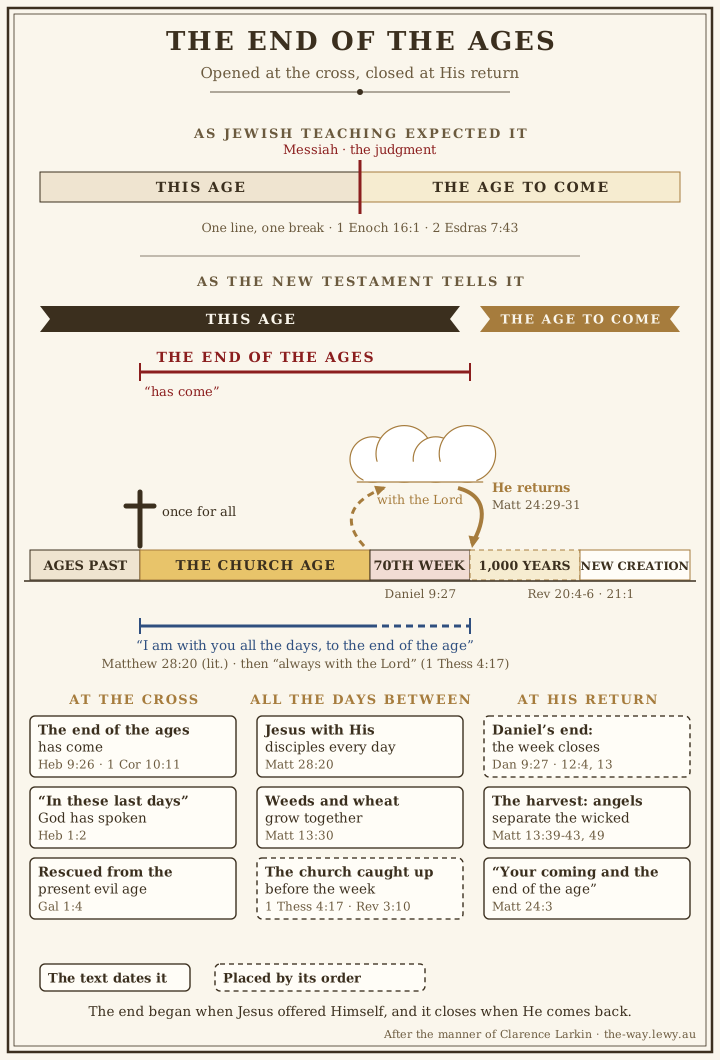
This shows that God has already begun to finish this age, and He began with the cross. The sin that would have had to be dealt with "repeatedly since the foundation of the world" was put away once (Hebrews 9:26). That is the atonement, and it is the first act of the end. So the second act is certain. You wait for Christ "not to deal with sin but to save" (Hebrews 9:28), because the sin was dealt with when the end began.
Living in this age
If the end of the ages has come, you live in an age that is passing and belong to one that is coming. Paul writes that Christ "gave himself for our sins to deliver us from the present evil age" (Galatians 1:4, ESV), ἐκ τοῦ αἰῶνος τοῦ ἐνεστῶτος πονηροῦ. Deliverance from an age is redemption: Christ paid for your sins and moved you out from under the age that produced them.
You still live in it. Titus 2:12 calls this "the present age", where grace trains you "to live self-controlled, upright, and godly lives" while "waiting for our blessed hope, the appearing of the glory of our great God and Savior Jesus Christ" (Titus 2:12-13, ESV).
A word most English versions translate "world"
Romans 12:2 uses the same noun:
✝️ Romans 12:2 (ESV)
2 Do not be conformed to this world, but be transformed by the renewal of your mind, that by testing you may discern what is the will of God, what is good and acceptable and perfect.
"This world" is τῷ αἰῶνι τούτῳ (tō aiōni toutō), "this age". The ESV, NIV, NASB, LSB, NKJV, WEB and ASV all translate it "world". The CSB alone keeps "Do not be conformed to this age" (Romans 12:2, CSB). "World" is a fair translation, and αἰών does sometimes mean the world as it now runs. But "age" keeps the time in it. Paul's command assumes the two ages: do not take the shape of an age that is ending, when you belong to the one that is coming. If you read Romans 12 in the ESV or NIV, read "age" where it says "world" and the command carries its date.
This shows that God transforms you ahead of time. The renewing of your mind is the age to come arriving in you before it arrives in the world (Hebrews 6:5). So every time you refuse the shape of this age, you are living the end of the ages that Christ opened at the cross.
Discussion Questions
- συντέλεια means a completion, the point where a thing is finished. Daniel's angel sealed the book "until the time of the end" (Daniel 12:4). What did Daniel have to do while he waited (Daniel 12:13), and what does that ask of you?
- In Matthew 13:30 the master refuses to let his servants pull up the weeds. Why does he wait, and what does that tell you about the work Jesus gives His people now?
- The disciples put "your coming" and "the end of the age" in one question (Matthew 24:3). Where in Matthew 24 does Jesus join the two, and what comes between the question and the answer?
- Matthew 28:20 runs "to the end of the age", and this site holds that the church is caught up before the tribulation. Read the two parts of the dispensational answer and the case against it. Which points does the text settle, and which does it leave open?
- Hebrews says Christ appeared "at the end of the ages" (Hebrews 9:26). What changes in how you read the news if the end has already begun?
- Romans 12:2 says "Do not be conformed to this age." Name one way this age has shaped your habits. What would it look like this week to live as someone who belongs to the age to come?
Group study sheet for a 40-minute group: two A4 sheets, or one with the guided path
The point, the passage, the questions and the response, from this study. Print on both sides of two A4 sheets, flipping on the long edge. While this block is open, printing the page prints the sheet; close it to print the study.
The End of the Age
Matthew 13:36-43; Matthew 24:3; Matthew 28:20The point Jesus took Daniel's word for the end and named three things by it: the harvest that separates the righteous from the wicked, His own coming, and the limit of His promise to be with you every day; the apostles say that end began at the cross, so you live between its opening and its close.
Ask: what comes to mind when you hear The End of the Age
? Hear a few answers before anyone reads.
Matthew 13:36-43 36Then Jesus dismissed the crowds and went into the house. His disciples came to Him and said, “Explain to us the parable of the weeds in the field.” 37He replied, “The One who sows the good seed is the Son of Man. 38The field is the world, and the good seed represents the sons of the kingdom. The weeds are the sons of the evil one, 39and the enemy who sows them is the devil. The harvest is the end of the age, and the harvesters are angels. 40As the weeds are collected and burned in the fire, so will it be at the end of the age. 41The Son of Man will send out His angels, and they will weed out of His kingdom every cause of sin and all who practice lawlessness. 42And they will throw them into the fiery furnace, where there will be weeping and gnashing of teeth. 43Then the righteous will shine like the sun in the kingdom of their Father. He who has ears, let him hear.
Matthew 24:3 3While Jesus was sitting on the Mount of Olives, the disciples came to Him privately. “Tell us,” they said, “when will these things happen, and what will be the sign of Your coming and of the end of the age?”
Matthew 28:20 20and teaching them to obey all that I have commanded you. And surely I am with you always, even to the end of the age.”
Also read:
The End of the Age
- Two ages. The frame Jesus' hearers already held: this age, the age to come, and one judgment between them.
- Daniel's word for the end. Where Matthew's συντέλεια comes from.
- Matthew's three hinges. The harvest and the net (Matthew 13), the disciples' question (Matthew 24:3), and the promise "all the days" (Matthew 28:20), with the question of where the church is at the close.
- The end has already come. Hebrews 9:26 and 1 Corinthians 10:11, and the chart that puts the two halves together.
- Living in this age. Romans 12:2 and Galatians 1:4, and a word most English versions translate "world".
The End of the Age
1συντέλεια means a completion, the point where a thing is finished. Daniel's angel sealed the book "until the time of the end" (Daniel 12:4). What did Daniel have to do while he waited (Daniel 12:13), and what does that ask of you?
2The disciples put "your coming" and "the end of the age" in one question (Matthew 24:3). Where in Matthew 24 does Jesus join the two, and what comes between the question and the answer?
3Matthew 28:20 runs "to the end of the age", and this site holds that the church is caught up before the tribulation. Read the two parts of the dispensational answer and the case against it. Which points does the text settle, and which does it leave open?
4Hebrews says Christ appeared "at the end of the ages" (Hebrews 9:26). What changes in how you read the news if the end has already begun?
5In Matthew 13:30 the master refuses to let his servants pull up the weeds. Why does he wait, and what does that tell you about the work Jesus gives His people now?
6Romans 12:2 says "Do not be conformed to this age." Name one way this age has shaped your habits. What would it look like this week to live as someone who belongs to the age to come?
The End of the Age
- Think. This age has a date on it. God fixed its end, began it at the cross, and will finish it when Jesus comes. You belong to the age that is coming.
- Attitude. Live unhurried and unafraid. The Lord of the harvest is with you every day until He returns, and He sorts the field Himself.
- Do. Each morning this week, read Jesus' promise aloud: "I am with you always, to the end of the age" (Matthew 28:20, ESV). Then name to Him one habit of this age you have taken on without thinking, and ask Him to renew your mind about it (Romans 12:2).
teaching them to observe all that I have commanded you. And behold, I am with you always, to the end of the age.
Matthew 28:20 (ESV)Father, you set the times by your own authority, and this age ends when you say. Thank you that your Son Jesus offered Himself once for all at the end of the ages, and that His blood has carried us out of the present evil age. Keep us faithful in the field until the harvest. Let us live as people of the age to come, with your Son beside us every day.
In Jesus' name. Amen.
The End of the Age
Matthew 13:36-43; Matthew 24:3; Matthew 28:20Open Ask: what comes to mind when you hear The End of the Age
? Hear a few answers before anyone reads.
Read it aloud Matthew 13:36-43; Matthew 24:3; Matthew 28:20
1συντέλεια means a completion, the point where a thing is finished. Daniel's angel sealed the book "until the time of the end" (Daniel 12:4). What did Daniel have to do while he waited (Daniel 12:13), and what does that ask of you?
2The disciples put "your coming" and "the end of the age" in one question (Matthew 24:3). Where in Matthew 24 does Jesus join the two, and what comes between the question and the answer?
3Matthew 28:20 runs "to the end of the age", and this site holds that the church is caught up before the tribulation. Read the two parts of the dispensational answer and the case against it. Which points does the text settle, and which does it leave open?
4Hebrews says Christ appeared "at the end of the ages" (Hebrews 9:26). What changes in how you read the news if the end has already begun?
5In Matthew 13:30 the master refuses to let his servants pull up the weeds. Why does he wait, and what does that tell you about the work Jesus gives His people now?
6Romans 12:2 says "Do not be conformed to this age." Name one way this age has shaped your habits. What would it look like this week to live as someone who belongs to the age to come?
- Think. This age has a date on it. God fixed its end, began it at the cross, and will finish it when Jesus comes. You belong to the age that is coming.
- Attitude. Live unhurried and unafraid. The Lord of the harvest is with you every day until He returns, and He sorts the field Himself.
- Do. Each morning this week, read Jesus' promise aloud: "I am with you always, to the end of the age" (Matthew 28:20, ESV). Then name to Him one habit of this age you have taken on without thinking, and ask Him to renew your mind about it (Romans 12:2).
The End of the Age
The point Jesus took Daniel's word for the end and named three things by it: the harvest that separates the righteous from the wicked, His own coming, and the limit of His promise to be with you every day; the apostles say that end began at the cross, so you live between its opening and its close.
References & Recommended Reading
- ESV Study Bible (Crossway) — notes on Matthew 13:39-40, Matthew 24:3, Hebrews 9:25-26 (quoted in summary) and 1 Corinthians 10:11. ESV verse text throughout.
- NIV Cultural Backgrounds Study Bible (Zondervan; Keener and Walton) — notes on Matthew 13:39 (harvest imagery, 2 Baruch 70:2), Matthew 28:20 (only God is omnipresent) and Hebrews 9:26 (Jewish schemes of ages).
- NIV Biblical Theology Study Bible (Zondervan) — notes on Hebrews 9:26, 1 Corinthians 10:11 and Matthew 28:20.
- Legacy Standard Bible (Lockman / Three Sixteen) — footnotes on Matthew 13:39, 24:3 ("Or consummation") and 28:20 ("Lit all the days").
- CSB Ancient Faith Study Bible (Holman) — footnotes on Matthew 28:20 and 1 Corinthians 10:11. Christian Standard Bible text of Romans 12:2.
- R. H. Charles, trans., The Book of Enoch (Oxford, 1912), 16:1; 2 Esdras in the King James Apocrypha, 7:43 and 8:1. Both in the public domain.
- Original-language data from this project's
bible-text.db— MACULA Greek (SBLGNT) for συντέλεια and αἰών; MACULA Hebrew (WLC) for Daniel 12:4 and 12:13; the Brenton Septuagint and the LXX lemma files for the Old Greek and Theodotion versions of Daniel.
On this site
- A New Heaven and a New Earth — the age to come, and where the thousand years fits.
- The Olivet Discourse — the disciples' question and Jesus' whole answer.
- One Taken, One Left — the wicked removed first at the return.
- The Tribulation — Daniel's seventieth week, charted.
- The Rapture of the Church — the pretribulational case.
- A Day Is a Thousand Years — how long the ages run: the six thousand-year days, the Talmud's three ages of two thousand years, and "the last days".
- The Zadok Calendar — the jubilees the ages are counted in, and the 49- or 50-year question.