The Judgment Seat of Christ
Week 6 of 7 in End Times Fundamentals · next: The Day Is Near
New, published 15 October 2026. What else is new
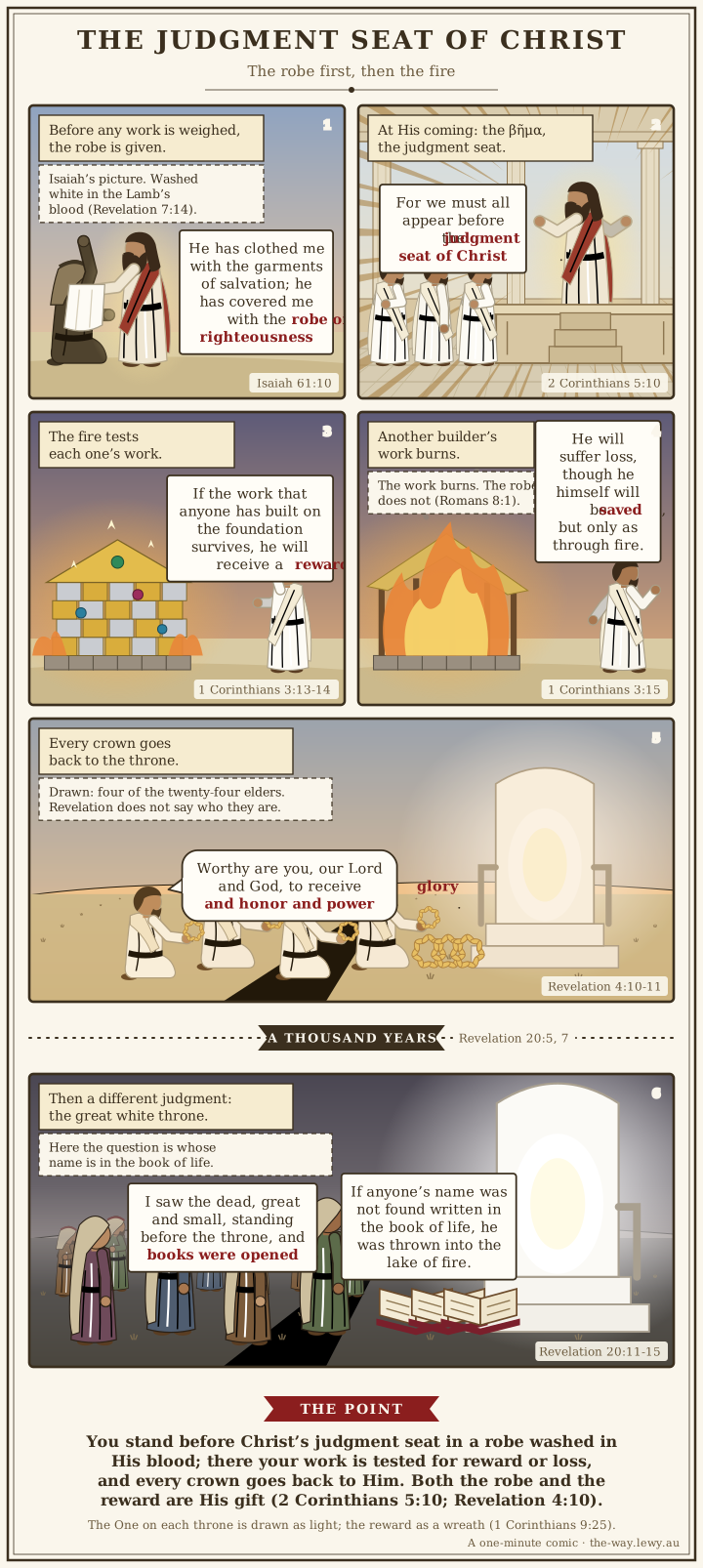
"For we must all appear before the judgment seat of Christ, so that each one may receive what is due for what he has done in the body, whether good or evil" (2 Corinthians 5:10, ESV). Paul wrote that to Christians, and included himself. Read carelessly, it sounds as if salvation is decided at the end by a ledger of deeds. Read beside the great white throne of Revelation 20, it can sound as if believers and unbelievers stand in the same line. And Revelation dresses the saints in white, which raises the question of whether the white is something they earned.
In one sentence: Every believer will stand before the judgment seat of Christ, clothed in a robe washed in His blood, to receive reward or loss for what was built on Him; that is a different judgment from the great white throne, and both the robe and the reward are His gift.
Key Takeaways
(This section follows the Key Takeaways format — see that page for what each part is for.)
Lessons about Jesus
- Jesus is the judge. "The Father judges no one, but has given all judgment to the Son" (John 5:22, ESV), so Paul can call the same tribunal "the judgment seat of God" (Romans 14:10) and "the judgment seat of Christ" (2 Corinthians 5:10).
- Isaiah said of the LORD, "his reward is with him" (Isaiah 40:10, ESV). Jesus says it of Himself: "I am coming soon, bringing my recompense with me" (Revelation 22:12, ESV). The reward is His to give because He is the LORD who comes.
- The white robes are white because they were washed "in the blood of the Lamb" (Revelation 7:14, ESV). What makes a believer fit to stand before Jesus is what Jesus did.
- Jesus is the foundation every believer builds on (1 Corinthians 3:11), and the one who tests the building.
Memory verses
✝️ 2 Corinthians 5:10 (ESV)
10 For we must all appear before the judgment seat of Christ, so that each one may receive what is due for what he has done in the body, whether good or evil.
✝️ Revelation 22:12 (ESV)
12 "Behold, I am coming soon, bringing my recompense with me, to repay each one for what he has done.
Be Transformed
- Think. Your standing before God was settled at the cross, and your work will still be examined. Hold both. The first keeps the judgment seat from being a terror; the second keeps grace from becoming an excuse.
- Attitude. Paul's response to the judgment seat was ambition: "we make it our aim to please him" (2 Corinthians 5:9, ESV). Take that posture toward an ordinary week, as someone whose Lord notices a cup of cold water (Matthew 10:42).
- Do. Choose one thing this week that nobody will see or thank you for (Matthew 6:4), and do it for Jesus by name.
Prayer
Lord Jesus, You are the foundation, and You are the judge. Thank You that the robe I will stand in was washed in Your blood, and that no condemnation is waiting for me. Build in me what will last the fire: let what I do be the work You prepared for me, done by Your grace. When I stand before You, let me not shrink back in shame, and let every crown You give me go back to Your feet. In Jesus' name. Amen.
Study outline
- What the Old Testament already said: God as Abram's reward, repayment and steadfast love in one verse, and the reward that comes with the LORD.
- The judgment seat and Good or evil: what Paul says happens there, the words he uses for it, and what loss means.
- Reward is grace too: why a reward for works is never wages for salvation, and Ezekiel's call as the pattern: the work, the words and the Spirit all given, and a watchman's account that Paul applies to himself. Then the crowns the New Testament names.
- Two garments: the white robe washed in the blood and the fine linen of righteous deeds, in one table.
- Two judgments: the great white throne, and the judgment seat beside it in a table with the three things that keep them apart.
- Where the reading is contested: the case for one general judgment, the case for two, and what the text leaves open.
What the Old Testament already said
God is the reward
The first time the Bible uses the word, God offers Himself. "Fear not, Abram, I am your shield; your reward shall be very great" (Genesis 15:1, ESV). The word is שָׂכָר (sakar, H7939), a hired man's wages, the word Jacob uses when he bargains with Laban (Genesis 30:28, 32), and here it is the LORD's word to a man who has just refused the spoil of a king (Genesis 14:22-24). Abram had not hired himself to anyone. The reward was the God who called him.
The Psalms hold repayment and love in a single verse: "to you, O Lord, belongs steadfast love. For you will render to a man according to his work" (Psalm 62:12, ESV). חֶסֶד (chesed, H2617), covenant love, and תְשַׁלֵּם (teshallem, H7999, "you repay") stand side by side. The psalmist finds the repayment part of the love: a God who notices what His people do is a God who keeps faith with them.
His reward is with Him
Isaiah twice pictures the LORD arriving with His reward in hand. "Behold, the Lord GOD comes with might... behold, his reward is with him, and his recompense before him" (Isaiah 40:10, ESV), and again to the daughter of Zion: "Behold, your salvation comes; behold, his reward is with him" (Isaiah 62:11, ESV). The Septuagint renders it ὁ μισθὸς αὐτοῦ μετʼ αὐτοῦ, "his reward is with him" (Isaiah 40:10, Brenton's Septuagint). Jesus' closing words in Revelation take that sentence in the first person: "Ἰδοὺ ἔρχομαι ταχύ, καὶ ὁ μισθός μου μετʼ ἐμοῦ", "I am coming soon, bringing my recompense with me" (Revelation 22:12, ESV). The One who comes with the reward in Isaiah is the Lord GOD, and Jesus speaks as that One.
Two awakenings, and the wise who shine
Daniel puts resurrection and reward in two verses. "Many of those who sleep in the dust of the earth shall awake, some to everlasting life, and some to shame and everlasting contempt. And those who are wise shall shine like the brightness of the sky above; and those who turn many to righteousness, like the stars forever and ever" (Daniel 12:2-3, ESV). Two destinies, and within the first, a difference: וּמַצְדִּיקֵי הָרַבִּים (umatsdiqe harabbim, "those who turn many to righteousness") shine like stars. Read as a group within those raised to life, they are given greater glory; some read verse 3 as all the righteous of verse 2, so hold the degrees more loosely than the two destinies.
Malachi adds that the LORD keeps a record of His own. "A book of remembrance was written before him of those who feared the LORD and esteemed his name. 'They shall be mine, says the LORD of hosts, in the day when I make up my treasured possession'" (Malachi 3:16-17, ESV). The book is written for the people He calls His own.
The judgment seat
What Paul says happens there
Paul introduces the judgment seat while talking about death and the resurrection body (2 Corinthians 5:1-8). He would rather be "away from the body and at home with the Lord" (2 Corinthians 5:8, ESV), and the next sentence is what that hope does to him now: "So whether we are at home or away, we make it our aim to please him. For we must all appear before the judgment seat of Christ" (2 Corinthians 5:9-10, ESV). The judgment seat is the reason a man who is sure of heaven still works.
The seat is the βῆμα (bēma, G968), the raised tribunal from which a Roman governor gave verdicts. The Corinthians had seen Paul brought before the one in their own forum, where Gallio threw the case out (Acts 18:12-17). The Rapture works through all twelve New Testament uses of the word.
In Romans the same seat is "the judgment seat of God", and Paul backs it with Isaiah 45:23, "every knee shall bow to me" (Romans 14:10-11, ESV). Some manuscripts read "of Christ" there, which is what the KJV prints (the CSB footnotes the variant). Either way Paul speaks of one tribunal, because the Father "has given all judgment to the Son" and "authority to execute judgment, because he is the Son of Man" (John 5:22, 27, ESV). The NIV Cultural Backgrounds Study Bible observes that by putting Jesus where Jewish sources put God on His throne, Paul depicts Jesus as divine (note on 2 Corinthians 5:10).
The words Paul chooses
Paul's vocabulary for the believer's appearance is the language of disclosure and wages:
| Greek | Meaning | Where |
|---|---|---|
| φανερόω (phaneroō, G5319) | be made visible, laid open | "we must all appear" (2 Corinthians 5:10); He "will disclose the purposes of the heart" (1 Corinthians 4:5) |
| δοκιμάζω (dokimazō, G1381) | test, as metal is assayed | "the fire will test what sort of work each one has done" (1 Corinthians 3:13) |
| κομίζω (komizō, G2865) | receive back, carry off | "so that each one may receive" (2 Corinthians 5:10) |
| μισθός (misthos, G3408) | wages, reward | "he will receive a reward" (1 Corinthians 3:14); "each will receive his wages according to his labor" (1 Corinthians 3:8) |
| ἔπαινος (epainos, G1868) | praise, commendation | "each one will receive his commendation from God" (1 Corinthians 4:5) |
The passages about the believer at the judgment seat never say he is condemned there. 1 Corinthians 4:5 ends the scene with praise from God. That is the same Lord who said that whoever believes "does not come into judgment, but has passed from death to life" (John 5:24, ESV): the word is κρίσις (krisis, G2920), judgment as a verdict on the person.
What is examined
1 Corinthians 3 says what is laid open: the building. "No one can lay a foundation other than that which is laid, which is Jesus Christ. Now if anyone builds on the foundation with gold, silver, precious stones, wood, hay, straw—each one's work will become manifest, for the Day will disclose it" (1 Corinthians 3:11-13, ESV). Work that survives brings a reward; work that burns is loss, "though he himself will be saved, but only as through fire" (1 Corinthians 3:15, ESV). Saved as Through Fire works through that passage verse by verse. The builders there are first those who teach and lead the church; reading it of every believer's work is a fair application, since 2 Corinthians 5:10 says "each one", but it is a step beyond the passage's first meaning. Here the point is its order: the foundation is laid before anyone builds, and the fire tests what was built.
Good or evil
Everything done is laid open
"Whether good or evil" translates εἴτε ἀγαθὸν εἴτε φαῦλον. φαῦλος (phaulos, G5337) occurs six times in the New Testament. John uses it for "everyone who does wicked things" and hates the light (John 3:20, ESV), and for those who "have done evil" and come out "to the resurrection of judgment" (John 5:29, ESV). Paul pairs it with "good" again for Jacob and Esau, who "had done nothing either good or bad" (Romans 9:11, ESV), so "good or bad" is its ordinary range: the pair covers everything done. What a believer has done badly will be laid open before Jesus as well as what he has done well. Tischendorf and the SBLGNT read φαῦλον; the Textus Receptus behind the KJV ("good or bad") and the Byzantine text read κακόν, the commoner word for evil, with the same sense.
What loss means
The New Testament gives loss a definite shape for a believer:
- Work burned up. "If anyone's work is burned up, he will suffer loss" (1 Corinthians 3:15, ESV).
- Shame at His coming. "Abide in him, so that when he appears we may have confidence and not shrink from him in shame at his coming" (1 John 2:28, ESV).
- Reward forfeited. "Watch yourselves, so that you may not lose what we have worked for, but may win a full reward" (2 John 8, ESV); "Hold fast what you have, so that no one may seize your crown" (Revelation 3:11, ESV).
- Wrong repaid. Paul tells Christian slaves, "from the Lord you will receive the inheritance as your reward... For the wrongdoer will be paid back for the wrong he has done, and there is no partiality" (Colossians 3:24-25, ESV).
Each of these is something lost by a person who is still the Lord's. Condemnation has already been borne by Jesus: "There is therefore now no condemnation for those who are in Christ Jesus" (Romans 8:1, ESV). The judgment seat weighs a son's work; his sonship was settled at the cross.
Reward is grace too
Wages are the wrong word for salvation
Paul uses μισθός for the believer's reward (1 Corinthians 3:8, 14), and he uses the same word to explain why salvation can never be earned: "Now to the one who works, his wages are not counted as a gift but as his due. And to the one who does not work but believes in him who justifies the ungodly, his faith is counted as righteousness" (Romans 4:4-5, ESV). Wages are owed. Righteousness is credited to the one who believes. "If it is by grace, it is no longer on the basis of works; otherwise grace would no longer be grace" (Romans 11:6, ESV).
None of Paul's six uses of μισθός names salvation. Salvation by grace through faith is "the gift of God" (Ephesians 2:8, ESV), received "not a result of works, so that no one may boast" (Ephesians 2:9, ESV). The reward is given to people who are already saved, for what they did as saved people.
Even the work is His
The next verse explains how a reward can be for works and still be grace: "we are his workmanship, created in Christ Jesus for good works, which God prepared beforehand, that we should walk in them" (Ephesians 2:10, ESV). God prepared the works and created the worker for them. Paul says the same of himself: "I worked harder than any of them, though it was not I, but the grace of God that is with me" (1 Corinthians 15:10, ESV). And to the Philippians: "work out your own salvation with fear and trembling, for it is God who works in you, both to will and to work for his good pleasure" (Philippians 2:12-13, ESV).
That leaves no ground for boasting at the judgment seat. Two verses after the commendation of 1 Corinthians 4:5, Paul asks the Corinthians, "What do you have that you did not receive?" (1 Corinthians 4:7, ESV). Jesus taught His disciples to say, after doing all they were commanded, "We are unworthy servants; we have only done what was our duty" (Luke 17:10, ESV). And when Revelation shows crowns in heaven, the elders "cast their crowns before the throne, saying, 'Worthy are you, our Lord and God'" (Revelation 4:10-11, ESV).
This shows that God rewards what His grace produced. He crowns His own work in you and lets you hold the crown long enough to give it back to Him.
Given the work, and the Spirit to do it
The Spirit and the words, both given
Ezekiel's call shows the same order in one man's life. He fell on his face before the glory of the LORD, and God said, "Son of man, stand on your feet, and I will speak with you" (Ezekiel 2:1, ESV). Ezekiel did not stand by his own strength: "And as he spoke to me, the Spirit entered into me and set me on my feet" (Ezekiel 2:2, ESV). The word is רוּחַ (ruach, H7307), which means wind, breath or spirit; the ESV reads it as the Spirit, and the next chapter says the same Spirit lifted him and set him on his feet again (Ezekiel 3:12, 14, 24).
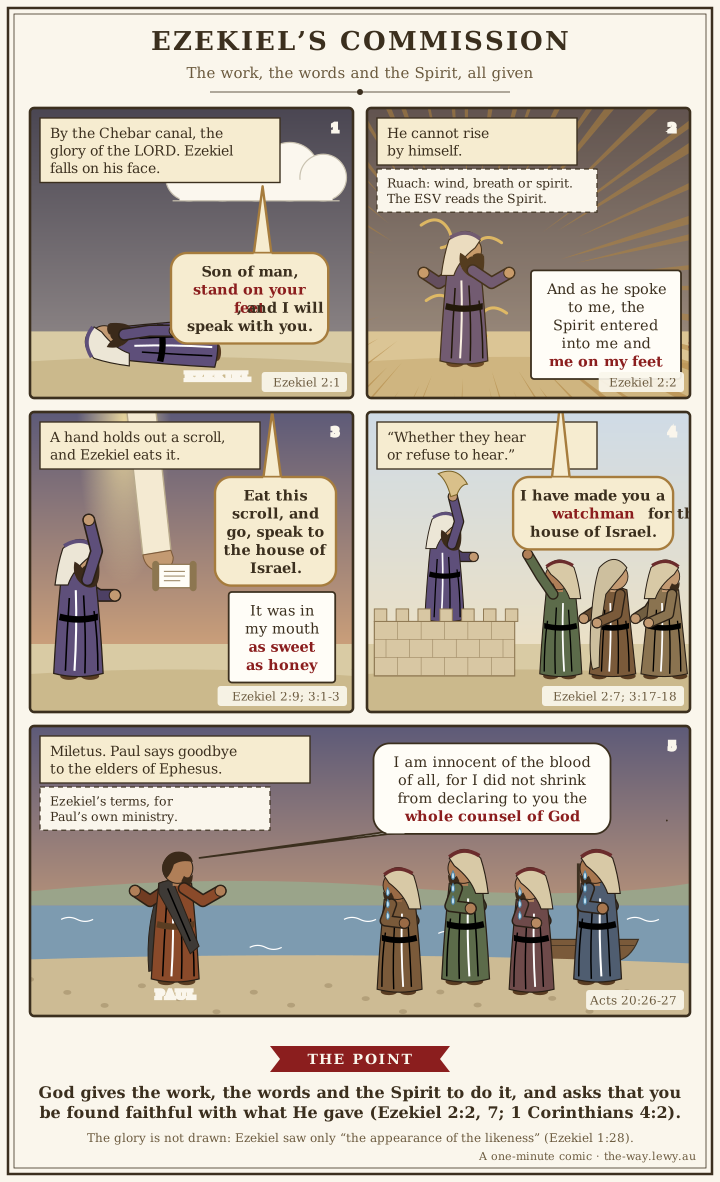
Then God gave him the words, as a meal. A hand held out a scroll, and he was told, "Eat this scroll, and go, speak to the house of Israel" (Ezekiel 3:1, ESV). "Then I ate it, and it was in my mouth as sweet as honey" (Ezekiel 3:3, ESV). Even his speaking was given: "when I speak with you, I will open your mouth, and you shall say to them, 'Thus says the Lord GOD'" (Ezekiel 3:27, ESV).
A watchman's account, in Ezekiel and in Paul
God measured him by faithfulness, and gave him the measure in advance: "you shall speak my words to them, whether they hear or refuse to hear" (Ezekiel 2:7, ESV). He made Ezekiel a watchman, and the account was strict: "If I say to the wicked, 'You shall surely die,' and you give him no warning... his blood I will require at your hand" (Ezekiel 3:18, ESV).
Paul used the watchman's language of his own work. Leaving Ephesus he said, "I am innocent of the blood of all, for I did not shrink from declaring to you the whole counsel of God" (Acts 20:26-27, ESV). At Corinth he told the synagogue, "Your blood be on your own heads! I am innocent" (Acts 18:6, ESV), close to Ezekiel's "his blood shall be upon his own head" (Ezekiel 33:4, ESV). Neither is a quotation; both are Ezekiel's terms. And straight after the judgment seat Paul writes, "Therefore, knowing the fear of the Lord, we persuade others" (2 Corinthians 5:11, ESV). "It is required of stewards that they be found faithful" (1 Corinthians 4:2, ESV).
What changes at the judgment seat, and what carries over
Two things change between Ezekiel and the judgment seat. Ezekiel's watch was a prophet's office, with a word for one people facing one judgment; the New Testament gives the watchman's account to Paul's apostolic teaching and to leaders who "will have to give an account" (Hebrews 13:17, ESV), and asks every believer to be "prepared to make a defense to anyone who asks you for a reason for the hope that is in you" (1 Peter 3:15, ESV). And the stakes in Ezekiel 3:16-21 are life and death: the watchman who warns "will have delivered your soul" (Ezekiel 3:19, ESV). At the judgment seat the stakes are reward and loss for people already saved (1 Corinthians 3:14-15; Romans 8:1).
What carries over is the pattern. God gives the work, gives the words, gives the Spirit to do it, and then asks whether you were faithful with what He gave. This shows that God never assigns a work He does not also equip, and that He weighs faithfulness, which is in your hands by His grace, and leaves the results with Himself.
The crowns named
The New Testament names the rewards as crowns: an imperishable wreath for those who run with discipline (1 Corinthians 9:25), "the crown of righteousness, which the Lord, the righteous judge, will award to me on that day, and not only to me but also to all who have loved his appearing" (2 Timothy 4:8, ESV), the crown of life for those who remain steadfast under trial (James 1:12; Revelation 2:10), and the unfading crown of glory for faithful shepherds (1 Peter 5:4). Paul called the believers he had brought to Christ his "crown of boasting before our Lord Jesus at his coming" (1 Thessalonians 2:19, ESV), the same picture Daniel gave of those who turn many to righteousness.
Two garments
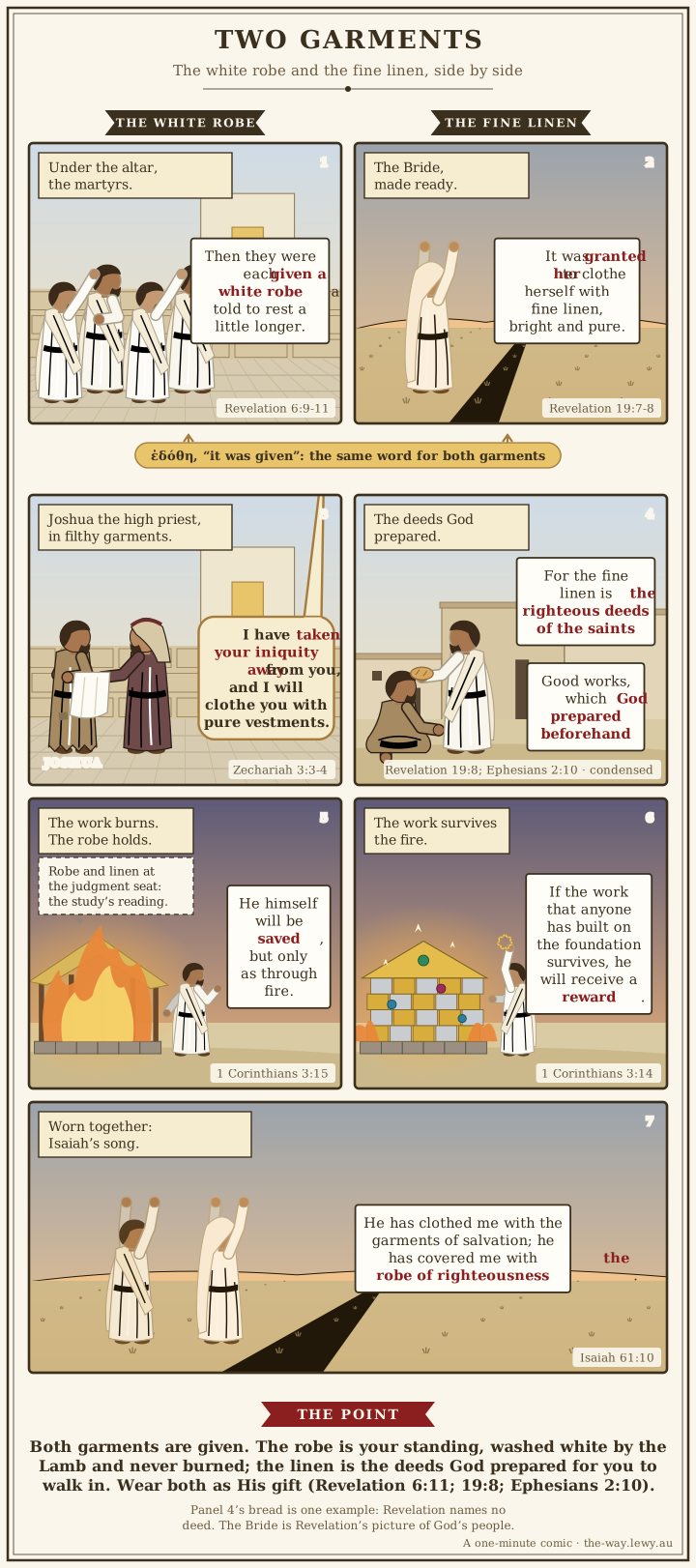
Revelation clothes the saints in two garments and explains both. The white robe is washed and made "white in the blood of the Lamb" (Revelation 7:14, ESV). The fine linen "is the righteous deeds of the saints" (Revelation 19:8, ESV). Both arrive the same way, ἐδόθη, "it was given" (Revelation 6:11) and "it was granted her" (Revelation 19:8). They Were Given White Robes works through every white garment in Scripture, from Eden to the Bride. For the judgment seat one distinction matters:
| The white robe (στολή) | The fine linen (βύσσινον) | |
|---|---|---|
| How it is described | Washed and made white in the blood of the Lamb (Revelation 7:14) | "The righteous deeds of the saints" (Revelation 19:8) |
| How it is received | ἐδόθη, "given" (Revelation 6:11) | ἐδόθη, the same verb, "granted" in the ESV (Revelation 19:8) |
| What it answers | May this person stand before God and enter the city? (Revelation 22:14) | What did they do with what they were given? |
| Old Testament picture | The robe of righteousness (Isaiah 61:10); Joshua's clean vestments (Zechariah 3:4) | The bride adorning herself, in the same verse (Isaiah 61:10) |
| The judgment it belongs with | Settled at the cross; no condemnation (Romans 8:1) | The judgment seat (2 Corinthians 5:10) |
The robe answers whether a person may stand; the linen shows what they built. That they answer two different questions is this study's reading of the text's own explanations: blood for the one, deeds for the other. Both are given.
Two judgments
The great white throne
✝️ Revelation 20:11-12, 15 (ESV)
11 Then I saw a great white throne and him who was seated on it. From his presence earth and sky fled away, and no place was found for them. 12 And I saw the dead, great and small, standing before the throne, and books were opened. Then another book was opened, which is the book of life. And the dead were judged by what was written in the books, according to what they had done. ... 15 And if anyone's name was not found written in the book of life, he was thrown into the lake of fire.
Revelation sets this scene after the thousand years: "The rest of the dead did not come to life until the thousand years were ended. This is the first resurrection. Blessed and holy is the one who shares in the first resurrection! Over such the second death has no power" (Revelation 20:5-6, ESV). The verb at the throne is κρίνω (krinō, G2919): "they were judged" (Revelation 20:12, 13). The outcome for anyone not in the book of life is the lake of fire, "the second death" (Revelation 20:14, ESV).
The two side by side, and what keeps them apart
The table sets the two scenes side by side; the three differences after it are where the text itself keeps them apart.
| The judgment seat | The great white throne | |
|---|---|---|
| Name | βῆμα, tribunal (2 Corinthians 5:10) | θρόνος μέγας λευκός, a great white throne (Revelation 20:11) |
| Judge | Christ (2 Corinthians 5:10) | "Him who was seated on it" (Revelation 20:11); all judgment is the Son's (John 5:22) |
| Who stands there | "We all", those Paul calls brothers (2 Corinthians 5:10; Romans 14:10) | "The dead, great and small" (Revelation 20:12) |
| When | At the Lord's coming: "before the Lord comes... Then each one will receive his commendation" (1 Corinthians 4:5); "at the resurrection of the just" (Luke 14:14) | After the thousand years (Revelation 20:5, 7, 11) |
| What is examined | The work built on the foundation (1 Corinthians 3:12-13) | "What they had done", written in the books (Revelation 20:12) |
| The deciding question | What sort of work was it? (1 Corinthians 3:13) | Is the name written in the book of life? (Revelation 20:15) |
| Outcome | Reward or loss; "he himself will be saved" (1 Corinthians 3:14-15) | Anyone not in the book of life to the lake of fire (Revelation 20:15) |
Three things in the text keep them apart.
The people. Jesus put two resurrections in one sentence: "those who have done good to the resurrection of life, and those who have done evil to the resurrection of judgment" (John 5:29, ESV). He had just said that the one who believes "does not come into judgment" (John 5:24, ESV). The judgment seat is where those who are already His appear; Paul says "we".
The time. Paul orders the resurrection: "Christ the firstfruits, then at his coming those who belong to Christ" (1 Corinthians 15:23, ESV). Jesus put the believer's repayment "at the resurrection of the just" (Luke 14:14, ESV), and Paul tells the Corinthians not to judge "before the Lord comes", because "then each one will receive his commendation from God" (1 Corinthians 4:5, ESV). Revelation 20 puts a thousand years between the first resurrection and "the rest of the dead" (Revelation 20:5). The judgment seat belongs with the first.
The question. At the judgment seat the foundation is already laid and the question is what was built on it. At the great white throne the book of life is opened, and a name not found there means the lake of fire. The believer's name was written there by grace; Jesus promises the one who conquers, "I will never blot his name out of the book of life" (Revelation 3:5, ESV).
Revelation 20:11 does not name the One on the throne; because the Father "has given all judgment to the Son" (John 5:22, ESV), the same Lord sits at both. This shows that God judges everyone, and that He judges His own children as a Father: their sin already judged at the cross, their work weighed so it can be rewarded.
Where the reading is contested
The case for one general judgment
Many Christians read the New Testament as describing one general judgment at the end, with believers and unbelievers together. The case is in the text:
- Jesus describes one scene when "the Son of Man comes in his glory... Before him will be gathered all the nations, and he will separate people one from another" (Matthew 25:31-32, ESV).
- Jesus puts both resurrections in one hour: "an hour is coming when all who are in the tombs will hear his voice and come out" (John 5:28-29, ESV).
- At the seventh trumpet the elders sing of "the time for the dead to be judged, and for rewarding your servants, the prophets and saints" (Revelation 11:18, ESV), judging and rewarding in one breath.
- Romans 2:6-7 says God "will render to each one according to his works: to those who by patience in well-doing seek for glory and honor and immortality, he will give eternal life" (ESV).
- The book of life is opened at the great white throne (Revelation 20:12, 15), which would be pointless if no name in it were present. The ESV Study Bible reads "the dead, great and small" as including the saints of Revelation 11:18 and 19:5 (note on 20:12).
The case for two judgments
The case for two judgments, which this site holds, is also in the text. Revelation 20:5-6 separates the first resurrection from "the rest of the dead" by a thousand years and says the second death has no power over those in the first. Jesus says the believer "does not come into judgment" (John 5:24). Paul ties the believer's commendation to the Lord's coming (1 Corinthians 4:5). Matthew 25:31-46 is read on this view as the judgment of the nations living at His return, a third scene. The "hour" of John 5:28 can span an age, as the hour that "is now here" in John 5:25 (ESV) has. Revelation 11:18 is read as compressing the end, and the ESV Study Bible notes that many futurists take the verse to skip forward beyond the millennium to the final judgment (note on 11:15-18).
What stays open
Some edges stay open on this reading. Revelation 20 does not say who, if anyone, is found written in the book of life at the great white throne; some dispensational teachers place there the believers who die during the thousand years. That no one there is a believer is an inference from "the rest of the dead" (Revelation 20:5), and it should be held as one. What the text does settle is the believer's side: whoever "shares in the first resurrection" is beyond the second death (Revelation 20:6), and nobody in Christ comes under condemnation (Romans 8:1).
Discussion questions
- The language. Paul uses μισθός (misthos), wages, for the believer's reward (1 Corinthians 3:14) and for what salvation can never be (Romans 4:4). How does the difference between a reward for the saved and wages for salvation change the way you hear Jesus' "my recompense is with me" (Revelation 22:12)?
- The text in its context. Paul brings up the judgment seat in a passage about longing for the resurrection body (2 Corinthians 5:1-10). Why does the hope of heaven lead him straight to "we make it our aim to please him"?
- Christ. Isaiah says of the Lord GOD, "his reward is with him" (Isaiah 40:10), and Jesus says "my recompense is with me" (Revelation 22:12). What does it tell you about Jesus that He speaks the LORD's line as His own?
- The hard part. Paul says a believer will receive for what he has done, "whether good or evil" (2 Corinthians 5:10), and the bad is laid open as well as the good. How do you hold that alongside "no condemnation" (Romans 8:1) without softening either?
- Be transformed. The elders cast their crowns at His feet (Revelation 4:10). What would change in the way you serve this week if you expected to give back everything you are given for it?
Group study sheet for a 40-minute group: two A4 sheets, or one with the guided path
The point, the passage, the questions and the response, from this study. Print on both sides of two A4 sheets, flipping on the long edge. While this block is open, printing the page prints the sheet; close it to print the study.
The Judgment Seat of Christ
2 Corinthians 5:10; 1 Corinthians 3:10-15; Revelation 20:11-15The point Every believer will stand before the judgment seat of Christ, clothed in a robe washed in His blood, to receive reward or loss for what was built on Him; that is a different judgment from the great white throne, and both the robe and the reward are His gift.
Ask: Will Christians be judged?
Hear a few answers before anyone reads.
2 Corinthians 5:10 10For we must all appear before the judgment seat of Christ, that each one may receive his due for the things done in the body, whether good or bad.
1 Corinthians 3:10-15 10By the grace God has given me, I laid a foundation as an expert builder, and someone else is building on it. But each one must be careful how he builds. 11For no one can lay a foundation other than the one already laid, which is Jesus Christ. 12If anyone builds on this foundation using gold, silver, precious stones, wood, hay, or straw, 13his workmanship will be evident, because the Day will bring it to light. It will be revealed with fire, and the fire will prove the quality of each man’s work. 14If what he has built survives, he will receive a reward. 15If it is burned up, he will suffer loss. He himself will be saved, but only as if through the flames.
Revelation 20:11-15 11Then I saw a great white throne and the One seated on it. Earth and heaven fled from His presence, and no place was found for them. 12And I saw the dead, great and small, standing before the throne. And books were opened, and one of them was the Book of Life. And the dead were judged according to their deeds, as recorded in the books. 13The sea gave up its dead, and Death and Hades gave up their dead, and each one was judged according to his deeds. 14Then Death and Hades were thrown into the lake of fire. This is the second death—the lake of fire. 15And if anyone was found whose name was not written in the Book of Life, he was thrown into the lake of fire.
Also read:
The Judgment Seat of Christ
- What the Old Testament already said: God as Abram's reward, repayment and steadfast love in one verse, and the reward that comes with the LORD.
- The judgment seat and Good or evil: what Paul says happens there, the words he uses for it, and what loss means.
- Reward is grace too: why a reward for works is never wages for salvation, and Ezekiel's call as the pattern: the work, the words and the Spirit all given, and a watchman's account that Paul applies to himself. Then the crowns the New Testament names.
- Two garments: the white robe washed in the blood and the fine linen of righteous deeds, in one table.
- Two judgments: the great white throne, and the judgment seat beside it in a table with the three things that keep them apart.
- Where the reading is contested: the case for one general judgment, the case for two, and what the text leaves open.
The Judgment Seat of Christ
1Christ. Isaiah says of the Lord GOD, "his reward is with him" (Isaiah 40:10), and Jesus says "my recompense is with me" (Revelation 22:12). What does it tell you about Jesus that He speaks the LORD's line as His own?
2The text in its context. Paul brings up the judgment seat in a passage about longing for the resurrection body (2 Corinthians 5:1-10). Why does the hope of heaven lead him straight to "we make it our aim to please him"?
3The hard part. Paul says a believer will receive for what he has done, "whether good or evil" (2 Corinthians 5:10), and the bad is laid open as well as the good. How do you hold that alongside "no condemnation" (Romans 8:1) without softening either?
4The language. Paul uses μισθός (misthos), wages, for the believer's reward (1 Corinthians 3:14) and for what salvation can never be (Romans 4:4). How does the difference between a reward for the saved and wages for salvation change the way you hear Jesus' "my recompense is with me" (Revelation 22:12)?
The Judgment Seat of Christ
5Be transformed. The elders cast their crowns at His feet (Revelation 4:10). What would change in the way you serve this week if you expected to give back everything you are given for it?
- Think. Your standing before God was settled at the cross, and your work will still be examined. Hold both. The first keeps the judgment seat from being a terror; the second keeps grace from becoming an excuse.
- Attitude. Paul's response to the judgment seat was ambition: "we make it our aim to please him" (2 Corinthians 5:9, ESV). Take that posture toward an ordinary week, as someone whose Lord notices a cup of cold water (Matthew 10:42).
- Do. Choose one thing this week that nobody will see or thank you for (Matthew 6:4), and do it for Jesus by name.
For we must all appear before the judgment seat of Christ, so that each one may receive what is due for what he has done in the body, whether good or evil.
2 Corinthians 5:10 (ESV)Lord Jesus, You are the foundation, and You are the judge. Thank You that the robe I will stand in was washed in Your blood, and that no condemnation is waiting for me. Build in me what will last the fire: let what I do be the work You prepared for me, done by Your grace. When I stand before You, let me not shrink back in shame, and let every crown You give me go back to Your feet. In Jesus' name. Amen.
The Judgment Seat of Christ
2 Corinthians 5:10; 1 Corinthians 3:10-15; Revelation 20:11-15Open Ask: Will Christians be judged?
Hear a few answers before anyone reads.
Read it aloud 2 Corinthians 5:10; 1 Corinthians 3:10-15; Revelation 20:11-15
1Christ. Isaiah says of the Lord GOD, "his reward is with him" (Isaiah 40:10), and Jesus says "my recompense is with me" (Revelation 22:12). What does it tell you about Jesus that He speaks the LORD's line as His own?
2The text in its context. Paul brings up the judgment seat in a passage about longing for the resurrection body (2 Corinthians 5:1-10). Why does the hope of heaven lead him straight to "we make it our aim to please him"?
3The hard part. Paul says a believer will receive for what he has done, "whether good or evil" (2 Corinthians 5:10), and the bad is laid open as well as the good. How do you hold that alongside "no condemnation" (Romans 8:1) without softening either?
4The language. Paul uses μισθός (misthos), wages, for the believer's reward (1 Corinthians 3:14) and for what salvation can never be (Romans 4:4). How does the difference between a reward for the saved and wages for salvation change the way you hear Jesus' "my recompense is with me" (Revelation 22:12)?
5Be transformed. The elders cast their crowns at His feet (Revelation 4:10). What would change in the way you serve this week if you expected to give back everything you are given for it?
- Think. Your standing before God was settled at the cross, and your work will still be examined. Hold both. The first keeps the judgment seat from being a terror; the second keeps grace from becoming an excuse.
- Attitude. Paul's response to the judgment seat was ambition: "we make it our aim to please him" (2 Corinthians 5:9, ESV). Take that posture toward an ordinary week, as someone whose Lord notices a cup of cold water (Matthew 10:42).
- Do. Choose one thing this week that nobody will see or thank you for (Matthew 6:4), and do it for Jesus by name.
The Judgment Seat of Christ
The point Every believer will stand before the judgment seat of Christ, clothed in a robe washed in His blood, to receive reward or loss for what was built on Him; that is a different judgment from the great white throne, and both the robe and the reward are His gift.
References & Recommended Reading
- ESV Study Bible (Crossway, 2008): notes on 2 Corinthians 5:10, Revelation 11:15-18, 19:7-8, 20:11-15 and 20:12. Quoted briefly with attribution.
- NIV Biblical Theology Study Bible (Zondervan, 2018): notes on 2 Corinthians 5:10 and Revelation 19:8, 20:12.
- NIV Cultural Backgrounds Study Bible (Zondervan, 2016): note on 2 Corinthians 5:10.
- CSB Ancient Faith Study Bible (Holman, 2019): textual footnotes on Romans 14:10 and Revelation 22:14.
- Greek: SBL Greek New Testament, with Tischendorf's 8th edition, the Textus Receptus, the Byzantine Textform 2013 and the KJV compared at 2 Corinthians 5:10, Romans 14:10 and Revelation 22:14; word counts from the MACULA Greek SBLGNT morphology.
- Hebrew: unfoldingWord Hebrew Bible and ULT interlinear for Genesis 15:1, Psalm 62:12, Isaiah 40:10, 61:10, Daniel 12:3 and Ezekiel 2:2; Brenton's Septuagint for Isaiah 40:10 and 62:11, and for Ezekiel 3:18 and 33:4 beside Acts 18:6 and 20:26.
- ESV Study Bible: notes on Ezekiel 2:1-3:11, 3:16-21 and 3:18-19 (the watchman's fidelity), and on Acts 18:6 and 20:26-27, which both send the reader to Ezekiel 33.
On this site
- The Rapture: the twelve uses of βῆμα and where the judgment seat falls in the sequence of His coming.
- Saved as Through Fire: 1 Corinthians 3:10-15 verse by verse.
- The Bride of Christ: the Bride made ready and granted her linen.
- They Were Given White Robes: every white garment in Scripture, and why each is God's gift.
- We Shall All Be Changed: the white robes beside the resurrection body.
- Assurance of Salvation: why the believer's standing is secure.
- Partakers of the Divine Nature: the virtues of 2 Peter 1 as fruit, and the entrance "richly provided".
- Statement of Faith: the short confession this study backs.