Partakers of the Divine Nature
New, published 15 October 2026. What else is new
✝️ 2 Peter 1:3-4 (ESV)
3 His divine power has granted to us all things that pertain to life and godliness, through the knowledge of him who called us to his own glory and excellence, 4 by which he has granted to us his precious and very great promises, so that through them you may become partakers of the divine nature, having escaped from the corruption that is in the world because of sinful desire.
Peter wrote his second letter expecting to die soon (2 Peter 1:14). Straight after his greeting he spent a paragraph on how a Christian grows: eight qualities, from faith to love, and a welcome into Christ's kingdom at the end of them. He begins with what God has already given.
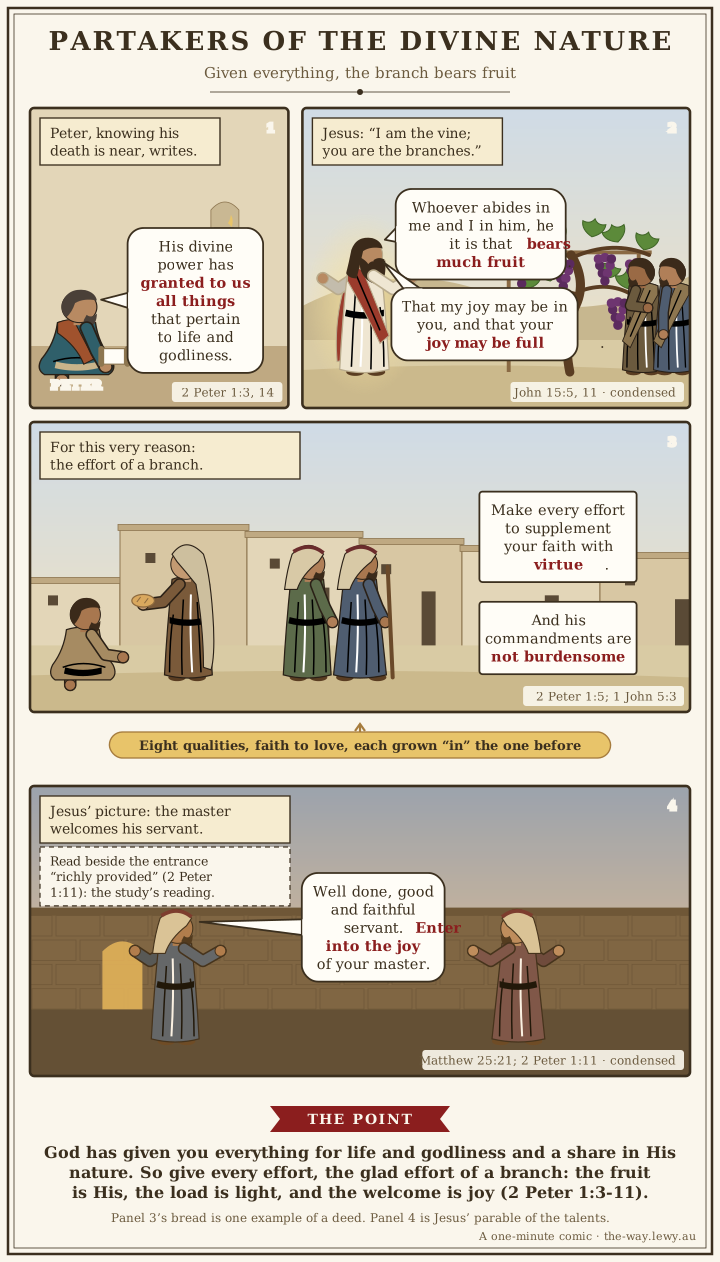
In one sentence: God has already given you everything a godly life needs and a share in His own nature, so the virtues of 2 Peter 1 grow as that nature's fruit: you give them real effort, the effort of a living branch, they carry no burden of earning, they come with joy, and they end in a rich welcome into the kingdom of your Lord Jesus.
Key Takeaways
(This section follows the Key Takeaways format — see that page for what each part is for.)
Lessons about Jesus
- Jesus is most likely the one who "called us to his own glory and excellence" (2 Peter 1:3, ESV), named last in the verse before; some read the Father. The word for "excellence", ἀρετή, is the "virtue" Peter tells you to add two verses later. The virtue you grow is His first.
- Jesus is the vine: "Whoever abides in me and I in him, he it is that bears much fruit" (John 15:5, ESV). The fruit comes from Him through you.
- He said why He taught the vine: "that my joy may be in you, and that your joy may be full" (John 15:11, ESV).
Memory verses
✝️ 2 Peter 1:3 (ESV)
3 His divine power has granted to us all things that pertain to life and godliness, through the knowledge of him who called us to his own glory and excellence,
✝️ Galatians 5:22-23 (ESV)
22 But the fruit of the Spirit is love, joy, peace, patience, kindness, goodness, faithfulness, 23 gentleness, self-control; against such things there is no law.
Be Transformed
- Think. Start from the gift. Everything that pertains to life and godliness has been granted (2 Peter 1:3). You are drawing on a supply.
- Attitude. Keep your cleansing in view. Peter says the one who lacks these qualities has "forgotten that he was cleansed from his former sins" (2 Peter 1:9, ESV). Growth starts in remembering grace.
- Do. Pick one of Peter's eight qualities that is thin in you this week. Ask God for it, then practise it in one concrete place, trusting "the strength that God supplies" (1 Peter 4:11, ESV).
Prayer
Father, by Your divine power You have given me everything I need for life and godliness, and You have made me a sharer in Your nature. Thank You for cleansing me from my sins. Grow in me the fruit of Your Spirit: faith that becomes virtue, and virtue that ends in love. Make my effort the glad work of a branch in Your Son Jesus, fill me with His joy, and bring me at last into His eternal kingdom. In Jesus' name. Amen.
Study outline
- Everything already given: 2 Peter 1:3-4, the gift and the divine nature.
- Make every effort and Supplied, and supplied richly: the eight qualities, and the verb Peter uses for adding them.
- Fruitful, and never idle: what the qualities do, and what their absence shows.
- The fruit a nature bears: Galatians 5, John 15, and how effort and fruit fit together.
- His burden is light and With joy: the weight of the life and the gladness in it.
- A rich entrance: 2 Peter 1:10-11, assurance and reward.
Everything already given
Granted by His power
Peter opens with a gift that is already complete. "His divine power has granted to us all things that pertain to life and godliness" (2 Peter 1:3, ESV), and "he has granted to us his precious and very great promises" (2 Peter 1:4, ESV). Both verbs are δωρέομαι (dōreomai, G1433), "to give as a gift", in the perfect tense: given, and still in your hands. "All things" covers life and godliness (εὐσέβεια, eusebeia, G2150, devotion to God). Nothing a godly life needs is left for you to supply from your own stock.
The gift comes "through the knowledge of him who called us to his own glory and excellence" (2 Peter 1:3, ESV). The NASB, NIV and CSB read "by his own glory", the Greek dative allowing either; on both readings the excellence is His. The word for excellence is ἀρετή (aretē, G703). It appears five times in the New Testament, in four verses. Twice it is God's: here, and in 1 Peter 2:9, where the church exists "that you may proclaim the excellencies of him who called you out of darkness" (ESV). Then in 2 Peter 1:5 it is the believer's, twice, translated "virtue", and once more in Philippians 4:8. The ESV Study Bible notes that Greek writers used ἀρετή for "the sum of all desirable character qualities" (note on 2 Peter 1:3). Peter takes that word, gives it to God first, and only then asks it of you.
Sharers in His nature
The promises have a purpose: "so that through them you may become partakers of the divine nature" (2 Peter 1:4, ESV). Partakers is κοινωνοί (koinōnoi, G2844), sharers, partners. Nature is φύσις (physis, G5449), what a thing is by birth. The adjective "divine", θεῖος (theios, G2304), occurs three times in the New Testament: twice in these two verses and once in Paul's speech at Athens (Acts 17:29).
This is the new birth described from God's side; Peter's first letter says you "have been born again" (1 Peter 1:23, ESV). You remain His creature, and you share His character as you become like Him. The ESV Study Bible puts it that way: believers "never become part of God, but amazingly they share in his nature as they become increasingly like him" (note on 2 Peter 1:4). The same verse names what you have left: "the corruption that is in the world because of sinful desire".
This shows that God gives before He asks. The power, the promises and a new nature come first, so that what He asks next grows out of what He has already put in you.
Make every effort
For this very reason
Then Peter turns to you: "For this very reason, make every effort to supplement your faith with virtue" (2 Peter 1:5, ESV). "For this very reason" ties the effort to verses 3-4. You make the effort because the power and the nature are already yours.
The effort is real. "Make every effort" is σπουδὴν πᾶσαν παρεισενέγκαντες, literally "bringing in all diligence". σπουδή (spoudē, G4710) is eagerness, haste, earnestness; it occurs twelve times in the New Testament. Peter repeats the idea in verse 10 with the verb: "be all the more diligent" (σπουδάσατε, from σπουδάζω, G4704). So holiness takes effort, and Peter says so twice. He has already named its source: the power and the promises of verses 3-4.
Eight qualities
✝️ 2 Peter 1:5-7 (ESV)
5 For this very reason, make every effort to supplement your faith with virtue, and virtue with knowledge, 6 and knowledge with self-control, and self-control with steadfastness, and steadfastness with godliness, 7 and godliness with brotherly affection, and brotherly affection with love.
Three of Peter's eight qualities are also in Paul's fruit of the Spirit:
| Quality | Greek | What it is | Also in the fruit of the Spirit (Galatians 5:22-23)? |
|---|---|---|---|
| Faith | πίστις (pistis, G4102) | Trust in Christ, the root of the rest | Yes, "faithfulness" |
| Virtue | ἀρετή (aretē, G703) | Moral excellence, God's own first (2 Peter 1:3) | |
| Knowledge | γνῶσις (gnōsis, G1108) | Understanding of God and His ways | |
| Self-control | ἐγκράτεια (enkrateia, G1466) | Mastery of desire | Yes, the last in Paul's list |
| Steadfastness | ὑπομονή (hypomonē, G5281) | Endurance under pressure | |
| Godliness | εὐσέβεια (eusebeia, G2150) | Devotion to God (also 1:3) | |
| Brotherly affection | φιλαδελφία (philadelphia, G5360) | Love for fellow believers | |
| Love | ἀγάπη (agapē, G26) | Self-giving love | Yes, the first in Paul's list |
The Greek joins each quality to the one before with ἐν (en, G1722), "in": "in your faith, virtue; in virtue, knowledge", seven times. Each grows inside the last. The list runs from faith to love; the ESV Study Bible observes that faith comes first because all the virtues are its results, and love last as "the ultimate result of faith" (note on 2 Peter 1:5). It also says the list "does not reflect a legalistic code but rather the desires and features of a transformed heart" (note on 2 Peter 1:5-7).
ἐγκράτεια is a rare word: four times in the New Testament, in three verses (Acts 24:25; Galatians 5:23; 2 Peter 1:6, twice). Peter and Paul both put it on their lists of what the Christian life looks like. Love and πίστις are on both lists too, though in Galatians 5:22 πίστις means faithfulness, the reliability that trust produces.
Supplied, and supplied richly
The verb behind "supplement" is ἐπιχορηγέω (epichorēgeō, G2023), to provide, furnish, supply generously. It occurs five times in the New Testament, and in four of them God, or Christ the Head, is the one supplying:
| Verse | Who supplies | What |
|---|---|---|
| Galatians 3:5 | God, "he who supplies the Spirit to you" | The Spirit |
| 2 Corinthians 9:10 | God, "he who supplies seed to the sower" | Seed and the harvest of righteousness |
| Colossians 2:19 | The Head, Christ | The body's growth, "a growth that is from God" |
| 2 Peter 1:5 | You | Virtue, knowledge, and the rest |
| 2 Peter 1:11 | God (passive) | "An entrance into the eternal kingdom", richly |
Peter uses the word twice in seven verses. You supply virtue to your faith (2 Peter 1:5); then "there will be richly provided for you an entrance into the eternal kingdom" (2 Peter 1:11, ESV). Your supplying sits between God's supply of everything at the start (2 Peter 1:3) and His rich supply at the end. Peter used the simple verb χορηγέω (chorēgeō, G5524) in his first letter for the same arrangement: "whoever serves, as one who serves by the strength that God supplies" (1 Peter 4:11, ESV).
This shows that God is the generous supplier from first to last. The effort you bring is real, and it is drawn from His supply: He gives the Spirit, you bring the virtue, He gives the welcome, richly.
Fruitful, and never idle
Kept from being idle and fruitless
"For if these qualities are yours and are increasing, they keep you from being ineffective or unfruitful in the knowledge of our Lord Jesus Christ" (2 Peter 1:8, ESV). Two Greek words sit behind the ESV's pair.
"Ineffective" is ἀργός (argos, G692), "idle", built from ἔργον (ergon, G2041), "work", with the negative prefix: workless. Jesus used it for the men standing "idle in the marketplace" until the owner of the vineyard hired them (Matthew 20:3, 6), and James for faith with no deeds: "faith apart from works is useless" (James 2:20, ESV), where "useless" is the same word. "Unfruitful" is ἄκαρπος (akarpos, G175), fruitless, the word Jesus used for the seed among thorns, choked by "the cares of the world and the deceitfulness of riches" (Matthew 13:22, ESV).
So Peter describes the Christian life with work words and fruit words together. The qualities keep knowledge of Christ from standing idle and from bearing nothing.
What the absence shows
"For whoever lacks these qualities is so nearsighted that he is blind, having forgotten that he was cleansed from his former sins" (2 Peter 1:9, ESV). Peter's diagnosis is memory. The fruitless believer has lost sight of his cleansing. The cure he prescribes in verse 12 is the same: "I intend always to remind you of these qualities" (ESV). Remembering what Christ did is where the growth comes from.
The fruit a nature bears
Works and fruit
Paul draws the line Peter's list implies. "Now the works of the flesh are evident" (Galatians 5:19, ESV), and the list runs on to drunkenness and orgies (Galatians 5:21). "But the fruit of the Spirit is love, joy, peace, patience, kindness, goodness, faithfulness, gentleness, self-control; against such things there is no law" (Galatians 5:22-23, ESV). The flesh produces works, ἔργα (erga, G2041), plural. The Spirit produces fruit, καρπός (karpos, G2590), singular: one harvest with nine flavours.
Fruit is what a living thing produces from what it is. Jesus said so plainly: "every healthy tree bears good fruit... A healthy tree cannot bear bad fruit, nor can a diseased tree bear good fruit" (Matthew 7:17-18, ESV). The psalmist's righteous man "is like a tree planted by streams of water that yields its fruit in its season" (Psalm 1:3, ESV), and the verse before gives the source: "his delight is in the law of the LORD" (Psalm 1:2, ESV). This is why Peter can tie the virtues to "the divine nature" (2 Peter 1:4). A nature bears its own fruit. The qualities Peter lists are what the new nature, fed by the Spirit, grows.
The branch and the vine
Jesus made the source a person. "As the branch cannot bear fruit by itself, unless it abides in the vine, neither can you, unless you abide in me. I am the vine; you are the branches. Whoever abides in me and I in him, he it is that bears much fruit, for apart from me you can do nothing" (John 15:4-5, ESV). A branch's whole task is to stay joined to the vine. The life in the vine does the producing.
Effort and fruit together
Here is the hard part, because a reader can hear "fruit" and conclude the Christian life takes no effort. Scripture keeps both. The same letter that says the fruit is the Spirit's says "keep in step with the Spirit" (Galatians 5:25, ESV) and "walk by the Spirit" (Galatians 5:16, ESV). Paul tells the Philippians, "work out your own salvation with fear and trembling, for it is God who works in you, both to will and to work for his good pleasure" (Philippians 2:12-13, ESV). He says of his own labour, "I worked harder than any of them, though it was not I, but the grace of God that is with me" (1 Corinthians 15:10, ESV), and "For this I toil, struggling with all his energy that he powerfully works within me" (Colossians 1:29, ESV).
So the effort is real, and it is the effort of a living branch: diligence drawn from God's energy, working out what He works in. It never earns standing with God. "By grace you have been saved through faith... not a result of works" (Ephesians 2:8-9, ESV), and the next verse puts the good works in their place: "created in Christ Jesus for good works, which God prepared beforehand, that we should walk in them" (Ephesians 2:10, ESV). Saving works are ruled out; prepared works are walked in.
This shows that God makes holiness the natural growth of a life He has made new. You work, and your work is the outworking of His. It flows from the nature He gave, as fruit from a healthy tree.
His burden is light
John says it outright: "For this is the love of God, that we keep his commandments. And his commandments are not burdensome" (1 John 5:3, ESV). The word is βαρύς (barys, G926), heavy. Jesus used the same word for what the scribes and Pharisees did: "They tie up heavy burdens, hard to bear, and lay them on people's shoulders, but they themselves are not willing to move them with their finger" (Matthew 23:4, ESV). There the heavy load is one men tie up for others to carry.
Jesus offered the alternative in His own words: "Take my yoke upon you, and learn from me, for I am gentle and lowly in heart, and you will find rest for your souls. For my yoke is easy, and my burden is light" (Matthew 11:29-30, ESV). Run the Race works through that invitation. There is still a yoke; it is His, and He carries it with you.
Galatians 5:23 says it of the fruit: "against such things there is no law". Love, joy and self-control grow from inside, where the Spirit lives, and no law stands against them.
This shows that God's commands fit the nature He has given you. Keeping them is what a new heart wants, so the load is light.
With joy
Joy in the fruit
Peter's list does not name joy. The passages that teach the same growth as fruit do. Joy is the second word in the fruit of the Spirit (Galatians 5:22). Jesus gave the vine teaching so "that my joy may be in you, and that your joy may be full" (John 15:11, ESV): fruitfulness and joy belong together in the same speech. Peter himself wrote of believers who have never seen Jesus: "you believe in him and rejoice with joy that is inexpressible and filled with glory" (1 Peter 1:8, ESV). Paul defines the kingdom as "righteousness and peace and joy in the Holy Spirit" (Romans 14:17, ESV).
Joy as strength
When the people wept at hearing the law read, Nehemiah, Ezra and the Levites sent them to feast (Nehemiah 8:9): "do not be grieved, for the joy of the LORD is your strength" (Nehemiah 8:10, ESV). Joy is part of what carries the effort. Jesus Himself "for the joy that was set before him endured the cross" (Hebrews 12:2, ESV). The hardest obedience in history was carried by joy ahead.
This shows that God means the godly life to be glad. He gives His Son's joy to those who abide in Him, and that joy is the strength for the diligence Peter asks.
A rich entrance
✝️ 2 Peter 1:10-11 (ESV)
10 Therefore, brothers, be all the more diligent to confirm your calling and election, for if you practice these qualities you will never fall. 11 For in this way there will be richly provided for you an entrance into the eternal kingdom of our Lord and Savior Jesus Christ.
Confirming the calling
God called and chose you; Peter tells you to "confirm" that calling, literally to make it firm (βεβαίαν, from βέβαιος, bebaios, G949), in your own experience. The ESV Study Bible states the order: "Good works are evidence of and give assurance of salvation, though they are never the basis for it" (note on 2 Peter 1:10). Assurance of Salvation works through that order. The fruit confirms the root; it never replaces it.
What "richly" measures
The welcome at the end is the second ἐπιχορηγέω, with an adverb: πλουσίως (plousiōs, G4146), "richly". What "richly" measures is contested. The ESV Study Bible gives both views: some read degrees of blessing and reward, others read eternal life itself as the reward, set against the false teachers' end (note on 2 Peter 1:11). The case for reward: Paul describes a believer who "will suffer loss, though he himself will be saved, but only as through fire" (1 Corinthians 3:15, ESV), which makes a meagre entrance a real possibility to set against a rich one. The case for eternal life itself: verse 11 speaks of entering the kingdom at all, set against the "swift destruction" of the false teachers (2 Peter 2:1, ESV). This study reads "richly" as the reward side, held as a reading. The Judgment Seat of Christ and Saved as Through Fire take up reward and loss.
The joy of your master
Either way the reward is joy. The master in Jesus' parable says, "Well done, good and faithful servant. You have been faithful over a little; I will set you over much. Enter into the joy of your master" (Matthew 25:21, ESV). And the deeds themselves are granted as clothing: They Were Given White Robes follows the Bride's fine linen, "the righteous deeds of the saints" (Revelation 19:8, ESV).
This shows that God finishes what He began with the same generosity. He supplied everything at the start, and He supplies the welcome richly at the end, so that you enter the joy of your Lord Jesus.
Discussion questions
- The language. Peter uses ἐπιχορηγέω, "supply", for what you add to your faith (2 Peter 1:5) and for the entrance God gives (2 Peter 1:11), and Paul uses it for God supplying the Spirit (Galatians 3:5). How does seeing your effort placed between God's supplies change how it feels?
- The text in its context. Peter wrote this knowing he would die soon (2 Peter 1:14) and that false teachers were coming (2 Peter 2:1). Why might a dying apostle open with growth in godliness?
- Christ. The ἀρετή, "excellence", you are told to add (2 Peter 1:5) is first His (2 Peter 1:3). What does it mean that the virtue you grow is His own character in you?
- The hard part. Peter says "make every effort" (2 Peter 1:5), and Jesus says "my yoke is easy" (Matthew 11:30). Where have you felt the Christian life as a heavy burden, and was that load His yoke or one laid on you by others?
- Be transformed. Psalm 1 puts delight before fruit (Psalm 1:2-3). What would it look like this week to tend your delight in God, and let the fruit come in its season?
Group study sheet for a 40-minute group: two A4 sheets, or one with the guided path
The point, the passage, the questions and the response, from this study. Print on both sides of two A4 sheets, flipping on the long edge. While this block is open, printing the page prints the sheet; close it to print the study.
Partakers of the Divine Nature
2 Peter 1:3-11The point God has already given you everything a godly life needs and a share in His own nature, so the virtues of 2 Peter 1 grow as that nature's fruit: you give them real effort, the effort of a living branch, they carry no burden of earning, they come with joy, and they end in a rich welcome into the kingdom of your Lord Jesus.
Ask: what comes to mind when you hear Partakers of the Divine Nature
? Hear a few answers before anyone reads.
2 Peter 1:3-11 3His divine power has given us everything we need for life and godliness through the knowledge of Him who called us by His own glory and excellence. 4Through these He has given us His precious and magnificent promises, so that through them you may become partakers of the divine nature, now that you have escaped the corruption in the world caused by evil desires. 5For this very reason, make every effort to add to your faith virtue; and to virtue, knowledge; 6and to knowledge, self-control; and to self-control, perseverance; and to perseverance, godliness; 7and to godliness, brotherly kindness; and to brotherly kindness, love. 8For if you possess these qualities and continue to grow in them, they will keep you from being ineffective and unproductive in your knowledge of our Lord Jesus Christ. 9But whoever lacks these traits is nearsighted to the point of blindness, having forgotten that he has been cleansed from his past sins. 10Therefore, brothers, strive to make your calling and election sure. For if you practice these things you will never stumble, 11and you will receive a lavish reception into the eternal kingdom of our Lord and Savior Jesus Christ.
Also read:
Partakers of the Divine Nature
- Everything already given: 2 Peter 1:3-4, the gift and the divine nature.
- Make every effort and Supplied, and supplied richly: the eight qualities, and the verb Peter uses for adding them.
- Fruitful, and never idle: what the qualities do, and what their absence shows.
- The fruit a nature bears: Galatians 5, John 15, and how effort and fruit fit together.
- His burden is light and With joy: the weight of the life and the gladness in it.
- A rich entrance: 2 Peter 1:10-11, assurance and reward.
Partakers of the Divine Nature
1Christ. The ἀρετή, "excellence", you are told to add (2 Peter 1:5) is first His (2 Peter 1:3). What does it mean that the virtue you grow is His own character in you?
2The hard part. Peter says "make every effort" (2 Peter 1:5), and Jesus says "my yoke is easy" (Matthew 11:30). Where have you felt the Christian life as a heavy burden, and was that load His yoke or one laid on you by others?
3The language. Peter uses ἐπιχορηγέω, "supply", for what you add to your faith (2 Peter 1:5) and for the entrance God gives (2 Peter 1:11), and Paul uses it for God supplying the Spirit (Galatians 3:5). How does seeing your effort placed between God's supplies change how it feels?
4The text in its context. Peter wrote this knowing he would die soon (2 Peter 1:14) and that false teachers were coming (2 Peter 2:1). Why might a dying apostle open with growth in godliness?
Partakers of the Divine Nature
5Be transformed. Psalm 1 puts delight before fruit (Psalm 1:2-3). What would it look like this week to tend your delight in God, and let the fruit come in its season?
- Think. Start from the gift. Everything that pertains to life and godliness has been granted (2 Peter 1:3). You are drawing on a supply.
- Attitude. Keep your cleansing in view. Peter says the one who lacks these qualities has "forgotten that he was cleansed from his former sins" (2 Peter 1:9, ESV). Growth starts in remembering grace.
- Do. Pick one of Peter's eight qualities that is thin in you this week. Ask God for it, then practise it in one concrete place, trusting "the strength that God supplies" (1 Peter 4:11, ESV).
His divine power has granted to us all things that pertain to life and godliness, through the knowledge of him who called us to his own glory and excellence,
2 Peter 1:3 (ESV)Father, by Your divine power You have given me everything I need for life and godliness, and You have made me a sharer in Your nature. Thank You for cleansing me from my sins. Grow in me the fruit of Your Spirit: faith that becomes virtue, and virtue that ends in love. Make my effort the glad work of a branch in Your Son Jesus, fill me with His joy, and bring me at last into His eternal kingdom. In Jesus' name. Amen.
Partakers of the Divine Nature
2 Peter 1:3-11Open Ask: what comes to mind when you hear Partakers of the Divine Nature
? Hear a few answers before anyone reads.
Read it aloud 2 Peter 1:3-11
1Christ. The ἀρετή, "excellence", you are told to add (2 Peter 1:5) is first His (2 Peter 1:3). What does it mean that the virtue you grow is His own character in you?
2The hard part. Peter says "make every effort" (2 Peter 1:5), and Jesus says "my yoke is easy" (Matthew 11:30). Where have you felt the Christian life as a heavy burden, and was that load His yoke or one laid on you by others?
3The language. Peter uses ἐπιχορηγέω, "supply", for what you add to your faith (2 Peter 1:5) and for the entrance God gives (2 Peter 1:11), and Paul uses it for God supplying the Spirit (Galatians 3:5). How does seeing your effort placed between God's supplies change how it feels?
4The text in its context. Peter wrote this knowing he would die soon (2 Peter 1:14) and that false teachers were coming (2 Peter 2:1). Why might a dying apostle open with growth in godliness?
5Be transformed. Psalm 1 puts delight before fruit (Psalm 1:2-3). What would it look like this week to tend your delight in God, and let the fruit come in its season?
- Think. Start from the gift. Everything that pertains to life and godliness has been granted (2 Peter 1:3). You are drawing on a supply.
- Attitude. Keep your cleansing in view. Peter says the one who lacks these qualities has "forgotten that he was cleansed from his former sins" (2 Peter 1:9, ESV). Growth starts in remembering grace.
- Do. Pick one of Peter's eight qualities that is thin in you this week. Ask God for it, then practise it in one concrete place, trusting "the strength that God supplies" (1 Peter 4:11, ESV).
Partakers of the Divine Nature
The point God has already given you everything a godly life needs and a share in His own nature, so the virtues of 2 Peter 1 grow as that nature's fruit: you give them real effort, the effort of a living branch, they carry no burden of earning, they come with joy, and they end in a rich welcome into the kingdom of your Lord Jesus.
References & Recommended Reading
- ESV Study Bible (Crossway, 2008): notes on 2 Peter 1:3, 1:4, 1:5, 1:5-7, 1:10 and 1:11. Quoted briefly with attribution.
- Greek: NA28 and SBL Greek New Testament for 2 Peter 1:3-11; word counts from the MACULA Greek SBLGNT morphology (ἀρετή, θεῖος, ἐπιχορηγέω, χορηγέω, σπουδή, ἀργός, ἄκαρπος, ἐγκράτεια, βαρύς).
On this site
- Assurance of Salvation: 2 Peter 1:10 and the order of root and fruit.
- Run the Race: the easy yoke and the light burden of Matthew 11:28-30.
- The Judgment Seat of Christ: how a reward can be for works and still be grace.
- Saved as Through Fire: the believer saved with loss.
- They Were Given White Robes: the fine linen of righteous deeds, granted.