Prayer: Communion with God
Week 1 of 4 in Learning to Pray · next: The Lord's Prayer: What Jesus Taught Us About How to Pray
An old man kneels at an open window in Babylon, facing a city that has lain in ruins for decades. He does it three times a day. The day the king signs a law that makes it a capital crime, he goes home and does it again, "as he had done previously" (Daniel 6:10, ESV). Six centuries later a prisoner bends his knees "before the Father" and asks that people he has never met would know a love too large to know (Ephesians 3:14-19).
Each man is keeping company with God.
Teaching children or teenagers? Prayer: Communion with God for young readers tells this story for ages 8 to 16, with its own comic.
In one sentence: God the Father has adopted you through His Son Jesus and given you His Spirit to cry "Abba! Father!", so prayer is communion with Him: you come to Him as your Father, you seek His will before your own, and you ask Him for this day's bread, as Jesus taught.
Key Takeaways
(This section follows the Key Takeaways format — see that page for what each part is for.)
Lessons about Jesus
- He opened the way. "We have confidence to enter the holy places by the blood of Jesus" (Hebrews 10:19, ESV). You pray as one already welcomed.
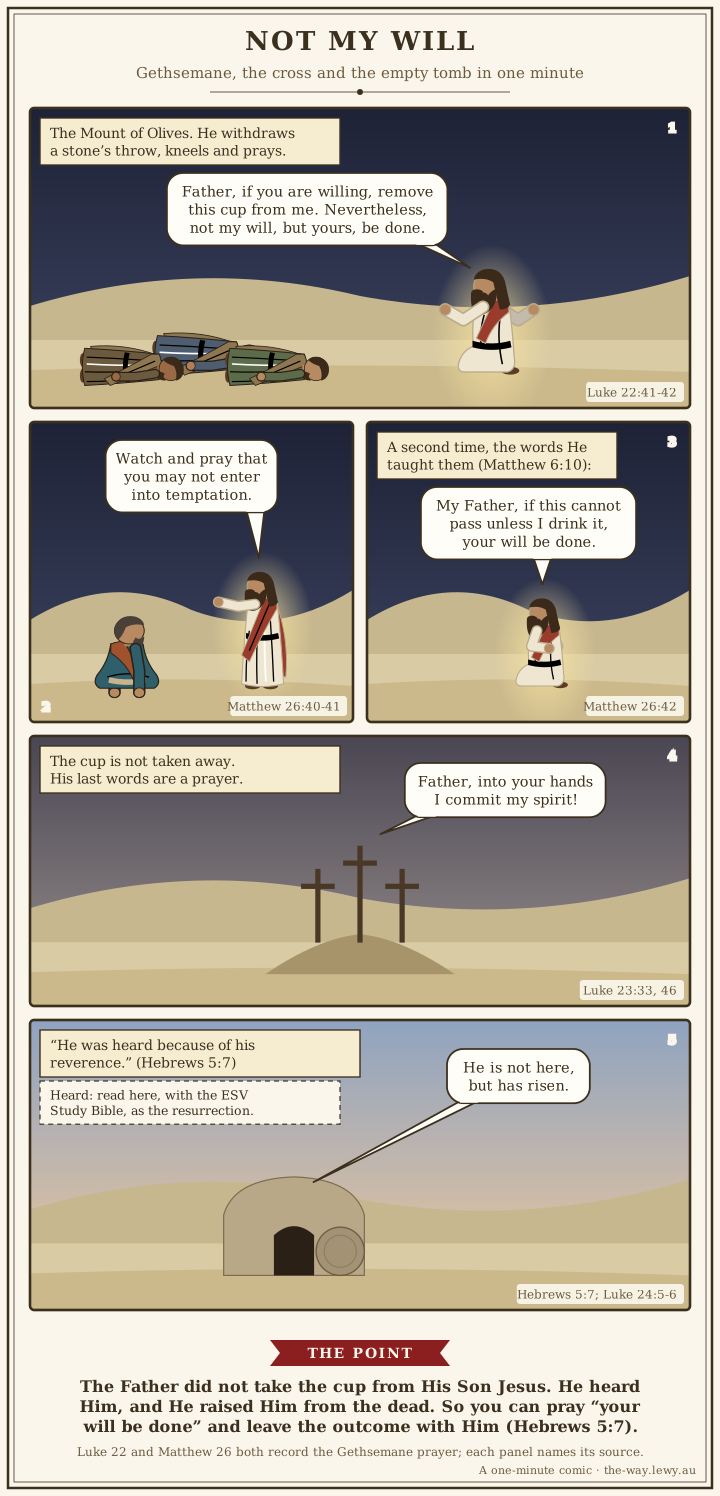
- He prayed the Father's will over His own. "Father, if you are willing, remove this cup from me. Nevertheless, not my will, but yours, be done" (Luke 22:42, ESV).
- He prayed as a habit, alone, at cost. "He would withdraw to desolate places and pray" (Luke 5:16, ESV), and before dawn He was gone so early His friends had to hunt Him down (Mark 1:35-37).
- He prayed for you, and still does. "I do not ask for these only, but also for those who will believe in me through their word" (John 17:20, ESV); "he always lives to make intercession for them" (Hebrews 7:25, ESV).
Memory verses
✝️ Ephesians 3:16-19 (ESV)
16 that according to the riches of his glory he may grant you to be strengthened with power through his Spirit in your inner being, 17 so that Christ may dwell in your hearts through faith—that you, being rooted and grounded in love, 18 may have strength to comprehend with all the saints what is the breadth and length and height and depth, 19 and to know the love of Christ that surpasses knowledge, that you may be filled with all the fullness of God.
✝️ Philippians 4:6-7 (ESV)
6 do not be anxious about anything, but in everything by prayer and supplication with thanksgiving let your requests be made known to God. 7 And the peace of God, which surpasses all understanding, will guard your hearts and your minds in Christ Jesus.
Be Transformed
- Think. Prayer is time with your Father (Romans 8:15), opened to you at the cost of His Son (Hebrews 10:19-20). You are invited to it before you are commanded to it.
- Attitude. Come as a child and as a creature: "Our Father" and "hallowed be your name" (Matthew 6:9). Let "your will be done" (Matthew 6:10) come before your list, and let Him set the tone of the day.
- Do. Fix a time and a place, as Daniel had a window (Daniel 6:10) and Jesus a desolate place before dawn (Mark 1:35), and pray there each day this week. (a) Pray Ephesians 3:16-19 by name for one person, and for yourself. (b) Set your heart on God, His will and His provision before your own list, by praying the pattern in four steps. (1) Our Father: recognise who He is and thank Him (Matthew 6:9; Philippians 4:6). (2) Your will: seek His will before your own (Matthew 6:10). (3) Today: ask for what you and others need this day (Matthew 6:11). (4) Forgive and keep: ask Him to forgive you as you forgive others, to lead you away from temptation and to keep you from evil (Matthew 6:12-13).
Prayer
Father, You have made me Your child through Your Son Jesus, and given me Your Spirit to call You Father. Thank You that the way to You is open and that You always hear. Your will be done in me today, before anything I ask. Give me what today needs. Strengthen me by Your Spirit in my inner being, let Christ settle in my heart, and root me in Your love, until I know the love of Christ that surpasses knowledge. Make me steady in prayer where I have been sporadic, and teach me to want what You want. In Jesus' name. Amen.
Study outline
- The shape of prayer — the prayer Jesus taught puts Father, will and bread in that order (Matthew 6:9-13).
- Our Father — adopted through His Son Jesus, given the Spirit's own cry, brought in by His blood; whom to pray to (Romans 8:15; Hebrews 10:19-22).
- Your will be done — the will handed over, Gethsemane, and Daniel asking for what God had promised (1 John 5:14; Luke 22:42; Daniel 9:2-3).
- Give us this day — communion, the manna, and the daily habit Jesus and Daniel kept; keep asking (Matthew 6:11; Luke 5:16; Daniel 6:10).
- Pray then like this — a pattern to pray by, Paul's prayer in Ephesians 3:14-21, what to pray about, alone and together, and households.
The shape of prayer
This site's first notes on prayer opened with one line: the attitude of prayer is that we are God's. The prayer Jesus taught is built that way.
Three lines about God and His purposes come before any request for yourself (Matthew 6:9-10). By the time you ask for bread you have already called Him Father, honoured His name and handed over your will. Prayer prayed this way re-orders the one praying before it brings a single need. The Lord's Prayer draws that shape and works through every line.
Our Father: you come as His child
A given willingness: the Spirit's own cry
Prayer is a child speaking with a Father, and God Himself makes it so.
✝️ Romans 8:15-16 (ESV)
15 For you did not receive the spirit of slavery to fall back into fear, but you have received the Spirit of adoption as sons, by whom we cry, "Abba! Father!" 16 The Spirit himself bears witness with our spirit that we are children of God,
The cry is produced: "by whom we cry." Galatians says it again and draws the conclusion: "God has sent the Spirit of his Son into our hearts, crying, 'Abba! Father!' So you are no longer a slave, but a son" (Galatians 4:6-7, ESV). This is adoption. It shows that God wants to be spoken to: He made you His child and sent the Spirit of His Son Jesus to say "Father" in you. So you can come to Him on the days you feel nothing, because the willingness to pray is His gift.
A way opened at great cost
✝️ Hebrews 10:19-22 (ESV)
19 Therefore, brothers, since we have confidence to enter the holy places by the blood of Jesus, 20 by the new and living way that he opened for us through the curtain, that is, through his flesh, 21 and since we have a great priest over the house of God, 22 let us draw near with a true heart in full assurance of faith, with our hearts sprinkled clean from an evil conscience and our bodies washed with pure water.
The curtain is the one before the Most Holy Place, the blood is Jesus', and the writer's conclusion is an instruction to pray: draw near, προσέρχομαι (proserchomai, pros-ER-kho-my, G4334). Hebrews 4:16 attaches the promise: "let us then with confidence draw near to the throne of grace, that we may receive mercy and find grace to help in time of need" (ESV). That cost is the atonement. The Father opened the way to Himself through the blood of His Son, and the Son "always lives to make intercession" for those who come (Hebrews 7:25, ESV). Neglecting prayer leaves unused a door that cost that much to open.
Whom to pray to
Jesus taught prayer to the Father: "Pray then like this: Our Father in heaven" (Matthew 6:9, ESV), and "whatever you ask of the Father in my name, he will give it to you" (John 16:23, ESV). Paul puts the whole Trinity in one sentence: "through him we both have access in one Spirit to the Father" (Ephesians 2:18, ESV). Paul's word for "access" is προσαγωγή (prosagōgē, G4318), being brought in and presented, as at court.
Prayer to Jesus is also in the New Testament and is never corrected. Stephen died praying "Lord Jesus, receive my spirit" (Acts 7:59, ESV), and Paul pleaded with the Lord about his thorn and was answered, "My grace is sufficient for you" (2 Corinthians 12:8-9, ESV). The Spirit helps from within: He "intercedes for us with groanings too deep for words" (Romans 8:26, ESV). No prayer in the New Testament is addressed to the Spirit; that is an argument from silence, which is why this study describes His part as help given to the one praying. Make the Father your habit, because Jesus taught it, and speak to the Son freely, because Scripture does.
Your will be done: you seek His will first
Your will handed over
Scripture repeats one structure about answered prayer: a will brought into line with God's, and then God acting.
| The condition | What follows | |
|---|---|---|
| Psalm 37:4 | "Delight yourself in the LORD" | "and he will give you the desires of your heart" |
| John 15:7 | "If you abide in me, and my words abide in you" | "ask whatever you wish, and it will be done for you" |
| 1 John 5:14 | "if we ask anything according to his will" | "he hears us" |
| Psalm 66:18-19 | "If I had cherished iniquity in my heart" | "the Lord would not have listened. But truly God has listened" |
| James 4:2-3 | "You do not have, because you do not ask." "You ask… wrongly" | "You ask and do not receive" |
Quotations are ESV. Psalm 37:4 is often quoted as a blank cheque, and it is the clearest case of the pattern: delight in God first, and the delight reshapes the desires He then grants. Romans 12 has the same order. Offer yourself first, and then "by testing you may discern what is the will of God, what is good and acceptable and perfect" (Romans 12:2, ESV).
This shows that God's purpose in your praying includes your sanctification: He conforms your will to His and acts through the surrendered will. Gethsemane was prayed perfectly and the cup stayed. Hebrews says Jesus "was heard because of his reverence" (Hebrews 5:7, ESV), and the ESV Study Bible reads the answer as the resurrection (note on Hebrews 5:7). So you can bring every request and leave the outcome with a Father whose will is wiser than yours.
Daniel: asking for what God has promised
Daniel was taken to Babylon as a youth (Daniel 1:1-6) and was still praying there in old age. The ESV Study Bible reckons him over eighty by Daniel 9 (note on Daniel 9:1-27).
In the first year of Darius, Daniel "perceived in the books" that Jeremiah had set seventy years for Jerusalem's desolation (Daniel 9:2, ESV). Daniel does not say which passage he read; Jeremiah gives the seventy years twice (Jeremiah 25:11-12; 29:10). The second, a letter to the exiles in Babylon, goes on: "When seventy years are completed for Babylon, I will visit you… Then you will call upon me and come and pray to me, and I will hear you" (Jeremiah 29:10, 12, ESV). Daniel did what it describes. "I turned my face to the Lord God, seeking him by prayer and pleas for mercy with fasting and sackcloth and ashes" (Daniel 9:3, ESV). Three things mark the prayer that follows:
- He began with who God is: "O Lord, the great and awesome God, who keeps covenant and steadfast love" (Daniel 9:4, ESV).
- He confessed as "we": "we have sinned and done wrong and acted wickedly" (Daniel 9:5, ESV). The man his enemies could find no fault in counted himself among the guilty.
- He pleaded God's mercy and God's name: "we do not present our pleas before you because of our righteousness, but because of your great mercy… for your own sake, O my God, because your city and your people are called by your name" (Daniel 9:18-19, ESV).
The answer had been sent "at the beginning of your pleas for mercy" (Daniel 9:23, ESV); How God Answers Prayer follows that thread into Daniel 10.
Aside: the hour of the evening sacrifice
Gabriel came "at the time of the evening sacrifice" (Daniel 9:21, ESV). There had been no evening sacrifice since the temple burned in 586 BC (some reckon 587; 2 Kings 25:8-9), and Daniel still marked the hour by it.
Moses argued from God's own promises too: "Remember Abraham, Isaac, and Israel… to whom you swore by your own self", and "the LORD relented" (Exodus 32:13-14, ESV).
This shows that God is a promise-keeping God who invites His people to pray His promises back to Him, and who hears those who come on His mercy and His name. So read your Bible with prayer open: when you find what God has said He will do, ask Him for it, and come with nothing in your hands but His mercy.
Give us this day: you depend on Him daily
Communion: being with Him
Communion is shared life, two persons with each other. When Jesus chose the Twelve, the first reason Mark gives is "so that they might be with him", and only then "he might send them out to preach" (Mark 3:14, ESV). Prayer is that being-with, carried on after the Ascension. Jesus defined the life He gives in the same terms, in prayer: "this is eternal life, that they know you, the only true God, and Jesus Christ whom you have sent" (John 17:3, ESV).
The Psalms record the appetite behind it: "As a deer pants for flowing streams, so pants my soul for you, O God" (Psalm 42:1, ESV). That is a lament, and it still speaks of thirst. And they record what is found there: "in your presence there is fullness of joy" (Psalm 16:11, ESV). Prayer includes asking, and Jesus says "your Father knows what you need before you ask him" (Matthew 6:8, ESV) as a reason to ask plainly, without heaping up words. Underneath the asking is a relationship: the Father wants your company, and prayer is where you give it.
Daily bread
God fed Israel in the wilderness with bread that came "a day's portion every day" (Exodus 16:4, ESV). It could not be stored: kept overnight "it bred worms and stank" (Exodus 16:20, ESV). "Morning by morning they gathered it" (Exodus 16:21, ESV). Moses told the next generation what it had been for: "that he might make you know that man does not live by bread alone, but man lives by every word that comes from the mouth of the LORD" (Deuteronomy 8:3, ESV). The ESV Study Bible reads the manna as a sign that Israel's "whole lives were to be sustained by the Lord and governed by his word" (note on Exodus 16:4).
Jesus taught His disciples to ask for bread "this day" (Matthew 6:11). He quoted Deuteronomy 8:3 when He was starving (Matthew 4:4), and He named His own food: "My food is to do the will of him who sent me and to accomplish his work" (John 4:34, ESV). What fed Jesus was the Father's will. This shows that God means to be depended on daily. So come to Him each morning as one who has nothing stored.
Bread of Life traces the manna to Jesus, and In Humility shows why one day at a time is humbling.
How Jesus prayed
The Gospels show His prayer life by reporting what He did:
| Early, and alone | "Rising very early in the morning, while it was still dark, he departed and went out to a desolate place, and there he prayed" (Mark 1:35) |
| Habitually | "he would withdraw to desolate places and pray" (Luke 5:16) |
| At length before decisions | "All night he continued in prayer to God," then chose the twelve (Luke 6:12) |
| After success | He dismisses the crowd He has just fed and goes up the mountain alone (Matthew 14:23) |
| Submitting a real request | "remove this cup from me. Nevertheless, not my will, but yours, be done" (Luke 22:42) |
Luke 5:16's "would" is a Greek periphrastic imperfect, ἦν ὑποχωρῶν καὶ προσευχόμενος, literally "He was withdrawing and praying": the form for repeated, customary action. It describes His routine. And it cost Him. After the whole town gathered at His door, Mark has Him gone before dawn, and Simon and the others κατεδίωξεν Him (katadiōkō, G2614, "hunted down"; Mark 1:36), a verb found nowhere else in the New Testament. "Everyone is looking for you" (Mark 1:37, ESV).
He went to be with His Father, and John 17 records what that sounded like. The Son, who shared the Father's glory "before the world existed" (John 17:5, ESV), still made time to be alone with Him. If He needed it, so do you.
Daniel at the window
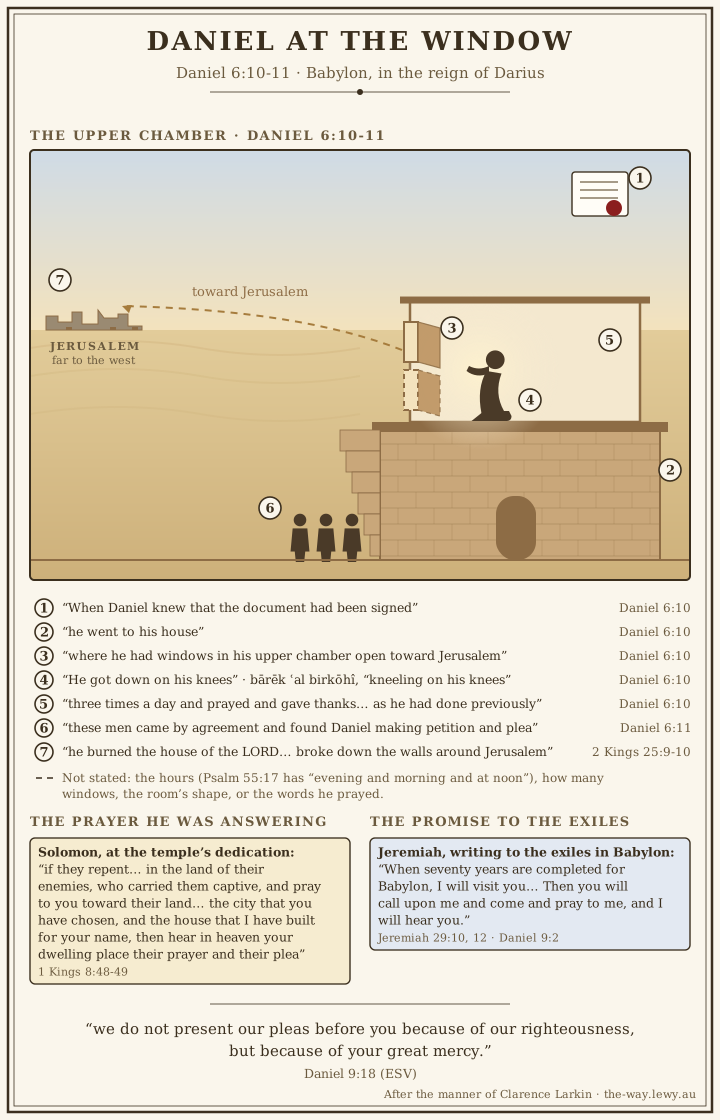
In Daniel 6, his rivals could find "no ground for complaint or any fault" in him, and concluded: "unless we find it in connection with the law of his God" (Daniel 6:4-5, ESV). His faithfulness to his God was the one thing about him they could count on. So they had a law signed against his prayer, and:
✝️ Daniel 6:10 (ESV)
10 When Daniel knew that the document had been signed, he went to his house where he had windows in his upper chamber open toward Jerusalem. He got down on his knees three times a day and prayed and gave thanks before his God, as he had done previously.
The Aramaic (numbered 6:11 there) makes the habit visible. בָּרֵךְ עַל־בִּרְכוֹהִי (bārēk ʿal birkōhî, H1289 and H1291) is "kneeling on his knees", verb and noun from the same root, and "kneeling", "praying" and "thanking" are all participles, the form for ongoing action: he was kneeling, praying, giving thanks. "As he had done previously" is literally "just as he had been doing before this." He changed nothing. The window had a reason too. Solomon had asked God to hear His people if, captive "in the land of their enemies", they would "pray to you toward their land… the city that you have chosen, and the house that I have built for your name" (1 Kings 8:48, ESV). The ESV Study Bible calls Daniel's practice "consciously fulfilling" that prayer (note on Daniel 6:10). The house was rubble; Daniel prayed toward the promise. And on the day the decree was signed, he gave thanks.
Keep asking, and keep talking
"Pray without ceasing" (1 Thessalonians 5:17, ESV). The word is ἀδιαλείπτως (adialeiptōs, G89), and Paul uses it of his own habit of remembering churches (Romans 1:9; 1 Thessalonians 1:2), so it means again and again through the day, with no long gaps. Hang short prayers on what you already do: waking, the kettle, the car, a meal, the moment before a hard conversation.
Jesus told two parables about not giving up. A man knocks at midnight for bread, and his friend gets up "because of his impudence" (Luke 11:8, ESV), ἀναίδεια (anaideia, G335), shamelessness, found only here in the New Testament. "How much more will the heavenly Father give the Holy Spirit to those who ask him!" (Luke 11:13, ESV). A widow wears down an unjust judge, and Luke gives the point first: "they ought always to pray and not lose heart" (Luke 18:1, ESV). If a sleepy neighbour and a corrupt judge give way, your Father will. This shows that God wants to be asked again. When an answer is slow, keep bringing the same request. Write it down with the date, and write the answer beside it when it comes. How God Answers Prayer shows how the answers come.
Pray then like this
A pattern to pray by
Everything above fits a shape small enough to carry. It follows the Lord's Prayer, with thanksgiving and intercession placed where the rest of the New Testament puts them:
- Recognise who you are speaking to. "Our Father in heaven, hallowed be your name." Say something true about Him first, as Daniel did (Daniel 9:4).
- Thank Him for what He has already done, "with thanksgiving" (Philippians 4:6). Daniel gave thanks the day the decree was signed.
- Hand over your will. "Your will be done." Ask what He wants before you tell Him what you want.
- Ask for today. "Give us this day our daily bread." Real needs, plainly said.
- Name other people. Pray Ephesians 3:16-19 over them by name.
- Clear the accounts and ask to be kept. "Forgive us… as we also have forgiven… deliver us from evil."
It takes twenty seconds if that is all you have, and will hold half an hour if you stay at each step. Jesus said "pray like this" (Matthew 6:9).
Paul on his knees: Ephesians 3:14-21
✝️ Ephesians 3:14-21 (ESV)
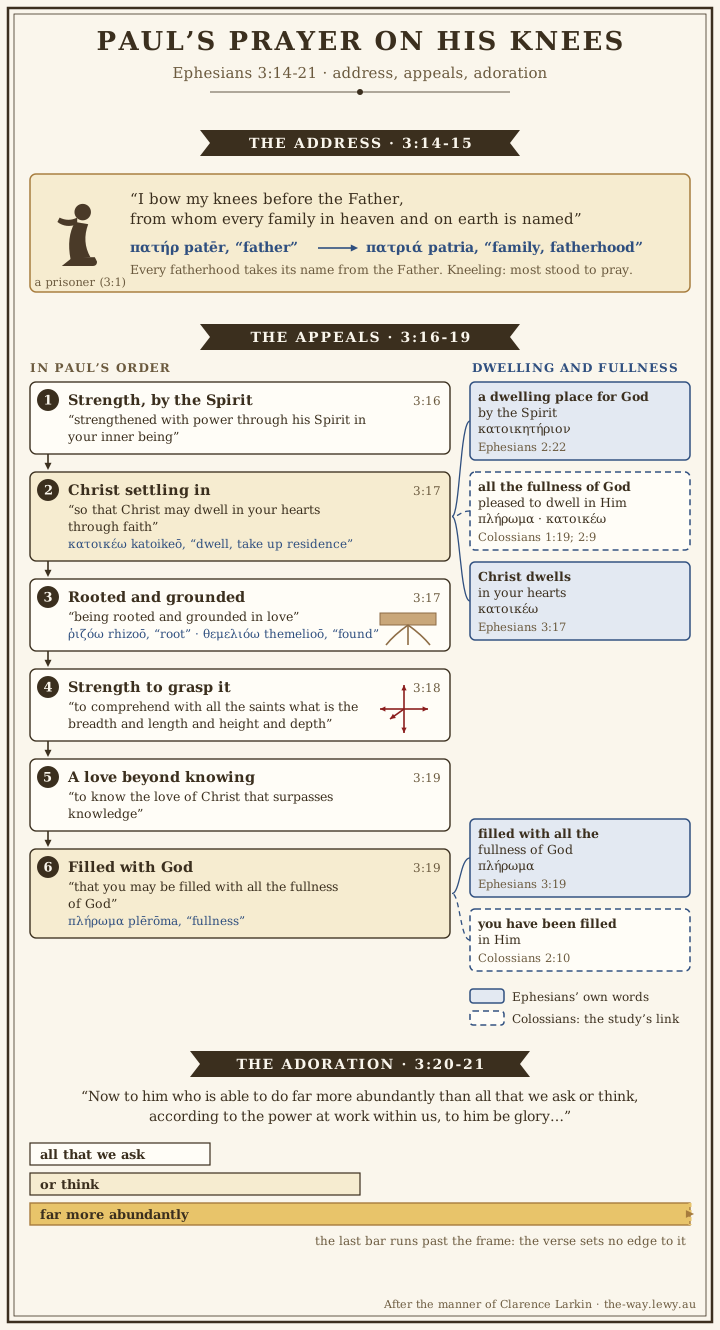
14 For this reason I bow my knees before the Father, 15 from whom every family in heaven and on earth is named, 16 that according to the riches of his glory he may grant you to be strengthened with power through his Spirit in your inner being, 17 so that Christ may dwell in your hearts through faith—that you, being rooted and grounded in love, 18 may have strength to comprehend with all the saints what is the breadth and length and height and depth, 19 and to know the love of Christ that surpasses knowledge, that you may be filled with all the fullness of God. 20 Now to him who is able to do far more abundantly than all that we ask or think, according to the power at work within us, 21 to him be glory in the church and in Christ Jesus throughout all generations, forever and ever. Amen.
On his knees, before the Father
Where he prayed it. "For this reason" picks up the sentence Paul broke off in 3:1, where he calls himself "a prisoner of Christ Jesus on behalf of you Gentiles" (Ephesians 3:1, ESV; ESV Study Bible, note on 3:14-15). He has just told them "not to lose heart over what I am suffering for you" (Ephesians 3:13, ESV). A prisoner prays, and he asks nothing for himself. He asks for their strength.
How he prayed it. "I bow my knees", κάμπτω τὰ γόνατά μου (kamptō, G2578). Most people in Paul's day stood to pray (Mark 11:25; Luke 18:11, 13), so kneeling expressed deep reverence (NIV Biblical Theology Study Bible, note on 3:14-15).
Aside: every knee will bow
Paul uses the same verb of the day when "at the name of Jesus every knee should bow" (Philippians 2:10, ESV). Paul does not join the two passages, but read side by side, in prayer he bends now the knee every creature will bend then.
To whom. "The Father, from whom every family in heaven and on earth is named." Family is πατριά (patria, G3965), built on πατήρ (patēr, G3962, "father"), and the wordplay is Paul's own: every fatherhood takes its name from the Father. To name, in Scripture, is to define an identity (ESV Study Bible, note on 3:14-15). The One Paul kneels before is the Father all fatherhood is named from, and you are His.
What he asks
Each request opens into the next, and each Person of the Trinity is in it:
- Strength by the Spirit, inside. "Strengthened with power through his Spirit in your inner being" (3:16). The inner being is the seat of consciousness and moral being, the heart (NIV Biblical Theology Study Bible, note on 3:16). Paul prays for what no change of circumstance can give.
- Christ settling in. "So that Christ may dwell in your hearts through faith" (3:17). The verb is κατοικέω (katoikeō, G2730), to dwell or take up residence. They already belong to Christ; Paul prays for His indwelling "with power" (ESV Study Bible, note on 3:17-18), His "controlling presence" as they keep trusting Him (NIV Biblical Theology Study Bible, note on 3:17). The chapter before has just called the church "a dwelling place for God by the Spirit" (Ephesians 2:22, ESV), κατοικητήριον (katoikētērion, G2732), from the same root.
- Rooted and grounded in love. ῥιζόω (rhizoō, G4492, "root") occurs only here and in Colossians 2:7, and θεμελιόω (themelioō, G2311) is to lay a foundation. A tree and a building: love is the soil they grow in and the ground they are built on.
- Strength to grasp it. The breadth, length, height and depth (3:18). Paul does not say what the four measure, and readers differ. The ESV Study Bible takes them as "the immeasurable dimensions of God's riches in Christ" (note on 3:17-18), and the next clause points to the love of Christ. It is grasped "with all the saints": no one comprehends it alone.
- To know a love beyond knowing. "To know the love of Christ that surpasses knowledge" (3:19). The paradox is deliberate. The love is too great ever to be fully known, and it can be truly known (NIV Biblical Theology Study Bible, note on 3:19).
- Filled with God. "That you may be filled with all the fullness of God" (3:19). As God's glory filled the temple (1 Kings 8:10-11), Paul prays God would fill His people with Himself (NIV Biblical Theology Study Bible, note on 3:19).
Aside: Christ dwelling, God's fullness
Paul's letter to Colossae uses the same two words of Christ: "in him all the fullness of God was pleased to dwell" (Colossians 1:19, ESV), and "in him the whole fullness of deity dwells bodily, and you have been filled in him" (Colossians 2:9-10, ESV). Read together, the fullness of God dwells in Christ, Christ dwells in you, and you are filled with the fullness of God. Ephesians 3 does not cite Colossians, so the link is this study's reading of one writer's vocabulary; the doctrine it points to is union with Christ.
More than we ask
Paul ends in praise. "Now to him who is able to do far more abundantly than all that we ask or think" (3:20): Paul has just asked for the fullness of God, and he closes by praising a God whose ability runs beyond all that anyone asks. The power is already "at work within us." The glory goes to God "in the church and in Christ Jesus" (3:21). The NIV Biblical Theology Study Bible sees the shape: address, appeals, adoration (note on 3:14-21).
This shows that God the Father wants His children strong within, indwelt by His Son, rooted in His love and filled with Himself, and that He is able to do far more than anyone dares to ask. So pray this way for the people you love: by name, for their inner strength, for Christ's settled presence, for their grasp of His love. Pray it for yourself, and for the people you find hardest to pray for. And when you have asked for the most you can imagine, finish by praising the God who can do more.
What to pray about
✝️ 1 Timothy 2:1-2 (ESV)
1 First of all, then, I urge that supplications, prayers, intercessions, and thanksgivings be made for all people, 2 for kings and all who are in high positions, that we may lead a peaceful and quiet life, godly and dignified in every way.
The four nouns are δεήσεις (deēseis, G1162, asking out of need), προσευχάς (proseuchas, G4335, prayer in general), ἐντεύξεις (enteuxeis, G1783, approaching on someone's behalf) and εὐχαριστίας (eucharistias, G2169, thanksgiving). The ESV Study Bible reads them as piled up "for their cumulative impact" (note on 1 Timothy 2:1): four angles on one call to pray for everyone, kings included. Most prayer lives are heavy on the first and light on the last two. Paul gives the ground four verses on: "there is one mediator between God and men, the man Christ Jesus" (1 Timothy 2:5, ESV). Philippians 4:6 gives the scope: "in everything."
Personal and corporate
"Go into your room and shut the door and pray to your Father who is in secret" (Matthew 6:6, ESV), against those who pray "that they may be seen by others" (Matthew 6:5, ESV). Yet every first-person word in the prayer Jesus then teaches is plural: our Father, give us, forgive us. The early church prayed together as a matter of course: "with one accord… devoting themselves to prayer" (Acts 1:14, ESV), and "earnest prayer for him was made to God by the church" (Acts 12:5, ESV). Daniel prayed alone at his window and with his friends in his house. You need both: the shut door keeps prayer honest, and the gathering keeps the "our". Where Two or Three Are Gathered treats praying together.
In Daniel 2, facing execution with the rest of Babylon's wise men, he went home and told Hananiah, Mishael and Azariah "to seek mercy from the God of heaven concerning this mystery" (Daniel 2:18, ESV). When the answer came, he blessed God before he went anywhere near the king: "To you, O God of my fathers, I give thanks and praise… for you have made known to us the king's matter" (Daniel 2:23, ESV). He asked together, and he thanked first.
Aside: two more who prayed
- Moses argued from God's own promises: "Remember Abraham, Isaac, and Israel… to whom you swore by your own self", and "the LORD relented" (Exodus 32:13-14, ESV).
- Nehemiah prayed in the space between a king's question and his answer: "I prayed to the God of heaven. And I said to the king…" (Nehemiah 2:4-5, ESV).
- The church under threat began with God's sovereignty, "Sovereign Lord, who made the heaven and the earth" (Acts 4:24, ESV), and asked for boldness to keep speaking (Acts 4:29).
Teaching a household to pray
Deuteronomy 6:7 puts God's words into the ordinary day: "when you sit in your house, and when you walk by the way, and when you lie down, and when you rise" (ESV). Let children watch you pray, hear you pray for them by name, and pray their own way without correction. Teaching the Lord's Prayer at Home is a guide for families, a line a week.
Discussion questions
- The language. Jesus' prayer opens "Our Father in heaven" (Matthew 6:9), and Paul's opens on his knees "before the Father, from whom every family in heaven and on earth is named" (Ephesians 3:14-15), where family (πατριά, patria) is built on father (πατήρ, patēr). Both begin with who God is to them before they ask for anything, and the Spirit gives you the same cry, "Abba! Father!" (Romans 8:15). How would your prayers change if you began each one by remembering whose child you are?
- The language. Daniel 6:10 describes Daniel kneeling, praying, giving thanks with participles for ongoing action, "as he had done previously". What would have to be true of your prayer life for "as he had done previously" to describe it?
- The text in its context. Daniel read Jeremiah's seventy years (Daniel 9:2) and then did what Jeremiah 29:12 describes: he called on God and prayed. What promise of God have you read recently, and how would you pray it back to Him?
- Christ. Paul prays that "Christ may dwell in your hearts through faith" (Ephesians 3:17) for people who already belonged to Christ. What is he asking for that they did not yet have?
- The hard part. Jesus prayed "remove this cup" and the cup stayed (Luke 22:42). Hebrews says He "was heard" (Hebrews 5:7). How do you hold those two verses together when your own prayer is not answered the way you asked?
- The text in its context. Manna could not be stored overnight (Exodus 16:20), and Jesus taught His disciples to ask for bread "this day" (Matthew 6:11). What do you need to ask your Father for today?
- Be transformed. Choose one person and pray Ephesians 3:16-19 for them by name every day this week, from its card. What do you expect to change, in them or in you?
Group study sheet for a 40-minute group: two A4 sheets, or one with the guided path
The point, the passage, the questions and the response, from this study. Print on both sides of two A4 sheets, flipping on the long edge. While this block is open, printing the page prints the sheet; close it to print the study.
Prayer: Communion with God
Ephesians 3:14-21The point God the Father has adopted you through His Son Jesus and given you His Spirit to cry "Abba! Father!", so prayer is communion with Him: you come to Him as your Father, you seek His will before your own, and you ask Him for this day's bread, as Jesus taught.
Ask: what comes to mind when you hear Prayer
? Hear a few answers before anyone reads.
Ephesians 3:14-21 14... for this reason I bow my knees before the Father, 15from whom every family in heaven and on earth derives its name. 16I ask that out of the riches of His glory He may strengthen you with power through His Spirit in your inner being, 17so that Christ may dwell in your hearts through faith. Then you, being rooted and grounded in love, 18will have power, together with all the saints, to comprehend the length and width and height and depth 19of the love of Christ, and to know this love that surpasses knowledge, that you may be filled with all the fullness of God. 20Now to Him who is able to do immeasurably more than all we ask or imagine, according to His power that is at work within us, 21to Him be the glory in the church and in Christ Jesus throughout all generations, forever and ever. Amen.
Also read:
Prayer: Communion with God
- The shape of prayer — the prayer Jesus taught puts Father, will and bread in that order (Matthew 6:9-13).
- Our Father — adopted through His Son Jesus, given the Spirit's own cry, brought in by His blood; whom to pray to (Romans 8:15; Hebrews 10:19-22).
- Your will be done — the will handed over, Gethsemane, and Daniel asking for what God had promised (1 John 5:14; Luke 22:42; Daniel 9:2-3).
- Give us this day — communion, the manna, and the daily habit Jesus and Daniel kept; keep asking (Matthew 6:11; Luke 5:16; Daniel 6:10).
- Pray then like this — a pattern to pray by, Paul's prayer in Ephesians 3:14-21, what to pray about, alone and together, and households.
Prayer: Communion with God
1The language. Jesus' prayer opens "Our Father in heaven" (Matthew 6:9), and Paul's opens on his knees "before the Father, from whom every family in heaven and on earth is named" (Ephesians 3:14-15), where family (πατριά, patria) is built on father (πατήρ, patēr). Both begin with who God is to them before they ask for anything, and the Spirit gives you the same cry, "Abba! Father!" (Romans 8:15). How would your prayers change if you began each one by remembering whose child you are?
2The text in its context. Daniel read Jeremiah's seventy years (Daniel 9:2) and then did what Jeremiah 29:12 describes: he called on God and prayed. What promise of God have you read recently, and how would you pray it back to Him?
3The hard part. Jesus prayed "remove this cup" and the cup stayed (Luke 22:42). Hebrews says He "was heard" (Hebrews 5:7). How do you hold those two verses together when your own prayer is not answered the way you asked?
4The language. Daniel 6:10 describes Daniel kneeling, praying, giving thanks with participles for ongoing action, "as he had done previously". What would have to be true of your prayer life for "as he had done previously" to describe it?
5The text in its context. Manna could not be stored overnight (Exodus 16:20), and Jesus taught His disciples to ask for bread "this day" (Matthew 6:11). What do you need to ask your Father for today?
6Christ. Paul prays that "Christ may dwell in your hearts through faith" (Ephesians 3:17) for people who already belonged to Christ. What is he asking for that they did not yet have?
Prayer: Communion with God
7Be transformed. Choose one person and pray Ephesians 3:16-19 for them by name every day this week, from its card. What do you expect to change, in them or in you?
- Think. Prayer is time with your Father (Romans 8:15), opened to you at the cost of His Son (Hebrews 10:19-20). You are invited to it before you are commanded to it.
- Attitude. Come as a child and as a creature: "Our Father" and "hallowed be your name" (Matthew 6:9). Let "your will be done" (Matthew 6:10) come before your list, and let Him set the tone of the day.
- Do. Fix a time and a place, as Daniel had a window (Daniel 6:10) and Jesus a desolate place before dawn (Mark 1:35), and pray there each day this week. (a) Pray Ephesians 3:16-19 by name for one person, and for yourself. (b) Set your heart on God, His will and His provision before your own list, by praying the pattern in four steps. (1) Our Father: recognise who He is and thank Him (Matthew 6:9; Philippians 4:6). (2) Your will: seek His will before your own (Matthew 6:10). (3) Today: ask for what you and others need this day (Matthew 6:11). (4) Forgive and keep: ask Him to forgive you as you forgive others, to lead you away from temptation and to keep you from evil (Matthew 6:12-13).
that according to the riches of his glory he may grant you to be strengthened with power through his Spirit in your inner being, so that Christ may dwell in your hearts through faith—that you, being rooted and grounded in love, may have strength to comprehend with all the saints what is the breadth and length and height and depth, and to know the love of Christ that surpasses knowledge, that you may be filled with all the fullness of God.
Ephesians 3:16-19 (ESV)Father, You have made me Your child through Your Son Jesus, and given me Your Spirit to call You Father. Thank You that the way to You is open and that You always hear. Your will be done in me today, before anything I ask. Give me what today needs. Strengthen me by Your Spirit in my inner being, let Christ settle in my heart, and root me in Your love, until I know the love of Christ that surpasses knowledge. Make me steady in prayer where I have been sporadic, and teach me to want what You want. In Jesus' name. Amen.
Prayer: Communion with God
Ephesians 3:14-21Open Ask: what comes to mind when you hear Prayer
? Hear a few answers before anyone reads.
Read it aloud Ephesians 3:14-21
1The language. Jesus' prayer opens "Our Father in heaven" (Matthew 6:9), and Paul's opens on his knees "before the Father, from whom every family in heaven and on earth is named" (Ephesians 3:14-15), where family (πατριά, patria) is built on father (πατήρ, patēr). Both begin with who God is to them before they ask for anything, and the Spirit gives you the same cry, "Abba! Father!" (Romans 8:15). How would your prayers change if you began each one by remembering whose child you are?
2The text in its context. Daniel read Jeremiah's seventy years (Daniel 9:2) and then did what Jeremiah 29:12 describes: he called on God and prayed. What promise of God have you read recently, and how would you pray it back to Him?
3The hard part. Jesus prayed "remove this cup" and the cup stayed (Luke 22:42). Hebrews says He "was heard" (Hebrews 5:7). How do you hold those two verses together when your own prayer is not answered the way you asked?
4The language. Daniel 6:10 describes Daniel kneeling, praying, giving thanks with participles for ongoing action, "as he had done previously". What would have to be true of your prayer life for "as he had done previously" to describe it?
5The text in its context. Manna could not be stored overnight (Exodus 16:20), and Jesus taught His disciples to ask for bread "this day" (Matthew 6:11). What do you need to ask your Father for today?
6Christ. Paul prays that "Christ may dwell in your hearts through faith" (Ephesians 3:17) for people who already belonged to Christ. What is he asking for that they did not yet have?
7Be transformed. Choose one person and pray Ephesians 3:16-19 for them by name every day this week, from its card. What do you expect to change, in them or in you?
- Think. Prayer is time with your Father (Romans 8:15), opened to you at the cost of His Son (Hebrews 10:19-20). You are invited to it before you are commanded to it.
- Attitude. Come as a child and as a creature: "Our Father" and "hallowed be your name" (Matthew 6:9). Let "your will be done" (Matthew 6:10) come before your list, and let Him set the tone of the day.
- Do. Fix a time and a place, as Daniel had a window (Daniel 6:10) and Jesus a desolate place before dawn (Mark 1:35), and pray there each day this week. (a) Pray Ephesians 3:16-19 by name for one person, and for yourself. (b) Set your heart on God, His will and His provision before your own list, by praying the pattern in four steps. (1) Our Father: recognise who He is and thank Him (Matthew 6:9; Philippians 4:6). (2) Your will: seek His will before your own (Matthew 6:10). (3) Today: ask for what you and others need this day (Matthew 6:11). (4) Forgive and keep: ask Him to forgive you as you forgive others, to lead you away from temptation and to keep you from evil (Matthew 6:12-13).
Prayer: Communion with God
The point God the Father has adopted you through His Son Jesus and given you His Spirit to cry "Abba! Father!", so prayer is communion with Him: you come to Him as your Father, you seek His will before your own, and you ask Him for this day's bread, as Jesus taught.
References & Recommended Reading
Original-language sources (queried in this project's own reference database):
- SBL Greek New Testament (SBLGNT), ed. Michael W. Holmes, and the MACULA Greek and MACULA Hebrew linguistic datasets (Clear Bible): the periphrastic imperfect at Luke 5:16, the concordance counts for καταδιώκω (G2614), ῥιζόω (G4492), πατριά, ἀδιαλείπτως and ἀναίδεια, and the Aramaic participles of Daniel 6:10.
- unfoldingWord Hebrew Bible and Unlocked Greek New Testament, via the interlinear alignment.
Study Bibles consulted:
- ESV Study Bible (Crossway, 2008): Exodus 16:4; Daniel 2:14-24, 6:10, 9:1-27; Ephesians 3:14-15, 3:17-18; 1 Timothy 2:1; Hebrews 5:7.
- NIV Biblical Theology Study Bible (Zondervan, 2018): Ephesians 3:14-21, 3:14-15, 3:16, 3:17, 3:19.
- NIV Cultural Backgrounds Study Bible (Zondervan, 2016): Daniel 6:10; Ephesians 3:14.
Translations quoted. ESV throughout. See Bible Translations & Source Texts and copyright.
Related on this site.
- The Lord's Prayer: every line of Matthew 6:9-13 and Luke 11:2-4.
- How God Answers Prayer: heard at once, answered by varied routes and on God's timetable, and kept, including Daniel 10.
- Teaching the Lord's Prayer at Home: a household guide.
- Fasting: the discipline Jesus treats beside prayer, and Daniel's fast in Daniel 9:3.
- Where Two or Three Are Gathered: praying together.
- The Golden Altar of Incense: incense and the prayers of the saints (Revelation 5:8; 8:3-4).