True Worship
New, published 22 October 2026. What else is new
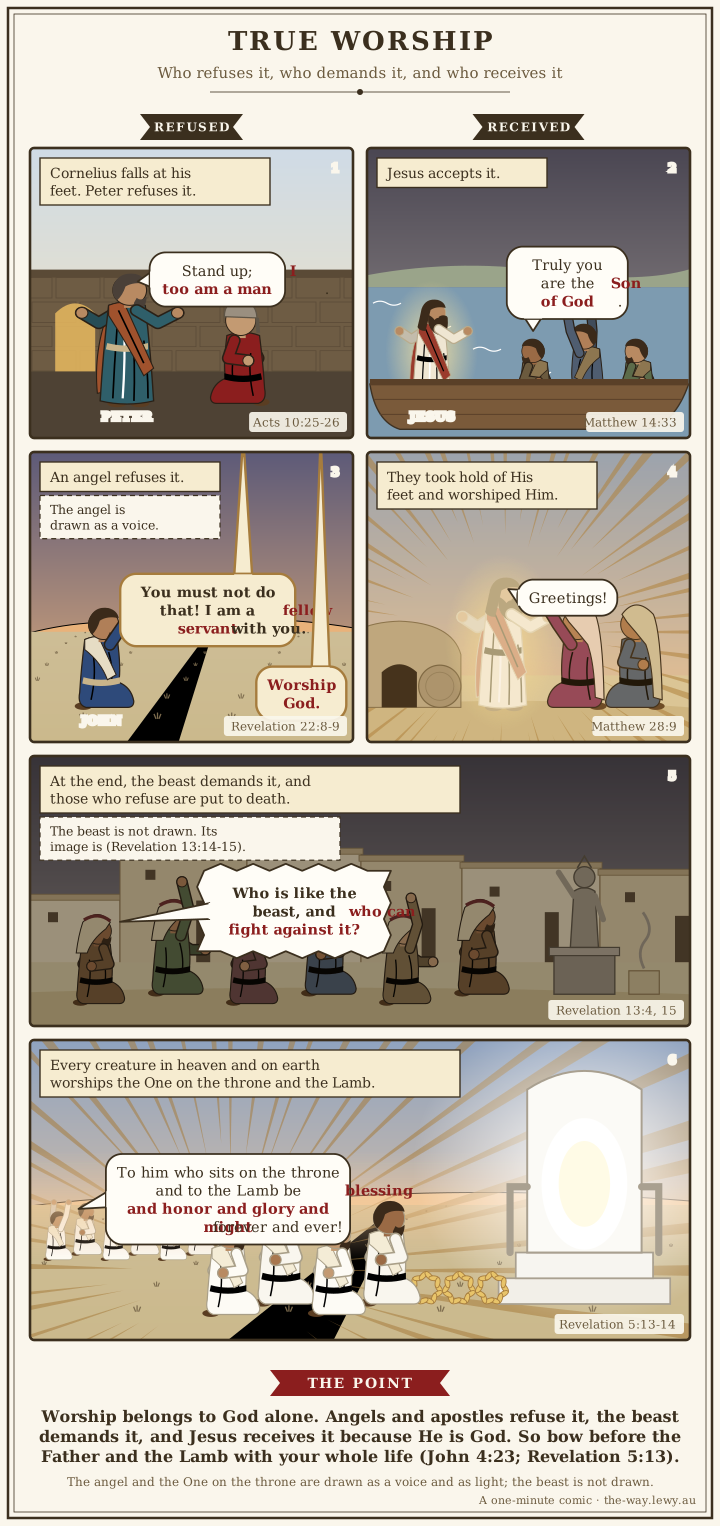
Twice near the end of Revelation, John falls at the feet of the angel who has been showing him the future. Twice the angel stops him: "You must not do that! I am a fellow servant with you and your brothers the prophets, and with those who keep the words of this book. Worship God" (Revelation 22:9, ESV; also 19:10).
Earlier in the same book John had watched that same heaven fall down before the Lamb.
In one sentence: Worship is bowing your whole self before God, who is worthy as Creator and Redeemer, and it belongs to Him alone: angels refuse it, the beast demands it, and Jesus receives it.
Key Takeaways
(This section follows the Key Takeaways format — see that page for what each part is for.)
Types & Prophecy
- The lamb God provides. On the way up Moriah to worship, Abraham told his son, "God will provide for himself the lamb for a burnt offering, my son" (Genesis 22:8, ESV). Heaven's worship is sung to "the Lamb who was slain" (Revelation 5:12, ESV).
- The nations going up to worship. "Everyone who survives of all the nations … shall go up year after year to worship the King, the LORD of hosts" (Zechariah 14:16, ESV). This is a prophecy of the thousand-year reign of Jesus on earth.
Lessons about Jesus
- Jesus receives the worship angels refuse. The angel says "Worship God" (Revelation 22:9), and of the Son God says, "Let all God's angels worship him" (Hebrews 1:6, ESV). Jesus is God.
- Jesus is the new temple. "He was speaking about the temple of his body" (John 2:21, ESV). Worship now comes to the Father through Him.
- Jesus is the way in. We "enter the holy places by the blood of Jesus, by the new and living way that he opened for us" (Hebrews 10:19-20, ESV).
Memory verses
✝️ John 4:23-24 (ESV)
23 But the hour is coming, and is now here, when the true worshipers will worship the Father in spirit and truth, for the Father is seeking such people to worship him. 24 God is spirit, and those who worship him must worship in spirit and truth."
✝️ Revelation 4:11 (ESV)
11 "Worthy are you, our Lord and God, to receive glory and honor and power, for you created all things, and by your will they existed and were created."
Be Transformed
- Think. Worship is your whole life presented to God (Romans 12:1), and it is also the words of praise you speak to Him (Hebrews 13:15). Both are His due.
- Attitude. Come with "reverence and awe, for our God is a consuming fire" (Hebrews 12:28-29, ESV), and with confidence, because the blood of Jesus has opened the way (Hebrews 10:19).
- Do. This week, gather with God's people, offer God one sacrifice of praise in words and one sacrifice of sharing what you have (Hebrews 13:15-16).
Prayer
Holy, holy, holy, Lord God Almighty. You made all things, and You are worthy. Your Son Jesus was slain, and by His blood He ransomed us for You. Forgive us for the worship we have given to other things and withheld from You. By Your Holy Spirit, make us the worshippers You are seeking: in spirit and in truth, with our lips and with our lives. Keep us bowing before You until we join the whole of heaven around Your throne and see Your face.
In Jesus' name. Amen.
Study outline
- What worship is. Bowing and serving, the two pairs of words Scripture uses.
- Why we worship. God is worthy as Creator and as Redeemer.
- Before Jesus. Moriah, the tabernacle, Isaiah's vision, and the prophets on worship without the heart.
- What Jesus taught. Him only; in spirit and truth; lips and heart; the temple of His body.
- Worship belongs to God alone and Jesus receives it. Angels and apostles refuse worship, kings who took it were judged, the beast demands it, and Jesus accepts it.
- The mightiest beings worship. Seraphim, living creatures, elders and the angels.
- Worship since Jesus. How, where and when the church worships.
- Worship in the kingdom and forever. The thousand-year reign and the new creation.
What worship is
Bowing down
The Old Testament's main word for worship is a posture. הִשְׁתַּחֲוָה (hishtachavah, hish-ta-kha-VAH, H7812) means to bow down to the ground. It occurs 162 times. Its first two uses are how Abraham greets honoured guests and how Lot meets the angels at Sodom's gate (Genesis 18:2; 19:1). Then Abraham uses it for what he is going up Mount Moriah to do: "I and the boy will go over there and worship and come again to you" (Genesis 22:5, ESV). The New Testament word carries the same picture. προσκυνέω (proskyneō, pros-koo-NEH-oh, G4352) is to fall down before someone. It occurs 60 times in the New Testament, and 24 of them are in Revelation.
Serving
The second pair of words is about service. עָבַד (ʿavad, ah-VAD, H5647) is to serve, and in Greek λατρεύω (latreuō, lat-ryoo-OH, G3000) is to serve God in worship. The first commandment puts the two side by side: "You shall not bow down to them or serve them" (Exodus 20:5, ESV). So does Jesus: "You shall worship the Lord your God and him only shall you serve" (Matthew 4:10, ESV). Worship is the bowing; service is the life that follows it.
Both senses
The New Testament speaks of worship in both senses. Paul calls the whole of a Christian's life worship: "present your bodies as a living sacrifice, holy and acceptable to God, which is your spiritual worship" (Romans 12:1, ESV). Hebrews names particular acts: "let us continually offer up a sacrifice of praise to God, that is, the fruit of lips that acknowledge his name" (Hebrews 13:15, ESV). True worship is the two together: a life laid down before God, and a mouth that says so.
Why we worship
He made us
God is worthy of your worship first because He made you. "Oh come, let us worship and bow down; let us kneel before the LORD, our Maker! For he is our God, and we are the people of his pasture" (Psalm 95:6-7, ESV). The reason is in the title, "our Maker". Heaven gives the same reason: "Worthy are you, our Lord and God, to receive glory and honor and power, for you created all things" (Revelation 4:11, ESV).
God made you for this. He calls His people those "whom I created for my glory" (Isaiah 43:7, ESV). When people refuse Him, the need to worship stays and finds something else, which is the story Idolatry tells.
He redeemed us
The second song in heaven gives the second reason. To the Lamb the elders sing, "Worthy are you to take the scroll and to open its seals, for you were slain, and by your blood you ransomed people for God from every tribe and language and people and nation" (Revelation 5:9, ESV). God is worthy because He made you, and worthy again because in His Son Jesus He bought you back.
His glory is His own
"I am the LORD; that is my name; my glory I give to no other, nor my praise to carved idols" (Isaiah 42:8, ESV). This shows that God is jealous for His glory because it is true. Only He is Creator. Only He is Redeemer. Worship given anywhere else is given to something that did neither.
Before Jesus
Moriah
At Moriah Abraham calls the hardest thing he ever did "worship". He is going up the mountain to offer the son he loves (Genesis 22:2), and he tells his servants he is going to worship (Genesis 22:5). When Isaac asks where the lamb is, Abraham answers, "God will provide for himself the lamb for a burnt offering, my son" (Genesis 22:8, ESV). Worship before God is giving Him what is dearest, and trusting Him to provide. God did provide: a ram that day (Genesis 22:13), and His own Son at the end.
A place to dwell
At Sinai God gave Israel a place: "let them make me a sanctuary, that I may dwell in their midst. Exactly as I show you concerning the pattern of the tabernacle … so you shall make it" (Exodus 25:8-9, ESV). The tabernacle and then the temple gave Israel's worship a centre, a priesthood and a calendar of sacrifice. The point of it all was God's presence: "that I may dwell in their midst". The Heavenly Pattern walks through what the furniture showed.
Isaiah's vision
The clearest picture of worship in the Old Testament is a man undone by it:
✝️ Isaiah 6:1-3, 5 (ESV)
1 In the year that King Uzziah died I saw the Lord sitting upon a throne, high and lifted up; and the train of his robe filled the temple. 2 Above him stood the seraphim. Each had six wings: with two he covered his face, and with two he covered his feet, and with two he flew. 3 And one called to another and said: "Holy, holy, holy is the LORD of hosts; the whole earth is full of his glory!" … 5 And I said: "Woe is me! For I am lost; for I am a man of unclean lips …; for my eyes have seen the King, the LORD of hosts!"
Worship begins with seeing who God is. "Worship the LORD in the splendor of holiness" (Psalm 29:2, ESV).
Worship without the heart
The prophets show the sacrifices could be kept while the worship was lost. "This people draw near with their mouth and honor me with their lips, while their hearts are far from me" (Isaiah 29:13, ESV). David, after his sin, knew what God was looking for: "The sacrifices of God are a broken spirit; a broken and contrite heart, O God, you will not despise" (Psalm 51:17, ESV). Micah asks what to bring "before the LORD" and answers: "to do justice, and to love kindness, and to walk humbly with your God" (Micah 6:6, 8, ESV). God gave the altar. He was always after the heart that came to it.
What Jesus taught
Him only
When the devil offered Jesus "all the kingdoms of the world and their glory" for one act of worship, Jesus answered from Deuteronomy: "Be gone, Satan! For it is written, 'You shall worship the Lord your God and him only shall you serve'" (Matthew 4:8-10, ESV). Deuteronomy 6:13 reads "It is the LORD your God you shall fear. Him you shall serve" (ESV). Jesus' wording puts "worship" where Moses has "fear", and His "only" matches the Septuagint's αὐτῷ μόνῳ. The fear of the LORD bows down. The temptation was to worship, and the answer was to worship God alone.
In spirit and truth
At Jacob's well a Samaritan woman raised the old dispute: "Our fathers worshiped on this mountain, but you say that in Jerusalem is the place where people ought to worship" (John 4:20, ESV). Jesus answered:
✝️ John 4:21, 23-24 (ESV)
21 Jesus said to her, "Woman, believe me, the hour is coming when neither on this mountain nor in Jerusalem will you worship the Father. … 23 But the hour is coming, and is now here, when the true worshipers will worship the Father in spirit and truth, for the Father is seeking such people to worship him. 24 God is spirit, and those who worship him must worship in spirit and truth."
She asked where one must worship. He answered how, and John marks the turn with the same word, δεῖ (dei, G1163), "must", in her question and in His answer (John 4:20, 24). The Woman at the Well works through that conversation: why she pointed at Gerizim, what "salvation is from the Jews" kept, and why "spirit" here most naturally means the Holy Spirit, the living water Jesus gives (John 7:39).
Three things in Jesus' answer shape everything after it. Worship is to "the Father", a God known as Father through the Son. It is "in spirit and truth": by the Holy Spirit, and true to who God has shown Himself to be. And the Father "is seeking such people". God goes looking for worshippers. He came to a well in Samaria to find one.
Lips and heart
Jesus took up Isaiah's charge against the religious leaders of His day: "This people honors me with their lips, but their heart is far from me; in vain do they worship me, teaching as doctrines the commandments of men" (Matthew 15:8-9, ESV). Worship can be correct in form and empty, "in vain".
The temple of His body
"Destroy this temple, and in three days I will raise it up," Jesus said, and John explains: "he was speaking about the temple of his body" (John 2:19, 21, ESV). The place where God dwells with His people is now a person. That is why the mountain no longer matters: worshippers come to the Father through the Son.
Worship belongs to God alone
Angels refuse it
John fell down before the angel twice, and twice heard the same command:
✝️ Revelation 19:10 (ESV)
10 Then I fell down at his feet to worship him, but he said to me, "You must not do that! I am a fellow servant with you and your brothers who hold to the testimony of Jesus. Worship God." For the testimony of Jesus is the spirit of prophecy.
The Greek is two words, Ὅρα μή (hora mē, HOR-ah may, G3708), "See that you don't!" The angel names himself "a fellow servant", σύνδουλος (syndoulos, SOON-doo-los, G4889), a slave of the same Master. However glorious he is, he is a creature, and creatures do not receive worship. He says it again in Revelation 22:8-9. Paul names the same error in the church and warns against anyone "insisting on asceticism and worship of angels" (Colossians 2:18, ESV).
Apostles refuse it
When Cornelius fell at Peter's feet and worshipped him, "Peter lifted him up, saying, 'Stand up; I too am a man'" (Acts 10:25-26, ESV). At Lystra the crowd called Barnabas Zeus and Paul Hermes, and the priest of Zeus brought oxen to sacrifice. The two apostles "tore their garments and rushed out into the crowd, crying out, 'Men, why are you doing these things? We also are men … turn from these vain things to a living God, who made the heaven and the earth'" (Acts 14:14-15, ESV).
Kings who took it were judged
Herod Agrippa sat on his throne in royal robes while the crowd shouted, "The voice of a god, and not of a man!" "Immediately an angel of the Lord struck him down, because he did not give God the glory" (Acts 12:22-23, ESV). Nebuchadnezzar set up a golden image for every people to worship, and three young men answered him, "we will not serve your gods or worship the golden image that you have set up" (Daniel 3:18, ESV). Later he claimed the glory for himself, looking over Babylon "which I have built by my mighty power as a royal residence and for the glory of my majesty" (Daniel 4:30, ESV), and was driven out to live with the beasts until he knew "that the Most High rules" (Daniel 4:32, ESV). He ended the story with his eyes lifted to heaven: "I blessed the Most High, and praised and honored him who lives forever" (Daniel 4:34, ESV). Pride sets out the men in Scripture who claimed to be gods, and how each one ended.
The beast demands it
The last man to claim worship is the man of lawlessness, "who opposes and exalts himself against every so-called god or object of worship, so that he takes his seat in the temple of God, proclaiming himself to be God" (2 Thessalonians 2:4, ESV). In Revelation the world "worshiped the dragon, for he had given his authority to the beast, and they worshiped the beast" (Revelation 13:4, ESV). The beast's image causes "those who would not worship the image of the beast to be slain" (Revelation 13:15, ESV), and "all who dwell on earth will worship it, everyone whose name has not been written … in the book of life of the Lamb who was slain" (Revelation 13:8, ESV).
Against that, God sends His own call through an angel with "an eternal gospel" to every nation: "Fear God and give him glory, because the hour of his judgment has come, and worship him who made heaven and earth, the sea and the springs of water" (Revelation 14:6-7, ESV). A third angel follows with the warning: "If anyone worships the beast and its image and receives a mark on his forehead or on his hand, he also will drink the wine of God's wrath" (Revelation 14:9-10, ESV). The last days come down to one question. Whom will you worship?
Jesus receives it
In the Gospels
Set the angel's "You must not do that!" beside the Gospels. Jesus never says it. The disciples in the boat "worshiped him, saying, 'Truly you are the Son of God'" (Matthew 14:33, ESV). The man born blind said, "'Lord, I believe,' and he worshiped him" (John 9:38, ESV). The women running from the empty tomb "took hold of his feet and worshiped him" (Matthew 28:9, ESV). Thomas said to Him, "My Lord and my God!" (John 20:28, ESV). Jesus accepted every one.
Hebrews 1:6 and the Song of Moses
Heaven does the same. Hebrews quotes the Song of Moses: "when he brings the firstborn into the world, he says, 'Let all God's angels worship him'" (Hebrews 1:6, ESV). The line is the Septuagint of Deuteronomy 32:43 word for word as Brenton's edition prints it, καὶ προσκυνησάτωσαν αὐτῷ πάντες ἄγγελοι θεοῦ (other Greek witnesses read "sons of God" in this line and "angels" in the next; CSB footnote on Deuteronomy 32:43). The Masoretic text of that verse is shorter and lacks it, but a Dead Sea Scroll of Deuteronomy (4Q44) has the Hebrew line, with "bow down" and "gods", and the ESV translates from it: "bow down to him, all gods" (Deuteronomy 32:43, ESV). It is the same Song in which Israel "sacrificed to demons that were no gods" (Deuteronomy 32:17, ESV). The Song that condemns worship given to the wrong beings ends by commanding heaven's beings to worship Him, and Hebrews says that "Him" is the Son.
Every knee
So every knee bows to Jesus: "at the name of Jesus every knee should bow, in heaven and on earth and under the earth, and every tongue confess that Jesus Christ is Lord, to the glory of God the Father" (Philippians 2:10-11, ESV). The angels refuse worship because they are servants. Jesus receives it because He is God the Son, and the Father is glorified when He is worshipped.
The mightiest beings worship
The most powerful beings Scripture shows us spend their existence worshipping. The seraphim stand above the throne and cover their faces before Him (Isaiah 6:2-3). Around the throne in Revelation:
✝️ Revelation 4:8, 10 (ESV)
8 And the four living creatures, each of them with six wings, are full of eyes all around and within, and day and night they never cease to say, "Holy, holy, holy, is the Lord God Almighty, who was and is and is to come!" … 10 the twenty-four elders fall down before him who is seated on the throne and worship him who lives forever and ever. They cast their crowns before the throne,
When the Lamb takes the scroll, the creatures and elders fall down before Him (Revelation 5:8), then "many angels, numbering myriads of myriads and thousands of thousands" (Revelation 5:11, ESV), then "every creature in heaven and on earth and under the earth and in the sea" (Revelation 5:13, ESV). Later "all the angels … fell on their faces before the throne and worshiped God" (Revelation 7:11, ESV). The Levites' prayer in Nehemiah had already confessed it: "the host of heaven worships you" (Nehemiah 9:6, ESV).
The elders cast their crowns. Whatever authority a creature holds, it holds from God, and in His presence it lays it down. This shows that God is so great that nothing He made, however mighty, stands upright before Him. If the seraphim cover their faces, so may you.
Worship since Jesus
How: through the blood, by the Spirit, with the whole life
Since the cross every believer may come into God's presence, and the way in is the blood of Jesus.
✝️ Hebrews 10:19-22 (ESV)
19 Therefore, brothers, since we have confidence to enter the holy places by the blood of Jesus, 20 by the new and living way that he opened for us through the curtain, that is, through his flesh, 21 and since we have a great priest over the house of God, 22 let us draw near with a true heart in full assurance of faith, with our hearts sprinkled clean from an evil conscience and our bodies washed with pure water.
Under the old covenant only the high priest went behind the curtain, once a year. The church is "a holy priesthood, to offer spiritual sacrifices acceptable to God through Jesus Christ" (1 Peter 2:5, ESV). Its people "worship by the Spirit of God and glory in Christ Jesus" (Philippians 3:3, ESV). Its sacrifices are bodies presented to God (Romans 12:1), praise from the lips, and good shared with others: "Do not neglect to do good and to share what you have, for such sacrifices are pleasing to God" (Hebrews 13:16, ESV). It comes "with reverence and awe, for our God is a consuming fire" (Hebrews 12:28-29, ESV).
Where: wherever His people are, and together
The Spirit makes the believer, and the church together, the place God dwells (1 Corinthians 3:16; 6:19). So you can worship anywhere. Worship is also something the church does gathered. The first believers "devoted themselves to the apostles' teaching and the fellowship, to the breaking of bread and the prayers" (Acts 2:42, ESV), and when they met they sang: "singing psalms and hymns and spiritual songs, with thankfulness in your hearts to God" (Colossians 3:16, ESV). Hebrews warns against "neglecting to meet together" (Hebrews 10:25, ESV).
When: continually, and on the first day
The sacrifice of praise is offered "continually" (Hebrews 13:15). The church also had a day. At Troas the believers gathered "on the first day of the week … to break bread" (Acts 20:7, ESV), the day Jesus rose (Luke 24:1). The New Testament records that practice; it gives no command fixing a day.
Worship in the kingdom and forever
The thousand-year reign
The people who refused the beast's worship reign with the King. John saw "those who had not worshiped the beast or its image and had not received its mark on their foreheads or their hands. They came to life and reigned with Christ for a thousand years" (Revelation 20:4, ESV).
When Jesus returns and reigns on earth, worship will have a centre again. "The LORD will be king over all the earth" (Zechariah 14:9, ESV), and the nations will come to Him: "everyone who survives of all the nations that have come against Jerusalem shall go up year after year to worship the King, the LORD of hosts, and to keep the Feast of Booths" (Zechariah 14:16, ESV). Isaiah saw the same stream: "all the nations shall flow to it, and many peoples shall come, and say: 'Come, let us go up to the mountain of the LORD'" (Isaiah 2:2-3, ESV), and "all flesh shall come to worship before me" (Isaiah 66:23, ESV). Tabernacles: God Dwelling with His People follows that feast into the kingdom.
Ezekiel 40-48 describes a temple with priests and offerings, and dispensational readers, this site among them, place it in the thousand years. How those offerings, given "to make atonement on behalf of the house of Israel" (Ezekiel 45:17, ESV), stand beside the once-for-all sacrifice of Hebrews 10 is debated among them: some read them as memorials looking back to the cross, others as offerings for ceremonial cleansing in a kingdom where mortal people still live. Scripture is clear that the nations will worship the King in Jerusalem; what Ezekiel's offerings will mean then is the part that stays open.
The new creation
At the end there is no temple at all. "I saw no temple in the city, for its temple is the Lord God the Almighty and the Lamb" (Revelation 21:22, ESV). Every place is His presence. "All nations will come and worship you, for your righteous acts have been revealed" (Revelation 15:4, ESV). And worship becomes sight:
✝️ Revelation 22:3-4 (ESV)
3 No longer will there be anything accursed, but the throne of God and of the Lamb will be in it, and his servants will worship him. 4 They will see his face, and his name will be on their foreheads.
The verb is λατρεύσουσιν (latreusousin, G3000), "they will serve" in worship, from λατρεύω, the verb behind Romans 12:1's noun λατρεία (latreia, G2999), "spiritual worship". The life of worship you begin now is the life you will live forever, with His face before you. The New Jerusalem describes the city where it happens.
This shows that God's purpose for His people has always been to dwell with them and be worshipped by them: in a garden, a tent, a temple, His Son, His church, a kingdom and a city. So you may start now. The Father is seeking worshippers, and through His Son Jesus and by the Holy Spirit you may be one.
Discussion questions
- The language. The Hebrew and Greek words for worship mean to bow down, and the words for service mean to serve a master (Exodus 20:5; Matthew 4:10). What does each picture add to what you mean when you say "worship"?
- The text in its context. The woman at the well asked where to worship, and Jesus answered how (John 4:20-24). Why did the place matter so much to her, and why does it stop mattering?
- Christ. The angel told John "You must not do that! … Worship God" (Revelation 19:10), yet the disciples worshipped Jesus and He accepted it (Matthew 14:33; 28:9). What does that tell you about who Jesus is?
- The hard part. Hebrews says Christ's sacrifice was once for all (Hebrews 10:10-14), and Ezekiel 40-48 describes offerings in a future temple. How would you hold those together, and what do you need to be sure of either way?
- Be transformed. Paul calls your whole life worship (Romans 12:1), and Hebrews asks for praise from your lips and good shared with others (Hebrews 13:15-16). Which of the three is weakest in your life right now, and what will you do about it this week?
Group study sheet for a 40-minute group: two A4 sheets, or one with the guided path
The point, the passage, the questions and the response, from this study. Print on both sides of two A4 sheets, flipping on the long edge. While this block is open, printing the page prints the sheet; close it to print the study.
True Worship
John 4:21-24The point Worship is bowing your whole self before God, who is worthy as Creator and Redeemer, and it belongs to Him alone: angels refuse it, the beast demands it, and Jesus receives it.
Ask: What is true worship?
Hear a few answers before anyone reads.
John 4:21-24 21“Believe Me, woman,” Jesus replied, “a time is coming when you will worship the Father neither on this mountain nor in Jerusalem. 22You worship what you do not know; we worship what we do know, for salvation is from the Jews. 23But a time is coming and has now come when the true worshipers will worship the Father in spirit and in truth, for the Father is seeking such as these to worship Him. 24God is Spirit, and His worshipers must worship Him in spirit and in truth.”
Also read:
True Worship
- What worship is. Bowing and serving, the two pairs of words Scripture uses.
- Why we worship. God is worthy as Creator and as Redeemer.
- Before Jesus. Moriah, the tabernacle, Isaiah's vision, and the prophets on worship without the heart.
- What Jesus taught. Him only; in spirit and truth; lips and heart; the temple of His body.
- Worship belongs to God alone and Jesus receives it. Angels and apostles refuse worship, kings who took it were judged, the beast demands it, and Jesus accepts it.
- The mightiest beings worship. Seraphim, living creatures, elders and the angels.
- Worship since Jesus. How, where and when the church worships.
- Worship in the kingdom and forever. The thousand-year reign and the new creation.
True Worship
1The language. The Hebrew and Greek words for worship mean to bow down, and the words for service mean to serve a master (Exodus 20:5; Matthew 4:10). What does each picture add to what you mean when you say "worship"?
2The text in its context. The woman at the well asked where to worship, and Jesus answered how (John 4:20-24). Why did the place matter so much to her, and why does it stop mattering?
3Christ. The angel told John "You must not do that! … Worship God" (Revelation 19:10), yet the disciples worshipped Jesus and He accepted it (Matthew 14:33; 28:9). What does that tell you about who Jesus is?
4The hard part. Hebrews says Christ's sacrifice was once for all (Hebrews 10:10-14), and Ezekiel 40-48 describes offerings in a future temple. How would you hold those together, and what do you need to be sure of either way?
True Worship
5Be transformed. Paul calls your whole life worship (Romans 12:1), and Hebrews asks for praise from your lips and good shared with others (Hebrews 13:15-16). Which of the three is weakest in your life right now, and what will you do about it this week?
- Think. Worship is your whole life presented to God (Romans 12:1), and it is also the words of praise you speak to Him (Hebrews 13:15). Both are His due.
- Attitude. Come with "reverence and awe, for our God is a consuming fire" (Hebrews 12:28-29, ESV), and with confidence, because the blood of Jesus has opened the way (Hebrews 10:19).
- Do. This week, gather with God's people, offer God one sacrifice of praise in words and one sacrifice of sharing what you have (Hebrews 13:15-16).
But the hour is coming, and is now here, when the true worshipers will worship the Father in spirit and truth, for the Father is seeking such people to worship him. God is spirit, and those who worship him must worship in spirit and truth."
John 4:23-24 (ESV)Holy, holy, holy, Lord God Almighty. You made all things, and You are worthy. Your Son Jesus was slain, and by His blood He ransomed us for You. Forgive us for the worship we have given to other things and withheld from You. By Your Holy Spirit, make us the worshippers You are seeking: in spirit and in truth, with our lips and with our lives. Keep us bowing before You until we join the whole of heaven around Your throne and see Your face.
In Jesus' name. Amen.
True Worship
John 4:21-24Open Ask: What is true worship?
Hear a few answers before anyone reads.
Read it aloud John 4:21-24
1The language. The Hebrew and Greek words for worship mean to bow down, and the words for service mean to serve a master (Exodus 20:5; Matthew 4:10). What does each picture add to what you mean when you say "worship"?
2The text in its context. The woman at the well asked where to worship, and Jesus answered how (John 4:20-24). Why did the place matter so much to her, and why does it stop mattering?
3Christ. The angel told John "You must not do that! … Worship God" (Revelation 19:10), yet the disciples worshipped Jesus and He accepted it (Matthew 14:33; 28:9). What does that tell you about who Jesus is?
4The hard part. Hebrews says Christ's sacrifice was once for all (Hebrews 10:10-14), and Ezekiel 40-48 describes offerings in a future temple. How would you hold those together, and what do you need to be sure of either way?
5Be transformed. Paul calls your whole life worship (Romans 12:1), and Hebrews asks for praise from your lips and good shared with others (Hebrews 13:15-16). Which of the three is weakest in your life right now, and what will you do about it this week?
- Think. Worship is your whole life presented to God (Romans 12:1), and it is also the words of praise you speak to Him (Hebrews 13:15). Both are His due.
- Attitude. Come with "reverence and awe, for our God is a consuming fire" (Hebrews 12:28-29, ESV), and with confidence, because the blood of Jesus has opened the way (Hebrews 10:19).
- Do. This week, gather with God's people, offer God one sacrifice of praise in words and one sacrifice of sharing what you have (Hebrews 13:15-16).
True Worship
The point Worship is bowing your whole self before God, who is worthy as Creator and Redeemer, and it belongs to Him alone: angels refuse it, the beast demands it, and Jesus receives it.
References & Recommended Reading
- Scripture quotations are from the ESV unless marked. Greek New Testament text and word counts from the SBLGNT (MACULA Greek); the Hebrew count for H7812 from the Westminster Leningrad Codex (OSHB morphology); Septuagint text from Brenton's edition; Dead Sea Scroll readings from this site's scroll data (4Q44 at Deuteronomy 32:43).
- ESV Study Bible (Crossway), notes on John 4:24, Romans 12:1, Hebrews 1:6 and Revelation 19:9-10.
- NIV Cultural Backgrounds Study Bible (Zondervan), note on Matthew 4:10.
On this site
- The Woman at the Well — John 4 in full, and worship in spirit and truth.
- Idolatry — what happens when worship goes to something God made.
- Pride — the men who claimed to be gods, and how each ended.
- Tabernacles: God Dwelling with His People — the nations keeping the feast in the kingdom.
- The New Jerusalem — the city whose temple is God and the Lamb.