Idolatry
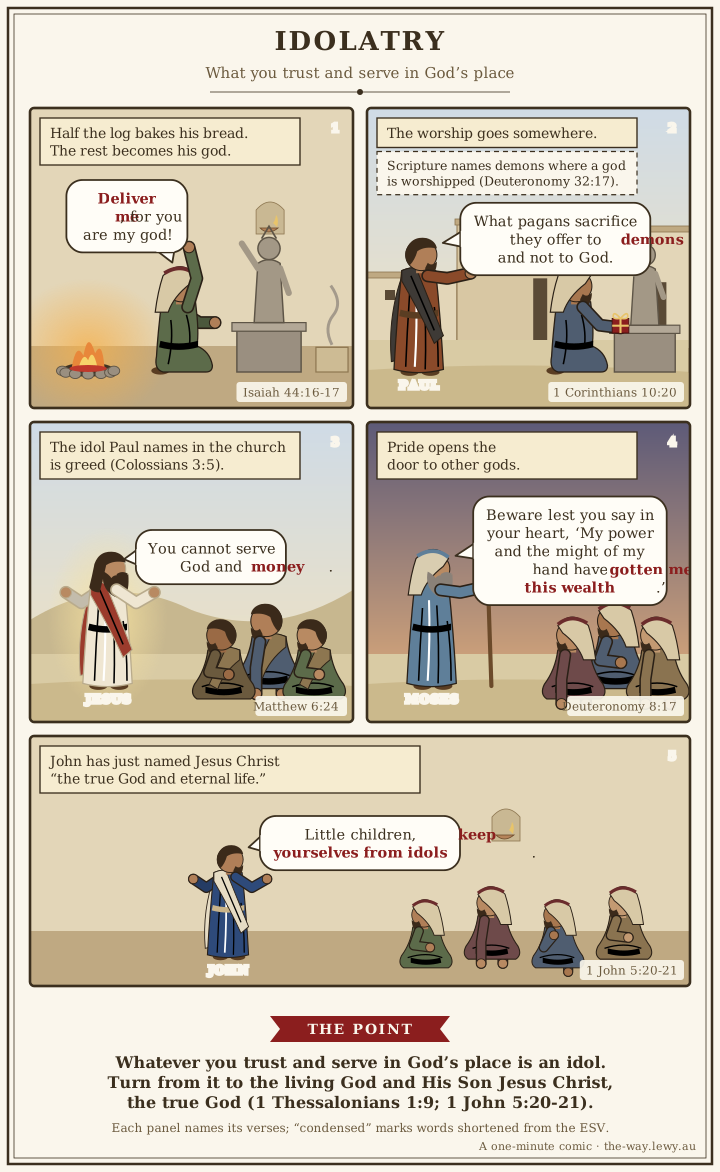
A carpenter cuts down a tree. Half of it he burns to bake his bread and roast his meat. "And the rest of it he makes into a god, his idol, and falls down to it and worships it. He prays to it and says, 'Deliver me, for you are my god!'" (Isaiah 44:17, ESV).
The question this study began with was "Is idolatry the worship of demons?" Scripture's answer has two halves. The block of wood is nothing. The worship offered to it goes to demons. And most of the idols a Christian meets are never carved at all, because Paul names one of them in the middle of a list of the heart's desires: "covetousness, which is idolatry" (Colossians 3:5, ESV).
In one sentence: Idolatry is giving a created thing the trust and service that belong to God; in its plainest form it is a made god, whose worship goes to demons, and in the form Paul names in the church it is greed, money trusted in God's place, while pride is the self-sufficiency that opens the door to both, and God answers every one of them with a jealous love and the call back to His Son Jesus Christ, the true God.
Key Takeaways
(This section follows the Key Takeaways format — see that page for what each part is for.)
Lessons about Jesus
- Jesus is the true God the idols counterfeit. John closes his letter by naming Him: "his Son Jesus Christ. He is the true God and eternal life. Little children, keep yourselves from idols" (1 John 5:20-21, ESV).
- Jesus is the reason you can put the idol to death. Paul's command in Colossians 3:5 rests on what has already happened: "you have died, and your life is hidden with Christ in God" (Colossians 3:3, ESV).
- Jesus delivers from the wrath idolatry earns. The Thessalonians "turned to God from idols … to wait for his Son from heaven, … Jesus who delivers us from the wrath to come" (1 Thessalonians 1:9-10, ESV).
Memory verses
✝️ 1 John 5:20-21 (ESV)
20 And we know that the Son of God has come and has given us understanding, so that we may know him who is true; and we are in him who is true, in his Son Jesus Christ. He is the true God and eternal life. 21 Little children, keep yourselves from idols.
✝️ Colossians 3:5 (ESV)
5 Put to death therefore what is earthly in you: sexual immorality, impurity, passion, evil desire, and covetousness, which is idolatry.
Be Transformed
- Think. An idol is whatever you trust to deliver you and whatever you serve (Isaiah 44:17; Matthew 6:24). Money is the one Paul names (Colossians 3:5).
- Attitude. Hold everything you have as given. "It is he who gives you power to get wealth" (Deuteronomy 8:18, ESV).
- Do. "Flee from idolatry" (1 Corinthians 10:14, ESV). Ask the three questions in Three questions for your heart, name the answer to God, and give away something the answer has a grip on.
Prayer
Father, You are the living God, the fountain of living waters, and You made us for Yourself. You love us with a jealous love and will not share us. Forgive us for the cisterns we have dug: the money we have trusted, the strength we have boasted in, the things we have served in Your place. Lay hold of our hearts again. Show us our idols, and give us the courage to put them to death. Keep us in Your Son Jesus Christ, who is the true God and eternal life, and keep us from idols until He comes.
In Jesus' name. Amen.
Study outline
- What idolatry is. Trust and service given to something God made.
- Made to worship. Why a heart that refuses God worships something else.
- The made god is nothing. Isaiah's carpenter, the psalmist's mouths that cannot speak, and Israel's exchange of the glory of God.
- The worship goes to demons. Paul's two statements in 1 Corinthians 8 and 10, the Song of Moses he quotes, and where Scripture does and does not place demons.
- Greed, the idolatry Paul names. Colossians 3:5, Job's gold, the Babylonian's net, and the two masters.
- Pride, the door to the idol. Self-sufficiency in Deuteronomy 8 and 32, and what to make of "idolatry of self".
- The idol in the heart. Ezekiel's elders and God's answer.
- Why God is jealous. The love behind the first commandment.
- Three questions for your heart and Turning back. The practical end of the study.
What idolatry is
The first commandment forbids two things, and they describe idolatry exactly: "You shall not bow down to them or serve them, for I the LORD your God am a jealous God" (Exodus 20:5, ESV). Bowing is worship. Serving is the life that follows it.
Underneath both is trust. The carpenter's prayer is "Deliver me, for you are my god!" (Isaiah 44:17, ESV). Jeremiah sets the two trusts side by side:
✝️ Jeremiah 17:5, 7 (ESV)
5 Thus says the LORD: "Cursed is the man who trusts in man and makes flesh his strength, whose heart turns away from the LORD. … 7 "Blessed is the man who trusts in the LORD, whose trust is the LORD."
Paul sums up the whole human story the same way: people "exchanged the truth about God for a lie and worshiped and served the creature rather than the Creator" (Romans 1:25, ESV). His verb for "served" is λατρεύω (latreuō, G3000), the word for religious service. So idolatry is giving a created thing the trust, worship and service that belong to the God who made it. The created thing may be an image, a power, money or a man. In every case the heart has turned toward it and away from the LORD.
Made to worship
God made you for Himself. He speaks of His people as "everyone who is called by my name, whom I created for my glory" (Isaiah 43:7, ESV). Of His Son, Paul writes, "all things were created through him and for him" (Colossians 1:16, ESV). Heaven's worship gives the same reason: "Worthy are you, our Lord and God, to receive glory and honor and power, for you created all things" (Revelation 4:11, ESV).
Refusing God does not switch that design off. Paul traces what happens instead. "Although they knew God, they did not honor him as God or give thanks to him" (Romans 1:21, ESV). Four verses later the same people "worshiped and served the creature rather than the Creator" (Romans 1:25, ESV). The worship they withheld from God went to something He made. Jeremiah draws the same picture. A people who forsake "the fountain of living waters" go on drinking: they hew out "broken cisterns that can hold no water" (Jeremiah 2:13, ESV). The thirst stays, so they dig.
Paul saw it in Athens. "His spirit was provoked within him as he saw that the city was full of idols" (Acts 17:16, ESV). He told the Athenians they were "very religious" and pointed to their altar "To the unknown god" (Acts 17:22-23, ESV). Then he told them why: God made every nation "that they should seek God, and perhaps feel their way toward him and find him. Yet he is actually not far from each one of us" (Acts 17:27, ESV). A city full of idols was a city full of people looking for God in the wrong places.
Scripture states the two ends plainly: God created you for His glory, and those who refuse Him worship the creature. The step between them, that the need to worship is built into every person and is always filled with something, is how the church has long read these texts. Augustine opened his Confessions by telling God that He made us for Himself and that our heart is restless until it rests in Him (Confessions 1.1). Ecclesiastes says God "has put eternity into man's heart" (Ecclesiastes 3:11, ESV).
This shows that God made you to find your joy in Him. Every idol is that design misdirected, a thirst for the fountain carried to a cistern. So the answer to idolatry is more than giving the idol up. It is coming back to the worship you were made for.
The made god is nothing
A god you have to carry
Scripture mocks idols. Isaiah's carpenter warms himself at one half of the log and kneels to the other, and never stops to ask, "Shall I fall down before a block of wood?" (Isaiah 44:19, ESV). Jeremiah says idols "are like scarecrows in a cucumber field, and they cannot speak; they have to be carried, for they cannot walk" (Jeremiah 10:5, ESV). A god you have to carry is a god you control, and that is its appeal.
The psalmist adds the cost:
✝️ Psalm 115:4-5, 8 (ESV)
4 Their idols are silver and gold, the work of human hands. 5 They have mouths, but do not speak; eyes, but do not see. … 8 Those who make them become like them; so do all who trust in them.
You become like what you trust. The worshipper of a deaf god grows deaf to God.
The Hebrew has a name for this kind of god. "All the gods of the peoples are worthless idols, but the LORD made the heavens" (Psalm 96:5, ESV), where "worthless idols" is אֱלִילִים (ʾelilim, eh-lee-LEEM, H457), a pun on ʾelohim, "gods". Those Called Gods sets that pun beside the other names Scripture gives the gods of the nations.
The exchange
Israel's first idol shows what an idol costs the worshipper. At Sinai "they made a calf in Horeb and worshiped a metal image. They exchanged the glory of God for the image of an ox that eats grass" (Psalm 106:19-20, ESV). The verb is מוּר (mur, H4171), "exchange", and Jeremiah uses it twice in one verse: "Has a nation changed its gods, even though they are no gods? But my people have changed their glory for that which does not profit" (Jeremiah 2:11, ESV). Then he names the two evils: "they have forsaken me, the fountain of living waters, and hewed out cisterns for themselves, broken cisterns that can hold no water" (Jeremiah 2:13, ESV).
Paul takes up the psalm's wording in Greek. The Septuagint of Psalm 106:20 reads ἠλλάξαντο τὴν δόξαν αὐτῶν ἐν ὁμοιώματι μόσχου, "they exchanged their glory for the likeness of a calf". Romans 1:23 reads ἤλλαξαν τὴν δόξαν τοῦ ἀφθάρτου θεοῦ ἐν ὁμοιώματι, "exchanged the glory of the immortal God for images". The verb, the object and the phrase "for the likeness" are the same. Paul reads the sin of the nations through the sin of Israel at Sinai.
This shows that God is the living God and the fountain, and that He is glorious. Every idol is a trade of that glory for something smaller, something you can hold.
The worship goes to demons
Paul's two statements
In 1 Corinthians Paul writes to Christians in a city where meat was sacrificed in temples, sold in the market and eaten in temple dining rooms (1 Corinthians 8:10). He makes two statements about idols, two chapters apart, in one argument.
The first agrees with the Corinthians: "we know that 'an idol has no real existence,' and that 'there is no God but one'" (1 Corinthians 8:4, ESV). The Greek is plainer: οὐδὲν εἴδωλον ἐν κόσμῳ, "an idol is nothing in the world" (eidōlon, G1497).
The second comes when he turns to the temple meal itself:
✝️ 1 Corinthians 10:19-22 (ESV)
19 What do I imply then? That food offered to idols is anything, or that an idol is anything? 20 No, I imply that what pagans sacrifice they offer to demons and not to God. I do not want you to be participants with demons. 21 You cannot drink the cup of the Lord and the cup of demons. You cannot partake of the table of the Lord and the table of demons. 22 Shall we provoke the Lord to jealousy? Are we stronger than he?
Paul holds both. The image is nothing. The sacrifice is real, and it reaches someone: δαιμονίοις καὶ οὐ θεῷ, "to demons and not to God" (daimonion, dai-MON-ee-on, G1140). A worshipper who eats at that table becomes a κοινωνός (koinōnos, G2844), a "participant" or partner, with demons, the same word Paul has just used of Israel's priests and the altar (1 Corinthians 10:18). The Lord's Supper sets out what the other table, the Lord's, shares.
The Song of Moses
Paul is quoting. "To demons and not to God" is the Septuagint of Deuteronomy 32:17 word for word: ἔθυσαν δαιμονίοις καὶ οὐ θεῷ, "they sacrificed to demons and not to God". His next question, "Shall we provoke the Lord to jealousy?", takes the verb παραζηλόω (parazēloō, G3863) from four verses later, where God says, "They have made me jealous with what is no god" (Deuteronomy 32:21, ESV). Paul reads the Corinthian temple through the Song of Moses.
✝️ Deuteronomy 32:16-17 (ESV)
16 They stirred him to jealousy with strange gods; with abominations they provoked him to anger. 17 They sacrificed to demons that were no gods, to gods they had never known, to new gods that had come recently, whom your fathers had never dreaded.
The Hebrew word is שֵׁדִים (shedim, shay-DEEM, H7700), and it occurs twice in the Old Testament, here and in Psalm 106:37: "They sacrificed their sons and their daughters to the demons." The next verse calls the same victims sacrificed "to the idols of Canaan" (Psalm 106:38, ESV), so the psalm names the idol and the demon in one act. The law had already forbidden Israel to "sacrifice their sacrifices to goat demons, after whom they whore" (Leviticus 17:7, ESV), where "goat demons" is שְׂעִירִם (seʿirim, H8163), "hairy ones".
One modern study Bible reads the shedim of Deuteronomy 32:17 as minor gods of the region, beings whose moral nature cannot be determined, and concludes they "would not have been considered demons" (NIV Cultural Backgrounds Study Bible, note on Deuteronomy 32:17). Paul read the verse in Greek as δαιμόνια and built his warning to the church on it, and the Septuagint translators had read it that way before him. The apostle's reading of Moses carries the argument here.
Where Scripture puts the demons
Every text that names demons in connection with idols describes sacrifice or worship offered to a god:
| Text | What is offered | To whom |
|---|---|---|
| Leviticus 17:7 | "their sacrifices" | "goat demons" |
| Deuteronomy 32:17 | sacrifice | "demons that were no gods" |
| Psalm 106:37-38 | "their sons and their daughters" | "the demons", "the idols of Canaan" |
| 1 Corinthians 10:20 | "what pagans sacrifice" | "demons and not … God" |
| Revelation 9:20 | worship | "demons and idols of gold and silver" |
None of them speaks of covetousness or pride. So the statement this study can defend is precise: where a god is worshipped in the LORD's place, the worship goes to demons. Scripture does not say that a demon stands behind every desire that takes God's place in the heart.
The devil is in the background of all sin in a different way. Before Christ every believer walked "following the prince of the power of the air, the spirit that is now at work in the sons of disobedience" (Ephesians 2:2, ESV). James calls the wisdom of "bitter jealousy and selfish ambition" "earthly, unspiritual, demonic" (James 3:14-15, ESV), and answers the heart's warring desires with "Resist the devil, and he will flee from you" (James 4:7, ESV). That is the enemy's work against every believer. It is a different claim from 1 Corinthians 10:20, and the two should be kept distinct. A Christian who loves money is an idolater by Paul's own word. Scripture calls that sin greed and calls him to put it to death. It does not call his bank account an altar to demons.
Greed, the idolatry Paul names
"Which is idolatry"
Paul's list in Colossians 3:5 runs from the body to the heart: sexual immorality, impurity, passion, evil desire, "and covetousness, which is idolatry" (Colossians 3:5, ESV). The Greek singles out the last item. It has the article, τὴν πλεονεξίαν, and the relative ἥτις ἐστὶν εἰδωλολατρία, "the very thing that is idolatry". The word is πλεονεξία (pleonexia, pleh-oh-nex-EE-ah, G4124), "wanting more". Ephesians 5:5 says it again: "everyone who … is covetous (that is, an idolater), has no inheritance in the kingdom of Christ and God" (ESV). εἰδωλολατρία (eidōlolatria, G1495) occurs four times in the New Testament (1 Corinthians 10:14; Galatians 5:20; Colossians 3:5; 1 Peter 4:3), and greed is the only sin it is used to define.
Job's gold and the Babylonian's net
Paul did not invent the idea. Job, defending his integrity, puts gold in the same list as the sun and the moon:
✝️ Job 31:24-28 (ESV)
24 "If I have made gold my trust or called fine gold my confidence, 25 if I have rejoiced because my wealth was abundant or because my hand had found much, 26 if I have looked at the sun when it shone, or the moon moving in splendor, 27 and my heart has been secretly enticed, and my mouth has kissed my hand, 28 this also would be an iniquity to be punished by the judges, for I would have been false to God above.
Trusting gold and kissing the hand to the moon are one sin to Job. Both are "false to God above".
Habakkuk sees it in Babylon. The Chaldeans are "guilty men, whose own might is their god!" (Habakkuk 1:11, ESV), and the prophet pictures their king as a fisherman who "sacrifices to his net and makes offerings to his dragnet; for by them he lives in luxury" (Habakkuk 1:16, ESV). The net is the means of his wealth, and he worships it.
Two masters
Jesus puts money in God's place by name: "No one can serve two masters … You cannot serve God and money" (Matthew 6:24, ESV). His verb is δουλεύω (douleuō, G1398), to serve as a slave serves. It is the word Paul uses when the Thessalonians "turned to God from idols to serve the living and true God" (1 Thessalonians 1:9, ESV). Money is a master that takes a slave's service, and the only alternative Jesus offers is the living God.
He told a parable to show where the service ends. A rich man with a full harvest builds bigger barns and says to his soul, "Soul, you have ample goods laid up for many years; relax, eat, drink, be merry." God answers, "Fool! This night your soul is required of you" (Luke 12:19-20, ESV). Jesus introduced it with the warning, "Be on your guard against all covetousness, for one's life does not consist in the abundance of his possessions" (Luke 12:15, ESV).
Greed is idolatry because money is trusted to do what only God does. Paul tells Timothy to charge the rich "not to be haughty, nor to set their hopes on the uncertainty of riches, but on God, who richly provides us with everything to enjoy" (1 Timothy 6:17, ESV). Hope, security and provision are the things money promises, and they belong to God. This shows that God is the giver. He "richly provides", and the covetous heart takes the gift and forgets the hand.
Pride, the door to the idol
Self-sufficiency comes first
Is pride an idolatry of the self? Scripture's own words place it one step earlier. Moses warns Israel what wealth will do:
✝️ Deuteronomy 8:12-14, 17, 19 (ESV)
12 lest, when you have eaten and are full and have built good houses and live in them, 13 and when your herds and flocks multiply and your silver and gold is multiplied and all that you have is multiplied, 14 then your heart be lifted up, and you forget the LORD your God … 17 Beware lest you say in your heart, 'My power and the might of my hand have gotten me this wealth.' … 19 And if you forget the LORD your God and go after other gods and serve them and worship them, I solemnly warn you today that you shall surely perish.
The order is wealth, a lifted heart, forgetting God, and then other gods. The Song of Moses tells the same story after it happened: "Jeshurun grew fat, and kicked … then he forsook God who made him … They sacrificed to demons that were no gods" (Deuteronomy 32:15, 17, ESV). Self-sufficiency is the door. The idol comes through it.
"Idolatry of self"
Scripture never calls pride idolatry. The nearest verse is Samuel's rebuke of Saul: "presumption is as iniquity and idolatry" (1 Samuel 15:23, ESV). "Idolatry" there is תְרָפִים (teraphim, H8655), household idols, and the sentence is a comparison: stubborn self-will before God's word is as serious as the idols Israel knew it must not keep.
What Scripture does describe is the proud heart claiming God's place. To the prince of Tyre God says, "Because your heart is proud, and you have said, 'I am a god' … yet you are but a man, and no god" (Ezekiel 28:2, ESV), and the man of lawlessness ends the story "proclaiming himself to be God" (2 Thessalonians 2:4, ESV). Paul's list of the last days opens with "lovers of self, lovers of money" and closes with "lovers of pleasure rather than lovers of God" (2 Timothy 3:2, 4, ESV).
So "idolatry of self" is a teaching phrase. It describes something true, the self put where God belongs, but it is not a term the Bible uses. The Bible's name for that sin is pride, and Pride is the study of it on this site. Used carefully, the two studies fit: pride is the self-sufficient heart, greed is that heart's trust in what it owns, and the carved god is where both end when they are left alone.
The idol in the heart
Ezekiel's elders
The elders of Israel in exile came and sat before Ezekiel to ask for a word from the LORD (Ezekiel 14:1; also 8:1; 20:1). Nothing in their hands or on their faces gave them away. God told the prophet what He saw:
✝️ Ezekiel 14:3, 5-6 (ESV)
3 "Son of man, these men have taken their idols into their hearts, and set the stumbling block of their iniquity before their faces. Should I indeed let myself be consulted by them? … 5 that I may lay hold of the hearts of the house of Israel, who are all estranged from me through their idols. 6 "Therefore say to the house of Israel, Thus says the Lord GOD: Repent and turn away from your idols, and turn away your faces from all your abominations.
The Hebrew is הֶעֱלוּ גִלּוּלֵיהֶם עַל־לִבָּם (heʿelu gilluleyhem ʿal libbam), "they have brought up their idols onto their heart". Gillulim (gillulim, gil-loo-LEEM, H1544) is Ezekiel's word: 39 of its 48 occurrences are in his book. It is most likely formed from a word for dung, so the prophet's name for the gods of Babylon is close to "dung pellets". That derivation is widely held but not certain.
One study Bible suggests the elders wore amulets of Babylonian gods on their chests (NIV Cultural Backgrounds Study Bible, note on Ezekiel 14:3). That may be part of it. God's own answer points inward: He will "lay hold of the hearts", and the one He rejects is the man "who separates himself from me, taking his idols into his heart" (Ezekiel 14:5, 7, ESV).
What God does with it
God's first word to an idolater is "Repent and turn away from your idols" (Ezekiel 14:6, ESV). He answers the man who comes to Him with an idol in his heart "myself" (Ezekiel 14:7), and He does it "that I may lay hold of the hearts of the house of Israel" (Ezekiel 14:5, ESV). This shows that God pursues the heart. He will not be consulted as one advisor among many, and He will not leave His people estranged.
Why God is jealous
The first commandment gives its reason: "for I the LORD your God am a jealous God" (Exodus 20:5, ESV). The Song of Moses tells it as grief: "They stirred him to jealousy with strange gods" (Deuteronomy 32:16, ESV). The law calls the sacrifice to goat demons whoring after them (Leviticus 17:7), and James calls a believer's friendship with the world adultery: "You adulterous people!" (James 4:4, ESV).
The jealousy is a husband's. God bound Israel to Himself by covenant (Jeremiah 2:2), and the church is betrothed to Christ (2 Corinthians 11:2). An idol is another lover, and God will not share His people with it. This shows that God loves exclusively. His jealousy is the measure of His love: He wants all of you because He has given all of Himself, and the same verse that warns of His jealousy promises "steadfast love to thousands of those who love me and keep my commandments" (Exodus 20:6, ESV).
Three questions for your heart
The texts above give three questions that find an idol without needing a carved one.
- What do I trust to deliver me? The carpenter prayed to his log, "Deliver me" (Isaiah 44:17). Job's test was gold made "my trust" (Job 31:24). Ask what you reach for first when trouble comes, and what you would feel helpless without.
- What do I serve? "You cannot serve God and money" (Matthew 6:24). Ask what gets your best hours, your first thoughts in the morning and your hardest work, and whether you would give the same to God.
- What could I not give up? The rich fool's soul was "required" of him and his barns stayed behind (Luke 12:20). Ask what God could take from you that would leave you angry with Him.
Money will be one answer for most readers, because Paul names it. Other answers are a career, a reputation, a relationship, a child, comfort, or your own strength. Each is a good gift. Each becomes an idol when it is trusted and served in God's place.
Turning back
God's command and His promise come together. "Repent and turn away from your idols" (Ezekiel 14:6, ESV). The Thessalonians did exactly that: they "turned to God from idols to serve the living and true God, and to wait for his Son from heaven, whom he raised from the dead, Jesus who delivers us from the wrath to come" (1 Thessalonians 1:9-10, ESV). The turning has a direction. It is toward a living God, a Son who rose, and a deliverance He has already won.
The worship the idol took comes home. Jesus told a woman at a well, beside a cistern, "the true worshipers will worship the Father in spirit and truth, for the Father is seeking such people to worship him" (John 4:23, ESV). The Woman at the Well follows that conversation from Jeremiah's broken cisterns to the spring Jesus gives, and True Worship sets out the worship you were made for: what it is, how it looked before and since Jesus, and why it belongs to God alone.
Paul grounds the command to put greed to death in what Christ has done:
✝️ Colossians 3:1, 3-4 (ESV)
1 If then you have been raised with Christ, seek the things that are above, where Christ is, seated at the right hand of God. … 3 For you have died, and your life is hidden with Christ in God. 4 When Christ who is your life appears, then you also will appear with him in glory.
The "therefore" of Colossians 3:5 points back to these verses. You put the idol to death because you have already died with Christ, and your life is hidden with Him. Christ is your life, so the idol has nothing left to offer you. This is the gospel at work: God forgives the idolater through the death of His Son, unites him to Christ in His resurrection, and gives him a new heart to seek the things above.
John's letter ends on the same ground. "He is the true God and eternal life. Little children, keep yourselves from idols" (1 John 5:20-21, ESV). The true God has come in His Son Jesus Christ, and you are in Him. So you may keep yourself from every idol, the carved and the uncarved, because you have been given the one they all imitate.
Discussion questions
- The language. Paul calls πλεονεξία, "wanting more", "the very thing that is idolatry" (Colossians 3:5), and Jesus uses the slave's verb δουλεύω for serving money (Matthew 6:24). What does each word show you about how greed works?
- The text in its context. Paul says "an idol has no real existence" (1 Corinthians 8:4) and then says sacrifices to idols go "to demons" (1 Corinthians 10:20). Why did the Corinthians need to hear both?
- Christ. John ends "He is the true God and eternal life. Little children, keep yourselves from idols" (1 John 5:20-21). Why does he put those two sentences side by side?
- The hard part. Every text that names demons behind idols describes sacrifice to a god, and none of them speaks of greed. How would you explain to a friend what Scripture does and does not say about a demon behind the love of money?
- Be transformed. Moses warned that a full house and a lifted heart come before other gods (Deuteronomy 8:12-19). Which of the three questions above was hardest for you to answer, and what is one thing you will give away or give up this week because of it?
Group study sheet for a 40-minute group: two A4 sheets, or one with the guided path
The point, the passage, the questions and the response, from this study. Print on both sides of two A4 sheets, flipping on the long edge. While this block is open, printing the page prints the sheet; close it to print the study.
Idolatry
1 Corinthians 10:14-22The point Idolatry is giving a created thing the trust and service that belong to God; in its plainest form it is a made god, whose worship goes to demons, and in the form Paul names in the church it is greed, money trusted in God's place, while pride is the self-sufficiency that opens the door to both, and God answers every one of them with a jealous love and the call back to His Son Jesus Christ, the true God.
Ask: Is idolatry the worship of demons?
Hear a few answers before anyone reads.
1 Corinthians 10:14-22 14Therefore, my beloved, flee from idolatry. 15I speak to reasonable people; judge for yourselves what I say. 16Is not the cup of blessing that we bless a participation in the blood of Christ? And is not the bread that we break a participation in the body of Christ? 17Because there is one loaf, we who are many are one body; for we all partake of the one loaf. 18Consider the people of Israel: Are not those who eat the sacrifices fellow partakers in the altar? 19Am I suggesting, then, that food sacrificed to an idol is anything, or that an idol is anything? 20No, but the sacrifices of pagans are offered to demons, not to God. And I do not want you to be participants with demons. 21You cannot drink the cup of the Lord and the cup of demons too; you cannot partake in the table of the Lord and the table of demons too. 22Are we trying to provoke the Lord to jealousy? Are we stronger than He?
Also read:
Idolatry
- What idolatry is. Trust and service given to something God made.
- Made to worship. Why a heart that refuses God worships something else.
- The made god is nothing. Isaiah's carpenter, the psalmist's mouths that cannot speak, and Israel's exchange of the glory of God.
- The worship goes to demons. Paul's two statements in 1 Corinthians 8 and 10, the Song of Moses he quotes, and where Scripture does and does not place demons.
- Greed, the idolatry Paul names. Colossians 3:5, Job's gold, the Babylonian's net, and the two masters.
- Pride, the door to the idol. Self-sufficiency in Deuteronomy 8 and 32, and what to make of "idolatry of self".
- The idol in the heart. Ezekiel's elders and God's answer.
- Why God is jealous. The love behind the first commandment.
- Three questions for your heart and Turning back. The practical end of the study.
Idolatry
1The text in its context. Paul says "an idol has no real existence" (1 Corinthians 8:4) and then says sacrifices to idols go "to demons" (1 Corinthians 10:20). Why did the Corinthians need to hear both?
2The language. Paul calls πλεονεξία, "wanting more", "the very thing that is idolatry" (Colossians 3:5), and Jesus uses the slave's verb δουλεύω for serving money (Matthew 6:24). What does each word show you about how greed works?
3Christ. John ends "He is the true God and eternal life. Little children, keep yourselves from idols" (1 John 5:20-21). Why does he put those two sentences side by side?
4The hard part. Every text that names demons behind idols describes sacrifice to a god, and none of them speaks of greed. How would you explain to a friend what Scripture does and does not say about a demon behind the love of money?
Idolatry
5Be transformed. Moses warned that a full house and a lifted heart come before other gods (Deuteronomy 8:12-19). Which of the three questions above was hardest for you to answer, and what is one thing you will give away or give up this week because of it?
- Think. An idol is whatever you trust to deliver you and whatever you serve (Isaiah 44:17; Matthew 6:24). Money is the one Paul names (Colossians 3:5).
- Attitude. Hold everything you have as given. "It is he who gives you power to get wealth" (Deuteronomy 8:18, ESV).
- Do. "Flee from idolatry" (1 Corinthians 10:14, ESV). Ask the three questions in Three questions for your heart, name the answer to God, and give away something the answer has a grip on.
And we know that the Son of God has come and has given us understanding, so that we may know him who is true; and we are in him who is true, in his Son Jesus Christ. He is the true God and eternal life. Little children, keep yourselves from idols.
1 John 5:20-21 (ESV)Father, You are the living God, the fountain of living waters, and You made us for Yourself. You love us with a jealous love and will not share us. Forgive us for the cisterns we have dug: the money we have trusted, the strength we have boasted in, the things we have served in Your place. Lay hold of our hearts again. Show us our idols, and give us the courage to put them to death. Keep us in Your Son Jesus Christ, who is the true God and eternal life, and keep us from idols until He comes.
In Jesus' name. Amen.
Idolatry
1 Corinthians 10:14-22Open Ask: Is idolatry the worship of demons?
Hear a few answers before anyone reads.
Read it aloud 1 Corinthians 10:14-22
1The text in its context. Paul says "an idol has no real existence" (1 Corinthians 8:4) and then says sacrifices to idols go "to demons" (1 Corinthians 10:20). Why did the Corinthians need to hear both?
2The language. Paul calls πλεονεξία, "wanting more", "the very thing that is idolatry" (Colossians 3:5), and Jesus uses the slave's verb δουλεύω for serving money (Matthew 6:24). What does each word show you about how greed works?
3Christ. John ends "He is the true God and eternal life. Little children, keep yourselves from idols" (1 John 5:20-21). Why does he put those two sentences side by side?
4The hard part. Every text that names demons behind idols describes sacrifice to a god, and none of them speaks of greed. How would you explain to a friend what Scripture does and does not say about a demon behind the love of money?
5Be transformed. Moses warned that a full house and a lifted heart come before other gods (Deuteronomy 8:12-19). Which of the three questions above was hardest for you to answer, and what is one thing you will give away or give up this week because of it?
- Think. An idol is whatever you trust to deliver you and whatever you serve (Isaiah 44:17; Matthew 6:24). Money is the one Paul names (Colossians 3:5).
- Attitude. Hold everything you have as given. "It is he who gives you power to get wealth" (Deuteronomy 8:18, ESV).
- Do. "Flee from idolatry" (1 Corinthians 10:14, ESV). Ask the three questions in Three questions for your heart, name the answer to God, and give away something the answer has a grip on.
Idolatry
The point Idolatry is giving a created thing the trust and service that belong to God; in its plainest form it is a made god, whose worship goes to demons, and in the form Paul names in the church it is greed, money trusted in God's place, while pride is the self-sufficiency that opens the door to both, and God answers every one of them with a jealous love and the call back to His Son Jesus Christ, the true God.
References & Recommended Reading
- Scripture quotations are from the ESV unless marked. Greek New Testament text and word counts from the SBLGNT (MACULA Greek); Hebrew word counts from the Westminster Leningrad Codex (MACULA Hebrew); Septuagint text from Brenton's edition.
- ESV Study Bible (Crossway), notes on 1 Corinthians 10:19-20, Colossians 3:5 and Ezekiel 14:1-11.
- NIV Cultural Backgrounds Study Bible (Zondervan), notes on 1 Corinthians 10:20, Deuteronomy 32:17 and Ezekiel 14:3.
- NIV Biblical Theology Study Bible (Zondervan), note on Colossians 3:5.
- NLT Life Application Study Bible (Tyndale), footnote on Ezekiel 14:3.
- Augustine, Confessions 1.1 (paraphrased; not in this site's local patristics corpus).
On this site
- Those Called Gods — the gods of the nations, the powers over them, and what Christ did to them at the cross.
- Pride — the self-sufficient heart that wants God's place.
- The Woman at the Well — the spring Israel forsook, and worship in spirit and truth.
- True Worship — the answer to idolatry: worship given to God alone.
- The Lord's Supper — the table of the Lord in 1 Corinthians 10.
- Sin and Sorcery — idolatry's neighbour in Galatians 5:20.
- Sin and Sexual Immorality — the other half of the Colossians 3:5 list.