The Woman at the Well
Week 2 of 4 in Through John's Gospel · next: Bread of Life: The Feeding of the 5,000 and the 4,000
Jesus asks a Samaritan woman for a drink He has no bucket to reach. Then He offers her water, and she spends the rest of the conversation talking about equipment and real estate — your bucket, our well, that mountain.
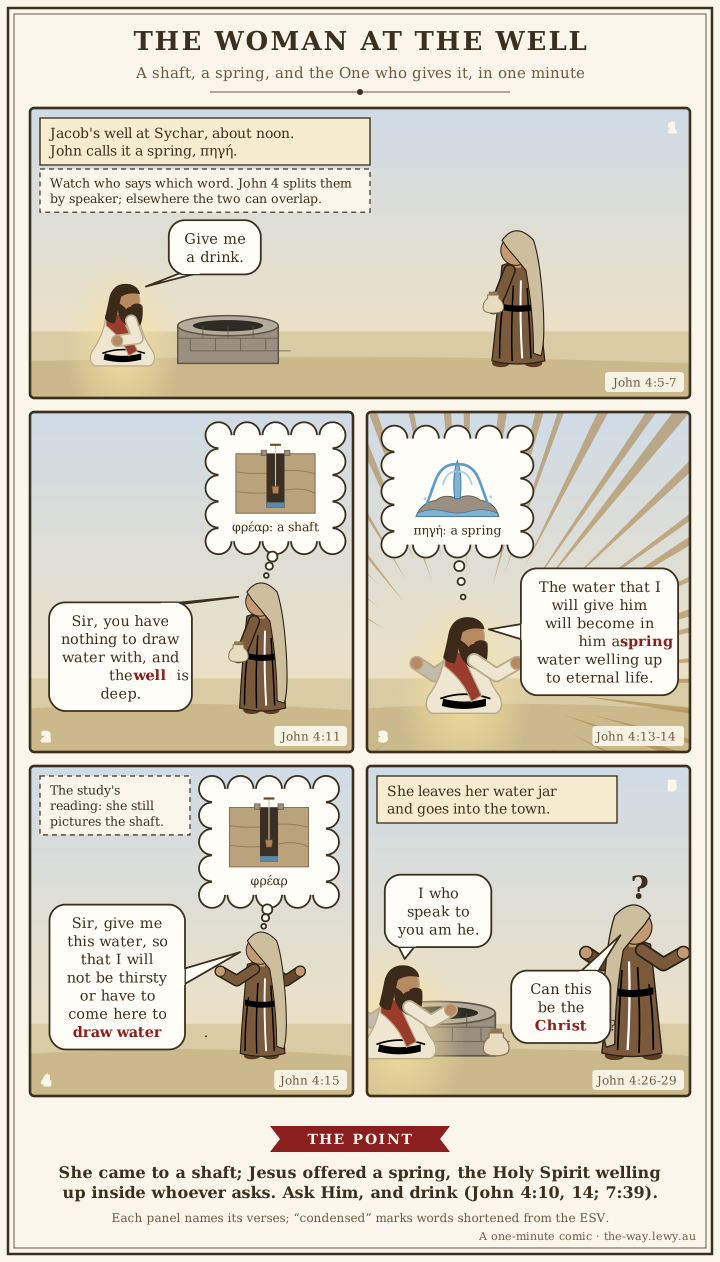
John 4 uses two Greek words English prints as one. The woman calls Jacob's well a φρέαρ (phrear), a shaft sunk to reach water; the narrator and Jesus call it a πηγή (pēgē), a spring. What Jesus offers is a spring set inside a person. Jeremiah had already set the spring against the water people dig for themselves, and named the trade as Israel's sin: "they have forsaken me, the spring of living waters, and cut out cisterns for themselves" (Jeremiah 2:13, WEB).
She asks for it anyway as a labour-saving device — "give me this water, so that I will not be thirsty or have to come here to draw water" (4:15) — and Jesus answers by asking about her husband.
In one sentence: Jesus is the spring of living waters that Israel forsook for cisterns, and He gives the Holy Spirit as a free gift that wells up inside whoever asks; He moves worship off every mountain to the Father Himself, so you may come to God fully known and worship Him in spirit and truth.
Teaching children or teenagers? The Woman at the Well for young readers tells this story for ages 8 to 16, with its own comic.
Key Takeaways
(This section follows the Key Takeaways format — see that page for what each part is for.)
Types & Prophecy
Type. A man sits at a well in a foreign country, a woman comes to draw water, and a betrothal follows. That is the shape of Genesis 24 (Abraham's servant and Rebekah, where a drink is requested too, 24:17), Genesis 29 (Jacob and Rachel) and Exodus 2 (Moses and Zipporah) — and John has just had the Baptist call Jesus "the bridegroom" who "has the bride" (John 3:29), two paragraphs earlier. Jesus steps into the scene and redirects it: the bride He leaves with is a village. Nobody in the text names the pattern, unlike the bronze serpent, where Jesus names it Himself (John 3:14) — the resemblance here is in the staging.
Prophecy. The Samaritans held only the Torah, and looked for the prophet like Moses of Deuteronomy 18:15-18 rather than a son of David. The woman's "I know that Messiah is coming" (4:25) is that expectation, and Jesus answers it directly. Jesus makes a prediction of His own in 4:21 — an hour when the Father is worshipped neither on Gerizim nor in Jerusalem.
Lessons about Jesus
- He is the spring itself. Jeremiah's indictment names God as "the spring of living waters" (Jeremiah 2:13; 17:13), and the Septuagint renders it with πηγή — the noun John puts in Jesus's mouth at 4:14. The woman argues about which ancestors dug the right hole and worshipped on the right hill while the spring her nation forsook sits on the wall asking her for a drink.
- What He gives renews itself. "Everyone who drinks of this water will be thirsty again" (4:13) — that is what a shaft delivers. What He gives "will become in him a spring of water welling up to eternal life" (4:14). John names the gift three chapters later: the Spirit (7:39).
- He hands it over as a gift, and the only prerequisite He names is asking. τὴν δωρεὰν τοῦ θεοῦ, "the gift of God" (4:10) — "you would have asked him, and he would have given you living water." She has no bucket either, and it stops being the problem.
- He exposes her sin, and keeps talking to her. The order in 4:16-26 is disclosure, then worship, then His own identity. The sin is named first, and the offer of living water stands with it on the table.
- John 4:26 is the first ἐγώ εἰμι on Jesus's lips in the Gospel. John records the phrase 23 more times, 22 of them Jesus's own, and the seven sayings with a predicate (the bread, the light, the door, the shepherd, the resurrection, the way, the vine) begin at 6:35. The first goes to a woman standing alone at a well.
- John uses the noun "Saviour" exactly once, at 4:42, and it is Samaritans who say it: "this is indeed the Savior of the world."
Memory verses
✝️ John 4:14 (ESV)
14 but whoever drinks of the water that I will give him will never be thirsty again. The water that I will give him will become in him a spring of water welling up to eternal life.
✝️ John 4:23 (ESV)
23 But the hour is coming, and is now here, when the true worshipers will worship the Father in spirit and truth, for the Father is seeking such people to worship him.
Be Transformed
- Think. Jeremiah names two evils: forsaking the spring, and cutting cisterns (2:13). The second is the industrious one, and it is the one that looks like devotion. Any arrangement you keep up to stay supplied — the routine, the place, the practice — has become a cistern the moment it stands in for the source.
- Attitude. She asked where (4:20); He answered how (4:24), using the same Greek word in both. Take your own questions about approaching God — the right building, the right posture, the right form of words — and ask which of them Jesus would answer and which He would replace.
- Do. She asked for the water so she would not have to come back (4:15), and His reply was "Go, call your husband." Name the sin you have kept outside your conversation with God, confess it to Him, and keep talking. For her, being known was the way into worship.
Prayer
Father, you are spirit, and you are seeking worshippers. You are the spring my people traded for cisterns we cut ourselves, and I have dug my own and found them empty. Give me the living water your Son Jesus offered her, your Holy Spirit, a spring you set inside me. When Jesus tells me the truth about my sin, let me hear it the way she did: confess it, and keep talking to you. In Jesus' name. Amen.
Study outline
- Where this sits in John. Nicodemus and the woman as a pair, the bridegroom, why Jesus "had to" go through Samaria, and a Jew asking a Samaritan for a drink.
- The two words English calls "well". πηγή and φρέαρ, then Jeremiah's two evils, living water and what she asks for. What the English versions do with it comes first.
- Five husbands. The allegorical reading of 2 Kings 17, and what John's text supports.
- Worship: the question relocated. Gerizim and Deuteronomy 27:4, then where one must worship turned into how.
- "I am, the one speaking to you". The first ἐγώ εἰμι on Jesus's lips in John, and whether it carries Exodus 3:14.
- A hesitant witness, and a two-day stay. The water jar, her tentative question, and a town that believed.
- The theological principle, what is cultural and what is not, and discussion questions. Five questions, for a group or on your own.
Where this sits in John
John 4 is the second of a pair. In chapter 3 a man comes to Jesus: Nicodemus, a Pharisee and teacher of Israel, who arrives at night, is told he must be born again, and is last heard asking "How can these things be?" (3:9). In chapter 4 Jesus comes to a woman: a Samaritan, unnamed, probably at midday, with no religious standing at all, who ends up bringing her town to Him. The contrast runs through sex, nation, standing and who comes to whom, and the hour sharpens it if "the sixth hour" is noon (see below).
Between them sits the Baptist's last speech, which is what sets up the well. He calls Jesus ὁ νυμφίος (ho nymphios, "the bridegroom"), the one who "has the bride" (John 3:29). Then Jesus goes and sits at a well.
"He had to pass through Samaria"
✝️ John 4:3-6 (ESV)
3 he left Judea and departed again for Galilee. 4 And he had to pass through Samaria. 5 So he came to a town of Samaria called Sychar, near the field that Jacob had given to his son Joseph. 6 Jacob's well was there; so Jesus, wearied as he was from his journey, was sitting beside the well. It was about the sixth hour.
"He had to" is ἔδει (edei, G1163, "it was necessary"). The road itself was the ordinary one: Josephus has Galileans crossing Samaria as the usual three-day route to Judea (Antiquities 20.118; Wars 2.232; Life 269), and the ESV Study Bible says Jesus "had to pass this way because of geography" (note on 4:4). The same note adds that the word may also mark God's plan, and John's usage supports that. δεῖ occurs ten times in this Gospel (3:7, 3:14, 3:30, 4:4, 4:20, 4:24, 9:4, 10:16, 12:34, 20:9), and seven of them mark what must happen because God has determined it: you must be born again, the Son of Man must be lifted up, He must increase, the Son of Man must rise. The other three are in this chapter: 4:4, and the woman's must at 4:20 with Jesus's answer at 4:24 (below). Both senses can stand at 4:4: the shortest road, and the road God had set. (The word's pop-up counts only this past-tense form, because the underlying data files the present δεῖ separately, so it shows fewer uses than these ten.)
Sychar is usually identified with Askar, about a mile from the well on the slope of Mount Ebal; the well is still there, and still over thirty metres deep — which is her objection in 4:11. The hour is disputed. "The sixth hour" is noon on Jewish reckoning, the hottest part of the day, and since women normally drew together, a woman drawing alone at noon is usually read as one unwelcome in the group. The Legacy Standard Bible's footnote at 4:6 allows "Perhaps 6 p.m. Roman time or noon Jewish time", and the solitary-woman inference stands or falls with noon.
A Jew asking a Samaritan for a drink
She is startled before any word about water is spoken: "How is it that you, a Jew, ask for a drink from me, a woman of Samaria?" (4:9, ESV). John's aside, "Jews have no dealings with Samaritans", uses συγχρῶνται, which can mean more narrowly "share use of"; the CSB footnotes "Or do not share vessels with". Many Jews held Samaritans to be continually unclean, so drinking from her jar would defile Him (ESV Study Bible, note on 4:9). Jesus asks for it anyway. (Some manuscripts omit the aside, as the CSB and NLT note.)
The two words English calls "well"
Read John 4 in any common English version and the well is a well throughout. The Greek uses two different nouns, and they divide by who is speaking.
| Verse | Speaker | Greek | What it means |
|---|---|---|---|
| 4:6 (×2) | the narrator | πηγή (pēgē, G4077) | a spring — water that rises on its own |
| 4:11 | the woman | φρέαρ (phrear, G5421) | a shaft sunk to reach water |
| 4:12 | the woman | φρέαρ | the same |
| 4:14 | Jesus | πηγή | a spring |
The narrator calls it Jacob's spring. The woman, both times she speaks of it, calls it a shaft — in this study's own rendering, "you have nothing to draw with, and the shaft is deep" (4:11), "are you greater than our father Jacob, who gave us the shaft?" (4:12). φρέαρ is rare in the New Testament: outside these two verses it appears only at Luke 14:5 and, four times, of the shaft of the abyss in Revelation 9:1-2.
Then Jesus takes the narrator's word and moves it: the water He gives "will become in him a πηγή of water welling up to eternal life" (4:14). A spring, relocated inside the person.
The difference between the words should not be pressed further than John's use of them. The Septuagint of Genesis 24 calls Rebekah's one water source both πηγή (24:13, 16, 42-45) and φρέαρ (24:11, 20), and Isaac's servants dig a φρέαρ of "living water" (Genesis 26:19). What is firm is the split by speaker in John 4 and the word Jesus chooses at 4:14. The spring-against-shaft contrast is John's staging, carried by who says which word.
What the English versions do with it
At 4:6 and 4:11, ESV, NIV, CSB, LSB, WEB, ASV and BSB all print "well" for both nouns, so an English reader cannot see that the narrator and the woman are using different words. At 4:14 — the promise, where it costs the most — the versions split:
| Renders πηγή at 4:14 as a spring | Renders it "well" |
|---|---|
| ESV, NIV — "a spring of water welling up" | WEB, ASV, LSB — "a well of water springing up" |
| BSB — "a fount of water" | CSB — "a well, of water springing up" |
The CSB's own footnote at 4:14 offers "Or spring", so its translators saw the choice. Where a version prints "well" here, the promise reads as Jesus giving her her own well — an improvement in convenience, which is precisely the thing she asks for in the next verse and does not get. Read the ESV or NIV at 4:14. At 4:6 and 4:11 none of the common modern versions will help; J. N. Darby's nineteenth-century translation is one that prints "fountain" at 4:6 and "well" at 4:11.
Jeremiah's two evils
✝️ Jeremiah 2:13 (WEB)
13 "For my people have committed two evils: they have forsaken me, the spring of living waters, and cut out cisterns for themselves: broken cisterns that can't hold water."
The Hebrew for "spring of living waters" is מְקוֹר מַיִם חַיִּים (meqôr mayim ḥayyîm), and the Septuagint renders מָקוֹר with πηγή — the noun John uses. Set against it are בֹּארוֹת (bo'rôt, H953), cisterns people cut for themselves, which hold nothing; the Septuagint calls them λάκκοι, pits, and its verb for making them is ὀρύσσω, "dig". Jeremiah says it again at 17:13: "they have forsaken Yahweh, the spring of living waters."
Jeremiah's word is not the woman's. A cistern stores rainwater and a φρέαρ reaches groundwater, and the Septuagint's phrase is "spring of the water of life" (πηγὴν ὕδατος ζωῆς) rather than John's "living water". The link between the passages is an analogy: both set water people dig for against the spring God is. The two evils are a trade, and John 4 stages the trade in reverse. A woman stands at a shaft her ancestors dug, arguing about whose ancestors dug the right things and worshipped on the right hill, and the spring of living water is sitting on the wall asking her for a drink.
Living water is the Spirit
ὕδωρ ζῶν (hydōr zōn, "living water") was ordinary language for running water as opposed to standing water in a cistern — the sense it carries at Genesis 26:19 and Leviticus 14:6. That is what the woman hears, and her reply is practical: you have no bucket, so where would you get flowing water (4:11)?
John explains what Jesus meant three chapters later:
✝️ John 7:37-39 (ESV)
37 On the last day of the feast, the great day, Jesus stood up and cried out, "If anyone thirsts, let him come to me and drink. 38 Whoever believes in me, as the Scripture has said, 'Out of his heart will flow rivers of living water.'" 39 Now this he said about the Spirit, whom those who believed in him were to receive, for as yet the Spirit had not been given, because Jesus was not yet glorified.
The gift is the Spirit. The prophets had promised water in these terms — water poured on thirsty ground (Isaiah 44:3), a river out of the temple (Ezekiel 47:1-6), living waters going out from Jerusalem (Zechariah 14:8) — and Jesus locates the fulfilment inside the believer.
What she asks for instead
✝️ John 4:13-16 (ESV)
13 Jesus said to her, "Everyone who drinks of this water will be thirsty again, 14 but whoever drinks of the water that I will give him will never be thirsty again. The water that I will give him will become in him a spring of water welling up to eternal life." 15 The woman said to him, "Sir, give me this water, so that I will not be thirsty or have to come here to draw water." 16 Jesus said to her, "Go, call your husband, and come here."
Jesus states the difference in the plainest terms available and she still hears an appliance. Verse 13 is what a shaft delivers: you drink, you are thirsty again, you walk back. Verse 14 is what a spring delivers. Her verse 15 keeps the shaft-shaped life entire and asks only for the walk to be removed — no thirst, no trip.
The verb she uses for that trip is ἀντλέω (antleō, G501, "to draw"), which occurs four times in the New Testament and all four are in John: twice of the servants drawing water at Cana (2:8-9), and twice here — she came to draw (4:7), and she asks never to have to draw again (4:15). It is also the Septuagint's verb for the women at the wells of Genesis 24 and Exodus 2, and for Isaiah's promise: "with joy you will draw water out of the wells of salvation" (Isaiah 12:3, WEB), where the Hebrew is מִמַּעַיְנֵי (mimma'ayĕnê, "from the springs") and the Septuagint again puts πηγή there.
Jesus answers her misunderstanding with a different subject. He says, "Go, call your husband." The conversation leaves the water and goes to the part of her life she had not brought to the well.
Five husbands: a count of marriages
✝️ John 4:17-19 (ESV)
17 The woman answered him, "I have no husband." Jesus said to her, "You are right in saying, 'I have no husband'; 18 for you have had five husbands, and the one you now have is not your husband. What you have said is true." 19 The woman said to him, "Sir, I perceive that you are a prophet.
A reading that circulates takes the five husbands allegorically, as the five foreign populations Assyria resettled in Samaria — 2 Kings 17:24 names Babylon, Cuthah, Avva, Hamath and Sepharvaim, five of them — with the sixth, illegitimate partner standing for Samaritan worship. Five verses later the same chapter names the gods those populations made, and there are seven (17:29-31). John gives no signal to read the number as anything but a count of marriages: Jesus states it, she confirms it, and what she draws from it is that He has knowledge she did not give Him — "I perceive that you are a prophet".
Her "I have no husband" is true and closes the topic. Jesus reopens it, agrees with her twice ("you are right", "what you have said is true"), and fills in the rest. What He exposes is sin: "the one you now have is not your husband" means the present relationship is not a marriage (ESV Study Bible, note on 4:18). She does not deny it. He names it and keeps talking, and the conversation goes on to worship, water and His own identity with the sin on the table. That is conviction, and the Jesus who exposes the sin is the one offering the sinner living water. The next thing she does is start asking Him theology.
Worship: the question relocated
✝️ John 4:20-24 (ESV)
20 Our fathers worshiped on this mountain, but you say that in Jerusalem is the place where people ought to worship." 21 Jesus said to her, "Woman, believe me, the hour is coming when neither on this mountain nor in Jerusalem will you worship the Father. 22 You worship what you do not know; we worship what we know, for salvation is from the Jews. 23 But the hour is coming, and is now here, when the true worshipers will worship the Father in spirit and truth, for the Father is seeking such people to worship him. 24 God is spirit, and those who worship him must worship in spirit and truth."
Why she points at that mountain
"This mountain" is Gerizim, visible from the well. Her claim rests on a reading in her own Bible. Deuteronomy 27:4 commands that stones be set up and an altar built after Israel crosses the Jordan. The Masoretic Text names the mountain Ebal; the Samaritan Pentateuch names Gerizim:
| Text | Deuteronomy 27:4 |
|---|---|
| Masoretic (WLC) | בְּהַר עֵיבָל — "on Mount Ebal" |
| Samaritan Pentateuch | בהר גריזים — "on Mount Gerizim" |
Gerizim is also the mountain of blessing in Deuteronomy 11:29, and Jacob built an altar at nearby Shechem (Genesis 33:18-20), where Joseph was buried (Joshua 24:32). The Samaritans put their temple on Gerizim, and the Hasmonean ruler John Hyrcanus destroyed it about a century and a half before this conversation. Her "our fathers worshiped on this mountain" rests on a real textual and historical claim, and she is standing next to its ruins.
The same word, a different question
Her verse 20 uses δεῖ — Jerusalem is "the place where one must worship". Jesus's verse 24 uses the same word: those who worship God "must worship in spirit and truth". She asks where one must worship; He answers how. Two of John's ten uses of δεῖ sit four verses apart, doing that pivot.
Verse 21 removes both mountains, and verse 22 still awards the Jewish claim outright — "you worship what you do not know; we worship what we know, for salvation is from the Jews", where the "you" is plural, addressed to Samaritans generally rather than to her. The Samaritan claim is wrong, and the Jerusalem claim is right about the past: salvation came through the Jews. What changes is the ground of access. From "now" (4:23) the Father is reached through the Son, whose body is the temple (John 2:21), and not by standing on the right mountain. That does not end Jerusalem's future. Jesus still calls it "the city of the great King" (Matthew 5:35), and the prophets see the nations going up there to worship the King in person (Zechariah 14:16). The place stays; it stops being the way in, and in the end the city's temple is "the Lord God the Almighty and the Lamb" (Revelation 21:22).
"God is spirit" (πνεῦμα ὁ θεός) grounds it: God is present wherever He is sought, so worship goes wherever His worshippers are. Whether "in spirit and truth" means the human spirit or the Holy Spirit is left open by the Greek — the LSB footnotes "Or Spirit" at 4:24 and the CSB "Or in spirit and truth" at 4:23, and the NIV and CSB print "Spirit" in their text — and John 7:39's identification of the living water as the Spirit makes the second reading the more natural one in this Gospel.
"I am, the one speaking to you"
✝️ John 4:25-26 (ESV)
25 The woman said to him, "I know that Messiah is coming (he who is called Christ). When he comes, he will tell us all things." 26 Jesus said to her, "I who speak to you am he."
The Samaritans kept only the Torah, so the figure she expects is the prophet like Moses of Deuteronomy 18:15-18 — one who would "tell us all things". Jesus answers in that register and exceeds it.
The Greek is Ἐγώ εἰμι, ὁ λαλῶν σοι — "I am, the one speaking to you." This is the first ἐγώ εἰμι on Jesus's lips in John's Gospel. John records the phrase 23 more times, 22 of them Jesus's own (the other is the healed blind man, 9:9): the bread, the light, the door, the shepherd, the resurrection, the way, the vine, and the bare "before Abraham was, I am" at 8:58. This one, first, is spoken to a lone Samaritan woman with no one else present.
Whether it carries the weight of Exodus 3:14 is unsettled. In context it answers her sentence about the Messiah, so "I am he" is the natural sense — but the NLT's footnote at 4:26 offers "The 'I AM' is here" and "I am the LORD", and cross-references Exodus 3:14, so the divine-name reading is a live translator's option as well as a commentator's. The absolute use, with no predicate at all, comes at 8:24 and 8:28 and is unmistakable at 8:58; what 4:26 establishes is that the formula starts here. The Names of God sets out Exodus 3:14 itself.
A hesitant witness, and a two-day stay
✝️ John 4:28-29 (ESV)
28 So the woman left her water jar and went away into town and said to the people, 29 "Come, see a man who told me all that I ever did. Can this be the Christ?"
She asked in 4:15 never to have to come back and draw. Thirteen verses later she walks back to town and the ὑδρία, the water jar, stays at the well. John does not say why she left it. He does say she came for water and left without it, and the verb is ἀφίημι (aphiēmi, G863) — the same one that opened the chapter when Jesus "left" Judea (4:3).
Her question is framed with μήτι (mēti, G3385), a particle that normally expects the answer no. John uses it twice more — the crowd asking "will he kill himself?" (8:22) and Pilate's "am I a Jew?" (18:35) — both expecting a denial. But Matthew uses the same form for amazed crowds wondering whether Jesus might be the Son of David (Matthew 12:23), and the ESV and NIV print 4:29 as an open question. So her testimony reads either as "this couldn't be the Christ, could it?" or as a hesitant hope. On both readings it is tentative, and it worked anyway:
✝️ John 4:39-42 (ESV)
39 Many Samaritans from that town believed in him because of the woman's testimony, "He told me all that I ever did." 40 So when the Samaritans came to him, they asked him to stay with them, and he stayed there two days. 41 And many more believed because of his word. 42 They said to the woman, "It is no longer because of what you said that we believe, for we have heard for ourselves, and we know that this is indeed the Savior of the world."
Her "Come, see" (Δεῦτε ἴδετε) uses the same verb as Jesus's "Come and you will see" to the first disciples (1:39, where it is future, ὄψεσθε), and the same imperative Philip used to Nathanael, "Come and see" (1:46), with a different verb for "come". She is doing what the disciples did, on the strength of one conversation and a question she was not sure of the answer to.
Two details close the account. Jesus, who arrived κεκοπιακώς — "wearied" from the journey (4:6) — tells the disciples that "Others have labored, and you have entered into their labor" (4:38). All three occurrences of κοπιάω in John are in this chapter, and they run from His tiredness at the well to the harvest it produced. And the Samaritans' verdict uses σωτήρ, "Saviour", the only time the noun appears in John's Gospel.
The theological principle
Jesus gives the Spirit as an inward, self-renewing source of life, received as a gift; He exposes the sin of the one He is giving it to, and keeps giving; and He relocates worship from a place to the Father Himself, so that access depends on Him alone.
None of this rests on the narrative alone. John identifies the living water as the Spirit Himself (7:39); the gift language is the passage's own (4:10) and is taught explicitly at Ephesians 2:8-9; and the relocation of worship is developed across the epistles, where the people themselves become the temple the Spirit indwells (1 Corinthians 3:16-17; Ephesians 2:19-22).
What is cultural and what is not
Several things in John 4 belong to their setting. The betrothal scene at a well is a literary convention of Genesis and Exodus; the Jewish avoidance of Samaritan vessels is a first-century purity rule; women drawing water together at set hours is village custom; and the Gerizim-Jerusalem dispute is a quarrel between two peoples. What crosses into every culture is what Jesus does with them: He gives the Spirit freely to whoever asks, He names sin and keeps talking to the sinner, and He is worshipped in spirit and truth wherever His people are.
Discussion questions
- Jesus says the well water leaves you thirsty again (4:13) and she asks for His water so she will not have to keep walking to the well (4:15). Where are you asking God for a shorter walk to the same well?
- Jeremiah 2:13 names two evils: forsaking the spring, and cutting cisterns. Why does the second one matter separately from the first?
- Jesus raises the woman's marital history before He says anything about worship or His own identity, and keeps talking to her afterwards. What does that ordering suggest about how being known relates to worship?
- Her testimony is a question expecting the answer no, and a town believed through it. What does that suggest about how sure a witness has to be?
- Deuteronomy 27:4 reads "Ebal" in one Bible and "Gerizim" in another, and centuries of dispute followed. Jesus answers by removing both mountains. What questions might we be asking that He would answer the same way?
Group study sheet for a 40-minute group: two A4 sheets, or one with the guided path
The point, the passage, the questions and the response, from this study. Print on both sides of two A4 sheets, flipping on the long edge. While this block is open, printing the page prints the sheet; close it to print the study.
The Woman at the Well
John 4:1-42The point Jesus is the spring of living waters that Israel forsook for cisterns, and He gives the Holy Spirit as a free gift that wells up inside whoever asks; He moves worship off every mountain to the Father Himself, so you may come to God fully known and worship Him in spirit and truth.
Ask: what comes to mind when you hear The Woman at the Well
? Hear a few answers before anyone reads.
John 4:1-42 1When Jesus realized that the Pharisees were aware He was gaining and baptizing more disciples than John 2(although it was not Jesus who baptized, but His disciples), 3He left Judea and returned to Galilee. 4Now He had to pass through Samaria. 5So He came to a town of Samaria called Sychar, near the plot of ground that Jacob had given to his son Joseph. 6Since Jacob’s well was there, Jesus, weary from His journey, sat down by the well. It was about the sixth hour. 7When a Samaritan woman came to draw water, Jesus said to her, “Give Me a drink.” 8(His disciples had gone into the town to buy food.) 9“You are a Jew,” said the woman. “How can You ask for a drink from me, a Samaritan woman?” (For Jews do not associate with Samaritans.) 10Jesus answered, “If you knew the gift of God and who is asking you for a drink, you would have asked Him, and He would have given you living water.” 11“Sir,” the woman replied, “You have nothing to draw with and the well is deep. Where then will You get this living water? 12Are You greater than our father Jacob, who gave us this well and drank from it himself, as did his sons and his livestock?” 13Jesus said to her, “Everyone who drinks this water will be thirsty again. 14But whoever drinks the water I give him will never thirst. Indeed, the water I give him will become in him a fount of water springing up to eternal life.” 15The woman said to Him, “Sir, give me this water so that I will not get thirsty and have to keep coming here to draw water.” 16Jesus told her, “Go, call your husband and come back.” 17“I have no husband,” the woman replied. Jesus said to her, “You are correct to say that you have no husband. 18In fact, you have had five husbands, and the man you now have is not your husband. You have spoken truthfully.” 19“Sir,” the woman said, “I see that You are a prophet. 20Our fathers worshiped on this mountain, but you Jews say that the place where one must worship is in Jerusalem.” 21“Believe Me, woman,” Jesus replied, “a time is coming when you will worship the Father neither on this mountain nor in Jerusalem. 22You worship what you do not know; we worship what we do know, for salvation is from the Jews. 23But a time is coming and has now come when the true worshipers will worship the Father in spirit and in truth, for the Father is seeking such as these to worship Him. 24God is Spirit, and His worshipers must worship Him in spirit and in truth.” 25The woman said, “I know that Messiah” (called Christ) “is coming. When He comes, He will explain everything to us.” 26Jesus answered, “I who speak to you am He.”
Also read: John 4:1-42 from 4:27
The Woman at the Well
- Where this sits in John. Nicodemus and the woman as a pair, the bridegroom, why Jesus "had to" go through Samaria, and a Jew asking a Samaritan for a drink.
- The two words English calls "well". πηγή and φρέαρ, then Jeremiah's two evils, living water and what she asks for. What the English versions do with it comes first.
- Five husbands. The allegorical reading of 2 Kings 17, and what John's text supports.
- Worship: the question relocated. Gerizim and Deuteronomy 27:4, then where one must worship turned into how.
- "I am, the one speaking to you". The first ἐγώ εἰμι on Jesus's lips in John, and whether it carries Exodus 3:14.
- A hesitant witness, and a two-day stay. The water jar, her tentative question, and a town that believed.
- The theological principle, what is cultural and what is not, and discussion questions. Five questions, for a group or on your own.
The Woman at the Well
1Jesus says the well water leaves you thirsty again (4:13) and she asks for His water so she will not have to keep walking to the well (4:15). Where are you asking God for a shorter walk to the same well?
2Jeremiah 2:13 names two evils: forsaking the spring, and cutting cisterns. Why does the second one matter separately from the first?
3Deuteronomy 27:4 reads "Ebal" in one Bible and "Gerizim" in another, and centuries of dispute followed. Jesus answers by removing both mountains. What questions might we be asking that He would answer the same way?
4Jesus raises the woman's marital history before He says anything about worship or His own identity, and keeps talking to her afterwards. What does that ordering suggest about how being known relates to worship?
5Her testimony is a question expecting the answer no, and a town believed through it. What does that suggest about how sure a witness has to be?
The Woman at the Well
- Think. Jeremiah names two evils: forsaking the spring, and cutting cisterns (2:13). The second is the industrious one, and it is the one that looks like devotion. Any arrangement you keep up to stay supplied — the routine, the place, the practice — has become a cistern the moment it stands in for the source.
- Attitude. She asked where (4:20); He answered how (4:24), using the same Greek word in both. Take your own questions about approaching God — the right building, the right posture, the right form of words — and ask which of them Jesus would answer and which He would replace.
- Do. She asked for the water so she would not have to come back (4:15), and His reply was "Go, call your husband." Name the sin you have kept outside your conversation with God, confess it to Him, and keep talking. For her, being known was the way into worship.
but whoever drinks of the water that I will give him will never be thirsty again. The water that I will give him will become in him a spring of water welling up to eternal life.
John 4:14 (ESV)Father, you are spirit, and you are seeking worshippers. You are the spring my people traded for cisterns we cut ourselves, and I have dug my own and found them empty. Give me the living water your Son Jesus offered her, your Holy Spirit, a spring you set inside me. When Jesus tells me the truth about my sin, let me hear it the way she did: confess it, and keep talking to you. In Jesus' name. Amen.
The Woman at the Well
John 4:1-42Open Ask: what comes to mind when you hear The Woman at the Well
? Hear a few answers before anyone reads.
Read it aloud John 4:1-42
1Jesus says the well water leaves you thirsty again (4:13) and she asks for His water so she will not have to keep walking to the well (4:15). Where are you asking God for a shorter walk to the same well?
2Jeremiah 2:13 names two evils: forsaking the spring, and cutting cisterns. Why does the second one matter separately from the first?
3Deuteronomy 27:4 reads "Ebal" in one Bible and "Gerizim" in another, and centuries of dispute followed. Jesus answers by removing both mountains. What questions might we be asking that He would answer the same way?
4Jesus raises the woman's marital history before He says anything about worship or His own identity, and keeps talking to her afterwards. What does that ordering suggest about how being known relates to worship?
5Her testimony is a question expecting the answer no, and a town believed through it. What does that suggest about how sure a witness has to be?
- Think. Jeremiah names two evils: forsaking the spring, and cutting cisterns (2:13). The second is the industrious one, and it is the one that looks like devotion. Any arrangement you keep up to stay supplied — the routine, the place, the practice — has become a cistern the moment it stands in for the source.
- Attitude. She asked where (4:20); He answered how (4:24), using the same Greek word in both. Take your own questions about approaching God — the right building, the right posture, the right form of words — and ask which of them Jesus would answer and which He would replace.
- Do. She asked for the water so she would not have to come back (4:15), and His reply was "Go, call your husband." Name the sin you have kept outside your conversation with God, confess it to Him, and keep talking. For her, being known was the way into worship.
The Woman at the Well
The point Jesus is the spring of living waters that Israel forsook for cisterns, and He gives the Holy Spirit as a free gift that wells up inside whoever asks; He moves worship off every mountain to the Father Himself, so you may come to God fully known and worship Him in spirit and truth.
References & Recommended Reading
Original-language and textual sources (all queried in this project's own reference database):
- SBL Greek New Testament (SBLGNT), ed. Michael W. Holmes — the Greek text of John 4 used throughout, including the πηγή/φρέαρ distribution and the ἐγώ εἰμι count.
- MACULA Greek Linguistic Datasets (Clear Bible) — lemma, morphology and Louw-Nida domains for the word studies; the source of the δεῖ, ἀντλέω and κοπιάω occurrence lists.
- Westminster Leningrad Codex and the Samaritan Pentateuch — the Deuteronomy 27:4 Ebal/Gerizim comparison.
- Open Scriptures Septuagint lemmas — the LXX's use of πηγή at Jeremiah 2:13, 17:13 and Isaiah 12:3, and of ἀντλέω at Genesis 24, Exodus 2 and Isaiah 12:3.
- unfoldingWord Literal Text (ULT) word alignment — checking which Greek word each English word renders before resting a point on the English.
Translations quoted. ESV throughout unless labelled otherwise; the World English Bible (WEB) for Jeremiah 2:13 and Isaiah 12:3. Renderings of John 4:6, 4:11 and 4:14 compared across ESV, NIV, CSB, LSB, WEB, ASV and BSB. See Bible Translations & Source Texts and copyright.
Commentaries and background (consulted after the exegesis above, and they corrected it — see the paragraph on ἔδει and on the sixth hour):
- ESV Study Bible (Crossway) — notes on John 4:4 (the δεῖ pattern), 4:5-6 (Sychar, Jacob's well), 4:9 (Samaritan uncleanness and the narrower sense of συγχρῶνται), 4:18 (the present relationship not a marriage), 4:20-24.
- NIV Cultural Backgrounds Study Bible (Zondervan) — notes on John 4:4 (the Josephus citations for the Samaria route), 4:6 (the hour and the woman drawing alone), 4:16 (the well betrothal scenes), 4:19 and 4:25 (Samaritan messianic expectation).
- CSB Ancient Faith Study Bible (Holman) and Legacy Standard Bible (Three Sixteen Publishing) — translators' footnotes at 4:6, 4:9, 4:14, 4:23 and 4:24, which is where the disputed hour and the "Or spring" alternative came from.
- NLT Life Application Study Bible (Tyndale) — the translators' footnote at 4:26 offering "The 'I AM' is here" and cross-referencing Exodus 3:14.
- J. N. Darby's translation — "fountain" at 4:6 and "well" at 4:11.
- Josephus, Antiquities 20.118; Wars of the Jews 2.232; Life 269 — cited via the Cultural Backgrounds note above for the ordinary Judea-to-Galilee route through Samaria.
- Gordon D. Fee and Douglas Stuart, How to Read the Bible for All Its Worth — the exegesis-before-application method this study follows.