Bread of Life: The Feeding of the 5,000 and the 4,000
Week 3 of 4 in Through John's Gospel · next: The Way
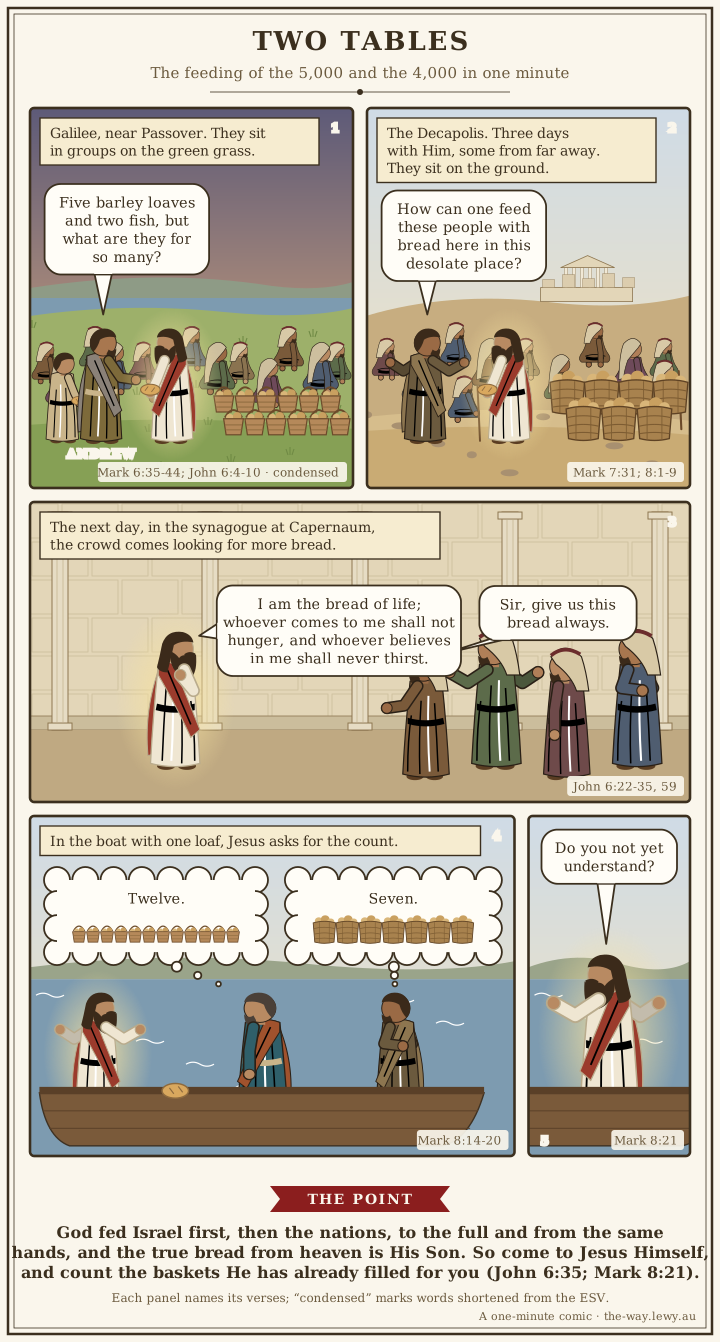
The feeding of the five thousand is the only miracle of Jesus's ministry recorded in all four Gospels, and Jesus Himself supplies the reading. Asked later about a loaf of bread in a boat, He makes the disciples recite the numbers from both, then asks, "Do you not yet understand?" (Mark 8:21, ESV).
In one sentence: In the two feedings God gives His people bread from heaven again, and this time the bread is His Son Jesus, the Shepherd who feeds Israel and then the nations to the full and loses none of those the Father gives Him; so you come to Jesus Himself for life, and take today's portion from your Father's hand.
Key Takeaways
(This section follows the Key Takeaways format — see that page for what each part is for.)
Types & Prophecy
Type. The manna is a τύπος (typos, G5179) of Christ, and the identification is Jesus's own. The pattern shows five things, point for point. Bread that comes down from heaven (Exodus 16:4; John 6:32-33). Given to people who did not work for it and could not have made it. Issued a day at a time and impossible to hoard (Exodus 16:19-20). Given as a test (Exodus 16:4 LXX πειράσω; John 6:6). And sufficient, never abundant. Jesus takes each of those and applies them to Himself, then presses the type past where it can follow: the fathers ate manna and died (6:49), so the true bread has to do something manna never did.
A second, lesser type, Elisha's twenty barley loaves (2 Kings 4:42-44), is worked through under Israel, then the nations.
Prophecy. Deuteronomy 18:15-18 promises a prophet like Moses, and Moses is the standard the crowd applies: they watch bread appear in a wilderness and conclude, correctly, "This is indeed the Prophet who is to come into the world!" (John 6:14, ESV). This is verbal prediction: God says in so many words that such a prophet is coming.
Lessons about Jesus
- He is the bread itself. Asked for a permanent supply, He answers with a predicate nominative: Ἐγώ εἰμι ὁ ἄρτος τῆς ζωῆς (John 6:35). The request could only be granted by being refused in those terms.
- He will not accept a crown on the crowd's terms, even from people who have just named Him correctly. When they move to take Him by force and make Him king, He withdraws (6:14-15).
- He works from what is already in someone's hands. "How many loaves do you have? Go and see" (Mark 6:38, ESV). Then the disciples do the distributing.
- He is the shepherd Israel was promised. Mark acts out Ezekiel 34:15 and Psalm 23:1-2: shepherdless sheep made to recline on green grass and pastured full (ἐχορτάσθησαν, Mark 6:42).
- He loses nothing. The verb used of the fragments gathered so that none would be wasted (6:12) is the verb used of the people the Father has given Him (John 6:39).
- He feeds Israel and the nations from the same hands, in that order: twelve Jewish baskets, seven Gentile hampers, and the Gentile meal narrated in the words the church would use at its own table (Mark 8:6; 1 Corinthians 11:24).
Memory verses
✝️ John 6:35 (ESV)
Jesus said to them, "I am the bread of life; whoever comes to me shall not hunger, and whoever believes in me shall never thirst."
✝️ John 6:26-27 (ESV)
Jesus answered them, "Truly, truly, I say to you, you are seeking me, not because you saw signs, but because you ate your fill of the loaves. Do not work for the food that perishes, but for the food that endures to eternal life, which the Son of Man will give to you."
Be Transformed
- Think. Stop sorting your prayers into "spiritual" and "practical." John 6 does not rebuke the crowd for wanting bread; it rebukes them for stopping there. Ask whether the answer stops at the gift or moves you to the Giver.
- Attitude. Treat sufficiency as provision. Numbers 11 is the account of people who had what they needed daily and called it deprivation: "there is nothing at all but this manna to look at." They were judged for despising enough.
- Do. Identify one arrangement in your life built so that you never have to ask God for it again, and pray about it each day this week as though you did: "Give us this day our daily bread" (Matthew 6:11, ESV). The manna could not be kept overnight (Exodus 16:19-20), and Jesus made the petition one to repeat.
Prayer
Father, you have never once fed your people carelessly. You rained bread on a nation that had just finished complaining, you counted the fragments on a hillside so that not one would be wasted, and you gave your Son Jesus so that of all you had given Him He would lose none. You are not a God who runs short, and you are not a God who spoils your children.
Teach me to want you more than what you hand me. Where I have been working for food that perishes, turn my labour. Where I have quietly arranged my life so that I need not ask, break the arrangement gently. Give me today what I need for today, and let it point me past itself to the Bread of Life, Jesus. In Jesus' name. Amen.
Study outline
- The two feedings, side by side. Place, loaves, crowd, baskets and verbs for each meal, in one table.
- Two events, not one retold. Mark 8:19-21, and the two basket words, kophinos and spyris, that never cross between the meals.
- What Jesus makes explicit — John 6, in five sections: Two words John puts around the sign (the test and "that nothing be lost") · "I am the bread of life" and Took, blessed, broke, gave (the discourse, and the Supper's verbs in both feedings) · Feeding on Him (trōgō and menō) · Daily bread (epiousios and the manna).
- What the narrative leaves implicit. Three readings Mark and John stage without stating: Israel, then the nations · Sheep without a shepherd · The wrong response — echoing the wilderness.
- Is there significance in the numbers?. Five, twelve, seven, seven, sorted into tiers from firm to speculative.
- Theological principle. The two opposite misreadings of the sign, John 6 and Numbers 11, and the pattern Scripture teaches.
- Discussion questions. Six, for a group or on your own.
The two feedings, side by side
| The 5,000 | The 4,000 | |
|---|---|---|
| Accounts | Matthew 14:13-21; Mark 6:30-44; Luke 9:10-17; John 6:1-15 | Matthew 15:32-39; Mark 8:1-10 |
| Where | Jewish Galilee -- near Bethsaida (Luke 9:10), across the Sea of Tiberias (John 6:1) | Following the circuit through Tyre, Sidon and the Decapolis (Mark 7:24, 7:31) -- Gentile territory |
| Loaves | 5 (barley, John 6:9) + 2 fish | 7 + "a few small fish" |
| Crowd | about 5,000 men, besides women and children (Matt 14:21) | 4,000 men, besides women and children (Matt 15:38); "about four thousand" (Mark 8:9) |
| Duration | one late afternoon | three days (Mark 8:2) |
| Left over | 12 κόφινοι (kophinoi, G2894) | 7 σπυρίδες (spyrides) |
| Blessing verb | εὐλόγησεν (eulogēsen, G2127, "blessed") | εὐχαριστήσας (eucharistēsas, G2168, "having given thanks") |
| Breaking verb | κατέκλασεν (kateklasen, G2622, the compound — only here and Luke 9:16 in the NT) | ἔκλασεν (eklasen, G2806, the simple verb used at the Last Supper) |
| Aftermath | the crowd tries to make Him king by force (John 6:15); the Bread of Life discourse follows | the Pharisees demand a sign (Mark 8:11); Jesus rebukes the disciples over the loaves (8:14-21) |
Two events, not one retold
Some readers take the second feeding as the first one retold in transmission. Jesus rules that out Himself:
✝️ Mark 8:19-21 (ESV)
19 "When I broke the five loaves for the five thousand, how many baskets full of broken pieces did you take up?" They said to him, "Twelve." 20 "And the seven for the four thousand, how many baskets full of broken pieces did you take up?" And they said to him, "Seven." 21 And he said to them, "Do you not yet understand?"
The rebuke has teeth because the disciples had already been through it once. Standing in front of the second crowd, with the twelve baskets of the first behind them, they say: "From where could one satisfy these people with bread here in a deserted place?" (Mark 8:4, WEB). It is Mark 6:37's problem presented as though it had never been solved. Jesus's "do you not yet understand?" is aimed at men who can recite the numbers on demand and still cannot reason from them to the next empty hillside. That is the failure the two feedings are laid side by side to expose, and it is the reason the numbers get rehearsed instead of explained. God means His past provision to be evidence you reason from. When the next hillside is empty, count the baskets He has already filled for you.
The Greek text never blurs the two events either. κόφινος (kophinos, G2894) belongs every time to the 5,000: Matthew 14:20; 16:9; Mark 6:43; 8:19; Luke 9:17; John 6:13. σπυρίς (spyris, G4711) belongs every time to the 4,000: Matthew 15:37; 16:10; Mark 8:8; 8:20. (It appears once more in the New Testament, at Acts 9:25, where Paul is lowered down a city wall in one, so a spyris is hamper-sized.) Four writers, two feedings, ten occurrences, zero crossover. Nearly every English version renders both words "basket," so Jesus's own distinction at Mark 8:19-20 is invisible in translation.
Held more loosely: the lexicons commonly identify a kophinos as the small wicker basket a Jewish traveler carried his own provisions in, and spyris as the general Hellenistic word for a large hamper. If that holds, the vocabulary alone marks the crowds: twelve Jewish provision baskets in Galilee, seven Greek hampers in the Decapolis.
What Jesus makes explicit — John 6
Two words John puts around the sign
Before the discourse begins, John frames the miracle with two words that the crowd never hears.
The first is at the start. Jesus asks Philip where they are to buy bread, and John steps in to say why: "He said this to test him, for he himself knew what he would do" (6:6, WEB), πειράζων (peirazōn, G3985). That is the word the Greek Old Testament uses for what the manna was for. The people gather a day's portion daily, "that I may test them, whether they will walk in my law or not" (Exodus 16:4, WEB). The LXX reads ὅπως πειράσω αὐτούς, from the same verb, rendering Hebrew נָסָה (nasah, H5254). Bread from heaven arrives, both times, as an examination. John 6:6 is the only undisputed occurrence of peirazō in his Gospel.
The second is at the end. With everyone full, Jesus orders the fragments collected: "Gather up the broken pieces which are left over, that nothing be lost" (6:12, WEB), ἀπόληται (apolētai, from ἀπόλλυμι, G622). So the twelve baskets exist because Jesus commanded that nothing perish. John uses the same verb twice more in the chapter, both times of something larger than bread. The food "that perishes" (ἀπολλυμένην, 6:27), which they are not to work for. And the Father's will that of all He has given the Son, "I should lose nothing" (ἀπολέσω, 6:39).
The care Jesus shows over barley scraps is the same care, in the same word, that He shows over everyone the Father gives Him.
God keeps what He gives. The doctrine is the preservation of the saints, and here it rests on Jesus' own statement of His Father's will (John 6:39): if the Father has given you to Jesus, He will not lose you.
"I am the bread of life"
The morning after the first feeding, the crowd tracks Jesus down across the lake (John 6:22-25). He doesn't feed them again.
✝️ John 6:26-27 (ESV)
Jesus answered them, "Truly, truly, I say to you, you are seeking me, not because you saw signs, but because you ate your fill of the loaves. Do not work for the food that perishes, but for the food that endures to eternal life, which the Son of Man will give to you."
He corrects what they're hungry for. They saw a sign (σημεῖον) and mistook it for a meal. His verb, ἐργάζεσθε (ergazesthe, "labor," G2038), echoes Isaiah's complaint: "Why do you spend your money for that which is not bread, and your labor for that which does not satisfy?" (Isaiah 55:2, ESV). The Hebrew is יְגִיעַ (yəgîaʿ, H3018, "toil") spent בְּלוֹא לְשָׂבְעָה (belo' lesov'ah), "for not-to-satisfaction." It is the same preposition Isaiah used a line earlier for money spent בְּלוֹא־לֶחֶם (belo'-leḥem), "for not-bread."
The crowd answers by quoting Scripture back: Moses gave our fathers manna, what will you do? (6:30-31), recombining both halves of LXX Psalm 77:24 (= 78:24) almost word for word. They know the text. Jesus corrects the verb tense before He corrects anything else: it was not Moses who gave that bread, and the giving is not finished: "my Father gives you the true bread from heaven," present tense, happening now (John 6:32). Then:
✝️ John 6:35 (ESV)
Jesus said to them, "I am the bread of life; whoever comes to me shall not hunger, and whoever believes in me shall never thirst."
Ἐγώ εἰμι ὁ ἄρτος τῆς ζωῆς is the first of John's seven "I am" sayings. They'd asked for a permanent supply: "Sir, give us this bread always" (6:34, ESV; κύριε, kyrie, reads here as polite address rather than confession; the rest of the chapter bears that out). His answer refuses the request the only way that could satisfy it: the bread is who He is. That claim reaches its own climax at 6:51: "the bread that I will give for the life of the world is my flesh." This shows that the Father's gift of life is a person, His Son Jesus, given in His own flesh for the life of the world. That is the atonement, and it is why you receive this bread by coming to Jesus and believing in Him (John 6:35).
Took, blessed, broke, gave
The verbs narrating these miracles are the church's own vocabulary for its central meal. Both feedings run the same four actions in the same order (took, blessed, broke, gave), and both sit close to the Last Supper's wording (Mark 14:22).
| Take | Bless / thank | Break | Give | |
|---|---|---|---|---|
| The 5,000 (Mark 6:41) | λαβών | εὐλόγησεν | κατέκλασεν | ἐδίδου |
| The 4,000 (Mark 8:6) | λαβών | εὐχαριστήσας | ἔκλασεν | ἐδίδου |
| Last Supper (Mark 14:22) | λαβών | εὐλογήσας | ἔκλασεν | ἔδωκεν |
| Paul's tradition (1 Cor 11:23-24) | ἔλαβεν | εὐχαριστήσας | ἔκλασεν | — |
Mark reserves a distinct verb for breaking the five loaves: κατακλάω (kataklaō, G2622), the intensive compound, which occurs exactly twice in the New Testament: Mark 6:41 and Luke 9:16, both the 5,000. Everywhere else, including both Supper accounts, it is the simple κλάω (klaō, G2806). So the Gentile feeding is the one that matches the eucharistic formula word for word: εὐχαριστήσας … ἔκλασεν at Mark 8:6 is what Paul says he "received from the Lord and delivered to you" (1 Corinthians 11:23-24). The meal Paul hands on to a largely Gentile church is narrated first at the meal on Gentile ground.
(John alone dates the sign to just before Passover, at barley harvest (John 6:4, 9), and alone specifies the loaves were barley, the grain of the poor. The whole discourse about bread from heaven sits under the shadow of the feast where a lamb dies and unleavened bread is eaten.)
Feeding on Him
The discourse gets more physical as the crowd's offense grows. Through verse 53 John uses the ordinary verb for eating, ἐσθίω/φαγεῖν (esthiō/phagein, G5315); from verse 54 he switches to τρώγω (trōgō, G5176, "chew, gnaw") and holds it to the end: the one who keeps chewing my flesh (6:54, 56, 57, 58). Trōgō is rare: six occurrences in the whole New Testament, four of them here (the others: Judas, "who ate my bread," John 13:18; the world eating and drinking before the flood, Matthew 24:38). By the first century the word had largely softened into an ordinary "eat," so it does not by itself make the language bestial. The switch is still deliberate: it arrives where the crowd starts objecting (6:52), and it is sustained. The ESV is the one major version that marks it consistently, rendering esthiō "eat" and every trōgō "feeds on." The crowd hears the offense regardless of translation: "This is a hard saying; who can listen to it?" (6:60). Many leave (John 6:66).
"The food that endures (μένω, menō, G3306) to eternal life" (6:27) is the same verb as "whoever feeds on my flesh... abides in me, and I in him" (6:56). Food that abides, in someone who abides. No major modern version keeps both occurrences visible: the ESV has "endures" then "abides," the WEB "remains" then "lives."
What God gives in His Son is union with Him. The food that endures abides in the one who feeds on it, and Jesus promises to abide in you as you abide in Him (6:56).
Daily bread
"Give us this day our daily bread" (Matt 6:11; Luke 11:3) turns on ἐπιούσιος (epiousios, G1967), a word the New Testament uses only in this prayer, whose every proposed derivation converges on the same sense, today's sufficiency (worked through fully in The Lord's Prayer). Its model is the manna, which by design could not be hoarded (Exodus 16:19-20), and which this chapter has Jesus identify as pointing at Himself. After John 6, "daily bread" can't be read as only a request for groceries.
What the narrative leaves implicit
Israel, then the nations
Jesus never states an ethnic reading of the two feedings. The narrative supplies one anyway, in layers.
Geography. The 5,000 happens in Jewish Galilee: Bethsaida (Luke 9:10), the Sea of Tiberias (John 6:1). The 4,000 follows Jesus's circuit through Tyre, Sidon, and the Decapolis (Mark 7:24, 31), all Gentile territory. Matthew adds a tell. The crowd "glorified the God of Israel" (Matt 15:31, ESV, emphasis added). That is an odd thing to say of Jewish worshippers, and natural for Gentile ones. Mark 8:3's "some of them have come from far away," and the three-day wait with nowhere nearby to buy bread, fit a thinly settled Gentile region. Mark 6:36 assumes the opposite, with villages close at hand.
Vocabulary follows geography. Baskets, above, and the two verbs already tabled. At the Jewish feeding Jesus says the berakhah over bread: εὐλόγησεν (eulogēsen, "blessed"), spoken to God rather than over the food (Mark 6:41). At the Gentile feeding Mark has εὐχαριστήσας (eucharistēsas, "having given thanks," 8:6), as John already does at the first (6:11). Either verb alone would be too small to build on. Both run the same direction as the geography and the baskets.
And one meal has an Old Testament rehearsal; the other doesn't.
✝️ 2 Kings 4:42-44 (WEB)
A man from Baal Shalishah came, and brought the man of God some bread of the first fruits: twenty loaves of barley and fresh ears of grain in his sack. Elisha said, "Give to the people, that they may eat." His servant said, "What, should I set this before a hundred men?" But he said, "Give it to the people, that they may eat; for Yahweh says, 'They will eat, and will have some left over.'" So he set it before them and they ate and had some left over, according to Yahweh's word.
Barley loaves, a servant's objection at the ratio, a command to distribute anyway, everyone eating, food left over: every beat Mark and John narrate, at fifty times the scale, already happened for Israel through Elisha, "according to Yahweh's word." The 5,000 is that miracle repeated, in Israel, by the one now speaking that word in person. Twelve Jewish baskets recapitulate a promise already made; seven Gentile hampers extend it somewhere the type never reached. This is the pattern of Romans 1:16, "to the Jew first, and also to the Greek," and of Isaiah 25:6-9's banquet "for all peoples," told here in loaves.
God keeps His promise to Israel first and then opens the same table to the nations. If you are a Gentile believer, you were fed at the second meal, from the same hands and to the full.
Sheep without a shepherd
Mark states a motive for the first feeding that has nothing to do with hunger: "he had compassion on them, because they were like sheep without a shepherd" (6:34, ESV). The phrase is Moses's own: he asked God for a successor so that "the congregation of the LORD may not be as sheep that have no shepherd" (Numbers 27:17, sharing probata/poimēn with Mark, though not verbatim).
The prayer gets an answer in the very next verse, and the answer is a name:
✝️ Numbers 27:18 (WEB)
Yahweh said to Moses, "Take Joshua the son of Nun, a man in whom is the Spirit, and lay your hand on him."
Joshua is יְהוֹשֻׁעַ (Yehoshua, H3091), which the Septuagint renders Ἰησοῦν (Iēsoun, G2424): "take to yourself Ἰησοῦν son of Nauē." The name God supplies when Israel needs a shepherd is the name of the man standing on the hillside in Mark 6. Mark writes probata and poimēn into the sentence and leaves the third word for the reader, because he has been using it since 1:1.
Ezekiel turns the same prayer into a promise about God Himself:
✝️ Ezekiel 34:15-16 (WEB)
"I myself will be the shepherd of my sheep, and I will cause them to lie down," says the Lord Yahweh. "I will seek that which was lost, and will bring back that which was driven away, and will bind up that which was broken, and will strengthen that which was sick; but I will destroy the fat and the strong. I will feed them in justice."
Mark's staging enacts that. Jesus has the crowd recline (ἀνακλῖναι, anaklinai, G347; "sit down" in the ESV) on green grass (6:39), arranged "by hundreds and by fifties" (6:40), the same ranks Moses used when he appointed leaders on Jethro's advice (Exodus 18:25). They are fed to the full: ἐχορτάσθησαν (echortasthēsan, G5526), from χόρτος (chortos, G5528, "grass"); the verb means, at root, to pasture. Shepherdless sheep, made to recline on green grass, grazed full: Psalm 23:1-2, staged.
This shows that God kept His promise to shepherd His sheep Himself, and kept it in person in Jesus. The doctrine is the incarnation. The Shepherd who had compassion on a shepherdless crowd (6:34) is the One who feeds you.
Immediately before this scene, Herod throws a birthday banquet for "his nobles, the high officers, and the chief men of Galilee" (6:21), a private feast for the powerful, ending with John the Baptist's head on a platter. Then Jesus hosts a meal on open grass for anyone who walked there, and everyone leaves full. Two kings, two banquets, placed back to back.
The wrong response — echoing the wilderness
The crowd responds to being fed with appetite. They track Him down the next day (6:22-25); they ask for the supply made permanent, "always" (6:34); some try to "take him by force to make him king" (6:15). Their theology is correct: the prophet like Moses, rightly identified (6:14). They put a right conclusion to the wrong use. That impulse has an ancestor.
In Numbers 11 the people have manna and want meat: "We remember the fish we ate in Egypt that cost nothing, the cucumbers, the melons, the leeks, the onions, and the garlic. But now our strength is dried up, and there is nothing at all but this manna to look at" (Numbers 11:5-6, ESV). God gives them what they crave, in obscene quantity: quail heaped three feet deep for a day's journey in every direction (11:31). Then:
✝️ Numbers 11:33-34 (ESV)
While the meat was yet between their teeth, before it was consumed, the anger of the LORD was kindled against the people, and the LORD struck down the people with a very great plague. Therefore the name of that place was called Kibroth-hattaavah, because there they buried the people who had the craving.
קִבְרוֹת הַתַּאֲוָה (Qivrot ha-Ta'avah) means "the graves of craving." Psalm 78 gives the verdict on both wilderness stories in one breath: God "rained down on them manna to eat" (78:24) and also "gave them what they craved" (78:29), and the craving killed them (78:29-31). They were punished for despising sufficiency and demanding surplus.
What the wilderness generation says it misses: the fish we ate in Egypt. On a Galilean hillside, Jesus hands out bread and fish, freely, to a crowd that hasn't asked for either, and nobody dies. Grace answers a craving the law once judged.
God is generous to people who have not asked, and He judges a craving that despises what He has given. So receive today's portion from Him with thanks.
Is there significance in the numbers?
Jesus treats the numbers as meaningful Himself: at Mark 8:19-21 He has the disciples recite five, twelve, seven, seven (so also Matthew 16:9-12). The text never says what the numbers mean, so hold what follows in tiers.
Firm. The loaves and baskets are exact, and they're what Jesus quotes back. The crowd sizes aren't: Matthew 14:21 and Mark 8:9 both hedge with "about" (ὡσεί/ὡς). Whatever the numbers carry rests on five, twelve, seven, seven.
A real pattern. Twelve and seven are both load-bearing numbers throughout Scripture: twelve for Israel (twelve tribes, twelve apostles, the New Jerusalem's twelve gates and foundations, Revelation 21:12-14), and seven for completeness, from Genesis 2:2 onward. Paired with the geography and the basket vocabulary above, the two meals together read: Israel first, fully provided for; the nations next, fully provided for, from the same hands.
Traditional, and speculative. A long tradition reads the five loaves as the five books of Moses, fitting if the sign presents Jesus as the prophet like Moses; Bullinger's scheme makes five the number of grace; others note five loaves plus two fish makes seven. None of it is stated in the text, and neither Mark nor John does anything with it. Enjoy it as an observation; don't preach it as an argument.
Plainly literal. The three days (Mark 8:2) explain why the crowd might faint on the road home. The two hundred denarii (Mark 6:37; John 6:7) is the disciples doing real arithmetic on an impossible grocery bill: roughly eight months' wages at a denarius a day (Matt 20:2).
Theological principle
God's provision in Christ is abundant (twelve baskets and seven hampers more than either crowd could eat), and it is given to reveal the Giver. The sign gets misread in two opposite directions, and Scripture corrects both: the crowd in John 6 wants the bread without the Bread; the generation in Numbers 11 wants more than the daily portion. One walks away from a person (John 6:66); the other gets what it craved, and a plague with it (Numbers 11:33-34; Psalm 78:29-31). Scripture states the same pattern elsewhere (all ESV): "man does not live by bread alone" (Deuteronomy 8:3); "seek first the kingdom of God… and all these things will be added to you" (Matthew 6:33); "why do you spend… your labor for that which does not satisfy?" (Isaiah 55:2); "give me neither poverty nor riches… lest I be full and deny you" (Proverbs 30:8-9); "if we have food and clothing, with these we will be content" (1 Timothy 6:8). So take today's bread from your Father's hand, and let it bring you to His Son Jesus, the bread of life.
Discussion questions
- The language. John uses one verb, ἀπόλλυμι, for the fragments gathered "that nothing may be lost" (John 6:12) and for the Father's will "that I should lose nothing of all that he has given me" (John 6:39). What does the hillside scene show you about how Jesus keeps those given to Him?
- The text in its context. The crowd called Jesus "the Prophet who is to come into the world" (John 6:14) and moved to "take him by force to make him king" (John 6:15). The next day He told them, "you are seeking me, not because you saw signs, but because you ate your fill of the loaves" (John 6:26). What did that crowd want from the prophet like Moses (Deuteronomy 18:15)?
- Christ. Jesus said, "Your fathers ate the manna in the wilderness, and they died" (John 6:49), and then, "I am the living bread that came down from heaven" (John 6:51). What does Jesus give as the bread from heaven that the manna of Exodus 16 could not?
- The hard part. Jesus has the disciples recite the loaves and baskets of both feedings (five and twelve, seven and seven), then asks, "Do you not yet understand?" (Mark 8:19-21). He never says what. What do Mark 6:34-44 and Mark 8:1-10, read side by side, give you to understand?
- Enough. The people complained of "nothing at all but this manna to look at" (Numbers 11:6), and God "gave them what they craved" (Psalm 78:29), with a plague behind it (Numbers 11:33). How does that account shape the way you read your own answered prayers for more than you need?
- Be transformed. Jesus taught His disciples to pray, "Give us this day our daily bread" (Matthew 6:11), and the manna could not be kept overnight (Exodus 16:19-20). What in your life is arranged so you never have to pray that again?
Group study sheet for a 40-minute group: two A4 sheets, or one with the guided path
The point, the passage, the questions and the response, from this study. Print on both sides of two A4 sheets, flipping on the long edge. While this block is open, printing the page prints the sheet; close it to print the study.
Bread of Life: The Feeding of the 5,000 and the 4,000
Matthew 14:13-21; Mark 6:30-44; Luke 9:10-17; John 6:1-15; Matthew 15:32-39; Mark 8:1-10The point In the two feedings God gives His people bread from heaven again, and this time the bread is His Son Jesus, the Shepherd who feeds Israel and then the nations to the full and loses none of those the Father gives Him; so you come to Jesus Himself for life, and take today's portion from your Father's hand.
Ask: what comes to mind when you hear Bread of Life
? Hear a few answers before anyone reads.
Matthew 14:13-21 13When Jesus heard about John , He withdrew by boat privately to a solitary place. But the crowds found out about it and followed Him on foot from the towns. 14When He stepped ashore and saw a large crowd, He had compassion on them and healed their sick. 15When evening came, the disciples came to Him and said, “This is a desolate place, and the hour is already late. Dismiss the crowds so they can go to the villages and buy themselves some food.” 16“They do not need to go away,” Jesus replied. “You give them something to eat.” 17“We have here only five loaves of bread and two fish,” they answered. 18“Bring them here to Me,” Jesus said. 19And He directed the crowds to sit down on the grass. Taking the five loaves and the two fish and looking up to heaven, He spoke a blessing. Then He broke the loaves and gave them to the disciples, and the disciples gave them to the people. 20They all ate and were satisfied, and the disciples picked up twelve basketfuls of broken pieces that were left over. 21About five thousand men were fed, besides women and children.
Mark 6:30-44 30Meanwhile, the apostles gathered around Jesus and brought Him news of all they had done and taught. 31And He said to them, “Come with Me privately to a solitary place, and let us rest for a while.” For many people were coming and going, and they did not even have time to eat. 32So they went away in a boat by themselves to a solitary place. 33But many people saw them leaving and recognized them. They ran together on foot from all the towns and arrived before them. 34When Jesus stepped ashore and saw a large crowd, He had compassion on them, because they were like sheep without a shepherd. And He began to teach them many things. 35By now the hour was already late. So the disciples came to Jesus and said, “This is a desolate place, and the hour is already late. 36Dismiss the crowd so they can go to the surrounding countryside and villages and buy themselves something to eat.” 37But Jesus told them, “You give them something to eat.” They asked Him, “Should we go out and spend two hundred denarii to give all of them bread to eat?” 38“Go and see how many loaves you have,” He told them. And after checking, they said, “Five—and two fish.” 39Then Jesus directed them to have the people sit in groups on the green grass. 40So they sat down in groups of hundreds and fifties. 41Taking the five loaves and the two fish and looking up to heaven, Jesus spoke a blessing and broke the loaves. Then He gave them to His disciples to set before the people. And He divided the two fish among them all. 42They all ate and were satisfied, 43and the disciples picked up twelve basketfuls of broken pieces of bread and fish.
Also read: Mark 6:30-44 from 6:44; Luke 9:10-17; John 6:1-15; Matthew 15:32-39; Mark 8:1-10
Bread of Life: The Feeding of the 5,000 and the 4,000
- The two feedings, side by side. Place, loaves, crowd, baskets and verbs for each meal, in one table.
- Two events, not one retold. Mark 8:19-21, and the two basket words, kophinos and spyris, that never cross between the meals.
- What Jesus makes explicit — John 6, in five sections: Two words John puts around the sign (the test and "that nothing be lost") · "I am the bread of life" and Took, blessed, broke, gave (the discourse, and the Supper's verbs in both feedings) · Feeding on Him (trōgō and menō) · Daily bread (epiousios and the manna).
- What the narrative leaves implicit. Three readings Mark and John stage without stating: Israel, then the nations · Sheep without a shepherd · The wrong response — echoing the wilderness.
- Is there significance in the numbers?. Five, twelve, seven, seven, sorted into tiers from firm to speculative.
- Theological principle. The two opposite misreadings of the sign, John 6 and Numbers 11, and the pattern Scripture teaches.
Bread of Life: The Feeding of the 5,000 and the 4,000
1The hard part. Jesus has the disciples recite the loaves and baskets of both feedings (five and twelve, seven and seven), then asks, "Do you not yet understand?" (Mark 8:19-21). He never says what. What do Mark 6:34-44 and Mark 8:1-10, read side by side, give you to understand?
2The language. John uses one verb, ἀπόλλυμι, for the fragments gathered "that nothing may be lost" (John 6:12) and for the Father's will "that I should lose nothing of all that he has given me" (John 6:39). What does the hillside scene show you about how Jesus keeps those given to Him?
3The text in its context. The crowd called Jesus "the Prophet who is to come into the world" (John 6:14) and moved to "take him by force to make him king" (John 6:15). The next day He told them, "you are seeking me, not because you saw signs, but because you ate your fill of the loaves" (John 6:26). What did that crowd want from the prophet like Moses (Deuteronomy 18:15)?
4Christ. Jesus said, "Your fathers ate the manna in the wilderness, and they died" (John 6:49), and then, "I am the living bread that came down from heaven" (John 6:51). What does Jesus give as the bread from heaven that the manna of Exodus 16 could not?
5Enough. The people complained of "nothing at all but this manna to look at" (Numbers 11:6), and God "gave them what they craved" (Psalm 78:29), with a plague behind it (Numbers 11:33). How does that account shape the way you read your own answered prayers for more than you need?
Bread of Life: The Feeding of the 5,000 and the 4,000
6Be transformed. Jesus taught His disciples to pray, "Give us this day our daily bread" (Matthew 6:11), and the manna could not be kept overnight (Exodus 16:19-20). What in your life is arranged so you never have to pray that again?
- Think. Stop sorting your prayers into "spiritual" and "practical." John 6 does not rebuke the crowd for wanting bread; it rebukes them for stopping there. Ask whether the answer stops at the gift or moves you to the Giver.
- Attitude. Treat sufficiency as provision. Numbers 11 is the account of people who had what they needed daily and called it deprivation: "there is nothing at all but this manna to look at." They were judged for despising enough.
- Do. Identify one arrangement in your life built so that you never have to ask God for it again, and pray about it each day this week as though you did: "Give us this day our daily bread" (Matthew 6:11, ESV). The manna could not be kept overnight (Exodus 16:19-20), and Jesus made the petition one to repeat.
Jesus said to them, "I am the bread of life; whoever comes to me shall not hunger, and whoever believes in me shall never thirst."
John 6:35 (ESV)Father, you have never once fed your people carelessly. You rained bread on a nation that had just finished complaining, you counted the fragments on a hillside so that not one would be wasted, and you gave your Son Jesus so that of all you had given Him He would lose none. You are not a God who runs short, and you are not a God who spoils your children.
Teach me to want you more than what you hand me. Where I have been working for food that perishes, turn my labour. Where I have quietly arranged my life so that I need not ask, break the arrangement gently. Give me today what I need for today, and let it point me past itself to the Bread of Life, Jesus. In Jesus' name. Amen.
Bread of Life: The Feeding of the 5,000 and the 4,000
Matthew 14:13-21; Mark 6:30-44; Luke 9:10-17; John 6:1-15; Matthew 15:32-39; Mark 8:1-10Open Ask: what comes to mind when you hear Bread of Life
? Hear a few answers before anyone reads.
Read it aloud Matthew 14:13-21; Mark 6:30-44; Luke 9:10-17; John 6:1-15; Matthew 15:32-39; Mark 8:1-10
1The hard part. Jesus has the disciples recite the loaves and baskets of both feedings (five and twelve, seven and seven), then asks, "Do you not yet understand?" (Mark 8:19-21). He never says what. What do Mark 6:34-44 and Mark 8:1-10, read side by side, give you to understand?
2The language. John uses one verb, ἀπόλλυμι, for the fragments gathered "that nothing may be lost" (John 6:12) and for the Father's will "that I should lose nothing of all that he has given me" (John 6:39). What does the hillside scene show you about how Jesus keeps those given to Him?
3The text in its context. The crowd called Jesus "the Prophet who is to come into the world" (John 6:14) and moved to "take him by force to make him king" (John 6:15). The next day He told them, "you are seeking me, not because you saw signs, but because you ate your fill of the loaves" (John 6:26). What did that crowd want from the prophet like Moses (Deuteronomy 18:15)?
4Christ. Jesus said, "Your fathers ate the manna in the wilderness, and they died" (John 6:49), and then, "I am the living bread that came down from heaven" (John 6:51). What does Jesus give as the bread from heaven that the manna of Exodus 16 could not?
5Enough. The people complained of "nothing at all but this manna to look at" (Numbers 11:6), and God "gave them what they craved" (Psalm 78:29), with a plague behind it (Numbers 11:33). How does that account shape the way you read your own answered prayers for more than you need?
6Be transformed. Jesus taught His disciples to pray, "Give us this day our daily bread" (Matthew 6:11), and the manna could not be kept overnight (Exodus 16:19-20). What in your life is arranged so you never have to pray that again?
- Think. Stop sorting your prayers into "spiritual" and "practical." John 6 does not rebuke the crowd for wanting bread; it rebukes them for stopping there. Ask whether the answer stops at the gift or moves you to the Giver.
- Attitude. Treat sufficiency as provision. Numbers 11 is the account of people who had what they needed daily and called it deprivation: "there is nothing at all but this manna to look at." They were judged for despising enough.
- Do. Identify one arrangement in your life built so that you never have to ask God for it again, and pray about it each day this week as though you did: "Give us this day our daily bread" (Matthew 6:11, ESV). The manna could not be kept overnight (Exodus 16:19-20), and Jesus made the petition one to repeat.
Bread of Life: The Feeding of the 5,000 and the 4,000
The point In the two feedings God gives His people bread from heaven again, and this time the bread is His Son Jesus, the Shepherd who feeds Israel and then the nations to the full and loses none of those the Father gives Him; so you come to Jesus Himself for life, and take today's portion from your Father's hand.
References & Recommended Reading
- ESV Bible (Crossway) — primary translation quoted throughout, per this site's translation conventions. World English Bible (WEB) used for the Old Testament background passages (2 Kings 4:42-44, Ezekiel 34:15-16), quoted from this repo's own text database. ASV (1901) and the Berean Study Bible consulted for the translation comparisons on menō and trōgō above. Note the WEB is a public-domain revision of the ASV whose New Testament leans on the Majority Text, while the ESV stands in the Tyndale-KJV stream and follows a critical text — hence small divergences like Matthew 15:39's "Magdala" (WEB, YLT) against "Magadan" (ESV, ASV, BSB).
- MACULA Greek Linguistic Datasets (SBLGNT) and MACULA Hebrew Linguistic Datasets (WLC),
queried via this repo's
references/build/bible-text.db— source of every Strong's number, Louw-Nida domain code, morphological note, and concordance count above, including the kophinos/spyris distribution, the trōgō count, the three apollymi occurrences in John 6, and the four-verb comparison across Mark 6:41, Mark 8:6, Mark 14:22 and 1 Corinthians 11:23-24 — which is where the κατακλάω/κλάω distinction turned up. - Brenton's Septuagint (public domain), same database — used to verify John 6:31 quotes LXX Psalm 77:24, to compare Numbers 27:17's shepherd language with Mark 6:34, to confirm Numbers 27:18 renders Joshua as Ἰησοῦν, and to confirm Exodus 16:4's "that I may test them" uses πειράσω, the verb behind John 6:6's peirazōn.
- Theological Wordbook of the Old Testament (TWOT), ed. R. Laird Harris, Gleason L. Archer Jr., and Bruce K. Waltke (Moody Publishers) — root 1105a (leḥem), consulted via this repo's committed TWOT Strong's-number map.
- ESV Study Bible (Crossway, 2016) — consulted as a check on conclusions already reached from the text. Independently confirmed the Numbers 27:17 / Ezekiel 34 shepherd background, the Psalm 23:2 echo, the 200-denarii wage calculation, and the Elisha parallel; its note on Mark 6:39-40 supplied the Exodus 18:25 "hundreds and fifties" connection.
- NIV Cultural Backgrounds Study Bible (Zondervan, 2016), ed. John H. Walton and Craig S. Keener — likewise consulted last. Source of the Herod's-banquet contrast above, and of the observation that green grass places the scene in springtime, corroborating John 6:4's Passover dating.
- E. W. Bullinger, Number in Scripture (1894) — the classical source behind the number-symbolism framework this site summarises on its Hebrew alphabet page, deferred to rather than duplicated in the numbers section above. Public domain.
- Related studies on this site: The Lord's Prayer (the epiousios word study), The Last Supper and the Four Cups, and As the Snake Was Lifted Up (the same shape of argument — an Old Testament type that Jesus applies to Himself in John's Gospel).