"You Are Gods": Psalm 82, John 10 and the Authority God Lends
New, published 11 October 2026. What else is new
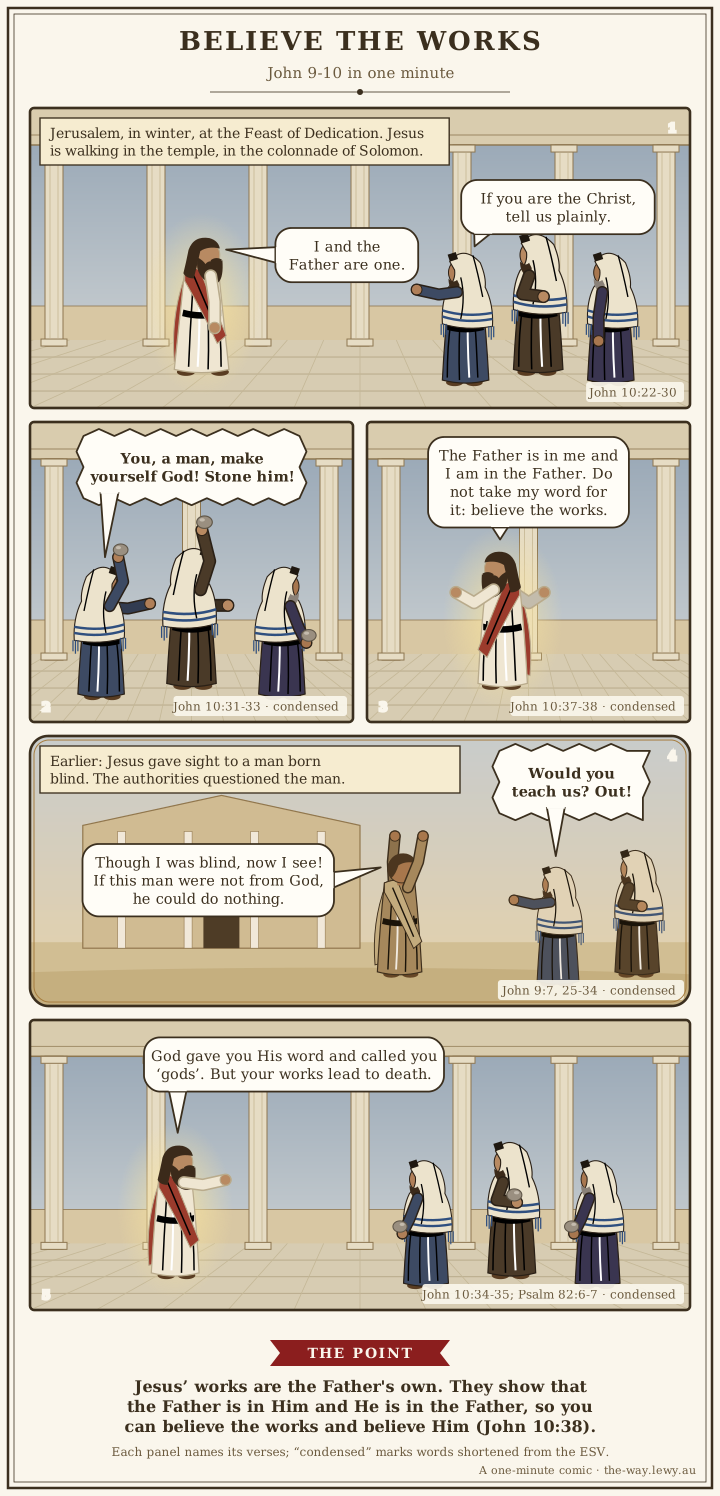
It is winter in Jerusalem, at the Feast of Dedication, and the men around Jesus have picked up stones to stone Him (John 10:31). They have just heard Him say, "I and the Father are one" (John 10:30, ESV), and they have understood Him exactly: "you, being a man, make yourself God" (John 10:33, ESV). Jesus answers from Psalm 82. There God stands among the judges He appointed and calls them "gods" for the office He gave them, then charges them with failing at its work: "Give justice to the weak and the fatherless" (Psalm 82:3, ESV). They judged unjustly, and for it they "shall die" like any man (Psalm 82:7, ESV). The men holding the stones are Israel's teachers, given that same word and authority, and they are judging the one the Father sent.
In one sentence: Jesus set His works beside theirs: His, the Father's own, verify His claim to be one with the Father, and theirs condemn them, because they held God's word and authority and did not do the work it was given for.
Key Takeaways
Lessons about Jesus
- He claimed more than any title God gives for an office. The judges of Psalm 82 were called gods for an office. Jesus said He was the one "whom the Father consecrated and sent into the world" (John 10:36, ESV), and that "the Father is in me and I am in the Father" (John 10:38, ESV). The men holding the stones heard a claim to be God, and they were right.
- He set His works against theirs. "The works that I do in my Father's name bear witness about me" (John 10:25, ESV), and "I have shown you many good works from the Father; for which of them are you going to stone me?" (John 10:32, ESV). His works verify His claim; theirs, the work of men given authority who used it against the weak, condemn them.
- He holds the judging the psalm prayed for. Psalm 82 ends, "Arise, O God, judge the earth" (Psalm 82:8, ESV), and Jesus said "the Father judges no one, but has given all judgment to the Son" (John 5:22, ESV). The prayer of the psalm is answered in the Son.
Memory verses
✝️ Psalm 82:6-7 (ESV)
6 I said, "You are gods, sons of the Most High, all of you; 7 nevertheless, like men you shall die, and fall like any prince."
✝️ John 10:37-38 (ESV)
37 If I am not doing the works of my Father, then do not believe me; 38 but if I do them, even though you do not believe me, believe the works, that you may know and understand that the Father is in me and I am in the Father.
Be Transformed
- Think. Every authority you hold, at home, at work or in a church, is given by God, and He will ask what you did with it for the weak (Psalm 82:3-4).
- Attitude. Honour Jesus as you honour the Father (John 5:23). His works settle who He is.
- Do. Name one person under your care who is weak or overlooked, and do one thing for them this week that Psalm 82 asks of everyone God sets over others: "Give justice to the weak and the fatherless" (Psalm 82:3, ESV).
Prayer
Father, You are God Most High, and every authority on earth and in heaven answers to You. You set judges over Your people and called them by Your name, and You judged them when they failed the weak. Thank You for sending Your Son Jesus, whom You consecrated, who did Your works and holds all judgment. Teach me to use what You have given me for the people You love, and to trust Your Son as the Judge who will put the world right. In Jesus' name. Amen.
Study outline
- The charge at the Feast of Dedication. Where John 10 happens, who is accusing Jesus, and why a winter feast about a king who called himself god matters.
- Psalm 82: authority given, abused and judged. Why God calls judges "gods", the psalm verse by verse, and who the gods are, in the psalm and in John 10.
- The rebuke in the quotation. Jesus' argument in John 10:34-36, the men He said it to, and His habit of rebuking Israel's teachers with their own Scriptures.
- Their works and His. The heart of the study: Jesus' works verify His claim, and the authorities' works condemn them.
- A title given for an office. What the psalm does to the teaching that believers are "little gods".
- Discussion questions. Five, for a group or on your own.
The charge at the Feast of Dedication
✝️ John 10:31-39 (ESV)
31 The Jews picked up stones again to stone him. 32 Jesus answered them, "I have shown you many good works from the Father; for which of them are you going to stone me?" 33 The Jews answered him, "It is not for a good work that we are going to stone you but for blasphemy, because you, being a man, make yourself God." 34 Jesus answered them, "Is it not written in your Law, 'I said, you are gods'? 35 If he called them gods to whom the word of God came—and Scripture cannot be broken— 36 do you say of him whom the Father consecrated and sent into the world, 'You are blaspheming,' because I said, 'I am the Son of God'? 37 If I am not doing the works of my Father, then do not believe me; 38 but if I do them, even though you do not believe me, believe the works, that you may know and understand that the Father is in me and I am in the Father." 39 Again they sought to arrest him, but he escaped from their hands.
A feast about a man who made himself god
"At that time the Feast of Dedication took place at Jerusalem. It was winter" (John 10:22, ESV). The feast, Hanukkah, remembered the rededication of the temple in December 164 BC, after the Seleucid king Antiochus IV Epiphanes had desecrated it (1 Maccabees 1:59; ESV Study Bible note on John 10:22). The NIV Cultural Backgrounds Study Bible notes that the festival "partly commemorated liberation from Antiochus IV Epiphanes, a man who claimed to be divine" (note on John 10:31). The Greek of 2 Maccabees records his confession as he died: "it is right to be subject to God, and that a mortal should not arrogantly think himself equal to God" (2 Maccabees 9:12, my translation of Brenton's Septuagint text, mē thnēton onta isothea phronein).
So the charge in John 10:33 lands in a week when Jerusalem was remembering exactly that sin. A man making himself God was the crime they celebrated God for punishing.
Who was accusing Him
John calls the accusers "the Jews" (John 10:24, 31, 33). In this Gospel the phrase often means the Jerusalem authorities, and John 9:22 shows these ones at work: "the Jews had already agreed that if anyone should confess Jesus to be Christ, he was to be put out of the synagogue" (ESV). The Pharisees had questioned the man born blind and "cast him out" (John 9:34, ESV), and some of them were standing by when Jesus answered (John 9:40). At Dedication He told the crowd around Him, "you are not among my sheep" (John 10:26, ESV). The festival is a new scene, and the argument has the same opponents in substance: men with authority over God's people, using it against Him.
Psalm 82: authority given, abused and judged
The psalm has a frame and a speech. The psalmist speaks in verses 1 and 8, about God and to Him; God speaks in verses 2-7, where He says "I said" (Psalm 82:6).
God in the assembly of the gods
✝️ Psalm 82:1 (ESV)
1 A Psalm of Asaph. God has taken his place in the divine council; in the midst of the gods he holds judgment:
אֱלֹהִים (ʾĕlōhîm, el-oh-HEEM, H430) occurs 2,601 times in the Hebrew Bible. Most of the time it means God. Psalm 82:1 uses it twice in one line. The first ʾĕlōhîm takes a singular participle, נִצָּב (nitsav, H5324, "has taken his place"), and a singular verb, יִשְׁפֹּט (yishpot, H8199, "he judges"). The second is the crowd He stands among. The assembly itself is עֲדַת אֵל (ʿadat ʾEl, "the assembly of God"), with the singular אֵל (ʾEl, H410). The LSB footnotes it, "Heb El; the one true God."
The Law had already used the word of people God set in authority:
| Who | Text | What the word does there |
|---|---|---|
| The judges of Israel | Exodus 22:8-9, 28 | Cases "shall come before God" and "the one whom God condemns" pays double (ESV). The LSB footnotes Exodus 21:6, "Or the judges who acted in God's name." "You shall not revile God, nor curse a ruler of your people" (Exodus 22:28, ESV) pairs ʾĕlōhîm with a ruler, and the CSB footnotes it, "Or judges." |
| Moses | Exodus 4:16; 7:1 | "You shall be as God to him"; "I have made you like God to Pharaoh" (ESV). |
The word names a rank: one who stands above others and acts with authority that comes from beyond them. Moses was "as God" to Pharaoh because he carried God's word with God's power behind it. The judges were ʾĕlōhîm because the verdict they gave was God's verdict. This shows that God shares His work with those He appoints, and puts His own name on the office while they hold it. His own name He keeps: "I am the LORD; that is my name; my glory I give to no other" (Isaiah 42:8, ESV). So God lends the title for the work, and keeps His name and His glory to Himself. That distinction is the hinge of John 10.
For other examples of Scripture applying אֱלֹהִים (ʾĕlōhîm) to those who are not the LORD, such as Moses and the heavenly beings, see the study Those Called Gods. It also covers the princes of Daniel 10 and the principalities and powers of Ephesians 6.
The charge and the job description
✝️ Psalm 82:2-5 (ESV)
2 "How long will you judge unjustly and show partiality to the wicked? Selah 3 Give justice to the weak and the fatherless; maintain the right of the afflicted and the destitute. 4 Rescue the weak and the needy; deliver them from the hand of the wicked." 5 They have neither knowledge nor understanding, they walk about in darkness; all the foundations of the earth are shaken.
"How long" is usually the cry of the sufferer to God: "How long, O LORD? Will you forget me forever?" (Psalm 13:1, ESV). Here God asks it of the judges. Verses 3-4 are the work they were given: justice for the weak, the fatherless, the afflicted, the needy. Their authority was meant to be seen in that work. What they did instead was favour the wicked, and verse 5 says what that does: "all the foundations of the earth are shaken." Injustice in a court is a crack in creation.
The sentence
✝️ Psalm 82:6-8 (ESV)
6 I said, "You are gods, sons of the Most High, all of you; 7 nevertheless, like men you shall die, and fall like any prince." 8 Arise, O God, judge the earth; for you shall inherit all the nations!
"I said" is the word that made them gods: God gave them the title. "Nevertheless" takes it away. The ones God called gods will die like אָדָם (ʾadam, H120, "man") and fall like one of the שָׂרִים (sarim, H8269, "princes"). Then the psalmist asks God to do the judging Himself. This shows that God holds every authority to account, and that the weak can appeal past a corrupt court to Him.
Who are the gods?
In John 10 the gods are people who received God's word, and Jesus' accusers stand among them. Jesus defines the psalm's gods Himself: "he called them gods to whom the word of God came" (John 10:35, ESV). The men in front of Him were such people. They held "your Law" (John 10:34, ESV), and as Israel's teachers they sat "on Moses' seat" (Matthew 23:2, ESV). His word for the psalm's gods is ἐκείνους (ekeinous, G1565, "those"), so He speaks of the psalm's first hearers and leaves His accusers to see themselves in them. Both human readings of the psalm lead to the same men: if the gods are Israel's judges, these men held that office, and if they are Israel receiving the law at Sinai, these men were Israel and the law's appointed teachers.
Readers also ask whom the psalm meant when it was first sung: human judges, heavenly powers, or Israel at Sinai. Those Called Gods sets out that question. For John 10, Jesus has answered it Himself.
The rebuke in the quotation
"To whom the word of God came"
Jesus called the psalm "your Law" (John 10:34), using "Law" for the Scriptures as a whole, and His Greek matches the Septuagint word for word: Ἐγὼ εἶπα· Θεοί ἐστε (Egō eipa: theoi este, "I said, you are gods"). Then He argued from the lesser to the greater. If God called men "gods" because His word came to them, and "Scripture cannot be broken" (John 10:35, ESV), then the one "whom the Father consecrated and sent into the world" cannot be charged with blasphemy for saying "I am the Son of God" (John 10:36, ESV).
The clause Jesus added carries the weight. The title came with the word: God spoke to them, and that made them answerable to Him for what they did with it. The men in front of Him had received the same word. "Has not Moses given you the law? Yet none of you keeps the law" (John 7:19, ESV).
"Consecrated" is ἡγίασεν (hēgiasen, from ἁγιάζω, hagiazō, G37, "set apart, make holy"). At a feast for the consecration of the temple, Jesus says the Father consecrated Him. The NIV Cultural Backgrounds Study Bible notes that some read this as Jesus presenting Himself as the new temple (note on John 10:36; compare John 2:21).
Men who sat on Moses' seat
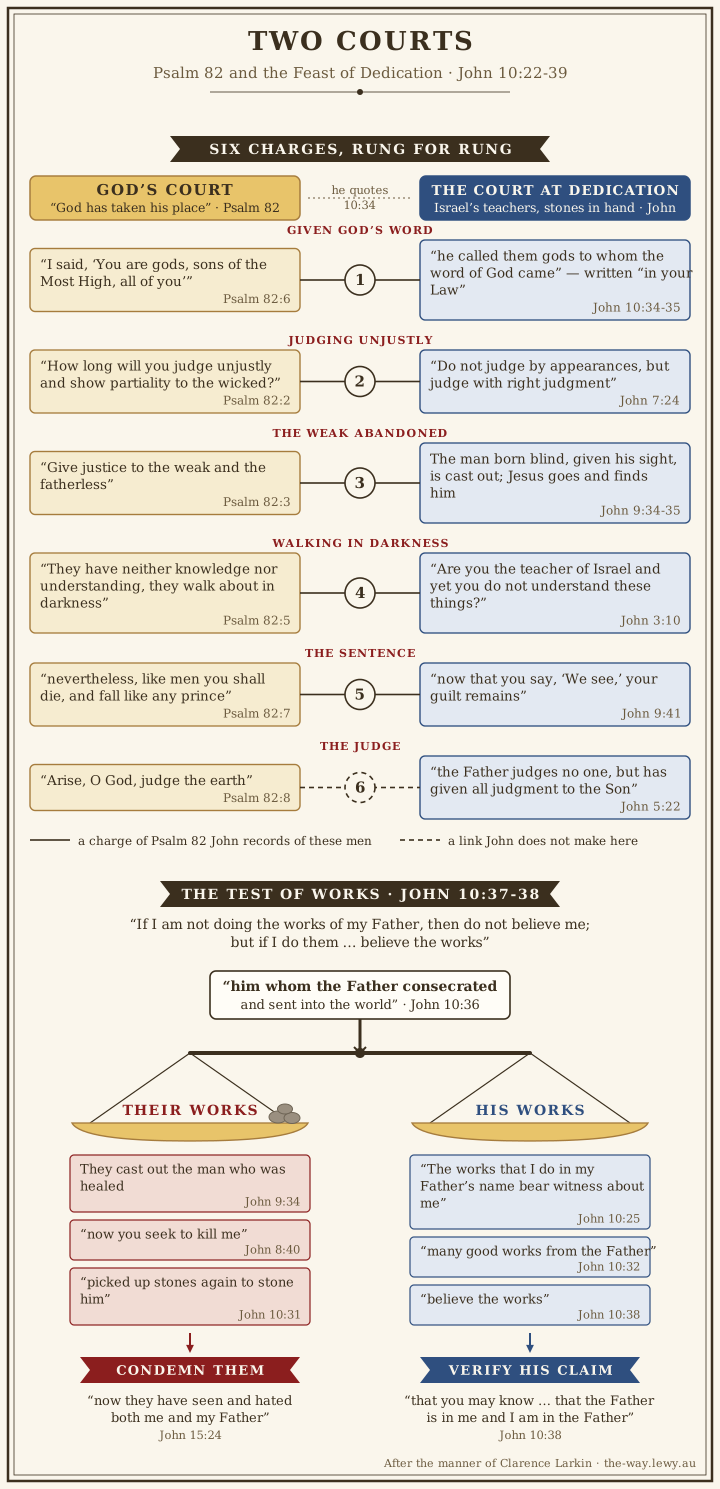
The quotation is a rebuke, and John's own text lays the psalm's charges on these men. John does not record Jesus reciting verse 7 to them. He records the authorities, chapter after chapter, doing what Psalm 82 condemns, and Jesus naming it:
- They were given God's word and did not keep it. "You search the Scriptures because you think that in them you have eternal life; and it is they that bear witness about me, yet you refuse to come to me that you may have life" (John 5:39-40, ESV). Their own lawgiver stands against them: "There is one who accuses you: Moses, on whom you have set your hope" (John 5:45, ESV).
- They held the teaching office and did not understand. "Are you the teacher of Israel and yet you do not understand these things?" (John 3:10, ESV). Psalm 82:5 says of the judges, "They have neither knowledge nor understanding, they walk about in darkness."
- They judged unjustly. The psalm opens, "How long will you judge unjustly" (Psalm 82:2, ESV), and Jesus told them, "Do not judge by appearances, but judge with right judgment" (John 7:24, ESV). One of their own council had to ask, "Does our law judge a man without first giving him a hearing and learning what he does?" (John 7:51, ESV). Now they held stones over a man for His good works (John 10:32).
- They failed the weak. Psalm 82:3-4 tells judges to rescue the weak and needy. The authorities in John 9 cast out a beggar who had been given his sight (John 9:34), and Jesus went and found him (John 9:35). Then He named them thieves and robbers at the sheepfold (John 10:1), the charge Ezekiel 34 brought against Israel's shepherds: "The weak you have not strengthened, the sick you have not healed" (Ezekiel 34:4, ESV).
Matthew records the same verdict on another day: "The scribes and the Pharisees sit on Moses' seat, so do and observe whatever they tell you, but not the works they do" (Matthew 23:2-3, ESV). Jesus honoured their office and condemned their works, which is Psalm 82 in a sentence.
So to quote "you are gods" to such men was to stand them in the psalm's dock, because the psalm goes on: "nevertheless, like men you shall die." The psalm Jesus chose is a court scene, and His hearers held the office it judges. Their works, set against His, are the subject of Their works and His.
Jesus rebukes with their own Scriptures
Jesus often answered Israel's teachers with a line from their own Scriptures, and the passage the line came from carried the charge. Psalm 82 in John 10 is one instance of a habit the Gospels record again and again:
- Isaiah 29:13. To Pharisees and scribes from Jerusalem: "You hypocrites! Well did Isaiah prophesy of you, when he said: 'This people honors me with their lips, but their heart is far from me'" (Matthew 15:7-8, ESV). Here He names them outright.
- Jeremiah 7:11. In the temple: "It is written, 'My house shall be called a house of prayer,' but you make it a den of robbers" (Matthew 21:13, ESV). Jeremiah's "den of robbers" comes from his sermon against people who trusted in "the temple of the LORD" (Jeremiah 7:4, ESV) while they oppressed "the sojourner, the fatherless, or the widow" (Jeremiah 7:6, ESV), the same people Psalm 82:3 tells the judges to defend.
- Hosea 6:6. "Go and learn what this means: 'I desire mercy, and not sacrifice'" (Matthew 9:13, ESV), and later, "if you had known what this means… you would not have condemned the guiltless" (Matthew 12:7, ESV). Teachers of the law are sent back to learn it.
- Psalm 118:22. To the chief priests and elders who had asked by what authority He acted (Matthew 21:23): "Have you never read in the Scriptures: 'The stone that the builders rejected has become the cornerstone'?" (Matthew 21:42, ESV). Matthew adds, "they perceived that he was speaking about them" (Matthew 21:45, ESV).
Each time, the hearers were the men who held the Scriptures and taught them, and the passage Jesus chose described them. They knew those texts whole, and Matthew 21:45 shows they heard what He meant. In John 10 He quoted the line about the title, and men who knew Psalm 82 heard the rest of it. This shows that God's word judges the people who hold it, and that the Son, the Word made flesh (John 1:14), applies it with authority. So read Scripture as His hearers should have, and let it search your own works before you turn it on anyone else's.
How they took it
They tried again to seize Him. "Again they sought to arrest him, but he escaped from their hands" (John 10:39, ESV). The argument from the psalm did not soften them; they still heard a claim to be God, and they understood Him to be claiming what the judges of Psalm 82 were never given.
Their works and His
ἔργον (ergon, G2041, "work", plural ἔργα) is the word John 10:25-38 keeps returning to, six times in fourteen verses. Jesus does not ask to be believed on His word alone. He sets His works beside the works of the men judging Him and lets the two speak.
His works verify His claim
✝️ John 10:25 (ESV)
25 Jesus answered them, "I told you, and you do not believe. The works that I do in my Father's name bear witness about me,
He said it again in John 5:36: "the works that the Father has given me to accomplish, the very works that I am doing, bear witness about me that the Father has sent me" (ESV). With the stones already in their hands He named the works as His defence: "I have shown you many good works from the Father; for which of them are you going to stone me?" (John 10:32, ESV). The NIV Cultural Backgrounds Study Bible notes that reminding opponents of one's kindness to them was an ancient way to shame them (note on John 10:32). Then He made the works the test: "If I am not doing the works of my Father, then do not believe me; but if I do them, even though you do not believe me, believe the works" (John 10:37-38, ESV). He says the same to His disciples: "the Father who dwells in me does his works… believe on account of the works themselves" (John 14:10-11, ESV).
Look at what the works were. In John 9 Jesus gave sight to a man born blind, saying, "We must work the works of him who sent me while it is day" (John 9:4, ESV). That is the job Psalm 82:3-4 gave the judges: "Give justice to the weak… Rescue the weak and the needy." This shows that God is known by His works, and that the Father has put His own works in the hands of His Son. "The Father is in me and I am in the Father" (John 10:38, ESV) is a claim no office could make. It names a union, and the works are its evidence.
Their works condemn them
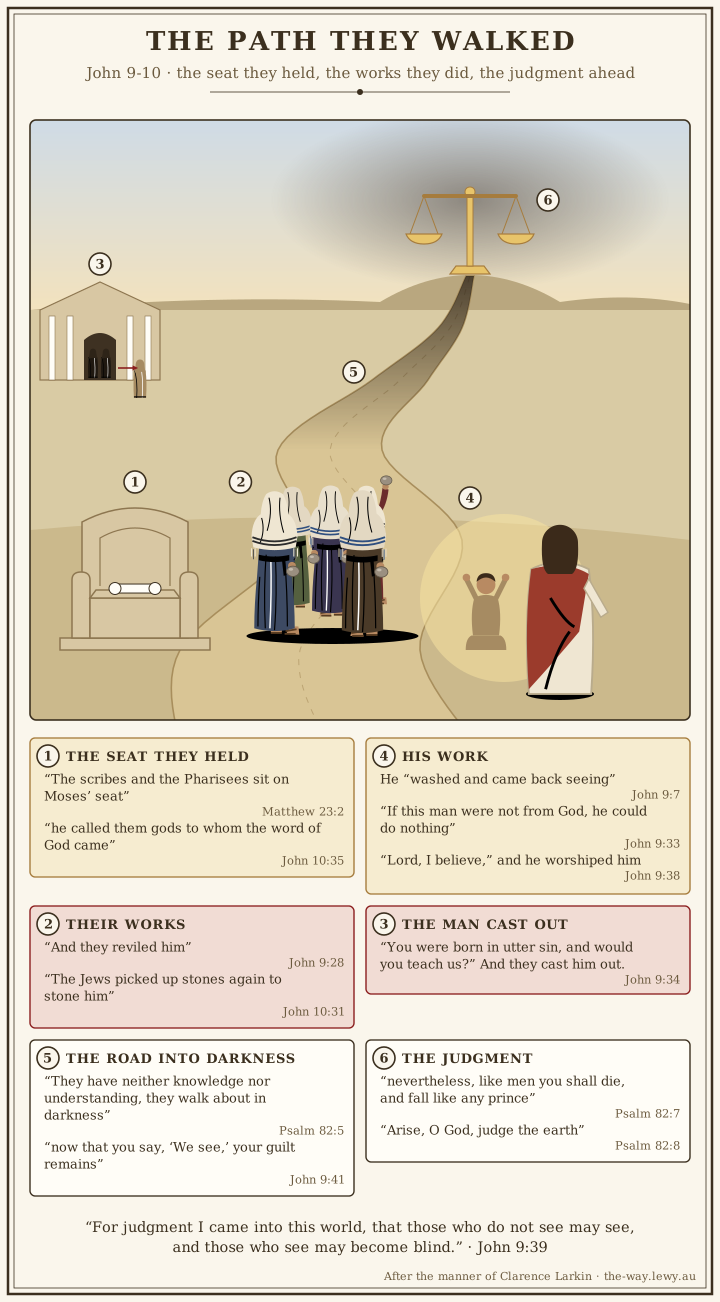
The authorities had the office. God had given them the Law and the seat of Moses to teach it (Matthew 23:2), and with it the work Psalm 82 describes: justice for the weak. Their works showed the opposite. They could not dispute the healing, so they "cast out" the man who had been healed (John 9:34, ESV). Earlier, in the temple, Jesus had named what seeking His death showed: "If you were Abraham's children, you would be doing the works Abraham did, but now you seek to kill me… You are doing the works your father did" (John 8:39-41, ESV). At Dedication they lifted stones against a man for His good works (John 10:32).
The Gospel states the principle early: "this is the judgment: the light has come into the world, and people loved the darkness rather than the light because their works were evil" (John 3:19, ESV). Jesus' works left them without excuse: "If I had not done among them the works that no one else did, they would not be guilty of sin, but now they have seen and hated both me and my Father" (John 15:24, ESV). And to the Pharisees who heard Him at the end of John 9: "now that you say, 'We see,' your guilt remains" (John 9:41, ESV).
This shows that God gives authority for a purpose, judges it by what it does, and will not let His own works be called blasphemy. Jesus quoted Psalm 82 to them, and John's narrative carries out its verdict: men who held God's authority were judged by their works, and the man they judged was vindicated by His.
The judgment is His
The judging God reserved to Himself in Psalm 82:8 is in the Son's hands as well: "the Father judges no one, but has given all judgment to the Son, that all may honor the Son, just as they honor the Father" (John 5:22-23, ESV). The Son is the one who answers the psalm's last prayer. So you may bring every injustice to Jesus, whom the Father has made Judge, and honour Him with the honour you give the Father.
A title given for an office
Some teach that believers are "little gods" and cite Psalm 82:6. The psalm gives the title to judges for their office and then sentences them to die like men; it is a verse of judgment. And Paul, who knew there are "so-called gods in heaven or on earth," wrote that "for us there is one God, the Father, … and one Lord, Jesus Christ" (1 Corinthians 8:5-6, ESV). The study Pride works through the three verses usually cited.
What God does give you is real. He lends you authority in your home, your work and your church, and He calls it His. You will answer to Him for the weak who were under it.
Discussion questions
- The language. "Works" (ἔργον) comes six times in John 10:25-38. Jesus said His works bear witness about Him (John 10:25), and told His hearers they were "doing the works your father did" (John 8:41). What did each set of works show about the one doing them?
- The text in its context. Jesus was answering men who had cast a healed beggar out of the synagogue (John 9:34). How would they have heard "Give justice to the weak and the fatherless" (Psalm 82:3)?
- Christ. Jesus said, "If I am not doing the works of my Father, then do not believe me" (John 10:37). What does it say about Him that He offered His works as the test of His claim?
- The hard part. Jesus told the crowds to "do and observe whatever they tell you, but not the works they do" (Matthew 23:3). How do you honour an office God gave while its holder fails at the work?
- Be transformed. Psalm 82:3-4 is the job God gave to everyone He set over others. Who is weak or overlooked under the authority God has given you, and what would justice for them look like this week?
Group study sheet for a 40-minute group: two A4 sheets, or one with the guided path
The point, the passage, the questions and the response, from this study. Print on both sides of two A4 sheets, flipping on the long edge. While this block is open, printing the page prints the sheet; close it to print the study.
"You Are Gods": Psalm 82, John 10 and the Authority God Lends
John 10:22-39; Psalm 82:1-8The point Jesus set His works beside theirs: His, the Father's own, verify His claim to be one with the Father, and theirs condemn them, because they held God's word and authority and did not do the work it was given for.
Ask: what comes to mind when you hear "You Are Gods"
? Hear a few answers before anyone reads.
John 10:22-39 22At that time the Feast of Dedication took place in Jerusalem. It was winter, 23and Jesus was walking in the temple courts in Solomon’s Colonnade. 24So the Jews gathered around Him and demanded, “How long will You keep us in suspense? If You are the Christ, tell us plainly.” 25“I already told you,” Jesus replied, “but you did not believe. The works I do in My Father’s name testify on My behalf. 26But because you are not My sheep, you refuse to believe. 27My sheep listen to My voice; I know them, and they follow Me. 28I give them eternal life, and they will never perish. No one can snatch them out of My hand. 29My Father who has given them to Me is greater than all. No one can snatch them out of My Father’s hand. 30I and the Father are one.” 31At this, the Jews again picked up stones to stone Him. 32But Jesus responded, “I have shown you many good works from the Father. For which of these do you stone Me?” 33“We are not stoning You for any good work,” said the Jews, “but for blasphemy, because You, who are a man, make Yourself out to be God.” 34Jesus replied, “Is it not written in your Law: ‘I have said you are gods’? 35If he called them gods to whom the word of God came—and the Scripture cannot be broken— 36then what about the One whom the Father sanctified and sent into the world? How then can you accuse Me of blasphemy for stating that I am the Son of God? 37If I am not doing the works of My Father, then do not believe Me. 38But if I am doing them, even though you do not believe Me, believe the works themselves, so that you may know and understand that the Father is in Me, and I am in the Father.” 39At this, they tried again to seize Him, but He escaped their grasp.
Psalm 82:1-8 1A Psalm of Asaph. God presides in the divine assembly; He renders judgment among the gods: 2“How long will you judge unjustly and show partiality to the wicked? Selah 3Defend the cause of the weak and fatherless; uphold the rights of the afflicted and oppressed. 4Rescue the weak and needy; save them from the hand of the wicked. 5They do not know or understand; they wander in the darkness; all the foundations of the earth are shaken. 6I have said, ‘You are gods; you are all sons of the Most High.’ 7But like mortals you will die, and like rulers you will fall.” 8Arise, O God, judge the earth, for all the nations are Your inheritance.
Also read:
"You Are Gods": Psalm 82, John 10 and the Authority God Lends
- The charge at the Feast of Dedication. Where John 10 happens, who is accusing Jesus, and why a winter feast about a king who called himself god matters.
- Psalm 82: authority given, abused and judged. Why God calls judges "gods", the psalm verse by verse, and who the gods are, in the psalm and in John 10.
- The rebuke in the quotation. Jesus' argument in John 10:34-36, the men He said it to, and His habit of rebuking Israel's teachers with their own Scriptures.
- Their works and His. The heart of the study: Jesus' works verify His claim, and the authorities' works condemn them.
- A title given for an office. What the psalm does to the teaching that believers are "little gods".
"You Are Gods": Psalm 82, John 10 and the Authority God Lends
1Christ. Jesus said, "If I am not doing the works of my Father, then do not believe me" (John 10:37). What does it say about Him that He offered His works as the test of His claim?
2The text in its context. Jesus was answering men who had cast a healed beggar out of the synagogue (John 9:34). How would they have heard "Give justice to the weak and the fatherless" (Psalm 82:3)?
3The hard part. Jesus told the crowds to "do and observe whatever they tell you, but not the works they do" (Matthew 23:3). How do you honour an office God gave while its holder fails at the work?
4The language. "Works" (ἔργον) comes six times in John 10:25-38. Jesus said His works bear witness about Him (John 10:25), and told His hearers they were "doing the works your father did" (John 8:41). What did each set of works show about the one doing them?
"You Are Gods": Psalm 82, John 10 and the Authority God Lends
5Be transformed. Psalm 82:3-4 is the job God gave to everyone He set over others. Who is weak or overlooked under the authority God has given you, and what would justice for them look like this week?
- Think. Every authority you hold, at home, at work or in a church, is given by God, and He will ask what you did with it for the weak (Psalm 82:3-4).
- Attitude. Honour Jesus as you honour the Father (John 5:23). His works settle who He is.
- Do. Name one person under your care who is weak or overlooked, and do one thing for them this week that Psalm 82 asks of everyone God sets over others: "Give justice to the weak and the fatherless" (Psalm 82:3, ESV).
I said, "You are gods, sons of the Most High, all of you; nevertheless, like men you shall die, and fall like any prince."
Psalm 82:6-7 (ESV)Father, You are God Most High, and every authority on earth and in heaven answers to You. You set judges over Your people and called them by Your name, and You judged them when they failed the weak. Thank You for sending Your Son Jesus, whom You consecrated, who did Your works and holds all judgment. Teach me to use what You have given me for the people You love, and to trust Your Son as the Judge who will put the world right. In Jesus' name. Amen.
"You Are Gods": Psalm 82, John 10 and the Authority God Lends
John 10:22-39; Psalm 82:1-8Open Ask: what comes to mind when you hear "You Are Gods"
? Hear a few answers before anyone reads.
Read it aloud John 10:22-39; Psalm 82:1-8
1Christ. Jesus said, "If I am not doing the works of my Father, then do not believe me" (John 10:37). What does it say about Him that He offered His works as the test of His claim?
2The text in its context. Jesus was answering men who had cast a healed beggar out of the synagogue (John 9:34). How would they have heard "Give justice to the weak and the fatherless" (Psalm 82:3)?
3The hard part. Jesus told the crowds to "do and observe whatever they tell you, but not the works they do" (Matthew 23:3). How do you honour an office God gave while its holder fails at the work?
4The language. "Works" (ἔργον) comes six times in John 10:25-38. Jesus said His works bear witness about Him (John 10:25), and told His hearers they were "doing the works your father did" (John 8:41). What did each set of works show about the one doing them?
5Be transformed. Psalm 82:3-4 is the job God gave to everyone He set over others. Who is weak or overlooked under the authority God has given you, and what would justice for them look like this week?
- Think. Every authority you hold, at home, at work or in a church, is given by God, and He will ask what you did with it for the weak (Psalm 82:3-4).
- Attitude. Honour Jesus as you honour the Father (John 5:23). His works settle who He is.
- Do. Name one person under your care who is weak or overlooked, and do one thing for them this week that Psalm 82 asks of everyone God sets over others: "Give justice to the weak and the fatherless" (Psalm 82:3, ESV).
"You Are Gods": Psalm 82, John 10 and the Authority God Lends
The point Jesus set His works beside theirs: His, the Father's own, verify His claim to be one with the Father, and theirs condemn them, because they held God's word and authority and did not do the work it was given for.
References & Recommended Reading
Scripture quotations are from the ESV unless marked. Hebrew morphology from MACULA Hebrew and the unfoldingWord Hebrew Bible; Greek New Testament from NA28 and SBLGNT; Septuagint from Brenton's text.
- ESV Study Bible (Crossway, 2016): notes on Psalm 82:1, 82:1-4, 82:5-7, 82:6; John 10:22, 10:34, 10:35, 10:36.
- NIV Biblical Theology Study Bible (Zondervan, 2018): notes on Psalm 82:1, 82:6.
- NIV Cultural Backgrounds Study Bible (Zondervan, 2016): notes on Psalm 82:1, 82:6; John 10:22, 10:31, 10:32, 10:34, 10:36.
- Legacy Standard Bible (Lockman Foundation, 2021) and CSB Ancient Faith Study Bible (Holman, 2019): footnotes on Psalm 82:1, Exodus 21:6, Exodus 22:8, Exodus 22:28.
- 2 Maccabees 9:12, Greek text in Brenton's Septuagint.
On this site
- Those Called Gods: אֱלֹהִים used of judges, Moses, heavenly beings and the powers over the nations, and Paul's principalities and powers.
- Pride: men who claimed to be gods, and the "little gods" verses.
- Melchizedek in Second Temple Judaism: how the Dead Sea Scroll 11Q13 read Psalm 82.