Why We Need Saving
Week 1 of 9 in Saved: Salvation Foundations
New, published 23 October 2026. What else is new
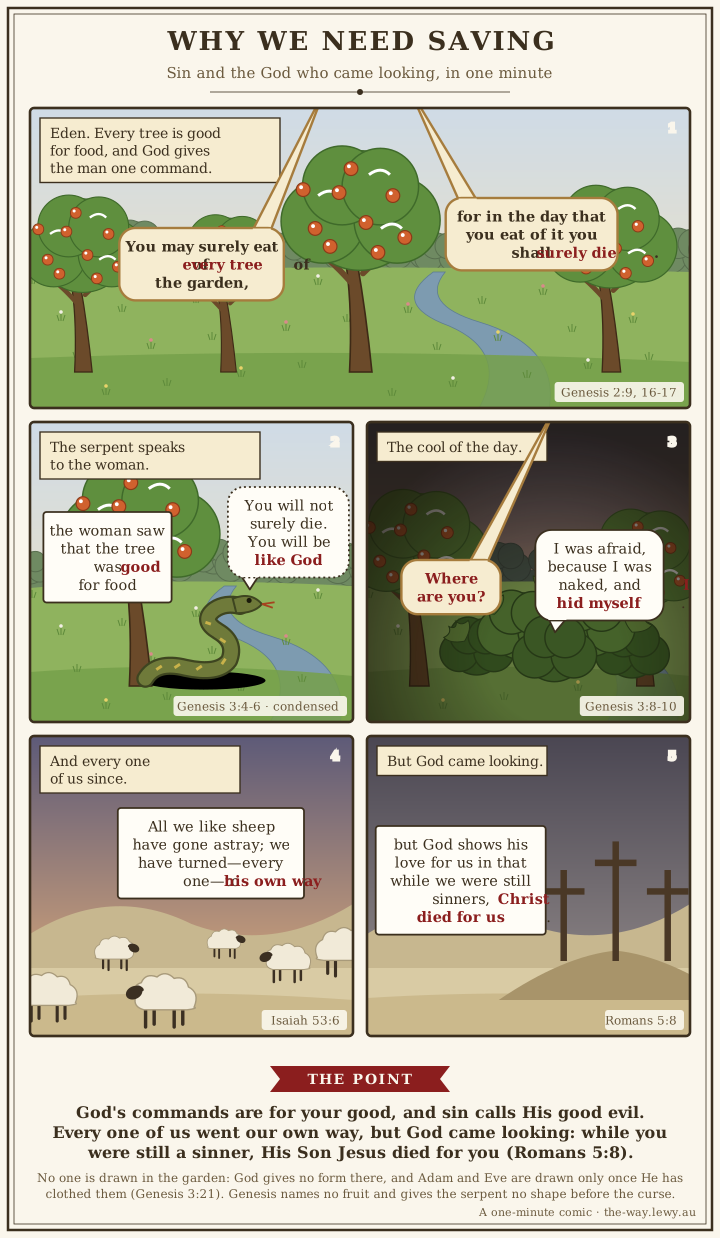
The first question God asks in the Bible is put to a man hiding in the trees. Adam and his wife had eaten what God told them not to eat, and when they heard Him coming they hid. "But the LORD God called to the man and said to him, 'Where are you?'" (Genesis 3:9, ESV).
God knew where Adam was. The question was for Adam, and the one asking it had come looking for him.
In one sentence: God is good and gave His commands for your good, but since Adam every one of us has turned to our own way, believing the lie that His good is evil; so sin separates you from God, enslaves you and earns you death, and God showed His love by sending His Son Jesus to die for you while you were still a sinner (Romans 5:8).
Key Takeaways
(This section follows the Key Takeaways format — see that page for what each part is for.)
Types & Prophecy
- The first promise. In the same breath as the curse, God promised that the woman's offspring would crush the serpent: "he shall bruise your head, and you shall bruise his heel" (Genesis 3:15, ESV). The rescue was announced on the day of the fall.
- Adam, a type. Paul calls Adam "a type of the one who was to come" (Romans 5:14, ESV). One man's disobedience made the many sinners; one Man's obedience will make the many righteous (Romans 5:19).
Lessons about Jesus
- Jesus carried the iniquity of the strays. "All we like sheep have gone astray... and the LORD has laid on him the iniquity of us all" (Isaiah 53:6, ESV). Philip read that chapter to the Ethiopian official and "told him the good news about Jesus" (Acts 8:35, ESV).
- Jesus came looking. "The Son of Man came to seek and to save the lost" (Luke 19:10, ESV). The God who called "Where are you?" in the garden came Himself, as the Good Shepherd who "lays down his life for the sheep" (John 10:11, ESV).
Memory verses
✝️ Romans 6:23 (ESV)
23 For the wages of sin is death, but the free gift of God is eternal life in Christ Jesus our Lord.
✝️ Romans 5:8 (ESV)
8 but God shows his love for us in that while we were still sinners, Christ died for us.
Be Transformed
- Think. God's commands are "for your good" (Deuteronomy 10:13). When His way looks like a loss, the lie of the garden is talking.
- Attitude. Agree with God about your sin. David said, "I acknowledged my sin to you, and I did not cover my iniquity" (Psalm 32:5, ESV), and he called the man who does that blessed.
- Do. Read Romans 3:9-23 aloud this week and put your own name in "all have sinned". Then read Romans 5:8 and put it there too.
Prayer
Holy Father, You are good and You do good. Every command You have given was for our life. We have gone astray like sheep and turned to our own way, and we called it better than Yours. We have sinned against You. Thank You that You came looking for us. Thank You that while we were still sinners Your Son Jesus died for us, and that You laid our iniquity on Him. Open our eyes to the lie of sin, and keep us walking in Your way.
In Jesus' name. Amen.
Study outline
- The good God gave. Creation was very good, and God's commands are for your good.
- What happened in the garden. The serpent painted God as withholding good, the forbidden tree began to look good, and the man and woman hid and were sent out. Sin is first named at Cain's door.
- Three words for one thing. Missing the mark, bending what is straight, and rebelling against the King, in Hebrew and in Greek.
- None is righteous. Romans 3: everyone is under sin and falling short of God's glory.
- Through one man. Romans 5 and Ephesians 2: how sin reached everyone, with the question Romans 5:12 leaves open.
- What sin costs. Separation, slavery, death and wrath, and why you cannot pay your way out.
- But God. The rescue, from Genesis 3 to Romans 5:8.
- Discussion questions. Five, for a group or on your own.
The good God gave
Sin only makes sense against the good it turns away from, so the Bible starts with the good.
"And God saw everything that he had made, and behold, it was very good" (Genesis 1:31, ESV). In the garden God made "every tree that is pleasant to the sight and good for food" (Genesis 2:9, ESV). Then He gave the man one command:
✝️ Genesis 2:16-17 (ESV)
16 And the LORD God commanded the man, saying, "You may surely eat of every tree of the garden, 17 but of the tree of the knowledge of good and evil you shall not eat, for in the day that you eat of it you shall surely die."
The command opens with a gift: every tree but one. The one prohibition comes with its reason, and the reason is the man's life. God told Adam where death was so that Adam could live.
That is how God's commands work all through Scripture. Moses asked Israel what God required of them, and answered: "to keep the commandments and statutes of the LORD, which I am commanding you today for your good" (Deuteronomy 10:13, ESV). The Hebrew is לְטוֹב לָךְ, "for good to you". He said it again: "the LORD commanded us to do all these statutes... for our good always, that he might preserve us alive" (Deuteronomy 6:24, ESV).
So God's way is the road on which His people live. Isaiah pictures God walking behind them like a teacher: "your ears shall hear a word behind you, saying, 'This is the way, walk in it'" (Isaiah 30:21, ESV). Moses set the choice out plainly: "I have set before you today life and good, death and evil... Therefore choose life" (Deuteronomy 30:15, 19, ESV).
This shows that God is good, and that His commands come from His goodness. "You are good and do good; teach me your statutes" (Psalm 119:68, ESV). When God says "This is the way," He is telling you where life is.
What happened in the garden
The lie about God
The serpent's first words cast doubt on what God said: "Did God actually say, 'You shall not eat of any tree in the garden'?" (Genesis 3:1, ESV). God had said the opposite. He had given them every tree but one. The serpent's question turned a generous Father into a stingy one. Verses Often Misquoted traces how the misquotation grew in the woman's answer.
Then the serpent contradicted God and accused Him:
✝️ Genesis 3:4-5 (ESV)
4 But the serpent said to the woman, "You will not surely die. 5 For God knows that when you eat of it your eyes will be opened, and you will be like God, knowing good and evil."
The accusation was that God was holding back something good, and that His command served Him at their expense. Scripture answers it directly: "No good thing does he withhold from those who walk uprightly" (Psalm 84:11, ESV). The offer "you will be like God" is the root of pride, which Pride follows through Scripture.
The forbidden tree looked good
✝️ Genesis 3:6 (ESV)
6 So when the woman saw that the tree was good for food, and that it was a delight to the eyes, and that the tree was to be desired to make one wise, she took of its fruit and ate, and she also gave some to her husband who was with her, and he ate.
The Hebrew describes this tree in the words used for the trees God gave. Genesis 2:9 calls them נֶחְמָד (nechmad, H2530, "pleasant", "desirable") and טוֹב (tov, H2896, "good") "for food". Genesis 3:6 calls the forbidden tree tov for food and nechmad to make one wise. The one thing God called death now looked like the good things He had given. Nechmad comes from חָמַד (chamad, H2530), the verb of "You shall not covet" (Exodus 20:17). Achan's confession runs through the same steps: "when I saw among the spoil a beautiful cloak... then I coveted them and took them" (Joshua 7:21, ESV).
That is the deceit of sin. It calls evil good. Eve named it: "The serpent deceived me, and I ate" (Genesis 3:13, ESV). Paul uses one Greek verb, ἐξαπατάω (exapataō, G1818, "deceive thoroughly"), for the serpent with Eve (2 Corinthians 11:3) and for sin with him: "For sin, seizing an opportunity through the commandment, deceived me and through it killed me" (Romans 7:11, ESV). And he says the command itself is good: "So the law is holy, and the commandment is holy and righteous and good" (Romans 7:12, ESV). Hebrews warns that the same deceit still works: "exhort one another every day... that none of you may be hardened by the deceitfulness of sin" (Hebrews 3:13, ESV). Isaiah pronounces woe on a whole people who "call evil good and good evil" (Isaiah 5:20, ESV).
Hiding and blaming
Their eyes were opened, as promised, and what they saw was their own nakedness. They covered themselves with fig leaves and hid "from the presence of the LORD God among the trees of the garden" (Genesis 3:8, ESV). When God asked what had happened, the man blamed the woman and, through her, God: "The woman whom you gave to be with me, she gave me fruit of the tree, and I ate" (Genesis 3:12, ESV). The woman blamed the serpent.
Then came what God had warned. "For you are dust, and to dust you shall return" (Genesis 3:19, ESV). They were sent out of the garden, and cherubim were placed "to guard the way to the tree of life" (Genesis 3:24, ESV).
Sin crouching at the door
Genesis 3 tells all this without using a word for sin. None of the Hebrew words below appears in it. The first is in the next generation, when God warns Cain before he kills his brother: "sin is crouching at the door. Its desire is contrary to you, but you must rule over it" (Genesis 4:7, ESV). By then sin is a predator waiting at the door of a man's life.
Three words for one thing
Missing, bending, rebelling
When God proclaimed His name to Moses, He named Himself the God "forgiving iniquity and transgression and sin" (Exodus 34:7, ESV). Those are three Hebrew words, and each sees sin from its own side.
- Missing. חָטָא (chata', KHA-tah, H2398, "miss"). Its plainest use is in Judges: seven hundred left-handed slingers "could sling a stone at a hair and not miss" (Judges 20:16, ESV), where "miss" is chata'. The noun חַטָּאת (chatta't, H2403) is the word in Genesis 4:7. Sin as chata' is missing the mark God set.
- Bending. עָוֹן (avon, ah-VONE, H5771, "iniquity"). Its verb, עָוָה (avah, H5753), means to bend or twist: "he has made my paths crooked" (Lamentations 3:9, ESV). Avon is the crookedness and the guilt it leaves, and it can mean the penalty as well. When Cain said, "My punishment is greater than I can bear" (Genesis 4:13, ESV), "punishment" is avon.
- Rebelling. פֶּשַׁע (pesha, PEH-shah, H6588, "transgression"). Its verb is used of subjects throwing off their king: "Edom revolted from the rule of Judah" (2 Kings 8:20, ESV), and "Israel has been in rebellion against the house of David to this day" (1 Kings 12:19, ESV). Pesha is rebellion against a rightful King.
David uses all three when he confesses. "Blessed is the one whose transgression is forgiven, whose sin is covered. Blessed is the man against whom the LORD counts no iniquity" (Psalm 32:1-2, ESV). Paul quotes these lines as David speaking "of the blessing of the one to whom God counts righteousness apart from works" (Romans 4:6-8, ESV). And in Psalm 51 he says who sin is against: "Against you, you only, have I sinned and done what is evil in your sight" (Psalm 51:4, ESV). He had wronged Bathsheba and had Uriah killed (2 Samuel 11-12), and still he names God as the one sinned against, because God made the people he harmed and gave the commands he broke.
Our own way
Isaiah sums the three up in a picture:
✝️ Isaiah 53:6 (ESV)
6 All we like sheep have gone astray; we have turned—every one—to his own way; and the LORD has laid on him the iniquity of us all.
A sheep that strays leaves the shepherd and the pasture and the water. "His own way" is the heart of it. Every sin is a choice of my way over God's, made because my way looks better. "There is a way that seems right to a man, but its end is the way to death" (Proverbs 14:12, ESV). God offered Judah "the ancient paths, where the good way is", and promised them "rest for your souls"; "But they said, 'We will not walk in it'" (Jeremiah 6:16, ESV).
The Greek words
- ἁμαρτία (hamartia, ha-mar-TEE-ah, G266, "sin") and its verb ἁμαρτάνω (hamartanō, G264) are the common words. Hamartia occurs 172 times in the New Testament, 48 of them in Romans.
- παράπτωμα (paraptōma, G3900, "trespass"), a false step off the path: "you were dead in the trespasses and sins" (Ephesians 2:1, ESV).
- παράβασις (parabasis, G3847, "transgression"), stepping over a line God drew. Paul uses it of Adam (Romans 5:14).
- ἀνομία (anomia, G458, "lawlessness"): "sin is lawlessness" (1 John 3:4, ESV).
Every one of them measures sin against God's good way: a mark missed, a path left, a line crossed, a law refused.
None is righteous
Everyone is under sin
Paul spends the first chapters of Romans showing that no one escapes. Gentiles "knew God" but "did not honor him as God or give thanks to him" (Romans 1:21, ESV). Jews had the law and broke it (Romans 2:21-24). Then he gives the verdict:
✝️ Romans 3:9-12 (ESV)
9 What then? Are we Jews any better off? No, not at all. For we have already charged that all, both Jews and Greeks, are under sin, 10 as it is written: "None is righteous, no, not one; 11 no one understands; no one seeks for God. 12 All have turned aside; together they have become worthless; no one does good, not even one."
Romans 3:9 is the first time the word hamartia appears in Romans, and Paul uses it for something people are under (ὑφ' ἁμαρτίαν, hyph' hamartian). The CSB's translators note "Under sin's power or dominion" there. Sin is the wrong things you do, and it is also a master you live under. Of the 48 times Paul uses the word in Romans, 42 fall in chapters 5 to 8, where sin "came into the world" (Romans 5:12), "reigned in death" (Romans 5:21), keeps slaves (Romans 6:17) and pays wages (Romans 6:23).
Paul builds the charge from the Psalms and from Isaiah 59:7-8 (Romans 3:10-18), moving from throat and tongue to feet and eyes. What the Links Reveal traces where each line comes from. The charge ends with the law silencing everyone: "so that every mouth may be stopped, and the whole world may be held accountable to God" (Romans 3:19, ESV).
Falling short of His glory
✝️ Romans 3:23 (ESV)
23 for all have sinned and fall short of the glory of God,
The two verbs have different tenses. "Have sinned" is ἥμαρτον (hēmarton, G264), an aorist, which sums up every life as a completed whole. "Fall short" is ὑστεροῦνται (hysterountai, G5302), a present: you go on falling short. The CSB's footnote gives "lack" as the other sense, so the verse also says we are without the glory God meant us to have.
Romans has already said where that glory went. People "exchanged the glory of the immortal God for images resembling mortal man and birds and animals and creeping things" (Romans 1:23, ESV). God made man crowned "with glory and honor" (Psalm 8:5, ESV), and sin traded it away. The end of Romans 8 says what God does about it: "those whom he justified he also glorified" (Romans 8:30, ESV).
Through one man
Sin entered, and death through sin
✝️ Romans 5:12 (ESV)
12 Therefore, just as sin came into the world through one man, and death through sin, and so death spread to all men because all sinned—
Paul traces sin and death through every human life back to one door, the "one man", Adam (Romans 5:14). He comes back to that one man and his one trespass through the next seven verses: "many died through one man's trespass" (Romans 5:15), "death reigned through that one man" (Romans 5:17), "one trespass led to condemnation for all men" (Romans 5:18), and "by the one man's disobedience the many were made sinners" (Romans 5:19, ESV).
Ephesians says the same from the inside: "we all once lived in the passions of our flesh... and were by nature children of wrath, like the rest of mankind" (Ephesians 2:3, ESV). "By nature" is φύσει (physei, G5449). It names what we are born as, before anything we choose. David said the same of himself: "Behold, I was brought forth in iniquity, and in sin did my mother conceive me" (Psalm 51:5, ESV).
"Because all sinned": the open question
How "all sinned" in Romans 5:12 is contested, and the case on each side comes from the text.
- Each person sinned personally. The verb is ἥμαρτον, the same form as Romans 3:23, where it plainly means everyone's own sins, and Romans 5:12 itself never says "in Adam". On this reading death spreads to all because all go on to sin as Adam did.
- All sinned in Adam, who stood for them. Romans 5:14 says death reigned "even over those whose sinning was not like the transgression of Adam", which is hard to explain if each death is paid only for that person's own sin. The paragraph's repeated "one man" and "one trespass" make Adam's single act the cause: "by the one man's disobedience the many were made sinners" (Romans 5:19). Elsewhere Paul writes, "in Adam all die" (1 Corinthians 15:22, ESV). Christ's one act of obedience counts for His people, and Adam's one act counts for his.
Jewish writers asked the same question of Genesis and answered it both ways. One wrote, "each of us has been the Adam of his own soul" (2 Baruch 54:19, trans. R. H. Charles). Another cried, "O thou Adam, what hast thou done? for though it was thou that sinned, thou art not fallen alone, but we all that come of thee" (2 Esdras 7:48, KJV). Neither book is Scripture, and neither settles what Paul meant; together they show that Jewish readers of Genesis were already asking it.
This site reads Romans 5:12 the second way, because the paragraph's own repeated "one man's trespass" carries it, and that agrees with the statement of faith: "every person since is born under sin's condemnation and needs a savior." Both readings agree on what matters most here. Every person sins, every person dies, and the cause entered through Adam.
What sin costs
Separated
Isaiah answered a people who complained that God was not listening:
✝️ Isaiah 59:1-2 (ESV)
1 Behold, the LORD's hand is not shortened, that it cannot save, or his ear dull, that it cannot hear; 2 but your iniquities have made a separation between you and your God, and your sins have hidden his face from you so that he does not hear.
The LORD could save, and He could hear. "Have made a separation" is a participle, מַבְדִּלִים (mavdilim, H914): their iniquities stood between them and God and kept on standing there. In the garden Adam hid from God's face; in Isaiah sin hides God's face from the sinner.
Dead, enslaved, paid, under wrath
Paul piles up the cost:
- Dead. "you were dead in the trespasses and sins in which you once walked" (Ephesians 2:1-2, ESV). A dead man can walk and still be dead toward God.
- Enslaved. "you are slaves of the one whom you obey, either of sin, which leads to death, or of obedience, which leads to righteousness" (Romans 6:16, ESV).
- Paid. "For the wages of sin is death" (Romans 6:23, ESV). "Wages" is ὀψώνιον (opsōnion, G3800), a soldier's pay. John the Baptist told soldiers, "be content with your wages" (Luke 3:14, ESV). Sin is a master that pays its servants, and the pay is death. You earn it.
- Under wrath. "By nature children of wrath" (Ephesians 2:3, ESV). God's wrath is His holy justice set "against all ungodliness and unrighteousness of men" (Romans 1:18, ESV).
No way out from our side
The law cannot fix this. "By works of the law no human being will be justified in his sight, since through the law comes knowledge of sin" (Romans 3:20, ESV). The law is good, and it shows you where you have missed; it cannot undo the miss. A sinner trying to save himself by keeping it is a crooked thing trying to straighten itself.
Isaiah 59 says the same. God looked for someone to put it right: "He saw that there was no man, and wondered that there was no one to intercede" (Isaiah 59:16, ESV). That is why you need saving.
But God
Isaiah 59:16 goes on: "then his own arm brought him salvation, and his righteousness upheld him" (Isaiah 59:16, ESV). When no one could save, God did it Himself. "And a Redeemer will come to Zion, to those in Jacob who turn from transgression" (Isaiah 59:20, ESV).
He had been doing it since the garden. Before He sent Adam out, God promised the offspring who would crush the serpent (Genesis 3:15), and "the LORD God made for Adam and for his wife garments of skins and clothed them" (Genesis 3:21, ESV). They Were Given White Robes follows that clothing through Scripture. The sheep of Isaiah 53:6 went astray, and the LORD laid their avon, their crookedness and its penalty, on His Servant. The New Testament names Him: Philip began from Isaiah 53 "and told him the good news about Jesus" (Acts 8:35, ESV). Jesus Himself said, "The thief comes only to steal and kill and destroy. I came that they may have life and have it abundantly" (John 10:10, ESV).
Ephesians 2 turns on two words. After "children of wrath, like the rest of mankind" comes this:
✝️ Ephesians 2:4-5 (ESV)
4 But God, being rich in mercy, because of the great love with which he loved us, 5 even when we were dead in our trespasses, made us alive together with Christ—by grace you have been saved—
And Romans 5 says when God's love reached us:
✝️ Romans 5:6-8 (ESV)
6 For while we were still weak, at the right time Christ died for the ungodly. 7 For one will scarcely die for a righteous person—though perhaps for a good person one would dare even to die— 8 but God shows his love for us in that while we were still sinners, Christ died for us.
This shows that God loves sinners as sinners. He came onto the road where you strayed and asked, "Where are you?" Then His Son Jesus died for you there, while you were weak, ungodly and still a sinner. The wages of sin is death, "but the free gift of God is eternal life in Christ Jesus our Lord" (Romans 6:23, ESV). The word for gift is χάρισμα (charisma, G5486), from χάρις (charis, G5485), grace. Grace is where this series goes next.
Discussion questions
- The language. Hebrew sees sin as chata' (missing the mark), avon (bending what is straight) and pesha (rebellion against a king). Which of the three best describes the sin you find hardest to admit, and what does that word show you about it?
- The text in its context. The serpent asked, "Did God actually say...?" and then said, "God knows that when you eat of it your eyes will be opened" (Genesis 3:1, 5). What did he want the woman to believe about God's character?
- Christ. Isaiah 53:6 says we turned "every one—to his own way" and that the LORD laid "the iniquity of us all" on His Servant. What does it mean for you that the crookedness was laid on Jesus?
- The hard part. Romans 5:19 says "by the one man's disobedience the many were made sinners", and Romans 3:23 says "all have sinned". How do Adam's sin and your own sins fit together?
- Be transformed. God's commands are "for your good" (Deuteronomy 10:13), and the forbidden tree looked "good for food" (Genesis 3:6). Where are you tempted to think your way is better than God's, and what does His command in that place protect?
Group study sheet for a 40-minute group: two A4 sheets, or one with the guided path
The point, the passage, the questions and the response, from this study. Print on both sides of two A4 sheets, flipping on the long edge. While this block is open, printing the page prints the sheet; close it to print the study.
Why We Need Saving
Romans 3:9-23The point God is good and gave His commands for your good, but since Adam every one of us has turned to our own way, believing the lie that His good is evil; so sin separates you from God, enslaves you and earns you death, and God showed His love by sending His Son Jesus to die for you while you were still a sinner (Romans 5:8).
Ask: What is sin?
Hear a few answers before anyone reads.
Romans 3:9-23 9What then? Are we any better? Not at all. For we have already made the charge that Jews and Greeks alike are all under sin. 10As it is written: “There is no one righteous, not even one. 11There is no one who understands, no one who seeks God. 12All have turned away, they have together become worthless; there is no one who does good, not even one.” 13“Their throats are open graves; their tongues practice deceit.” “The venom of vipers is on their lips.” 14“Their mouths are full of cursing and bitterness.” 15“Their feet are swift to shed blood; 16ruin and misery lie in their wake, 17and the way of peace they have not known.” 18“There is no fear of God before their eyes.” 19Now we know that whatever the law says, it says to those who are under the law, so that every mouth may be silenced and the whole world held accountable to God. 20Therefore no one will be justified in His sight by works of the law. For the law merely brings awareness of sin. 21But now, apart from the law, the righteousness of God has been revealed, as attested by the Law and the Prophets. 22And this righteousness from God comes through faith in Jesus Christ to all who believe. There is no distinction, 23for all have sinned and fall short of the glory of God,
Also read:
Why We Need Saving
- The good God gave. Creation was very good, and God's commands are for your good.
- What happened in the garden. The serpent painted God as withholding good, the forbidden tree began to look good, and the man and woman hid and were sent out. Sin is first named at Cain's door.
- Three words for one thing. Missing the mark, bending what is straight, and rebelling against the King, in Hebrew and in Greek.
- None is righteous. Romans 3: everyone is under sin and falling short of God's glory.
- Through one man. Romans 5 and Ephesians 2: how sin reached everyone, with the question Romans 5:12 leaves open.
- What sin costs. Separation, slavery, death and wrath, and why you cannot pay your way out.
- But God. The rescue, from Genesis 3 to Romans 5:8.
Why We Need Saving
1The text in its context. The serpent asked, "Did God actually say...?" and then said, "God knows that when you eat of it your eyes will be opened" (Genesis 3:1, 5). What did he want the woman to believe about God's character?
2Christ. Isaiah 53:6 says we turned "every one—to his own way" and that the LORD laid "the iniquity of us all" on His Servant. What does it mean for you that the crookedness was laid on Jesus?
3The hard part. Romans 5:19 says "by the one man's disobedience the many were made sinners", and Romans 3:23 says "all have sinned". How do Adam's sin and your own sins fit together?
4The language. Hebrew sees sin as chata' (missing the mark), avon (bending what is straight) and pesha (rebellion against a king). Which of the three best describes the sin you find hardest to admit, and what does that word show you about it?
Why We Need Saving
5Be transformed. God's commands are "for your good" (Deuteronomy 10:13), and the forbidden tree looked "good for food" (Genesis 3:6). Where are you tempted to think your way is better than God's, and what does His command in that place protect?
- Think. God's commands are "for your good" (Deuteronomy 10:13). When His way looks like a loss, the lie of the garden is talking.
- Attitude. Agree with God about your sin. David said, "I acknowledged my sin to you, and I did not cover my iniquity" (Psalm 32:5, ESV), and he called the man who does that blessed.
- Do. Read Romans 3:9-23 aloud this week and put your own name in "all have sinned". Then read Romans 5:8 and put it there too.
For the wages of sin is death, but the free gift of God is eternal life in Christ Jesus our Lord.
Romans 6:23 (ESV)Holy Father, You are good and You do good. Every command You have given was for our life. We have gone astray like sheep and turned to our own way, and we called it better than Yours. We have sinned against You. Thank You that You came looking for us. Thank You that while we were still sinners Your Son Jesus died for us, and that You laid our iniquity on Him. Open our eyes to the lie of sin, and keep us walking in Your way.
In Jesus' name. Amen.
Why We Need Saving
Romans 3:9-23Open Ask: What is sin?
Hear a few answers before anyone reads.
Read it aloud Romans 3:9-23
1The text in its context. The serpent asked, "Did God actually say...?" and then said, "God knows that when you eat of it your eyes will be opened" (Genesis 3:1, 5). What did he want the woman to believe about God's character?
2Christ. Isaiah 53:6 says we turned "every one—to his own way" and that the LORD laid "the iniquity of us all" on His Servant. What does it mean for you that the crookedness was laid on Jesus?
3The hard part. Romans 5:19 says "by the one man's disobedience the many were made sinners", and Romans 3:23 says "all have sinned". How do Adam's sin and your own sins fit together?
4The language. Hebrew sees sin as chata' (missing the mark), avon (bending what is straight) and pesha (rebellion against a king). Which of the three best describes the sin you find hardest to admit, and what does that word show you about it?
5Be transformed. God's commands are "for your good" (Deuteronomy 10:13), and the forbidden tree looked "good for food" (Genesis 3:6). Where are you tempted to think your way is better than God's, and what does His command in that place protect?
- Think. God's commands are "for your good" (Deuteronomy 10:13). When His way looks like a loss, the lie of the garden is talking.
- Attitude. Agree with God about your sin. David said, "I acknowledged my sin to you, and I did not cover my iniquity" (Psalm 32:5, ESV), and he called the man who does that blessed.
- Do. Read Romans 3:9-23 aloud this week and put your own name in "all have sinned". Then read Romans 5:8 and put it there too.
Why We Need Saving
The point God is good and gave His commands for your good, but since Adam every one of us has turned to our own way, believing the lie that His good is evil; so sin separates you from God, enslaves you and earns you death, and God showed His love by sending His Son Jesus to die for you while you were still a sinner (Romans 5:8).
References & Recommended Reading
- ESV Study Bible (Crossway) — notes on Romans 3:9-20 (the sources of the quotations in Romans 3:10-18), Romans 5:12 (the two readings of "all sinned") and Ephesians 2:3.
- NIV Biblical Theology Study Bible (Zondervan) — notes on Romans 3:9 (sin in the singular as a power) and Ephesians 2:3.
- NIV Cultural Backgrounds Study Bible and NKJV Cultural Backgrounds Study Bible (Zondervan) — the article "Adam in Jewish Tradition" (at Romans 5:12-21) and the note on Romans 6:23.
- 2 Baruch 54:15, 19, trans. R. H. Charles, and 2 Esdras (4 Ezra) 7:48 in the KJV Apocrypha — Jewish apocalypses on Adam's sin and ours, read as background and never as Scripture.
- CSB Ancient Faith Study Bible (Holman) — translators' footnotes at Romans 3:9, 3:23 and 5:12.
- R. Laird Harris, Gleason L. Archer Jr. and Bruce K. Waltke, Theological Wordbook of the Old Testament (Moody) — entries 638 (chata'), 1577 (avah, avon) and 1846 (pesha).
- Macula Hebrew (WLC) and Macula Greek (SBLGNT) — occurrence data for חָטָא, חַטָּאת, עָוֹן, עָוָה and פֶּשַׁע, and for ἁμαρτία, ὑστερέω, παράπτωμα and ὀψώνιον.
- unfoldingWord Literal Text — the word alignments for Genesis 2:9, 3:6, Exodus 34:7 and Isaiah 59:2.
On this site
- Saved: Salvation Foundations — the series this study opens.
- Pride — "you will be like God", and pride through Scripture.
- Sin and Idolatry — the heart that sets up something in God's place.
- Forgive Us Our Debts — Romans 5:8-10 and the forgiveness that came before anyone asked.
- Faith — leaning your whole weight on God, and on what He has finished in Jesus.