Sin and Sexual Immorality
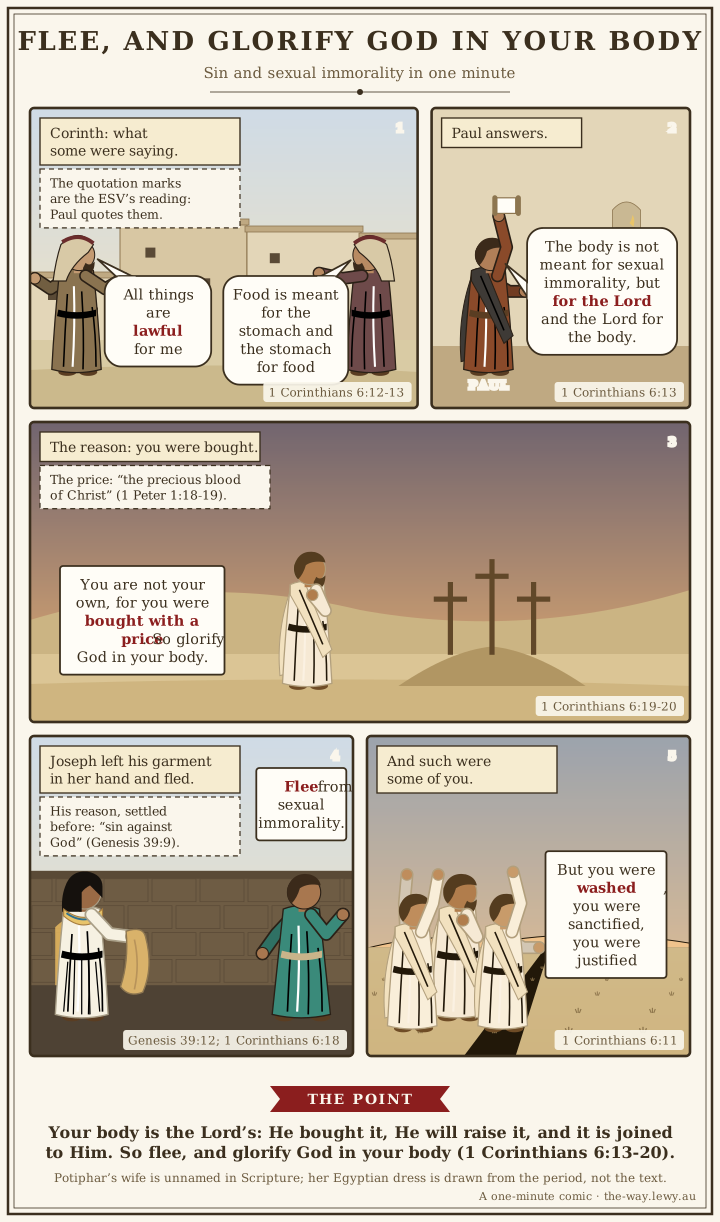
Paul answered a church whose members were visiting prostitutes, and his answer is the fullest account in Scripture of why sexual sin is sin. His answer is about the body: who made it, who bought it, who lives in it, and who will raise it.
In one sentence: Scripture calls every sexual union outside the one-flesh marriage of a man and a woman sexual immorality, and Paul gives the reason it is sin: your body belongs to the Lord who bought it and will raise it, and it is joined to Him, so flee immorality and glorify God in your body.
Key Takeaways
(This section follows the Key Takeaways format — see that page for what each part is for.)
Lessons about Jesus
- He drew the boundary of sexual life from creation itself: "What therefore God has joined together, let not man separate" (Matthew 19:6). Jesus took His answer from Genesis 2:24.
- He bought the body with His own blood (1 Corinthians 6:20; Revelation 5:9), and the believer is "joined to the Lord" (1 Corinthians 6:17) with the verb Jesus used for a husband joined to his wife (Matthew 19:5).
- God raised Him bodily, and the same power will raise you (1 Corinthians 6:14). His resurrection is the reason your body has a future.
Memory verses
✝️ 1 Corinthians 6:19-20 (ESV)
19 Or do you not know that your body is a temple of the Holy Spirit within you, whom you have from God? You are not your own, 20 for you were bought with a price. So glorify God in your body.
✝️ 1 Corinthians 10:13 (ESV)
13 No temptation has overtaken you that is not common to man. God is faithful, and he will not let you be tempted beyond your ability, but with the temptation he will also provide the way of escape, that you may be able to endure it.
Be Transformed
- Think. Your body is a person's dwelling place: the Holy Spirit's (1 Corinthians 6:19). What you do with it, you do in His house and with Him present.
- Attitude. Hold your body as purchased property, cared for on behalf of its Owner. You were bought with a price, and the price was Christ's blood (1 Corinthians 6:20; 1 Peter 1:18-19).
- Do. Name the place, the screen, the hour or the friendship where temptation reliably meets you, and decide now how you will leave it. Joseph's escape took one decision made in advance and a pair of legs (Genesis 39:12). Then each morning this week, name that place to God and ask Him for the strength to leave it, as Jesus told His disciples: "Watch and pray that you may not enter into temptation" (Matthew 26:41, ESV). The flesh is weak, and God is faithful to provide the way of escape (1 Corinthians 10:13).
Prayer
Father, you made our bodies, and your Son Jesus bought them with His blood. Your Spirit lives in us, and you have promised to raise us as you raised Him. Teach us to treat what you own as yours. Where we have sinned with our bodies, wash us as you washed the Corinthians, and give us your strength to run when temptation comes. Thank you that such were some of us, and that we are washed, sanctified and justified in His name.
In Jesus' name. Amen.
Study outline
- What the word covers — What Scripture calls sexual immorality. πορνεία in the New Testament, the Law behind Acts 15, and the boundary Jesus draws from Genesis 2:24.
- The passage — Two slogans from Corinth · The body is for the Lord. The Corinthians' case for using prostitutes, and Paul's first answer: the resurrection.
- Why it is sin — Joined to Christ · A sin against your own body · A temple bought with a price. The verb of Genesis 2:24 used for two unions, the contested line in 6:18, and the Spirit's temple.
- What to do — Flee, and you were washed · Theological principle. Flight, the way of escape, and the washing that comes first.
- Discussion questions. Six, for a group or on your own.
What Scripture calls sexual immorality
The New Testament's word is πορνεία (porneia, por-NAY-ah, G4202). It occurs 25 times, and its uses show it to be the umbrella term for every sexual union outside marriage. Four uses fix its range.
Incest. "It is actually reported that there is sexual immorality among you, and of a kind that is not tolerated even among pagans, for a man has his father's wife" (1 Corinthians 5:1, ESV). Leviticus 18:8 forbids exactly this union.
The Law of Leviticus 18. When the council at Jerusalem asked what Gentile believers must keep, James named four things: "abstain from the things polluted by idols, and from sexual immorality, and from what has been strangled, and from blood" (Acts 15:20, ESV). The four correspond to laws Leviticus 17-18 lays on the sojourner as well as on Israel: sacrifice (Leviticus 17:8-9), blood (Leviticus 17:10-12), an animal's blood poured out (Leviticus 17:13), and the sexual laws, kept by "the native or the stranger who sojourns among you" (Leviticus 18:26, ESV). James's next sentence names Moses, who "is read every Sabbath in the synagogues" (Acts 15:21, ESV). So the sexual laws of Leviticus 18 are likely, though not certainly, the list behind James's one word: incest, adultery, same-sex intercourse and bestiality (Leviticus 18:6-23). The other reading takes πορνεία in its general sense, the sexual sins common among pagans; the NIV Biblical Theology Study Bible offers both. God's judgment on the land of Canaan was for these: "by all these the nations I am driving out before you have become unclean, and the land became unclean, so that I punished its iniquity, and the land vomited out its inhabitants" (Leviticus 18:24-25, ESV). Those nations had no Sinai covenant, so the standard binds every people.
Wider than adultery. Jesus lists the two side by side: "out of the heart come evil thoughts, murder, adultery, sexual immorality, theft, false witness, slander" (Matthew 15:19, ESV; compare Mark 7:21). Adultery, μοιχεία (moicheia, moy-KAY-ah, G3430), is unfaithfulness to a marriage. πορνεία is the wider term, and it takes in sex before marriage, sex for pay, and every union Leviticus 18 forbids.
The boundary Jesus draws from Genesis 2:24
Defined from creation. When Jesus was asked about marriage, He went back past Moses to the beginning:
✝️ Matthew 19:4-6 (ESV)
4 He answered, "Have you not read that he who created them from the beginning made them male and female, 5 and said, 'Therefore a man shall leave his father and his mother and hold fast to his wife, and the two shall become one flesh'? 6 So they are no longer two but one flesh. What therefore God has joined together, let not man separate."
That is the boundary. One man and one woman, joined by God, become one flesh. Every sexual union outside it is πορνεία. Hebrews says the same in one sentence: "Let marriage be held in honor among all, and let the marriage bed be undefiled, for God will judge the sexually immoral and adulterous" (Hebrews 13:4, ESV).
Jesus also carried the boundary inward: "everyone who looks at a woman with lustful intent has already committed adultery with her in his heart" (Matthew 5:28, ESV). The sin begins where Matthew 15:19 says every sin begins, in the heart.
Same-sex intercourse, divorce and idolatry
Three questions sit inside this word and each needs its own study. Same-sex intercourse is named in Leviticus 18:22, and Paul's vice list includes "men who practice homosexuality" (1 Corinthians 6:9, ESV). Divorce is a separate question, though πορνεία appears in Jesus' exception (Matthew 5:32; 19:9). And the prophets use harlotry as a picture of idolatry: the Septuagint renders Hosea's charge against Israel with this same word (Hosea 1:2; 4:12), and Revelation does the same of Babylon (Revelation 17:2). This study keeps to the sin of the body.
Two slogans from Corinth
Paul wrote 1 Corinthians from Ephesus, before Pentecost (1 Corinthians 16:8). Chapters 5-7 are one block about bodies and sex: a man living with his stepmother (1 Corinthians 5:1), believers suing each other (1 Corinthians 6:1-8), a list of those who will not inherit the kingdom (1 Corinthians 6:9-11), men visiting prostitutes (1 Corinthians 6:12-20), and then marriage, "because of the temptation to sexual immorality" (1 Corinthians 7:2, ESV). Five of Paul's ten uses of πορνεία are in these three chapters.
The ESV Study Bible reads 6:12-20 as a response to Corinthian believers who were using prostitutes, and Paul's argument requires it: "Shall I then take the members of Christ and make them members of a prostitute?" (1 Corinthians 6:15, ESV). Here is the whole passage.
✝️ 1 Corinthians 6:12-20 (ESV)
12 "All things are lawful for me," but not all things are helpful. "All things are lawful for me," but I will not be dominated by anything. 13 "Food is meant for the stomach and the stomach for food"—and God will destroy both one and the other. The body is not meant for sexual immorality, but for the Lord, and the Lord for the body. 14 And God raised the Lord and will also raise us up by his power. 15 Do you not know that your bodies are members of Christ? Shall I then take the members of Christ and make them members of a prostitute? Never! 16 Or do you not know that he who is joined to a prostitute becomes one body with her? For, as it is written, "The two will become one flesh." 17 But he who is joined to the Lord becomes one spirit with him. 18 Flee from sexual immorality. Every other sin a person commits is outside the body, but the sexually immoral person sins against his own body. 19 Or do you not know that your body is a temple of the Holy Spirit within you, whom you have from God? You are not your own, 20 for you were bought with a price. So glorify God in your body.
Whose words are in quotation marks
The ESV prints two lines in quotation marks. Greek has no quotation marks, so the punctuation is the translators' judgment. The ESV, CSB, NIV and NLT print the quotation marks; the NASB, LSB and NKJV leave them out. The ESV's reading, followed here, is that Paul is quoting the Corinthians and answering them. Two things support it. Each slogan is followed at once by a correction ("but not all things are helpful"; "and God will destroy both"), and Paul quotes "All things are lawful" again at 1 Corinthians 10:23 with the same qualification. The translations that use quotation marks differ on where the second slogan ends: the NIV carries "and God will destroy them both" inside it, as the Corinthians' own words; the ESV, CSB and NLT give that clause to Paul.
The first slogan sounds like Paul's own teaching on freedom from the Law. Paul agrees with the words and answers what was being done with them. Some things are unhelpful, and he says, "I will not be dominated by anything" (1 Corinthians 6:12). A freedom that ends in a habit you cannot leave has turned into its opposite.
The second slogan is an argument by analogy. The stomach is made for food, and food for the stomach; both are passing things, so what you feed an appetite has no moral weight. The Corinthians applied it to sex: the body has a hunger, so meet it. Paul accepts the first half. Food and stomach both pass away, "God will destroy both one and the other" (1 Corinthians 6:13). Then he breaks the analogy at the point where it fails.
The body is for the Lord
"The body is not meant for sexual immorality, but for the Lord, and the Lord for the body" (1 Corinthians 6:13, ESV). Paul answers the slogan with the purpose God gave the body. The relation runs both ways.
Then comes the reason the body differs from the stomach: "God raised the Lord and will also raise us up by his power" (1 Corinthians 6:14, ESV). The stomach will be done away with; the body will be raised. Paul gives a whole chapter to this later in the letter, where the body sown perishable is raised imperishable (1 Corinthians 15:42-44). Some in Corinth were saying "there is no resurrection of the dead" (1 Corinthians 15:12, ESV), and a body with no future is easy to hold cheap. Paul's answer is the empty tomb. What God means to raise, He cares about now.
This shows that God values the human body. He made it, His Son took one, and He will raise it. Your body belongs to the life to come, and so what you do with it belongs to your life with Him today.
Joined to Christ
Paul's next step turns on a single verb.
✝️ 1 Corinthians 6:15-17 (ESV)
15 Do you not know that your bodies are members of Christ? Shall I then take the members of Christ and make them members of a prostitute? Never! 16 Or do you not know that he who is joined to a prostitute becomes one body with her? For, as it is written, "The two will become one flesh." 17 But he who is joined to the Lord becomes one spirit with him.
"Joined" in 6:16 and 6:17 translates the same participle, κολλώμενος, from κολλάω (kollaō, kol-LAH-oh, G2853), "to join, to cling, to hold fast." It is the verb Jesus uses when He quotes Genesis 2:24: the man "will be joined" (κολληθήσεται) to his wife (Matthew 19:5; the Septuagint of Genesis has the compound προσκολλάω). Behind both stands the Hebrew דָּבַק (dāḇaq, dah-VAHK, H1692), "to cling, to hold fast."
Paul does not cite it, but the Old Testament already used this verb for Israel and its God: "You shall fear the LORD your God. You shall serve him and hold fast to him" (Deuteronomy 10:20, ESV; also Deuteronomy 11:22; 30:20; Joshua 23:8). The Septuagint renders Deuteronomy 10:20 with κολλάω. Scripture had one word for a husband clinging to his wife and for a people clinging to the LORD.
Paul puts the two unions side by side. Joined to a prostitute, a man becomes "one body with her," and Paul cites Genesis 2:24 to say so: "The two will become one flesh." Sex makes a union whether the two intend one or not. The Corinthian man thought he was feeding an appetite. God's word from creation says he joined himself to a woman. Joined to the Lord, the believer becomes "one spirit with him." The believer's body is a member of Christ (1 Corinthians 6:15), so the man who goes to a prostitute takes Christ's members with him. Paul answers that thought with μὴ γένοιτο, "Never!"
This is the ground of the prohibition. Sexual immorality is sin because it joins to someone else a body that already belongs to Christ.
The bride and the picture
Does sexual sin defile the image of the bride of Christ? Paul draws the line between marriage and Christ himself. He quotes Genesis 2:24 at Ephesians 5:31 and says, "This mystery is profound, and I am saying that it refers to Christ and the church" (Ephesians 5:32, ESV). Earlier in the same chapter he writes, "sexual immorality and all impurity or covetousness must not even be named among you, as is proper among saints" (Ephesians 5:3, ESV). To the Corinthians he writes, "I betrothed you to one husband, to present you as a pure virgin to Christ" (2 Corinthians 11:2, ESV). Scripture also uses the picture in reverse, for unfaithfulness to God: "as a treacherous wife leaves her husband, so have you been treacherous to me" (Jeremiah 3:20, ESV); "You adulterous people!" (James 4:4, ESV). The study The Harlot and the Bride follows that reverse picture to Babylon in Revelation.
The conclusion is this study's reading, though it follows closely: a sexual union outside marriage tells a false story about Christ's union with the church, a joining with no covenant behind it. The study The Bride of Christ lays out the betrothal in full.
This shows that God binds Himself to His people by covenant and keeps it, and He made marriage to show the world what that faithfulness looks like.
A sin against your own body
✝️ 1 Corinthians 6:18 (ESV)
18 Flee from sexual immorality. Every other sin a person commits is outside the body, but the sexually immoral person sins against his own body.
The command is plain. The sentence after it is the hardest in the passage, and its reading is contested.
The Greek reads πᾶν ἁμάρτημα ὃ ἐὰν ποιήσῃ ἄνθρωπος ἐκτὸς τοῦ σώματός ἐστιν: "every sin that a person might commit is outside the body." The word "other" is supplied. The ESV, CSB, NASB, LSB and NIV all add it, and the CSB footnotes it "Lit Every sin"; the NKJV leaves it out. Two readings follow.
Paul's statement, or a third slogan
Paul's own statement. Translators who add "other" take the line as Paul's, contrasting sexual sin with every other sin. Gluttony and drunkenness involve the body too, so on this reading Paul means that sexual sin is different in kind. The NIV Biblical Theology Study Bible notes that it alone involves the union of two bodies, and the ESV Study Bible that it is a sin against Christ, whose member the body is, and against one's own body at once. Proverbs makes a related point about adultery: "he who does it destroys himself" (Proverbs 6:32, ESV).
A third slogan. The line has the same shape as the other two. It is short, general and in the voice of a principle, and Paul answers it with "but" (δέ). Read this way, "Every sin a person commits is outside the body" is the Corinthians' claim, that what the body does cannot touch the self. Paul replies, "but the sexually immoral person sins against his own body." The NIV Cultural Backgrounds Study Bible mentions this possibility. It fits the passage's pattern of slogan and answer, and it fits a church that thought the body did not matter. Against it: of the translations compared here only the WEB prints the line as a quotation (the ESV, CSB, NASB, LSB, NIV and NKJV do not), and it is longer and more qualified than the two slogans before it.
Where both readings land
Both readings land in the same place, which is why the passage can be taught confidently while this line is held loosely. On either reading Paul says that the immoral person "sins against his own body," εἰς τὸ ἴδιον σῶμα. The sin is done to the body as well as with it. The body that was made for the Lord, that will be raised, that is joined to Christ, is the very thing being wronged.
Sexual sin wrongs others too: Paul names the brother wronged (1 Thessalonians 4:6), and Malachi the spouse betrayed, "the wife of your youth, to whom you have been faithless" (Malachi 2:14, ESV).
A temple bought with a price
✝️ 1 Corinthians 6:19-20 (ESV)
19 Or do you not know that your body is a temple of the Holy Spirit within you, whom you have from God? You are not your own, 20 for you were bought with a price. So glorify God in your body.
Earlier in the letter Paul called the church God's temple: "Do you not know that you are God's temple and that God's Spirit dwells in you?" (1 Corinthians 3:16, ESV). Here he applies the same picture to each believer's body. The word is ναός (naos, nah-OSS, G3485), and the LSB footnotes it "The inner part of the temple": the sanctuary itself, where God's presence dwelt. Your body is the place where the Holy Spirit lives. Sexual sin is committed in His house.
Then the reason in commercial language: "You are not your own, for you were bought with a price." ἠγοράσθητε is from ἀγοράζω (agorazō, ah-go-RAD-zoh, G59), the ordinary verb for buying. Paul's readers included slaves (1 Corinthians 7:21-23), and a bought slave belonged to the master who paid for him. Paul repeats the purchase at 1 Corinthians 7:23: "You were bought with a price; do not become bondservants of men" (ESV). He does not name the price in either verse. Peter does: "you were ransomed ... not with perishable things such as silver or gold, but with the precious blood of Christ" (1 Peter 1:18-19, ESV), and the song of Revelation 5:9 uses Paul's verb, "by your blood you ransomed people for God" (ESV).
So the conclusion: "glorify God in your body." Other manuscripts add "and in your spirit, which belong to God" (CSB footnote). Modern editions print the shorter text, and it keeps the command on the body, the subject of the whole paragraph.
This shows that God paid for you in full. Your body is His by creation, by purchase and by indwelling, and He means it to show His glory.
Flee, and you were washed
Paul's command is a single word: φεύγετε (pheugete, FYOO-geh-teh, G5343), "Flee." It is a present imperative, keep fleeing, and Paul gives the same command to Timothy as a way of life paired with a pursuit: "So flee youthful passions and pursue righteousness" (2 Timothy 2:22, ESV). Joseph refused Potiphar's wife "day after day" (Genesis 39:10, ESV). Paul gives the command once more in this letter: "Therefore, my beloved, flee from idolatry" (1 Corinthians 10:14, ESV). The ESV Study Bible draws the line between the two, and Israel's history had already joined them. Paul recalls the golden calf, when "the people sat down to eat and drink and rose up to play," and the plains of Moab, where Israel's men went after the women of Moab and bowed to their gods: "We must not indulge in sexual immorality as some of them did" (1 Corinthians 10:7-8, ESV; Exodus 32:6; Numbers 25:1-2).
Joseph and the way of escape
Fleeing is a strategy of distance. Joseph is the picture. Potiphar's wife "spoke to Joseph day after day," and his answer was to refuse "to lie beside her or to be with her" (Genesis 39:10, ESV). When she caught his garment, "he left his garment in her hand and fled and got out of the house" (Genesis 39:12, ESV). He had already settled why: "How then can I do this great wickedness and sin against God?" (Genesis 39:9, ESV). Joseph named the sin as one against God before the moment came, and when it came he ran.
God promises an exit every time: "God is faithful, and he will not let you be tempted beyond your ability, but with the temptation he will also provide the way of escape, that you may be able to endure it" (1 Corinthians 10:13, ESV). The way of escape is often a door. The command to flee means walking through it.
Paul gave the Thessalonians the same instruction as God's will for them: "For this is the will of God, your sanctification: that you abstain from sexual immorality; that each one of you know how to control his own body in holiness and honor" (1 Thessalonians 4:3-4, ESV). He closes the paragraph with the Spirit: "whoever disregards this, disregards not man but God, who gives his Holy Spirit to you" (1 Thessalonians 4:8, ESV). The God who calls you to holiness gives you His Spirit, the Spirit who lives in the temple of 1 Corinthians 6:19.
Such were some of you
Paul's argument in 6:12-20 stands on the verses just before it. After the list of those who will not inherit the kingdom, headed by "the sexually immoral," he writes:
✝️ 1 Corinthians 6:11 (ESV)
11 And such were some of you. But you were washed, you were sanctified, you were justified in the name of the Lord Jesus Christ and by the Spirit of our God.
Some of the Corinthians had been exactly what the list names. Three verbs describe what God had done for them: washed, sanctified, justified, each in the past tense, each done "in the name of the Lord Jesus Christ and by the Spirit of our God." The command to flee is addressed to people already washed. Purity in 6:12-20 is the life of the justified, and the call is to live as what God has already made you.
For a believer who has fallen, the same God remains faithful: "If we confess our sins, he is faithful and just to forgive us our sins and to cleanse us from all unrighteousness" (1 John 1:9, ESV). And the One who hears that confession knows the pull of temptation from the inside. He "in every respect has been tempted as we are, yet without sin," so "let us then with confidence draw near to the throne of grace, that we may receive mercy and find grace to help in time of need" (Hebrews 4:15-16, ESV).
Marriage is the place where God gives sexual love freely. Paul's very next chapter tells husband and wife each to give the other their body (1 Corinthians 7:3-4), and the study Reading the Song of Songs shows how warmly Scripture celebrates that gift. The command to flee protects something God made good.
Theological principle
The body belongs to the Lord. God made it for Himself; Christ bought it at the cost of His life; the Holy Spirit lives in it; and God will raise it as He raised Jesus. A sexual union joins the body to another person, and God has given one union for that joining, the one-flesh marriage of a man and a woman, which pictures Christ's faithfulness to His people. Every other union is πορνεία, and it is sin because it gives away what belongs to Christ and wrongs the body He bought.
This is the doctrine of redemption reaching the body. God has bought you, washed you and filled you with His Spirit, so you may flee immorality and glorify God in your body.
Discussion questions
- The language. Paul uses κολλάω, "joined," for a man with a prostitute (1 Corinthians 6:16) and for a believer with the Lord (1 Corinthians 6:17), the verb Jesus uses for a husband with his wife (Matthew 19:5). What does the one verb in three places say about what sex does?
- The text in its context. Chapters 5-7 move from incest, to lawsuits, to prostitutes, to marriage (1 Corinthians 7:2). Why might Paul place "such were some of you. But you were washed" (1 Corinthians 6:11) immediately before the command to flee?
- Christ. "You were bought with a price" (1 Corinthians 6:20). How does knowing who paid, and what He paid, change the way you think about your own body?
- The hard part. "Every other sin a person commits is outside the body" (1 Corinthians 6:18) may be Paul's statement or a Corinthian slogan he answers. What does each reading claim, and what does Paul say on both?
- Be transformed. The Corinthians said "Food is meant for the stomach" (1 Corinthians 6:13). What slogans does our own culture use to say the body's choices carry no moral weight, and how does the resurrection answer them (1 Corinthians 6:14)?
- Be transformed. Joseph decided why he would refuse before the day she caught his garment (Genesis 39:9, 12). What is your way of escape (1 Corinthians 10:13), and what would it take to decide on it, and pray for strength to take it, before you need it (Matthew 26:41)?
Group study sheet for a 40-minute group: two A4 sheets, or one with the guided path
The point, the passage, the questions and the response, from this study. Print on both sides of two A4 sheets, flipping on the long edge. While this block is open, printing the page prints the sheet; close it to print the study.
Sin and Sexual Immorality
1 Corinthians 6:12-20The point Scripture calls every sexual union outside the one-flesh marriage of a man and a woman sexual immorality, and Paul gives the reason it is sin: your body belongs to the Lord who bought it and will raise it, and it is joined to Him, so flee immorality and glorify God in your body.
Ask: what comes to mind when you hear Sin and Sexual Immorality
? Hear a few answers before anyone reads.
1 Corinthians 6:12-20 12“Everything is permissible for me,” but not everything is beneficial. “Everything is permissible for me,” but I will not be mastered by anything. 13“Food for the stomach and the stomach for food,” but God will destroy them both. The body is not intended for sexual immorality, but for the Lord, and the Lord for the body. 14By His power God raised the Lord from the dead, and He will raise us also. 15Do you not know that your bodies are members of Christ? Shall I then take the members of Christ and unite them with a prostitute? Never! 16Or don’t you know that he who unites himself with a prostitute is one with her in body? For it is said, “The two will become one flesh.” 17But he who unites himself with the Lord is one with Him in spirit. 18Flee from sexual immorality. Every other sin a man can commit is outside his body, but he who sins sexually sins against his own body. 19Do you not know that your body is a temple of the Holy Spirit who is in you, whom you have received from God? You are not your own; 20you were bought at a price. Therefore glorify God with your body.
Also read:
Sin and Sexual Immorality
- What the word covers — What Scripture calls sexual immorality. πορνεία in the New Testament, the Law behind Acts 15, and the boundary Jesus draws from Genesis 2:24.
- The passage — Two slogans from Corinth · The body is for the Lord. The Corinthians' case for using prostitutes, and Paul's first answer: the resurrection.
- Why it is sin — Joined to Christ · A sin against your own body · A temple bought with a price. The verb of Genesis 2:24 used for two unions, the contested line in 6:18, and the Spirit's temple.
- What to do — Flee, and you were washed · Theological principle. Flight, the way of escape, and the washing that comes first.
Sin and Sexual Immorality
1The language. Paul uses κολλάω, "joined," for a man with a prostitute (1 Corinthians 6:16) and for a believer with the Lord (1 Corinthians 6:17), the verb Jesus uses for a husband with his wife (Matthew 19:5). What does the one verb in three places say about what sex does?
2The text in its context. Chapters 5-7 move from incest, to lawsuits, to prostitutes, to marriage (1 Corinthians 7:2). Why might Paul place "such were some of you. But you were washed" (1 Corinthians 6:11) immediately before the command to flee?
3Christ. "You were bought with a price" (1 Corinthians 6:20). How does knowing who paid, and what He paid, change the way you think about your own body?
4The hard part. "Every other sin a person commits is outside the body" (1 Corinthians 6:18) may be Paul's statement or a Corinthian slogan he answers. What does each reading claim, and what does Paul say on both?
Sin and Sexual Immorality
5Be transformed. The Corinthians said "Food is meant for the stomach" (1 Corinthians 6:13). What slogans does our own culture use to say the body's choices carry no moral weight, and how does the resurrection answer them (1 Corinthians 6:14)?
6Be transformed. Joseph decided why he would refuse before the day she caught his garment (Genesis 39:9, 12). What is your way of escape (1 Corinthians 10:13), and what would it take to decide on it, and pray for strength to take it, before you need it (Matthew 26:41)?
- Think. Your body is a person's dwelling place: the Holy Spirit's (1 Corinthians 6:19). What you do with it, you do in His house and with Him present.
- Attitude. Hold your body as purchased property, cared for on behalf of its Owner. You were bought with a price, and the price was Christ's blood (1 Corinthians 6:20; 1 Peter 1:18-19).
- Do. Name the place, the screen, the hour or the friendship where temptation reliably meets you, and decide now how you will leave it. Joseph's escape took one decision made in advance and a pair of legs (Genesis 39:12). Then each morning this week, name that place to God and ask Him for the strength to leave it, as Jesus told His disciples: "Watch and pray that you may not enter into temptation" (Matthew 26:41, ESV). The flesh is weak, and God is faithful to provide the way of escape (1 Corinthians 10:13).
Or do you not know that your body is a temple of the Holy Spirit within you, whom you have from God? You are not your own, for you were bought with a price. So glorify God in your body.
1 Corinthians 6:19-20 (ESV)Father, you made our bodies, and your Son Jesus bought them with His blood. Your Spirit lives in us, and you have promised to raise us as you raised Him. Teach us to treat what you own as yours. Where we have sinned with our bodies, wash us as you washed the Corinthians, and give us your strength to run when temptation comes. Thank you that such were some of us, and that we are washed, sanctified and justified in His name.
In Jesus' name. Amen.
References & Recommended Reading
- ESV Bible (Crossway) — the translation quoted throughout, per this site's conventions. All quotations were verified against the ESV text rather than reproduced from memory. See Copyright for the full notice.
- MACULA Greek Linguistic Datasets (SBLGNT) and MACULA Hebrew Linguistic Datasets
(Westminster Leningrad Codex), Clear Bible — queried through this repo's
references/build/bible-text.db. Source of the Greek and Hebrew forms, Strong's numbers and occurrence counts above, including the 25 occurrences of πορνεία and the distribution of κολλάω. - unfoldingWord Literal Text and Greek New Testament — the word-level alignments used to check 1 Corinthians 6:13-20, Genesis 2:24, Deuteronomy 10:20 and Proverbs 6:32.
- Brenton's Septuagint (eBible.org) — Genesis 2:24 (προσκολλάω) and Deuteronomy 10:20 (κολλάω).
- ESV Study Bible (Crossway) — consulted after the exegesis, as a check. Introduction to 1 Corinthians for date and place; notes on 6:12-20 (believers using prostitutes) and 6:16-18 (sin against Christ and the body; the "flee" of 10:14); and on Acts 15:19-21 (the ban on sexual immorality as lasting moral law).
- NIV Biblical Theology Study Bible (Zondervan), gen. ed. D. A. Carson — 1 Corinthians 6:18 (the union of two bodies); Acts 15:20 (the parallels with Leviticus 17-18).
- NIV Cultural Backgrounds Study Bible (Zondervan), ed. John H. Walton and Craig S. Keener — 1 Corinthians 6:18, the possibility that the line is the interlocutor's.
- CSB and LSB footnotes — 1 Corinthians 6:18 ("Lit Every sin"), 6:19 (ναός, "The inner part of the temple") and 6:20 (the longer reading).
- Gordon D. Fee and Douglas Stuart, How to Read the Bible for All Its Worth — the methodology behind this study's order of work and its handling of the epistles.
Related studies on this site: The Bride of Christ · Reading the Song of Songs · Sin and Idolatry · The Harlot and the Bride