The Lord's Supper: Do This in Remembrance of Me
Week 3 of 6 in The Spring Feasts, for Easter · next: Unleavened Bread: A New Lump
Paul wrote to a church that met to eat the Lord's Supper and went home worse for it. "When you come together, it is not the Lord's supper that you eat" (1 Corinthians 11:20, ESV). Then he told them what the meal is, in the words Jesus spoke over it "on the night when he was betrayed" (1 Corinthians 11:23, ESV).
In one sentence: The Lord's Supper is the memorial Jesus gave His church, as the Passover was Israel's: in it you remember His death, proclaim it until He comes, and share in His body and blood with the one body He has made, and you wait for the cup He has not yet drunk, which He will drink new with you in His Father's kingdom; so come to it examined, reconciled to your brothers and sisters, and with your eyes on Him.
Paul's four verses on the night itself hold the remembrance, the new covenant and the proclamation:
✝️ 1 Corinthians 11:23-26 (ESV)
23 For I received from the Lord what I also delivered to you, that the Lord Jesus on the night when he was betrayed took bread, 24 and when he had given thanks, he broke it, and said, "This is my body, which is for you. Do this in remembrance of me." 25 In the same way also he took the cup, after supper, saying, "This cup is the new covenant in my blood. Do this, as often as you drink it, in remembrance of me." 26 For as often as you eat this bread and drink the cup, you proclaim the Lord's death until he comes.
Key Takeaways
(This section follows the Key Takeaways format — see that page for what each part is for.)
Types & Prophecy
- Type: the Passover memorial. God made the Passover "a memorial day ... throughout your generations" (Exodus 12:14, ESV). Jesus kept that meal with His disciples and gave it a new object: "Do this in remembrance of me" (Luke 22:19, ESV). Paul names the link: "Christ, our Passover lamb, has been sacrificed" (1 Corinthians 5:7, ESV).
- Type: a meal that looks ahead. Jesus said of the Passover, "I will not eat it until it is fulfilled in the kingdom of God" (Luke 22:16, ESV). The Supper is kept "until he comes" (1 Corinthians 11:26).
- Prophecy. "On this mountain the LORD of hosts will make for all peoples a feast of rich food" (Isaiah 25:6, ESV). Revelation names it: "Blessed are those who are invited to the marriage supper of the Lamb" (Revelation 19:9, ESV).
Lessons about Jesus
- He gave Himself for you. "This is my body, which is given for you" (Luke 22:19, ESV).
- He made the new covenant in His own blood. "This cup that is poured out for you is the new covenant in my blood" (Luke 22:20, ESV).
- He is the host. It is "the Lord's supper" (1 Corinthians 11:20) and "the table of the Lord" (1 Corinthians 10:21).
- He is made known at His table. The two at Emmaus told "how he was known to them in the breaking of the bread" (Luke 24:35, ESV).
- He has promised to finish the meal with you. "I will not drink again of this fruit of the vine until that day when I drink it new with you in my Father's kingdom" (Matthew 26:29, ESV).
Memory verses
✝️ Luke 22:19 (ESV)
19 And he took bread, and when he had given thanks, he broke it and gave it to them, saying, "This is my body, which is given for you. Do this in remembrance of me."
✝️ 1 Corinthians 11:26 (ESV)
26 For as often as you eat this bread and drink the cup, you proclaim the Lord's death until he comes.
Be Transformed
- Think. The Supper keeps you grounded in what is true. "Set your minds on things that are above, not on things that are on earth" (Colossians 3:2, ESV).
- Attitude. Come examined and reconciled. "Let a person examine himself, then, and so eat" (1 Corinthians 11:28, ESV), and "wait for one another" (1 Corinthians 11:33, ESV).
- Do. Answer the children's question, "What do you mean by this service?" (Exodus 12:26, ESV). At the next Lord's Supper, tell someone, a child if you can, what the bread and the cup mean, and that each time you "proclaim the Lord's death until he comes" (1 Corinthians 11:26, ESV).
Prayer
Father, You gave Israel a meal to remember how You brought them out of Egypt, and You have given us a meal to remember how Your Son Jesus gave His body and poured out His blood for us. Thank You for the new covenant in His blood, and that we who eat one bread are one body. Keep our eyes on Him. Make us examine ourselves honestly, wait for one another gladly, and tell what this means to those who ask. And keep us at His table until the day He drinks it new with us in Your kingdom.
In Jesus' name. Amen.
Study outline
- A memorial, as Passover was. What Israel remembered, and what Jesus told His disciples to remember instead.
- A meal that teaches. The children's question, the Supper as proclamation, and remembering as what keeps you grounded.
- One loaf, one body. Sharing in Christ, and in His people, at His table alone.
- What went wrong at Corinth. A supper arranged by rank.
- Coming in a worthy manner. Examining yourself, discerning the body, and the Lord's discipline.
- The cup not yet drunk. The meal Jesus will finish with you at the marriage supper of the Lamb.
- Discussion questions. Six, for a group or on your own.
A memorial, as Passover was
What Israel remembered
The Passover was given to be remembered. "This day shall be for you a memorial day, and you shall keep it as a feast to the LORD; throughout your generations, as a statute forever, you shall keep it as a feast" (Exodus 12:14, ESV). "Memorial" is זִכָּרוֹן (zikkaron, H2146), from the verb to remember; the Septuagint renders it μνημόσυνον (mnēmosynon, G3422). The unleavened bread carried the same purpose, "that all the days of your life you may remember the day when you came out of the land of Egypt" (Deuteronomy 16:3, ESV).
God built memorials because His people forget. "Take care lest you forget the LORD your God" (Deuteronomy 8:11, ESV). When Israel crossed the Jordan He had them set up twelve stones, so that "when your children ask in time to come, 'What do those stones mean to you?'" they would hear what God had done, and "these stones shall be to the people of Israel a memorial forever" (Joshua 4:6-7, ESV). The Passover did the same work every spring: a meal, eaten in every house, that said what God had done.
Passover: When I See the Blood studies the night in Egypt and the feast itself.
"Do this in remembrance of me"
Jesus' last meal before the cross was that memorial. "I have earnestly desired to eat this Passover with you before I suffer" (Luke 22:15, ESV). He kept its form and gave it a new object.
✝️ Luke 22:19-20 (ESV)
19 And he took bread, and when he had given thanks, he broke it and gave it to them, saying, "This is my body, which is given for you. Do this in remembrance of me." 20 And likewise the cup after they had eaten, saying, "This cup that is poured out for you is the new covenant in my blood.
"Remembrance" is ἀνάμνησις (anamnēsis, G364). It occurs four times in the New Testament: here, twice in Paul's account (1 Corinthians 11:24, 25), and once in Hebrews, of the old sacrifices: "in these sacrifices there is a reminder of sins every year" (Hebrews 10:3, ESV). The sacrifices offered year after year brought sin back to mind. The Lord's Supper brings Jesus to mind, and the death that took sin away.
Israel remembered the night God brought them out of Egypt. The church remembers the night Jesus was betrayed, and the body and blood given "for you." Paul draws the line between the two meals himself: "Christ, our Passover lamb, has been sacrificed. Let us therefore celebrate the festival ... with the unleavened bread of sincerity and truth" (1 Corinthians 5:7-8, ESV). "I Will Not Drink Again" follows the Passover cups through that night.
"This is my body"
Christians have long divided over these four words, and the question of how Christ is present in the bread and cup is contested between the churches. This study stays with what Scripture says the meal is.
Scripture names the meal three ways: a remembrance (Luke 22:19), a proclamation (1 Corinthians 11:26) and a participation (1 Corinthians 10:16, below). And it uses "is" for a sign and the thing signified in the same Passover setting. Of the lamb eaten in haste God said, "It is the LORD's Passover" (Exodus 12:11, ESV). Paul says of the water from the rock in the wilderness, "the Rock was Christ" (1 Corinthians 10:4, ESV). Jesus says, "I am the door" (John 10:9, ESV). The disciples heard "This is my body" at a table where Jesus' own body was in front of them, holding the bread.
This shows that God gives His people a way to remember. He gave Israel a meal for the night He saved them, and He has given you a meal for the death that saved you.
A meal that teaches
The children's question
God wrote the teaching into the Passover. "When your children say to you, 'What do you mean by this service?' you shall say, 'It is the sacrifice of the LORD's Passover'" (Exodus 12:26-27, ESV). "You shall tell your son on that day, 'It is because of what the LORD did for me when I came out of Egypt'" (Exodus 13:8, ESV). The feast was "a memorial between your eyes, that the law of the LORD may be in your mouth" (Exodus 13:9, ESV).
"You proclaim the Lord's death"
The Supper teaches in the same way. "As often as you eat this bread and drink the cup, you proclaim the Lord's death until he comes" (1 Corinthians 11:26, ESV). "Proclaim" is καταγγέλλω (katangellō, G2605), Paul's word for preaching the gospel. He uses it of his own preaching at Corinth (1 Corinthians 2:1) and of those who "proclaim the gospel" (1 Corinthians 9:14, ESV). Each time the church eats the bread and drinks the cup, it preaches the death of Jesus, without a sermon, to everyone at the table.
The first church kept it alongside the teaching. "They devoted themselves to the apostles' teaching and the fellowship, to the breaking of bread and the prayers" (Acts 2:42, ESV). At Troas "on the first day of the week, when we were gathered together to break bread, Paul talked with them" (Acts 20:7, ESV). And the risen Jesus, who had opened the Scriptures to two disciples on the road, "was known to them in the breaking of the bread" (Luke 24:35, ESV).
Remembering keeps you grounded
The New Testament treats reminding as part of keeping believers steady. Peter wrote, "I intend always to remind you of these qualities, though you know them and are established in the truth that you have. I think it right ... to stir you up by way of reminder" (2 Peter 1:12-13, ESV). Jesus promised that the Holy Spirit would "bring to your remembrance all that I have said to you" (John 14:26, ESV).
The Supper is a reminder you can taste. It sets your eyes where Hebrews sets them: "looking to Jesus, the founder and perfecter of our faith, who for the joy that was set before him endured the cross" (Hebrews 12:2, ESV). So you may come to the table and be brought back, every time, to what is true: Jesus died for you, and He is coming back.
One loaf, one body
A sharing in Christ
Before Paul corrects the Corinthians' Supper, he tells them what it is.
✝️ 1 Corinthians 10:16-17 (ESV)
16 The cup of blessing that we bless, is it not a participation in the blood of Christ? The bread that we break, is it not a participation in the body of Christ? 17 Because there is one bread, we who are many are one body, for we all partake of the one bread.
"Participation" is κοινωνία (koinōnia, G2842), sharing, fellowship, having in common. Paul uses it of being "called into the fellowship of his Son, Jesus Christ our Lord" (1 Corinthians 1:9, ESV). At the table believers share in what Christ's body and blood have won for them.
A sharing in one another
Verse 17 draws the second line. One loaf is broken and everyone eats from it, so the many who eat it are one body. "Now you are the body of Christ and individually members of it" (1 Corinthians 12:27, ESV). The Supper is never a private meal. You eat it with the people Jesus died for.
The table of the Lord alone
Paul makes the point to warn them. "Consider the people of Israel: are not those who eat the sacrifices participants in the altar?" (1 Corinthians 10:18, ESV). A meal joins the one who eats it to the one it is offered to. So "you cannot drink the cup of the Lord and the cup of demons. You cannot partake of the table of the Lord and the table of demons" (1 Corinthians 10:21, ESV).
Paul takes the warning from the Song of Moses. "To demons and not to God" (1 Corinthians 10:20, ESV) is the Greek Old Testament's wording at Deuteronomy 32:17, and "Shall we provoke the Lord to jealousy?" (1 Corinthians 10:22, ESV) takes its verb from Deuteronomy 32:21; Idolatry traces both, and Those Called Gods what stands behind the idols. Moses sang those words over Israel, God's own people, and Paul turns them on the church.
Both of Paul's tables already had Old Testament names. Isaiah charged Israel with laying the rival one, "who set a table for Fortune and fill cups of mixed wine for Destiny" (Isaiah 65:11, ESV), and the Greek Old Testament there sets the table "for the demon"; Paul does not cite the verse. Malachi calls the altar "the LORD's table" (Malachi 1:7, ESV; 1:12), τράπεζα κυρίου in Greek, Paul's own phrase, as The Table and the Bread of the Presence shows. The Lord's table belongs to one Lord, and the one who eats at it belongs to Him.
What went wrong at Corinth
"Not the Lord's supper"
✝️ 1 Corinthians 11:20-22 (ESV)
20 When you come together, it is not the Lord's supper that you eat. 21 For in eating, each one goes ahead with his own meal. One goes hungry, another gets drunk. 22 What! Do you not have houses to eat and drink in? Or do you despise the church of God and humiliate those who have nothing? What shall I say to you? Shall I commend you in this? No, I will not.
The meal belonged to the Lord. "Lord's" is κυριακός (kyriakos, G2960, "belonging to the Lord"), a word the New Testament uses only twice: here, and of "the Lord's day" (Revelation 1:10). The Corinthians had made it "his own meal" (1 Corinthians 11:21). Some ate their fill and drank too much while others arrived to find nothing left.
A supper arranged by rank
The churches met in homes (1 Corinthians 16:19), and in a Roman city a dinner was arranged by status. The NIV Cultural Backgrounds Study Bible describes the setting: an average wealthy home could recline nine to twelve guests on three couches in its dining room, the triclinium, with more, perhaps forty, in the larger atrium; the best places and the best food went to those nearest the host.1 Paul's own words fit that picture. Each one "goes ahead with his own meal", some have "nothing", and his remedy is "wait for one another" (1 Corinthians 11:21-22, 33).
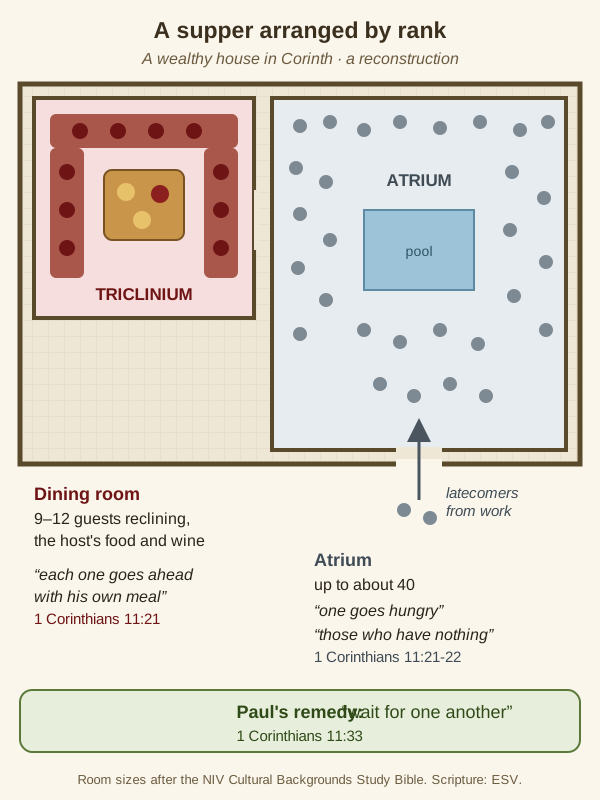
The layout is a reconstruction; Paul does not describe the room. What he does say is enough. At the meal that proclaims Christ's death for others, they had put themselves first. "It is not the Lord's supper that you eat."
Coming in a worthy manner
"In an unworthy manner"
✝️ 1 Corinthians 11:27-29 (ESV)
27 Whoever, therefore, eats the bread or drinks the cup of the Lord in an unworthy manner will be guilty concerning the body and blood of the Lord. 28 Let a person examine himself, then, and so eat of the bread and drink of the cup. 29 For anyone who eats and drinks without discerning the body eats and drinks judgment on himself.
"In an unworthy manner" is one word, ἀναξίως (anaxiōs, G371), found nowhere else in the New Testament; later manuscripts repeat it in 1 Corinthians 11:29, the KJV's "unworthily". It is an adverb. It describes how a person eats, and in context it is the way the Corinthians were eating: each for himself, the poor shamed. No one is worthy of Christ's body given for them; that is why it was given. Paul asks for a worthy manner.
"Let a person examine himself"
The remedy is self-examination, δοκιμάζω (dokimazō, G1381), to test and approve. Paul does not tell the church to keep people from the table. He tells each person to look at himself, "and so eat" (1 Corinthians 11:28). The examination ends at the table.
"Discerning the body"
"Without discerning the body" (1 Corinthians 11:29) is read two ways, and both have support.
- The Lord's body given for you. The bread is "my body, which is for you" (1 Corinthians 11:24), so to eat without discerning the body is to eat without recognising what Christ's death means. Some manuscripts read "not discerning the Lord's body", which takes it this way.
- The church as Christ's body. Paul has just said "we who are many are one body" (1 Corinthians 10:17), and he goes on, "you are the body of Christ" (1 Corinthians 12:27). The Greek text behind most modern translations reads simply "the body", and the sin Paul is correcting is contempt for fellow believers.
The two readings meet at Corinth. Despising the people Christ died for is a failure to understand why He died.
Judged, so as not to be condemned
Paul builds the end of the paragraph on one word family. Discerning is διακρίνω (diakrinō, G1252), and judgment is κρίμα (krima, G2917). "If we judged [diakrinō] ourselves truly, we would not be judged. But when we are judged by the Lord, we are disciplined so that we may not be condemned along with the world" (1 Corinthians 11:31-32, ESV). Some at Corinth had become "weak and ill, and some have died" (1 Corinthians 11:30, ESV).
The judgment here is the Lord's discipline of His own people, and its purpose is stated: "so that we may not be condemned along with the world." This shows that God disciplines His children because they are His. Judge yourself at the table, and you will not need His correction.
"Wait for one another"
Paul ends with a plain instruction. "So then, my brothers, when you come together to eat, wait for one another — if anyone is hungry, let him eat at home — so that when you come together it will not be for judgment" (1 Corinthians 11:33-34, ESV). The fix for a selfish supper is a shared one.
The cup not yet drunk
"Until it is fulfilled in the kingdom of God"
At the table Jesus spoke of a meal still to come. "I will not eat it until it is fulfilled in the kingdom of God" (Luke 22:16, ESV). Over the cup: "I will not drink of the fruit of the vine until the kingdom of God comes" (Luke 22:18, ESV). Matthew records the company He means to share it with: "until that day when I drink it new with you in my Father's kingdom" (Matthew 26:29, ESV).
So the Lord's Supper is unfinished on purpose. It looks back to the cross and forward to a table in the kingdom. Jesus promised that table to His disciples in the same evening: "I assign to you, as my Father assigned to me, a kingdom, that you may eat and drink at my table in my kingdom and sit on thrones judging the twelve tribes of Israel" (Luke 22:29-30, ESV).
Three tables
The Passover, the Lord's Supper and the marriage supper of the Lamb stand in a line.
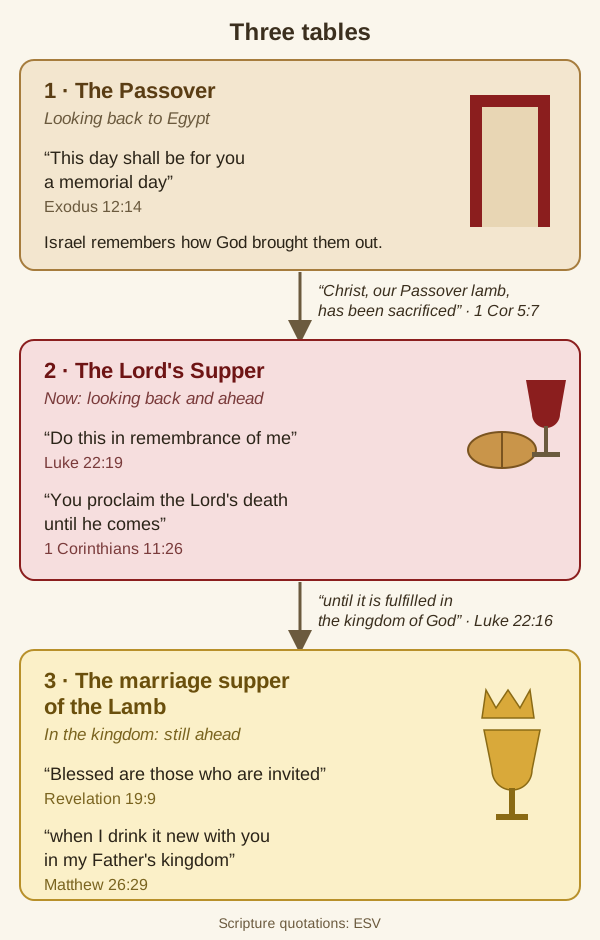
The prophets saw the last of them. "On this mountain the LORD of hosts will make for all peoples a feast of rich food, a feast of well-aged wine ... He will swallow up death forever; and the Lord GOD will wipe away tears from all faces" (Isaiah 25:6, 8, ESV). John heard it announced: "the marriage of the Lamb has come, and his Bride has made herself ready ... Blessed are those who are invited to the marriage supper of the Lamb" (Revelation 19:7, 9, ESV).
Which cup of the Passover Jesus left undrunk, and why the promise it carried is God taking His people to Himself, is traced in "I Will Not Drink Again". The wedding supper itself, and who its guests are, is studied in The Bride of Christ.
"Until he comes"
Every Lord's Supper ends with the same two words. The church eats and drinks "until he comes" (1 Corinthians 11:26). The meal is for the time between the cross and His return, and it will not be needed when He is at the table. This shows that God finishes what He starts. The Lamb who was sacrificed at the Passover will sit down at the marriage supper with the people He bought, and each time you eat this bread you say that you expect to be there.
Discussion questions
- The language. "Remembrance" (ἀνάμνησις) is used at the Supper and in Hebrews 10:3 for the "reminder of sins" the old sacrifices brought every year. What is the difference between the two remembrances?
- The text in its context. Paul says the Corinthians' gathering "is not the Lord's supper" (1 Corinthians 11:20). What exactly had they done, and what does his remedy in 11:33 tell you about it?
- Christ. Read Exodus 12:14, Luke 22:19 and 1 Corinthians 11:26 together. What did Israel remember, what does the church remember, and what does the church announce that Israel could not?
- The hard part. "Without discerning the body" (1 Corinthians 11:29) is read of Christ's body given on the cross and of the church as His body. Which reading do you find stronger, and does the difference change how you come to the table?
- Be transformed. Israel's children were expected to ask, "What do you mean by this service?" (Exodus 12:26). How would you answer that about the Lord's Supper, in a sentence a child could follow?
- Be transformed. Jesus said He would drink the cup new "with you" in His Father's kingdom (Matthew 26:29). How does knowing the meal is unfinished change what you think about while you eat it?
Group study sheet for a 40-minute group: two A4 sheets, or one with the guided path
The point, the passage, the questions and the response, from this study. Print on both sides of two A4 sheets, flipping on the long edge. While this block is open, printing the page prints the sheet; close it to print the study.
The Lord's Supper: Do This in Remembrance of Me
1 Corinthians 11:17-34The point The Lord's Supper is the memorial Jesus gave His church, as the Passover was Israel's: in it you remember His death, proclaim it until He comes, and share in His body and blood with the one body He has made, and you wait for the cup He has not yet drunk, which He will drink new with you in His Father's kingdom; so come to it examined, reconciled to your brothers and sisters, and with your eyes on Him.
Ask: What is communion for, and how should I take it?
Hear a few answers before anyone reads.
1 Corinthians 11:17-34 17In the following instructions I have no praise to offer, because your gatherings do more harm than good. 18First of all, I hear that when you come together as a church, there are divisions among you, and in part I believe it. 19And indeed, there must be differences among you to show which of you are approved. 20Now then, when you come together, it is not the Lord’s Supper you eat. 21For as you eat, each of you goes ahead without sharing his meal. While one remains hungry, another gets drunk. 22Don’t you have your own homes in which to eat and drink? Or do you despise the church of God and humiliate those who have nothing? What can I say to you? Shall I praise you for this? No, I will not! 23For I received from the Lord what I also passed on to you: The Lord Jesus, on the night He was betrayed, took bread, 24and when He had given thanks, He broke it and said, “This is My body, which is for you; do this in remembrance of Me.” 25In the same way, after supper He took the cup, saying, “This cup is the new covenant in My blood; do this, as often as you drink it, in remembrance of Me.” 26For as often as you eat this bread and drink this cup, you proclaim the Lord’s death until He comes. 27Therefore, whoever eats the bread or drinks the cup of the Lord in an unworthy manner will be guilty of sinning against the body and blood of the Lord. 28Each one must examine himself before he eats of the bread and drinks of the cup. 29For anyone who eats and drinks without recognizing the body eats and drinks judgment on himself. 30That is why many among you are weak and sick, and a number of you have fallen asleep. 31Now if we judged ourselves properly, we would not come under judgment. 32But when we are judged by the Lord, we are being disciplined so that we will not be condemned with the world. 33So, my brothers, when you come together to eat, wait for one another. 34If anyone is hungry, he should eat at home, so that when you come together it will not result in judgment. And when I come, I will give instructions about the remaining matters.
Also read:
The Lord's Supper: Do This in Remembrance of Me
- A memorial, as Passover was. What Israel remembered, and what Jesus told His disciples to remember instead.
- A meal that teaches. The children's question, the Supper as proclamation, and remembering as what keeps you grounded.
- One loaf, one body. Sharing in Christ, and in His people, at His table alone.
- What went wrong at Corinth. A supper arranged by rank.
- Coming in a worthy manner. Examining yourself, discerning the body, and the Lord's discipline.
- The cup not yet drunk. The meal Jesus will finish with you at the marriage supper of the Lamb.
The Lord's Supper: Do This in Remembrance of Me
1The language. "Remembrance" (ἀνάμνησις) is used at the Supper and in Hebrews 10:3 for the "reminder of sins" the old sacrifices brought every year. What is the difference between the two remembrances?
2Christ. Read Exodus 12:14, Luke 22:19 and 1 Corinthians 11:26 together. What did Israel remember, what does the church remember, and what does the church announce that Israel could not?
3The text in its context. Paul says the Corinthians' gathering "is not the Lord's supper" (1 Corinthians 11:20). What exactly had they done, and what does his remedy in 11:33 tell you about it?
4The hard part. "Without discerning the body" (1 Corinthians 11:29) is read of Christ's body given on the cross and of the church as His body. Which reading do you find stronger, and does the difference change how you come to the table?
The Lord's Supper: Do This in Remembrance of Me
5Be transformed. Israel's children were expected to ask, "What do you mean by this service?" (Exodus 12:26). How would you answer that about the Lord's Supper, in a sentence a child could follow?
6Be transformed. Jesus said He would drink the cup new "with you" in His Father's kingdom (Matthew 26:29). How does knowing the meal is unfinished change what you think about while you eat it?
- Think. The Supper keeps you grounded in what is true. "Set your minds on things that are above, not on things that are on earth" (Colossians 3:2, ESV).
- Attitude. Come examined and reconciled. "Let a person examine himself, then, and so eat" (1 Corinthians 11:28, ESV), and "wait for one another" (1 Corinthians 11:33, ESV).
- Do. Answer the children's question, "What do you mean by this service?" (Exodus 12:26, ESV). At the next Lord's Supper, tell someone, a child if you can, what the bread and the cup mean, and that each time you "proclaim the Lord's death until he comes" (1 Corinthians 11:26, ESV).
And he took bread, and when he had given thanks, he broke it and gave it to them, saying, "This is my body, which is given for you. Do this in remembrance of me."
Luke 22:19 (ESV)Father, You gave Israel a meal to remember how You brought them out of Egypt, and You have given us a meal to remember how Your Son Jesus gave His body and poured out His blood for us. Thank You for the new covenant in His blood, and that we who eat one bread are one body. Keep our eyes on Him. Make us examine ourselves honestly, wait for one another gladly, and tell what this means to those who ask. And keep us at His table until the day He drinks it new with us in Your kingdom.
In Jesus' name. Amen.
The Lord's Supper: Do This in Remembrance of Me
1 Corinthians 11:17-34Open Ask: What is communion for, and how should I take it?
Hear a few answers before anyone reads.
Read it aloud 1 Corinthians 11:17-34
1The language. "Remembrance" (ἀνάμνησις) is used at the Supper and in Hebrews 10:3 for the "reminder of sins" the old sacrifices brought every year. What is the difference between the two remembrances?
2Christ. Read Exodus 12:14, Luke 22:19 and 1 Corinthians 11:26 together. What did Israel remember, what does the church remember, and what does the church announce that Israel could not?
3The text in its context. Paul says the Corinthians' gathering "is not the Lord's supper" (1 Corinthians 11:20). What exactly had they done, and what does his remedy in 11:33 tell you about it?
4The hard part. "Without discerning the body" (1 Corinthians 11:29) is read of Christ's body given on the cross and of the church as His body. Which reading do you find stronger, and does the difference change how you come to the table?
5Be transformed. Israel's children were expected to ask, "What do you mean by this service?" (Exodus 12:26). How would you answer that about the Lord's Supper, in a sentence a child could follow?
6Be transformed. Jesus said He would drink the cup new "with you" in His Father's kingdom (Matthew 26:29). How does knowing the meal is unfinished change what you think about while you eat it?
- Think. The Supper keeps you grounded in what is true. "Set your minds on things that are above, not on things that are on earth" (Colossians 3:2, ESV).
- Attitude. Come examined and reconciled. "Let a person examine himself, then, and so eat" (1 Corinthians 11:28, ESV), and "wait for one another" (1 Corinthians 11:33, ESV).
- Do. Answer the children's question, "What do you mean by this service?" (Exodus 12:26, ESV). At the next Lord's Supper, tell someone, a child if you can, what the bread and the cup mean, and that each time you "proclaim the Lord's death until he comes" (1 Corinthians 11:26, ESV).
The Lord's Supper: Do This in Remembrance of Me
The point The Lord's Supper is the memorial Jesus gave His church, as the Passover was Israel's: in it you remember His death, proclaim it until He comes, and share in His body and blood with the one body He has made, and you wait for the cup He has not yet drunk, which He will drink new with you in His Father's kingdom; so come to it examined, reconciled to your brothers and sisters, and with your eyes on Him.
References & Recommended Reading
- ESV (Crossway) — verse text throughout, verified against the edition in this site's study-notes database.
- MACULA Greek (SBLGNT) and MACULA Hebrew (WLC) — occurrence data for ἀνάμνησις, κυριακός, ἀναξίως, καταγγέλλω, κοινωνία, διακρίνω and זִכָּרוֹן; unfoldingWord ULT interlinear for Exodus 12:14 and 1 Corinthians 10:16; 11:24, 29.
- ESV Study Bible (Crossway) — notes on 1 Corinthians 10:16-17 and 11:17-34, including the two readings of 11:29. Consulted to check the reading of the text.
- NIV Cultural Backgrounds Study Bible (Zondervan), ed. John H. Walton and Craig S. Keener — notes on 1 Corinthians 11:17-27 and the article "Banquets in Corinth".
- CSB Ancient Faith Study Bible and NLT footnotes on 1 Corinthians 11:29 — the manuscript reading "the Lord's body".
On this site
- Passover: When I See the Blood
- "I Will Not Drink Again": The Last Supper and the Cups of Passover
- The Appointed Times
- Bread of Life — the feeding miracles and John 6, and the same "given thanks ... broke" in Mark 8:6 and 1 Corinthians 11:23-24
- The Bride of Christ
- Idolatry — 1 Corinthians 10:14-22 and the Song of Moses behind "the table of demons"
-
NIV Cultural Backgrounds Study Bible, article "Banquets in Corinth" and note on 1 Corinthians 11:21. ↩