The Zadok calendar
In one sentence: the Zadok calendar is a 364-day priestly year built in sevens, and its sabbaticals, jubilees and ages of history are the units this site uses when it counts the years from creation.
Dates on this site carry a Zadok year beside the BC/AD one: an anno mundi ("year of the world") count of the years since creation. It takes its name from the Zadokite priests' 364-day calendar, which the Dead Sea Scrolls community kept. I follow it over the rabbinic (lunisolar) Hebrew calendar. Primary source for the structure below: dsscalendar.org, the work of Dr. Ken Johnson, Th.D. (BibleFacts Ministries).
What it is
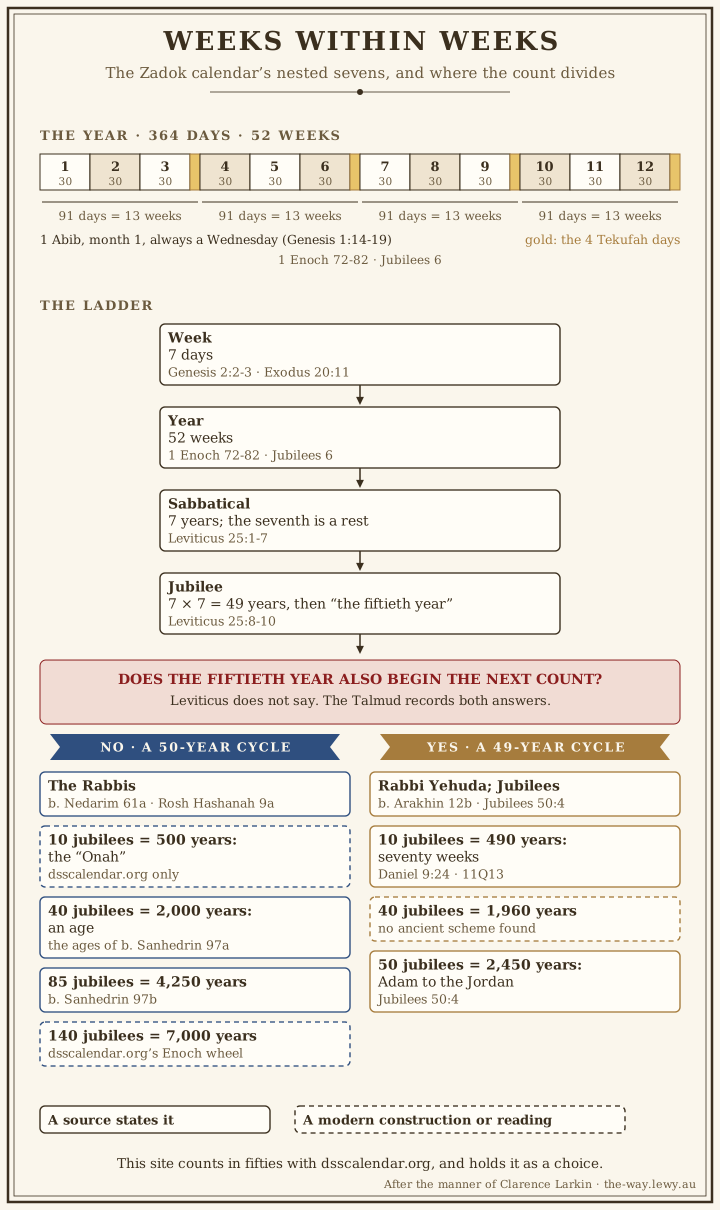
The Zadok calendar is a 364-day solar calendar: 12 months of exactly 30 days (360 days), plus 4 additional "Tekufah" days marking the two equinoxes and two solstices, bringing the total to 364.
Every month begins on the same weekday every year, because 364 divides evenly into 52 full weeks. This is a perpetual calendar. In a lunar or lunisolar one, a feast date drifts across the days of the week from year to year.
On this reckoning, 1 Abib/Nisan — New Year's Day — always falls on a Wednesday. That is the fourth day, when God made the greater light and the lesser light and set them "for signs and for seasons, and for days and years" (Genesis 1:14-19, ESV). The year begins on the day the lights that measure it were made.
364 days runs about a day and a quarter short of the true solar year. So the system periodically inserts an extra week to stay aligned with the actual seasons, roughly every 5-6 years on dsscalendar.org's own reckoning. A lunisolar calendar instead makes monthly lunar adjustments.
| Element | Detail |
|---|---|
| Months | 12, each 30 days (360 days total) |
| Extra days | 4 Tekufah (equinox/solstice) days |
| Year length | 364 days = exactly 52 weeks |
| New Year | 1 Abib/Nisan, always a Wednesday |
| Sabbath | The 7th day of each week |
| Leap mechanism | An intercalary week roughly every 5-6 years |
Why "Zadok"
Zadok was the high priest under David and Solomon (2 Samuel 8:17; 1 Kings 2:35), and his descendants became the standard by which later Scripture measures a faithful priesthood.
When Ezekiel is shown the future temple, it's specifically "the sons of Zadok" who are named as the priests who stayed faithful and will minister there (Ezekiel 44:15, ESV).
Centuries later, the community behind the Dead Sea Scrolls at Qumran identified itself with that same Zadokite priestly line. It rejected the calendar kept by the Hasmonean-controlled priesthood running the Jerusalem Temple of its day, and used this 364-day calendar instead. Their sectarian writings (the Community Rule, the Damascus Document) and a body of calendrical scrolls devoted to tracking the priestly courses (mishmarot) against this calendar are the reason it's usually called the Zadok, Essene, or Qumran calendar today.
Older than Qumran
The calendar itself predates the Qumran community. The clearest early exposition is the "Book of the Luminaries" in 1 Enoch 72-82, an extended account of the sun, moon, and stars' courses that lays out the same 364-day, 12-month structure. The book of Jubilees, writing not long after, commands this calendar explicitly and warns that following a lunar reckoning instead is a departure from what God appointed. Both works were known and copied at Qumran, and both are part of why the calendar is associated with a much older priestly tradition than the sect that preserved it for us.
Weeks within weeks: the calendar's cycles
Ten weeks of history
The community also read its own history and future through a much larger version of the same "week" pattern: 1 Enoch 91-93, the "Apocalypse of Weeks," divides all of history into ten "weeks", with "many weeks without number for ever" after them (1 Enoch 91:17, trans. R. H. Charles). Enoch numbers the weeks without giving their length. dsscalendar.org reads each as 700 years, which makes 7,000 years from creation to a new creation.
Ages of 2,000 years and days of 1,000
dsscalendar.org also divides its scheme into ages of 2,000 years, each made of four 500-year "Onahs" of ten 50-year jubilees. The 2,000-year age has an ancient witness: the Talmud's six thousand years in three ages of two thousand (b. Sanhedrin 97a; b. Avodah Zarah 9a), set out in A Day Is a Thousand Years. The 500-year Onah is dsscalendar.org's own unit. The Hebrew עוֹנָה (onah, H5772) occurs once in the Hebrew Bible, as a wife's "marital rights" (Exodus 21:10, ESV), and I have found no ancient source that uses it for a span of 500 years.
The same week of thousand-year days is the shape of this site's own reading of 2 Peter 3:8 in A Day Is a Thousand Years: six 1,000-year "days" of ordinary history followed by a seventh, sabbath-rest millennium. Where the New Testament draws the line between this age and the next is The End of the Age.
Sabbaticals and jubilees
Nested inside that larger scheme are ordinary Sabbatical (7-year, Leviticus 25:1-7) and Jubilee (50-year, Leviticus 25:8-13) cycles. The calendar is the scaffolding the whole chronology runs on. dsscalendar.org even ties a specific messianic claim to that scaffolding. The Melchizedek scroll (11Q13) dates its jubilee release "in the first week of the jubilee after the ni[ne] jubilees". Its Day of Atonement falls at "the e[nd of] the tenth jubilee" (11Q13 II 7-8, ed. García Martínez and Tigchelaar). So the first week after nine jubilees is the tenth jubilee's opening week. dsscalendar.org dates that week to around AD 32, the time of the Messiah's death. The scroll itself gives no year. The AD date is that site's chronology applied to it (Melchizedek in Second Temple Judaism).
The Enoch wheel's 140 jubilees
One structural detail from the same source bears on how this site uses jubilees. dsscalendar.org's Enoch wheel divides the 7,000 years three ways. Ten weeks of 700 years. Seventy centuries of 100. And 140 jubilees of 50 years each. That last figure settles, for its scheme, the ambiguity Leviticus 25:8-10 leaves open between a 49-year and a 50-year cycle: 140 × 50 = 7,000 exactly, where 49-year cycles would not divide the total at all.
Forty-nine years or fifty
The ambiguity is old, and Leviticus leaves it open. Everyone agrees on the text: "count seven weeks of years … forty-nine years", then "consecrate the fiftieth year … It shall be a jubilee for you" (Leviticus 25:8, 10, ESV). The question is where the next count starts once the jubilee year ends. The Talmud records both answers. The Rabbis hold that "the year following the Jubilee Year is considered the first year of the next seven-year cycle", a 50-year cycle. Rabbi Yehuda holds that "the fiftieth year is counted for here and for there", as the jubilee and as year one of the next cycle, "and therefore each Jubilee cycle is only forty-nine years" (b. Nedarim 61a; b. Arakhin 12b, William Davidson Edition). The book of Jubilees counts in 49s: "forty-nine jubilees from the days of Adam until this day, and one week and two years", with forty more years to the Jordan (Jubilees 50:4, trans. R. H. Charles), which is 2,450 years.
The choice changes every larger number. Forty jubilees make 2,000 years on the Rabbis' count and 1,960 on Rabbi Yehuda's. Ten make 500 or 490, and 490 is Daniel's seventy weeks (Daniel 9:24), the span usually read behind the "tenth jubilee" of the Melchizedek scroll (11Q13). When Elijah tells Rav Yehuda the world will last "no fewer than eighty-five Jubilee cycles, or 4,250 years" (b. Sanhedrin 97b), the Talmud is counting in fifties. This site follows dsscalendar.org's 50 and holds it as a choice, since Scripture does not settle it.
Why I use it
A few reasons this calendar is the one behind this site's Zadok years:
- It's priestly, and the calendar was a priestly responsibility. Israel's priests kept the sacred calendar, and the priestly courses of 1 Chronicles 24 need a fixed rotation. The Qumran calendar scrolls track those same courses against the 364-day year; the Chronicler himself names no calendar. And it's the Zadokite line Scripture names as the one that stayed faithful.
- It matches Israel's "appointed times." The feasts of Leviticus 23 are called moedim, fixed appointed times, and under this calendar every feast falls on the same weekday every year.
- It was in live use among people steeped in the text. The Qumran community preserved the Old Testament with remarkable textual fidelity (see Ancient Texts and Manuscripts) and kept this calendar as a matter of course. That is evidence about what calendar was in use in the Second Temple period, though it does not by itself prove the calendar was Moses'.
- It is built in sevens at every scale. The week, the 52-week year, the sabbatical and the jubilee nest inside one another, and the Apocalypse of Weeks carries the same pattern across all of history. Daniel's seventy weeks are counted separately: this site measures them in 360-day prophetic years (Chronology Anchors; Prophecy: Events and Times), so the 364-day year is not what makes Daniel's arithmetic work.
This is a minority position. Most of modern Judaism and most Christian scholarship use other calendars, and this one is largely a Second Temple sectarian reconstruction, so treating it as settled would overclaim. I use it because the case above persuades me, and because the site's dating and the Prophetic Timeline tool are already built on it.
Counting the years from creation
The calendar's structure says nothing about when the count starts. A Zadok year is a count of the years elapsed since creation, with creation's own year as year 0, and this site puts year 0 at 3959 BC. That epoch is derived: the Masoretic numbers of Genesis 5 and 11, counted forward to an Exodus in 1446 BC. That date is 1 Kings 6:1's 480 years counted back from Solomon's fourth year, 966 BC on Edwin Thiele's chronology of the kings. On it AD 2026 is AM 5984, and the six-thousandth year falls in AD 2042. dsscalendar.org starts its count at 3925 BC, 34 years later, which puts year 6000 in AD 2075. This page follows dsscalendar.org on the calendar's structure and the site's own line on the epoch.
Chronology Anchors is the dated rail the epoch hangs from, Genealogy and Times sets out the candidate epochs and the choices between them, and Why Not 4004 BC? traces how Ussher's older epoch came out forty-five years earlier.
Resources
- Dr. Ken Johnson, Th.D., dsscalendar.org — the primary source for the calendar structure described above, including the Enoch calendar overview and the outer-ring structural explanation.
- Dr. Ken Johnson, Th.D., BibleFacts.org — related ministry resources on Dead Sea Scrolls and ancient documents.
- 1 Enoch 72-82 ("Book of the Luminaries") and 91-93 ("Apocalypse of Weeks").
- The book of Jubilees, chapter 6.
- Ancient Texts and Manuscripts — for the Dead Sea Scrolls' broader significance.
- A Day Is a Thousand Years — the thousand-year days and the Talmud's three ages of two thousand years: this site's 7,000-year, six-days-plus-a-sabbath-millennium reading that this calendar's larger week-of-weeks scheme supports.
- The End of the Age — the New Testament's line between this age and the next.
- Genealogy and Times and Chronology Anchors — the epoch and the dates it rests on.
- R. H. Charles, trans., The Book of Jubilees (1913), 50:4; b. Nedarim 61a, b. Arakhin 12b and b. Sanhedrin 97b, William Davidson Edition (Sefaria, CC-BY-NC).