Why Not 4004 BC? Where Ussher's Forty-Six Years Came From
New, published 8 October 2026. What else is new
For about 250 years, English Bibles printed "4004 BC" beside Genesis 1:1. The date was James Ussher's, worked out in his Annales Veteris Testamenti of 1650 and set in the margin of the Authorised Version from 1701. This site counted from it until 1 October 2026. It now counts from 3959 BC, forty-five years later.
Ussher's arithmetic from Adam to the Exodus is exactly this site's arithmetic. So is the Babylonian date he started from. All but one year of the difference lies in one stretch: the four centuries of kings between Solomon's temple and the exile.
In one sentence: Ussher's count from Adam to the Exodus and his Babylonian anchor both stand; his forty-six-year error came from laying the kings' reigns end to end as full years, and the book of Kings itself, checked by an Assyrian eclipse, shows how Israel's scribes actually counted.
Key Takeaways
(This section follows the Key Takeaways format — see that page for what each part is for.)
Lessons about Jesus
Ussher's scheme put Christ's birth four thousand years after creation, in 5 BC, just before Herod's death in 4 BC. That round number was partly expected before he counted: four thousand years from Adam to Christ was a widely held scheme in his day. On the corrected line Jesus is born about AM 3954 and crucified in AM 3991, dates that rest on Herod's death, Daniel's seventy weeks and Luke's Roman regnal year (see Chronology Anchors). God sent His Son "when the fullness of time had come" (Galatians 4:4, ESV), and Scripture's own evidence is what places that time.
Memory verses
✝️ Psalm 119:160 (ESV)
160 The sum of your word is truth, and every one of your righteous rules endures forever.
Be Transformed
- Think. When two numbers in Scripture seem to collide, ask first how the writer counted. Kings gave its own answer in 1 Kings 15:25-28, and Ussher's error stood in Bible margins for two and a half centuries because readers assumed a modern way of counting.
- Attitude. Hold your own sums loosely and God's word firmly. A respected archbishop's arithmetic stood in Bible margins for 250 years and was still a reader's arithmetic.
- Do. Next time you read a king's reign in Kings, check it against the synchronism beside it ("in the second year of Asa", 1 Kings 15:25, ESV). Where the two seem not to fit, pray Psalm 119:160 before you decide anything: "The sum of your word is truth" (ESV).
Prayer
Father, You are the God who keeps time, from the first day to the fullness of time when You sent Your Son Jesus. Thank You that the sum of Your word is truth, even where my sums have gone wrong. Teach me to read what You gave the way You gave it, without bending it to my habits, and to trust You where I cannot yet count. In Jesus' name. Amen.
Study outline
- Ussher's method. His three steps back from Babylon, and the two that still stand.
- Where the years came from. How Kings counts a reign, Ussher's 424 years against Thiele's 380, and the Assyrian check.
- Who else says so. Rodger Young's 2018 correction of Ussher, and those who still defend 4004 BC.
- What stays open. Thiele's loose ends, the 480 years, the Septuagint's 440, and how long Israel was in Egypt.
- What changed. The dates that moved, and what the correction shows about God's word.
What Ussher did
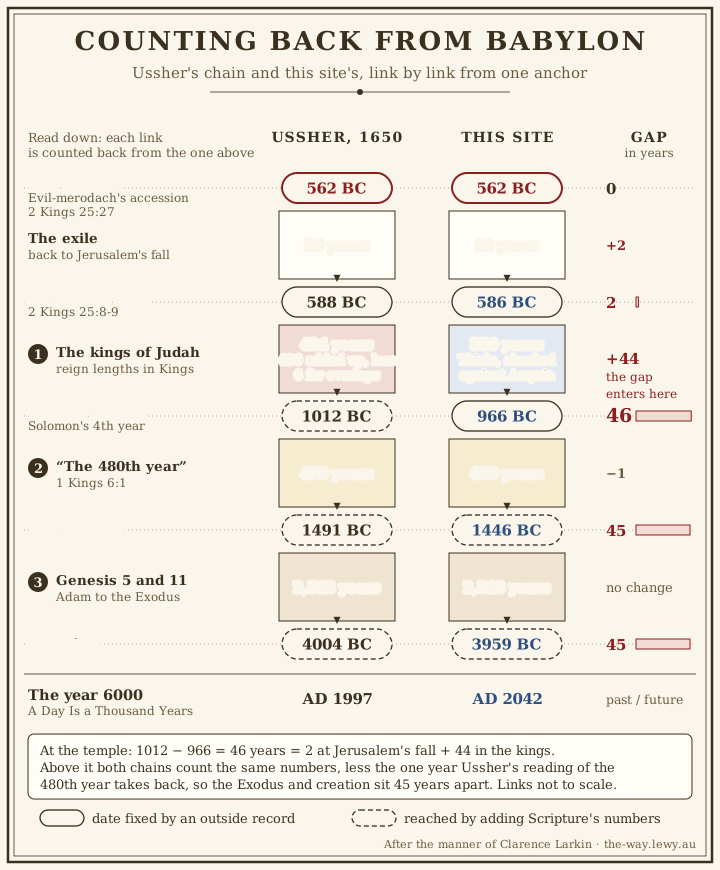
Ussher worked backward from a date he could fix outside the Bible. Second Kings ends with Jehoiachin released from prison by "Evil-merodach king of Babylon, in the year that he began to reign" (2 Kings 25:27, ESV). Babylonian, Greek and Roman sources put that accession, Amel-Marduk's, in 562 BC. The release itself came in the twelfth month of that year (2 Kings 25:27), early in 561 BC, which is where the timeline marks it. From there Ussher had three steps to take:
- The kings, from the exile back to the temple. He added up the reign lengths of the kings of Judah and reached the fourth year of Solomon at 1012 BC.
- The temple back to the Exodus. First Kings 6:1 dates the temple "in the four hundred and eightieth year after the people of Israel came out of the land of Egypt" (ESV). That gave the Exodus at 1491 BC.
- The Exodus back to Adam. The Masoretic ages in Genesis 5 and 11, Abram's 75 years at the call (Genesis 12:4) and the 430 years of Galatians 3:17 put the Exodus at Anno Mundi 2513. 1491 + 2513 gives creation in 4004 BC.
In 1701 William Lloyd, Bishop of Worcester, set these dates in the margin of a folio Authorised Version. Bibles went on printing them for about two and a half centuries, and many readers took them for part of the text.
Two of his three steps still stand
Step 3 is this site's own count. The Masoretic chain from Adam to the Exodus gives AM 2513 here too, and Genealogy and Times works through why the site follows the Masoretic numbers. It takes one contested fork, the length of Israel's stay in Egypt, which How long was Israel in Egypt? sets out below. The starting date stands as well: 562 BC is still the accepted year of Amel-Marduk's accession.
Step 2 depends on reading 1 Kings 6:1's 480 years as elapsed years. That is contested (see below), but this site reads it as a real interval, as Ussher did. The two differ by one year in the counting: Ussher took "the four hundred and eightieth year" as 479 years elapsed (1012 to 1491 BC), and this site counts 480 (966 to 1446 BC).
That leaves step 1. Ussher's fourth year of Solomon is 1012 BC. The reconstruction this site follows puts it at 966 BC, forty-six years later. Less the one year of step 2, everything above the temple moves by forty-five: the Exodus from 1491 to 1446 BC and creation from 4004 to 3959 BC.
Scripture counts the same years twice
Kings tells the history of two kingdoms side by side. That builds a check into the text itself: the same stretch of time is counted twice, once in each kingdom's list.
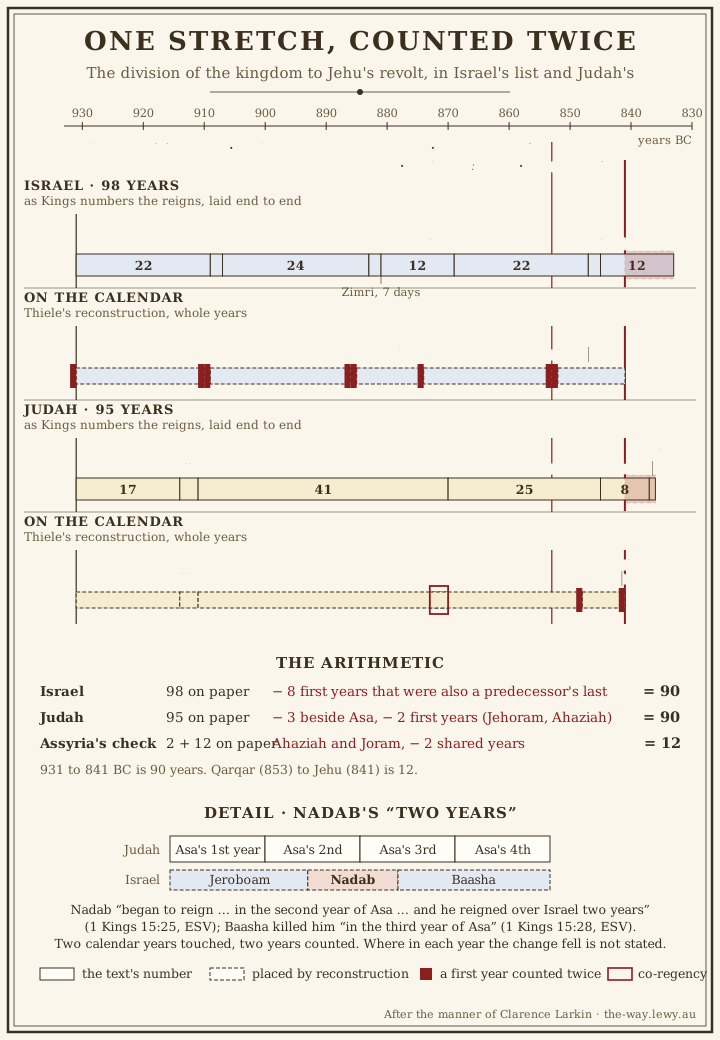
The cleanest stretch runs from the division of the kingdom to Jehu's revolt. It opens with Jeroboam and Rehoboam taking their thrones in the same year. It closes in one chariot chase, when Jehu shoots Joram of Israel and has Ahaziah of Judah shot as he flees (2 Kings 9:24, 27). Both lists cover exactly the same years.
| Israel | Years | Judah | Years | |
|---|---|---|---|---|
| Jeroboam (1 Kings 14:20) | 22 | Rehoboam (1 Kings 14:21) | 17 | |
| Nadab (1 Kings 15:25) | 2 | Abijam (1 Kings 15:2) | 3 | |
| Baasha (1 Kings 15:33) | 24 | Asa (1 Kings 15:10) | 41 | |
| Elah (1 Kings 16:8) | 2 | Jehoshaphat (1 Kings 22:42) | 25 | |
| Zimri (1 Kings 16:15) | 7 days | Jehoram (2 Kings 8:17) | 8 | |
| Omri (1 Kings 16:23) | 12 | Ahaziah (2 Kings 8:26) | 1 | |
| Ahab (1 Kings 16:29) | 22 | |||
| Ahaziah (1 Kings 22:51) | 2 | |||
| Joram (2 Kings 3:1) | 12 | |||
| Total | 98 | Total | 95 |
Laid end to end, Israel's reigns give 98 years for this stretch and Judah's give 95. Both cannot be the elapsed time. In Edwin Thiele's reconstruction it is 90 years, from 931 to 841 BC. The book of Kings records two habits that account for the difference.
A part-year counted whole
✝️ 1 Kings 15:25 (ESV)
25 Nadab the son of Jeroboam began to reign over Israel in the second year of Asa king of Judah, and he reigned over Israel two years.
Three verses later Baasha kills him "in the third year of Asa king of Judah" (1 Kings 15:28, ESV). Nadab's "two years" fit between Asa's second year and Asa's third. The Hebrew is שְׁנָתָיִם (shenatayim, H8141), the dual of shanah, "year": a pair of years, counted as two. Both "began to reign" and "reigned" render one verb, מָלַךְ (malakh, H4427), "to be king". The verse counts any part of a calendar year on the throne as a year of the reign.
Elah shows the same thing. He "began to reign over Israel in Tirzah, and he reigned two years" from Asa's twenty-sixth year (1 Kings 16:8, ESV), and Zimri killed him "in the twenty-seventh year of Asa" (1 Kings 16:10, ESV). Historians call this non-accession reckoning. The year a king dies is counted twice, as his last year and as his successor's first, so every change of king adds a year on paper that never happened. Nine kings reign in Israel's column. Laid end to end, their numbers run long by most of those changeovers.
Sons beside their fathers
Judah's column runs long for a different reason. Some sons began to reign while their fathers were still alive. Joram of Israel took the throne "in the second year of Jehoram the son of Jehoshaphat, king of Judah" (2 Kings 1:17, ESV), and also "in the eighteenth year of Jehoshaphat king of Judah" (2 Kings 3:1, ESV). Jehoshaphat's eighteenth year was his son's second, so the son was already counting years of his own reign while his father still reigned. Of Uzziah, 2 Kings says, "he was a leper to the day of his death, and he lived in a separate house. And Jotham the king's son was over the household, governing the people of the land" (2 Kings 15:5, ESV). When father and son both count those shared years, the sum double-counts them.
Ussher's 424 years against Thiele's 380
Ussher knew this. Added straight through, the kings of Judah from the temple to the fall of Jerusalem total about 430 years. He allowed for a few overlapping reigns and brought it down to 424, from 1012 to 588 BC. Thiele's reconstruction gives 380, from 966 to 586 BC, and both ends of that span are rows in this site's anchor table.
- 586 BC, Jerusalem falls (row 12, Fixed). The temple burned in Nebuchadnezzar's nineteenth year (2 Kings 25:8), and the Babylonian Chronicle and the astronomical tablet VAT 4956 put that year at 587/586 BC.
- 966 BC, the temple begun (row 1, Anchored, ±5). Kings reaches it through the reigns, and Tyre's king list reaches 968 or 967 BC by a route through Phoenicia that never touches the kings of Judah.
Forty-four of Ussher's years, then, are overlaps and part-years that he still counted as elapsed time. The other two of the forty-six sit at the far end, where Ussher put Jerusalem's fall in 588 BC, two years before the date the Babylonian records fix.
The Assyrian check
Ussher had no outside record of the kings to test his total against. Assyrian cuneiform was deciphered only in the 1850s, two centuries after he wrote.
The Assyrians named each year after an official, the eponym, and kept the list. One entry, in the eponymy of Bur-Sagale, records a solar eclipse. Astronomers can date it to 15 June 763 BC, and that one fixed point turns the whole list into a calendar of known years. Two of its kings then meet Israel's, rows 5 and 6 of the anchor table (both monuments are pictured there):
- 853 BC. Shalmaneser III's Kurkh Monolith lists "Ahab the Israelite" among the kings who fought him at Qarqar. Ahab is alive in 853.
- 841 BC. His Black Obelisk shows Jehu, or his envoy, bowing with tribute. Jehu is on the throne by 841.
That leaves twelve years between Ahab's last year and Jehu's first. Scripture gives the two kings in between 2 and 12 years (1 Kings 22:51; 2 Kings 3:1), fourteen on paper. Count them the way Nadab was counted and they come to twelve. Ahaziah "began to reign over Israel in Samaria in the seventeenth year of Jehoshaphat ... and he reigned two years" (1 Kings 22:51, ESV), and Joram followed him "in the eighteenth year of Jehoshaphat" (2 Kings 3:1, ESV). Ahaziah's two years cover one calendar year, the same pattern as Nadab's. Ahaziah's first year was also Ahab's last, and Joram's first was also Ahaziah's last. Take out those two shared years and fourteen becomes twelve, the interval Assyria gives.
Thiele published this reconstruction in The Mysterious Numbers of the Hebrew Kings (1951, third edition 1983). Its fixed points carry the kings back to Solomon's fourth year at 966 BC. The synchronisms Kings gives fit Assyria's independent record once they are counted the way Kings counts them.
Others have reached the same answer
Rodger Young, who has carried Thiele's work forward with Leslie McFall, followed Ussher step by step in "Ussher Explained and Corrected" (Bible and Spade 31.2, 2018). He reaches this study's verdict by the same route. He accepts Ussher's count from Adam to the Exodus, AM 2513. He notes that Ussher's BC dates "are measured upward from the chronology of the divided kingdom," so an error there moves every date above it. He puts the start of the temple in spring 967 BC, "45 years later than Ussher's date". And he explains the gap by the Nadab pattern: Israel's scribes counted a new king's first part-year twice, a method Valerius Coucke identified in the 1920s and Thiele found independently.
Young's 967 BC and this site's 966 differ by a year, and so do his 479 elapsed years and this site's 480. The two differences cancel, and both put the Exodus in 1446 BC. Young prints no creation date, but his figures with Ussher's AM 2513 give 3959 BC, the date this site uses. He closes by asking Ussher's defenders "to accept these corrections to his otherwise magnificent work."
Not all of them have. Floyd Nolen Jones's Chronology of the Old Testament keeps 4004 BC, though Young notes that Jones already follows Thiele in telling accession-year counting from non-accession counting. Danny Faulkner of Answers in Genesis doubts Ussher's exact day and holds that "Ussher's approximate date of creation still is 4000 BC". He names "regnal dating of monarchs" and a longer sojourn in Egypt as open questions (Answers Research Journal 9, 2016). Outside specialist work on the kings, 4004 BC is still widely taken as "the" Bible date, which is the confusion Lloyd's margins began.
What is still contested
Three questions remain open, and none of them brings back 1012 BC.
- Thiele's system has loose ends. He could not reconcile the synchronisms of Hezekiah's reign in 2 Kings 18 with the rest, and later work by Leslie McFall and Rodger Young has adjusted several of his dates by a year or two. Jerusalem's fall is still argued between 587 and 586 BC. These move dates by a year or two. None moves the temple by forty.
- The 480 years may be schematic. The ESV Study Bible reads 1 Kings 6:1 at face value as supporting an Exodus about 1446 BC. It also sets out the case for twelve generations of a symbolic forty years, which gives a "late" Exodus around 1260 BC. The NIV Biblical Theology Study Bible adds a third option: a total of periods that partly overlapped. This site reads the 480 as elapsed years.
- The Septuagint reads 440. Greek 1 Kings (3 Kingdoms) 6:1 has the "four hundred and fortieth year". This site follows the Masoretic 480.
Each of these bears on the Exodus and creation dates. None bears on the temple, which the Assyrian record fixes on its own. A fourth question sits inside step 3, the part of Ussher's chain this site shares, and it moves creation further than any of them.
How long was Israel in Egypt?
Exodus gives the stay as 430 years, and the ancient texts attach that number to different things.
✝️ Exodus 12:40 (ESV)
40 The time that the people of Israel lived in Egypt was 430 years.
The Septuagint reads "in the land of Egypt and in the land of Canaan". The Samaritan Pentateuch reads "the dwelling of the sons of Israel and their fathers" in "the land of Canaan and the land of Egypt". Paul counts the 430 years from the promise to Abraham: "the law, which came 430 years afterward" (Galatians 3:17, ESV). Josephus gives 430 years from Abraham's arrival in Canaan and 215 from Jacob's move to Egypt (Antiquities 2.15.2). On that reading Israel was in Egypt 215 years. This is the short sojourn, taken by Ussher and by this site. The long sojourn reads the Hebrew of Exodus 12:40 as 430 years in Egypt itself, and Genesis 15:13 and Acts 7:6 speak of four hundred years of affliction in a land not theirs.
Two kinds of evidence pull opposite ways.
- The family line favours the short stay. Kohath went down to Egypt with his father Levi (Genesis 46:11). Kohath lived 133 years, his son Amram 137, and Amram's son Moses was 80 at the Exodus (Exodus 6:18, 20; 7:7). Even if each son was born in his father's last year, that allows at most 350 years from the move to Egypt to the Exodus. Moses' mother was "Jochebed the daughter of Levi, who was born to Levi in Egypt" (Numbers 26:59, ESV). A 430-year stay needs this line to skip generations, as Four Hundred and Eighty Years shows Ruth's and Ezra's lists do.
- Population favours the long stay. What World Population Declares works out the growth from seventy people to the two million or so implied by the census of Numbers 1:46. Over 430 years that takes 2.39% a year, the population doubling every 29 years. Over 215 years it takes 4.77% a year, a doubling every 15 years. Read the census as clans or military units, as some do, and seventy reaching 20,000 in 215 years takes 2.63% a year. Exodus presents the growth as extraordinary in itself: Israel "multiplied and grew exceedingly strong" (Exodus 1:7, ESV), and "the more they were oppressed, the more they multiplied" (Exodus 1:12, ESV).
Population makes the short stay harder without ruling it out, and the family line does the same to the long stay. This site follows the short sojourn because two of the three ancient texts state it outright and Paul counts that way. It remains contested.
The choice moves dates more than anything else in this study. On the long sojourn the Exodus falls in AM 2728, Abram is born in 2166 BC, and creation moves to 4174 BC, which puts the six-thousandth year in AD 1827.
What moved when the site corrected it
Moving the temple from 1012 to 966 BC moved every date counted back from it.
| Ussher | This site since 2026-10-01 | |
|---|---|---|
| Solomon's temple begun | 1012 BC | 966 BC |
| The Exodus | 1491 BC | 1446 BC |
| Creation | 4004 BC | 3959 BC |
| AD 2026 | AM 6029 | AM 5984 |
| AM 6000 | AD 1997 | AD 2042 |
The last row matters most for the rest of the site. On Ussher's epoch the six-thousandth year has already passed. On the corrected line it is still future, which keeps the millennial-week reading open; A Day Is a Thousand Years weighs that reading, and Genealogy and Times sets out the alternate epochs the site still tracks.
The sum of your word is truth
The kings' numbers in Kings were right all along. Nadab's two years and Ahaziah's two years say what Israel's court scribes meant by them, and the synchronisms beside them tell any reader how to count. The error belonged to a reader who added them up under a convention the writers never used.
This shows that God gave His word through real people writing in the conventions of their own courts and calendars, and that what He gave is true in what it affirms. The statement of faith this site holds says Scripture "in its original writing, is without error and fully trustworthy in everything it affirms", and starts from Psalm 119:160:
✝️ Psalm 119:160 (ESV)
160 The sum of your word is truth, and every one of your righteous rules endures forever.
Ussher's sum was a man's sum. The sum of God's word, read the way it was written, comes out right. So you may read Kings with confidence, check one number against another as Ussher tried to, and expect the text to hold. It held for him everywhere but the kings' reigns, where he counted his own way.
Discussion questions
- The language. Nadab "reigned over Israel two years" (1 Kings 15:25, ESV), and Baasha killed him "in the third year of Asa king of Judah" (1 Kings 15:28, ESV). The Hebrew for his two years is שְׁנָתָיִם (shenatayim), the dual of shanah. What does a pair of years that ends the year after it began tell you about how Israel's scribes counted a reign?
- The text in its context. Kings gives every king a reign length and a synchronism with the other kingdom, as Nadab's "in the second year of Asa" (1 Kings 15:25, ESV). Why might the writer have supplied both, when either alone would place the king?
- Christ. Paul writes that "when the fullness of time had come, God sent forth his Son" (Galatians 4:4, ESV). What does it say about God that the time He chose can still be located from Herod's death, Daniel's seventy weeks and the kings of Judah?
- The hard part. Exodus 12:40 reads, "The time that the people of Israel lived in Egypt was 430 years" (ESV). The Septuagint adds "and in the land of Canaan", Paul counts the 430 years from the promise to Abraham (Galatians 3:17), and Genesis 15:13 foretells affliction "for four hundred years" in "a land that is not theirs" (ESV). What is each of these texts measuring?
- Be transformed. Ussher's arithmetic stood in Bible margins for 250 years and was still a reader's arithmetic. Psalm 119:160 says, "The sum of your word is truth" (ESV), meaning the whole of it. What would it look like to trust the whole of His word in the place where one of its numbers has refused to fit your own?
Group study sheet for a 40-minute group: two A4 sheets, or one with the guided path
The point, the passage, the questions and the response, from this study. Print on both sides of two A4 sheets, flipping on the long edge. While this block is open, printing the page prints the sheet; close it to print the study.
Why Not 4004 BC? Where Ussher's Forty-Six Years Came From
1 Kings 15:25-28The point Ussher's count from Adam to the Exodus and his Babylonian anchor both stand; his forty-six-year error came from laying the kings' reigns end to end as full years, and the book of Kings itself, checked by an Assyrian eclipse, shows how Israel's scribes actually counted.
Ask: what comes to mind when you hear Why Not 4004 BC? Where Ussher's Forty-Six Years Came From
? Hear a few answers before anyone reads.
1 Kings 15:25-28 25In the second year of Asa’s reign over Judah, Nadab son of Jeroboam became king of Israel, and he reigned two years. 26And he did evil in the sight of the LORD and walked in the way of his father and in his sin, which he had caused Israel to commit. 27Then Baasha son of Ahijah of the house of Issachar conspired against Nadab, and Baasha struck him down at Gibbethon of the Philistines while Nadab and all Israel were besieging the city. 28In the third year of Asa’s reign over Judah, Baasha killed Nadab and reigned in his place.
Also read:
Why Not 4004 BC? Where Ussher's Forty-Six Years Came From
- Ussher's method. His three steps back from Babylon, and the two that still stand.
- Where the years came from. How Kings counts a reign, Ussher's 424 years against Thiele's 380, and the Assyrian check.
- Who else says so. Rodger Young's 2018 correction of Ussher, and those who still defend 4004 BC.
- What stays open. Thiele's loose ends, the 480 years, the Septuagint's 440, and how long Israel was in Egypt.
- What changed. The dates that moved, and what the correction shows about God's word.
Why Not 4004 BC? Where Ussher's Forty-Six Years Came From
1The language. Nadab "reigned over Israel two years" (1 Kings 15:25, ESV), and Baasha killed him "in the third year of Asa king of Judah" (1 Kings 15:28, ESV). The Hebrew for his two years is שְׁנָתָיִם (shenatayim), the dual of shanah. What does a pair of years that ends the year after it began tell you about how Israel's scribes counted a reign?
2The text in its context. Kings gives every king a reign length and a synchronism with the other kingdom, as Nadab's "in the second year of Asa" (1 Kings 15:25, ESV). Why might the writer have supplied both, when either alone would place the king?
3The hard part. Exodus 12:40 reads, "The time that the people of Israel lived in Egypt was 430 years" (ESV). The Septuagint adds "and in the land of Canaan", Paul counts the 430 years from the promise to Abraham (Galatians 3:17), and Genesis 15:13 foretells affliction "for four hundred years" in "a land that is not theirs" (ESV). What is each of these texts measuring?
4Christ. Paul writes that "when the fullness of time had come, God sent forth his Son" (Galatians 4:4, ESV). What does it say about God that the time He chose can still be located from Herod's death, Daniel's seventy weeks and the kings of Judah?
Why Not 4004 BC? Where Ussher's Forty-Six Years Came From
5Be transformed. Ussher's arithmetic stood in Bible margins for 250 years and was still a reader's arithmetic. Psalm 119:160 says, "The sum of your word is truth" (ESV), meaning the whole of it. What would it look like to trust the whole of His word in the place where one of its numbers has refused to fit your own?
- Think. When two numbers in Scripture seem to collide, ask first how the writer counted. Kings gave its own answer in 1 Kings 15:25-28, and Ussher's error stood in Bible margins for two and a half centuries because readers assumed a modern way of counting.
- Attitude. Hold your own sums loosely and God's word firmly. A respected archbishop's arithmetic stood in Bible margins for 250 years and was still a reader's arithmetic.
- Do. Next time you read a king's reign in Kings, check it against the synchronism beside it ("in the second year of Asa", 1 Kings 15:25, ESV). Where the two seem not to fit, pray Psalm 119:160 before you decide anything: "The sum of your word is truth" (ESV).
The sum of your word is truth, and every one of your righteous rules endures forever.
Psalm 119:160 (ESV)Father, You are the God who keeps time, from the first day to the fullness of time when You sent Your Son Jesus. Thank You that the sum of Your word is truth, even where my sums have gone wrong. Teach me to read what You gave the way You gave it, without bending it to my habits, and to trust You where I cannot yet count. In Jesus' name. Amen.
Why Not 4004 BC? Where Ussher's Forty-Six Years Came From
1 Kings 15:25-28Open Ask: what comes to mind when you hear Why Not 4004 BC? Where Ussher's Forty-Six Years Came From
? Hear a few answers before anyone reads.
Read it aloud 1 Kings 15:25-28
1The language. Nadab "reigned over Israel two years" (1 Kings 15:25, ESV), and Baasha killed him "in the third year of Asa king of Judah" (1 Kings 15:28, ESV). The Hebrew for his two years is שְׁנָתָיִם (shenatayim), the dual of shanah. What does a pair of years that ends the year after it began tell you about how Israel's scribes counted a reign?
2The text in its context. Kings gives every king a reign length and a synchronism with the other kingdom, as Nadab's "in the second year of Asa" (1 Kings 15:25, ESV). Why might the writer have supplied both, when either alone would place the king?
3The hard part. Exodus 12:40 reads, "The time that the people of Israel lived in Egypt was 430 years" (ESV). The Septuagint adds "and in the land of Canaan", Paul counts the 430 years from the promise to Abraham (Galatians 3:17), and Genesis 15:13 foretells affliction "for four hundred years" in "a land that is not theirs" (ESV). What is each of these texts measuring?
4Christ. Paul writes that "when the fullness of time had come, God sent forth his Son" (Galatians 4:4, ESV). What does it say about God that the time He chose can still be located from Herod's death, Daniel's seventy weeks and the kings of Judah?
5Be transformed. Ussher's arithmetic stood in Bible margins for 250 years and was still a reader's arithmetic. Psalm 119:160 says, "The sum of your word is truth" (ESV), meaning the whole of it. What would it look like to trust the whole of His word in the place where one of its numbers has refused to fit your own?
- Think. When two numbers in Scripture seem to collide, ask first how the writer counted. Kings gave its own answer in 1 Kings 15:25-28, and Ussher's error stood in Bible margins for two and a half centuries because readers assumed a modern way of counting.
- Attitude. Hold your own sums loosely and God's word firmly. A respected archbishop's arithmetic stood in Bible margins for 250 years and was still a reader's arithmetic.
- Do. Next time you read a king's reign in Kings, check it against the synchronism beside it ("in the second year of Asa", 1 Kings 15:25, ESV). Where the two seem not to fit, pray Psalm 119:160 before you decide anything: "The sum of your word is truth" (ESV).
Why Not 4004 BC? Where Ussher's Forty-Six Years Came From
The point Ussher's count from Adam to the Exodus and his Babylonian anchor both stand; his forty-six-year error came from laying the kings' reigns end to end as full years, and the book of Kings itself, checked by an Assyrian eclipse, shows how Israel's scribes actually counted.
References & Recommended Reading
- James Ussher, Annales Veteris Testamenti (1650; English as The Annals of the World, 1658) — the 4004 BC chronology and its 562 BC anchor. Summary of his method, including the Judahite total of 430 years reduced to 424: Wikipedia, "Ussher chronology".
- Edwin R. Thiele, The Mysterious Numbers of the Hebrew Kings (3rd ed., 1983) — the regnal reconstruction, non-accession reckoning and the co-regencies.
- Assyrian Eponym List, the Kurkh Monolith and the Black Obelisk of Shalmaneser III — the 763 BC eclipse, Ahab at Qarqar and Jehu's tribute. Fuller treatment in Chronology Anchors and Prophecy: Events and Times.
- Rodger C. Young, "Ussher Explained and Corrected", Bible and Spade 31.2 (2018), from p. 47, Associates for Biblical Research (PDF) — Ussher's method followed step by step, and the correction through the divided kingdom.
- Floyd Nolen Jones, Chronology of the Old Testament: A Return to the Basics — a modern defence of 4004 BC that updates Ussher's Annals.
- Danny R. Faulkner, "Comments on Ussher's Date of Creation", Answers Research Journal 9 (2016) (online) — names the long sojourn as able to "move the creation date back to 4200 BC".
- Flavius Josephus, Antiquities of the Jews 2.15.2 — 215 years from Jacob's move to Egypt to the Exodus.
- Septuagint (Brenton) and Samaritan Pentateuch, Exodus 12:40, checked in
bible-text.db; the CSB Ancient Faith Study Bible footnote there records the variant. - What World Population Declares — the growth rates each length of stay requires.
- Dunham Bible Museum, "KJV @400" — the 1701 marginal dates under William Lloyd.
- ESV Study Bible (Crossway) and NIV Biblical Theology Study Bible (Zondervan), notes on 1 Kings 6:1 — the early and late Exodus readings.
- Genealogy and Times and The Combined Timeline — the count from Adam to the Exodus, and the whole line in one view.
- The Prophetic Timeline — the kings, the Assyrian synchronisms and the exile plotted on the corrected line.
- ESV Bible (Crossway) — all scripture verified against
study-notes.db; the Septuagint reading of 1 Kings 6:1 checked againstbible-text.db.