What Languages Declare: Babel and the Arithmetic of Tongues
New, published 20 October 2026. What else is new
Genesis 10 names seventy nations, each with its own language. Today linguists catalogue 7,674 languages. They sort them into 246 families and 183 isolates, and no accepted method joins any of those 429 lineages to another.
One language drifting for the Bible's four thousand years would still show its family likeness. Any two languages on earth would share about a fifth of their basic words. They share chance-level look-alikes. Something broke the line.
In one sentence: At Babel God divided one language in a single act, and the shape of the world's languages today, hundreds of lineages with no common trunk, is what that act leaves behind; the long common ancestry that does without Babel has to assume that new languages and lost ones stayed in balance for tens of thousands of years, longer than any record reaches, while every family whose growth was written down multiplied fast.
It is the third of a set. What Creation Declares argues from design and What World Population Declares from headcount. This one argues from speech.
Key Takeaways
Types & Prophecy
- Prophecy. God has promised to make the nations' speech clean: "I will change the speech of the peoples to a pure speech, that all of them may call upon the name of the LORD" (Zephaniah 3:9, ESV). "Speech" is Babel's word, saphah, and the promise most likely answers Babel. It comes after the LORD judges the nations (Zephaniah 3:8) and belongs to the kingdom He restores to Israel. Pentecost gave the first taste of it.
Lessons about Jesus
- At Pentecost the Holy Spirit gave the believers the nations' languages to tell the mighty works of God, and the crowd "were bewildered" with the verb the Greek Old Testament uses at Babel (Acts 2:6; Genesis 11:7, 9). The gospel of Jesus goes out in every tongue.
- The Lamb ransomed His people "from every tribe and language and people and nation" (Revelation 5:9, ESV). The languages God divided at Babel are the languages Jesus bought people from.
- Babel's builders tried to make a name for themselves. God made Abram's name great (Genesis 12:2) and promised that in him "all the families of the earth shall be blessed" (Genesis 12:3, ESV). Paul calls that promise the gospel preached beforehand, and names Abraham's offspring: "who is Christ" (Galatians 3:8, 16, ESV). The scattered families are blessed in Jesus.
Memory verses
✝️ Genesis 11:9 (ESV)
9 Therefore its name was called Babel, because there the LORD confused the language of all the earth. And from there the LORD dispersed them over the face of all the earth.
✝️ Revelation 7:9 (ESV)
9 After this I looked, and behold, a great multitude that no one could number, from every nation, from all tribes and peoples and languages, standing before the throne and before the Lamb, clothed in white robes, with palm branches in their hands,
Be Transformed
- Think. Your language is a gift from God's hand at Babel. It carries His judgment on human pride and His mercy that sent the nations out to seek Him.
- Attitude. Hold your own language loosely. The multitude before the throne speaks thousands of languages, and yours is one voice among them.
- Do. Learn the name of one people group still without Scripture in their language, and pray for it by name each day this week, toward the multitude John saw "from every nation, from all tribes and peoples and languages" (Revelation 7:9, ESV).
Prayer
Father, You divided the speech of the proud at Babel, and You scattered the nations so they would seek You. Thank You for sending Your Son Jesus to ransom people from every language, and for pouring out the Holy Spirit so the nations heard Your mighty works in their own tongues. Keep me from building a name for myself. Send Your word into every language that has not yet heard it, until every tongue confesses that Jesus Christ is Lord. In Jesus' name. Amen.
Study outline
- Part one: what Scripture says. Babel read in its context: Genesis 10 as the result, Genesis 11 as the cause, the Hebrew of "one lip," and what Genesis 10 does not claim to be.
- Part two: what the languages say. The evidence from outside Scripture, with four charts, in three steps and then its limits:
- Today's languages against the Bible's timescale — 429 lineages and no common trunk · The decay test · How many languages Babel made.
- The long-ancestry alternative and what it costs — How fast tongues multiply · Two more facts to weigh.
- The written record — The first written witnesses · Speech and writing.
- Where this argument is weak.
- Part three: what languages declare. Babel to Pentecost to the throne, and what it shows about God.
- Annex: two outside claims this study sets aside. A Sumerian text on a single language and a reading of Genesis in Chinese characters, each weighed and left out of the argument.
Part one: what Scripture says
Genesis 10 first, then its cause
Genesis 10 lists the nations descended from Noah's three sons. Three times it closes a branch with the same four terms: "by their clans, their languages, their lands, and their nations" (Genesis 10:20, 31, ESV; compare 10:5). The word for "languages" there is לָשׁוֹן (lashon, H3956, "tongue").
Genesis 11:1-9 then explains how one family came to have many tongues. The ESV Study Bible notes at Genesis 11:1 that the episode is "not placed chronologically after the events narrated in ch. 10"; Genesis 10:25 dates it, giving Peleg his name "for in his days the earth was divided" (ESV). On the Masoretic text this site follows, Peleg lived from 2202 to 1963 BC, and What World Population Declares models the dispersal at about 2103 BC.
✝️ Genesis 11:1-9 (ESV)
1 Now the whole earth had one language and the same words. 2 And as people migrated from the east, they found a plain in the land of Shinar and settled there. 3 And they said to one another, "Come, let us make bricks, and burn them thoroughly." And they had brick for stone, and bitumen for mortar. 4 Then they said, "Come, let us build ourselves a city and a tower with its top in the heavens, and let us make a name for ourselves, lest we be dispersed over the face of the whole earth." 5 And the LORD came down to see the city and the tower, which the children of man had built. 6 And the LORD said, "Behold, they are one people, and they have all one language, and this is only the beginning of what they will do. And nothing that they propose to do will now be impossible for them. 7 Come, let us go down and there confuse their language, so that they may not understand one another's speech." 8 So the LORD dispersed them from there over the face of all the earth, and they left off building the city. 9 Therefore its name was called Babel, because there the LORD confused the language of all the earth. And from there the LORD dispersed them over the face of all the earth.
One lip, and the verb that broke it
Genesis 11 uses a different word for language: שָׂפָה (saphah, H8193), "lip." The same noun names the rim of Solomon's bronze sea (1 Kings 7:23) and the shore of a sea (1 Kings 9:26). Of people it means the lips that form words, and so speech itself: "one lip" is one speech, and the whole earth had it. "The same words" is דְּבָרִים אֲחָדִים (devarim achadim), literally "one words": one vocabulary.
The builders' "let us" (Genesis 11:3, 4) is answered by the LORD's "let us" (Genesis 11:7). Their fear was פּוּץ (puts, H6327), "lest we be dispersed" (Genesis 11:4, ESV), and the narrator uses the same verb for what God did: "the LORD dispersed them" (Genesis 11:8, 9). Their fear ran against the command God gave Noah and his sons: "Be fruitful and multiply and fill the earth" (Genesis 9:1, ESV), which What World Population Declares traces. The verb of judgment is בָּלַל (balal, H1101), "to mix, confuse," and the city's name בָּבֶל (Bavel, H894) sounds like it. The Septuagint makes the point in Greek: God says "let us confound," συγχέωμεν (synchéōmen, G4797), and the city is named Σύγχυσις (Synchysis, G4799), "Confusion" (Genesis 11:7, 9, Brenton LXX).
Three things in the text matter for what follows. God acts at a stroke: one decision, one descent, one result (Genesis 11:7-8). He acts on speech itself, so the people "may not understand one another" (Genesis 11:7, ESV). And the result is a scattering over all the earth, which Moses later sets in God's sovereign plan: "when he divided mankind, he fixed the borders of the peoples" (Deuteronomy 32:8, ESV). Paul tells the Athenians why: God "made from one man every nation of mankind … that they should seek God" (Acts 17:26-27, ESV).
This shows that God opposes the pride that builds a name in place of His, and that His judgment on it carried mercy inside it from the first day. Babel scattered the nations into the places where they would grope for Him.
Genesis 10 groups nations by descent, land and language
Genesis 10 groups nations by descent, territory and language together. It is no language family tree, and reading it as one runs into the text itself:
- Canaan is a son of Ham (Genesis 10:6), yet Isaiah calls Hebrew "the language of Canaan" (Isaiah 19:18, ESV). Hebrew, Canaanite and Phoenician are one Semitic cluster.
- Elam is a son of Shem (Genesis 10:22), yet Elamite is an isolate with no Semitic connection.
So a map that paints Japheth as Indo-European, Shem as Semitic and Ham as African says more than Genesis does. Genesis also gives no count of languages. It lists seventy nations in the Masoretic text, each "with his own language" (Genesis 10:5, ESV); "seventy languages" is a later Jewish tradition built on that list.
Part two: what the languages say
Part one rests on Scripture. Part two weighs evidence from outside it: the catalogues and methods of historical linguistics, cited as such. The question is which history of human speech that evidence fits.
429 lineages and no common trunk
Glottolog 5.3 (March 2026), the standard reference catalogue, lists 7,674 first languages, living and recorded extinct. It sorts them into 246 families and 183 isolates. A family is a group whose common ancestor can be reconstructed by the comparative method: matching words across languages by regular sound changes, the way Latin is recovered from French, Spanish and Italian. An isolate is a language with no demonstrable relative at all, such as Basque, Sumerian or Elamite.
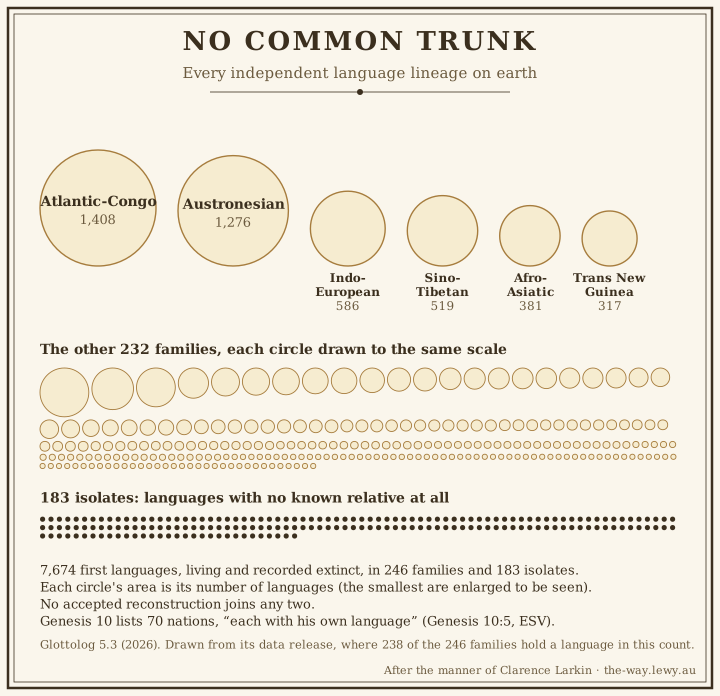
Two features of this picture matter. Most families are small: in Glottolog's data, 135 of them hold five languages or fewer. And the method that builds the families stops at the family. Its reach is usually put at six to eight thousand years. Proposals to join families above that level, such as Nostratic or "Proto-World," have not won acceptance among historical linguists.
The decay test
Languages replace their basic words at a measurable pace. Robert Lees (1953) measured thirteen language pairs with known histories and found that a language keeps about 80.5% of a 200-word core list per thousand years. Morris Swadesh (1955) trimmed the list to its 100 most stable items and put the figure at 86%. Both languages of a pair are losing words, so two sisters share the rate squared.
Run that forward from Babel. If one language had simply drifted apart from 2103 BC, any two languages alive today would share between 17% and 29% of their core words. That figure is far above chance and is easy to detect. Between families, they share chance-level look-alikes.
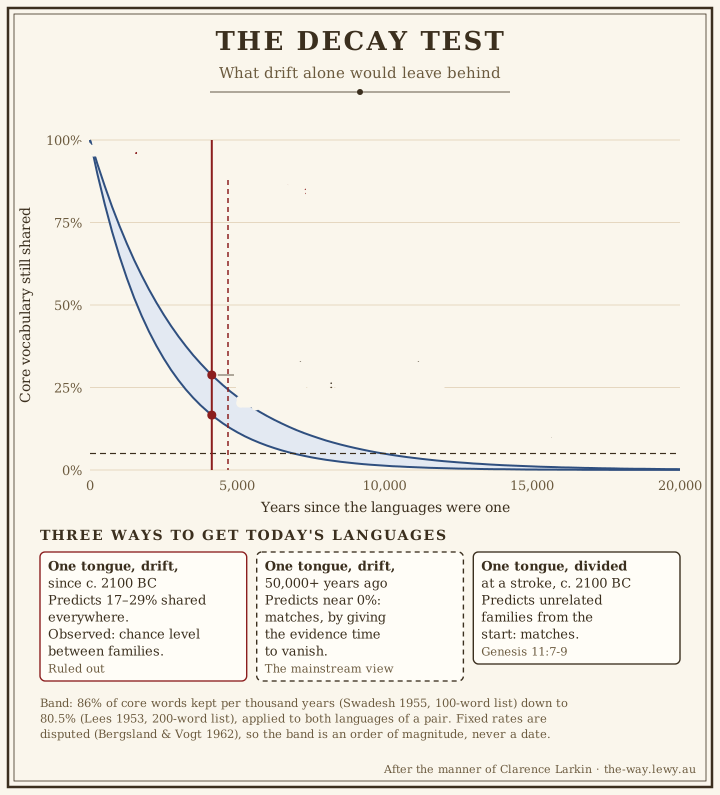
That leaves three ways to get today's languages:
- One language, drifting since about 2100 BC. Ruled out. It predicts a family likeness the languages do not have.
- One language, drifting for 50,000 years or more. This is the mainstream view, and the decay test cannot refute it. It fits by giving the evidence time to vanish.
- One language, divided at a stroke about 2100 BC. This is Genesis 11:7-9. It predicts unrelated families from the start, and that is what the languages show between families. Inside the deepest families the same arithmetic presses on this model too; see Where this argument is weak.
Glottochronology's fixed rate has been disputed since Knut Bergsland and Hans Vogt (1962) showed real languages varying around it, which is why the chart draws a band and why the test gives an order of magnitude. The conclusion survives the dispute: no published rate leaves 4,000 years of drift looking like chance. Within the Bible's chronology, the shape of the world's languages requires Babel.
How many languages Babel made
The decay test also counts. Two languages descended from one Babel language would still share a fifth of their core words today, and the comparative method would join them. So every lineage with no relative goes back to a language of its own at Babel. Babel produced at least 429 mutually unrelated languages, and more if some lineages have since died out unrecorded.
That settles which way the count in Genesis 10 runs. Seventy nations cannot each have had one language. Genesis ties the languages to clans: "each with his own language, by their clans, in their nations" (Genesis 10:5, ESV). The population study models about 10,000 people at the dispersal, and 429 languages among them is about 23 speakers each, the size of an extended household. A language for each clan is the plain reading of Genesis 10:5, and the arithmetic points the same way. Both figures rest on models, so this is a strong inference, and it stays an inference.
Could lineages begun together at Babel grow to today's sizes? A simulation tested it. It started the 421 lineages in Glottolog's data at about 2103 BC and drew each one's growth from the exact formula for languages splitting and dying at set rates (D. G. Kendall, 1948).
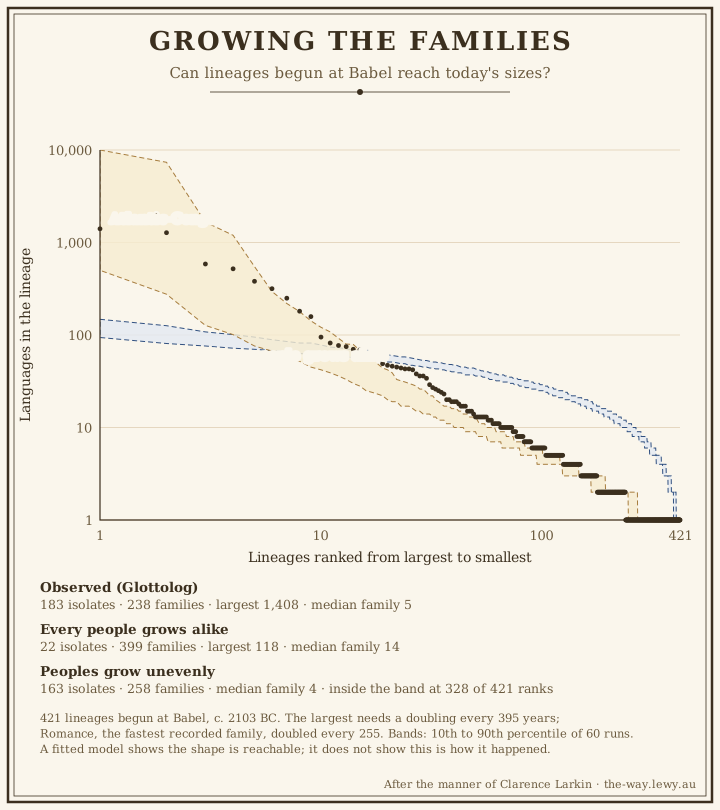
If every people's languages grew at one rate, the result looks nothing like the world: about 22 isolates against 183, and a largest family near 120 against 1,408. Equal growth from Babel fails. If peoples grew unevenly, most staying put and a few spreading far, the model comes much closer. Its range contains the real lineage at 328 of 421 ranks, though 226 of those are the smallest lineages, of one to three languages, where it can hardly miss. Where it misses, it misses one way: at ranks 6 to 149 it makes too few mid-sized families, and its typical largest family, about 5,200 languages, overshoots Atlantic-Congo's 1,408. Its best fit also needed no lineage to die out, though history shows whole branches dying (Anatolian, Tocharian). The model gets the shape and misses the middle. The largest family, Atlantic-Congo, needs its languages to double every 395 years from one Babel language. Romance doubled every 255. No family needs a faster pace than history records.
Uneven growth is what history shows. The Bantu and Austronesian expansions carried two families across much of Africa and the Pacific. The mainstream account uses the same expansions to explain the same shape, so this test does not choose between the two histories. It shows that the Babel model survives the family sizes, and what it requires: hundreds of languages at the start, and peoples who spread at very different speeds.
How fast tongues multiply
That leaves the second model, a long common ancestry. It escapes the decay test with time. The time it needs has its own cost, and the growth of known families measures it.
Families with a written history let the rate be counted. Latin became 77 Romance languages in about 1,600 years. Arabic became 37 varieties in about 1,350, and Common Slavic 20 languages in about 1,400. Each doubled its number of languages every 255 to 324 years, counting the recorded extinct ones as the world total does.
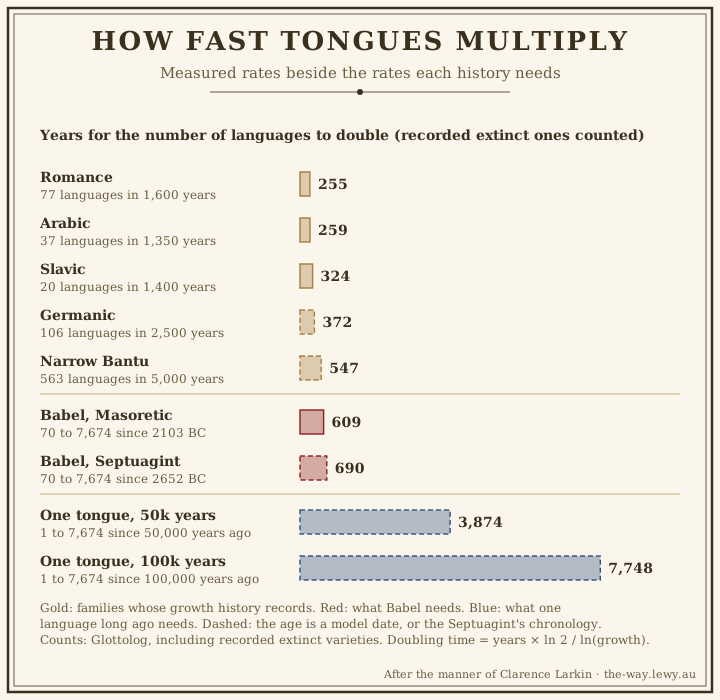
From seventy nations at Babel to 7,674 languages needs a doubling every 609 years. That is slower than every recorded family, which leaves room for the languages lost along the way.
From one language 50,000 years ago, the same total needs a doubling every 3,874 years. From 100,000 years ago it needs one every 7,748. That is ten to thirty times slower than any family history records. A long ancestry works only if new languages and dead ones stayed closely balanced for tens of thousands of years. Language death is real, and the mainstream account appeals to it: Anatolian and Tocharian died out entirely, as did Latin's Italic sisters. The balance itself cannot be tested, because no written record reaches back that far, and every family we can watch across its written history grew far faster.
This is the same kind of argument the population study makes, and it has the same ceiling. It shows which history fits the measured rates without help. It cannot by itself rule out a history that adds a balancing assumption.
Two more facts to weigh
Every known language is complete. Edward Sapir wrote in 1921 that "we know of no people that is not possessed of a fully developed language" (Language, ch. 1). The oldest written languages, Sumerian, Egyptian and Akkadian, already have full grammars. The long account expects this as well: it places any simpler stages of speech before writing, where no evidence of them can survive. Genesis needs no such stages. It begins with a man who speaks: "whatever the man called every living creature, that was its name" (Genesis 2:19, ESV).
Speech is old and writing is young. On the mainstream account people spoke fully for over a hundred thousand years. They began writing only about 5,200 years ago, in Mesopotamia and Egypt within a few centuries of each other, and later independently in China and Mesoamerica. In the Bible's history speech begins with Adam, a few thousand years before the oldest inscriptions, and Genesis already calls Adam's genealogy a סֵפֶר (sepher, H5612), "the book of the generations of Adam" (Genesis 5:1, ESV). Scripture never says when writing began. The long account has to explain a hundred thousand years of speech without a written word; the shorter one has only a short gap to explain.
Both facts fit the long account as well, so neither proves Babel. Genesis's history holds them without the unseen stages and the long silence.
The first written witnesses
Each family's first written record can be placed against Genesis.
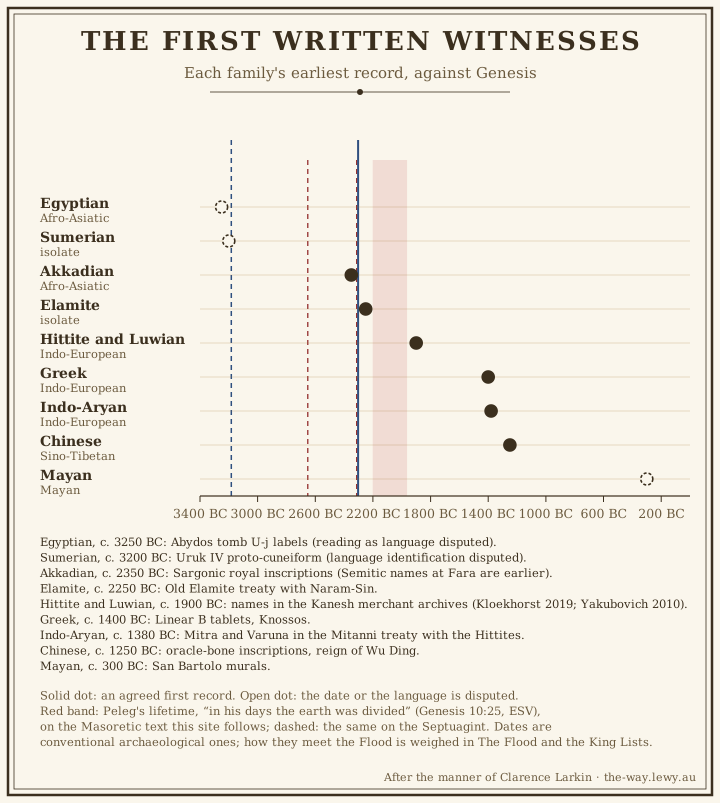
Every Indo-European record falls after Peleg's birth. So do the Chinese oracle bones and the Mayan murals. The pressure point is at the top of the chart. On conventional dates, Egyptian, Sumerian and Akkadian were written before the Masoretic Flood, and Elamite before Peleg was born. That conflict belongs to the dating of early Mesopotamia and Egypt as a whole, and The Flood and the King Lists weighs it there.
Speech and writing have different family trees
Babel confused speech. Every word Genesis 11 uses for what God changed belongs to the mouth and the ear: the "lip" (saphah, Genesis 11:1, 6, 7, 9), the "words" (Genesis 11:1), and hearing, for the people would no longer שָׁמַע (shama, H8085), "hear," one another (Genesis 11:7, where the ESV has "understand"). The Septuagint keeps to the body too: God confuses their "tongue" (Genesis 11:7) and their "lips," χείλη (Genesis 11:9, Brenton LXX). Genesis 11 says nothing about writing, and writing's history has the opposite shape to the history of speech.
Writing was invented only a few times: in Mesopotamia, Egypt, China and Mesoamerica. Every other script was borrowed or adapted from one of those. Cuneiform, made for Sumerian, an isolate, went on to write Akkadian (Semitic), Elamite (an isolate) and Hittite (Indo-European), four unrelated languages in one script. Chinese characters went on to write Japanese, Korean and Vietnamese. And nearly every alphabet in use, Hebrew, Arabic, Greek, Latin and Cyrillic among them, descends from one source, the Proto-Sinaitic letters of Egypt and Sinai, usually dated about 1850 BC and by some scholars a few centuries later. Korean Hangul (AD 1443) is a rare script invented by design, its consonant shapes drawn from the mouth that speaks them.
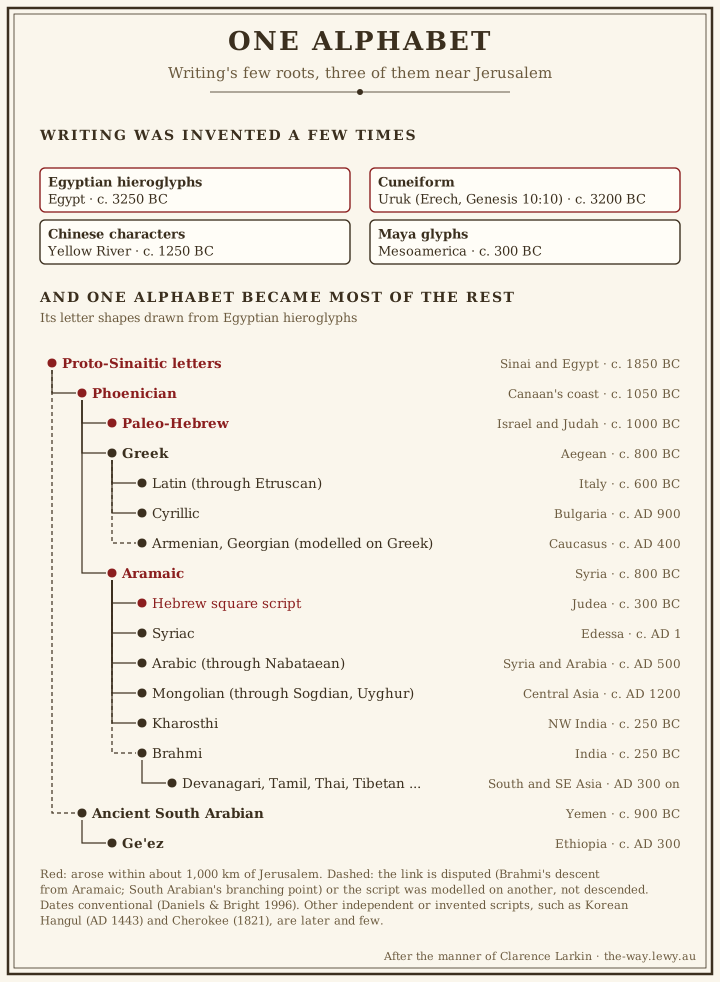
So writing behaves like any human invention: a few inventions, then spread by borrowing across language lines. Speech breaks into hundreds of lineages that borrowing never connects. The two records sit side by side in the same peoples, and only one of them shows a break. Genesis puts God's act on the spoken word and nowhere else.
Writing's roots also gather in one region. The oldest known writing comes from two places at about the same time, about 3200 BC: Uruk, in southern Iraq, and Egypt. Which came first is disputed. Genesis names Uruk: Nimrod's kingdom began with "Babel, Erech, Accad, and Calneh, in the land of Shinar" (Genesis 10:10, ESV), and Erech is Uruk. The alphabet was made in Sinai and Egypt and carried out through Canaan and Syria. Three of writing's roots lie within about 1,000 km of Jerusalem, and the one that became most of the world's scripts passed through the land God gave Israel. Writing began in the land where Genesis sets the dispersal and was borrowed outward from there. On conventional dates Uruk's tablets are older than the Flood on either chronology, the conflict The first written witnesses sets out. Whether anyone wrote before Babel, Scripture does not say.
Where this argument is weak
- The decay test is neutral between Babel and deep time. It rules out a young, gradual history. Against a long one, the argument rests on growth rates and the written record, and those show fit, which is weaker than proof.
- The count and the simulation are models. The floor of 429 Babel languages rests on the decay rates, and the 23 speakers each on the population study's headcount. The simulation fits three free settings to the data, so its good fit shows the family sizes are reachable from Babel; it cannot show that this is how they arose.
- Indo-European is the hardest case. Hittite and Luwian names were already distinct at Kanesh by about 1900 BC, two or three centuries after Peleg's birth on the Masoretic dates. The current Bayesian estimate puts the family's first split about 8,100 years ago (Heggarty and others, 2023). Quentin Atkinson and colleagues (2008) found that 10-33% of vocabulary change in three large families happens in bursts when languages split, so change runs fastest where a language divides. That narrows the gap by an amount nobody has measured, and a gap remains. Babel could also have produced sister languages within a family. Genesis is silent on that, so it stays a speculation.
- Afro-Asiatic is harder still. Egyptian and Akkadian belong to one family, yet they are already far apart in their first records, and on conventional dates both were written before the modelled Babel. The decay arithmetic applied inside this family presses on Babel the way it presses on drift from one tongue. The answers available are the ones for Indo-European, faster change at each split or sister languages made at Babel, plus the conventional dates themselves, which The Flood and the King Lists weighs. None of them is settled.
- The rates are disputed. Mark Pagel and colleagues (2013) argued that a few very frequent words keep a signal for about 15,000 years, joining seven Eurasian families. Most historical linguists rejected the method. The claim cuts both ways. If Pagel is right, the young, gradual model fails more clearly still; and families that Babel would make independent turn out related, at a depth of about 15,000 years, which presses on Babel too.
Part three: what languages declare
At Babel the nations were scattered by language. At Pentecost they were gathered by language. The crowd in Jerusalem "were bewildered, because each one was hearing them speak in his own language" (Acts 2:6, ESV). "Bewildered" is συνεχύθη, from συγχέω (synchéō, G4797), the verb the Septuagint used at Babel. It occurs five times in the New Testament, all in Acts, and Luke also uses it for rioting crowds (Acts 19:32; 21:27, 31), so the verb alone is a modest echo. It has a second word beside it. The Septuagint has God confuse their γλῶσσα (glōssa, G1100, "tongue," Genesis 11:7), and at Pentecost the believers speak in other γλῶσσαι and the crowd hears God's works "in our own tongues" (Acts 2:4, 11, ESV). Two of Babel's words in one scene of divided languages make the echo likely. Luke quotes nothing from Genesis 11. Among the hearers were "Medes and Elamites" (Acts 2:9, ESV), descendants of Madai and Elam in the table of nations (Genesis 10:2, 22).
✝️ Acts 2:6-11 (ESV)
6 And at this sound the multitude came together, and they were bewildered, because each one was hearing them speak in his own language. 7 And they were amazed and astonished, saying, "Are not all these who are speaking Galileans? 8 And how is it that we hear, each of us in his own native language? 9 Parthians and Medes and Elamites and residents of Mesopotamia, Judea and Cappadocia, Pontus and Asia, 10 Phrygia and Pamphylia, Egypt and the parts of Libya belonging to Cyrene, and visitors from Rome, 11 both Jews and proselytes, Cretans and Arabians—we hear them telling in our own tongues the mighty works of God."
The Holy Spirit kept the languages. Each man heard in his own διάλεκτος (dialektos, G1258), "his own native language" (Acts 2:8, ESV). Those who spoke were "all together in one place" (Acts 2:1, ESV), and Luke does not narrow "all" to the apostles. Babel's division stands, and God now speaks through it.
The end of the story keeps them too. John saw "a great multitude that no one could number, from every nation, from all tribes and peoples and languages, standing before the throne and before the Lamb" (Revelation 7:9, ESV). Two chapters earlier the living creatures and the elders sing to the Lamb that "by your blood you ransomed people for God from every tribe and language and people and nation" (Revelation 5:9, ESV). Zephaniah promised a "pure speech" for the peoples (Zephaniah 3:9, ESV), in the kingdom that follows the day of judgment. The word is Babel's saphah, and the peoples unite to "call upon the name of the LORD" where Babel's builders united to "make a name for ourselves" (Genesis 11:4, ESV). Zephaniah never names Babel, so the allusion stays a likelihood. Pentecost was its first taste.
Three things the languages declare about God
So the languages declare three things about God. He judges pride: the city built for a name stands unfinished (Genesis 11:8). He rules the nations: He divided them, fixed their borders and set their times (Deuteronomy 32:8; Acts 17:26). He redeems them: His Son Jesus ransomed people from every one of those languages, and the Holy Spirit carries the gospel into each of them.
So when you hear a language you cannot understand, you are hearing Babel, and you are hearing a people God scattered so they would seek Him. Jesus died for people who speak it. Pray that they hear His mighty works in their own tongue.
Annex: two outside claims this study sets aside
Babel in Sumerian memory
One Sumerian text speaks to Babel directly. In Enmerkar and the Lord of Aratta (lines 134-155), the lands are to "address Enlil together in a single language," and the god Enki will "change the speech in their mouths" (ETCSL translation). Scholars dispute whether the passage looks back to a lost unity, as Samuel Noah Kramer read it, or forward to a hoped-for one, as the ETCSL rendering has it. At most it is a distorted memory of a confusion of tongues sent by heaven; it carries nothing in this argument. The king-lists study covers it with the ziggurat of Babylon.
Chinese characters and the creation story
C. H. Kang and Ethel Nelson's The Discovery of Genesis (1979) reads Genesis in Chinese characters, such as 船 (boat) as "vessel, eight, mouths" for the eight people on the ark. The oldest Chinese dictionary, the Shuowen Jiezi (AD 100), analyses 船 as 舟 "boat" for meaning plus a shortened 鉛 for sound. It reads 禁 (forbid), which the book takes as two trees and a divine command, as 示 for meaning plus 林 for sound. Most Chinese characters are built this way, from one part for meaning and one for sound, and the book reads the sound parts as story. The oldest characters, on oracle bones of about 1250 BC, are also later than Moses. This study leaves the claim out.
Discussion questions
- The language. Genesis 11 calls language "one lip," saphah, and Zephaniah 3:9 promises the peoples a "pure" saphah. What does the choice of that word, over Genesis 10's lashon, tell you about what God means to restore?
- The text in its context. The builders built "lest we be dispersed" (Genesis 11:4), and God dispersed them with the same verb. What does that reversal show about the purpose behind their tower?
- Christ. Revelation 5:9 sings that the Lamb ransomed people "from every tribe and language." How does Babel shape the way you hear that song?
- The hard part. Genesis 11:9 says the LORD confused "the language of all the earth," and the linguists' clock puts Indo-European's first split about 8,100 years ago. How do you weigh a clock built outside Scripture against Scripture's own chronology?
- Be transformed. At Babel people built to make a name for themselves (Genesis 11:4). Where are you building a name, and what would it look like to make Jesus' name known in its place?
Group study sheet for a 40-minute group: two A4 sheets, or one with the guided path
The point, the passage, the questions and the response, from this study. Print on both sides of two A4 sheets, flipping on the long edge. While this block is open, printing the page prints the sheet; close it to print the study.
What Languages Declare: Babel and the Arithmetic of Tongues
Genesis 11:1-9The point At Babel God divided one language in a single act, and the shape of the world's languages today, hundreds of lineages with no common trunk, is what that act leaves behind; the long common ancestry that does without Babel has to assume that new languages and lost ones stayed in balance for tens of thousands of years, longer than any record reaches, while every family whose growth was written down multiplied fast.
Ask: what comes to mind when you hear What Languages Declare
? Hear a few answers before anyone reads.
Genesis 11:1-9 1Now the whole world had one language and a common form of speech. 2And as people journeyed eastward, they found a plain in the land of Shinar and settled there. 3And they said to one another, “Come, let us make bricks and bake them thoroughly.” So they used brick instead of stone, and tar instead of mortar. 4“Come,” they said, “let us build for ourselves a city with a tower that reaches to the heavens, that we may make a name for ourselves and not be scattered over the face of all the earth.” 5Then the LORD came down to see the city and the tower that the sons of men were building. 6And the LORD said, “If they have begun to do this as one people speaking the same language, then nothing they devise will be beyond them. 7Come, let Us go down and confuse their language, so that they will not understand one another’s speech.” 8So the LORD scattered them from there over the face of all the earth, and they stopped building the city. 9That is why it is called Babel, for there the LORD confused the language of the whole world, and from that place the LORD scattered them over the face of all the earth.
Also read:
What Languages Declare: Babel and the Arithmetic of Tongues
- Part one: what Scripture says. Babel read in its context: Genesis 10 as the result, Genesis 11 as the cause, the Hebrew of "one lip," and what Genesis 10 does not claim to be.
- Part two: what the languages say. The evidence from outside Scripture, with four charts, in three steps and then its limits:
- Today's languages against the Bible's timescale — 429 lineages and no common trunk · The decay test · How many languages Babel made.
- The long-ancestry alternative and what it costs — How fast tongues multiply · Two more facts to weigh.
- The written record — The first written witnesses · Speech and writing.
- Where this argument is weak.
What Languages Declare: Babel and the Arithmetic of Tongues
1The language. Genesis 11 calls language "one lip," saphah, and Zephaniah 3:9 promises the peoples a "pure" saphah. What does the choice of that word, over Genesis 10's lashon, tell you about what God means to restore?
2The text in its context. The builders built "lest we be dispersed" (Genesis 11:4), and God dispersed them with the same verb. What does that reversal show about the purpose behind their tower?
3The hard part. Genesis 11:9 says the LORD confused "the language of all the earth," and the linguists' clock puts Indo-European's first split about 8,100 years ago. How do you weigh a clock built outside Scripture against Scripture's own chronology?
4Christ. Revelation 5:9 sings that the Lamb ransomed people "from every tribe and language." How does Babel shape the way you hear that song?
What Languages Declare: Babel and the Arithmetic of Tongues
5Be transformed. At Babel people built to make a name for themselves (Genesis 11:4). Where are you building a name, and what would it look like to make Jesus' name known in its place?
- Think. Your language is a gift from God's hand at Babel. It carries His judgment on human pride and His mercy that sent the nations out to seek Him.
- Attitude. Hold your own language loosely. The multitude before the throne speaks thousands of languages, and yours is one voice among them.
- Do. Learn the name of one people group still without Scripture in their language, and pray for it by name each day this week, toward the multitude John saw "from every nation, from all tribes and peoples and languages" (Revelation 7:9, ESV).
Therefore its name was called Babel, because there the LORD confused the language of all the earth. And from there the LORD dispersed them over the face of all the earth.
Genesis 11:9 (ESV)Father, You divided the speech of the proud at Babel, and You scattered the nations so they would seek You. Thank You for sending Your Son Jesus to ransom people from every language, and for pouring out the Holy Spirit so the nations heard Your mighty works in their own tongues. Keep me from building a name for myself. Send Your word into every language that has not yet heard it, until every tongue confesses that Jesus Christ is Lord. In Jesus' name. Amen.
What Languages Declare: Babel and the Arithmetic of Tongues
Genesis 11:1-9Open Ask: what comes to mind when you hear What Languages Declare
? Hear a few answers before anyone reads.
Read it aloud Genesis 11:1-9
1The language. Genesis 11 calls language "one lip," saphah, and Zephaniah 3:9 promises the peoples a "pure" saphah. What does the choice of that word, over Genesis 10's lashon, tell you about what God means to restore?
2The text in its context. The builders built "lest we be dispersed" (Genesis 11:4), and God dispersed them with the same verb. What does that reversal show about the purpose behind their tower?
3The hard part. Genesis 11:9 says the LORD confused "the language of all the earth," and the linguists' clock puts Indo-European's first split about 8,100 years ago. How do you weigh a clock built outside Scripture against Scripture's own chronology?
- Today's languages against the Bible's timescale — 429 lineages and no common trunk · The decay test · How many languages Babel made.
4Christ. Revelation 5:9 sings that the Lamb ransomed people "from every tribe and language." How does Babel shape the way you hear that song?
5Be transformed. At Babel people built to make a name for themselves (Genesis 11:4). Where are you building a name, and what would it look like to make Jesus' name known in its place?
- Think. Your language is a gift from God's hand at Babel. It carries His judgment on human pride and His mercy that sent the nations out to seek Him.
- Attitude. Hold your own language loosely. The multitude before the throne speaks thousands of languages, and yours is one voice among them.
- Do. Learn the name of one people group still without Scripture in their language, and pray for it by name each day this week, toward the multitude John saw "from every nation, from all tribes and peoples and languages" (Revelation 7:9, ESV).
What Languages Declare: Babel and the Arithmetic of Tongues
The point At Babel God divided one language in a single act, and the shape of the world's languages today, hundreds of lineages with no common trunk, is what that act leaves behind; the long common ancestry that does without Babel has to assume that new languages and lost ones stayed in balance for tens of thousands of years, longer than any record reaches, while every family whose growth was written down multiplied fast.
References & Recommended Reading
- ESV Bible (Crossway) — primary translation; every quotation verified against
study-notes.db. - ESV Study Bible (Crossway) — notes on Genesis 11:1 (the episode placed before Genesis 10's outcome), 11:1-9, 11:5-8 and 11:9 (balal and Bavel; ziggurats).
- Westminster Leningrad Codex and unfoldingWord ULT/UHB interlinear, via this repo's
bible-text.db— saphah, lashon, balal and puts in Genesis 10:5, 11:1-9 and Zephaniah 3:9. - Brenton Septuagint (Genesis 11:7, 9: συγχέω, Σύγχυσις) and SBLGNT (συγχέω in Acts), via
bible-text.db. - Glottolog 5.3 (Hammarström, Forkel, Haspelmath & Bank, 2026) — glottolog.org: 7,674 spoken first languages, 246 families, 183 isolates; family sizes from the glottolog-cldf v5.3 data release.
- D. G. Kendall, "On the Generalized 'Birth-and-Death' Process," Annals of Mathematical
Statistics 19 (1948) 1-15 — the lineage-size formula behind the simulation, which is
utils/simulate_language_families.pyin this site's repository, with its results indocs/data/language-simulation.json. - R. B. Lees, "The Basis of Glottochronology," Language 29 (1953) 113-127.
- M. Swadesh, "Towards Greater Accuracy in Lexicostatistic Dating," International Journal of American Linguistics 21 (1955) 121-137.
- K. Bergsland & H. Vogt, "On the Validity of Glottochronology," Current Anthropology 3 (1962) 115-153.
- Q. D. Atkinson, A. Meade, C. Venditti, S. J. Greenhill & M. Pagel, "Languages Evolve in Punctuational Bursts," Science 319 (2008) 588.
- M. Pagel, Q. D. Atkinson, A. S. Calude & A. Meade, "Ultraconserved Words Point to Deep Language Ancestry across Eurasia," PNAS 110 (2013) 8471-8476; and the critique at Language Log, "Ultraconserved words? Really??" (2013).
- P. Heggarty and others, "Language Trees with Sampled Ancestors Support a Hybrid Model for the Origin of Indo-European Languages," Science 381 (2023) eabg0818.
- Edward Sapir, Language: An Introduction to the Study of Speech (1921), ch. 1 (public domain, Project Gutenberg #12629).
- P. T. Daniels & W. Bright (eds.), The World's Writing Systems (Oxford, 1996) — the descent of the alphabet and the independent inventions of writing.
- R. D. Woodard (ed.), The Cambridge Encyclopedia of the World's Ancient Languages (Cambridge, 2004) — conventional dates of first attestation.
- A. Kloekhorst, Kanišite Hittite: The Earliest Attested Record of Indo-European (Brill, 2019) — Hittite names and words at Kanesh; and I. Yakubovich, Sociolinguistics of the Luvian Language (Brill, 2010) — Luwian names there, some of which Kloekhorst disputes.
- Enmerkar and the Lord of Aratta, lines 134-155, in the Electronic Text Corpus of Sumerian Literature (Oxford), c.1.8.2.3.
- C. H. Kang & E. R. Nelson, The Discovery of Genesis (Concordia, 1979); and Xu Shen, Shuowen Jiezi (c. AD 100), entries 船 and 禁.