Test the Spirits: Recognising False Teachers and Wolves
New, published 10 October 2026. What else is new
Paul, Peter, John and Jude all warned the churches about false teachers. Paul told the Ephesian elders the wolves would come from "among your own selves" (Acts 20:30, ESV). Peter said, "there will be false teachers among you" (2 Peter 2:1, ESV). Jude wrote because they had already "crept in unnoticed" (Jude 4, ESV). John gave the command this study is named for:
✝️ 1 John 4:1-3 (ESV)
1 Beloved, do not believe every spirit, but test the spirits to see whether they are from God, for many false prophets have gone out into the world. 2 By this you know the Spirit of God: every spirit that confesses that Jesus Christ has come in the flesh is from God, 3 and every spirit that does not confess Jesus is not from God. This is the spirit of the antichrist, which you heard was coming and now is in the world already.
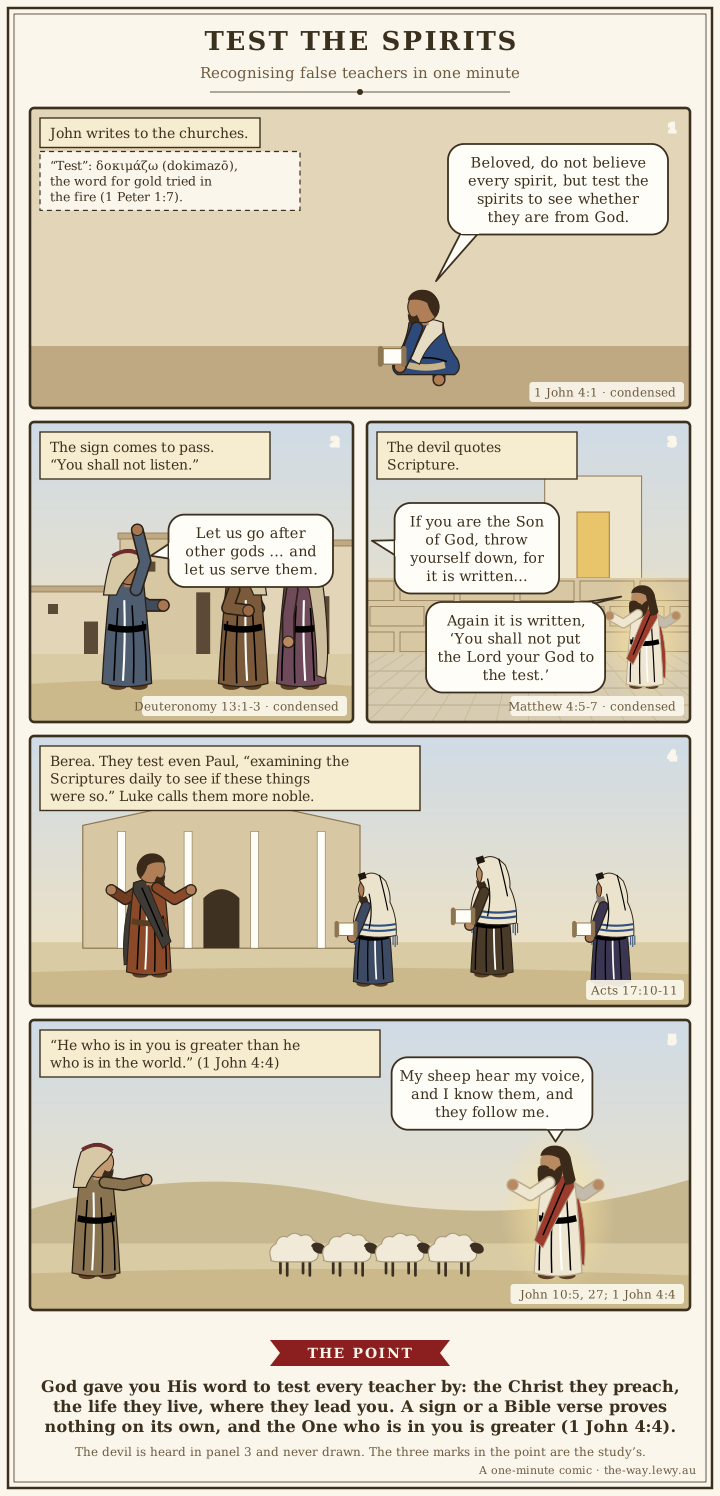
In one sentence: God guards His flock by giving it one fixed standard, the apostles' teaching about Jesus Christ come in the flesh, and He tells you to keep testing every teacher against it by three marks Scripture repeats: the Christ they preach, the life they live, and where they lead you; signs, crowds and Bible words can all be counterfeited, and the One who is in you is greater than the one who is in the world.
If a wolf has already hurt you or someone you love, read this alongside Hurt by the Church, which deals with the wound.
Key Takeaways
(This section follows the Key Takeaways format — see that page for what each part is for.)
Types & Prophecy
- Prophecy. Jesus foretold false christs and false prophets who "perform great signs and wonders, so as to lead astray, if possible, even the elect" (Matthew 24:24, ESV), and added, "See, I have told you beforehand" (Matthew 24:25, ESV). Paul describes the climax of that deception in the coming of "the lawless one" with "false signs and wonders" (2 Thessalonians 2:9, ESV).
- Pattern. Peter sets the church's false teachers beside Israel's false prophets: "false prophets also arose among the people, just as there will be false teachers among you" (2 Peter 2:1, ESV). The tests God gave Israel in Deuteronomy 13 and 18 carry straight over.
Lessons about Jesus
- He is the test. The first question of any teacher is what they say about Him: "every spirit that confesses that Jesus Christ has come in the flesh is from God" (1 John 4:2, ESV).
- He warned you first. The Good Shepherd named the wolves before they came (Matthew 7:15; 24:24-25).
- He keeps His sheep. "My sheep hear my voice, and I know them, and they follow me ... no one will snatch them out of my hand" (John 10:27-28, ESV).
Memory verses
✝️ 1 John 4:1 (ESV)
1 Beloved, do not believe every spirit, but test the spirits to see whether they are from God, for many false prophets have gone out into the world.
✝️ 1 John 4:4 (ESV)
4 Little children, you are from God and have overcome them, for he who is in you is greater than he who is in the world.
Be Transformed
- Think. A sign that comes true, a growing crowd and a sermon full of Bible verses prove nothing about a teacher (Deuteronomy 13:1-3; 2 Corinthians 11:14). Ask what they say about Jesus, how they live, and where they are taking you.
- Attitude. Be a Berean. Receive the word "with all eagerness," and check it against Scripture every time (Acts 17:11, ESV).
- Do. Pick the teacher you listen to most. This week, test one of their messages against the three marks below. Then read 1 John 2:18-27 and ask what you "heard from the beginning".
Prayer
Father, you have given us your word, and it is true. Thank you for your Son Jesus, who came in the flesh, died for us and rose, and who warned us about the wolves before they came. Give us the Holy Spirit's discernment to test what we hear, and keep us from being tossed by every wind of doctrine. Guard us from teachers who serve their own appetites, and guard us from becoming that kind of teacher. Have mercy on those who have been led astray, and bring them back. Keep us from stumbling until we stand before you with great joy.
In Jesus' name. Amen.
Study outline
- Test, and keep testing. What John's word for "test" means, and why testing is how you keep what is good.
- Where wolves come from. From inside the church, in disguise, with spirits behind them.
- What does not prove a teacher. Signs that come true, crowds, and borrowed words.
- The three marks:
- The Christ they preach. John's test, the heresy he faced, and Paul's "another Jesus".
- The life they live. Greed, sensuality and contempt for authority.
- Where they lead you. After themselves, into false peace, into new rules, into division.
- What to do. Abide, refuse the platform, avoid, refute, and show mercy.
- Kept by the Shepherd. Why the sheep can know His voice.
- Discussion questions. Six, for a group or on your own.
Test, and keep testing
The assayer's word
"Test" in 1 John 4:1 is δοκιμάζω (dokimazō, G1381), a word used for testing metal. Peter uses it of "gold that perishes though it is tested by fire" (1 Peter 1:7, ESV). The Greek Old Testament uses it at Proverbs 17:3, where silver and gold are tested in a furnace, and so are chosen hearts before the Lord. An assayer puts a coin in the fire to find out whether it is what it claims to be.
John writes it as a present imperative, a standing order. Keep testing. Do the same with the next teacher, and the one after.
Testing keeps the good
Paul gives the same command in the same tense: "Do not despise prophecies, but test everything; hold fast what is good" (1 Thessalonians 5:20-21, ESV). Testing is how you find the good and hold it. The Bereans "received the word with all eagerness, examining the Scriptures daily to see if these things were so" (Acts 17:11, ESV). They were testing Paul, and Luke calls them "more noble" for it.
Jesus commended the church at Ephesus because it "tested those who call themselves apostles and are not, and found them to be false" (Revelation 2:2, ESV). He rebuked Thyatira because it tolerated "that woman Jezebel, who calls herself a prophetess" (Revelation 2:20, ESV).
This shows that God wants His people to know the truth and hold it. He gives you a standard to test by and expects you to use it. Isaiah put it plainly: "To the teaching and to the testimony! If they will not speak according to this word, it is because they have no dawn" (Isaiah 8:20, ESV). That is the statement of faith's position too: Scripture judges every other voice.
Where wolves come from
From inside
The New Testament expects false teachers to arise in the church itself. Paul told the Ephesian elders:
✝️ Acts 20:29-30 (ESV)
29 I know that after my departure fierce wolves will come in among you, not sparing the flock; 30 and from among your own selves will arise men speaking twisted things, to draw away the disciples after them.
Peter calls them ψευδοδιδάσκαλοι (pseudodidaskaloi, G5572), "false teachers", and says they "will secretly bring in destructive heresies" (2 Peter 2:1, ESV). "Secretly bring in" is παρεισάγω (pareisagō, G3919), to bring something in on the quiet; this is its only use in the New Testament. Jude says they "crept in unnoticed" (Jude 4, ESV). John's false teachers had sat in his congregation: "They went out from us, but they were not of us" (1 John 2:19, ESV).
So a false teacher usually arrives with credentials. He knows the songs and the vocabulary. That is why Jesus pictured him "in sheep's clothing" (Matthew 7:15, ESV).
In disguise
Paul says it outright:
✝️ 2 Corinthians 11:13-15 (ESV)
13 For such men are false apostles, deceitful workmen, disguising themselves as apostles of Christ. 14 And no wonder, for even Satan disguises himself as an angel of light. 15 So it is no surprise if his servants, also, disguise themselves as servants of righteousness. Their end will correspond to their deeds.
With spirits behind them
John says "test the spirits" because a teacher speaks from a spirit. "The Spirit expressly says that in later times some will depart from the faith by devoting themselves to deceitful spirits and teachings of demons" (1 Timothy 4:1, ESV). Israel knew this too: a lying spirit spoke through Ahab's prophets (1 Kings 22:22-23). Ezekiel adds a second source. The false prophets "prophesy from their own hearts" and "follow their own spirit, and have seen nothing" (Ezekiel 13:2-3, ESV).
Both are still true. Some false teaching is demonic. Much of it is a man's own heart, dreams and ambition dressed up as a word from the Lord. Jeremiah said they "speak visions of their own minds, not from the mouth of the LORD" (Jeremiah 23:16, ESV). The test is the same either way. For how the demonic side relates to deliverance ministry, see Deliverance and the Edge of Sorcery.
What does not prove a teacher
Many believers arrive holding one of three wrong tests. Scripture takes each apart.
A sign that comes true
✝️ Deuteronomy 13:1-3 (ESV)
1 "If a prophet or a dreamer of dreams arises among you and gives you a sign or a wonder, 2 and the sign or wonder that he tells you comes to pass, and if he says, 'Let us go after other gods,' which you have not known, 'and let us serve them,' 3 you shall not listen to the words of that prophet or that dreamer of dreams. For the LORD your God is testing you, to know whether you love the LORD your God with all your heart and with all your soul.
The sign "comes to pass", and Israel is still told not to listen. Deuteronomy 18 gives the other half: a prophet whose word "does not come to pass" has spoken presumptuously (Deuteronomy 18:22, ESV). A failed prediction disqualifies a prophet. A fulfilled one does not qualify him. What he teaches about God decides it.
"Testing" in Deuteronomy 13:3 (13:4 in the Hebrew numbering) is נָסָה (nasah, H5254), the verb Genesis uses when "God tested Abraham" (Genesis 22:1, ESV). The Hebrew is a participle: the LORD "is testing" you. God lets the counterfeit appear, and it shows whether His people love Him "with all your heart and with all your soul". When a false teacher appears, God is still ruling His church, and He is proving the love of His people.
Jesus said the same about miracles. "On that day many will say to me, 'Lord, Lord, did we not prophesy in your name, and cast out demons in your name, and do many mighty works in your name?' And then will I declare to them, 'I never knew you'" (Matthew 7:22-23, ESV). At the end of the age false christs "perform great signs and wonders, so as to lead astray, if possible, even the elect" (Matthew 24:24, ESV). Power is no evidence of truth. The questions about a dream are the same; see A framework for discernment.
A crowd
"Many will follow their sensuality" (2 Peter 2:2, ESV). "They are from the world; therefore they speak from the world, and the world listens to them" (1 John 4:5, ESV). A packed room is a measure of what people want to hear. Paul saw it coming: "having itching ears they will accumulate for themselves teachers to suit their own passions" (2 Timothy 4:3, ESV).
Bible words
False teachers quote Scripture. Satan did, to Jesus (Matthew 4:6). God says through Jeremiah, "I am against the prophets ... who steal my words from one another" (Jeremiah 23:30, ESV). Borrowed words can carry another message. The teachers Paul opposed in Corinth preached a "Jesus" too (2 Corinthians 11:4).
First mark: the Christ they preach
John's test
John's test is about a person. "Every spirit that confesses that Jesus Christ has come in the flesh is from God" (1 John 4:2, ESV). "Who is the liar but he who denies that Jesus is the Christ? This is the antichrist, he who denies the Father and the Son" (1 John 2:22, ESV).
John alone uses ἀντίχριστος (antichristos, G500), five times in his first two letters (1 John 2:18, 22; 4:3; 2 John 7). "Antichrist is coming," he says, "so now many antichrists have come" (1 John 2:18, ESV). The spirit of the final antichrist was already at work in teachers who denied who Jesus is.
The heresy John faced
The likeliest background is a teacher Irenaeus names. Writing about AD 180, Irenaeus records that Cerinthus taught Jesus was the natural son of Joseph and Mary; that "Christ" descended on Jesus at His baptism; and that the Christ "departed from Jesus" before the crucifixion, so that only the man suffered (Against Heresies 1.26.1). Irenaeus also passes on a story from those who heard Polycarp: John once ran out of a bath-house at Ephesus because Cerinthus was inside (Against Heresies 3.3.4).
That teaching fits 1 John 2:22 closely. It splits Jesus from the Christ, and it denies that the Son of God died in the flesh. Scholars debate whether Cerinthus himself was John's opponent or one of several with similar ideas. The point stands either way: the error John fought was about the person of Christ.
This is why the test works. Salvation rests on who Jesus is. "Whoever confesses the Son has the Father also" (1 John 2:23, ESV). A teacher who changes who He is has changed the gospel, however warm he sounds. "No one can say 'Jesus is Lord' except in the Holy Spirit" (1 Corinthians 12:3, ESV).
Another Jesus, another gospel
Paul feared the Corinthians would be led astray "from a sincere and pure devotion to Christ":
✝️ 2 Corinthians 11:4 (ESV)
4 For if someone comes and proclaims another Jesus than the one we proclaimed, or if you receive a different spirit from the one you received, or if you accept a different gospel from the one you accepted, you put up with it readily enough.
The three go together: another Jesus, a different spirit, a different gospel. In Galatia the change was to the gospel of grace, and Paul's verdict was "let him be accursed", even if the preacher were "an angel from heaven" (Galatians 1:8, ESV). Peter's false teachers end by "denying the Master who bought them" (2 Peter 2:1, ESV). Jude's false teachers "pervert the grace of our God into sensuality and deny our only Master and Lord, Jesus Christ" (Jude 4, ESV).
So ask of any teacher: Is Jesus fully God and fully man? Did He die for sins and rise bodily? Is salvation by grace through faith in Him? Is He Lord of how you live? A teacher can be wrong on many secondary things and still be a brother. A teacher who is wrong here is preaching another Jesus.
Second mark: the life they live
You will recognise them by their fruits
✝️ Matthew 7:15-17 (ESV)
15 "Beware of false prophets, who come to you in sheep's clothing but inwardly are ravenous wolves. 16 You will recognize them by their fruits. Are grapes gathered from thornbushes, or figs from thistles? 17 So, every healthy tree bears good fruit, but the diseased tree bears bad fruit.
"Ravenous" is ἅρπαξ (harpax, G727). Its four other New Testament uses name people who take what is not theirs: "extortioners" (Luke 18:11, ESV) and "swindlers" (1 Corinthians 5:10, 11; 6:10, ESV). The wolf takes. Jesus gives this warning in the same sermon as "Judge not" (Matthew 7:1) and "do not throw your pearls before pigs" (Matthew 7:6), fourteen verses on. You do not condemn your brother, and you are not naive either. "Judge with right judgment" (John 7:24, ESV).
Time shows fruit. A season of charm can hide a wolf; years of life cannot. The epistles name three kinds of bad fruit again and again.
Greed
"In their greed they will exploit you with false words" (2 Peter 2:3, ESV). They have "hearts trained in greed" and follow "Balaam ... who loved gain from wrongdoing" (2 Peter 2:14-15, ESV). They teach "for shameful gain" (Titus 1:11, ESV), "imagining that godliness is a means of gain" (1 Timothy 6:5, ESV). Jude says they "abandoned themselves for the sake of gain to Balaam's error" (Jude 11, ESV).
Sensuality
They "pervert the grace of our God into sensuality" (Jude 4, ESV). They have "eyes full of adultery" and "entice unsteady souls" (2 Peter 2:14, ESV). "They promise them freedom, but they themselves are slaves of corruption" (2 Peter 2:19, ESV). Some "creep into households and capture weak women" (2 Timothy 3:6, ESV).
Pride and contempt for authority
They "despise authority" and are "bold and willful" (2 Peter 2:10, ESV). They "reject authority" while "relying on their dreams" (Jude 8, ESV). They are "loud-mouthed boasters, showing favoritism to gain advantage" (Jude 16, ESV), "puffed up with conceit", with "an unhealthy craving for controversy" (1 Timothy 6:4, ESV). Jude's pictures are of something that promises and does not deliver: "waterless clouds", "fruitless trees in late autumn" (Jude 12, ESV).
"They profess to know God, but they deny him by their works" (Titus 1:16, ESV). Set that beside the fruit of the Spirit: "love, joy, peace, patience, kindness, goodness, faithfulness, gentleness, self-control" (Galatians 5:22-23, ESV). A true teacher still sins, and he repents when he is corrected, and his life over years looks like his Lord.
Third mark: where they lead you
After themselves
Paul's wolves speak twisted things "to draw away the disciples after them" (Acts 20:30, ESV). The prophet of Deuteronomy 13 is condemned because he tried "to make you leave the way in which the LORD your God commanded you to walk" (Deuteronomy 13:5, ESV). Watch which way people move. A faithful teacher points past himself to Christ. A wolf gathers people to himself and makes them depend on him.
Into a false peace
Ezekiel's prophets "misled my people, saying, 'Peace,' when there is no peace" and smeared whitewash on a cracked wall (Ezekiel 13:10, ESV). They "disheartened the righteous falsely" and "encouraged the wicked, that he should not turn from his evil way" (Ezekiel 13:22, ESV). Jeremiah's false prophets said to everyone "who stubbornly follows his own heart ... 'No disaster shall come upon you'" (Jeremiah 23:17, ESV).
A true word from God calls sinners to repent and comforts the repentant. "If they had stood in my council," God says, "... they would have turned them from their evil way" (Jeremiah 23:22, ESV).
Into new rules
False teaching can also be stricter than Scripture. Paul's "teachings of demons" came from men "who forbid marriage and require abstinence from foods that God created to be received with thanksgiving" (1 Timothy 4:3, ESV). Hebrews warns against "diverse and strange teachings", because "it is good for the heart to be strengthened by grace, not by foods" (Hebrews 13:9, ESV). A teacher who adds conditions to grace is leading you away from it as surely as one who makes grace a licence.
Into division
"Watch out for those who cause divisions and create obstacles contrary to the doctrine that you have been taught; avoid them. For such persons do not serve our Lord Christ, but their own appetites, and by smooth talk and flattery they deceive the hearts of the naive" (Romans 16:17-18, ESV). Jude: "It is these who cause divisions, worldly people, devoid of the Spirit" (Jude 19, ESV).
What to do
Abide in what you heard
John's answer to deceivers is to stay where you are. "Let what you heard from the beginning abide in you" (1 John 2:24, ESV). "The anointing that you received from him abides in you ... abide in him" (1 John 2:27, ESV). Paul told Timothy to "continue in what you have learned", because Scripture is "breathed out by God" and makes "the man of God ... complete" (2 Timothy 3:14, 16-17, ESV). The best protection against counterfeit is long handling of the real thing. Christ gave teachers to His church "so that we may no longer be children, tossed to and fro by the waves and carried about by every wind of doctrine" (Ephesians 4:14, ESV). See also Know the Truth.
Refuse the platform
✝️ 2 John 10-11 (ESV)
10 If anyone comes to you and does not bring this teaching, do not receive him into your house or give him any greeting, 11 for whoever greets him takes part in his wicked works.
Churches met in homes, and travelling teachers depended on believers' hospitality (3 John 5-8). To take one in was to sponsor his ministry. John forbids sponsoring a teacher who denies Christ come in the flesh. Today that means not giving him your pulpit, your money, your platform or your endorsement. Paul says the same: "avoid them" (Romans 16:17, ESV). Israel's law put the false prophet to death (Deuteronomy 13:5), a sentence given to Israel's courts. The church keeps Deuteronomy's test and applies the sanction the apostles give it: no platform, and distance.
Elders refute
An elder "must hold firm to the trustworthy word as taught, so that he may be able to give instruction in sound doctrine and also to rebuke those who contradict it ... They must be silenced" (Titus 1:9, 11, ESV). Guarding the flock is the shepherds' work first (Acts 20:28). Every believer is also called "to contend for the faith that was once for all delivered to the saints" (Jude 3, ESV).
Show mercy to the deceived
Jude ends with three kinds of people: "have mercy on those who doubt; save others by snatching them out of the fire; to others show mercy with fear" (Jude 22-23, ESV). The Lord's servant corrects "his opponents with gentleness. God may perhaps grant them repentance" (2 Timothy 2:25, ESV). The people a wolf has led away are sheep. Go after them.
Tell a wolf from a brother
Testing teachers is different from suspecting your brothers. Paul and Barnabas fell out, and Mark failed, and none of them was a wolf. Hurt by the Church shows how Scripture answers a brother who fails you (go to him, forgive, restore) and how it answers a wolf (watch for him, avoid him, protect the flock). The marks in this study are for teachers who claim to speak for God. A brother who is wrong on a secondary point, or who has sinned and repents, is still your brother. And a shepherd who harms the flock without denying Christ is answered in Shepherds who harm.
Kept by the Shepherd
Jesus said His sheep "know his voice. A stranger they will not follow, but they will flee from him, for they do not know the voice of strangers" (John 10:4-5, ESV). Then He promised:
✝️ John 10:27-29 (ESV)
27 My sheep hear my voice, and I know them, and they follow me. 28 I give them eternal life, and they will never perish, and no one will snatch them out of my hand. 29 My Father, who has given them to me, is greater than all, and no one is able to snatch them out of the Father's hand.
That is why John can write after the warning, "Little children, you are from God and have overcome them, for he who is in you is greater than he who is in the world" (1 John 4:4, ESV). The Holy Spirit lives in you. He is the Spirit of truth, and He teaches you through the word He inspired.
The deception will grow worse before the end. John already called his day "the last hour" (1 John 2:18, ESV). Jesus warns of false christs whose signs would mislead "even the elect" if that were possible (Matthew 24:24, ESV), and Paul of a final "lawless one" who comes with "false signs and wonders" (2 Thessalonians 2:9, ESV). To those he deceives God "sends ... a strong delusion", because "they refused to love the truth and so be saved" (2 Thessalonians 2:10-11, ESV). On what holds that deceiver back until his time, see The Restrainer. The remedy is the same in every age: love the truth.
So you may test what you hear without fear. God gave you His word, His Spirit and His Son. Jude closes his letter about wolves with this:
✝️ Jude 24-25 (ESV)
24 Now to him who is able to keep you from stumbling and to present you blameless before the presence of his glory with great joy, 25 to the only God, our Savior, through Jesus Christ our Lord, be glory, majesty, dominion, and authority, before all time and now and forever. Amen.
Discussion questions
- The language. John's "test" (1 John 4:1) is the word for testing gold in fire (1 Peter 1:7), and it is a standing command. What would it look like to test the teaching you hear every week, and not only the teaching that sounds strange?
- The text in its context. In Deuteronomy 13:1-3 the sign comes true and Israel is still told not to listen. Why does God allow it, according to Deuteronomy 13:3? What does that change about how you react to a powerful testimony?
- Christ. Cerinthus used the name "Christ" and denied that the Son of God died in the flesh. What are some ways teachers today use Jesus' name while preaching "another Jesus" (2 Corinthians 11:4)?
- The hard part. Jesus says "Judge not" (Matthew 7:1) and fourteen verses later "Beware of false prophets" (Matthew 7:15). How do you test a teacher without becoming suspicious of every brother?
- Where they lead. Which is the more likely danger in your church: a teacher who loosens grace into licence (Jude 4), or one who adds rules to it (1 Timothy 4:3)?
- Be transformed. John's answer to deceivers is "Let what you heard from the beginning abide in you" (1 John 2:24). What is one thing you will do to know the real thing better this month?
Group study sheet for a 40-minute group: two A4 sheets, or one with the guided path
The point, the passage, the questions and the response, from this study. Print on both sides of two A4 sheets, flipping on the long edge. While this block is open, printing the page prints the sheet; close it to print the study.
Test the Spirits: Recognising False Teachers and Wolves
1 John 4:1-6; Deuteronomy 13:1-5; Matthew 7:15-23The point God guards His flock by giving it one fixed standard, the apostles' teaching about Jesus Christ come in the flesh, and He tells you to keep testing every teacher against it by three marks Scripture repeats: the Christ they preach, the life they live, and where they lead you; signs, crowds and Bible words can all be counterfeited, and the One who is in you is greater than the one who is in the world.
Ask: How can I tell if a teacher is a false teacher?
Hear a few answers before anyone reads.
1 John 4:1-6 1Beloved, do not believe every spirit, but test the spirits to see whether they are from God. For many false prophets have gone out into the world. 2By this you will know the Spirit of God: Every spirit that confesses that Jesus Christ has come in the flesh is from God, 3and every spirit that does not confess Jesus is not from God. This is the spirit of the antichrist, which you have heard is coming and which is already in the world at this time. 4You, little children, are from God and have overcome them, because greater is He who is in you than he who is in the world. 5They are of the world. That is why they speak from the world’s perspective, and the world listens to them. 6We are from God. Whoever knows God listens to us; whoever is not from God does not listen to us. That is how we know the Spirit of truth and the spirit of deception.
Deuteronomy 13:1-5 1If a prophet or dreamer of dreams arises among you and proclaims a sign or wonder to you, 2and if the sign or wonder he has spoken to you comes about, but he says, “Let us follow other gods (which you have not known) and let us worship them,” 3you must not listen to the words of that prophet or dreamer. For the LORD your God is testing you to find out whether you love Him with all your heart and with all your soul. 4You are to follow the LORD your God and fear Him. Keep His commandments and listen to His voice; serve Him and hold fast to Him. 5Such a prophet or dreamer must be put to death, because he has advocated rebellion against the LORD your God, who brought you out of the land of Egypt and redeemed you from the house of slavery; he has tried to turn you from the way in which the LORD your God has commanded you to walk. So you must purge the evil from among you.
Matthew 7:15-23 15Beware of false prophets. They come to you in sheep’s clothing, but inwardly they are ravenous wolves. 16By their fruit you will recognize them. Are grapes gathered from thornbushes, or figs from thistles? 17Likewise, every good tree bears good fruit, but a bad tree bears bad fruit. 18A good tree cannot bear bad fruit, and a bad tree cannot bear good fruit. 19Every tree that does not bear good fruit is cut down and thrown into the fire. 20So then, by their fruit you will recognize them. 21Not everyone who says to Me, ‘Lord, Lord,’ will enter the kingdom of heaven, but only he who does the will of My Father in heaven. 22Many will say to Me on that day, ‘Lord, Lord, did we not prophesy in Your name, and in Your name drive out demons and perform many miracles?’ 23Then I will tell them plainly, ‘I never knew you; depart from Me, you workers of lawlessness!’
Also read:
Test the Spirits: Recognising False Teachers and Wolves
- Test, and keep testing. What John's word for "test" means, and why testing is how you keep what is good.
- Where wolves come from. From inside the church, in disguise, with spirits behind them.
- What does not prove a teacher. Signs that come true, crowds, and borrowed words.
- The three marks:
- The Christ they preach. John's test, the heresy he faced, and Paul's "another Jesus".
- The life they live. Greed, sensuality and contempt for authority.
- Where they lead you. After themselves, into false peace, into new rules, into division.
Test the Spirits: Recognising False Teachers and Wolves
1The language. John's "test" (1 John 4:1) is the word for testing gold in fire (1 Peter 1:7), and it is a standing command. What would it look like to test the teaching you hear every week, and not only the teaching that sounds strange?
2Where they lead. Which is the more likely danger in your church: a teacher who loosens grace into licence (Jude 4), or one who adds rules to it (1 Timothy 4:3)?
3The text in its context. In Deuteronomy 13:1-3 the sign comes true and Israel is still told not to listen. Why does God allow it, according to Deuteronomy 13:3? What does that change about how you react to a powerful testimony?
4Christ. Cerinthus used the name "Christ" and denied that the Son of God died in the flesh. What are some ways teachers today use Jesus' name while preaching "another Jesus" (2 Corinthians 11:4)?
5The hard part. Jesus says "Judge not" (Matthew 7:1) and fourteen verses later "Beware of false prophets" (Matthew 7:15). How do you test a teacher without becoming suspicious of every brother?
Test the Spirits: Recognising False Teachers and Wolves
6Be transformed. John's answer to deceivers is "Let what you heard from the beginning abide in you" (1 John 2:24). What is one thing you will do to know the real thing better this month?
- Think. A sign that comes true, a growing crowd and a sermon full of Bible verses prove nothing about a teacher (Deuteronomy 13:1-3; 2 Corinthians 11:14). Ask what they say about Jesus, how they live, and where they are taking you.
- Attitude. Be a Berean. Receive the word "with all eagerness," and check it against Scripture every time (Acts 17:11, ESV).
- Do. Pick the teacher you listen to most. This week, test one of their messages against the three marks below. Then read 1 John 2:18-27 and ask what you "heard from the beginning".
Beloved, do not believe every spirit, but test the spirits to see whether they are from God, for many false prophets have gone out into the world.
1 John 4:1 (ESV)Father, you have given us your word, and it is true. Thank you for your Son Jesus, who came in the flesh, died for us and rose, and who warned us about the wolves before they came. Give us the Holy Spirit's discernment to test what we hear, and keep us from being tossed by every wind of doctrine. Guard us from teachers who serve their own appetites, and guard us from becoming that kind of teacher. Have mercy on those who have been led astray, and bring them back. Keep us from stumbling until we stand before you with great joy.
In Jesus' name. Amen.
Test the Spirits: Recognising False Teachers and Wolves
1 John 4:1-6; Deuteronomy 13:1-5; Matthew 7:15-23Open Ask: How can I tell if a teacher is a false teacher?
Hear a few answers before anyone reads.
Read it aloud 1 John 4:1-6; Deuteronomy 13:1-5; Matthew 7:15-23
1The language. John's "test" (1 John 4:1) is the word for testing gold in fire (1 Peter 1:7), and it is a standing command. What would it look like to test the teaching you hear every week, and not only the teaching that sounds strange?
2Where they lead. Which is the more likely danger in your church: a teacher who loosens grace into licence (Jude 4), or one who adds rules to it (1 Timothy 4:3)?
3The text in its context. In Deuteronomy 13:1-3 the sign comes true and Israel is still told not to listen. Why does God allow it, according to Deuteronomy 13:3? What does that change about how you react to a powerful testimony?
4Christ. Cerinthus used the name "Christ" and denied that the Son of God died in the flesh. What are some ways teachers today use Jesus' name while preaching "another Jesus" (2 Corinthians 11:4)?
5The hard part. Jesus says "Judge not" (Matthew 7:1) and fourteen verses later "Beware of false prophets" (Matthew 7:15). How do you test a teacher without becoming suspicious of every brother?
6Be transformed. John's answer to deceivers is "Let what you heard from the beginning abide in you" (1 John 2:24). What is one thing you will do to know the real thing better this month?
- Think. A sign that comes true, a growing crowd and a sermon full of Bible verses prove nothing about a teacher (Deuteronomy 13:1-3; 2 Corinthians 11:14). Ask what they say about Jesus, how they live, and where they are taking you.
- Attitude. Be a Berean. Receive the word "with all eagerness," and check it against Scripture every time (Acts 17:11, ESV).
- Do. Pick the teacher you listen to most. This week, test one of their messages against the three marks below. Then read 1 John 2:18-27 and ask what you "heard from the beginning".
Test the Spirits: Recognising False Teachers and Wolves
The point God guards His flock by giving it one fixed standard, the apostles' teaching about Jesus Christ come in the flesh, and He tells you to keep testing every teacher against it by three marks Scripture repeats: the Christ they preach, the life they live, and where they lead you; signs, crowds and Bible words can all be counterfeited, and the One who is in you is greater than the one who is in the world.
References & Recommended Reading
- ESV Study Bible (Crossway) — verse text throughout; notes on 1 John 4:1, Matthew 7:13-29 and 7:15-20, and Deuteronomy 13:3.
- NIV Biblical Theology Study Bible (Zondervan) — note on 1 John 4:1, reading "gone out" with 1 John 2:19.
- NIV Cultural Backgrounds Study Bible (Zondervan) — notes on 1 John 4:1 (false prophecy and wrong spirits in Jewish thought) and Matthew 7:15 (the wolf image).
- Irenaeus, Against Heresies 1.26.1 and 3.3.4, in Ante-Nicene Fathers vol. 1 (ed. Roberts and Donaldson) — Cerinthus' teaching, and John at Ephesus.
- Macula Greek (SBLGNT) and Macula Hebrew (WLC) — occurrence data for δοκιμάζω, ψευδοδιδάσκαλος, παρεισάγω, ἅρπαξ, ἀντίχριστος and נָסָה.
On this site
- Hurt by the Church — brothers who fail you, shepherds who harm, wolves who prey, and how Scripture answers each.
- Know the Truth — truth, and the father of lies.
- Dreams and Visions — testing a dream by Deuteronomy 13 and Jeremiah 23.
- Sorcery — why an accurate prediction settles nothing.
- The Restrainer — what holds back the final deceiver.