The Restrainer
Paul wrote to a frightened church that thought the day of the Lord had already come. He told them it had not, and that something was holding back the man who must come first: "And you know what is restraining him now so that he may be revealed in his time" (2 Thessalonians 2:6, ESV). They knew. We have to read it back out of what Paul wrote.
In one sentence: The restrainer of 2 Thessalonians 2:6-7 is the Holy Spirit dwelling in the church, the body of believers; while the church stands in the midst of the world, God holds back the full revelation of lawlessness, and when the church is caught up, His restraining presence comes to be out of the midst and the lawless one is revealed.
Key Takeaways
(This section follows the Key Takeaways format — see that page for what each part is for.)
Types & Prophecy
Paul prophesies an order of events: the rebellion, the revealing of "the man of lawlessness," his seat "in the temple of God," and his end, when "the Lord Jesus will kill [him] with the breath of his mouth and bring to nothing by the appearance of his coming" (2 Thessalonians 2:3-4, 8, ESV). The restrainer stands between the church's present and that revealing, which falls within Daniel's seventieth week, the seven years of the tribulation (Daniel 9:27).
Lessons about Jesus
- Jesus sent the restrainer. "If I go, I will send him to you" (John 16:7, ESV). The Spirit who holds back lawlessness came because Jesus went to the Father.
- Jesus ends the lawless one. The man Satan empowers is brought "to nothing by the appearance of his coming" (2 Thessalonians 2:8, ESV).
- Jesus gathers His people first. Paul opens the chapter with "the coming of our Lord Jesus Christ and our being gathered together to him" (2:1, ESV).
Memory verses
✝️ 2 Thessalonians 2:7 (ESV)
7 For the mystery of lawlessness is already at work. Only he who now restrains it will do so until he is out of the way.
✝️ 1 John 4:4 (ESV)
4 Little children, you are from God and have overcome them, for he who is in you is greater than he who is in the world.
Be Transformed
- Think. The Holy Spirit lives in the church, and His presence in her holds back the full tide of lawlessness now. The church matters to the world in ways the world cannot see.
- Attitude. Live as salt and light "in the midst of a crooked and twisted generation" (Philippians 2:15, ESV), unafraid of the day of wrath: "God has not destined us for wrath" (1 Thessalonians 5:9, ESV).
- Do. Paul's own command after this passage is "stand firm and hold to the traditions that you were taught by us" (2 Thessalonians 2:15, ESV). Name one place this week, at work, online or in your family, where wrong is being called right, and stand there with what Scripture says, as someone the Spirit lives in.
Prayer
Father, thank you for sending your Holy Spirit to dwell in your church, and for holding back the mystery of lawlessness through Him. Keep us shining in the midst of a crooked generation until your Son Jesus gathers us to Himself. Give us courage to stand, and joy to wait.
In Jesus' name. Amen.
Study outline
- The passage. What Paul told a frightened church, and the order of events.
- What the restrainer must be. Personal, greater than Satan, present now until a set end.
- From "what" to "he". The neuter and masculine participles, and the Spirit.
- The Spirit dwells in the church. Temple, Helper, salt and light.
- Out of the midst. Paul's own phrase, Lot sent out before the fire, and the church caught up.
- Where this falls in the seven years. Daniel's seventieth week, and the temple seating at its midpoint.
- The Spirit in the tribulation. What ends and what does not.
- Other readings. Rome, government, Michael and the gospel, and where each falls short.
- Discussion questions. Seven, for a group or on your own.
The passage
The Thessalonians had been told, "either by a spirit or a spoken word, or a letter seeming to be from us," that "the day of the Lord has come" (2 Thessalonians 2:2, ESV). Paul answers with an order that has not yet happened: "that day will not come, unless the rebellion comes first, and the man of lawlessness is revealed, the son of destruction" (2:3, ESV), who "takes his seat in the temple of God, proclaiming himself to be God" (2:4, ESV).
Then Paul reminds them of what he taught them in person (2:5) and names the reason the lawless one has not yet appeared:
✝️ 2 Thessalonians 2:6-8 (ESV)
6 And you know what is restraining him now so that he may be revealed in his time. 7 For the mystery of lawlessness is already at work. Only he who now restrains it will do so until he is out of the way. 8 And then the lawless one will be revealed, whom the Lord Jesus will kill with the breath of his mouth and bring to nothing by the appearance of his coming.
The verb is κατέχω (katechō, G2722), to hold back or hold fast. Lawlessness is "already at work" as a mystery, hidden. Its full form, a man, waits until the restrainer is out of the way. And Paul begins the whole chapter with "our being gathered together to him" (2:1, ESV), the event he described in 1 Thessalonians 4:17.
What the restrainer must be
The passage itself sets three requirements.
Personal. In verse 7 the restrainer is ὁ κατέχων (ho katechōn), "he who restrains," a masculine participle.
Greater than Satan. "The coming of the lawless one is by the activity of Satan with all power and false signs and wonders" (2:9, ESV). Whatever holds that back holds back Satan's own work. John says who is greater: "he who is in you is greater than he who is in the world" (1 John 4:4, ESV).
Present now, until a set end. The restrainer is at work "now" (2:6, 7) and will do so "until" he is out of the way. His restraint belongs to this age and ends at a point God has fixed, "in his time" (2:6).
A person, stronger than Satan, present in the world through this whole age and then out of the way: that describes God. Which Person of God is the next question, and the answer this study gives is the One who dwells in the church in this age, the Holy Spirit. Interpreters divide over that identification (see Other readings); what follows is the case for it.
From "what" to "he"
Paul names the restrainer twice, in two genders. Verse 6 has τὸ κατέχον (to katechon), neuter, "what is restraining." Verse 7 has ὁ κατέχων (ho katechōn), masculine, "he who restrains." The ESV Study Bible notes the same shift (note on 2:5-7).
The Holy Spirit carries both kinds of name in John's Gospel. His name πνεῦμα (pneuma, G4151), "Spirit," is neuter. His title παράκλητος (paraklētos, G3875), "Helper," is masculine. John 14:26 uses both in one sentence: "But the Helper, the Holy Spirit, whom the Father will send in my name, he will teach you all things" (ESV). There the neuter "whom" (ὅ) follows "Spirit," and the masculine "he" (ἐκεῖνος) takes up "Helper." John 16:13 sets the two side by side: ἐκεῖνος, τὸ πνεῦμα τῆς ἀληθείας, "he, the Spirit of truth" (ESV "When the Spirit of truth comes"). One Person is spoken of in the neuter and in the masculine. Paul's neuter τὸ κατέχον and masculine ὁ κατέχων fit a restrainer who is that Person; the correspondence is this study's reading, and the grammar leaves room for it.
The Spirit dwells in the church
His temple
Jesus promised the Spirit to His disciples as a lasting presence: "he will give you another Helper, to be with you forever, even the Spirit of truth, whom the world cannot receive ... he dwells with you and will be in you" (John 14:16-17, ESV). Paul tells a whole congregation, "you are God's temple and ... God's Spirit dwells in you" (1 Corinthians 3:16, ESV), where "you" is plural. The church is "being built together into a dwelling place for God by the Spirit" (Ephesians 2:22, ESV).
So in this age the Holy Spirit's dwelling on earth is the church, the body of believers. When Paul says "he who now restrains," he describes the Spirit present in the world in a particular way: in the people He indwells.
Convicting the world through them
Jesus said the Spirit's coming would reach the world through the disciples: "if I go, I will send him to you. And when he comes, he will convict the world concerning sin and righteousness and judgment" (John 16:7-8, ESV). He comes to you, and from there He convicts the world. Jesus called His people "the salt of the earth" and "the light of the world" (Matthew 5:13-14, ESV). Salt kept meat and fish from spoiling, and it keeps only while it is in what it salts. Jesus names no single use of salt, so preserving is one reading of His picture among several; Salt, Light and the Aroma of Christ follows it to the restrainer.
The Old Testament may show the Spirit holding back evil before. Before the flood the LORD said, "My Spirit shall not abide in man forever" (Genesis 6:3, ESV). The Hebrew verb there is uncertain: the CSB footnotes "strive," and the LSB "rule in," adding that some ancient versions read "abide in." On any rendering, God's Spirit was engaged with a corrupt world until a set time, and then judgment fell.
This shows that God holds back evil through the people His Spirit lives in. The church's presence in the world is God's restraint on lawlessness in this age.
Out of the midst
Paul's phrase
"Until he is out of the way" is ἕως ἐκ μέσου γένηται (heōs ek mesou genētai), literally "until he comes to be out of the midst." The verb γίνομαι (ginomai, G1096) means "become, come to be." The clause names no one who removes him; it says he comes to be out of the midst. The Rapture of the Church sets out that grammar in full.
Paul uses "out of the midst," ἐκ μέσου (ek mesou), of people and things taken out from among others. The man in Corinth is to "be removed from among you" (1 Corinthians 5:2, ESV). The record of debt was "set aside," literally taken "out of the midst" (ἐκ τοῦ μέσου), at the cross (Colossians 2:14). And the church herself is called out, in words Paul takes from Isaiah 52:11: "Therefore go out from their midst, and be separate from them" (2 Corinthians 6:17, ESV).
Lot sent out of the midst
Genesis gives a precedent. When God overthrew the cities of the valley, He "sent Lot out of the midst of the overthrow" (Genesis 19:29, ESV). The Septuagint, the Greek Old Testament Paul quotes, reads ἐκ μέσου τῆς καταστροφῆς, Paul's own phrase, and the Hebrew is מִתּוֹךְ (mitokh), the word both Hebrew New Testaments use at 2 Thessalonians 2:7 (see How Hebrew translators heard it below). The judgment waited on Lot's going. God would spare the city "for the sake of ten" (Genesis 18:32, ESV), and the angel told Lot, "I can do nothing till you arrive there" (Genesis 19:22, ESV). Paul does not cite Genesis 19 here. The shared phrase and the same order of events, the righteous taken out and then judgment, are a likeness this study notes. Taken Before Judgment reads Lot as a type of the church's rescue.
Two more passages follow the same order. At Korah's rebellion the LORD told Moses and Aaron, "Separate yourselves from among this congregation, that I may consume them in a moment" (Numbers 16:21, ESV), and the Septuagint reads ἐκ μέσου τῆς συναγωγῆς. Jeremiah calls God's people out of Babylon: "Flee from the midst of Babylon ... for this is the time of the LORD's vengeance" (Jeremiah 51:6, ESV), ἐκ μέσου Βαβυλῶνος in the Septuagint, which numbers the chapter 28. The Hebrew of both is מִתּוֹךְ, as at Genesis 19:29. In all three, God's people are brought out from the midst of others, and then judgment falls.
The church in the midst now
Paul also tells the church where she stands now. Believers are "children of God without blemish in the midst of a crooked and twisted generation, among whom you shine as lights in the world" (Philippians 2:15, ESV). "In the midst" is μέσον (meson, G3319), the same word. The church stands in the midst of the world now. 2 Thessalonians 2:7 does not say what the restrainer comes out of the midst of; read with Philippians 2:15, this study takes it as the world where the church now stands.
How Hebrew translators heard it
Two nineteenth-century translations of the New Testament into Hebrew show how Hebraists heard Paul's phrase: Franz Delitzsch's and the Salkinson–Ginsburg version. Both were translated from the Greek, so they record a Hebraist's judgement of what Paul meant.
Delitzsch renders "out of the midst" with מתוך (mitokh, "from the midst"). He uses the same word at 2 Corinthians 6:17, "go out from their midst" (מתוכם, mitokham), and he places the church בתוך (betokh), "in the midst of," a crooked generation at Philippians 2:15. In his Hebrew the three verses share one word, as they share μέσος in Paul's Greek.
Salkinson–Ginsburg carries the same word through all three verses: מִתּוֹךְ at 2 Thessalonians 2:7, בְּתוֹךְ at Philippians 2:15 and מִתּוֹכָם at 2 Corinthians 6:17. It names the restrainer הָעֹצֵר (ha-otser), "the one who holds back," from עָצַר (atsar, H6113), and adds הַמְּסִילָּה (ha-mesillah), "the road," which has no counterpart in the Greek; whether it is the translator supplying the idiom behind English "out of the way" is an open question. Both translations use a passive verb — Delitzsch שיוסר (she-yusar), Salkinson–Ginsburg יוּסַר (yusar, H5493), "he will be removed" — which supplies an agent the Greek leaves unstated.
Caught up
On this reading, the rapture is that moment. "We who are alive, who are left, will be caught up together with them in the clouds to meet the Lord in the air" (1 Thessalonians 4:17, ESV). "Caught up" is ἁρπαγησόμεθα, from ἁρπάζω (harpazō, G726), to snatch. The church is taken out of the midst, and the Spirit's restraining presence in her goes with her. Then "the lawless one will be revealed" (2 Thessalonians 2:8, ESV).
This shows that God keeps His people out of the wrath to come. The same event that ends the restraint gathers the church to her Lord: "God has not destined us for wrath, but to obtain salvation through our Lord Jesus Christ" (1 Thessalonians 5:9, ESV).
Where this falls in the seven years
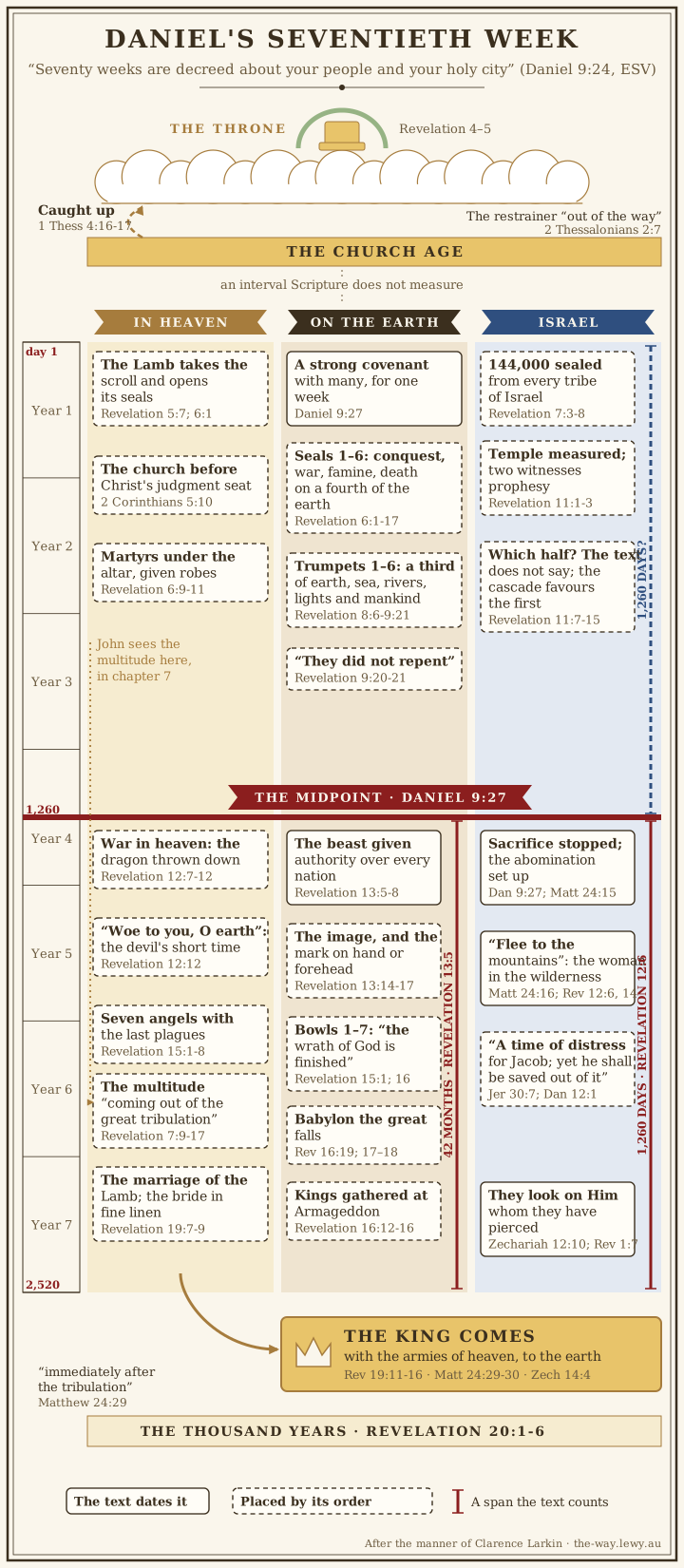
The tribulation that follows the rapture is Daniel's seventieth week: "he shall make a strong covenant with many for one week, and for half of the week he shall put an end to sacrifice and offering. And on the wing of abominations shall come one who makes desolate" (Daniel 9:27, ESV). This site reads that week as seven literal years, beginning after the church is caught up (The Rapture of the Church).
Dispensational readers identify Paul's lawless one with Daniel's covenant-maker. He comes into the open during the seven years. At their midpoint, the "half of the week" of Daniel 9:27, he "takes his seat in the temple of God, proclaiming himself to be God" (2 Thessalonians 2:4, ESV). On that reading this is the "abomination of desolation spoken of by the prophet Daniel, standing in the holy place" (Matthew 24:15, ESV), and it opens what Jesus called "great tribulation, such as has not been from the beginning of the world until now" (24:21, ESV). Paul does not say how long passes between the restrainer's going and the covenant; he says only that the revealing cannot come first.
So the order is this: the church in the midst, restraining; the church caught up; the seven years, with the lawless one revealed and seated in the temple at their midpoint; and his end "by the appearance of his coming" (2 Thessalonians 2:8, ESV).
The Spirit in the tribulation
The Holy Spirit does not leave the world. He is God: "Where shall I go from your Spirit?" (Psalm 139:7, ESV). After the church is caught up, people still come to Christ: John sees "a great multitude that no one could number, from every nation," who "are the ones coming out of the great tribulation" and "have washed their robes and made them white in the blood of the Lamb" (Revelation 7:9, 14, ESV). An angel proclaims "an eternal gospel ... to every nation and tribe and language and people" (14:6, ESV). No one is saved apart from the Spirit.
What ends is His restraining presence in the church, the body He indwells in this age. On this reading the Spirit works in the tribulation as He worked before Pentecost, among people He draws to God, and the full tide of lawlessness is let loose.
Other readings
Interpreters have proposed other restrainers, and the identification is contested. The ESV Study Bible lists the Roman Empire or emperor, the Holy Spirit and the archangel Michael (note on 2:5-7). The NIV Biblical Theology Study Bible lists seven, among them "the presence of the church and the Holy Spirit" (note on 2:6-7). The case against each alternative rests on the passage's own requirements.
The objection from verses 1-4
The sharpest objection to this study's reading comes from the NIV Cultural Backgrounds Study Bible: "Some suggest the church in the world, but this would contradict the context (vv. 1–4)" (note on 2:6-7). The answer lies in that context. Paul's subject in verse 1 is "the coming of our Lord Jesus Christ and our being gathered together to him." The error he corrects in verse 2 is that "the day of the Lord has come." Verses 3-4 list what must come before that day: the rebellion and the revealing of the man of lawlessness. They set the conditions for the day of the Lord, and the gathering of verse 1 is not among them. A church gathered before that day, and a restrainer who comes out of the midst when she is gathered, fits verses 1-4. The Rapture of the Church makes the same case at length.
Rome, Michael and the gospel
- Rome, or human government. Government does restrain evil: the ruler is "the servant of God, an avenger who carries out God's wrath on the wrongdoer" (Romans 13:4, ESV). But the third requirement fails. Rome fell, and the lawless one did not appear. Government does not come out of the midst when he is revealed; its authority passes to him, as the beast is given "authority ... over every tribe and people and language and nation" (Revelation 13:7, ESV). Victorinus of Pettau read the restrainer as Rome; What Victorinus actually says sets out what he wrote.
- The archangel Michael. This is the strongest alternative, and the NIV Biblical Theology Study Bible favours it (note on 2:6-7). Michael resists evil powers: he "came to help" against "the prince of the kingdom of Persia" (Daniel 10:13, ESV), and "Michael and his angels" fight the dragon (Revelation 12:7, ESV). The ESV Study Bible cites a Septuagint reading and rabbinic traditions in which Michael "passes away" before the great tribulation (note on 2:5-7). That Greek text is not in this project, whose Greek Daniel is Theodotion's; it reads ἀναστήσεται, "shall arise." The Hebrew verb עָמַד (amad, H5975) means "stand," and it can mean "stop" ("she ceased bearing," Genesis 29:35, ESV), so the verb alone does not settle it. The verse's context does: Michael is "the great prince who has charge of your people," and "at that time your people shall be delivered" (Daniel 12:1, ESV). He stands for Israel in the time of trouble. And he fights under God's authority: contending with the devil, he "did not presume to pronounce a blasphemous judgment, but said, 'The Lord rebuke you'" (Jude 9, ESV). On the Michael reading the restraint is still God's, which leads back to the one Person of God who dwells in the church.
- The preaching of the gospel, and Paul. The gospel is proclaimed in the tribulation (Revelation 14:6), so it does not come out of the midst when the lawless one is revealed, and Paul's death did not bring the lawless one.
What Victorinus actually says
Ken Johnson (Th.D.) argues from what he presents as an ancient Hebrew-language text of 1-2 Thessalonians, quoted by two church fathers by around AD 180, that the restrainer is named there as the Holy Spirit. The publicly available material doesn't name the manuscript, give a catalog reference, or identify the two fathers, so the claim itself can't be checked from here. And a Hebrew Vorlage for letters written to a Gentile-majority congregation in Macedonia is part of no established textual-critical tradition, unlike the Peshitta or the Old Latin.
One half of it can be checked, because our notes name Victorinus of Pettau as one of the two fathers. Haussleiter's critical edition (CSEL 49, 1916) prints both surviving recensions, and at Commentary on the Apocalypse 11.4-5 Victorinus quotes 2 Thessalonians 2:7 as donec de medio tollatur, with Jerome's revision reading donec de medio fiat. So "out of the midst" is genuinely his phrase. What follows it in his own text is a gloss identifying the restrainer as Roman imperial power — fuisse inter Caesares, "he was among the Caesars", qui tunc erat princeps, "who was then the prince." Whatever his Greek or Latin read, Victorinus did not take the restrainer to be the Church. His date is a second problem: he died around 304, so he cannot be a witness "by around AD 180."
The reading that meets all three
The Holy Spirit dwelling in the church meets all three requirements: He is a person, He is greater than Satan, and His presence in the church lasts through this age and ends when she is caught up.
Discussion Questions
- John 14:26 names the Spirit "the Helper" (masculine) and "the Holy Spirit" (neuter) in one sentence. How does that help you read Paul's "what is restraining" and "he who restrains" (2:6-7)?
- The Thessalonians thought the day of the Lord had come (2:2). What fears does the order of events in 2:1-8 answer?
- Jesus sent the Spirit to His disciples, and the Spirit convicts the world (John 16:7-8). How does the church's presence hold back evil where you live?
- Michael is the strongest alternative reading. What in Daniel 12:1 and Jude 9 weighs against it?
- Philippians 2:15 places the church "in the midst" of a crooked generation, and 2 Thessalonians 2:7 has the restrainer come "out of the midst." How does the rapture connect the two?
- Jesus sent the Spirit (John 16:7) and will end the lawless one by His coming (2:8). Trace the order of events in "Where this falls in the seven years": where is the church at each point?
- "God has not destined us for wrath" (1 Thessalonians 5:9). How does that change the way you wait?
Group study sheet for a 40-minute group: two A4 sheets, or one with the guided path
The point, the passage, the questions and the response, from this study. Print on both sides of two A4 sheets, flipping on the long edge. While this block is open, printing the page prints the sheet; close it to print the study.
The Restrainer
2 Thessalonians 2:1-12The point The restrainer of 2 Thessalonians 2:6-7 is the Holy Spirit dwelling in the church, the body of believers; while the church stands in the midst of the world, God holds back the full revelation of lawlessness, and when the church is caught up, His restraining presence comes to be out of the midst and the lawless one is revealed.
Ask: what comes to mind when you hear The Restrainer
? Hear a few answers before anyone reads.
2 Thessalonians 2:1-12 1Now concerning the coming of our Lord Jesus Christ and our being gathered together to Him, we ask you, brothers, 2not to be easily disconcerted or alarmed by any spirit or message or letter seeming to be from us, alleging that the Day of the Lord has already come. 3Let no one deceive you in any way, for it will not come until the rebellion occurs and the man of lawlessness—the son of destruction—is revealed. 4He will oppose and exalt himself above every so-called god or object of worship. So he will seat himself in the temple of God, proclaiming himself to be God. 5Do you not remember that I told you these things while I was still with you? 6And you know what is now restraining him, so that he may be revealed at the proper time. 7For the mystery of lawlessness is already at work, but the one who now restrains it will continue until he is taken out of the way. 8And then the lawless one will be revealed, whom the Lord Jesus will slay with the breath of His mouth and annihilate by the majesty of His arrival. 9The coming of the lawless one will be accompanied by the working of Satan, with every kind of power, sign, and false wonder, 10and with every wicked deception directed against those who are perishing, because they refused the love of the truth that would have saved them. 11For this reason God will send them a powerful delusion so that they believe the lie, 12in order that judgment may come upon all who have disbelieved the truth and delighted in wickedness.
Also read:
The Restrainer
- The passage. What Paul told a frightened church, and the order of events.
- What the restrainer must be. Personal, greater than Satan, present now until a set end.
- From "what" to "he". The neuter and masculine participles, and the Spirit.
- The Spirit dwells in the church. Temple, Helper, salt and light.
- Out of the midst. Paul's own phrase, Lot sent out before the fire, and the church caught up.
- Where this falls in the seven years. Daniel's seventieth week, and the temple seating at its midpoint.
- The Spirit in the tribulation. What ends and what does not.
- Other readings. Rome, government, Michael and the gospel, and where each falls short.
The Restrainer
1The Thessalonians thought the day of the Lord had come (2:2). What fears does the order of events in 2:1-8 answer?
2Jesus sent the Spirit (John 16:7) and will end the lawless one by His coming (2:8). Trace the order of events in "Where this falls in the seven years": where is the church at each point?
3John 14:26 names the Spirit "the Helper" (masculine) and "the Holy Spirit" (neuter) in one sentence. How does that help you read Paul's "what is restraining" and "he who restrains" (2:6-7)?
4Jesus sent the Spirit to His disciples, and the Spirit convicts the world (John 16:7-8). How does the church's presence hold back evil where you live?
5Philippians 2:15 places the church "in the midst" of a crooked generation, and 2 Thessalonians 2:7 has the restrainer come "out of the midst." How does the rapture connect the two?
6"God has not destined us for wrath" (1 Thessalonians 5:9). How does that change the way you wait?
7Michael is the strongest alternative reading. What in Daniel 12:1 and Jude 9 weighs against it?
The Restrainer
- Think. The Holy Spirit lives in the church, and His presence in her holds back the full tide of lawlessness now. The church matters to the world in ways the world cannot see.
- Attitude. Live as salt and light "in the midst of a crooked and twisted generation" (Philippians 2:15, ESV), unafraid of the day of wrath: "God has not destined us for wrath" (1 Thessalonians 5:9, ESV).
- Do. Paul's own command after this passage is "stand firm and hold to the traditions that you were taught by us" (2 Thessalonians 2:15, ESV). Name one place this week, at work, online or in your family, where wrong is being called right, and stand there with what Scripture says, as someone the Spirit lives in.
For the mystery of lawlessness is already at work. Only he who now restrains it will do so until he is out of the way.
2 Thessalonians 2:7 (ESV)Father, thank you for sending your Holy Spirit to dwell in your church, and for holding back the mystery of lawlessness through Him. Keep us shining in the midst of a crooked generation until your Son Jesus gathers us to Himself. Give us courage to stand, and joy to wait.
In Jesus' name. Amen.
The Restrainer
2 Thessalonians 2:1-12Open Ask: what comes to mind when you hear The Restrainer
? Hear a few answers before anyone reads.
Read it aloud 2 Thessalonians 2:1-12
1The Thessalonians thought the day of the Lord had come (2:2). What fears does the order of events in 2:1-8 answer?
2Jesus sent the Spirit (John 16:7) and will end the lawless one by His coming (2:8). Trace the order of events in "Where this falls in the seven years": where is the church at each point?
3John 14:26 names the Spirit "the Helper" (masculine) and "the Holy Spirit" (neuter) in one sentence. How does that help you read Paul's "what is restraining" and "he who restrains" (2:6-7)?
4Jesus sent the Spirit to His disciples, and the Spirit convicts the world (John 16:7-8). How does the church's presence hold back evil where you live?
5Philippians 2:15 places the church "in the midst" of a crooked generation, and 2 Thessalonians 2:7 has the restrainer come "out of the midst." How does the rapture connect the two?
6"God has not destined us for wrath" (1 Thessalonians 5:9). How does that change the way you wait?
7Michael is the strongest alternative reading. What in Daniel 12:1 and Jude 9 weighs against it?
- Think. The Holy Spirit lives in the church, and His presence in her holds back the full tide of lawlessness now. The church matters to the world in ways the world cannot see.
- Attitude. Live as salt and light "in the midst of a crooked and twisted generation" (Philippians 2:15, ESV), unafraid of the day of wrath: "God has not destined us for wrath" (1 Thessalonians 5:9, ESV).
- Do. Paul's own command after this passage is "stand firm and hold to the traditions that you were taught by us" (2 Thessalonians 2:15, ESV). Name one place this week, at work, online or in your family, where wrong is being called right, and stand there with what Scripture says, as someone the Spirit lives in.
The Restrainer
The point The restrainer of 2 Thessalonians 2:6-7 is the Holy Spirit dwelling in the church, the body of believers; while the church stands in the midst of the world, God holds back the full revelation of lawlessness, and when the church is caught up, His restraining presence comes to be out of the midst and the lawless one is revealed.
References & Recommended Reading
- ESV Study Bible (Crossway) — note on 2 Thessalonians 2:5-7 (the neuter and masculine participles; the Rome, Holy Spirit and Michael theories). ESV verse text throughout. Quoted briefly with attribution.
- NIV Biblical Theology Study Bible and NIV Cultural Backgrounds Study Bible (Zondervan) — notes on 2 Thessalonians 2:6-7 (the seven proposals; the objection from verses 1-4).
- CSB Ancient Faith Study Bible (Holman) and Legacy Standard Bible (Lockman / Three Sixteen) — footnotes on Genesis 6:3.
- Original-language data from this project's
bible-text.db— MACULA Greek (SBLGNT) for κατέχω, γίνομαι, μέσος and ἁρπάζω; unfoldingWord interlinear for 2 Thessalonians 2:6-7, John 14:26, Philippians 2:15, 1 Corinthians 5:2, 2 Corinthians 6:17, Colossians 2:14, 1 Thessalonians 4:17 and Daniel 12:1; Septuagint lemmas for Daniel 12:1; Brenton's Septuagint and the Westminster Leningrad Codex for Genesis 19:29, Numbers 16:21 and Jeremiah 51:6 (Septuagint Jeremiah 28:6). - Hebrew translations of the New Testament — Franz Delitzsch (ebible-heb) and Salkinson–Ginsburg (ebible-hebsg), both nineteenth-century translations from the Greek — at 2 Thessalonians 2:6-7, Philippians 2:15 and 2 Corinthians 6:17.
- Ken Johnson, Th.D., Paul's Ancient Hebrew Thessalonian Epistles — see What Victorinus actually says: the underlying manuscript claim could not be checked from publicly available material, and Victorinus, named as one of the two witnesses, glosses 2 Thessalonians 2:7 as Roman imperial power.
On this site
- The Rapture of the Church — the pretribulational case, and the grammar of 2 Thessalonians 2:7.
- Salt, Light and the Aroma of Christ — the church as salt and light in the world (Matthew 5:13-16; Philippians 2:15), and salt that preserves while it stays.
- Taken Before Judgment — Lot sent "out of the midst of the overthrow" before the fire (Genesis 19:22-29).
- Know the Truth — the strong delusion of 2 Thessalonians 2:10-11.
- The Names of the Holy Spirit — the Helper given "to be with you forever".