The Trumpet Call of God
A trumpet blast is never incidental in Scripture. From the thunder at Sinai to the fall of Jericho, from a king's coronation to the alarm cried in a besieged city, the same handful of instruments keep showing up at the same kind of moment: God is about to act, and someone needs to know it now. That pattern runs on past the end of the Old Testament and escalates. This study traces the trumpet from its Hebrew and Greek vocabulary through its ordinary uses in Israel's life to the seven trumpets of Revelation and the "last trumpet" of the resurrection.
In one sentence: From Sinai to Jericho to a king's coronation, a trumpet in Scripture marks the moment God has decided to act, and that same pattern climbs through Revelation's seven trumpets to the sound that finally, publicly hands God His kingdom (Revelation 11:15).
Key Takeaways
(This section follows the Key Takeaways format — see that page for what each part is for.)
Types & Prophecy
Type. No single trumpet is a type the way Melchizedek or the tabernacle are. A trumpet blast is a pattern, repeated across very different Old Testament settings, that consistently marks the same kind of moment: God moving decisively, and His people being summoned to respond. Revelation reads that pattern forward in seven trumpet-announced judgments that reuse Egypt's own plagues and Joel's locust-army imagery, climbing in intensity until the seventh trumpet announces what every earlier trumpet in Scripture was a smaller version of: God taking visible, final possession of His kingdom (Revelation 11:15).
Prophecy. Two direct verbal predictions anchor this study. Isaiah 27:13 states outright that "a great trumpet will be blown" to gather Israel's exiles back to worship at Jerusalem. In 1 Corinthians 15:51-52 Paul announces a mystery, a truth newly revealed: at "the last trumpet" the dead will be raised and the living transformed. Neither has happened yet; both are stated as certainties.
Lessons about Jesus
- The seventh trumpet's announcement, "the kingdom of the world has become the kingdom of our Lord and of his Christ" (Revelation 11:15, ESV), reuses the pattern of a trumpet-announced coronation (1 Kings 1:34-39), now applied to Christ's kingdom over the whole earth.
- Jesus Himself sends out the gathering trumpet call at His return (Matthew 24:31): "he will send out his angels." The Cultural Backgrounds Study Bible notes that the Son of Man sending "His angels" "indicates His deity" (cf. Zechariah 14:5).9
- Paul's "mystery" about the resurrection (1 Corinthians 15:51) is that the dead will be raised imperishable. The trumpet that announces Christ's return delivers what His resurrection already secured for those who are His.
Memory verses
✝️ 1 Corinthians 15:52 (ESV)
52 In a moment, in the twinkling of an eye, at the last trumpet. For the trumpet will sound, and the dead will be raised imperishable, and we shall be changed.
✝️ Revelation 11:15 (ESV)
15 Then the seventh angel blew his trumpet, and there were loud voices in heaven, saying, "The kingdom of the world has become the kingdom of our Lord and of his Christ, and he shall reign forever and ever."
Be Transformed
- Think: every trumpet in Scripture assumes someone is listening for it. A watchman who sounds an alarm no one heeds still isn't at fault for the outcome (Ezekiel 33:3-6). But a people trained to expect no trumpet at all won't recognize one when it sounds. Examine whether you're listening for what Scripture says is coming, or have quietly stopped expecting it.
- Attitude: 1 Corinthians 15:58 draws the conclusion right after this chapter's resurrection trumpet: "be steadfast, immovable, always abounding in the work of the Lord, knowing that in the Lord your labor is not in vain." The trumpet's certainty is meant to produce settled work now, not anxious speculation about timing.
- Do: name one place your life is currently arranged as though this world's ordinary order is permanent. The seventh trumpet says otherwise. Let that shape one concrete decision this week.
Prayer
Lord, every trumpet you have ever sounded has meant the same thing: you are not silent, and you are not finished. You called Israel to your presence at Sinai, you leveled Jericho's wall, you seated a king with a blast that still echoes in your Son Jesus' own coronation. You have promised one more sound is coming: a last trumpet, at which the dead in Christ rise and the living are changed, and a seventh, at which your kingdom is openly, finally yours.
Until then, let me be found awake and listening, working, and steadfast however long the wait feels. In Jesus' name. Amen.
Study outline
- Scope. Where the Feast of Trumpets is covered, and what this study traces instead.
- Two instruments, two Hebrew words. The ram's-horn shofar, the silver chatsotsrah, and the one Greek word salpigx.
- What a trumpet call was for. Five purposes in Israel's life, each with its text, and the prophets' warning trumpet.
- The trumpet as theophany: Sinai. The first trumpet in Scripture, sounding the LORD's own presence.
- The seven trumpets of Revelation. John on Patmos, a table of the seven against Egypt's plagues, Joel's locusts, and the seventh trumpet's coronation.
- At the last trumpet. 1 Corinthians 15 with 1 Thessalonians 4, Matthew 24 and Revelation 11 read one at a time, with a counter-reading.
- Then and now. What carries over from every one of these texts to the reader today.
- Discussion questions. Five, for a group or on your own.
Scope: what this study covers, and what it doesn't
Leviticus 23:23-25 commands Israel to keep a day in the seventh month marked by teruah, the blast or shout a trumpet gave. That feast, its Hebrew name (Yom Teruah), and the word teruah itself already have a full word-study treatment on this site: Feast of Trumpets: Yom Teruah. This study doesn't repeat that ground. What follows treats the trumpet as an instrument and a recurring biblical pattern across the whole canon: Sinai, the wilderness camp, the conquest, the monarchy, the prophets' warnings, and finally Revelation and the resurrection. The feast appears only as one occasion among several where a trumpet sounded.
Two instruments, two Hebrew words
Ancient Israel used two distinct instruments for the "trumpet" English translations render with one word.
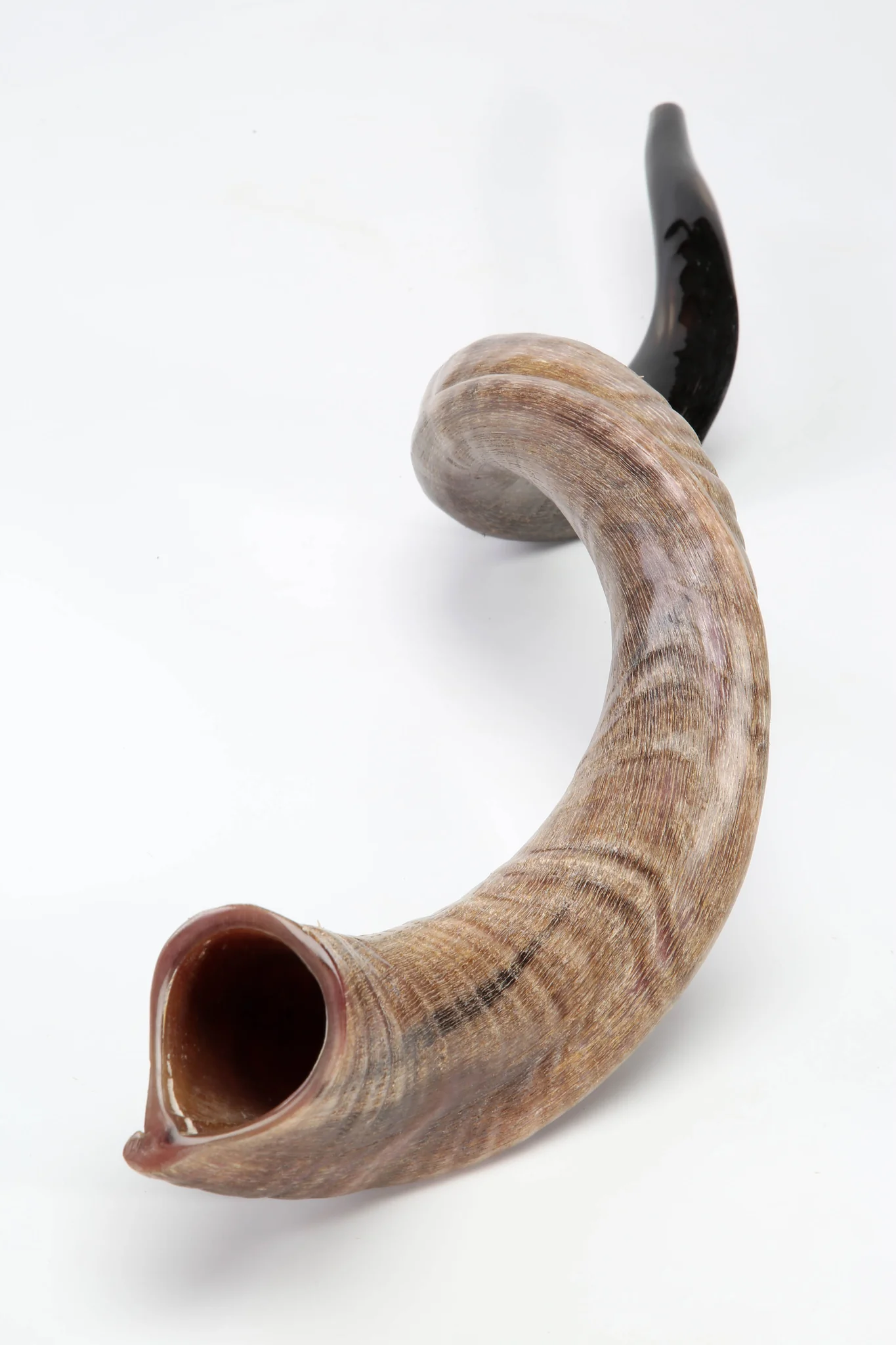
The shofar: a ram's horn
שׁוֹפָר (shofar, H7782) is a ram's horn: a natural instrument, no two alike, blown by anyone who could produce a sound from it. It announced the Day of Atonement and the start of Jubilee throughout the land (Leviticus 25:9), and it led Israel's march around Jericho (Joshua 6:4-5). Its Hebrew root sense is simply "horn," and the related noun יוֹבֵל (yobel, H3104, TWOT root 835e), "ram" or "ram's horn," is where "jubilee" gets its name: the Year of Jubilee is, at the level of its own vocabulary, "the ram's-horn year."1
The silver trumpets: chatsotsrah
חֲצֹצְרָה (chatsotsrah, H2689, TWOT root 726a), glossed "clarion," is a different instrument entirely: straight, metal, made of hammered silver, roughly two feet long with a flared end.2 Numbers 10:1-10 specifies exactly two of them, commissioned for a specific job:
✝️ Numbers 10:2-3 (ESV)
2 "Make two silver trumpets. Of hammered work you shall make them, and you shall use them for summoning the congregation and for breaking camp. 3 And when both are blown, all the congregation shall gather themselves to you at the entrance of the tent of meeting."
The Cultural Backgrounds Study Bible notes these were likely styled after Egyptian instruments of the same period: narrow-tubed, sharp-pitched trumpets known from Late Bronze Age Egypt, used in both cultic and military settings. Examples were found in Tutankhamun's own tomb.3
Josephus describes Israel's pair as just over a foot long and flared. Pictures of the captured temple trumpets survive on the Arch of Titus in Rome, carried among the plunder of Jerusalem's fall in AD 70.3
Aaron's priestly line blew the silver trumpets specifically (Numbers 10:8), and they reappear in Phinehas's hand at the battle against Midian (Numbers 31:6). So the same instrument served war as well as worship.
Two distinct jobs, one Greek word in the New Testament
The shofar and the silver trumpet had different functions. The ram's horn belonged to Israel generally, and to unrepeatable, dramatic moments: Sinai, Jericho, Jubilee. The silver trumpets belonged to the priesthood and to Israel's ordinary operating rhythm: assembling, marching, going to war, marking a feast day.
The New Testament's Greek draws no such distinction: σάλπιγξ (salpigx, G4536) covers every trumpet in the New Testament, from Paul's illustration about an army preparing for battle (1 Corinthians 14:8) to the seven angels of Revelation 8-11. The word itself carries no information about which Hebrew instrument (or neither) lies behind a given use. Context has to supply that, and the "last trumpet" section below depends on it.
What a trumpet call was for
Five purposes recur across the Old Testament, each with its own text:
- To gather the assembly. "You shall use them for summoning the congregation" (Numbers 10:2-3, ESV). Both trumpets blown in long notes called everyone (10:3, 7); blowing just one trumpet called only the tribal leaders (10:4).
- To move the camp. A different pattern, short staccato blasts sounding an alarm, signaled each tribal division in turn to break camp and march (Numbers 10:5-6).
-
To sound a war alarm. "And when you go to war in your land against the adversary who oppresses you, then you shall sound an alarm with the trumpets, that you may be remembered before the LORD your God, and you shall be saved from your enemies" (Numbers 10:9, ESV).
Here the trumpet works as a prayer as well as a signal: a plea attached to the sound itself.2 Gideon's three hundred each carried one into battle against Midian (Judges 7:16-22), and Joshua's seven priests carried rams' horns around Jericho for seven days before the city's wall fell at the sound (Joshua 6:4-5). - To mark sacred time. "At your appointed feasts... you shall blow the trumpets... they shall be a reminder of you before your God" (Numbers 10:10, ESV); the ram's horn specifically announced the Day of Atonement and, every fifty years, the start of Jubilee: "you shall sound the loud trumpet... and proclaim liberty throughout the land" (Leviticus 25:9-10, ESV). - To announce a king. When Solomon was anointed, the command was explicit: "Then blow the trumpet and say, 'Long live King Solomon!'" (1 Kings 1:34, ESV). When it happened, "they blew the trumpet, and all the people said, 'Long live King Solomon!'" (1:39, ESV). A trumpet blast was, in ancient Israel, the sound of a coronation.
The purpose the prophets return to most is the warning: "Is a trumpet blown in a city, and the people are not afraid?" (Amos 3:6, ESV). Zephaniah names an entire coming day by its trumpet: "a day of trumpet blast and battle cry" (Zephaniah 1:16, ESV). Joel opens his description of the Day of the LORD the same way: "Blow a trumpet in Zion; sound an alarm on my holy mountain" (Joel 2:1, ESV). He then describes an invading army "like the appearance of horses," advancing in unbroken ranks, darkening the sun and moon (2:4-10). That image (locust-like, horse-shaped, unstoppable, sun-darkening) resurfaces almost unchanged under Revelation's fifth trumpet.
The trumpet as theophany: Sinai
Before any of those ordinary uses existed, a trumpet had already announced the LORD's own arrival:
✝️ Exodus 19:16 (ESV)
16 On the morning of the third day there were thunders and lightnings and a thick cloud on the mountain and a very loud trumpet blast, so that all the people in the camp trembled.
The ESV Study Bible's note ties the sound directly to the sight. "All the sights... and sounds... signify the LORD's presence... a continual reminder to Israel that the LORD had spoken to Moses."4
Here the trumpet is part of what God's presence sounds like, growing "louder and louder" as the mountain shakes (19:19).
Every later trumpet in Israel's worship inherits that first association: gathering the congregation, marking a feast, sounding Atonement. The sound itself means the LORD is here.
Hebrews 12:19 looks back on this same trumpet centuries later. It is part of what made Sinai a terrifying encounter, and believers under the new covenant are told explicitly that they have not come to it (Hebrews 12:18-24). So in the New Testament's own reckoning the sound still marks God's dramatic, unmediated presence.
The seven trumpets of Revelation
John's own circumstances
John received this vision while exiled on Patmos, an Aegean island Rome used to banish political prisoners (Revelation 1:9). He gives that detail himself, as evidence he shares in the very "tribulation" his readers are enduring.5
What follows is addressed to seven specific, named congregations in Asia Minor (chs. 2-3), already under real pressure before a single trumpet sounds. So the trumpet judgments are the second half of a vision whose first half is Christ's own diagnosis of, and promises to, the churches reading it.
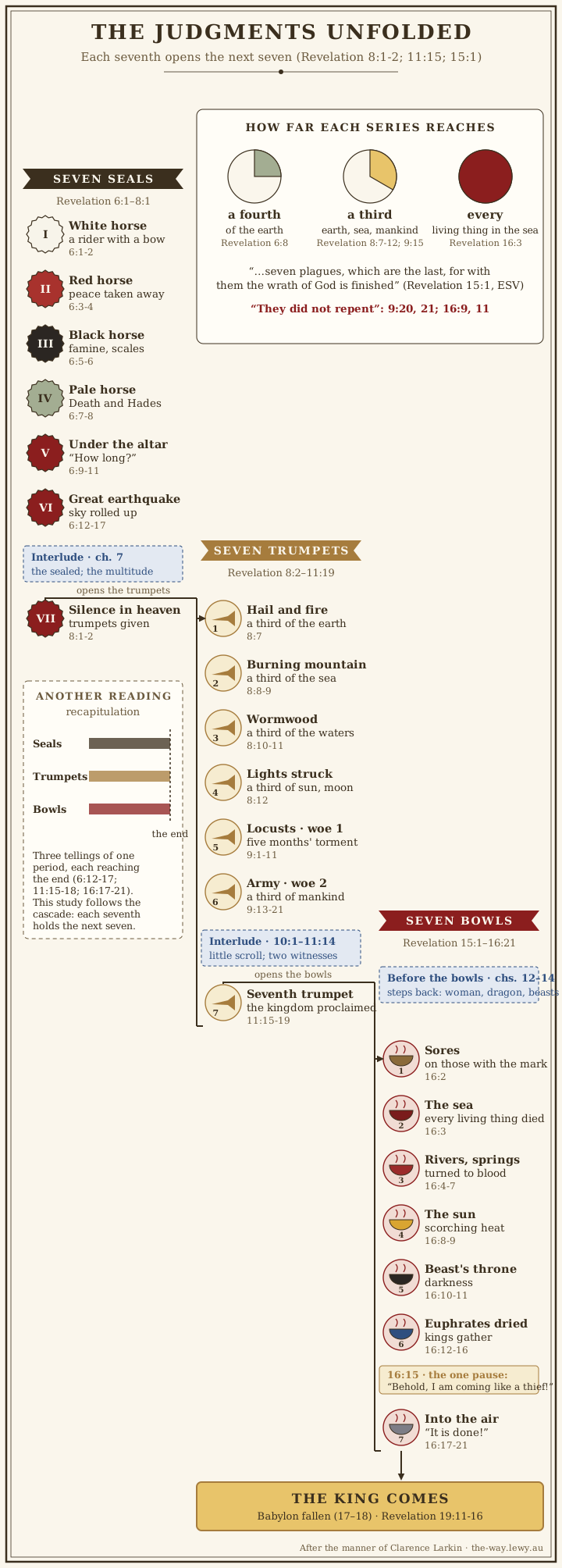
Revelation structures its judgments in four cycles: seven letters, seven seals, seven trumpets, seven bowls. The trumpets are the third.6
The trumpets' Exodus pattern
They open in heaven. Seven angels are given seven trumpets in response to the prayers of the saints, offered up with incense from a golden altar (Revelation 8:2-5), before the first one sounds. What follows deliberately reuses Egypt's own plagues, escalated from one nation to "those who dwell on the earth":
| Trumpet | Revelation | Result | Old Testament echo |
|---|---|---|---|
| First | 8:7 | Hail, fire, and blood cast on the earth — a third of it, and all green grass, burned up | The seventh plague on Egypt: hail mixed with fire (Exodus 9:23-24) |
| Second | 8:8-9 | A burning mountain cast into the sea — a third of the sea turned to blood, a third of sea life and ships destroyed | The first plague: the Nile turned to blood (Exodus 7:20-21) |
| Third | 8:10-11 | A burning star, "Wormwood," falls on a third of the rivers and springs, poisoning them | The first plague's undrinkable water (Exodus 7:21), now made bitter in rivers and springs |
| Fourth | 8:12 | A third of the sun, moon, and stars struck, darkening a third of day and night | The ninth plague: darkness over the land (Exodus 10:21-22) |
| Fifth (1st woe) | 9:1-11 | Locusts from the abyss torment (not kill) those without God's seal, for five months | The eighth plague, locusts (Exodus 10:12-15) — but their shape and battle-array come from Joel's locust army (Joel 2:4-11), not Exodus |
| Sixth (2nd woe) | 9:13-21 | Four bound angels released at the Euphrates lead a vast army that kills a third of mankind | — |
| Seventh (3rd woe) | 11:15-19 | "The kingdom of the world has become the kingdom of our Lord and of his Christ" | The coronation-trumpet pattern of 1 Kings 1:34-39, now cosmic |
The Cultural Backgrounds Study Bible tracks this Exodus pattern across two of Revelation's judgment cycles, the trumpets and again the bowls of chapter 16. Its conclusion: "Revelation is not simply recounting what happened in Moses's day; it is depicting judgments on the world in familiar biblical terms."7
The fifth trumpet's borrowed imagery
John's locusts are "like horses prepared for battle," crowned, with human faces, women's hair, and a king named Ἀβαδδών / Ἀπολλύων, Hebrew and Greek names both meaning "Destroyer" (Revelation 9:7-11).
None of that comes from Exodus's locust plague, which is simply locusts. It comes from Joel 2:4-11's war-horse imagery, describing what Joel calls Yahweh's own army executing the Day of the LORD. Revelation identifies which prophetic locust-army this is.
Where the escalation ends
The fourth seal had touched "a fourth" of the earth (Revelation 6:8). The first four trumpets touch "a third": worse, and still restrained, "giving foretastes of total devastation to come if rebels ignore his warnings."6
The seventh trumpet is where restraint ends. It sounds a coronation, as one sounded for Solomon a thousand years earlier. This throne is the whole world's, and this reign has no successor to wait for.
Revelation 10:7 marks the same moment from another angle. It is the point at which "the mystery of God would be fulfilled, just as he announced to his servants the prophets" (ESV). Every trumpet warning the prophets ever gave was building toward this one sound.
"At the last trumpet": three texts, not automatically one event
Three New Testament passages use trumpet language for a future gathering, and popular reading often merges them into a single moment. The vocabulary invites that, since all three use forms of the same word, salpigx. Vocabulary alone cannot establish it. Read on their own terms, each text names a different audience and a different content.
1 Corinthians 15 and 1 Thessalonians 4: the church's resurrection
1 Corinthians 15:51-53 and 1 Thessalonians 4:16-17 address the church specifically. "We shall not all sleep, but we shall all be changed" (1 Corinthians 15:51, ESV). "The dead in Christ will rise first. Then we who are alive, who are left, will be caught up together with them" (1 Thessalonians 4:16-17, ESV).
The ESV Study Bible identifies the verb behind "caught up" as ἁρπάζω (harpazō, G726, "to seize suddenly, snatch away"), which is the term the word "rapture" translates. It notes that the three sounds Paul describes (a cry of command, an archangel's voice, "the trumpet of God") together summon the dead to rise, before the living join them in the air.8
Neither passage mentions judgment on unbelievers, a tribulation, or the earth itself. The whole scene concerns believers already united to Christ.
Matthew 24: Israel's regathering after tribulation
Matthew 24:29-31 is different in every one of those respects. It comes explicitly "immediately after the tribulation of those days" (24:29, ESV), a stated chronological marker neither Corinthians nor Thessalonians carries. And it describes Christ's visible appearing "with power and great glory," at which His angels "will gather his elect from the four winds" (24:30-31).
The Cultural Backgrounds Study Bible traces this trumpet image to Jewish end-time expectation rooted in Isaiah 27:12-13, a passage naming Israel specifically. Exiled Israelites "lost in the land of Assyria" and "driven out to the land of Egypt," gathered by a "great trumpet" to worship at Jerusalem (Isaiah 27:13, ESV).9
That is a regathering of scattered Israel, to a specific place, at a stated point after tribulation. It is not the same shape of event as believers of every nation caught up to meet Christ "in the air".
Revelation 11: a kingdom announcement and judgment
Revelation 11:15-19, the seventh trumpet studied above, differs from both: it is the last of a numbered judgment sequence falling on "those who dwell on the earth" (8:13), and its content is a kingdom announcement and a reckoning: "the time for the dead to be judged, and for rewarding your servants, the prophets and saints, and those who fear your name, both small and great, and for destroying the destroyers of the earth" (11:18, ESV). It describes no resurrection of the righteous dead in Christ.
A counter-reading, and this study's timing distinction
Not every source treats these three as sharply distinct. The NIV Biblical Theology Study Bible lists Isaiah 27:13, Joel 2:1, Matthew 24:31, 1 Thessalonians 4:16 and Revelation's trumpets together as one family of "trumpet announces the Lord's coming" texts, without separating them by timing.10
That is true as far as it goes. All of them draw on the same Old Testament pattern this study has traced from Sinai onward. And Revelation 10:7's "mystery of God", fulfilled at the seventh trumpet, echoes the very word Paul uses for the resurrection: "I tell you a mystery" (1 Corinthians 15:51).
But sharing an image and a vocabulary word is not sharing an event. Paul's audience, timing and content point one way. Matthew's point another. Revelation's a third.
On a dispensational reading, which keeps the church's hope distinct from Israel's promised regathering and from the tribulation judgments poured out on an unbelieving world, that is what the text's own details predict. Three trumpets, doing three different jobs. A shofar at Jericho and a shofar at Jubilee were two occasions with the same kind of horn.
Then and now
A trumpet in Scripture marks the specific moment God has decided to act. The right response is readiness for what it announces: worship at Sinai, obedience in the camp, resistance in war, celebration at a coronation, repentance at a warning. Which instrument, which occasion and which audience belong to each text's own moment; a ram's horn calling one nation to atonement and the last trumpet raising the dead in Christ are different events. Amos asked it of a besieged city, and it holds for every trumpet in Scripture: when the trumpet sounds, something real is happening (Amos 3:6).
Discussion questions
- A shofar and a silver trumpet were never interchangeable in ancient Israel: different material, different maker, different job. Where do you collapse things Scripture keeps distinct, the way popular reading often merges the "last trumpet" texts?
- Revelation's fifth trumpet takes its locust imagery from Joel's army. What does it change to read Revelation as identifying an existing prophecy?
- The seventh trumpet's coronation language deliberately echoes 1 Kings 1:34-39. Does thinking of Christ's future reign as a coronation (a specific, sound-marked moment) change how you picture "the kingdom of God" versus treating it as a vague future state?
- Numbers 10:9 ties the war trumpet to being "remembered before the LORD"; the sound is described as a kind of prayer. Where in your own life could a concrete, audible act (not just an internal feeling) function the same way?
- Amos asks whether a trumpet can sound in a city without the people trembling. What would it look like for you to tremble at what Scripture says is still coming, as well as agree with it?
Group study sheet for a 40-minute group: two A4 sheets, or one with the guided path
The point, the passage, the questions and the response, from this study. Print on both sides of two A4 sheets, flipping on the long edge. While this block is open, printing the page prints the sheet; close it to print the study.
The Trumpet Call of God
Revelation 8:6-9:21; 11:15-19The point From Sinai to Jericho to a king's coronation, a trumpet in Scripture marks the moment God has decided to act, and that same pattern climbs through Revelation's seven trumpets to the sound that finally, publicly hands God His kingdom (Revelation 11:15).
Ask: what comes to mind when you hear The Trumpet Call of God
? Hear a few answers before anyone reads.
Revelation 8:6-9:21 8:6And the seven angels with the seven trumpets prepared to sound them. 7Then the first angel sounded his trumpet, and hail and fire mixed with blood were hurled down upon the earth. A third of the earth was burned up, along with a third of the trees and all the green grass. 8Then the second angel sounded his trumpet, and something like a great mountain burning with fire was thrown into the sea. A third of the sea turned to blood, 9a third of the living creatures in the sea died, and a third of the ships were destroyed. 10Then the third angel sounded his trumpet, and a great star burning like a torch fell from heaven and landed on a third of the rivers and on the springs of water. 11The name of the star is Wormwood. A third of the waters turned bitter like wormwood oil, and many people died from the bitter waters. 12Then the fourth angel sounded his trumpet, and a third of the sun and moon and stars were struck. A third of the stars were darkened, a third of the day was without light, and a third of the night as well. 13And as I observed, I heard an eagle flying overhead, calling in a loud voice, “Woe! Woe! Woe to those who dwell on the earth, because of the trumpet blasts about to be sounded by the remaining three angels!” 9:1Then the fifth angel sounded his trumpet, and I saw a star that had fallen from heaven to earth, and it was given the key to the pit of the Abyss. 2The star opened the pit of the Abyss, and smoke rose out of it like the smoke of a great furnace, and the sun and the air were darkened by the smoke from the pit. 3And out of the smoke, locusts descended on the earth, and they were given power like that of the scorpions of the earth. 4They were told not to harm the grass of the earth or any plant or tree, but only those who did not have the seal of God on their foreheads. 5The locusts were not given power to kill them, but only to torment them for five months, and their torment was like the stinging of a scorpion. 6In those days men will seek death and will not find it; they will long to die, but death will escape them. 7And the locusts looked like horses prepared for battle, with something like crowns of gold on their heads; and their faces were like the faces of men. 8They had hair like that of women, and teeth like those of lions. 9They also had breastplates like breastplates of iron, and the sound of their wings was like the roar of many horses and chariots rushing into battle. 10They had tails with stingers like scorpions, which had the power to injure people for five months.
Also read: Revelation 8:6-9:21 from 9:11; Revelation 11:15-19
The Trumpet Call of God
- Scope. Where the Feast of Trumpets is covered, and what this study traces instead.
- Two instruments, two Hebrew words. The ram's-horn shofar, the silver chatsotsrah, and the one Greek word salpigx.
- What a trumpet call was for. Five purposes in Israel's life, each with its text, and the prophets' warning trumpet.
- The trumpet as theophany: Sinai. The first trumpet in Scripture, sounding the LORD's own presence.
- The seven trumpets of Revelation. John on Patmos, a table of the seven against Egypt's plagues, Joel's locusts, and the seventh trumpet's coronation.
- At the last trumpet. 1 Corinthians 15 with 1 Thessalonians 4, Matthew 24 and Revelation 11 read one at a time, with a counter-reading.
- Then and now. What carries over from every one of these texts to the reader today.
The Trumpet Call of God
1Numbers 10:9 ties the war trumpet to being "remembered before the LORD"; the sound is described as a kind of prayer. Where in your own life could a concrete, audible act (not just an internal feeling) function the same way?
2The seventh trumpet's coronation language deliberately echoes 1 Kings 1:34-39. Does thinking of Christ's future reign as a coronation (a specific, sound-marked moment) change how you picture "the kingdom of God" versus treating it as a vague future state?
3A shofar and a silver trumpet were never interchangeable in ancient Israel: different material, different maker, different job. Where do you collapse things Scripture keeps distinct, the way popular reading often merges the "last trumpet" texts?
4Revelation's fifth trumpet takes its locust imagery from Joel's army. What does it change to read Revelation as identifying an existing prophecy?
5Amos asks whether a trumpet can sound in a city without the people trembling. What would it look like for you to tremble at what Scripture says is still coming, as well as agree with it?
The Trumpet Call of God
- Think: every trumpet in Scripture assumes someone is listening for it. A watchman who sounds an alarm no one heeds still isn't at fault for the outcome (Ezekiel 33:3-6). But a people trained to expect no trumpet at all won't recognize one when it sounds. Examine whether you're listening for what Scripture says is coming, or have quietly stopped expecting it.
- Attitude: 1 Corinthians 15:58 draws the conclusion right after this chapter's resurrection trumpet: "be steadfast, immovable, always abounding in the work of the Lord, knowing that in the Lord your labor is not in vain." The trumpet's certainty is meant to produce settled work now, not anxious speculation about timing.
- Do: name one place your life is currently arranged as though this world's ordinary order is permanent. The seventh trumpet says otherwise. Let that shape one concrete decision this week.
In a moment, in the twinkling of an eye, at the last trumpet. For the trumpet will sound, and the dead will be raised imperishable, and we shall be changed.
1 Corinthians 15:52 (ESV)Lord, every trumpet you have ever sounded has meant the same thing: you are not silent, and you are not finished. You called Israel to your presence at Sinai, you leveled Jericho's wall, you seated a king with a blast that still echoes in your Son Jesus' own coronation. You have promised one more sound is coming: a last trumpet, at which the dead in Christ rise and the living are changed, and a seventh, at which your kingdom is openly, finally yours.
Until then, let me be found awake and listening, working, and steadfast however long the wait feels. In Jesus' name. Amen.
The Trumpet Call of God
Revelation 8:6-9:21; 11:15-19Open Ask: what comes to mind when you hear The Trumpet Call of God
? Hear a few answers before anyone reads.
Read it aloud Revelation 8:6-9:21; 11:15-19
1Numbers 10:9 ties the war trumpet to being "remembered before the LORD"; the sound is described as a kind of prayer. Where in your own life could a concrete, audible act (not just an internal feeling) function the same way?
2The seventh trumpet's coronation language deliberately echoes 1 Kings 1:34-39. Does thinking of Christ's future reign as a coronation (a specific, sound-marked moment) change how you picture "the kingdom of God" versus treating it as a vague future state?
3A shofar and a silver trumpet were never interchangeable in ancient Israel: different material, different maker, different job. Where do you collapse things Scripture keeps distinct, the way popular reading often merges the "last trumpet" texts?
4Revelation's fifth trumpet takes its locust imagery from Joel's army. What does it change to read Revelation as identifying an existing prophecy?
5Amos asks whether a trumpet can sound in a city without the people trembling. What would it look like for you to tremble at what Scripture says is still coming, as well as agree with it?
- Think: every trumpet in Scripture assumes someone is listening for it. A watchman who sounds an alarm no one heeds still isn't at fault for the outcome (Ezekiel 33:3-6). But a people trained to expect no trumpet at all won't recognize one when it sounds. Examine whether you're listening for what Scripture says is coming, or have quietly stopped expecting it.
- Attitude: 1 Corinthians 15:58 draws the conclusion right after this chapter's resurrection trumpet: "be steadfast, immovable, always abounding in the work of the Lord, knowing that in the Lord your labor is not in vain." The trumpet's certainty is meant to produce settled work now, not anxious speculation about timing.
- Do: name one place your life is currently arranged as though this world's ordinary order is permanent. The seventh trumpet says otherwise. Let that shape one concrete decision this week.
The Trumpet Call of God
The point From Sinai to Jericho to a king's coronation, a trumpet in Scripture marks the moment God has decided to act, and that same pattern climbs through Revelation's seven trumpets to the sound that finally, publicly hands God His kingdom (Revelation 11:15).
References & Recommended Reading
- ESV Bible (Crossway) — primary translation quoted throughout, per this site's translation conventions. World English Bible (WEB), queried from this repo's own text database, used for initial research passages.
- MACULA Greek Linguistic Datasets (SBLGNT) and MACULA Hebrew Linguistic Datasets (WLC),
queried via this repo's
references/build/bible-text.db— source of every Strong's number, gloss, and Greek/Hebrew form cited above, including the full NT concordance for salpigx (G4536) and OT concordance for shofar (H7782) behind this study's scoping. - Theological Wordbook of the Old Testament (TWOT), ed. R. Laird Harris, Gleason L. Archer Jr., and Bruce K. Waltke (Moody Publishers) — roots 2449c (shofar), 726a (chatsotsrah), and 835e (yobel), consulted via this repo's committed TWOT Strong's-number map.
- ESV Study Bible (Crossway, 2016) — consulted last, as a check on conclusions already reached from the text. Source of the Numbers 10 silver-trumpet background (construction, Josephus citation, the "blowing" vs. "alarm" distinction), the Exodus 19 Sinai note, the Leviticus 25 Jubilee/yobel word connection, the Revelation 1:9 Patmos background, the four-cycle structure of Revelation's judgments, and the harpazō word study at 1 Thessalonians 4:16-17.
- NIV Cultural Backgrounds Study Bible and NKJV Cultural Backgrounds Study Bible (Zondervan, ed. John H. Walton and Craig S. Keener) — source of the Numbers 10 silver-trumpet construction detail (Egyptian parallels, Tutankhamun's tomb), the Exodus-plague/trumpet/bowl parallel chart behind this study's Seven Trumpets table, the Joel-locust background to Revelation 9's fifth trumpet, and the Isaiah 27:12-13 background to Matthew 24:31.
- NIV Biblical Theology Study Bible (Zondervan, 2018), gen. ed. D. A. Carson — consulted for the 1 Corinthians 15:52 cross-reference list, engaged directly in the "last trumpet" section above rather than simply cited, since it reads those texts as one thematic family rather than drawing the timing distinction this study argues for.
- Flavius Josephus, Jewish Antiquities 3.291 — description of the silver trumpets' physical dimensions, consulted via the ESV Study Bible's citation.
- Related study on this site: Feast of Trumpets: Yom Teruah — the full word study on teruah and the Leviticus 23 feast this study deliberately doesn't repeat.
-
ESV Study Bible, note on Leviticus 25:8-12. ↩
-
NIV Cultural Backgrounds Study Bible / NKJV Cultural Backgrounds Study Bible, note on Numbers 10:2. ↩↩
-
ESV Study Bible, note on Exodus 19:16-20. ↩
-
ESV Study Bible, note on Revelation 1:9. ↩
-
ESV Study Bible, notes on Revelation 8:2-11:18 and 8:6-11:18. ↩↩
-
NIV Cultural Backgrounds Study Bible / NKJV Cultural Backgrounds Study Bible, note on Revelation 8:7-9:19. ↩
-
ESV Study Bible, note on 1 Thessalonians 4:16-17. ↩
-
NKJV Cultural Backgrounds Study Bible, note on Matthew 24:31. ↩↩
-
NIV Biblical Theology Study Bible, note on 1 Corinthians 15:52. ↩