Taken before judgment: Enoch, Noah, Lot and Elijah
Before the flood, God took Enoch. Before the fire, the angels pulled Lot out of Sodom by the hand. Elijah went up in a whirlwind while he was still talking with Elisha. And Noah, in the same chapters as Enoch, went into the ark and was carried through the water. Three lives removed from the earth before judgment reached them, and one preserved in the middle of it.
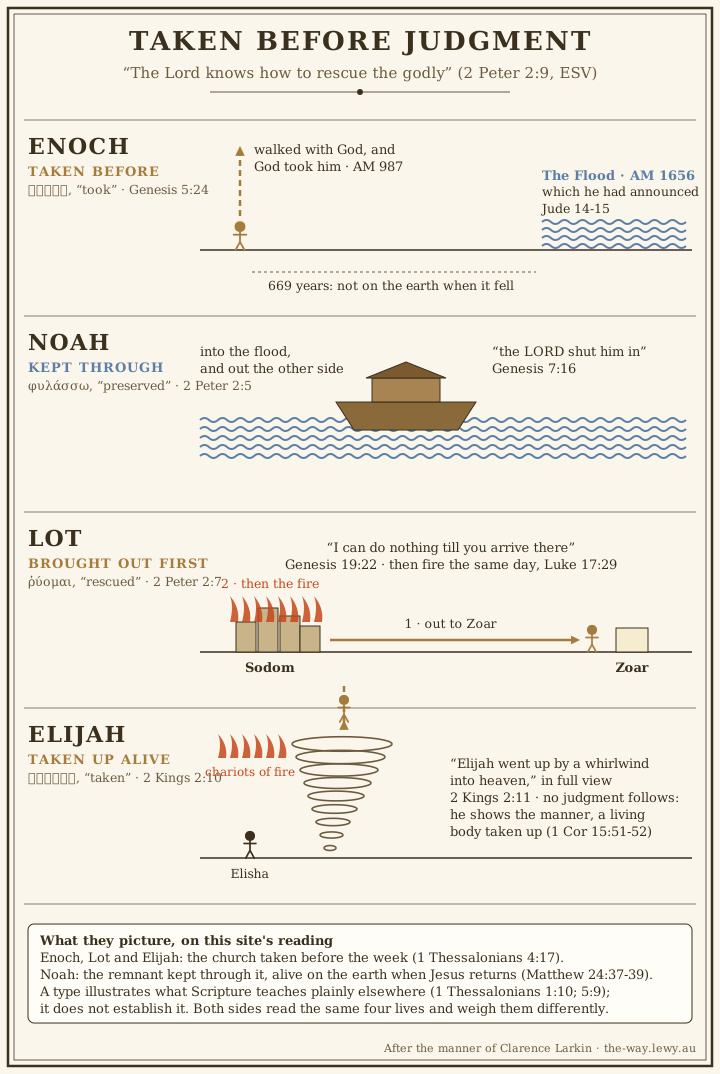
In one sentence: Enoch, Lot and Elijah were taken out before God's judgment reached them and Noah was kept through it, which shows that God distinguishes His own in the day of wrath and knows how to rescue them; read as types, they illustrate the promise Jesus and Paul give directly, that the church will be caught up before the tribulation.
Key Takeaways
(This section follows the Key Takeaways format — see that page for what each part is for.)
Types & Prophecy
Types. Enoch "was taken up so that he should not see death" (Hebrews 11:5, ESV). Lot was brought out of Sodom before "the LORD rained on Sodom and Gomorrah sulfur and fire" (Genesis 19:24, ESV). Elijah "went up by a whirlwind into heaven" (2 Kings 2:11, ESV). Enoch and Elijah are living persons taken up bodily, the shape Paul gives the rapture in 1 Thessalonians 4:17, and Lot shows the timing: out before the fire. Noah, "preserved" through the flood (2 Peter 2:5, ESV), is a second pattern beside them.
How much weight they carry. A type is an argument from resemblance. It illustrates a doctrine that Scripture teaches in plain words somewhere else; it does not establish one on its own. The pretribulational rapture rests on 1 Thessalonians 4:13-18, 1 Thessalonians 1:10 and 5:9, and the restrainer of 2 Thessalonians 2:6-7, set out in The Rapture of the Church. These four lives show the same God acting the same way long before.
Lessons about Jesus
- Jesus is the One who delivers. Paul calls Him "Jesus who delivers us from the wrath to come" (1 Thessalonians 1:10, ESV), with the same verb Peter uses when God "rescued righteous Lot" (2 Peter 2:7, ESV).
- Jesus chose these stories Himself. "Just as it was in the days of Noah... Likewise, just as it was in the days of Lot" (Luke 17:26, 28, ESV). He told His disciples to read His coming through them.
Memory verses
✝️ Hebrews 11:5 (ESV)
5 By faith Enoch was taken up so that he should not see death, and he was not found, because God had taken him. Now before he was taken he was commended as having pleased God.
✝️ 2 Peter 2:9 (ESV)
9 then the Lord knows how to rescue the godly from trials, and to keep the unrighteous under punishment until the day of judgment,
Be Transformed
- Think. The God who took Enoch and pulled Lot out by the hand is the God you wait for. "God has not destined us for wrath, but to obtain salvation through our Lord Jesus Christ" (1 Thessalonians 5:9, ESV).
- Attitude. Walk with God now, the way Enoch did for three hundred years, and leave the timing of your going to Him.
- Do. Lot "lingered", and the angels took him by the hand (Genesis 19:16, ESV). Name the thing in your own Sodom that makes you linger, confess it to God this week, and ask one believer you trust to take you by the hand on it by asking you about it next week.
Prayer
Father, you walked with Enoch and took him to yourself. You were merciful to Lot and brought him out by the hand, and you shut Noah into the ark with your own hand. Thank you that you know how to rescue the godly, and that your Son Jesus delivers us from the wrath to come. Teach us to walk with you today, and to be ready to go when He calls.
In Jesus' name. Amen.
Study outline
- Reading a type. What typology can carry, and what it cannot.
- Enoch. Genesis 5, the Hebrew verbs, and the prophet of judgment who never saw it.
- Noah. The one kept through the flood, the words Scripture uses of him, where the prophets name him, and whom he pictures.
- Lot. Seized by the hand, and a judgment that could not start until he was out.
- Elijah. A living man taken up in front of a witness.
- What the pattern shows, and where it stops. The objection from Noah, stated fairly, and the texts the doctrine stands on.
Reading a type
A type is a real person or event in the Old Testament that resembles something God does later. Paul calls Adam "a type of the one who was to come" (Romans 5:14, ESV). The resemblance is real, and it is the whole of the argument: a narrative records what God did once, and a type says He acted in a recognisable pattern.
This study's claim is modest. The New Testament writers name Enoch, Noah and Lot, and Jesus names Noah and Lot in the same breath as His coming (Luke 17:26-30). No New Testament writer sets Enoch beside the rapture in so many words. Hebrews uses Enoch for faith (11:5-6). Jude uses him for his prophecy (14-15). Reading Enoch as a picture of the rapture is an inference from pattern, and it is only as strong as the direct texts it illustrates. Those texts are strong, and they are collected in The Rapture of the Church.
Enoch: taken before the flood
"Enoch walked with God, and he was not, for God took him" (Genesis 5:24, ESV). Genesis 5 is a genealogy with a refrain. Each man lives, fathers a son, lives on, "and he died." Enoch's entry breaks the refrain twice. Where the others simply live, "Enoch walked with God" (5:22, ESV). Where the others die, "he was not, for God took him." He was 365 years old (5:23).
What the Hebrew says
Two details in the Hebrew sharpen this. "Walked" is וַיִּתְהַלֵּךְ (wayyithallēkh), from הָלַךְ (hālakh, H1980), a Hithpael, the stem that carries iterative or habitual action. It describes a sustained manner of life, "walked about with God," and Genesis uses the same form twice (5:22, 5:24) to frame the three hundred years between. The ESV Study Bible notes the same stem for Noah (6:9). The stem marks the intimacy, and what God did with each man was His own choice. The Septuagint renders it with εὐαρεστέω (euaresteō, yoo-ah-res-TEH-oh, G2100), "pleased" God, and Hebrews picks up that verb: "before he was taken he was commended as having pleased God" (Hebrews 11:5, ESV).
"Took" is לָקַח (lāqach, H3947), the ordinary verb for taking or fetching. It is the same verb Scripture uses for Elijah's departure (2 Kings 2:3, 5, 9, 10), and for the psalmists' hope beyond death: "for he will receive me" (Psalm 49:15, ESV), and "afterward you will receive me to glory" (Psalm 73:24, ESV). The ESV renders לָקַח "took" in Genesis and "receive" in both psalms, so an English reader cannot see the link without checking the underlying word. The verb is common (966 occurrences in the Hebrew Bible), which makes the link a possible echo for the reader to weigh; the NLT Life Application Study Bible cross-references Genesis 5:24 to Psalm 73:24. Hebrews uses μετατίθημι (metatithēmi, meh-ta-TEE-thay-mee, G3346), "transfer," twice in one verse, with its noun μετάθεσις (metathesis, meh-TATH-eh-sis, G3331) once, following the Septuagint's verb at Genesis 5:24.
The prophet of judgment who did not see it
Enoch is "the seventh from Adam," and Jude records his prophecy: "Behold, the Lord comes with ten thousands of his holy ones, to execute judgment on all" (Jude 14-15, ESV). The man who announced judgment was taken before it came.
On the Masoretic numbers, Enoch fathered Methuselah at 65 (Genesis 5:21) and was taken at 365, when Methuselah was 300. Methuselah fathered Lamech at 187, Lamech fathered Noah at 182, and Noah was 600 when the flood came (5:25, 28; 7:6). That puts the flood in the 969th year of Methuselah's life, the year he died (5:27), and 669 years after Enoch was taken. The Septuagint's numbers differ, and The Flood and the King Lists explains why this site works from the Masoretic. On the Masoretic numbers, Genesis does not time Enoch's removal to the flood. What it records is a man who walked with God, was taken alive, and was not on the earth when the judgment he had announced fell on it. This shows that God keeps company with those who walk with Him, and that death does not get the last word over them.
Noah: preserved through the judgment
Noah is a different pattern. "Go into the ark, you and all your household, for I have seen that you are righteous before me in this generation" (Genesis 7:1, ESV). He and his family go into the flood, and "the LORD shut him in" (Genesis 7:16, ESV). They come out the other side. Peter's word is "preserved": God "did not spare the ancient world, but preserved Noah, a herald of righteousness, with seven others" (2 Peter 2:5, ESV). The verb is φυλάσσω (phylassō, fee-LAS-soh, G5442), to guard.
Enoch and Noah are both righteous and both spared. God took one before the judgment and guarded the other through it. Jesus chose the flood as His picture of His own coming: "As were the days of Noah, so will be the coming of the Son of Man" (Matthew 24:37, ESV). In that picture the flood "swept them all away," and Noah is the one left on the earth, the reading worked out in One Taken, One Left. Jesus places that coming "immediately after the tribulation of those days" (Matthew 24:29, ESV).
What Scripture calls Noah
Each of the four lives has its own verb, and none of Noah's is a verb of removal.
| Hebrew | Greek | |
|---|---|---|
| Enoch | לָקַח (lāqach), "took" (Genesis 5:24) | μετέθηκεν, "transferred" (Hebrews 11:5) |
| Elijah | לֻקָּח (luqqāch, H3947), "taken," and וַיַּעַל, "went up" (2 Kings 2:10-11) | |
| Lot | וַיֹּצִאֻהוּ, "brought him out" (Genesis 19:16) | ἐρρύσατο, "rescued" (2 Peter 2:7) |
| Noah | וַיִּשָּׁאֶר (wayyishshā'er, H7604), "was left" (Genesis 7:23) | ἐφύλαξεν, "preserved" (2 Peter 2:5); διεσώθησαν δι' ὕδατος, "were brought safely through water" (1 Peter 3:20) |
Genesis puts Noah inside the ark in 7:7, and "after seven days the waters of the flood came upon the earth" (7:10, ESV). The Hebrew of 7:16 is וַיִּסְגֹּר יְהוָה בַּעֲדוֹ (wayyisgōr YHWH ba'ădô, the verb סָגַר, H5462), "the LORD shut him in" (ESV). The chapter closes: "Only Noah was left, and those who were with him in the ark" (7:23, ESV).
The New Testament names Noah eight times: Matthew 24:37-38, Luke 3:36 and 17:26-27, Hebrews 11:7, 1 Peter 3:20 and 2 Peter 2:5. Hebrews says he built the ark "for the saving of his household" (11:7, ESV). Peter says "a few, that is, eight persons, were brought safely through water" (1 Peter 3:20, ESV). None of these has Noah leave the earth. Luke and Matthew give his entry into the ark as the end of ordinary life (Luke 17:27; Matthew 24:38), and Genesis 7:13 repeats the entry on the day the fountains of the deep burst. Either way he was inside when the water came.
The prophets use Noah three ways. Isaiah 54:9 has God say, "This is like the days of Noah to me: as I swore that the waters of Noah should no more go over the earth, so I have sworn that I will not be angry with you" (ESV), the flood as the pattern of an oath to Israel. Ezekiel 14:14 and 20 name Noah, Daniel and Job as men who "would deliver but their own lives by their righteousness" (14:14, ESV), a righteous man kept alive while judgment falls on the land. And Isaiah 26:20 takes Noah's words without naming him: "Come, my people, enter your chambers, and shut your doors behind you; hide yourselves for a little while until the fury has passed by" (ESV). The Hebrew סְגֹר ... בַּעֲדֶךָ is the verb and preposition of Genesis 7:16, and the ESV Study Bible notes that "Isaiah alludes to Gen. 7:16." The people in Isaiah's picture are sheltered on the earth while the fury passes. Which period that describes is debated, and 26:19, "Your dead shall live; their bodies shall rise" (ESV), stands just before it.
So in the dispensational reading Noah pictures the people God preserves through the tribulation: the believing remnant who are on the earth when Jesus returns in glory, and who enter the kingdom alive. That reading places the entry at Matthew 25:34, a separate scene from the Noah saying. Enoch pictures the church, taken out before it begins. This shows that God is faithful to both of His peoples, and saves each in the way He has promised.
Lot: judgment waits for the rescue
Genesis records the angels dragging Lot, his wife and his daughters out of Sodom because Lot himself hesitated: "But he lingered. So the men seized him and his wife and his two daughters by the hand, the LORD being merciful to him, and they brought him out and set him outside the city" (Genesis 19:16, ESV). Then the angel says something that governs the whole scene: "Escape there quickly, for I can do nothing till you arrive there" (Genesis 19:22, ESV). The judgment is ready, and it waits. Lot reaches Zoar, and only then: "Then the LORD rained on Sodom and Gomorrah sulfur and fire from the LORD out of heaven" (19:24, ESV).
Jesus tells the same story in the same order. "On the day when Lot went out from Sodom, fire and sulfur rained from heaven and destroyed them all — so will it be on the day when the Son of Man is revealed" (Luke 17:29-30, ESV). Luke's Noah does the same: they were eating and drinking "until the day when Noah entered the ark, and the flood came and destroyed them all" (17:27, ESV). In both, ordinary life runs until the day the righteous move, and judgment follows: for Lot the same day, for Noah within the week (Genesis 7:10).
Genesis 19:29 sums up the rescue: God "sent Lot out of the midst of the overthrow" (ESV). The Septuagint reads ἐκ μέσου τῆς καταστροφῆς, and "out of the midst," ἐκ μέσου (ek mesou), is Paul's phrase for the restrainer's going: "until he is out of the way" (2 Thessalonians 2:7, ESV), literally "until he comes to be out of the midst." The Restrainer sets the two side by side.
Peter's two verbs
Peter names Noah and Lot together as one argument. The ESV Study Bible describes 2 Peter 2:4-10a as a proof from minor premise to major premise, aimed at the false teachers: if God did these things, He will do the greater thing, and its note on 2:5 adds that God will protect the godly even when they are few. The conclusion is general: "the Lord knows how to rescue the godly from trials, and to keep the unrighteous under punishment until the day of judgment" (2 Peter 2:9, ESV).
Peter uses two verbs. God "preserved" Noah (φυλάσσω, 2:5) and "rescued" Lot (ῥύομαι, rhyomai, HROO-oh-my, G4506, 2:7). The rescuing verb is the one Paul uses of Jesus: "Jesus who delivers us from the wrath to come" (1 Thessalonians 1:10, ESV), ῥυόμενον (rhyomenon, G4506). This shows that God rescues as a settled part of His character. He had mercy on a lingering, compromised man, and He held back His own judgment until that man was safe.
Lot's rescue is also untidy. He is seized by the hand because he is slow to leave what he is about to lose, and his wife looks back (Genesis 19:26). The type pictures God's mercy. It says little in Lot's favour.
Elijah: taken up in full view
Where Enoch's departure is quiet, Elijah's is public: "as they still went on and talked, behold, chariots of fire and horses of fire separated the two of them. And Elijah went up by a whirlwind into heaven" (2 Kings 2:11, ESV), in full view of Elisha. Elisha had been told the condition: "If you see me as I am being taken from you" (2:10, ESV), לֻקָּח, the passive of לָקַח.
Elijah is taken up alive, without dying. That is the shape 1 Corinthians 15:51-52 gives for believers still alive at the rapture: "We shall not all sleep, but we shall all be changed, in a moment, in the twinkling of an eye, at the last trumpet" (ESV). Elijah is also the one type here with no judgment falling behind him in the narrative. He illustrates the manner of the rapture, a living body taken up. Enoch, Lot and the flood illustrate its timing.
What the pattern shows, and where it stops
The objection from Noah
This reading is contested. Noah was preserved through the flood, and Jesus chose Noah as His picture of His coming (Matthew 24:37-39). A posttribulational reader takes Noah as the type of the church: God keeps His people in the ark while judgment falls around them. On that view Revelation 3:10, "I will keep you from the hour of trial" (ESV), is a promise of protection within the hour, and Enoch stands alone as an exception.
The answer begins with where Matthew puts the saying. The Noah illustration (24:37-39) follows "immediately after the tribulation of those days" (24:29), so it describes the return in glory, and Noah fits the people left on the earth then, as One Taken, One Left reads it. The words Scripture uses of Noah, set out above, are "left," "preserved" and "brought safely through." Luke's parallel gives the timing of both stories: ordinary life runs until the day Noah enters the ark and the day Lot goes out of Sodom, and the judgment follows (17:27, 29). For Lot, Genesis 19:22 gives the pattern in God's own words: "I can do nothing till you arrive there."
The types alone cannot settle this. Both sides read the same four lives and weight them differently. What settles it for this site is the direct teaching: "God has not destined us for wrath" (1 Thessalonians 5:9, ESV), and "we who are alive, who are left, will be caught up together with them in the clouds to meet the Lord in the air" (1 Thessalonians 4:17, ESV). The types agree with that teaching and make it vivid.
What God is like
Read together, the four lives say one thing about God. He knows who belongs to Him. He walked with Enoch and took him. He shut Noah in with His own hand. He held His fire until Lot was through the gate of Zoar. He sent chariots for Elijah. "The Lord knows how to rescue the godly" (2 Peter 2:9, ESV), and He does it in more than one way, every time on purpose.
This is the God whose Son you wait for. His wrath against sin is real, and it will fall. You will not be under it, because Jesus bore it in your place at the cross, the atonement He made once for all, and He "delivers us from the wrath to come" (1 Thessalonians 1:10, ESV). So you can walk with God as Enoch did, and wait for His Son without fear.
Discussion Questions
- Genesis uses לָקַח, "took," for Enoch, and the psalmist uses the same verb in "afterward you will receive me to glory" (Psalm 73:24). What does that shared word add to the psalmist's hope?
- Enoch prophesied that the Lord would come "to execute judgment on all" (Jude 15), and was taken 669 years before the flood. What does it mean to you that the prophet of judgment never saw it?
- Peter's verb for Lot's rescue is the verb Paul uses of Jesus in 1 Thessalonians 1:10. The angel tells Lot, "I can do nothing till you arrive there" (Genesis 19:22). What does that sentence show about the One who delivers?
- Noah was preserved through the flood, and Jesus chose Noah as His picture of His coming (Matthew 24:37). How do you hold that beside Enoch's being taken before it?
- Lot lingered and had to be seized by the hand. Where are you lingering in something you would be pulled out of?
Group study sheet for a 40-minute group: two A4 sheets, or one with the guided path
The point, the passage, the questions and the response, from this study. Print on both sides of two A4 sheets, flipping on the long edge. While this block is open, printing the page prints the sheet; close it to print the study.
Taken Before Judgment: Enoch, Noah, Lot and Elijah
Genesis 5:21-24The point Enoch, Lot and Elijah were taken out before God's judgment reached them and Noah was kept through it, which shows that God distinguishes His own in the day of wrath and knows how to rescue them; read as types, they illustrate the promise Jesus and Paul give directly, that the church will be caught up before the tribulation.
Ask: what comes to mind when you hear Taken Before Judgment
? Hear a few answers before anyone reads.
Genesis 5:21-24 21When Enoch was 65 years old, he became the father of Methuselah. 22And after he had become the father of Methuselah, Enoch walked with God 300 years and had other sons and daughters. 23So Enoch lived a total of 365 years. 24Enoch walked with God, and then he was no more, because God had taken him away.
Also read:
Taken Before Judgment: Enoch, Noah, Lot and Elijah
- Reading a type. What typology can carry, and what it cannot.
- Enoch. Genesis 5, the Hebrew verbs, and the prophet of judgment who never saw it.
- Noah. The one kept through the flood, the words Scripture uses of him, where the prophets name him, and whom he pictures.
- Lot. Seized by the hand, and a judgment that could not start until he was out.
- Elijah. A living man taken up in front of a witness.
- What the pattern shows, and where it stops. The objection from Noah, stated fairly, and the texts the doctrine stands on.
Taken Before Judgment: Enoch, Noah, Lot and Elijah
1Genesis uses לָקַח, "took," for Enoch, and the psalmist uses the same verb in "afterward you will receive me to glory" (Psalm 73:24). What does that shared word add to the psalmist's hope?
2Noah was preserved through the flood, and Jesus chose Noah as His picture of His coming (Matthew 24:37). How do you hold that beside Enoch's being taken before it?
3Peter's verb for Lot's rescue is the verb Paul uses of Jesus in 1 Thessalonians 1:10. The angel tells Lot, "I can do nothing till you arrive there" (Genesis 19:22). What does that sentence show about the One who delivers?
4Enoch prophesied that the Lord would come "to execute judgment on all" (Jude 15), and was taken 669 years before the flood. What does it mean to you that the prophet of judgment never saw it?
5Lot lingered and had to be seized by the hand. Where are you lingering in something you would be pulled out of?
Taken Before Judgment: Enoch, Noah, Lot and Elijah
- Think. The God who took Enoch and pulled Lot out by the hand is the God you wait for. "God has not destined us for wrath, but to obtain salvation through our Lord Jesus Christ" (1 Thessalonians 5:9, ESV).
- Attitude. Walk with God now, the way Enoch did for three hundred years, and leave the timing of your going to Him.
- Do. Lot "lingered", and the angels took him by the hand (Genesis 19:16, ESV). Name the thing in your own Sodom that makes you linger, confess it to God this week, and ask one believer you trust to take you by the hand on it by asking you about it next week.
By faith Enoch was taken up so that he should not see death, and he was not found, because God had taken him. Now before he was taken he was commended as having pleased God.
Hebrews 11:5 (ESV)Father, you walked with Enoch and took him to yourself. You were merciful to Lot and brought him out by the hand, and you shut Noah into the ark with your own hand. Thank you that you know how to rescue the godly, and that your Son Jesus delivers us from the wrath to come. Teach us to walk with you today, and to be ready to go when He calls.
In Jesus' name. Amen.
Taken Before Judgment: Enoch, Noah, Lot and Elijah
Genesis 5:21-24Open Ask: what comes to mind when you hear Taken Before Judgment
? Hear a few answers before anyone reads.
Read it aloud Genesis 5:21-24
1Genesis uses לָקַח, "took," for Enoch, and the psalmist uses the same verb in "afterward you will receive me to glory" (Psalm 73:24). What does that shared word add to the psalmist's hope?
2Noah was preserved through the flood, and Jesus chose Noah as His picture of His coming (Matthew 24:37). How do you hold that beside Enoch's being taken before it?
3Peter's verb for Lot's rescue is the verb Paul uses of Jesus in 1 Thessalonians 1:10. The angel tells Lot, "I can do nothing till you arrive there" (Genesis 19:22). What does that sentence show about the One who delivers?
4Enoch prophesied that the Lord would come "to execute judgment on all" (Jude 15), and was taken 669 years before the flood. What does it mean to you that the prophet of judgment never saw it?
5Lot lingered and had to be seized by the hand. Where are you lingering in something you would be pulled out of?
- Think. The God who took Enoch and pulled Lot out by the hand is the God you wait for. "God has not destined us for wrath, but to obtain salvation through our Lord Jesus Christ" (1 Thessalonians 5:9, ESV).
- Attitude. Walk with God now, the way Enoch did for three hundred years, and leave the timing of your going to Him.
- Do. Lot "lingered", and the angels took him by the hand (Genesis 19:16, ESV). Name the thing in your own Sodom that makes you linger, confess it to God this week, and ask one believer you trust to take you by the hand on it by asking you about it next week.
Taken Before Judgment: Enoch, Noah, Lot and Elijah
The point Enoch, Lot and Elijah were taken out before God's judgment reached them and Noah was kept through it, which shows that God distinguishes His own in the day of wrath and knows how to rescue them; read as types, they illustrate the promise Jesus and Paul give directly, that the church will be caught up before the tribulation.
References & Recommended Reading
- ESV Study Bible (Crossway) — notes on Genesis 5:22-24 (the distinctive form of "walked," Enoch not dying) and 2 Peter 2:4-10a (Peter's lesser-to-greater argument). ESV verse text throughout.
- NIV Cultural Backgrounds Study Bible (Zondervan) — note on Genesis 5:24 (ancient Near Eastern accounts of men "taken," and the observation that Genesis does not say where Enoch went).
- NIV Biblical Theology Study Bible (Zondervan) — notes on Genesis 5:24 and 2 Peter 2:9.
- Original-language data from this project's
bible-text.db— WLC Hebrew morphology for Genesis 5:24 and 2 Kings 2:10; Septuagint lemmas for Genesis 5:24; Brenton's Septuagint for Genesis 19:29; unfoldingWord interlinear for Hebrews 11:5, 2 Peter 2:5, 7, 9 and 1 Thessalonians 1:10.
On this site
- The Rapture of the Church — the direct case for a pretribulational rapture.
- One Taken, One Left — Matthew 24:40-41, with Noah as the one left.
- The Restrainer — 2 Thessalonians 2:6-7.
- Those Who Sigh and Groan — Lot's daily grief in Sodom (2 Peter 2:8) beside the men marked before judgment in Ezekiel 9.