The New Jerusalem
Week 4 of 4 in The Bride
One of the seven bowl angels came to John and said, "Come, I will show you the judgment of the great prostitute" (Revelation 17:1, ESV), and carried him into a wilderness to see a woman who was a city. Four chapters later one of the same seven angels comes again with the same words:
✝️ Revelation 21:9-11 (ESV)
9 Then came one of the seven angels who had the seven bowls full of the seven last plagues and spoke to me, saying, "Come, I will show you the Bride, the wife of the Lamb." 10 And he carried me away in the Spirit to a great, high mountain, and showed me the holy city Jerusalem coming down out of heaven from God, 11 having the glory of God, its radiance like a most rare jewel, like a jasper, clear as crystal.
He promises a bride and shows a city.
In one sentence: The New Jerusalem is a real city that God builds and brings down to the new earth, and it is called the Bride because the Lamb's wife lives in it and it wears her glory; Israel's names are on its gates, the apostles' on its foundations, the nations walk in its light, and God and the Lamb are its temple.
This study covers the city. Its companion, A New Heaven and a New Earth, covers the new creation it comes down into, and where both fall after the thousand years and the great white throne.
Key Takeaways
(This section follows the Key Takeaways format — see that page for what each part is for.)
Types & Prophecy
Prophecy. Ezekiel saw a city on "a very high mountain" with twelve gates named for the tribes, and its name "shall be, The LORD Is There" (Ezekiel 40:2; 48:31, 35, ESV). Isaiah saw a city with foundations of sapphires, gates never shut, and "the LORD will be your everlasting light" (Isaiah 54:11; 60:11, 19, ESV). John sees all of it in one city (Revelation 21:10-25).
Types. The city is shaped like the Most Holy Place, "twenty cubits long, twenty cubits wide, and twenty cubits high" (1 Kings 6:20, ESV), and its foundations recall the twelve stones the high priest wore over his heart (Exodus 28:17-21, 29). Its river and tree of life are Eden's (Genesis 2:9-10).
Lessons about Jesus
- Jesus is the city's temple and its lamp. "Its temple is the Lord God the Almighty and the Lamb" and "its lamp is the Lamb" (Revelation 21:22-23, ESV).
- Jesus is preparing a place. "I go to prepare a place for you" (John 14:2, ESV). Reading that place as this city is the dispensational reading, and an inference.
- Jesus opens the way back to the tree. The cherubim guarded "the way to the tree of life" (Genesis 3:24, ESV); the Lamb's people "have the right to the tree of life" (Revelation 22:14, ESV).
Memory verses
✝️ Revelation 21:22-23 (ESV)
22 And I saw no temple in the city, for its temple is the Lord God the Almighty and the Lamb. 23 And the city has no need of sun or moon to shine on it, for the glory of God gives it light, and its lamp is the Lamb.
✝️ Revelation 22:4 (ESV)
4 They will see his face, and his name will be on their foreheads.
Be Transformed
- Think. "Our citizenship is in heaven" (Philippians 3:20, ESV), and Jesus promises the one who conquers, "I will write on him … the name of the city of my God, the new Jerusalem" (Revelation 3:12, ESV).
- Attitude. Live as a stranger here, the way Abraham lived in tents while "looking forward to the city that has foundations" (Hebrews 11:10, ESV).
- Do. Pray this week by name for Israel and for one nation that does not yet know Jesus. Both are written into the city (Revelation 21:12, 24).
Prayer
Father, builder of the city that has foundations, thank you that your Son Jesus has gone to prepare a place for us and will come again to take us to Himself. Thank you that you keep your promises to Israel, to the church and to the nations, and that you will make your home with us. Make us strangers here and citizens there, and give us hearts that long to see your face.
In Jesus' name. Amen.
Study outline
- Three Jerusalems. The city John knew, the city of the thousand years, and the city above that comes down.
- A real city. What the text does with the city that it only does with a place.
- Why a city is called the Bride. Three readings, and the prostitute who is also a city.
- Who lives there. Israel on the gates, the apostles on the foundations, the nations in its light.
- A city shaped like the Most Holy Place. The cube, the stones and the missing temple.
- Eden with a city built around it. River, tree, curse, face.
- Discussion questions. Five, for a group or on your own.
Three Jerusalems
The city John knew
"The present Jerusalem," Paul says, "is in slavery with her children" (Galatians 4:25, ESV). Revelation calls it "the great city that symbolically is called Sodom and Egypt, where their Lord was crucified" (Revelation 11:8, ESV), and says the nations "will trample the holy city for forty-two months" (Revelation 11:2, ESV).
The beloved city
At the end of the thousand years the nations surround "the camp of the saints and the beloved city" (Revelation 20:9, ESV). That is Jerusalem on this earth, during the kingdom. On the dispensational reading this site holds, Ezekiel 40-48 describes the same city and its temple, with a river flowing east from the temple (Ezekiel 47:1-12) and "living waters" flowing from Jerusalem (Zechariah 14:8). John Walvoord keeps those rivers in the millennium and Revelation's river in the new creation (Bible Knowledge Commentary, on Revelation 22:1). Ezekiel's city has a temple at its centre. John's has none (Revelation 21:22). That difference is one reason to read them as two cities.
The Jerusalem above
The third city already exists. "The Jerusalem above is free, and she is our mother" (Galatians 4:26, ESV), ἡ ἄνω Ἰερουσαλήμ (hē anō Ierousalēm, G507). Hebrews tells believers, "you have come to Mount Zion and to the city of the living God, the heavenly Jerusalem" (Hebrews 12:22, ESV). Abraham "was looking forward to the city that has foundations, whose designer and builder is God" (Hebrews 11:10, ESV), and "God … has prepared for them a city" (Hebrews 11:16, ESV). "Here we have no lasting city, but we seek the city that is to come" (Hebrews 13:14, ESV). Jesus calls it "the city of my God, the new Jerusalem, which comes down from my God out of heaven" (Revelation 3:12, ESV).
John sees it come down twice, in the summary (Revelation 21:2) and in the full vision (Revelation 21:10). Walvoord takes the second as a closer look at the first, set in the eternal state (Bible Knowledge Commentary, on Revelation 21:9-11).
Where the city is during the thousand years, Scripture does not say. Some dispensational writers, collected by J. Dwight Pentecost, suggest it hangs above the earth as the home of the resurrected saints. Walvoord leans toward it ("In the Millennium the New Jerusalem clearly does not rest on the earth") while calling it "an inference rather than a direct revelation of the Bible" (Bible Knowledge Commentary, on Revelation 21:2). Tertullian placed the city in the thousand years itself, and took it to be the city Ezekiel saw (Against Marcion 3.24). Hold both loosely. Revelation shows the city coming down to the new earth after the new creation (Revelation 21:1-2).
This shows that God keeps each promise in its own place. The earthly Jerusalem keeps Ezekiel's promises to Israel, and the city above does not cancel them. Both are His, and He built both.
A real city
The ESV Study Bible says the city is "the church redeemed by Jesus Christ" (note on Revelation 21:2). Read that way, the gold, the gates and the measurements are a picture of people. The NIV Biblical Theology Study Bible holds both: "a place that also represents God's people, the believing community" (note on Revelation 21:9-27). The text treats the city as a place, and it does so in at least six ways:
- It is measured. The angel "had a measuring rod of gold to measure the city and its gates and walls" (Revelation 21:15, ESV), as the man with the measuring reed measured Ezekiel's city (Ezekiel 40:3) and the man with the line measured Jerusalem (Zechariah 2:1-2).
- It has a builder. God is its τεχνίτης καὶ δημιουργός (technitēs kai dēmiourgos, G5079, G1217), "designer and builder" (Hebrews 11:10), and He "has prepared for them a city" (Hebrews 11:16, ESV).
- People go in and out of it. The blessed "enter the city by the gates" (Revelation 22:14, ESV), and "outside are the dogs and sorcerers" (Revelation 22:15, ESV).
- People have a share in it. God can "take away his share in the tree of life and in the holy city" (Revelation 22:19, ESV). The "share" is μέρος (meros, G3313). A person can have a share in a place.
- Others come to it. "By its light will the nations walk, and the kings of the earth will bring their glory into it" (Revelation 21:24, ESV). They walk by its light and bring their glory into it, the way people come to a place.
- It comes down. It descends "out of heaven from God" to the new earth (Revelation 21:2, 10).
Irenaeus read it this way. Writing about AD 180, he said of this city that "nothing is capable of being allegorized, but all things are stedfast, and true, and substantial, having been made by God for righteous men's enjoyment" (Against Heresies 5.35.2). He argued it from the resurrection: "as it is God truly who raises up man, so also does man truly rise from the dead, and not allegorically." A real body needs a real home.
The numbers carry meaning as well. Twelve gates, twelve foundations, 12,000 stadia and 144 cubits all build on twelve, the number of the tribes and the apostles. The NIV Cultural Backgrounds Study Bible notes that Jewish descriptions of the future Jerusalem were mostly "meant to praise God for his wonderful plans, rather than to provide a literal blueprint" (note on Revelation 21:9-21). A real city can bear symbolic numbers, the way the tabernacle was a real tent built to a pattern with meaning (Exodus 25:9). The ESV Study Bible allows both: the dimensions "may indicate the literal dimensions of the city or may symbolize the perfect life of the people of God" (note on Revelation 21:15-17).
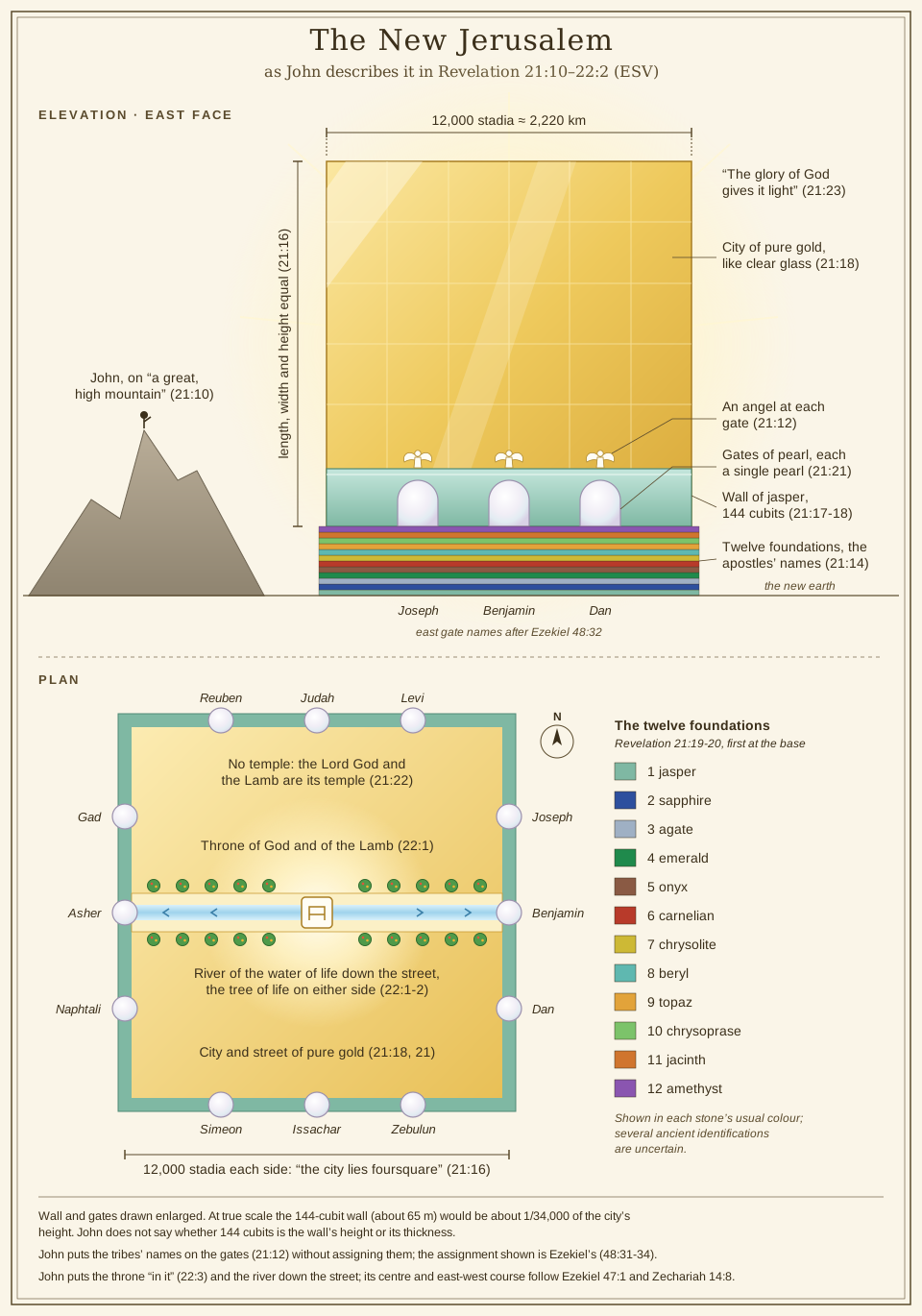
Drawn from what the angel measured and John recorded, the city looks like this:
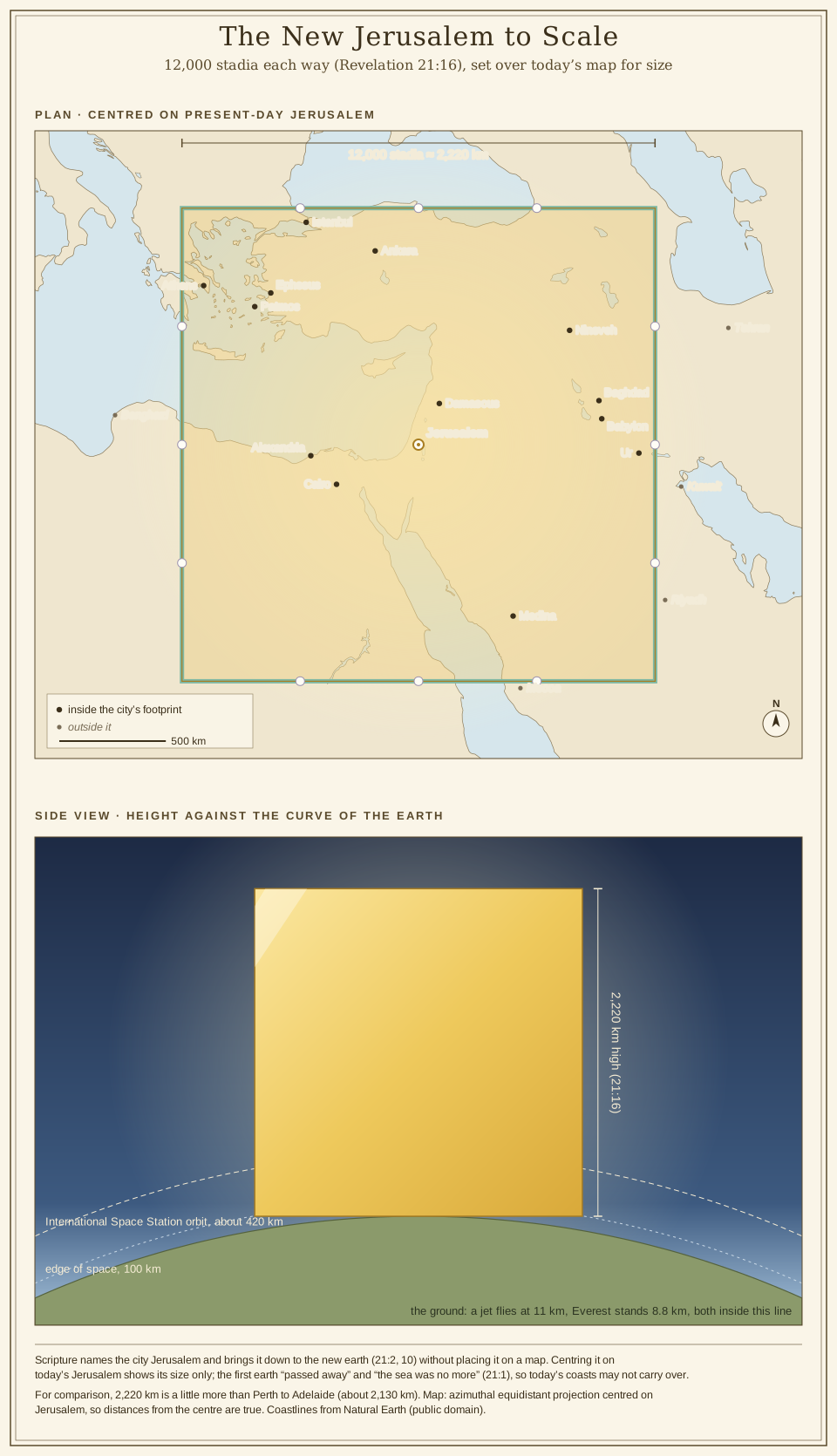
Centred on today's Jerusalem for scale, its footprint would reach from Athens to Ur, and Patmos, where John saw it, would lie inside:
Why a city is called the Bride
Three readings
The angel says "the Bride" and shows a city. The readings divide three ways, and this is contested:
- The city is the people. The ESV Study Bible, quoted above. The city is a picture of the church, or of all the redeemed. The NIV Biblical Theology Study Bible stands between this and reading 3.
- A real city compared to a bride. Walvoord: "Though the city is compared to a beautifully dressed bride, it actually is a city, not a person or group of people" (Bible Knowledge Commentary, on Revelation 21:2). "Bride" describes its beauty and its readiness. Walvoord still fills the city with "the saints of all ages," and he declines to make its people "specifically the church saints," because Scripture uses marriage "not only to relate Christ to the church but also Yahweh to Israel."
- A real city named for the people who live in it. The city and its citizens are spoken of as one, the way a city is in the rest of Scripture: "O Jerusalem, Jerusalem, the city that kills the prophets" (Matthew 23:37, ESV).
The prostitute who is also a city
Revelation's own pattern favours the third. John builds the two visions to match:
| Babylon (Revelation 17) | The New Jerusalem (Revelation 21-22) | |
|---|---|---|
| The invitation | "Come, I will show you the judgment of the great prostitute" (Revelation 17:1) | "Come, I will show you the Bride, the wife of the Lamb" (Revelation 21:9) |
| Where John is taken | "in the Spirit into a wilderness" (Revelation 17:3) | "in the Spirit to a great, high mountain" (Revelation 21:10) |
| Her adornment | "gold and jewels and pearls" (Revelation 17:4) | gold, every kind of jewel, gates of pearl (Revelation 21:18-21) |
| The name on foreheads | her own name, "Babylon the great" (Revelation 17:5) | His name, "on their foreheads" (Revelation 22:4) |
| Who she is | "the woman that you saw is the great city" (Revelation 17:18) | the Bride shown as "the holy city Jerusalem" (Revelation 21:10) |
Babylon is a woman and a city at once. The NIV Cultural Backgrounds Study Bible observes that "Babylon in Revelation represents the people of Rome and not simply its location," and that "the new Jerusalem undoubtedly includes the people of God" (note on Revelation 21:2). The city is a place, and the people are why it has a bride's name. The study The Harlot and the Bride follows the harlot through Scripture, from Proverbs and the prophets to Babylon's fall.
Who the bride is
On this site the bride is the church. Paul betrothed the church "to one husband, to present you as a pure virgin to Christ" (2 Corinthians 11:2, ESV), and her marriage is announced in heaven before Christ rides out (Revelation 19:7, 11). She is clothed in "fine linen, bright and pure" (Revelation 19:8, ESV), and the city comes down "prepared as a bride adorned for her husband" (Revelation 21:2, ESV). The city wears her dress because it is her home. The New Testament gives the bridal name to one people: Paul to the church (2 Corinthians 11:2; Ephesians 5:25-27), John to the one married at Revelation 19:7. Israel has her own marriage language, as the LORD's wife (Isaiah 54:5), which answers Walvoord's point: one Husband, two covenanted peoples, both at home in one city. The Wife of the Lamb carries that argument in full. Readers who hold one people of God read the whole city, Israel and church together, as a single bride.
So the city is a place, the bride is a people, and the city carries the bride's name. Reading 3 keeps all three statements true. This shows that God builds a home that fits the people He loves. The city is made ready the way the bride makes herself ready.
Who lives there
The city cannot be a code-word for the church alone, or for Israel alone, because John names more than one people on it:
- On the gates, "the names of the twelve tribes of the sons of Israel" (Revelation 21:12, ESV). Ezekiel's city had the same: "the gates of the city being named after the tribes of Israel" (Ezekiel 48:31, ESV; the full list is 48:31-34).
- On the foundations, "the twelve names of the twelve apostles of the Lamb" (Revelation 21:14, ESV), the apostles on whom the church is "built" (Ephesians 2:20, ESV).
- Walking in its light, the nations and their kings, bringing "the glory and the honor of the nations" (Revelation 21:24-26, ESV), as Isaiah promised: "nations shall come to your light, and kings to the brightness of your rising" (Isaiah 60:3, ESV).
Walvoord notes that Hebrews names the same company for "the heavenly Jerusalem": angels, "the assembly of the firstborn who are enrolled in heaven," God the judge, "the spirits of the righteous made perfect," and Jesus (Hebrews 12:22-24, ESV).
Walvoord draws the dispensational conclusion: "both the church and Israel will be in the city … The distinction between Israel and the church is thus maintained," and the city is "the dwelling place of the saints of all ages" (Bible Knowledge Commentary, on Revelation 21:14-16 and 21:22-27). The ESV Study Bible reads the two sets of names as "the unity of OT and NT believers" (note on Revelation 21:12-14). Both readings put every redeemed person in one city. They differ over whether the names still mark two peoples. The Wife of the Lamb argues that they do, from the plural "peoples" of Revelation 21:3 and the olive tree of Romans 11.
The nations
Scripture keeps the nations as nations to the end. Isaiah ties it to the new creation itself: "as the new heavens and the new earth that I make shall remain before me … all flesh shall come to worship before me" (Isaiah 66:22-23, ESV). "All the nations you have made shall come and worship before you" (Psalm 86:9, ESV), and the song of Revelation repeats it: "All nations will come and worship you" (Revelation 15:4, ESV). Daniel's Son of Man receives a kingdom "that all peoples, nations, and languages should serve him" (Daniel 7:14, ESV), and God's promise to Abraham was that "in your offspring shall all the nations of the earth be blessed" (Genesis 22:18, ESV).
So in the city the nations keep their names and their kings. They "walk" by its light, their kings "bring their glory into it," its gates "will never be shut" (Revelation 21:24-25, ESV), and the leaves of the tree are "for the healing of the nations" (Revelation 22:2, ESV). They are the redeemed of every nation, "ransomed … from every tribe and language and people and nation" (Revelation 5:9, ESV), and only "those who are written in the Lamb's book of life" enter (Revelation 21:27, ESV). Scripture never says whether they live inside the walls or on the new earth around them. It says they belong to the city's light and come and go through gates that never shut.
This shows that God keeps every promise to every people He made one to. The tribes are on the gates because God swore to Israel. The apostles are on the foundations because Christ built His church. The nations are in the light because God told Abraham, "in you all the families of the earth shall be blessed" (Genesis 12:3, ESV).
A city shaped like the Most Holy Place
The cube
"The city lies foursquare, its length the same as its width. And he measured the city with his rod, 12,000 stadia. Its length and width and height are equal" (Revelation 21:16, ESV). The LSB footnotes 12,000 stadia as about 2,220 km, or 1,380 miles, on each side. The NIV Cultural Backgrounds Study Bible notes that the walls of Babylon and Alexandria, the great cities of John's world, ran about nine miles around (article on the dimensions of the New Jerusalem). Walvoord leans toward a pyramid; the three study Bibles consulted read a cube, and "length and width and height are equal" fits a cube.
The one cube in Israel's worship was the inner sanctuary of Solomon's temple, twenty cubits each way (1 Kings 6:20). Only the high priest went in, "but once a year, and not without taking blood" (Hebrews 9:7, ESV). The whole city is built in that shape.
No temple
"I saw no temple in the city, for its temple is the Lord God the Almighty and the Lamb" (Revelation 21:22, ESV). The word is ναός (naos, G3485), the sanctuary itself. Earlier Revelation promised that the one who conquers will be "a pillar in the temple of my God" (Revelation 3:12, ESV) and that the great multitude will "serve him day and night in his temple" (Revelation 7:15, ESV). Here the temple is God and the Lamb, and the city is inside it. The NIV Cultural Backgrounds Study Bible notes that Revelation "does not repudiate Ezekiel's vision, but offers an even greater image" (note on Revelation 21:22).
This shows that God's presence will fill the whole city. The place one man entered once a year, with blood, is the place you will live, because the Lamb's blood has already been offered.
The stones on the high priest's heart
The twelve foundation stones (Revelation 21:19-20) "substantially correspond" to the stones on the high priest's breastpiece (NIV Biblical Theology Study Bible, note on Revelation 21:19-21). Those stones carried the names of the tribes, "so Aaron shall bear the names of the sons of Israel in the breastpiece of judgment on his heart" (Exodus 28:29, ESV). Isaiah promised Jerusalem, "I will … lay your foundations with sapphires" (Isaiah 54:11, ESV). The stones the priest wore over his heart into the Holy Place become the foundations of the city. Precious Stones in Scripture sets the two lists side by side, with what each stone was and what its light shows.
Light, open gates, and nothing unclean
Three more lines come straight from Isaiah:
- "The glory of God gives it light, and its lamp is the Lamb" (Revelation 21:23, ESV), from "the LORD will be your everlasting light" (Isaiah 60:19, ESV).
- "Its gates will never be shut by day—and there will be no night there" (Revelation 21:25, ESV), from "Your gates shall be open continually" (Isaiah 60:11, ESV).
- "Nothing unclean will ever enter it" (Revelation 21:27, ESV), from "there shall no more come into you the uncircumcised and the unclean" (Isaiah 52:1, ESV).
The gates stand open because there is no enemy left and no night to hide one. Only "those who are written in the Lamb's book of life" go in (Revelation 21:27, ESV).
Eden with a city built around it
✝️ Revelation 22:1-5 (ESV)
1 Then the angel showed me the river of the water of life, bright as crystal, flowing from the throne of God and of the Lamb 2 through the middle of the street of the city; also, on either side of the river, the tree of life with its twelve kinds of fruit, yielding its fruit each month. The leaves of the tree were for the healing of the nations. 3 No longer will there be anything accursed, but the throne of God and of the Lamb will be in it, and his servants will worship him. 4 They will see his face, and his name will be on their foreheads. 5 And night will be no more. They will need no light of lamp or sun, for the Lord God will be their light, and they will reign forever and ever.
The river and the tree
"A river flowed out of Eden to water the garden" (Genesis 2:10, ESV), and "the tree of life was in the midst of the garden" (Genesis 2:9, ESV). After the fall God placed cherubim "to guard the way to the tree of life" (Genesis 3:24, ESV). In the city the river flows from the throne, and the tree stands on either side of it. The psalmist already sang of "a river whose streams make glad the city of God" (Psalm 46:4, ESV). Ezekiel's river had fruit trees on both banks that "bear fresh fruit every month … and their leaves for healing" (Ezekiel 47:12, ESV). John echoes Ezekiel's trees and names them "the tree of life."
The NKJV Cultural Backgrounds Study Bible notes that Ezekiel 47 and Zechariah 14, the rivers from the temple and from Jerusalem, were read on the last day of the Feast of Booths (article on John 7:37-39). On that day Jesus stood and cried, "If anyone thirsts, let him come to me and drink" (John 7:37, ESV). John closes his book with the same invitation: "let the one who is thirsty come; let the one who desires take the water of life without price" (Revelation 22:17, ESV).
The curse lifted
"No longer will there be anything accursed" (Revelation 22:3, ESV). The Greek, πᾶν κατάθεμα οὐκ ἔσται ἔτι (pan katathema ouk estai eti, G2652), follows the Greek Old Testament of Zechariah 14:11 about Jerusalem, where Brenton's Septuagint prints ἀνάθεμα οὐκ ἔσται ἔτι (anathema ouk estai eti, G331), "there shall never again be a decree of utter destruction" (Zechariah 14:11, ESV). That link is verbal. The Hebrew behind Zechariah is חֵרֶם (cherem, H2764), a thing devoted to destruction. The second link is theological: Genesis 3:17, "cursed is the ground because of you" (ESV), uses a different Greek word, and the ESV Study Bible makes the connection (note on Revelation 22:3). The ground God cursed for Adam's sake is gone, and the new ground carries no curse at all.
His face
"You cannot see my face, for man shall not see me and live," God told Moses (Exodus 33:20, ESV). In the city "they will see his face" (Revelation 22:4). The servants who see Him also "worship him" and "reign forever and ever" (Revelation 22:3, 5). The Bride of Christ works through that worship and that sight as the bride's last homecoming.
This shows that God undoes the fall completely. The way to the tree was guarded with a flaming sword; now the gates never shut. So you may take the invitation now, while it is still being given: "Blessed are those who wash their robes, so that they may have the right to the tree of life and that they may enter the city by the gates" (Revelation 22:14, ESV).
Discussion Questions
- God can "take away his share in the tree of life and in the holy city" (Revelation 22:19), and the word is μέρος (meros), a share. What does that word tell you about the city, and about the people who have a share in it?
- Set Revelation 17:1-5, 18 beside Revelation 21:9-11 and Revelation 22:4. What does Babylon's being both a woman and a city show about how John means "the Bride" at Revelation 21:9?
- Ezekiel's city has a temple at its centre (Ezekiel 40-48); John's has none (Revelation 21:22). What does each city say about how near God is to His people?
- The tribes are on the gates and the apostles on the foundations (Revelation 21:12-14). Read those names as two peoples, then as one. What changes, and what stays the same?
- Abraham lived in tents because he was looking for a city (Hebrews 11:9-10). What would change in how you spend this year if your citizenship there (Philippians 3:20) were the fact you planned around?
Group study sheet for a 40-minute group: two A4 sheets, or one with the guided path
The point, the passage, the questions and the response, from this study. Print on both sides of two A4 sheets, flipping on the long edge. While this block is open, printing the page prints the sheet; close it to print the study.
The New Jerusalem
Revelation 21:9-22:5The point The New Jerusalem is a real city that God builds and brings down to the new earth, and it is called the Bride because the Lamb's wife lives in it and it wears her glory; Israel's names are on its gates, the apostles' on its foundations, the nations walk in its light, and God and the Lamb are its temple.
Ask: what comes to mind when you hear The New Jerusalem
? Hear a few answers before anyone reads.
Revelation 21:9-22:5 21:9Then one of the seven angels with the seven bowls full of the seven final plagues came and said to me, “Come, I will show you the bride, the wife of the Lamb.” 10And he carried me away in the Spirit to a mountain great and high, and showed me the holy city of Jerusalem coming down out of heaven from God, 11shining with the glory of God. Its radiance was like a most precious jewel, like a jasper, as clear as crystal. 12The city had a great and high wall with twelve gates inscribed with the names of the twelve tribes of Israel, and twelve angels at the gates. 13There were three gates on the east, three on the north, three on the south, and three on the west. 14The wall of the city had twelve foundations bearing the names of the twelve apostles of the Lamb. 15The angel who spoke with me had a golden measuring rod to measure the city and its gates and walls. 16The city lies foursquare, with its width the same as its length. And he measured the city with the rod, and all its dimensions were equal—12,000 stadia in length and width and height. 17And he measured its wall to be 144 cubits, by the human measure the angel was using. 18The wall was made of jasper, and the city itself of pure gold, as pure as glass. 19The foundations of the city walls were adorned with every kind of precious stone: The first foundation was jasper, the second sapphire, the third chalcedony, the fourth emerald, 20the fifth sardonyx, the sixth carnelian, the seventh chrysolite, the eighth beryl, the ninth topaz, the tenth chrysoprase, the eleventh jacinth, and the twelfth amethyst. 21And the twelve gates were twelve pearls, with each gate consisting of a single pearl. The main street of the city was pure gold, as clear as glass. 22But I saw no temple in the city, because the Lord God Almighty and the Lamb are its temple. 23And the city has no need of sun or moon to shine on it, because the glory of God illuminates the city, and the Lamb is its lamp. 24By its light the nations will walk, and into it the kings of the earth will bring their glory. 25Its gates will never be shut at the end of the day, because there will be no night there. 26And into the city will be brought the glory and honor of the nations. 27But nothing unclean will ever enter it, nor anyone who practices an abomination or a lie, but only those whose names are written in the Lamb’s Book of Life. 22:1Then the angel showed me a river of the water of life, as clear as crystal, flowing from the throne of God and of the Lamb
Also read: Revelation 21:9-22:5 from 22:2
The New Jerusalem
- Three Jerusalems. The city John knew, the city of the thousand years, and the city above that comes down.
- A real city. What the text does with the city that it only does with a place.
- Why a city is called the Bride. Three readings, and the prostitute who is also a city.
- Who lives there. Israel on the gates, the apostles on the foundations, the nations in its light.
- A city shaped like the Most Holy Place. The cube, the stones and the missing temple.
- Eden with a city built around it. River, tree, curse, face.
The New Jerusalem
1Ezekiel's city has a temple at its centre (Ezekiel 40-48); John's has none (Revelation 21:22). What does each city say about how near God is to His people?
2Abraham lived in tents because he was looking for a city (Hebrews 11:9-10). What would change in how you spend this year if your citizenship there (Philippians 3:20) were the fact you planned around?
3God can "take away his share in the tree of life and in the holy city" (Revelation 22:19), and the word is μέρος (meros), a share. What does that word tell you about the city, and about the people who have a share in it?
4The tribes are on the gates and the apostles on the foundations (Revelation 21:12-14). Read those names as two peoples, then as one. What changes, and what stays the same?
5Set Revelation 17:1-5, 18 beside Revelation 21:9-11 and Revelation 22:4. What does Babylon's being both a woman and a city show about how John means "the Bride" at Revelation 21:9?
The New Jerusalem
- Think. "Our citizenship is in heaven" (Philippians 3:20, ESV), and Jesus promises the one who conquers, "I will write on him … the name of the city of my God, the new Jerusalem" (Revelation 3:12, ESV).
- Attitude. Live as a stranger here, the way Abraham lived in tents while "looking forward to the city that has foundations" (Hebrews 11:10, ESV).
- Do. Pray this week by name for Israel and for one nation that does not yet know Jesus. Both are written into the city (Revelation 21:12, 24).
And I saw no temple in the city, for its temple is the Lord God the Almighty and the Lamb. And the city has no need of sun or moon to shine on it, for the glory of God gives it light, and its lamp is the Lamb.
Revelation 21:22-23 (ESV)Father, builder of the city that has foundations, thank you that your Son Jesus has gone to prepare a place for us and will come again to take us to Himself. Thank you that you keep your promises to Israel, to the church and to the nations, and that you will make your home with us. Make us strangers here and citizens there, and give us hearts that long to see your face.
In Jesus' name. Amen.
The New Jerusalem
Revelation 21:9-22:5Open Ask: what comes to mind when you hear The New Jerusalem
? Hear a few answers before anyone reads.
Read it aloud Revelation 21:9-22:5
1Ezekiel's city has a temple at its centre (Ezekiel 40-48); John's has none (Revelation 21:22). What does each city say about how near God is to His people?
2Abraham lived in tents because he was looking for a city (Hebrews 11:9-10). What would change in how you spend this year if your citizenship there (Philippians 3:20) were the fact you planned around?
3God can "take away his share in the tree of life and in the holy city" (Revelation 22:19), and the word is μέρος (meros), a share. What does that word tell you about the city, and about the people who have a share in it?
4The tribes are on the gates and the apostles on the foundations (Revelation 21:12-14). Read those names as two peoples, then as one. What changes, and what stays the same?
5Set Revelation 17:1-5, 18 beside Revelation 21:9-11 and Revelation 22:4. What does Babylon's being both a woman and a city show about how John means "the Bride" at Revelation 21:9?
- Think. "Our citizenship is in heaven" (Philippians 3:20, ESV), and Jesus promises the one who conquers, "I will write on him … the name of the city of my God, the new Jerusalem" (Revelation 3:12, ESV).
- Attitude. Live as a stranger here, the way Abraham lived in tents while "looking forward to the city that has foundations" (Hebrews 11:10, ESV).
- Do. Pray this week by name for Israel and for one nation that does not yet know Jesus. Both are written into the city (Revelation 21:12, 24).
The New Jerusalem
The point The New Jerusalem is a real city that God builds and brings down to the new earth, and it is called the Bride because the Lamb's wife lives in it and it wears her glory; Israel's names are on its gates, the apostles' on its foundations, the nations walk in its light, and God and the Lamb are its temple.
References & Recommended Reading
Ancient sources
- Irenaeus, Against Heresies 5.35.2, Ante-Nicene Fathers vol. 1 (public domain) — the new Jerusalem "not … allegorized."
- Tertullian, Against Marcion 3.24, Ante-Nicene Fathers vol. 3 (public domain) — the city "let down from heaven" in the thousand years.
Commentaries and study Bibles
- John F. Walvoord, "Revelation," in The Bible Knowledge Commentary, ed. John F. Walvoord and Roy B. Zuck (Victor Books) — on Revelation 21:2, 21:9-27 and 22:1; reporting J. Dwight Pentecost, Things to Come (Zondervan, 1958), on the city during the millennium. Quoted briefly with attribution.
- ESV Study Bible (Crossway) — verse text (ESV) and notes on Revelation 21:2, 21:12-14 and 21:15-17.
- NIV Biblical Theology Study Bible (Zondervan) — notes on Revelation 21:2 and 21:19-21.
- NIV Cultural Backgrounds Study Bible (Zondervan) — notes on Revelation 21:2, 21:9-21 and 21:22, and its article on the dimensions of the New Jerusalem.
- NKJV Cultural Backgrounds Study Bible (Thomas Nelson) — article on John 7:37-39 (the readings on the last day of Booths).
- Legacy Standard Bible (The Lockman Foundation) — footnote converting 12,000 stadia.
- MACULA Greek morphology and the Septuagint lemma data (open licence) — μέρος in Revelation; the Greek of Revelation 22:3 and Zechariah 14:11.
On this site
- A New Heaven and a New Earth — the new creation the city comes down into.
- The Wife of the Lamb — why the whole city is called the bride, and the one Husband with two covenanted peoples.
- The Bride of Christ — the wedding pattern, and the bride homed.
- The Harlot and the Bride — Babylon set beside the Bride, and the call to come out of her.
- Israel and the Church — the distinction the gates and foundations keep.