The Image and the Kingdoms
Week 3 of 7 in End Times Fundamentals · next: The Rapture of the Church
New, published 19 October 2026. What else is new
Daniel 2 and 7 through history
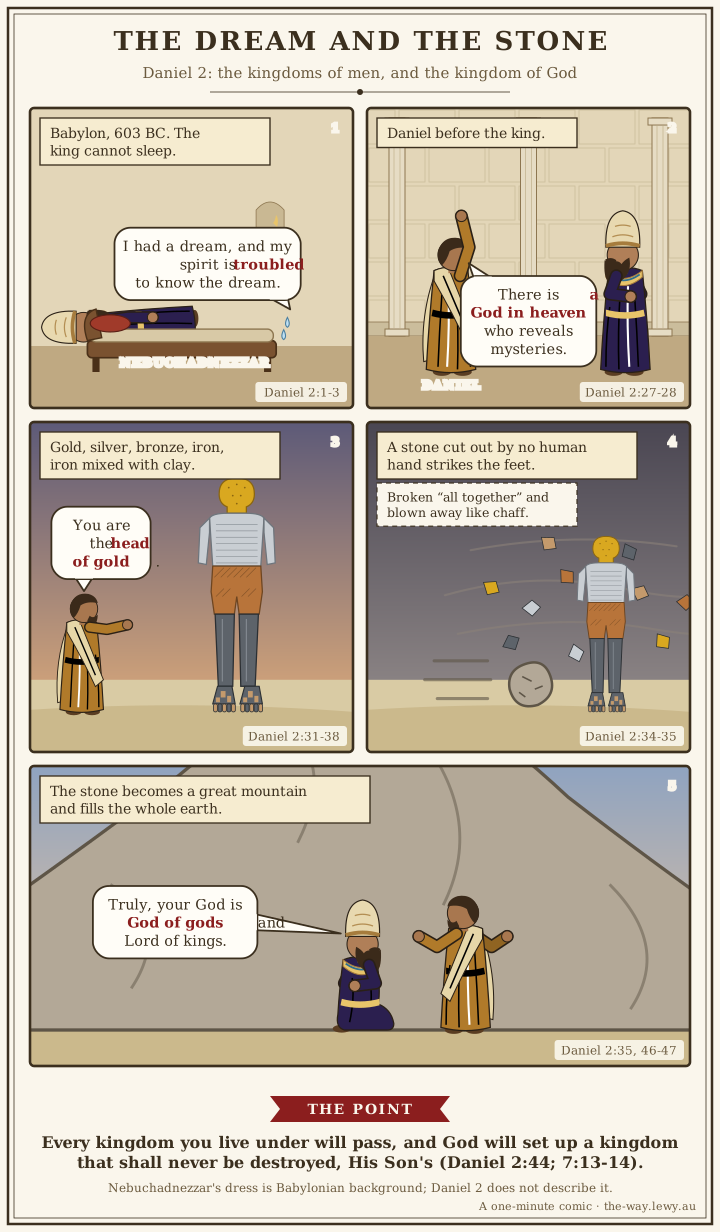
In 603 BC a king who had already taken Jerusalem lay awake over a dream, and a young captive from Judah told him what he had seen. It was the whole future of the kingdoms that would rule God's people, from that king's own empire to the day God ends them all, given before most of them existed:
✝️ Daniel 2:31-35 (ESV)
31 "You saw, O king, and behold, a great image. This image, mighty and of exceeding brightness, stood before you, and its appearance was frightening. 32 The head of this image was of fine gold, its chest and arms of silver, its middle and thighs of bronze, 33 its legs of iron, its feet partly of iron and partly of clay. 34 As you looked, a stone was cut out by no human hand, and it struck the image on its feet of iron and clay, and broke them in pieces. 35 Then the iron, the clay, the bronze, the silver, and the gold, all together were broken in pieces, and became like the chaff of the summer threshing floors; and the wind carried them away, so that not a trace of them could be found. But the stone that struck the image became a great mountain and filled the whole earth.
In one sentence: God showed a pagan king the whole course of Gentile power, from Babylon to the end, as one image that a stone not cut by human hands will strike and replace; Daniel 7 shows the same four kingdoms as God sees them and names the last ruler of the fourth, and that ruler's three and a half years are the second half of Daniel's seventieth week, so the image, the beasts and the weeks are one prophecy of history ending in Christ's kingdom.
The Daniel's kingdoms sheet on the timeline draws this study as one picture: the image down the left side, each part ruled across to the years its kingdom held.
Key Takeaways
(This section follows the Key Takeaways format — see that page for what each part is for.)
Types & Prophecy
- Four kingdoms, three of them named by Daniel. Babylon is the head of gold (Daniel 2:38), Media-Persia the ram (Daniel 8:20), Greece the goat (Daniel 8:21). The fourth is unnamed; this site reads it as Rome, on the evidence of Daniel 9:26.
- One prophecy told three ways. The image (Daniel 2), the beasts (Daniel 7) and the seventy weeks (Daniel 9) cover the same history, and the little horn's "time, times, and half a time" (Daniel 7:25) is the last half of the seventieth week (Daniel 9:27).
Lessons about Jesus
- Jesus is the Son of Man who receives the kingdom. Daniel saw "one like a son of man" given an everlasting dominion (Daniel 7:13-14), and Jesus claimed that title before the high priest (Mark 14:62).
- He is the stone. The kingdom God sets up "in the days of those kings" breaks every kingdom before it (Daniel 2:44), and Jesus spoke of a stone that "will crush" whoever it falls on (Luke 20:18) with the verb Greek Daniel uses of the stone kingdom (Daniel 2:44).
Memory verses
✝️ Daniel 2:44 (ESV)
44 And in the days of those kings the God of heaven will set up a kingdom that shall never be destroyed, nor shall the kingdom be left to another people. It shall break in pieces all these kingdoms and bring them to an end, and it shall stand forever,
Be Transformed
- Think. History is going somewhere. God "removes kings and sets up kings" (Daniel 2:21), and the last kingdom on the map is His Son's.
- Attitude. Steadiness under powers you did not choose. Daniel served four kings across nearly seventy years (Daniel 1:21; 10:1) and bowed to none of their gods.
- Do. Pray for the city you live in, as God told the exiles to (Jeremiah 29:7), and refuse the one thing Shadrach, Meshach and Abednego refused: worship of anything but God (Daniel 3:18).
Prayer
Father, You rule the kingdom of men and give it to whom You will. You told a proud king the end of his empire before it began, and You have told us the end of ours. Thank You that the kingdom that will fill the earth belongs to Your Son Jesus, and that You have already transferred us into it. Keep us faithful under the rulers we live under, unafraid of the beasts, and watching for the stone. In Jesus' name. Amen.
Study outline
- The night the king could not sleep: the setting in 603 BC, and the God who reveals mysteries.
- One image, four metals: the image part by part, and the image of gold the king built in answer.
- Naming the four kingdoms: Babylon, Media-Persia and Greece from Daniel's own mouth, and the case for Rome as the fourth.
- The same four as God sees them: Daniel 7's beasts, the ten horns and the little horn.
- The stone and the Son of Man: who receives the kingdom, and the stone Jesus spoke of in Luke 20:18.
- Where the seventy weeks sit in the image: Daniel 9 inside the silver and the iron.
- Between the legs and the feet: whether the stone has struck, with the case on both sides.
- What this shows about God: God rules the kingdoms of men, gives the kingdom to His Son, and so you can live faithfully under any of them.
The night the king could not sleep
Daniel 2 in its year
The dream came in "the second year of the reign of Nebuchadnezzar" (Daniel 2:1, ESV). He took the throne in 605 BC, the year he beat Egypt at Carchemish and first besieged Jerusalem (Daniel 1:1; Chronology Anchors, entry 10). Counted the Babylonian way, from his first full year, his second year is 603/602 BC. Daniel had been in Babylon two or three years and was still a young man in training at court (Daniel 1:3-6).
The king summoned "the magicians, the enchanters, the sorcerers, and the Chaldeans" and demanded the dream itself as well as its meaning (Daniel 2:2-5). They answered that only "the gods, whose dwelling is not with flesh" could do that (Daniel 2:11, ESV). Daniel and his three friends prayed, God showed Daniel the dream in a night vision (Daniel 2:17-19), and Daniel blessed the God who "removes kings and sets up kings" (Daniel 2:21, ESV). Dreams and Visions treats the chapter as a dream given and interpreted; this study takes up what the dream said.
A God in heaven who reveals mysteries
Daniel's first words to the king give the credit away.
✝️ Daniel 2:27-28 (ESV)
27 Daniel answered the king and said, "No wise men, enchanters, magicians, or astrologers can show to the king the mystery that the king has asked, 28 but there is a God in heaven who reveals mysteries, and he has made known to King Nebuchadnezzar what will be in the latter days. Your dream and the visions of your head as you lay in bed are these:
The word for "mystery" is the Aramaic רָז (raz, H7328), a secret held in heaven until God discloses it. Israel and the Church follows the word into Paul. "In the latter days" is בְּאַחֲרִית יוֹמַיָּא (be'acharit yomayya, H320, H3118), literally "at the end of the days", as the LSB's footnote gives it. The phrase sets the dream's horizon: it runs from the king's own reign to the end of history.
One image, four metals
What the king saw
The image is one figure from head to toe. The Aramaic צְלֵם (tselem, H6755) means an image or statue, and it was "mighty and of exceeding brightness" (Daniel 2:31, ESV). Each part is a different material, and the materials run downward from gold through silver and bronze to iron, then iron mixed with "potter's clay" (Daniel 2:41), חֲסַף (chasaf, H2635), fired earthenware.
Two things change as the eye moves down. The metals lose value: gold, then silver, then bronze, then iron. And they gain hardness, until the iron "breaks to pieces and shatters all things" (Daniel 2:40, ESV). The feet then lose the strength the legs had, because iron and clay "will not hold together" (Daniel 2:43, ESV). Daniel calls that last stage "a divided kingdom", פְּלִיגָה (peligah, H6386) (Daniel 2:41).
The stone
The end of the image comes from outside it. A stone "was cut out by no human hand", לָא בִידַיִן (la vidayin, H3809, H3028, "not by hands"), and struck the image "on its feet" (Daniel 2:34, ESV). The metals were broken "all together" (Daniel 2:35), כַּחֲדָה (kachadah, H2298), "as one", which is the LSB's footnoted literal rendering. Then the stone "became a great mountain and filled the whole earth" (Daniel 2:35, ESV). Daniel 2:45 adds that the stone was cut "from a mountain": God's kingdom comes from where God is.
The king's answer: an image all of gold
The next thing Nebuchadnezzar built was an image, the same word, all of gold. "King Nebuchadnezzar made an image of gold, whose height was sixty cubits and its breadth six cubits" (Daniel 3:1, ESV). צְלֵם runs through both chapters, from the dream (Daniel 2:31-35) to the plain of Dura (Daniel 3:1-19). Told he was the head of gold and that a kingdom would come after his, the king set up an image of gold from top to bottom and ordered the nations to worship it. Daniel 3 leaves his motive unstated; the shared word sets the two images side by side, and the reader sees the king's answer to God's revelation. Three young men refused it: "we will not serve your gods or worship the golden image that you have set up" (Daniel 3:18, ESV).
Naming the four kingdoms
Babylon, Media-Persia, Greece
Daniel names three of the four himself. The first he names to Nebuchadnezzar's face: "you are the head of gold" (Daniel 2:38, ESV). Babylon's kingdom held from 605 BC until Cyrus took the city in 539 BC (Daniel 5:30-31).
The next two he names in a later vision, of a ram and a goat:
✝️ Daniel 8:20-21 (ESV)
20 As for the ram that you saw with the two horns, these are the kings of Media and Persia. 21 And the goat is the king of Greece. And the great horn between his eyes is the first king.
The ram is one animal with two horns, so Media and Persia are one kingdom, the silver of the image. Daniel 5:28 says the same of Babylon's end: "your kingdom is divided and given to the Medes and Persians" (ESV). Greece is the bronze: Alexander broke Persia at Gaugamela in 331 BC, died in 323 BC, and his empire went to four kingdoms of his generals, settled at Ipsus in 301 BC (Daniel 8:8, 22). Chronology Anchors dates each of these fulfilments.
The fourth kingdom: Rome
Daniel never names the fourth kingdom, and this site reads it as Rome. The case rests on three things in the text.
- Daniel 9 points to it. After the sixty-nine weeks, "the people of the prince who is to come shall destroy the city and the sanctuary" (Daniel 9:26, ESV). Rome destroyed both in AD 70, so the people of the coming prince are Rome's people, and the last ruler arises from the fourth kingdom.
- The kingdom follows Greece. The fourth kingdom crushes "all these" (Daniel 2:40), and Rome took the Greek kingdoms one by one, ruling Judea from 63 BC.
- Jesus put Daniel's end after Greece. He told His disciples to watch for "the abomination of desolation spoken of by the prophet Daniel" (Matthew 24:15, ESV) in the Roman years, two centuries after Antiochus IV.
The other reading counts Media and Persia as two kingdoms and makes Greece the fourth, so that the little horn of Daniel 7 is Antiochus IV and the book ends in the second century BC. Daniel 8:20 tells against it: the angel gives Media and Persia one ram. The ESV Study Bible notes that the church's traditional commentators have "almost universally" identified the four as Babylon, Medo-Persia, Greece and Rome (note on Daniel 2:43-44), and that scholars who take the visions as written after the events date the book to the second century BC.
The same four as God sees them
Four beasts from the sea
About fifty years after the dream, Daniel saw the same four kingdoms again, as beasts. The vision came "in the first year of Belshazzar king of Babylon" (Daniel 7:1, ESV), when Belshazzar ruled as regent for Nabonidus, between 553 and 550 BC. Chapters 2 and 7 open and close the Aramaic part of the book (Daniel 2:4 to 7:28), and both are about four kingdoms. In chapter 2 a king sees them as a splendid figure of metal; in chapter 7 a prophet sees them as beasts that devour.
| Daniel 2: the image | Daniel 7: the beasts | Daniel 8 | |
|---|---|---|---|
| Babylon | Head of fine gold (2:32, 38) | A lion with eagles' wings, made to stand like a man (7:4) | |
| Media-Persia | Chest and arms of silver (2:32, 39) | A bear raised up on one side, three ribs in its mouth (7:5) | A ram with two horns (8:3-4, 20) |
| Greece | Middle and thighs of bronze (2:32, 39) | A leopard with four wings and four heads (7:6) | A goat whose great horn breaks into four (8:5-8, 21-22) |
| Rome | Legs of iron (2:33, 40) | A fourth beast with iron teeth and ten horns (7:7, 19, 23) | |
| Its last form | Feet and toes of iron and clay (2:33, 41-43) | Ten horns, and a little horn that puts down three (7:7-8, 24) | |
| God's kingdom | A stone that becomes a mountain (2:34-35, 44-45) | One like a son of man given an everlasting kingdom (7:13-14, 27) |
The leopard's four heads match the goat's four horns, both the divided Greek empire. The fourth beast has "great iron teeth" (Daniel 7:7, ESV) and "claws of bronze" (Daniel 7:19, ESV), the iron of the image's legs.
The ten horns and the little horn
The angel explains the horns as kings.
✝️ Daniel 7:23-25 (ESV)
23 "Thus he said: 'As for the fourth beast, there shall be a fourth kingdom on earth, which shall be different from all the kingdoms, and it shall devour the whole earth, and trample it down, and break it to pieces. 24 As for the ten horns, out of this kingdom ten kings shall arise, and another shall arise after them; he shall be different from the former ones, and shall put down three kings. 25 He shall speak words against the Most High, and shall wear out the saints of the Most High, and shall think to change the times and the law; and they shall be given into his hand for a time, times, and half a time.
The ten horns answer to the toes of the image, which Daniel 2 does not number (Daniel 2:41-42); this site reads both as the fourth kingdom's last form, divided among ten kings. The little horn rises after them and rules over the saints for "a time, times, and half a time", three and a half years. Paul calls him "the man of lawlessness" who "takes his seat in the temple of God, proclaiming himself to be God" (2 Thessalonians 2:3-4, ESV), and Revelation gives his beast authority "for forty-two months" (Revelation 13:5, ESV). This is the figure the church has called the Antichrist.
Daniel 8 has a different little horn. Daniel 8's horn grows "out of one of" the goat's four horns (Daniel 8:9, ESV), from the Greek kingdoms, and its acts fit Antiochus IV Epiphanes, who desecrated the temple in 167 BC. Daniel 7's grows from the fourth beast. Antiochus is a preview of the last ruler, and Jesus still spoke of the abomination as future after him (Matthew 24:15).
The stone and the Son of Man
One like a son of man
Both visions end with God's kingdom replacing the kingdoms of men, and Daniel 7 says who receives it.
✝️ Daniel 7:13-14 (ESV)
13 "I saw in the night visions, and behold, with the clouds of heaven there came one like a son of man, and he came to the Ancient of Days and was presented before him. 14 And to him was given dominion and glory and a kingdom, that all peoples, nations, and languages should serve him; his dominion is an everlasting dominion, which shall not pass away, and his kingdom one that shall not be destroyed.
"One like a son of man" is כְּבַר אֱנָשׁ (kevar enash, H1247, H606): a human figure coming "with the clouds of heaven", where the beasts came up out of the sea. The kingdom that "shall not be destroyed" (Daniel 7:14) is the kingdom of Daniel 2:44 that "shall never be destroyed", and Daniel 7:27 gives it to "the people of the saints of the Most High". Before the high priest Jesus took the title as His own: "you will see the Son of Man seated at the right hand of Power, and coming with the clouds of heaven" (Mark 14:62, ESV). The Olivet Discourse follows Daniel 7:13 through Jesus' teaching.
The stone that will crush
Jesus also spoke of the stone. After quoting Psalm 118:22, He said, "Everyone who falls on that stone will be broken to pieces, and when it falls on anyone, it will crush him" (Luke 20:18, ESV; compare Matthew 21:44, which some early manuscripts lack). "Crush" is λικμάω (likmaō, G3039), and in the New Testament it occurs in these two verses only. Greek Daniel uses it of the stone kingdom: "λεπτυνεῖ καὶ λικμήσει πάσας τὰς βασιλείας", "it will grind and crush all the kingdoms" (Daniel 2:44, Theodotion's Greek). The link is one rare verb, which makes this an allusion, and it puts Jesus in the stone's place.
Where the seventy weeks sit in the image
Daniel 9 runs inside the image, in the silver and the iron. Gabriel's count starts from "the going out of the word to restore and build Jerusalem" (Daniel 9:25, ESV), a Persian decree, and runs sixty-nine weeks of years to the Messiah:
✝️ Daniel 9:26-27 (ESV)
26 And after the sixty-two weeks, an anointed one shall be cut off and shall have nothing. And the people of the prince who is to come shall destroy the city and the sanctuary. Its end shall come with a flood, and to the end there shall be war. Desolations are decreed. 27 And he shall make a strong covenant with many for one week, and for half of the week he shall put an end to sacrifice and offering. And on the wing of abominations shall come one who makes desolate, until the decreed end is poured out on the desolator."
Read against the image:
- The sixty-nine weeks begin in the silver and end in the iron. The decree is Artaxerxes', in his twentieth year (Nehemiah 2:1), and the count reaches the week Jesus rode into Jerusalem in AD 33 under Rome. Prophecy Events and Times works the arithmetic.
- The Messiah is cut off in the iron, crucified under a Roman governor, and the city falls to Roman armies in AD 70 (Daniel 9:26).
- The seventieth week belongs to the feet. "The prince who is to come" makes the covenant of Daniel 9:27, and his people are the people who destroyed the city. He is the little horn of Daniel 7, risen from the fourth kingdom. His "time, times, and half a time" (Daniel 7:25) is the "half of the week" after he stops the sacrifice (Daniel 9:27), and Revelation's forty-two months (Revelation 13:5). The Tribulation draws that week year by year.
So the three visions meet at one point. The little horn of Daniel 7, the prince of Daniel 9 and the toes of Daniel 2 are the last form of the fourth kingdom, and the kingdom of God replaces it.
Between the legs and the feet
The question
Has the stone struck yet? If it is Christ's first coming, the kingdom began with Him and grows like the stone into a mountain. If it is His return, the image still stands, and the church age runs between the iron legs and the feet. Both readings are held by believers who take Daniel as prophecy, and the text gives reasons on each side.
The case that it is still to come
This site holds that the stone strikes at Christ's return. The reasons are in the text:
- The stone strikes the feet, the divided last form (Daniel 2:34), and every metal is broken "all together", כַּחֲדָה (Daniel 2:35). The image is destroyed in one blow, and only then does the stone grow. Rome outlived the cross by centuries.
- "In the days of those kings" (Daniel 2:44) points to the kings of the feet, the ten of Daniel 7:24. Rome in Jesus' day had one emperor. Writing late in the first century on the usual dating, John still called the ten kings future: they "have not yet received royal power" (Revelation 17:12, ESV).
- Daniel 7 gives the kingdom after a judgment. The little horn prevails "until the Ancient of Days came, and judgment was given for the saints" (Daniel 7:22, ESV); the beast is killed, and then the kingdom is given (Daniel 7:11, 26-27).
- Daniel 9 already has a gap. The events of Daniel 9:26, the Messiah cut off and the city destroyed, fall after the sixty-ninth week and before the seventieth begins. Prophecy Essentials and Immediately After treat that gap, and the image has the same one between legs and feet.
- Jesus put His coming with the clouds in the future when He took Daniel 7:13 as His own (Mark 14:62).
The case that it has struck
The other reading takes the stone "cut out by no human hand" as Christ in His first coming, and the mountain filling the earth as the kingdom spreading through the gospel, the way the mustard seed grows into a tree (Matthew 13:31-32). Its reasons are that Jesus announced the kingdom at hand in His own ministry (Mark 1:15), that God has already "transferred us to the kingdom of his beloved Son" (Colossians 1:13, ESV), and that the stone "became" a mountain, which suggests growth over time.
Where that leaves the reader
Both readings hold that Jesus is the King and that His kingdom ends every other. They divide over when the image falls. The kingdom is present now in its King and its people (Colossians 1:13), and Your Kingdom Come treats what that means for prayer. Daniel 2 describes something more: the visible end of Gentile rule, in one blow, which history has not yet seen. Jesus called that span "the times of the Gentiles", during which "Jerusalem will be trampled underfoot by the Gentiles" (Luke 21:24, ESV), and the statement of faith on this site holds the dispensational order it implies: the church caught up, the seventieth week, then Christ's return to reign.
What this shows about God
God rules the kingdoms of men. The sentence on Nebuchadnezzar in Daniel 4 says why it was given: "that the living may know that the Most High rules the kingdom of men and gives it to whom he will" (Daniel 4:17, ESV). He showed the greatest king of his age where his empire stood in a sequence of four, decades before the second arrived and centuries before the fourth. History is His story told in advance, and every empire in it has a date of expiry He has already set.
God gives the kingdom to His Son. The image ends in a stone and the beasts end in a Son of Man. The Father has appointed Jesus to the throne that outlasts every throne, and He has given that kingdom "to the people of the saints of the Most High" (Daniel 7:27, ESV). That is you, if you belong to Christ: delivered "from the domain of darkness and transferred... to the kingdom of his beloved Son" (Colossians 1:13, ESV).
So you can live faithfully under any kingdom. Daniel served Nebuchadnezzar, Belshazzar, Darius and Cyrus (Daniel 2:48; 5:29; 6:28). He sought the welfare of Babylon, as Jeremiah told the exiles to (Jeremiah 29:7), and he never bowed. You live in the long middle of this prophecy, under rulers who will one day be chaff on a threshing floor. Serve them well, pray for them, and keep your worship for the God who will set up the kingdom that stands forever.
Discussion questions
- The language. The same word, צְלֵם, names the image in Nebuchadnezzar's dream (Daniel 2:31) and the golden image he set up (Daniel 3:1). What does putting the two side by side say about how he received God's revelation?
- The text in its context. Daniel names Babylon, Media-Persia and Greece (Daniel 2:38; 8:20-21) and leaves the fourth kingdom unnamed. How does Daniel 9:26 help identify it?
- Christ. Jesus took the title "Son of Man" from Daniel 7:13 before the high priest (Mark 14:62). Why would that answer have been heard as a claim to the kingdom of Daniel 7:14?
- The hard part. Does the stone strike at Christ's first coming or at His return? Which details of Daniel 2:34-35, 44 weigh most with you, and why?
- Be transformed. Daniel served four kings faithfully and bowed to none of their gods. Where do you need to serve the authority over you better, and where do you need to refuse it?
Group study sheet for a 40-minute group: two A4 sheets, or one with the guided path
The point, the passage, the questions and the response, from this study. Print on both sides of two A4 sheets, flipping on the long edge. While this block is open, printing the page prints the sheet; close it to print the study.
The Image and the Kingdoms: Daniel 2 and 7 Through History
Daniel 2:31-45; Daniel 7:1-28The point God showed a pagan king the whole course of Gentile power, from Babylon to the end, as one image that a stone not cut by human hands will strike and replace; Daniel 7 shows the same four kingdoms as God sees them and names the last ruler of the fourth, and that ruler's three and a half years are the second half of Daniel's seventieth week, so the image, the beasts and the weeks are one prophecy of history ending in Christ's kingdom.
Ask: what comes to mind when you hear The Image and the Kingdoms
? Hear a few answers before anyone reads.
Daniel 2:31-45 31As you, O king, were watching, a great statue appeared. A great and dazzling statue stood before you, and its form was awesome. 32The head of the statue was pure gold, its chest and arms were silver, its belly and thighs were bronze, 33its legs were iron, and its feet were part iron and part clay. 34As you watched, a stone was cut out, but not by human hands. It struck the statue on its feet of iron and clay, and crushed them. 35Then the iron, clay, bronze, silver, and gold were shattered and became like chaff on the threshing floor in summer. The wind carried them away, and not a trace of them could be found. But the stone that had struck the statue became a great mountain and filled the whole earth. 36This was the dream; now we will tell the king its interpretation. 37You, O king, are the king of kings, to whom the God of heaven has given sovereignty, power, strength, and glory. 38Wherever the sons of men or beasts of the field or birds of the air dwell, He has given them into your hand and has made you ruler over them all. You are that head of gold. 39But after you, there will arise another kingdom, inferior to yours. Next, a third kingdom, one of bronze, will rule the whole earth. 40Finally, there will be a fourth kingdom as strong as iron; for iron shatters and crushes all things, and like iron that crushes all things, it will shatter and crush all the others. 41And just as you saw that the feet and toes were made partly of fired clay and partly of iron, so this will be a divided kingdom, yet some of the strength of iron will be in it—just as you saw the iron mixed with clay. 42And as the toes of the feet were partly iron and partly clay, so this kingdom will be partly strong and partly brittle. 43As you saw the iron mixed with clay, so the peoples will mix with one another but will not hold together any more than iron mixes with clay. 44In the days of those kings, the God of heaven will set up a kingdom that will never be destroyed, nor will it be left to another people. It will shatter all these kingdoms and bring them to an end, but will itself stand forever. 45And just as you saw a stone being cut out of the mountain without human hands, and it shattered the iron, bronze, clay, silver, and gold, so the great God has told the king what will happen in the future. The dream is true, and its interpretation is trustworthy.”
Daniel 7:1-28 1In the first year of the reign of Belshazzar over Babylon, Daniel had a dream, and visions passed through his mind as he lay on his bed. He wrote down the dream, and this is the summary of his account.
Also read: Daniel 7:1-28 from 7:2
The Image and the Kingdoms: Daniel 2 and 7 Through History
- The night the king could not sleep: the setting in 603 BC, and the God who reveals mysteries.
- One image, four metals: the image part by part, and the image of gold the king built in answer.
- Naming the four kingdoms: Babylon, Media-Persia and Greece from Daniel's own mouth, and the case for Rome as the fourth.
- The same four as God sees them: Daniel 7's beasts, the ten horns and the little horn.
- The stone and the Son of Man: who receives the kingdom, and the stone Jesus spoke of in Luke 20:18.
- Where the seventy weeks sit in the image: Daniel 9 inside the silver and the iron.
- Between the legs and the feet: whether the stone has struck, with the case on both sides.
- What this shows about God: God rules the kingdoms of men, gives the kingdom to His Son, and so you can live faithfully under any of them.
The Image and the Kingdoms: Daniel 2 and 7 Through History
1The hard part. Does the stone strike at Christ's first coming or at His return? Which details of Daniel 2:34-35, 44 weigh most with you, and why?
2The language. The same word, צְלֵם, names the image in Nebuchadnezzar's dream (Daniel 2:31) and the golden image he set up (Daniel 3:1). What does putting the two side by side say about how he received God's revelation?
3The text in its context. Daniel names Babylon, Media-Persia and Greece (Daniel 2:38; 8:20-21) and leaves the fourth kingdom unnamed. How does Daniel 9:26 help identify it?
4Christ. Jesus took the title "Son of Man" from Daniel 7:13 before the high priest (Mark 14:62). Why would that answer have been heard as a claim to the kingdom of Daniel 7:14?
The Image and the Kingdoms: Daniel 2 and 7 Through History
5Be transformed. Daniel served four kings faithfully and bowed to none of their gods. Where do you need to serve the authority over you better, and where do you need to refuse it?
- Think. History is going somewhere. God "removes kings and sets up kings" (Daniel 2:21), and the last kingdom on the map is His Son's.
- Attitude. Steadiness under powers you did not choose. Daniel served four kings across nearly seventy years (Daniel 1:21; 10:1) and bowed to none of their gods.
- Do. Pray for the city you live in, as God told the exiles to (Jeremiah 29:7), and refuse the one thing Shadrach, Meshach and Abednego refused: worship of anything but God (Daniel 3:18).
And in the days of those kings the God of heaven will set up a kingdom that shall never be destroyed, nor shall the kingdom be left to another people. It shall break in pieces all these kingdoms and bring them to an end, and it shall stand forever,
Daniel 2:44 (ESV)Father, You rule the kingdom of men and give it to whom You will. You told a proud king the end of his empire before it began, and You have told us the end of ours. Thank You that the kingdom that will fill the earth belongs to Your Son Jesus, and that You have already transferred us into it. Keep us faithful under the rulers we live under, unafraid of the beasts, and watching for the stone. In Jesus' name. Amen.
The Image and the Kingdoms: Daniel 2 and 7 Through History
Daniel 2:31-45; Daniel 7:1-28Open Ask: what comes to mind when you hear The Image and the Kingdoms
? Hear a few answers before anyone reads.
Read it aloud Daniel 2:31-45; Daniel 7:1-28
1The hard part. Does the stone strike at Christ's first coming or at His return? Which details of Daniel 2:34-35, 44 weigh most with you, and why?
2The language. The same word, צְלֵם, names the image in Nebuchadnezzar's dream (Daniel 2:31) and the golden image he set up (Daniel 3:1). What does putting the two side by side say about how he received God's revelation?
3The text in its context. Daniel names Babylon, Media-Persia and Greece (Daniel 2:38; 8:20-21) and leaves the fourth kingdom unnamed. How does Daniel 9:26 help identify it?
4Christ. Jesus took the title "Son of Man" from Daniel 7:13 before the high priest (Mark 14:62). Why would that answer have been heard as a claim to the kingdom of Daniel 7:14?
5Be transformed. Daniel served four kings faithfully and bowed to none of their gods. Where do you need to serve the authority over you better, and where do you need to refuse it?
- Think. History is going somewhere. God "removes kings and sets up kings" (Daniel 2:21), and the last kingdom on the map is His Son's.
- Attitude. Steadiness under powers you did not choose. Daniel served four kings across nearly seventy years (Daniel 1:21; 10:1) and bowed to none of their gods.
- Do. Pray for the city you live in, as God told the exiles to (Jeremiah 29:7), and refuse the one thing Shadrach, Meshach and Abednego refused: worship of anything but God (Daniel 3:18).
The Image and the Kingdoms: Daniel 2 and 7 Through History
The point God showed a pagan king the whole course of Gentile power, from Babylon to the end, as one image that a stone not cut by human hands will strike and replace; Daniel 7 shows the same four kingdoms as God sees them and names the last ruler of the fourth, and that ruler's three and a half years are the second half of Daniel's seventieth week, so the image, the beasts and the weeks are one prophecy of history ending in Christ's kingdom.
References & Recommended Reading
- ESV Study Bible (Crossway, 2008), introduction to Daniel; notes on Daniel 2:1-49, 2:40, 2:43-44, 7:1-2, 7:15-27. Consulted to check this study's reading, especially the traditional identification of the four kingdoms and the dates of the visions.
- NIV Cultural Backgrounds Study Bible (Zondervan, 2016), note on Daniel 7:1: Belshazzar's regency, the Verse Account of Nabonidus and the Nabonidus Chronicle.
- NIV Biblical Theology Study Bible (Zondervan, 2018), note on Daniel 7:1.
- Legacy Standard Bible (Lockman Foundation, 2021), footnotes at Daniel 2:28 ("Lit end of the days") and Daniel 2:35 ("Lit like one").
- CSB Ancient Faith Study Bible and NLT Life Application Study Bible, footnotes on Matthew 21:44.
- Brenton's Septuagint (Theodotion's Greek Daniel), Daniel 2:44; Masoretic Text (Westminster Leningrad Codex) with MACULA Hebrew morphology for the Aramaic.
- On this site: Chronology Anchors, Prophecy Events and Times, The Tribulation, Immediately After, Prophecy Essentials, The Olivet Discourse, Your Kingdom Come, Dreams and Visions.