Precious Stones in Scripture
New, published 29 October 2026. What else is new
By the Chebar canal in Babylon, Ezekiel saw the throne of God move. He had to describe it to exiles who had lost their land, and the words kept failing him. In three verses (Ezekiel 1:26-28) he writes "appearance" nine times and "likeness" four, the Hebrew מַרְאֶה (marʾeh, H4758) and דְּמוּת (demut, H1823). The throne itself was "in appearance like sapphire" (Ezekiel 1:26, ESV). Then he gave up and fell down:
✝️ Ezekiel 1:28 (ESV)
28 Like the appearance of the bow that is in the cloud on the day of rain, so was the appearance of the brightness all around. Such was the appearance of the likeness of the glory of the LORD. And when I saw it, I fell on my face, and I heard the voice of one speaking.
When words failed him before the glory of God, he reached for a stone and a rainbow.
In one sentence: When the prophets saw God's glory they reached for precious stones, because a gem shows a light it does not make; so the stones that carried Israel's names on the high priest's heart become the foundations of a city lit by God and the Lamb, and God means you to shine in the same way, with His light.
Key Takeaways
(This section follows the Key Takeaways format — see that page for what each part is for.)
Types & Prophecy
Prophecy. God promised afflicted Jerusalem, "I will … lay your foundations with sapphires. I will make your pinnacles of agate, your gates of carbuncles, and all your wall of precious stones" (Isaiah 54:11-12, ESV). John sees the city built that way: "The foundations of the wall of the city were adorned with every kind of jewel" (Revelation 21:19, ESV).
Type. Aaron carried the twelve tribes on twelve stones "on his heart, when he goes into the Holy Place, to bring them to regular remembrance before the LORD" (Exodus 28:29, ESV). Hebrews names Jesus the "great high priest who has passed through the heavens" (Hebrews 4:14, ESV). Scripture never says the breastpiece pictures Him, so this is a pattern drawn from the two, and it fits: He carries His people into God's presence by name.
Lessons about Jesus
- Jesus is the city's lamp. "The glory of God gives it light, and its lamp is the Lamb" (Revelation 21:23, ESV). He said it first: "I am the light of the world" (John 8:12, ESV).
- God's glory is seen in Jesus' face. God "has shone in our hearts to give the light of the knowledge of the glory of God in the face of Jesus Christ" (2 Corinthians 4:6, ESV).
Memory verses
✝️ Revelation 21:23 (ESV)
23 And the city has no need of sun or moon to shine on it, for the glory of God gives it light, and its lamp is the Lamb.
✝️ Philippians 2:15 (ESV)
15 that you may be blameless and innocent, children of God without blemish in the midst of a crooked and twisted generation, among whom you shine as lights in the world,
Be Transformed
- Think. Whatever shines in you is God's light falling on you. The city has "the glory of God" and no light of its own (Revelation 21:11, 23).
- Attitude. Point away from yourself. John the Baptist "came to bear witness about the light" (John 1:8, ESV). The king of Tyre kept the shine for himself: "your heart was proud because of your beauty" (Ezekiel 28:17, ESV).
- Do. Name one person who sees you every week, and ask God this week for a way your good works can show them His glory, so that they "give glory to your Father who is in heaven" (Matthew 5:16, ESV).
Prayer
Father of lights, you dwell in light, and in you is no darkness at all. Thank you that you showed Ezekiel and John your glory, and that you have shown it to us in the face of your Son Jesus. Thank you that He carries our names before you as the high priest carried Israel's. Shine on us, and through us, until we shine as lights in this generation, and bring us at last into the city whose lamp is the Lamb.
In Jesus' name. Amen.
Study outline
- The stones Scripture names. Where gems appear, from Eden to the city, and a plate of the three lists.
- What the stones looked like. Why translations disagree, what the ancient names meant, and photographs of each.
- The language of appearance. How Ezekiel and John describe what they saw, and what they pick out of each stone.
- A light the stone does not make. Where the city's light comes from, and a first-century tradition that the breastpiece shone.
- What a gem does with light. Five things a gem does with light, the star stone Pliny saw, and the colour that turns.
- Names on the stones. The tribes on the priest's heart and the apostles on the foundations.
- Stones worn and stones built. The cherub of Tyre, Babylon and the Bride.
- So you may shine. The same word for the city's light and for yours.
- Discussion questions and an annex on the charts that pair stones with tribes, apostles and months.
The stones Scripture names
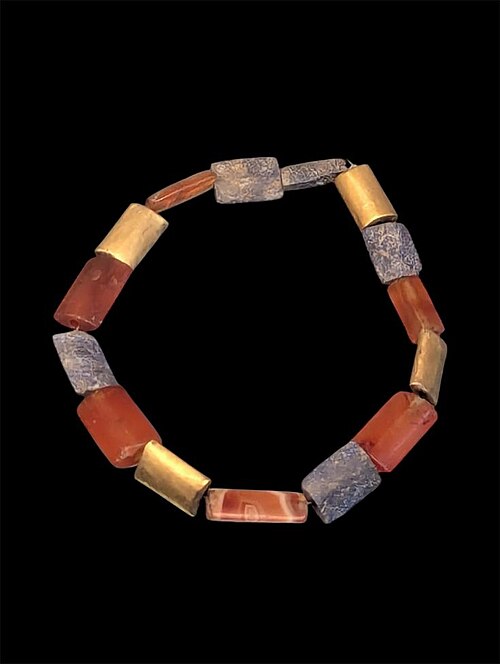 Gold, carnelian and lapis lazuli beads from a grave at Ur, 2600-2400 BC, now in the British
Museum: the wealth of the ancient Near East a thousand years before Moses.
Gems turn up at a handful of moments, and nearly every one is a meeting between God and people.
- Eden. The river of Eden ran through Havilah: "the gold of that land is good; bdellium and onyx stone are there" (Genesis 2:12, ESV).
- Sinai. Moses and the elders "saw the God of Israel. There was under his feet as it were a pavement of sapphire stone, like the very heaven for clearness" (Exodus 24:10, ESV).
- The high priest. Two onyx stones on his shoulders and twelve stones on his breastpiece carried the names of Israel's sons (Exodus 28:9-21).
- The throne-chariot. Ezekiel saw wheels "like the gleaming of beryl" and a throne "like sapphire" (Ezekiel 1:16, 26, ESV), and saw them again in Ezekiel 10:1, 9.
- The man by the Tigris. Daniel saw a man whose "body was like beryl, his face like the appearance of lightning" (Daniel 10:6, ESV).
- The cherub of Tyre. "Every precious stone was your covering" (Ezekiel 28:13, ESV).
- The throne in heaven. "He who sat there had the appearance of jasper and carnelian, and around the throne was a rainbow that had the appearance of an emerald" (Revelation 4:3, ESV).
- Babylon and the Bride. The prostitute is "adorned with gold and jewels and pearls" (Revelation 17:4, ESV). The New Jerusalem is built of them (Revelation 21:18-21).
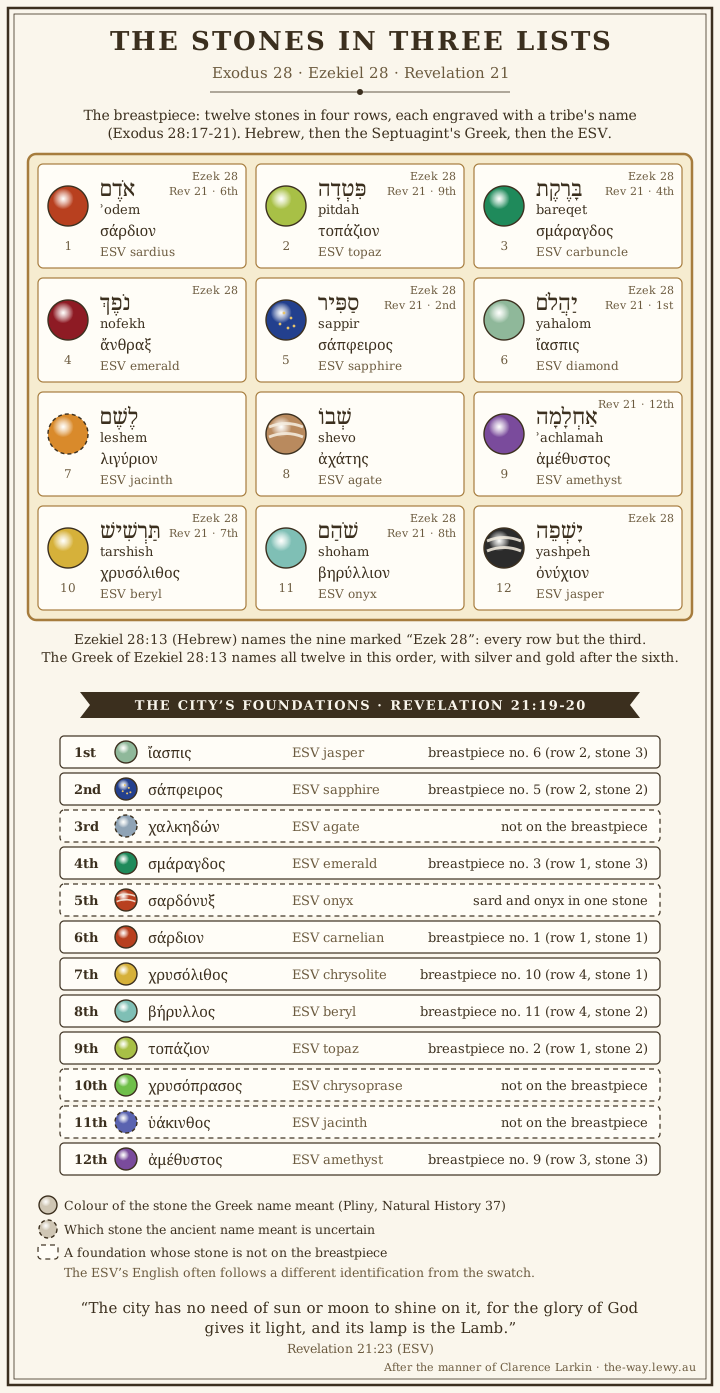
Three of these are lists of stones, and they are one list. Exodus 28:17-20 gives twelve. The Hebrew of Ezekiel 28:13 gives nine of the same twelve, every row of the breastpiece except the third. Revelation 21:19-20 gives twelve foundations, and eight of them carry the same Greek names as the breastpiece in the Septuagint, the Greek Old Testament John's readers knew.
What the stones looked like
Why the translations disagree
Nobody now knows for certain which stone each Hebrew name meant. The BSB, CSB and NLT all footnote Exodus 28:17 to say so. The Hebrew words are rare. The three stones of the breastpiece's third row, לֶשֶׁם (leshem, H3958), שְׁבוֹ (shevo, H7618) and אַחְלָמָה (ʾachlamah, H306), occur only in Exodus 28:19 and its repeat in Exodus 39:12. So translators lean on three things: the Septuagint, translated in the third century BC; a root meaning where one exists, as with אֹדֶם (ʾodem, H124), from the word for red; and ancient writers on stones such as Pliny the Elder.
Rows one, two and four are where the English versions part:
| # | Hebrew | Septuagint | ESV | NIV | NASB 2020 |
|---|---|---|---|---|---|
| 1 | ʾodem | σάρδιον | sardius | carnelian | ruby |
| 2 | pitdah | τοπάζιον | topaz | chrysolite | topaz |
| 3 | bareqet | σμάραγδος | carbuncle | beryl | emerald |
| 4 | nofekh | ἄνθραξ | emerald | turquoise | turquoise |
| 5 | sappir | σάπφειρος | sapphire | lapis lazuli | sapphire |
| 6 | yahalom | ἴασπις | diamond | emerald | diamond |
| 10 | tarshish | χρυσόλιθος | beryl | topaz | beryl |
| 11 | shoham | βηρύλλιον | onyx | onyx | onyx |
| 12 | yashpeh | ὀνύχιον | jasper | jasper | jasper |
The third row (leshem, shevo, ʾachlamah) is jacinth, agate and amethyst in all three, following the Septuagint.
What the ancient names meant
The Greek names are what Revelation shares with Exodus, so the Greek names are the ones to identify. Pliny the Elder wrote a book on stones a generation before John, Natural History 37, and two of his descriptions change how these chapters read:
- Sapphire. Pliny's sapphirus is blue and never transparent, and "gold gleams in it in spots" (Natural History 37.119-120). That is lapis lazuli, the deep blue stone flecked with gold pyrite. The NIV prints "lapis lazuli" for סַפִּיר (sappir, H5601), and the NIV Cultural Backgrounds Study Bible notes that the ancient world often identified the two (note on Revelation 4:3). The pavement under God's feet at Sinai, "like the very heaven for clearness" (Exodus 24:10, ESV), was then a deep sky-blue flecked with gold.
- Jasper. Pliny's iaspis "is green and often translucent" (Natural History 37.115). John's jasper is "clear as crystal" (Revelation 21:11, ESV). The modern stone sold as jasper is opaque, so the name has moved to another stone since John wrote. John F. Walvoord reads the same: "in verse 11 the jasper is translucent" (Bible Knowledge Commentary, on Revelation 21:17-18).
The photographs below show the stone each foundation's name most probably meant, in John's order, with three breastpiece stones that do not reappear. Where the identification is uncertain, the caption says so.
-
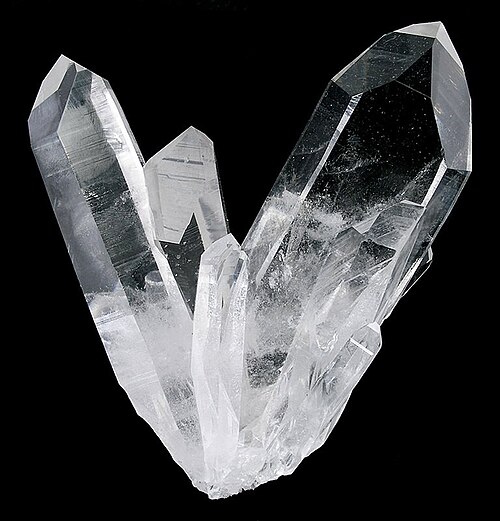
1st · Jasper · ἴασπις (iaspis, G2393). Shown: rock crystal, the clearness John names. Ancient jasper was often green and translucent (Pliny 37.115).
-
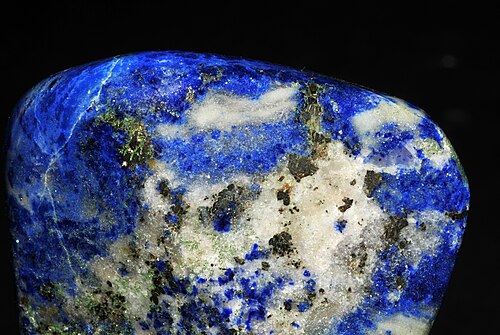
2nd · Sapphire · σάπφειρος (sappheiros, G4552). Lapis lazuli: the throne of Ezekiel 1:26 and the pavement of Exodus 24:10.
-
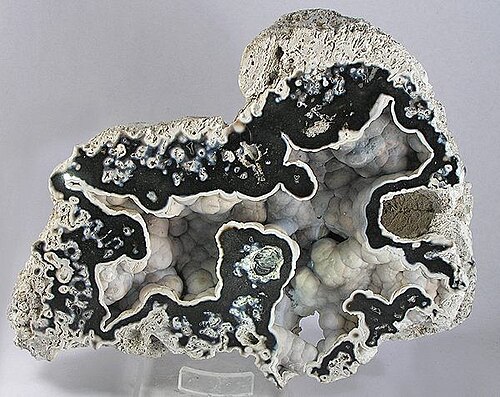
3rd · Chalcedony · χαλκηδών (chalkēdōn, G5472, ESV "agate"). Uncertain: Pliny has no stone by this name. Shown: modern chalcedony.
-
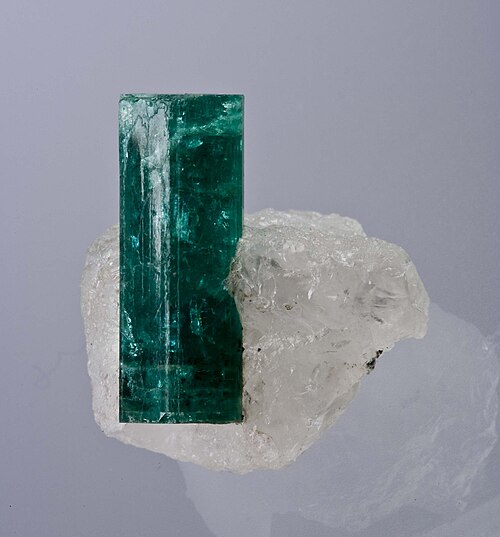
4th · Emerald · σμάραγδος (smaragdos, G4665). "Nothing green is greener" (Pliny 37.62). The rainbow of Revelation 4:3.
-
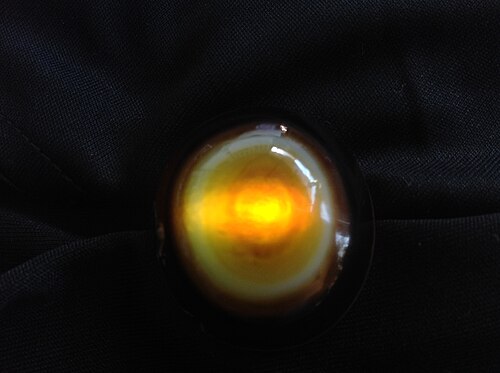
5th · Sardonyx · σαρδόνυξ (sardonyx, G4557, ESV "onyx"). White layered over red sard (Pliny 37.86). Shown lit from behind.
-
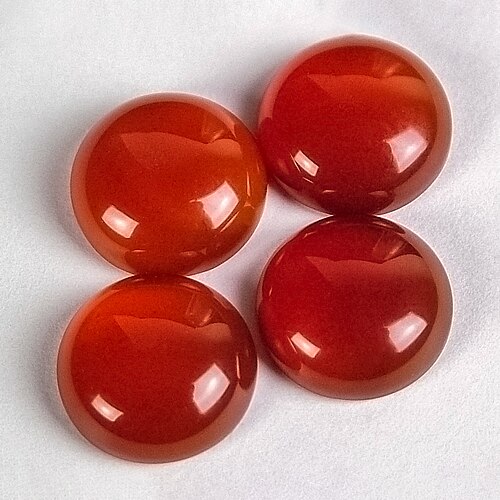
6th · Carnelian · σάρδιον (sardion, G4556). The first stone of the breastpiece, and the second stone of Revelation 4:3.
-
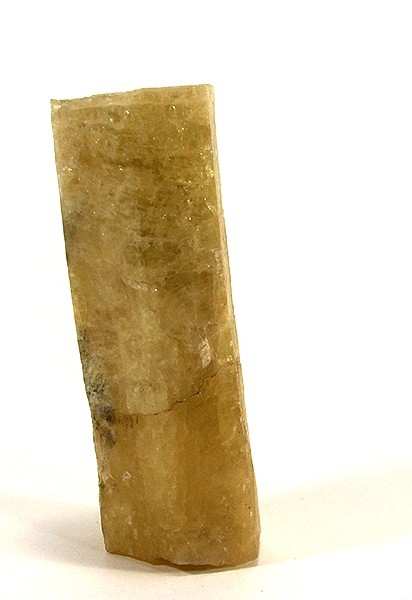
7th · Chrysolite · χρυσόλιθος (chrysolithos, G5555, "gold-stone"). "Translucent with a golden gleam" (Pliny 37.126). Shown: golden beryl.
-
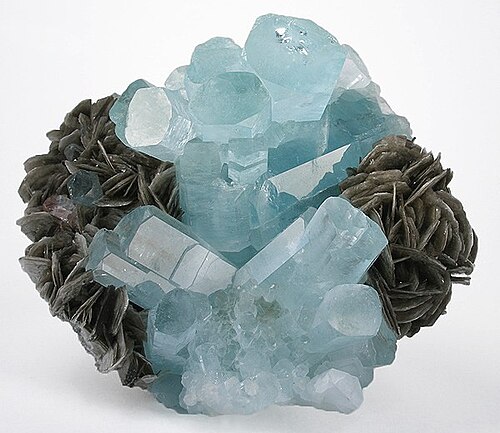
8th · Beryl · βήρυλλος (bēryllos, G969). "The green of a clear sea" (Pliny 37.76).
-
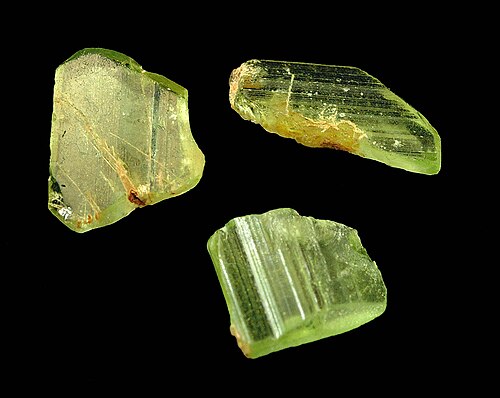
9th · Topaz · τοπάζιον (topazion, G5116). Pliny's topaz is green (37.107), most likely the stone now called peridot.
-
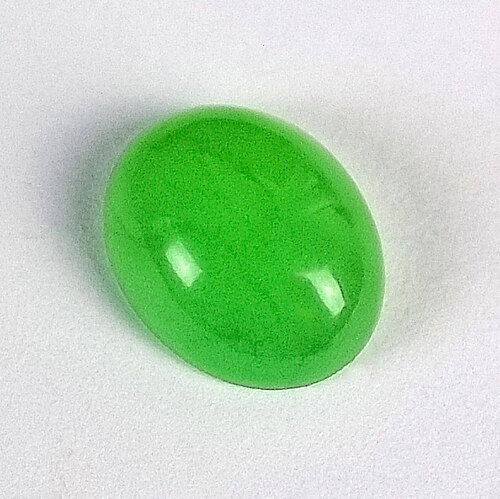
10th · Chrysoprase · χρυσόπρασος (chrysoprasos, G5556, "gold-leek"). The colour of leek juice (Pliny 37.113).
-
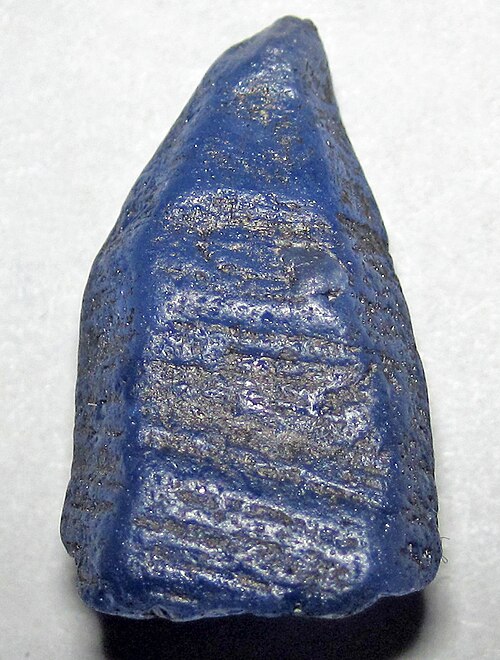
11th · Jacinth · ὑάκινθος (hyakinthos, G5192). Uncertain: a blue-violet stone (Pliny 37.125), perhaps the modern sapphire shown here.
-
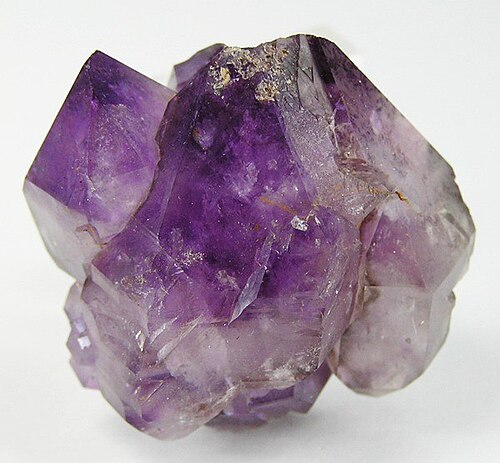
12th · Amethyst · ἀμέθυστος (amethystos, G271). "All shine through with a violet beauty" (Pliny 37.121).
-
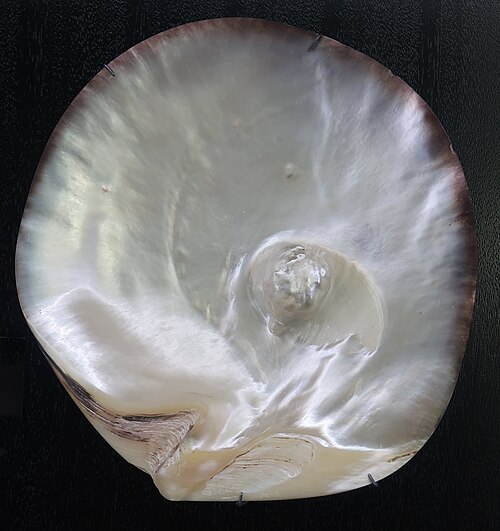
The gates · Pearl · μαργαρίτης (margaritēs, G3135). "Each of the gates made of a single pearl" (Revelation 21:21, ESV).
-
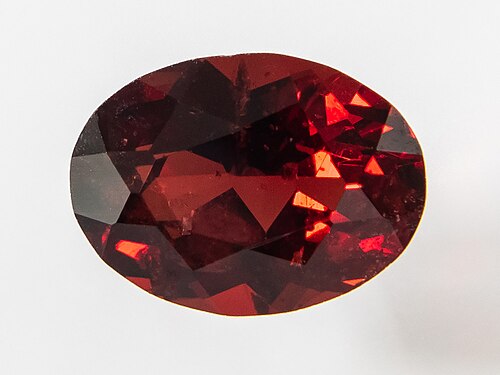
Breastpiece 4 · Carbuncle · ἄνθραξ (anthrax, G440, "burning coal"), named "for its likeness to fire" (Pliny 37.92). Shown: red garnet.
-
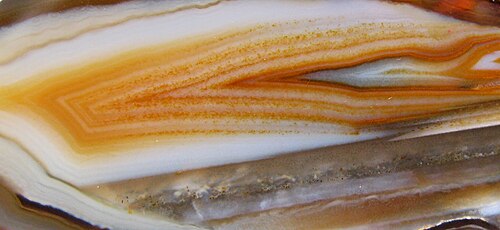
Breastpiece 8 · Agate · ἀχάτης (achatēs). A banded stone; Pliny lists many colours (37.139).
-
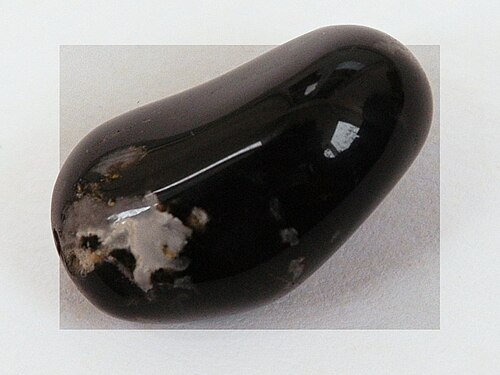
Breastpiece 12 · Onyx · ὀνύχιον (onychion). White like a fingernail over dark (Pliny 37.90).
The language of appearance
Ezekiel's likenesses
Ezekiel describes by likeness. Beside marʾeh, "appearance", his working word is עַיִן (ʿayin, H5869), literally "eye", used of the sparkle of a thing. The wheels were "like the gleaming of beryl", כְּעֵין תַּרְשִׁישׁ (keʿeyn tarshish, Ezekiel 1:16, ESV), the eye of the stone. The expanse over the creatures was "shining like awe-inspiring crystal" (Ezekiel 1:22, ESV), and the LSB footnotes "Or ice". In the fire was חַשְׁמַל (chashmal, H2830), "gleaming metal" (Ezekiel 1:4, 27, ESV), a word found only in Ezekiel 1:4, 27 and 8:2. The Septuagint translated it ἤλεκτρον (ēlektron), the shining alloy of gold and silver.
Then he stacks the words until they run out: "Such was the appearance of the likeness of the glory of the LORD" (Ezekiel 1:28, ESV). The ESV Study Bible sees John "imitating Isaiah's and Ezekiel's reserve in describing visions of God's glory" (note on Revelation 4:3).
John builds on Ezekiel
John's throne room in Revelation 4 is drawn from Ezekiel 1:
- Ezekiel's throne was "in appearance like sapphire" (Ezekiel 1:26, ESV). The One on John's throne "had the appearance of jasper and carnelian" (Revelation 4:3, ESV).
- Ezekiel's brightness was "like the appearance of the bow that is in the cloud on the day of rain" (Ezekiel 1:28, ESV). John's throne has "a rainbow that had the appearance of an emerald" (Revelation 4:3, ESV). Both look back to the bow God set in the cloud after the flood (Genesis 9:13).
- Ezekiel's expanse shone like crystal, κρύσταλλος in the Septuagint. Before John's throne "there was as it were a sea of glass, like crystal" (Revelation 4:6, ESV).
John keeps the reserve. Each comparison carries ὅμοιος (homoios, G3664) or ὡς (hōs, G5613), "like", and he describes no face.
What the prophets took from the stones
Read every verse above for what it says about the stones, and one property comes back: light. Gleaming, sparkling, shining, clear as the sky, clear as crystal, fire, brightness, a rainbow. One word touches price beyond the name "precious stone" itself: "most rare" (Revelation 21:11, ESV), and it describes the city's radiance. The prophets used precious stones as a vocabulary for light. The likeliest reason is the plain one: short of fire and the sky, a gem was the brightest thing they had seen.
Walvoord says John is "using the language of appearance" (on Revelation 21:17-18). The city is still real: "the wall was built of jasper" (Revelation 21:18, ESV), and The New Jerusalem argues the case. The stones tell you how that place looks in the light of God.
A light the stone does not make
Where the city's light comes from
John says where:
✝️ Revelation 21:10-11 (ESV)
10 And he carried me away in the Spirit to a great, high mountain, and showed me the holy city Jerusalem coming down out of heaven from God, 11 having the glory of God, its radiance like a most rare jewel, like a jasper, clear as crystal.
"Radiance" is φωστήρ (phōstēr, G5458), which the LSB footnotes "Lit luminary". The Septuagint uses it for the sun, moon and stars that God set in the sky (Genesis 1:14-16). "Clear as crystal" is κρυσταλλίζοντι (krystallizonti, G2929), the only use of the verb in the New Testament. The city holds "the glory of God", and it shines it out like a jewel.
Twelve verses later John names the source: "The city has no need of sun or moon to shine on it, for the glory of God gives it light, and its lamp is the Lamb" (Revelation 21:23, ESV). Isaiah had promised it: "the LORD will be your everlasting light" (Isaiah 60:19, ESV). The gold of the city is "like clear glass" (Revelation 21:18, ESV), and its street "like transparent glass" (Revelation 21:21, ESV), διαυγής (diaugēs, G1307), letting the light through. Every surface in the city is made to carry a light that comes from the throne.
A tradition about the breastpiece
Josephus, writing in the 90s AD, records a tradition about the high priest's stones. The sardonyx on the right shoulder "shined out when God was present at their sacrifices … which splendor yet was not before natural to the stone", and the twelve stones of the breastpiece shone before Israel went out to win a battle. He says both had stopped shining two hundred years before he wrote (Antiquities 3.8.9, Whiston). Scripture does not record this. It shows how one first-century Jewish writer understood those stones: they shone with God's presence and lost the light when He withdrew it.
This shows that God is the light His works display. "God is light, and in him is no darkness at all" (1 John 1:5, ESV). The throne, the wheels and the city shine because He is there. He made the stones, and He made them able to show His light. In Christ He has made you able to as well.
What a gem does with light
Here is how a stone does it: five ways it handles a light that is not its own.
Five ways a stone returns light
A gem in a dark room shows nothing. Everything it shows, it shows by doing something with light that comes from outside it.
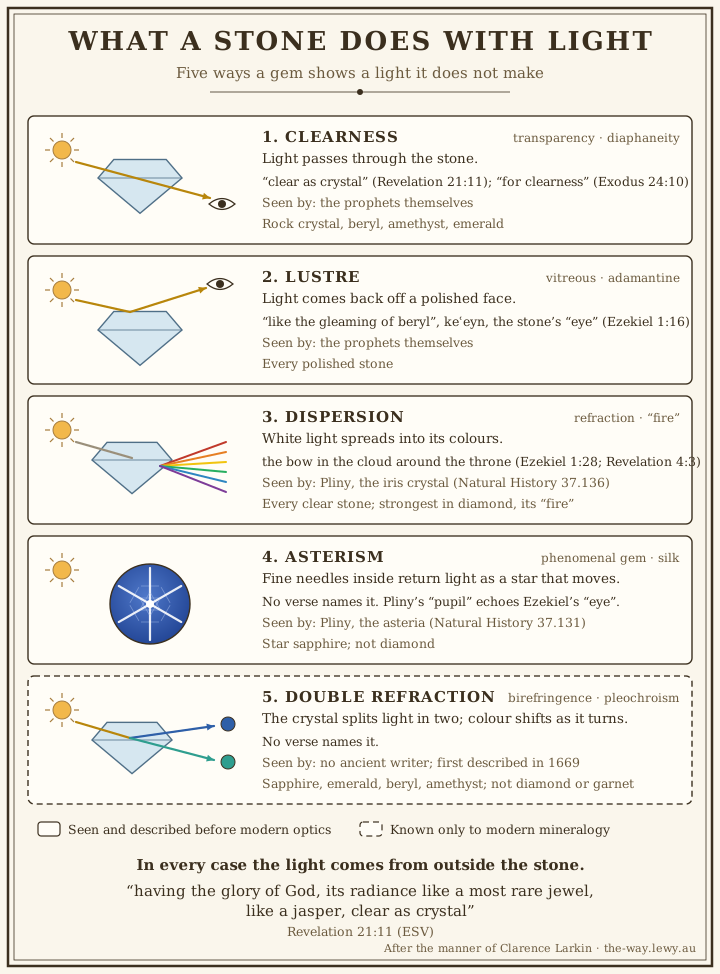
| What the eye sees | Gemmologist's term | Related terms |
|---|---|---|
| Light passes through | Transparency (diaphaneity) | transparent, translucent, opaque |
| A polished face gleams | Lustre | vitreous (glassy), adamantine (diamond's) |
| Light bends inside the stone | Refraction | refractive index, brilliance |
| White light spreads into colours | Dispersion | fire |
| A star glides across a dome | Asterism | star stone, phenomenal gem, silk, chatoyancy (cat's eye) |
| Light splits in two | Double refraction | birefringence, doubly refractive, anisotropic; single refraction, isotropic |
| Colour changes with direction | Pleochroism | dichroism, trichroism |
The plate's first three are the prophets' own words. John's jasper is "clear as crystal" (Revelation 21:11, ESV). Ezekiel's "gleaming" is the stone's eye (Ezekiel 1:16). A clear stone also spreads white light into its colours, and Ezekiel and John both put a rainbow around the throne (Ezekiel 1:28; Revelation 4:3). Pliny describes a crystal that, struck by the sun under a roof, "throws the appearance and colours of the rainbow onto the nearest walls", and in the open sun scatters the rays that strike it (Natural History 37.136-137).
Diamond spreads light into colour more strongly than any stone in these lists, in the flashes jewellers call its "fire" (GIA), and its adamantine lustre outshines the glassy, vitreous lustre of the rest. It is probably not among the Bible's stones. The ESV and NASB print "diamond" for yahalom in Exodus 28:18, but the Septuagint reads it as jasper, and Pliny knew diamond as the point engravers set in iron to cut other stones (Natural History 37.60). A stone that cuts every other stone is an unlikely one to be engraved with a name (Exodus 28:21).
The star in the stone
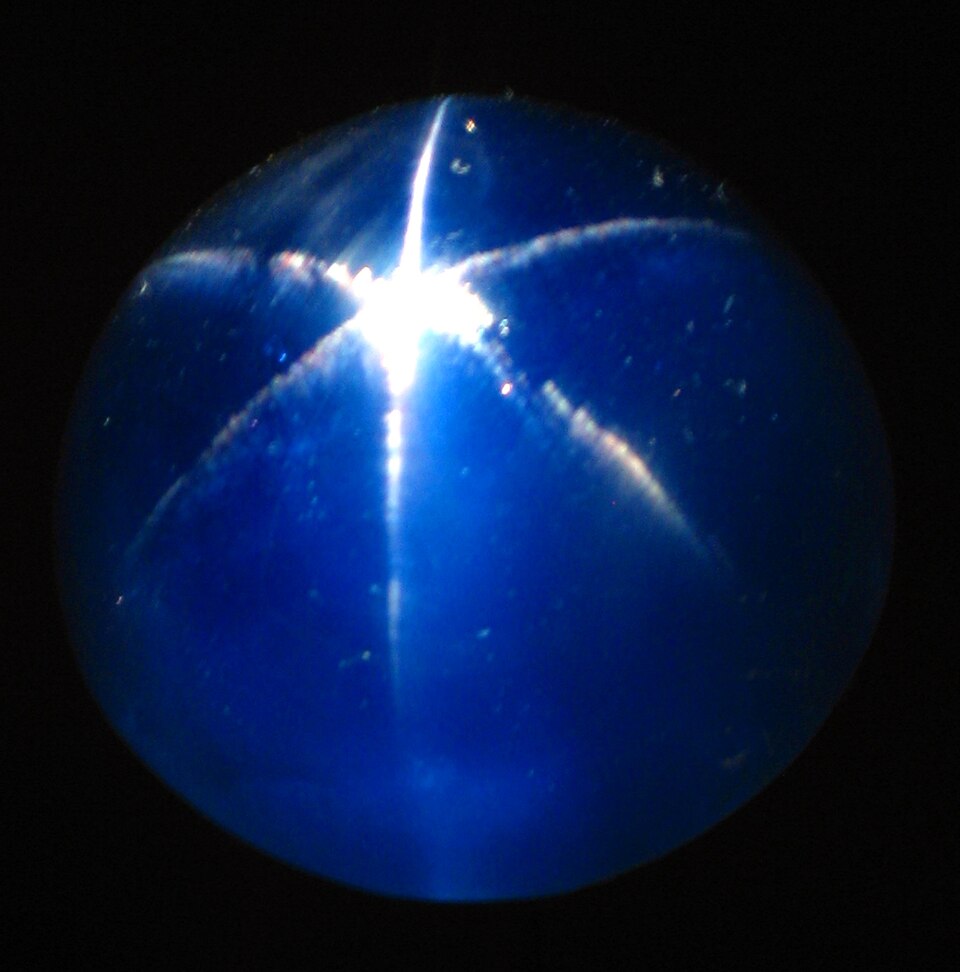 The Star of Asia, a 330-carat star sapphire from Burma, in the Smithsonian's National Museum of
Natural History.
Pliny describes a stone he calls asteria. "By a property of its nature it holds an enclosed light, in a kind of pupil." As the stone is tilted the light passes "from one place to another, as though walking inside", and turned to the sun it throws back white rays "in the shape of a star" (Natural History 37.131). Pliny counts it among the whitish stones, so it was probably a pale star corundum, the mineral of sapphire. The effect is asterism, and gemmologists class such stones as phenomenal gems. Fine needles of another mineral, called silk, lie inside the crystal in three directions, and each set throws one bright line across the dome; the three lines cross to make the six rays (Jin and others, Gems & Gemology, Summer 2025). Take the stone out of the light and the star is gone; move the light and it moves.
No verse names this stone. Pliny and Ezekiel did reach for the same picture, though. Ezekiel's word for the gleam of the wheels is ʿayin, "eye" (Ezekiel 1:16; 10:9). Pliny's word for the star is pupilla, the pupil of an eye. Nearly seven centuries apart, both men likened the light living in a stone to an eye, Ezekiel by a Hebrew idiom, Pliny by a picture. That tells you how people saw gems, and it settles nothing about which stone Ezekiel meant.
The colour that turns
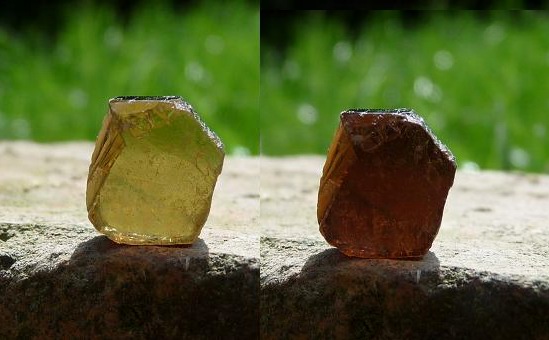 One tourmaline in two directions of light, photographed through a turning polarising filter. To the
unaided eye the shift shows as the stone is turned.
Most clear gems are doubly refractive, or anisotropic, a property called birefringence: the crystal splits each ray in two, and the two rays can carry different colours, so the stone's colour changes with the direction you look through it. That is pleochroism (dichroism where there are two colours, trichroism where there are three). GIA's Richard Hughes calls blue sapphire "strongly dichroic". Emerald, beryl and amethyst show it too, in varying strength. Diamond and garnet are isotropic and cannot do it at all, since "pleochroism cannot occur in singly refractive stones" (Hughes, Gems & Gemology, Fall 2014). Chalcedony, sardonyx, carnelian and chrysoprase among the foundations, and agate and onyx on the breastpiece, are cryptocrystalline, masses of tiny crystals that look the same from every side.
No ancient writer described double refraction. Rasmus Bartholin first did, with Iceland spar, in 1669, so it explains nothing in the text. It is one more way these stones return light from outside: many show a different colour from each side.
Names on the stones
The stones carried names. "There shall be twelve stones with their names according to the names of the sons of Israel. They shall be like signets, each engraved with its name, for the twelve tribes" (Exodus 28:21, ESV). The two shoulder stones were "stones of remembrance", and Aaron bore Israel's names "before the LORD on his two shoulders for remembrance" (Exodus 28:12, ESV). Every time he went in, Israel went in with him:
✝️ Exodus 28:29 (ESV)
29 So Aaron shall bear the names of the sons of Israel in the breastpiece of judgment on his heart, when he goes into the Holy Place, to bring them to regular remembrance before the LORD.
The two sets of stones hung together. Gold chains ran from the breastpiece's top corners to the settings of the shoulder stones, so the names on his heart hung from the names on his shoulders (Exodus 28:22-25).
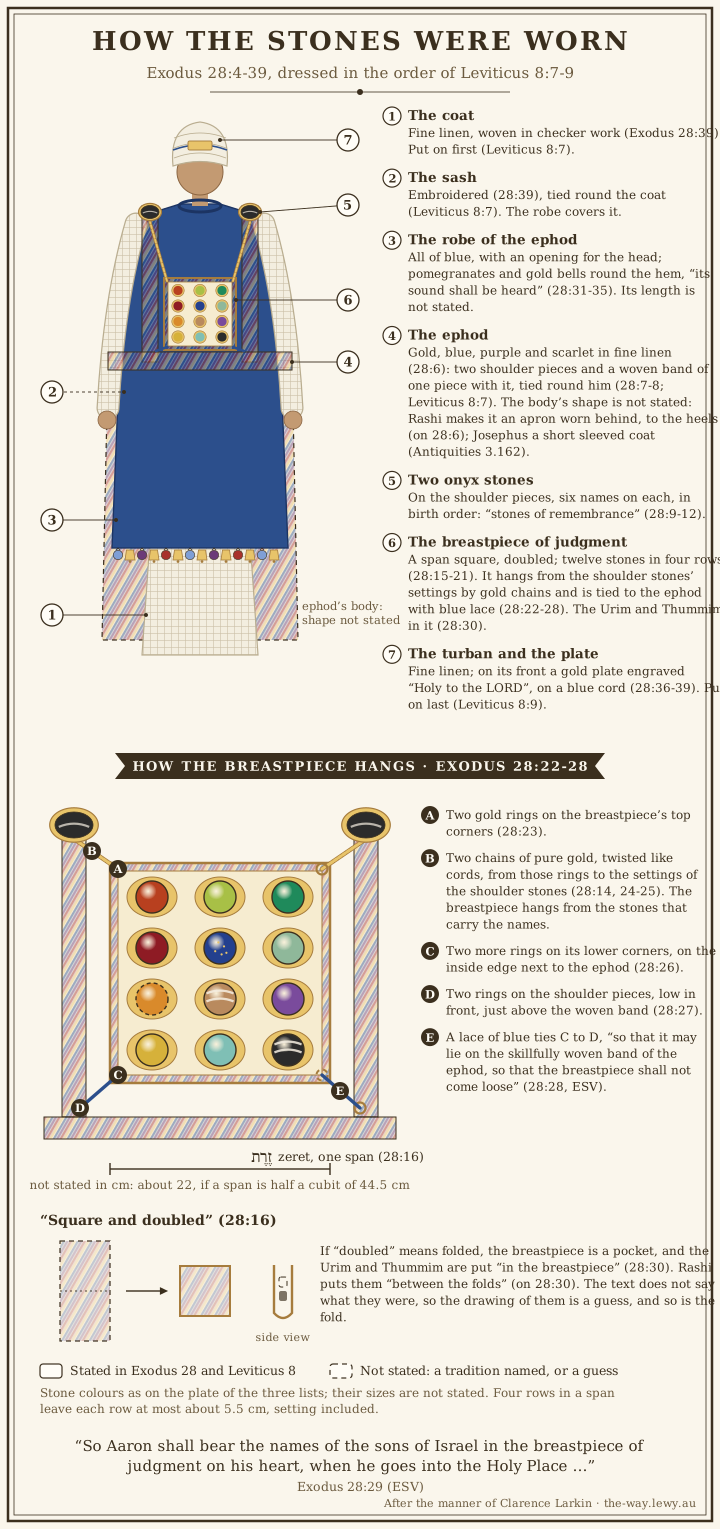
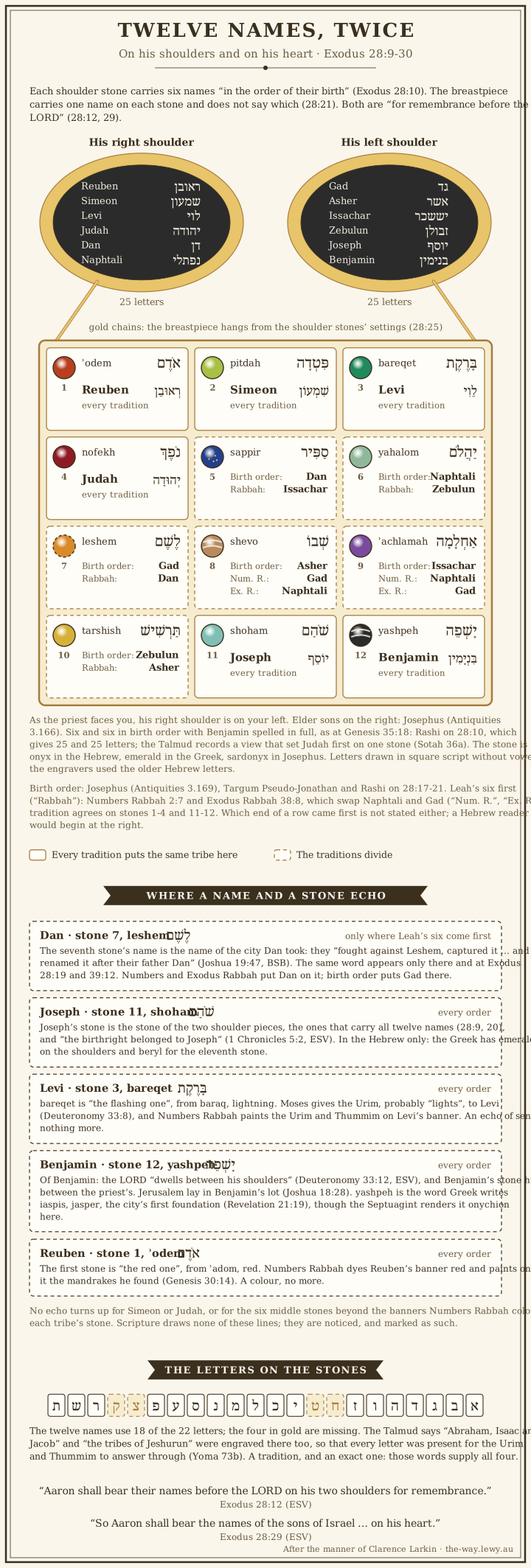
Exodus fixes the order on the shoulders and leaves it open on the breastpiece. Josephus, Targum Pseudo-Jonathan and Rashi put the tribes on the breastpiece in birth order; Numbers Rabbah 2:7 puts Leah's six sons first. All of them agree on the first four stones and the last two. Here and there a stone's name echoes its tribe. The seventh stone is leshem, and Leshem is the city Dan captured and renamed after himself (Joshua 19:47), though only Numbers Rabbah's order puts Dan on it. Scripture draws none of these links, so the plate marks each one with the order it depends on.
In the city the stones carry names again. "The wall of the city had twelve foundations, and on them were the twelve names of the twelve apostles of the Lamb" (Revelation 21:14, ESV). The names of the twelve tribes are on the gates (Revelation 21:12). The New Jerusalem works through what the two sets of names say about Israel and the church. The stones that once went into the Holy Place on one man's chest are now the foundations of a city shaped like the Most Holy Place, where all God's people live.
This shows that God remembers His people by name. He had their names cut into stone and carried before Him, and He has written the names of His Son's apostles into the foundations of the city. Jesus, the great high priest, "always lives to make intercession" for those who come to God through Him (Hebrews 7:25, ESV). He knows your name.
Stones worn and stones built
The cherub of Tyre
Ezekiel's lament over the king of Tyre dresses him in the stones:
✝️ Ezekiel 28:13-14 (ESV)
13 You were in Eden, the garden of God; every precious stone was your covering, sardius, topaz, and diamond, beryl, onyx, and jasper, sapphire, emerald, and carbuncle; and crafted in gold were your settings and your engravings. On the day that you were created they were prepared. 14 You were an anointed guardian cherub. I placed you; you were on the holy mountain of God; in the midst of the stones of fire you walked.
The Hebrew names nine stones, all from the breastpiece. The Septuagint names all twelve, σάρδιον, τοπάζιον, σμάραγδος, ἄνθραξ, σάπφειρος, ἴασπις, then λιγύριον, ἀχάτης, ἀμέθυστος, χρυσόλιθος, βηρύλλιον, ὀνύχιον, in exactly the breastpiece's order, with silver and gold after the sixth. In that text the king wears every stone of the high priest's breastpiece, and no tribe is named on them. (The Septuagint also places him "with the cherub" in 28:14, where the Hebrew calls him one.) Then: "Your heart was proud because of your beauty; you corrupted your wisdom for the sake of your splendor" (Ezekiel 28:17, ESV).
Whether this lament describes Satan behind the king of Tyre is contested. Pride sets out the case on both sides. Either way, the passage shows a creature dressed in stones that were made to show God's light, who came to treat the shining as his own.
Babylon and the Bride
Revelation sets two women side by side, and both are cities. The prostitute "was arrayed in purple and scarlet, and adorned with gold and jewels and pearls" (Revelation 17:4, ESV), and the merchants mourn the city "adorned with gold, with jewels, and with pearls!" (Revelation 18:16, ESV). The Greek for "adorned" is κεχρυσωμένη (kechrysōmenē, G5558), "gilded", a covering laid over her. The Bride has "the glory of God" (Revelation 21:11, ESV), and the same materials, gold, precious stone and pearl, are what she is built of (Revelation 21:18-21). The Harlot and the Bride treats the two cities in full.
This shows that God gives His glory to His people as their home. Babylon wore the stones. God builds His city out of them, and lights it Himself.
So you may shine
The word John used for the city's radiance, φωστήρ, appears in only one other place in the New Testament. Paul uses it of you:
✝️ Philippians 2:14-15 (ESV)
14 Do all things without grumbling or disputing, 15 that you may be blameless and innocent, children of God without blemish in the midst of a crooked and twisted generation, among whom you shine as lights in the world,
Paul is echoing Daniel. In the Old Greek of Daniel 12:3, at the resurrection, the wise will shine "like the luminaries of heaven", with the same verb, φαίνω (phainō, G5316), and the same noun, φωστήρ, that Paul uses. The ESV renders the Hebrew: they "shall shine like the brightness of the sky above" (Daniel 12:3, ESV). What the city will be, God's people are already becoming. "We all, with unveiled face, beholding the glory of the Lord, are being transformed into the same image from one degree of glory to another" (2 Corinthians 3:18, ESV). Zechariah saw it coming for Israel: "like the jewels of a crown they shall shine on his land" (Zechariah 9:16, ESV). Peter calls you "living stones" being built into a house where you serve as priests (1 Peter 2:5, ESV).
John's Gospel shows what this looks like in one man:
✝️ John 1:7-9 (ESV)
7 He came as a witness, to bear witness about the light, that all might believe through him. 8 He was not the light, but came to bear witness about the light. 9 The true light, which gives light to everyone, was coming into the world.
Jesus called John the Baptist "a burning and shining lamp" (John 5:35, ESV), ὁ λύχνος (lychnos, G3088). In the city that word belongs to Jesus: "its lamp is the Lamb", and the glory of God "gives it light" (Revelation 21:23, ESV), with φωτίζω (phōtizō, G5461), the verb of the true light in John 1:9. The Baptist shone, and everything he shone with pointed to the Light. A witness carries light the way a stone does.
This is the work of the Holy Spirit, "for this comes from the Lord who is the Spirit" (2 Corinthians 3:18, ESV), and it ends in glorification, when Christ "will transform our lowly body to be like his glorious body" (Philippians 3:21, ESV). A stone shines only while it faces the light. So you may shine, keep your face toward Jesus, in whose face God's glory is seen (2 Corinthians 4:6).
Discussion Questions
- The language. Ezekiel says the wheels looked "like the gleaming of beryl", כְּעֵין תַּרְשִׁישׁ (keʿeyn tarshish), literally "like the eye of the stone" (Ezekiel 1:16). Why would a prophet describe God's throne by the sparkle of a stone, and what would he lose by describing its substance?
- The text in its context. Ezekiel saw the throne of God in Babylon, by a canal, among exiles whose temple was about to fall (Ezekiel 1:1-3). What did it tell them that the glory of God appeared there?
- Christ. The stones over Aaron's heart carried Israel's names into the Holy Place (Exodus 28:29), and Jesus "always lives to make intercession" for His people (Hebrews 7:25). What changes in how you pray when you know He carries your name?
- The hard part. The Septuagint dresses the king of Tyre in all twelve breastpiece stones; the Hebrew names nine (Ezekiel 28:13). Read Ezekiel 28:11-19 with the Greek list in mind. Does it make the lament read more like the fall of a priestly being than the fall of a king, and how far can a variant like this carry an argument?
- Looking closer. Pliny called the star in a sapphire a "pupil"; Ezekiel called the gleam of a stone its "eye" (Ezekiel 1:16). Neither light belongs to the stone. Where else does Scripture show a person shining with a light that is not their own (Exodus 34:29-35; 2 Corinthians 3:18), and what happened when the light was taken away?
- Be transformed. The city has "no need of sun or moon" because God's glory gives it light (Revelation 21:23), and Paul says you "shine as lights in the world" (Philippians 2:15). Where are you most tempted to treat God's gifts in you as your own shine, and what would it look like to turn that back toward Him this week?
Group study sheet for a 40-minute group: two A4 sheets, or one with the guided path
The point, the passage, the questions and the response, from this study. Print on both sides of two A4 sheets, flipping on the long edge. While this block is open, printing the page prints the sheet; close it to print the study.
Precious Stones in Scripture
Ezekiel 1:26-28; Revelation 21:9-21The point When the prophets saw God's glory they reached for precious stones, because a gem shows a light it does not make; so the stones that carried Israel's names on the high priest's heart become the foundations of a city lit by God and the Lamb, and God means you to shine in the same way, with His light.
Ask: what comes to mind when you hear Precious Stones in Scripture
? Hear a few answers before anyone reads.
Ezekiel 1:26-28 26Above the expanse over their heads was the likeness of a throne with the appearance of sapphire, and on the throne high above was a figure like that of a man. 27From what seemed to be His waist up, I saw a gleam like amber, with what looked like fire within it all around. And from what seemed to be His waist down, I saw what looked like fire; and brilliant light surrounded Him. 28The appearance of the brilliant light all around Him was like that of a rainbow in a cloud on a rainy day. This was the appearance of the likeness of the glory of the LORD. And when I saw it, I fell facedown and heard a voice speaking.
Revelation 21:9-21 9Then one of the seven angels with the seven bowls full of the seven final plagues came and said to me, “Come, I will show you the bride, the wife of the Lamb.” 10And he carried me away in the Spirit to a mountain great and high, and showed me the holy city of Jerusalem coming down out of heaven from God, 11shining with the glory of God. Its radiance was like a most precious jewel, like a jasper, as clear as crystal. 12The city had a great and high wall with twelve gates inscribed with the names of the twelve tribes of Israel, and twelve angels at the gates. 13There were three gates on the east, three on the north, three on the south, and three on the west. 14The wall of the city had twelve foundations bearing the names of the twelve apostles of the Lamb. 15The angel who spoke with me had a golden measuring rod to measure the city and its gates and walls. 16The city lies foursquare, with its width the same as its length. And he measured the city with the rod, and all its dimensions were equal—12,000 stadia in length and width and height. 17And he measured its wall to be 144 cubits, by the human measure the angel was using. 18The wall was made of jasper, and the city itself of pure gold, as pure as glass. 19The foundations of the city walls were adorned with every kind of precious stone: The first foundation was jasper, the second sapphire, the third chalcedony, the fourth emerald, 20the fifth sardonyx, the sixth carnelian, the seventh chrysolite, the eighth beryl, the ninth topaz, the tenth chrysoprase, the eleventh jacinth, and the twelfth amethyst. 21And the twelve gates were twelve pearls, with each gate consisting of a single pearl. The main street of the city was pure gold, as clear as glass.
Also read:
Precious Stones in Scripture
- The stones Scripture names. Where gems appear, from Eden to the city, and a plate of the three lists.
- What the stones looked like. Why translations disagree, what the ancient names meant, and photographs of each.
- The language of appearance. How Ezekiel and John describe what they saw, and what they pick out of each stone.
- A light the stone does not make. Where the city's light comes from, and a first-century tradition that the breastpiece shone.
- What a gem does with light. Five things a gem does with light, the star stone Pliny saw, and the colour that turns.
- Names on the stones. The tribes on the priest's heart and the apostles on the foundations.
- Stones worn and stones built. The cherub of Tyre, Babylon and the Bride.
- So you may shine. The same word for the city's light and for yours.
Precious Stones in Scripture
1The language. Ezekiel says the wheels looked "like the gleaming of beryl", כְּעֵין תַּרְשִׁישׁ (keʿeyn tarshish), literally "like the eye of the stone" (Ezekiel 1:16). Why would a prophet describe God's throne by the sparkle of a stone, and what would he lose by describing its substance?
2The hard part. The Septuagint dresses the king of Tyre in all twelve breastpiece stones; the Hebrew names nine (Ezekiel 28:13). Read Ezekiel 28:11-19 with the Greek list in mind. Does it make the lament read more like the fall of a priestly being than the fall of a king, and how far can a variant like this carry an argument?
3Looking closer. Pliny called the star in a sapphire a "pupil"; Ezekiel called the gleam of a stone its "eye" (Ezekiel 1:16). Neither light belongs to the stone. Where else does Scripture show a person shining with a light that is not their own (Exodus 34:29-35; 2 Corinthians 3:18), and what happened when the light was taken away?
4Christ. The stones over Aaron's heart carried Israel's names into the Holy Place (Exodus 28:29), and Jesus "always lives to make intercession" for His people (Hebrews 7:25). What changes in how you pray when you know He carries your name?
5The text in its context. Ezekiel saw the throne of God in Babylon, by a canal, among exiles whose temple was about to fall (Ezekiel 1:1-3). What did it tell them that the glory of God appeared there?
Precious Stones in Scripture
6Be transformed. The city has "no need of sun or moon" because God's glory gives it light (Revelation 21:23), and Paul says you "shine as lights in the world" (Philippians 2:15). Where are you most tempted to treat God's gifts in you as your own shine, and what would it look like to turn that back toward Him this week?
- Think. Whatever shines in you is God's light falling on you. The city has "the glory of God" and no light of its own (Revelation 21:11, 23).
- Attitude. Point away from yourself. John the Baptist "came to bear witness about the light" (John 1:8, ESV). The king of Tyre kept the shine for himself: "your heart was proud because of your beauty" (Ezekiel 28:17, ESV).
- Do. Name one person who sees you every week, and ask God this week for a way your good works can show them His glory, so that they "give glory to your Father who is in heaven" (Matthew 5:16, ESV).
And the city has no need of sun or moon to shine on it, for the glory of God gives it light, and its lamp is the Lamb.
Revelation 21:23 (ESV)Father of lights, you dwell in light, and in you is no darkness at all. Thank you that you showed Ezekiel and John your glory, and that you have shown it to us in the face of your Son Jesus. Thank you that He carries our names before you as the high priest carried Israel's. Shine on us, and through us, until we shine as lights in this generation, and bring us at last into the city whose lamp is the Lamb.
In Jesus' name. Amen.
Precious Stones in Scripture
Ezekiel 1:26-28; Revelation 21:9-21Open Ask: what comes to mind when you hear Precious Stones in Scripture
? Hear a few answers before anyone reads.
Read it aloud Ezekiel 1:26-28; Revelation 21:9-21
1The language. Ezekiel says the wheels looked "like the gleaming of beryl", כְּעֵין תַּרְשִׁישׁ (keʿeyn tarshish), literally "like the eye of the stone" (Ezekiel 1:16). Why would a prophet describe God's throne by the sparkle of a stone, and what would he lose by describing its substance?
2The hard part. The Septuagint dresses the king of Tyre in all twelve breastpiece stones; the Hebrew names nine (Ezekiel 28:13). Read Ezekiel 28:11-19 with the Greek list in mind. Does it make the lament read more like the fall of a priestly being than the fall of a king, and how far can a variant like this carry an argument?
3Looking closer. Pliny called the star in a sapphire a "pupil"; Ezekiel called the gleam of a stone its "eye" (Ezekiel 1:16). Neither light belongs to the stone. Where else does Scripture show a person shining with a light that is not their own (Exodus 34:29-35; 2 Corinthians 3:18), and what happened when the light was taken away?
4Christ. The stones over Aaron's heart carried Israel's names into the Holy Place (Exodus 28:29), and Jesus "always lives to make intercession" for His people (Hebrews 7:25). What changes in how you pray when you know He carries your name?
5The text in its context. Ezekiel saw the throne of God in Babylon, by a canal, among exiles whose temple was about to fall (Ezekiel 1:1-3). What did it tell them that the glory of God appeared there?
6Be transformed. The city has "no need of sun or moon" because God's glory gives it light (Revelation 21:23), and Paul says you "shine as lights in the world" (Philippians 2:15). Where are you most tempted to treat God's gifts in you as your own shine, and what would it look like to turn that back toward Him this week?
- Think. Whatever shines in you is God's light falling on you. The city has "the glory of God" and no light of its own (Revelation 21:11, 23).
- Attitude. Point away from yourself. John the Baptist "came to bear witness about the light" (John 1:8, ESV). The king of Tyre kept the shine for himself: "your heart was proud because of your beauty" (Ezekiel 28:17, ESV).
- Do. Name one person who sees you every week, and ask God this week for a way your good works can show them His glory, so that they "give glory to your Father who is in heaven" (Matthew 5:16, ESV).
Precious Stones in Scripture
The point When the prophets saw God's glory they reached for precious stones, because a gem shows a light it does not make; so the stones that carried Israel's names on the high priest's heart become the foundations of a city lit by God and the Lamb, and God means you to shine in the same way, with His light.
Annex: Correlations Scripture does not make
Popular charts pair each stone with a tribe, an apostle, a month or a meaning. Here is what each rests on.
- Stone to tribe. Exodus 28:21 says each stone bears one son's name, and it does not say which. Exodus 28:10 sets the shoulder stones' names "in the order of their birth" (ESV). Josephus applies birth order to the breastpiece too (Antiquities 3.7.5), which in his own list puts Reuben on a sardonyx. Targum Pseudo-Jonathan and Rashi follow birth order as well, and Numbers Rabbah 2:7 puts Leah's six sons first; the plate in Names on the stones above sets the orders side by side. Each is a reading, and the text is silent.
- Stone to apostle. Revelation 21:14 puts the twelve apostles' names on the foundations and does not pair them with stones.
- Stones and the months or the zodiac. Josephus says the twelve stones may be read as the months "or the like number of the signs of that circle which the Greeks call the Zodiac", and the two shoulder stones as the sun and moon (Antiquities 3.7.7, Whiston). Scripture makes neither connection.
- A meaning for each colour. Victorinus of Pettau, in the oldest surviving Latin commentary on Revelation (died about AD 304), read the jasper as water and the sardius as fire, the two judgments of the flood and the end (Commentary on the Apocalypse, on 4:3). It is an early example of assigning each stone its own lesson.
The text gives the stones two jobs: to carry names and to show light. The ESV Study Bible says the jewels "are not meant to be interpreted individually but together" (note on Revelation 4:3), and Walvoord, from the dispensational side, says "no clue is given as to the precise interpretation" (on Revelation 21:19-21). Read them as the prophets used them, together, as the glory of God.
References & Recommended Reading
Ancient sources
- Pliny the Elder, Natural History 37.53, 60, 62, 76, 86, 90, 92, 105, 107, 113, 115, 119-121, 125-126, 131, 136-137, 139, Latin text via LacusCurtius (public domain) — what each Greek stone name meant, the rainbow-throwing crystal. Translations in this study are its own.
- Flavius Josephus, Antiquities of the Jews 3.7.5, 3.7.7 and 3.8.9, trans. William Whiston (1737, public domain) — the order of the stones, the elder sons on the right shoulder (3.166), their reading as months and zodiac, and the tradition that they shone.
- Targum Pseudo-Jonathan on Exodus 28:17-21, trans. J. W. Etheridge (1862, public domain), via Sefaria — the tribes on the breastpiece in birth order.
- Numbers Rabbah 2:7 and Exodus Rabbah 38:8, Hebrew with The Sefaria Midrash Rabbah (2022), via Sefaria — Leah's six sons first, and each tribe's banner coloured like its stone.
- Rashi on Exodus 28:6, 10, 16, 21 and 30, trans. M. Rosenbaum and A. M. Silbermann (1929-1934), via Sefaria — the ephod as an apron worn behind, six names on each shoulder stone, the breastpiece in birth order, the Urim and Thummim between its folds.
- Babylonian Talmud Sotah 36a and Yoma 73b, William Davidson edition, via Sefaria — twenty-five letters on each shoulder stone; the patriarchs and "the tribes of Jeshurun" on the breastpiece.
- Rasmus Bartholin, Experimenta crystalli Islandici disdiaclastici (Copenhagen, 1669) — the first description of double refraction.
- Victorinus of Pettau, Commentary on the Apocalypse, on 4:3, Ante-Nicene Fathers vol. 7 (public domain).
Gemmology
- Shiyun Jin, Nathan D. Renfro, Aaron C. Palke and James E. Shigley, "Structures Behind the Spectacle: A Review of Optical Effects in Phenomenal Gemstones and Their Underlying Nanotextures," Gems & Gemology (Gemological Institute of America) 61, no. 2, Summer 2025 (gia.edu) — needle inclusions and the star in star sapphire.
- Richard W. Hughes, "Pleochroism in Faceted Gems: An Introduction," Gems & Gemology (Gemological Institute of America) 50, no. 3, Fall 2014 (gia.edu) — double refraction and pleochroism; none in diamond or garnet.
- Gemological Institute of America, "Diamond Cut" (gia.edu) — fire as the dispersion of light into spectral colours.
Commentaries and study Bibles
- John F. Walvoord, "Revelation," in The Bible Knowledge Commentary, ed. John F. Walvoord and Roy B. Zuck (Victor Books) — on Revelation 21:17-21. Quoted briefly with attribution.
- ESV Study Bible (Crossway) — verse text (ESV) and notes on Revelation 4:3 and 21:19-21.
- NIV Cultural Backgrounds Study Bible (Zondervan) — notes on Revelation 4:3 and 21:11, 19-21; NIV text of Exodus 28:17-20.
- NIV Biblical Theology Study Bible (Zondervan) — notes on Revelation 4:3 and 21:19.
- Legacy Standard Bible (The Lockman Foundation) — footnotes on Ezekiel 1:22 and Revelation 21:11.
- New American Standard Bible 2020 (The Lockman Foundation) — text of Exodus 28:17-20.
- Berean Standard Bible, CSB and NLT footnotes on Exodus 28:17 — the identifications uncertain.
- Brenton's Septuagint and Tischendorf's Greek New Testament (public domain) — the Greek stone names of Exodus 28, Ezekiel 28 and Revelation 21.
Photographs
All via Wikimedia Commons, resized.
- Gold, carnelian and lapis lazuli beads from Ur: SpeakingArch, CC BY-SA 4.0.
- Rock crystal: Robert M. Lavinsky, CC BY-SA 3.0.
- Lapis lazuli: Parent Géry, CC BY-SA 3.0.
- Chalcedony: Robert M. Lavinsky, CC BY-SA 3.0.
- Emerald: Robert M. Lavinsky, CC BY-SA 3.0.
- Sardonyx lit from behind: Warclachaja, CC BY-SA 4.0.
- Carnelian: W.carter, CC BY-SA 4.0.
- Golden beryl: Robert M. Lavinsky, CC BY-SA 3.0.
- Beryl: Robert M. Lavinsky, CC BY-SA 3.0.
- Peridot: Darla Sondrol, CC0.
- Chrysoprase: W.carter, CC BY-SA 4.0.
- Sapphire: James St. John, CC BY 2.0.
- Amethyst: Robert M. Lavinsky, CC BY-SA 3.0.
- Pearl: Wmpearl, CC0.
- Garnet: W.carter, CC BY 4.0.
- Agate: Ra'ike, CC BY-SA 3.0.
- Star of Asia sapphire: thisisbossi, CC BY-SA 2.0.
- Tourmaline in two directions: Mauswiesel, public domain.
- Onyx: Simon Eugster, CC BY-SA 3.0.


On this site
- The New Jerusalem — the city, its cube, and the tribes and apostles on its gates and foundations.
- The Harlot and the Bride — Babylon and the Bride as two cities.
- Pride — Ezekiel 28 and the question of Satan's fall.
- The Heavenly Pattern — the tabernacle furniture drawn to the pattern shown to Moses.