Teaching the Lord's Prayer at Home
New, published 4 October 2026. What else is new
Jesus' disciples learned to pray by watching Him do it. "Jesus was praying in a certain place, and when he finished, one of his disciples said to him, 'Lord, teach us to pray, as John taught his disciples'" (Luke 11:1, ESV). A household learns the same way. This guide takes the prayer He gave them one line a week, for children and adults together.
In one sentence: A household learns the Lord's Prayer by praying it together in the ordinary hours of the day, one line at a time, the way Deuteronomy 6 puts God's words into family life, so that children and parents come to know who the Father is and ask Him for what they need.
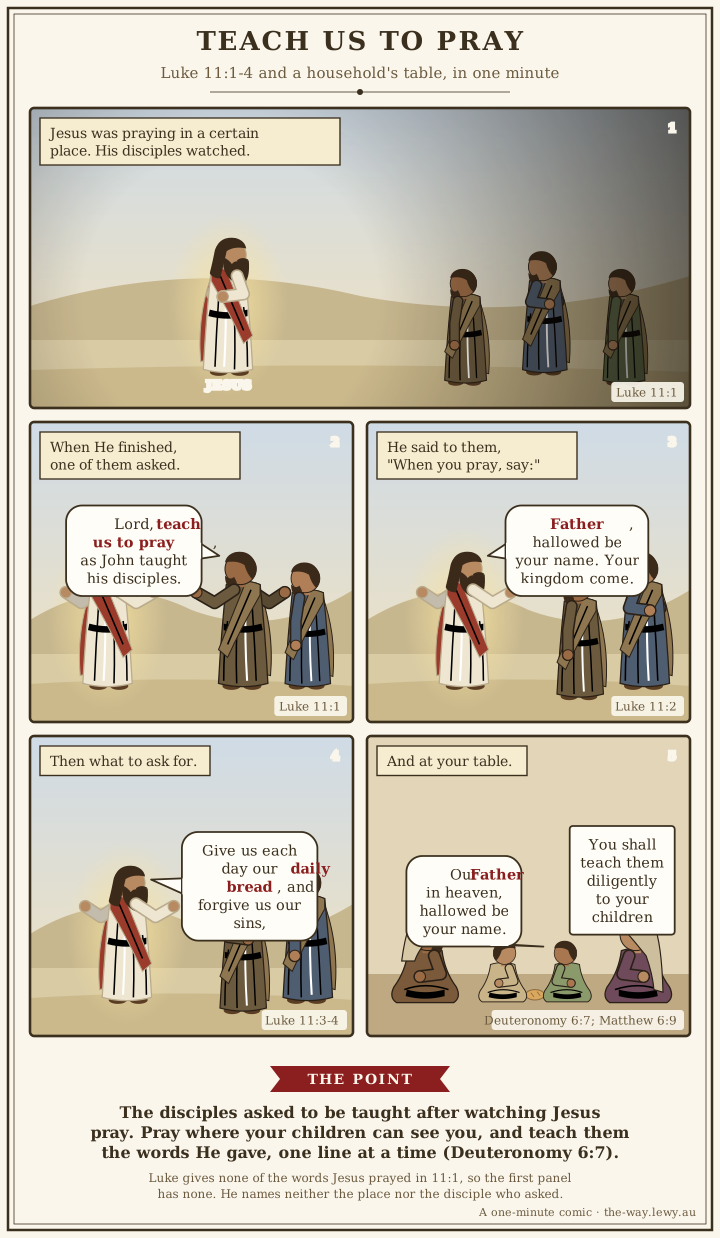
The theology and the Greek behind each line are in The Lord's Prayer. This page is for using it at home.
Key Takeaways
(This section follows the Key Takeaways format — see that page for what each part is for.)
Lessons about Jesus
- He taught prayer by praying. The disciples asked after watching Him (Luke 11:1). The first lesson a child gets about prayer is whether they see the adults in the house do it.
- He gave a prayer short enough for a child. Fifty-two words in the ESV of Matthew 6:9-13, from "Our Father" to "evil", every line of which a five-year-old can say and a lifetime does not exhaust.
Memory verses
✝️ Deuteronomy 6:6-7 (ESV)
6 And these words that I command you today shall be on your heart. 7 You shall teach them diligently to your children, and shall talk of them when you sit in your house, and when you walk by the way, and when you lie down, and when you rise.
Be Transformed
- Think. Parents are told to teach their children God's words (Deuteronomy 6:7; Ephesians 6:4), and the prayer Jesus gave is among them. You plant and water; the Father gives the growth (1 Corinthians 3:6).
- Attitude. Pray before you explain. In Deuteronomy 6:20-21 the child asks what God's commands mean and the parent answers; let the prayer be familiar enough that your children ask, as Timothy knew the Scriptures "from childhood" (2 Timothy 3:15).
- Do. Pick one fixed time this week, a meal or bedtime, and pray the Lord's Prayer aloud together there every day, so that God's words are spoken "when you sit in your house" (Deuteronomy 6:7, ESV). Then begin Week 1.
Prayer
Father, You named every family, and You have made us Yours through Your Son Jesus. Thank You for these children and for this home. Teach us to pray as Jesus taught His disciples. Let Your name be honoured in the way we speak to each other, give us today what we need, make us quick to forgive, and keep every one of us from the evil one. Let our children know You as their Father for the whole of their lives. In Jesus' name. Amen.
Study outline
- Why a household teaches this prayer — Psalm 78 and the early church's three times a day.
- How to use this guide — what each week contains, and how to pitch it to little children, school-age children and teenagers.
- The seven weeks — Our Father · Hallowed · Kingdom and will · Daily bread · Forgive · Temptation and evil · The whole prayer.
- Questions for parents — five questions to look back on the seven weeks.
Why a household teaches this prayer
Deuteronomy 6 puts the teaching of God's words inside the ordinary day, and Psalm 78:4 gives the reason: "We will not hide them from their children, but tell to the coming generation the glorious deeds of the LORD" (ESV). Five practices carry the wider habit, and this guide applies them to one prayer:
- Let them watch. The disciples asked to be taught after seeing Jesus pray (Luke 11:1). A child who never sees a parent pray has been taught something already.
- Use Paul's four words. A child can do all of 1 Timothy 2:1: something I need, something I want to say, someone else by name, something to say thank you for.
- Use fixed times as scaffolding, as Daniel's three set times (Daniel 6:10) and Jesus' before-dawn habit were.
- Let them hear you pray for them, by name, as Paul prayed for his churches (Ephesians 1:17-18).
- Let a child's prayer run its course. Leave corrections for later. Ephesians 6:4 warns fathers against provoking children, and early prayers grow when they are welcomed.
Prayer: Communion with God is the wider study of what prayer is.
The church used this prayer for that from early on. The Didache, a church manual probably from about AD 100, gives the Lord's Prayer and then says, "Thrice in the day thus pray" (Didache 8:3, ANF 7). A set time holds the habit up until the habit can stand. This shows that God means to be known by children, and that He gives parents the work of introducing them.
How to use this guide
Take one line a week, and pray the whole prayer together every day while you do. Each week has:
- The line, and what it shows about God, in a sentence a child can say back.
- A story from the Bible to read or tell (Weeks 1–6; Week 7 takes the whole prayer).
- A question for children and a question for adults.
- At home: one thing to do as a household that week.
- A verse to learn.
- Pray it over your children: one of Paul's prayers for his churches, set beside the line. Paul prayed for his churches the way a parent prays for children.
- Go deeper: the studies on this site for the adults.
Seven weeks is a pace, and a family can stay on a line for longer. The point is that each line gets a week of attention before the next.
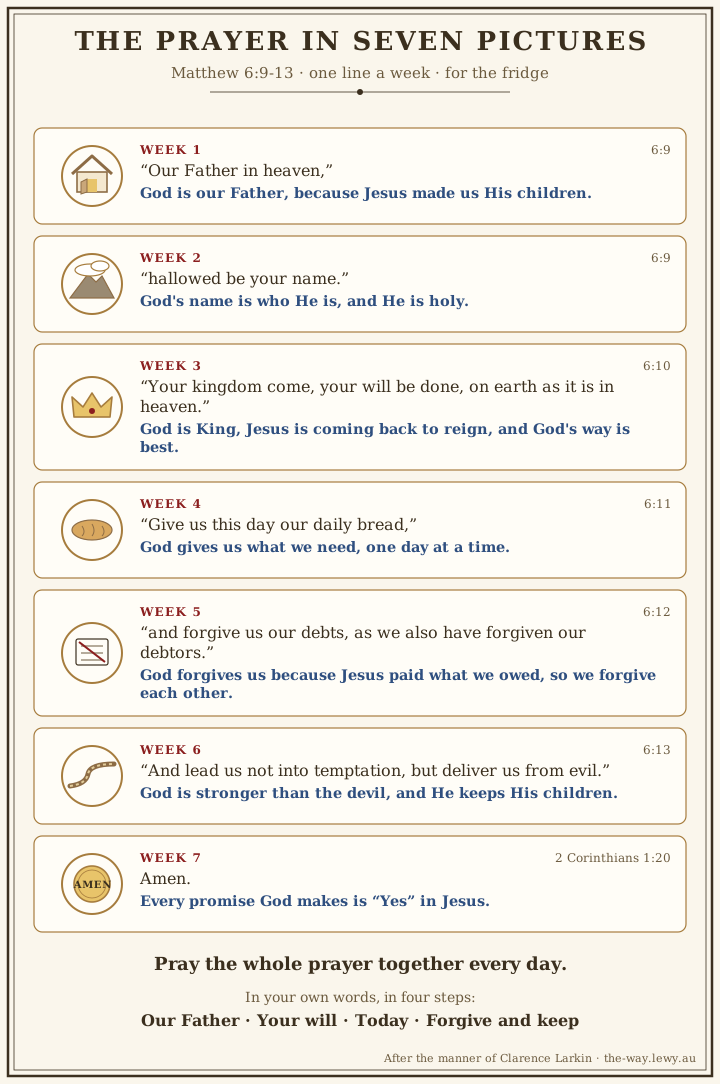
The card below has each week's line, its picture and its sentence for children. Print it for the fridge.
Different ages
Little children learn the words by hearing them. Pray the prayer aloud every day; let them join in as they can, and teach them the one-sentence "what it shows about God" line for each week. A three- or four-year-old who can say "God is our Father, because Jesus made us His children" is already saying the gospel.
School-age children can take the story, the question and the verse. Let them retell the story in their own words before you add anything. Let their prayers run their course; corrections can wait (Ephesians 6:4).
Teenagers are ready for the hard questions, and taking them seriously is part of teaching them. Two arise from this prayer. How can we ask God not to lead us into temptation when "he himself tempts no one" (James 1:13, ESV)? And does Matthew 6:15 mean God's forgiveness depends on ours? The Lord's Prayer answers both; read those sections with them and ask what they make of it.
Week 1: Our Father in heaven

What it shows about God. God is our Father, because Jesus made us His children.
Story. The father of the lost son (Luke 15:11-32). The son wasted everything and came home expecting to be a servant, "But while he was still a long way off, his father saw him and felt compassion, and ran and embraced him and kissed him" (Luke 15:20, ESV). This is the Father Jesus teaches us to talk to.
For children. Who can call God "Father"? (John 1:12: everyone who receives Jesus.) Why do we say "our Father" and not "my Father"?
For adults. What picture of a father do you bring to this word, and where does the father in Luke 15 correct it?
At home. Before anyone asks God for anything this week, each person finishes the sentence "Father, thank You that You…". The prayer says our, us or we nine times and never my or me, so pray it as a family even when you pray it alone.
Learn. "To all who did receive him, who believed in his name, he gave the right to become children of God" (John 1:12, ESV).
Pray it over your children. "I bow my knees before the Father, from whom every family in heaven and on earth is named" (Ephesians 3:14-15, ESV). The word for "family", πατριά (patria, pat-ree-AH, G3965), is built on the word for "father": every family takes its name from Him.
Go deeper. Our Father in heaven, A given willingness, Assurance of Salvation.
Week 2: Hallowed be your name

What it shows about God. God's name is who He is, and He is holy.
Story. God shows Moses His name (Exodus 34:5-7). "The LORD, the LORD, a God merciful and gracious, slow to anger, and abounding in steadfast love and faithfulness" (Exodus 34:6, ESV). When the Bible talks about God's name, it means everything He has told us He is.
For children. What does it mean to "hallow" something? (To treat it as special and holy.) How can the way we talk to each other make people think better or worse of God?
For adults. In Ezekiel 36:17-20 Israel's conduct brought exile, and the exile made the nations think less of God. What would your neighbours learn about God from your household this week?
At home. Learn Exodus 34:6 together as "God's name". At the end of each day, ask: where did we honour His name today, and where did we not?
Learn. "Oh, magnify the LORD with me, and let us exalt his name together!" (Psalm 34:3, ESV).
Pray it over your children. Paul prayed "that the name of our Lord Jesus may be glorified in you, and you in him" (2 Thessalonians 1:12, ESV).
Go deeper. Hallowed be your name.
Week 3: Your kingdom come, your will be done

What it shows about God. God is King, Jesus is coming back to reign, and God's way is best.
Story. Jesus in Gethsemane (Matthew 26:36-46). The night before the cross He asked the Father for another way, and then prayed, "not as I will, but as you will" (Matthew 26:39, ESV). Jesus prayed this line when it cost Him most.
For children. What is a kingdom? Who is the King in God's kingdom, and what will it be like when He comes back?
For adults. Where is your own will most at odds with God's right now, and what would it take to pray Jesus' words from Gethsemane over it?
At home. When a family decision comes up this week, pray "Your will be done" over it together before deciding. End each day's prayer with the Bible's last prayer, "Come, Lord Jesus!"
Learn. Jesus' promise and the church's answer: "Surely I am coming soon." / "Amen. Come, Lord Jesus!" (Revelation 22:20, ESV).
Pray it over your children. Paul asked that the Colossians "be filled with the knowledge of his will in all spiritual wisdom and understanding" (Colossians 1:9, ESV), and thanked the Father who "transferred us to the kingdom of his beloved Son" (Colossians 1:13, ESV).
Go deeper. Your kingdom come, Your Kingdom Come, The Rapture of the Church.
Week 4: Give us this day our daily bread

What it shows about God. God gives us what we need, one day at a time.
Story. The manna (Exodus 16). God said, "I am about to rain bread from heaven for you, and the people shall go out and gather a day's portion every day" (Exodus 16:4, ESV). Those who gathered much "had nothing left over, and whoever gathered little had no lack" (Exodus 16:18, ESV), and manna kept overnight went bad, except before the Sabbath (Exodus 16:19-26). Moses later told Israel why: "that he might make you know that man does not live by bread alone, but man lives by every word that comes from the mouth of the LORD" (Deuteronomy 8:3, ESV). Then tell how Jesus fed five thousand, and the next day said, "I am the bread of life" (John 6:35, ESV).
For children. Why do you think God sent manna one day at a time instead of a whole year at once? What did we eat today that came from God?
For adults. Where do you want security for months ahead instead of trusting God for today? And the prayer says our bread: who near you has less?
At home. At meals this week, thank God for one food by name. Choose one way to share bread with someone outside the house.
Learn. "And my God will supply every need of yours according to his riches in glory in Christ Jesus" (Philippians 4:19, ESV).
Pray it over your children. In a storm at sea, with everyone aboard afraid, Paul "took bread, and giving thanks to God in the presence of all he broke it and began to eat" (Acts 27:35, ESV). Give thanks for your children's food in front of them the same way, and ask that they learn what Paul learned, to be content "in whatever situation" (Philippians 4:11, ESV).
Go deeper. Give us this day our daily bread, Bread of Life, In Humility.
Week 5: Forgive us our debts

What it shows about God. God forgives us because Jesus paid what we owed, so we forgive each other.
Story. The unforgiving servant (Matthew 18:21-35). Peter asked how many times he must forgive, and Jesus said "seventy-seven times" (Matthew 18:22, ESV; the CSB and NLT footnote "seventy times seven"). Then He told of a servant forgiven a debt he could never pay, who would not forgive a small one. The king asked him, "should not you have had mercy on your fellow servant, as I had mercy on you?" (Matthew 18:33, ESV).
For children. What did Jesus do so that God could forgive us? When someone says sorry to you, what do you say?
For adults. Is there someone this prayer, prayed honestly, asks you to forgive? What would you want your children to learn by watching you do it?
At home. Agree on the words your family uses. The one who did wrong says, "I was wrong. I'm sorry. Will you forgive me?" The one wronged answers, "I forgive you." Use them this week, parents included. Children learn more from a parent asking a child's forgiveness than from any lesson about it.
Learn. "Be kind to one another, tenderhearted, forgiving one another, as God in Christ forgave you" (Ephesians 4:32, ESV).
Pray it over your children. Thank the Father for His Son, "in whom we have redemption, the forgiveness of sins" (Colossians 1:14, ESV), and ask that your children would know it for themselves.
Go deeper. Forgive us our debts, Forgive Us Our Debts, Hurt by the Church.
Week 6: Lead us not into temptation, but deliver us from evil

What it shows about God. God is stronger than the devil, and He keeps His children.
Story. Jesus in the wilderness (Matthew 4:1-11). "Jesus was led up by the Spirit into the wilderness to be tempted by the devil" (Matthew 4:1, ESV). Hungry after forty days, Jesus answered every temptation with Scripture, until He said, "Be gone, Satan!" and "the devil left him, and behold, angels came and were ministering to him" (Matthew 4:10-11, ESV). Jesus went into the test and won, and He helps us in ours (Hebrews 4:15-16).
For children. What did Jesus use to answer the devil? What is something that tempts you, and what could you say back?
For adults. Where do you most need a "way of escape" planned before the temptation comes?
At home. Talk through one temptation each person faces, and agree a way of escape for it: a verse to say, a place to go, a person to tell. Praise one another when you take it.
Learn. "God is faithful, and he will not let you be tempted beyond your ability, but with the temptation he will also provide the way of escape, that you may be able to endure it" (1 Corinthians 10:13, ESV).
Pray it over your children. "Now may the God of peace himself sanctify you completely, and may your whole spirit and soul and body be kept blameless at the coming of our Lord Jesus Christ" (1 Thessalonians 5:23, ESV). Then hold on to the promises: "He who calls you is faithful; he will surely do it" (1 Thessalonians 5:24, ESV), and "He will establish you and guard you against the evil one" (2 Thessalonians 3:3, ESV). Jesus prayed the same for His disciples, "that you keep them from the evil one" (John 17:15, ESV).
Go deeper. Lead us not into temptation, Forty days in the wilderness.
Week 7: The whole prayer, and Amen

What it shows about God. Every promise God makes is "Yes" in Jesus.
The prayer. This week, pray the whole prayer slowly each day and stop after each line for one sentence in your own words. Learn the ending many churches use, "For yours is the kingdom and the power and the glory, forever." The earliest manuscripts of Matthew do not have it, but the Didache already prays a shorter form of it, and it is probably drawn from David's prayer in 1 Chronicles 29:11 (Why some Bibles end differently).
In your own words. Once the words are known, pray them in four steps, the same four that Prayer as Communion gives. Our Father: say who He is and thank Him. Your will: ask for what He wants first. Today: ask for what you and others need today. Forgive and keep: ask Him to forgive you as you forgive others, and to keep you from temptation and from evil. The steps follow the prayer's own lines (Matthew 6:9-13), with thanks added as Paul adds it, "with thanksgiving" (Philippians 4:6, ESV).
Amen. The word is Hebrew, אָמֵן (amen, ah-MANE, H543), and means "it is so, truly". Israel answered God's words with it (Deuteronomy 27:15-26). Paul says why we can say it: "all the promises of God find their Yes in him. That is why it is through him that we utter our Amen to God for his glory" (2 Corinthians 1:20, ESV). We say Amen because of Jesus.
For children. Can you say the whole prayer? Which line is your favourite, and why?
For adults. Which line has changed most for you over these seven weeks?
At home. Keep the set time you started in Week 1. Let each child lead the prayer on one day.
Learn. the whole prayer, Matthew 6:9-13.
Pray it over your children. Paul closed his prayer for the Ephesians, "Now to him who is able to do far more abundantly than all that we ask or think, according to the power at work within us, to him be glory in the church and in Christ Jesus throughout all generations, forever and ever. Amen" (Ephesians 3:20-21, ESV). All generations includes the ones at your table.
Go deeper. What the prayer teaches, A pattern to pray by.
Questions for parents
- Deuteronomy 6:7 places teaching in sitting, walking, lying down and rising. Which of those four is already a time your household prays, and which could become one?
- Each week names what a line shows about God. Which of the seven sentences do you most need to believe yourself?
- Jesus prayed "not as I will" in Gethsemane (Matthew 26:39). How does it help a child to hear a parent pray that line about something hard?
- Paul's prayers ask mostly for people to know God and live worthy of Him (Colossians 1:9-10). How do the things you pray for your children compare?
- Which of the household practices was hardest to keep, and what does that show you?
References & Recommended Reading
- ESV Bible (Crossway) -- translation quoted throughout.
- Didache 8:3, from Ante-Nicene Fathers vol. 7 (public domain).
- CSB and NLT footnotes on Matthew 18:22, consulted via this site's study-notes database.
- The Lord's Prayer -- the exegesis, word studies and sources behind each week.
- Prayer as Communion -- the wider habit of prayer and teaching a household to pray.