The Golden Altar of Incense
Week 3 of 8 in The Heavenly Pattern · next: The Lampstand
The prayers of the saints before the throne of God
Luke opens his Gospel's story at this altar, and the first thing said there is that a prayer has been heard. An old priest named Zechariah was chosen by lot to burn the incense (Luke 1:9). Outside, the people prayed at the same hour:
✝️ Luke 1:10-11, 13 (ESV)
10 And the whole multitude of the people were praying outside at the hour of incense. 11 And there appeared to him an angel of the Lord standing on the right side of the altar of incense. ... 13 But the angel said to him, "Do not be afraid, Zechariah, for your prayer has been heard, and your wife Elizabeth will bear you a son, and you shall call his name John.
The smoke went up inside while the people prayed outside, and the angel who stood by the altar answered a prayer.
In one sentence: God set a golden altar before the veil, facing the mercy seat, where the priest burned God's own incense every morning and evening as he tended the lamps; Scripture itself says what that incense is, the prayers of God's people (Psalm 141:2; Revelation 5:8), and in heaven the same altar receives the saints' prayers and sends fire back to the earth, so the prayers of the saints are heard before God's throne and answered in what He does.
This is the second furnishing in The Heavenly Pattern, after The Lampstand.
Key Takeaways
(This section follows the Key Takeaways format — see that page for what each part is for.)
Types & Prophecy
- Revelation names what the incense is. The elders hold "golden bowls full of incense, which are the prayers of the saints" (Revelation 5:8, ESV). Psalm 141:2 had already prayed, "Let my prayer be counted as incense before you."
- Malachi foresaw incense offered among the nations. "In every place incense will be offered to my name, and a pure offering" (Malachi 1:11, ESV).
Lessons about Jesus
- Prayer reaches God through the priest God appoints. Only Aaron's line could burn this incense, and a king who tried was struck (2 Chronicles 26:18-19). Jesus is the High Priest God appointed, who "always lives to make intercession" for those who come to God through Him (Hebrews 7:25). Reading the altar as a picture of that intercession belongs to later interpreters; the NIV Biblical Theology Study Bible says it "may prefigure" it (note on Exodus 30:1).
- Heaven receives the prayers of Jesus' people. They are kept in golden bowls before the Lamb (Revelation 5:8), and the fire of the trumpet judgements comes from the altar where they rose (Revelation 8:3-5).
Memory verses
✝️ Psalm 141:2 (ESV)
2 Let my prayer be counted as incense before you, and the lifting up of my hands as the evening sacrifice!
✝️ Revelation 8:4 (ESV)
4 and the smoke of the incense, with the prayers of the saints, rose before God from the hand of the angel.
Be Transformed
- Think. Your prayers rise before God's throne. Revelation shows them kept there in golden bowls.
- Attitude. Come to God on His terms: through Jesus, the priest He appointed.
- Do. Pray at a set hour morning and evening this week, as Aaron burned the incense (Exodus 30:7-8). Open with David's prayer, "Let my prayer be counted as incense before you" (Psalm 141:2, ESV), and write down what you ask.
Prayer
Father, You set an altar before Your throne and You receive the prayers of Your people like incense. Thank You that You appointed Your Son Jesus as our High Priest, so that we come to You through Him and are heard. Keep us praying morning and evening. Teach us to ask for what You will do, and to trust that not one prayer of Your saints is lost before You.
In Jesus' name. Amen.
Study outline
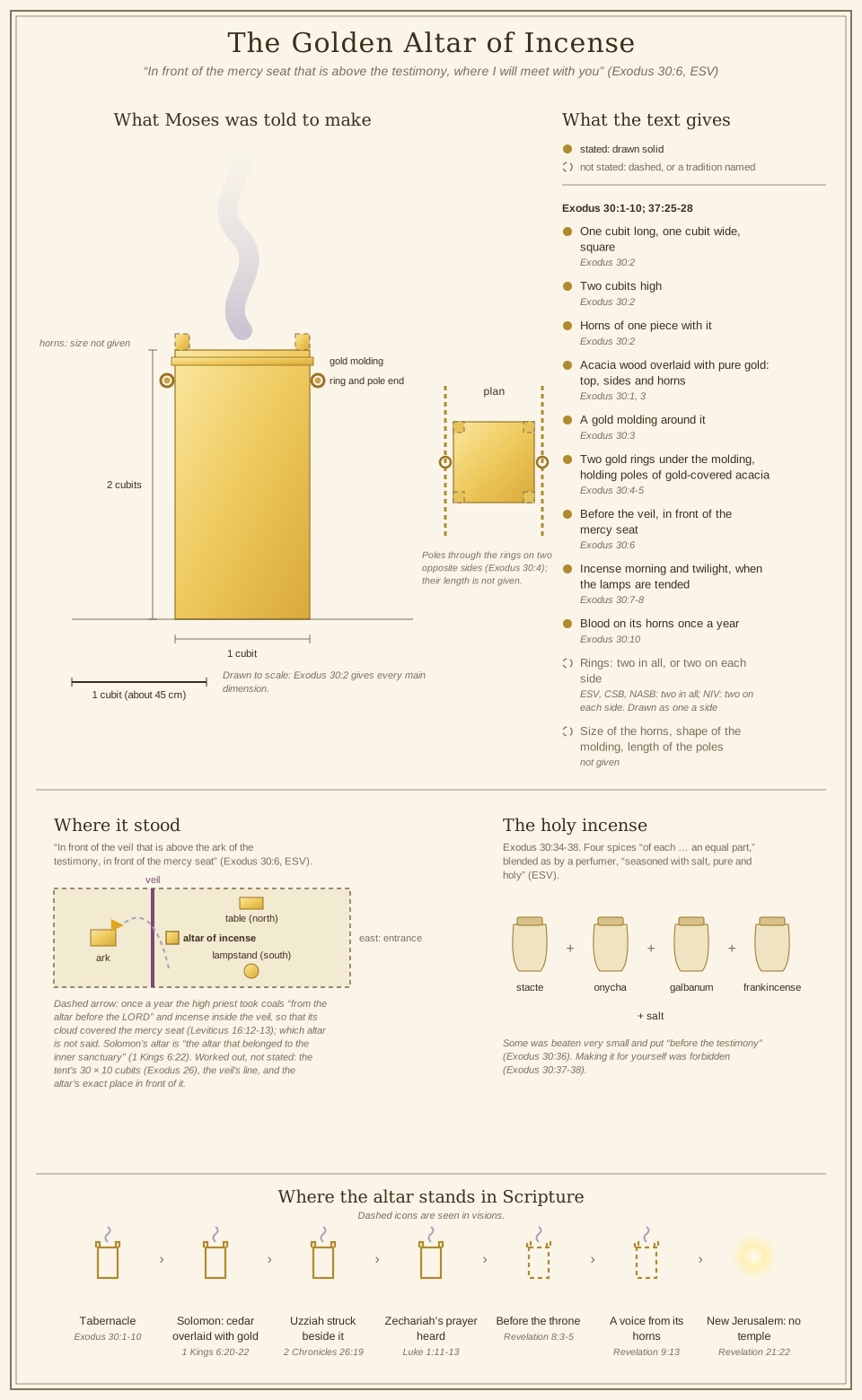
- Made after the pattern. Exodus 30:1-10: an altar a cubit square and two high, horns on its corners, set in front of the mercy seat. The plate draws it to scale.
- His incense and His fire. A recipe reserved for God, and the people who came near it the wrong way or the right way.
- Morning and evening, with the lamps. The daily incense and the yearly blood on its horns.
- Outside the veil, belonging to the inner room. Where 1 Kings and Hebrews place it.
- Incense is prayer. The Psalms, Luke and Malachi.
- The golden altar before the throne. Revelation 5-16: prayers kept, prayers offered, fire returned.
- What the altar shows about God. Each connection sorted by how firmly Scripture makes it.
- Discussion Questions. Six, for a group or on your own.
Made after the pattern
The altar of incense is described apart from the other gold furniture. The ark, the table and the lampstand come in Exodus 25, the priesthood in Exodus 28-29, and this altar in Exodus 30, after the priest who will use it:
✝️ Exodus 30:1-6 (ESV)
1 "You shall make an altar on which to burn incense; you shall make it of acacia wood. 2 A cubit shall be its length, and a cubit its breadth. It shall be square, and two cubits shall be its height. Its horns shall be of one piece with it. 3 You shall overlay it with pure gold, its top and around its sides and its horns. And you shall make a molding of gold around it. 4 And you shall make two golden rings for it. Under its molding on two opposite sides of it you shall make them, and they shall be holders for poles with which to carry it. 5 You shall make the poles of acacia wood and overlay them with gold. 6 And you shall put it in front of the veil that is above the ark of the testimony, in front of the mercy seat that is above the testimony, where I will meet with you.
The Hebrew of verse 1 reads "an altar, a place of burning of incense": מִזְבֵּחַ (mizbeach, H4196) and מִקְטָר (miqtar, H4729), with קְטֹרֶת (qetoret, keh-TOH-ret, H7004), "incense."
Drawn to scale
Exodus gives this altar's main dimensions, so the plate draws it to scale: a cubit square and two cubits high, about 45 by 45 by 90 cm, roughly waist height. The text leaves three things unstated: the size of the horns, the shape of the gold molding and the length of the poles. It is also unclear about the rings. The ESV, CSB and NASB read two rings in all, one on each side; the NIV reads two on each side. The Hebrew says "two" and "on its two sides" and allows either.
In front of the mercy seat
Verse 6 places the altar twice: "in front of the veil" and "in front of the mercy seat." The veil stood between them, and the altar faced the place God said He would meet with Moses (Exodus 25:22). The lampstand and the table are placed on the south and north sides (Exodus 26:35); the altar is placed by the mercy seat.
This shows that God put the place of prayer as close to His presence as a priest could come on an ordinary day. The priest could not go through the veil, but every morning and evening he stood at the altar that faced it.
His incense and His fire
A recipe reserved for God
God gave the incense its own formula: stacte, onycha, galbanum and frankincense, "of each shall there be an equal part," blended "as by the perfumer, seasoned with salt, pure and holy" (Exodus 30:34-35, ESV). The priests made it by that recipe, but no one was to make it for himself: "Whoever makes any like it to use as perfume shall be cut off from his people" (Exodus 30:37-38, ESV). The altar was forbidden "unauthorized incense," burnt offerings, grain offerings and drink offerings (Exodus 30:9). Only God's incense went up from it.
Nadab and Abihu
Aaron's two eldest sons found out what that meant on the day the priesthood began:
✝️ Leviticus 10:1-3 (ESV)
1 Now Nadab and Abihu, the sons of Aaron, each took his censer and put fire in it and laid incense on it and offered unauthorized fire before the LORD, which he had not commanded them. 2 And fire came out from before the LORD and consumed them, and they died before the LORD. 3 Then Moses said to Aaron, "This is what the LORD has said: 'Among those who are near me I will be sanctified, and before all the people I will be glorified.'" And Aaron held his peace.
The text says their fire was "unauthorized" and that God "had not commanded" it. What exactly made it so is not said. The NIV Biblical Theology Study Bible lists the possibilities: coals from somewhere other than the altar, the wrong incense, the wrong time, or the wrong room (note on Leviticus 10:1).
Aaron between the dead and the living
After Korah's rebellion a plague broke out among the people, and Moses sent Aaron with incense:
✝️ Numbers 16:46-48 (ESV)
46 And Moses said to Aaron, "Take your censer, and put fire on it from off the altar and lay incense on it and carry it quickly to the congregation and make atonement for them, for wrath has gone out from the LORD; the plague has begun." 47 So Aaron took it as Moses said and ran into the midst of the assembly. And behold, the plague had already begun among the people. And he put on the incense and made atonement for the people. 48 And he stood between the dead and the living, and the plague was stopped.
Fire from the LORD consumed Nadab and Abihu as they offered incense, and it consumed Korah's 250 men "offering the incense" in the same chapter (Numbers 16:35, ESV). Now incense saved the nation. This time the priest God appointed used fire "from off the altar," as Moses told him. Numbers calls it atonement.
King Uzziah
Centuries later King Uzziah "grew proud" and went into the temple "to burn incense on the altar of incense" (2 Chronicles 26:16, ESV). Eighty priests followed him in: "It is not for you, Uzziah, to burn incense to the LORD, but for the priests, the sons of Aaron, who are consecrated to burn incense" (2 Chronicles 26:18, ESV). He raged at them with the censer in his hand, and leprosy broke out on his forehead "by the altar of incense" (2 Chronicles 26:19, ESV). He was a leper until he died.
This shows that God decides how He is approached. The incense was His, the fire was His, and the priest was His choice. When Aaron came as God directed, incense stopped a plague. When men came on their own terms, fire consumed them or leprosy struck them.
Morning and evening, with the lamps
The altar kept the same hours as the lampstand:
✝️ Exodus 30:7-8 (ESV)
7 And Aaron shall burn fragrant incense on it. Every morning when he dresses the lamps he shall burn it, 8 and when Aaron sets up the lamps at twilight, he shall burn it, a regular incense offering before the LORD throughout your generations.
"Regular incense" is קְטֹרֶת תָּמִיד (qetoret tamid, H8548), the same word that keeps the lamp burning in Exodus 27:20. "At twilight" is literally "between the evenings." Twice a day the priest trimmed the lamps and burned the incense in one visit. The Lampstand covers the light; this altar is the other half of that daily service.
Blood on its horns
Once a year the altar itself was cleansed: "Aaron shall make atonement on its horns once a year. With the blood of the sin offering of atonement he shall make atonement for it once in the year throughout your generations. It is most holy to the LORD" (Exodus 30:10, ESV). The NIV Biblical Theology Study Bible ties this to the Day of Atonement of Leviticus 16 (note on Exodus 30:10).
On that day incense also went further than the altar. The high priest took coals and "two handfuls of sweet incense beaten small" inside the veil, "that the cloud of the incense may cover the mercy seat that is over the testimony, so that he does not die" (Leviticus 16:12-13, ESV). The one day a man went into God's presence, he went in behind a cloud of incense.
Outside the veil, belonging to the inner room
Exodus puts the altar outside the veil (Exodus 30:6; 40:26). Two later texts connect it to the room behind it.
When Solomon built the temple, 1 Kings describes gold overlay for "the whole altar that belonged to the inner sanctuary" (1 Kings 6:22, ESV). The Hebrew is "the altar that was to the debir," the inner room.
Hebrews describes the Most Holy Place as "having the golden altar of incense and the ark of the covenant" (Hebrews 9:4, ESV). Two questions sit in that sentence, and both are contested.
- "Having." The Greek ἔχουσα (echousa, G2192) can mean "containing." The ESV Study Bible argues that the writer, who knew the tabernacle, means the altar "belonged to" the Most Holy Place, since its smoke drifted in and it served the inner room (note on Hebrews 9:4). The NIV Cultural Backgrounds Study Bible agrees, pointing to 1 Kings 6:22.
- "Altar." The word is θυμιατήριον (thymiatērion, thoo-mee-ah-TAY-ree-on, G2369). In the Greek Old Testament it names a censer (2 Chronicles 26:19; Ezekiel 8:11), and the Legacy Standard Bible footnotes Hebrews 9:4 "Or censer." The KJV and NKJV read "the golden censer." Most modern translations read "altar." Read that way, Hebrews names every gold furnishing; read as "censer," its list leaves the golden altar out.
On either reading of Hebrews, Exodus is clear on where the altar stood: outside the veil (Exodus 30:6; 40:26). 1 Kings and Hebrews both tie it to the inner room it served.
Incense is prayer
The Old Testament makes the connection before Revelation does. David asks:
✝️ Psalm 141:2 (ESV)
2 Let my prayer be counted as incense before you, and the lifting up of my hands as the evening sacrifice!
Luke shows the two happening together. "The whole multitude of the people were praying outside at the hour of incense" (Luke 1:10, ESV), and the angel answered a prayer at the altar. Malachi, rebuking priests who despised God's table, looked ahead to a day when "in every place incense will be offered to my name, and a pure offering. For my name will be great among the nations" (Malachi 1:11, ESV). The ESV Study Bible reads that as the nations brought in to worship the true God (note on Malachi 1:11).
This shows that God has always received the prayers of His people as an offering. The incense was the priest's; the prayer belonged to everyone standing in the court. Prayer as Communion takes up what that prayer is and how Jesus and the apostles prayed.
The golden altar before the throne
Revelation uses the Greek word for "altar," θυσιαστήριον (thysiastērion, G2379), eight times. Twice it is called "the golden altar," the name Exodus gives the incense altar (Revelation 8:3; 9:13; Exodus 40:26).
Prayers kept
When the Lamb takes the scroll, the elders fall before Him holding "golden bowls full of incense, which are the prayers of the saints" (Revelation 5:8, ESV). This is Scripture's own interpretation of the incense, and it is stated as plainly as "the seven lampstands are the seven churches" (Revelation 1:20, ESV). The prayers are in heaven, in gold, before the Lamb.
The souls under the altar
At the fifth seal John sees "under the altar the souls of those who had been slain for the word of God and for the witness they had borne," crying, "O Sovereign Lord, holy and true, how long before you will judge and avenge our blood on those who dwell on the earth?" (Revelation 6:9-10, ESV). Which altar this is, is contested. The Cultural Backgrounds Study Bible reads it as the altar of sacrifice, where blood was poured at the base (note on Revelation 6:9), and the ESV Study Bible describes it as the place "where sacrificial blood would pool" (note on Revelation 6:9-11). The NIV Biblical Theology Study Bible leaves open either altar (note on Revelation 6:9). The ESV Study Bible also argues that heaven has one altar serving both purposes (note on Revelation 8:3-5). Either way the martyrs' cry is a prayer at an altar before God. At Home with the Lord covers what the passage says about believers who have died.
Prayers offered, fire returned
✝️ Revelation 8:3-5 (ESV)
3 And another angel came and stood at the altar with a golden censer, and he was given much incense to offer with the prayers of all the saints on the golden altar before the throne, 4 and the smoke of the incense, with the prayers of the saints, rose before God from the hand of the angel. 5 Then the angel took the censer and filled it with fire from the altar and threw it on the earth, and there were peals of thunder, rumblings, flashes of lightning, and an earthquake.
The censer here, λιβανωτός (libanōtos, G3031), appears in the New Testament only in these two verses. The angel does in heaven what Zechariah did in the temple: he offers incense with the prayers of the people. Then the same censer carries fire from the altar to the earth, and the seven trumpets begin. Aaron's censer once turned wrath away (Numbers 16:46-48); this one brings it down. The ESV Study Bible reads the sequence as an answer: "the judgments to follow answer the prayers of the saints" (note on Revelation 8:3-5). That is a strong inference from the order of the vision, and Revelation does not state it in so many words.
The altar keeps speaking. At the sixth trumpet a voice comes "from the four horns of the golden altar before God" (Revelation 9:13, ESV), the horns Aaron touched with blood once a year. An angel "came out from the altar, the angel who has authority over the fire" (Revelation 14:18, ESV). And when the bowls are poured out John hears "the altar saying, 'Yes, Lord God the Almighty, true and just are your judgments!'" (Revelation 16:7, ESV).
This shows that God keeps the prayers of His people and receives them with incense. The martyrs asked "how long?" The first answer they were given was "rest a little longer" (Revelation 6:11, ESV). The ESV Study Bible sees the answer beginning at the sixth seal (note on Revelation 6:9-11, citing 6:15-17), and the fire from the altar in Revelation 8 appears to carry it further. Revelation presents their prayers as heard, and as part of how God judges the world.
No temple in the city
The New Jerusalem has no temple: "its temple is the Lord God the Almighty and the Lamb" (Revelation 21:22, ESV). "They will see his face" (Revelation 22:4, ESV). The prayer once offered outside a veil is spoken face to face. The New Jerusalem covers the city.
What the altar shows about God
This table sorts the study's connections by how directly Scripture makes each one.
| Connection | Where | How firm |
|---|---|---|
| The incense in heaven is the prayers of the saints | Revelation 5:8; 8:3-4 | Stated |
| Prayer likened to incense | Psalm 141:2 | Stated, as a prayer |
| Prayer and incense at the same hour | Luke 1:10 | Stated, as narrative |
| The trumpet judgements answer the saints' prayers | Revelation 8:3-5 | A strong inference from the vision's order (ESV Study Bible) |
| The altar of Revelation 6:9 is the incense altar | Revelation 6:9 | Contested |
| Hebrews 9:4 means the altar, not a censer | Hebrews 9:4 | Contested; most translations read "altar" |
| The altar pictures Christ's intercession | Hebrews 7:25 | Read in by later interpreters (NIV Biblical Theology Study Bible, note on Exodus 30:1: "may prefigure") |
The stated rows carry the doctrine. God set a place of prayer as near to His presence as a priest could stand on an ordinary day, and He guarded it. Only His incense, His fire and His priest were allowed there, because "among those who are near me I will be sanctified" (Leviticus 10:3, ESV). When the priest He chose came with the fire He gave, incense stopped a plague.
Heaven shows what the altar was a copy of. Your prayers go up before the throne. They are kept in gold before the Lamb, and Revelation shows God acting in the world after they rise, including in judgement on those who shed His people's blood.
So pray, and pray through Jesus. God appointed Him as your High Priest, and He "always lives to make intercession" for those who draw near to God through Him (Hebrews 7:25, ESV). Come the way God opened, and your prayer rises before Him.
Discussion Questions
- The text in its context. The altar is placed "in front of the mercy seat" though a veil stood between them (Exodus 30:6). What does that placement say about prayer?
- The text in its context. Nadab and Abihu offered incense and died; Aaron offered incense and a plague stopped (Leviticus 10:1-2; Numbers 16:46-48). What made the difference?
- Christ. Uzziah was a strong king, and still the priests told him, "It is not for you, Uzziah, to burn incense to the LORD, but for the priests, the sons of Aaron" (2 Chronicles 26:18, ESV). Jesus "always lives to make intercession" for those who draw near to God through Him (Hebrews 7:25, ESV). What does it tell you about Jesus that He holds the office no king could take for himself?
- The hard part. Exodus sets the altar "in front of the veil" (Exodus 30:6, ESV), yet Hebrews describes the Most Holy Place as "having the golden altar of incense" (Hebrews 9:4, ESV), and 1 Kings 6:22 calls it "the altar that belonged to the inner sanctuary." How do you hold these texts together?
- Be transformed. The martyrs ask "how long?" (Revelation 6:10), and the fire of Revelation 8:5 comes from the altar where the saints' prayers rose. How should that shape the way you pray about injustice?
- Be transformed. The incense was burned "every morning" and "at twilight" (Exodus 30:7-8). What would a set time of prayer, morning and evening, change in your week?
Group study sheet for a 40-minute group: two A4 sheets, or one with the guided path
The point, the passage, the questions and the response, from this study. Print on both sides of two A4 sheets, flipping on the long edge. While this block is open, printing the page prints the sheet; close it to print the study.
The Golden Altar of Incense
Exodus 30:1-10The point God set a golden altar before the veil, facing the mercy seat, where the priest burned God's own incense every morning and evening as he tended the lamps; Scripture itself says what that incense is, the prayers of God's people (Psalm 141:2; Revelation 5:8), and in heaven the same altar receives the saints' prayers and sends fire back to the earth, so the prayers of the saints are heard before God's throne and answered in what He does.
Ask: what comes to mind when you hear The Golden Altar of Incense
? Hear a few answers before anyone reads.
Exodus 30:1-10 1“You are also to make an altar of acacia wood for the burning of incense. 2It is to be square, a cubit long, a cubit wide, and two cubits high. Its horns must be of one piece. 3Overlay with pure gold the top and all the sides and horns, and make a molding of gold around it. 4And make two gold rings below the molding on opposite sides to hold the poles used to carry it. 5Make the poles of acacia wood and overlay them with gold. 6Place the altar in front of the veil that is before the ark of the Testimony—before the mercy seat that is over the Testimony—where I will meet with you. 7And Aaron is to burn fragrant incense on it every morning when he tends the lamps. 8When Aaron sets up the lamps at twilight, he must burn the incense perpetually before the LORD for the generations to come. 9On this altar you must not offer unauthorized incense or a burnt offering or grain offering; nor are you to pour a drink offering on it. 10Once a year Aaron shall make atonement on the horns of the altar. Throughout your generations he shall make atonement on it annually with the blood of the sin offering of atonement. The altar is most holy to the LORD.”
Also read:
The Golden Altar of Incense
- Made after the pattern. Exodus 30:1-10: an altar a cubit square and two high, horns on its corners, set in front of the mercy seat. The plate draws it to scale.
- His incense and His fire. A recipe reserved for God, and the people who came near it the wrong way or the right way.
- Morning and evening, with the lamps. The daily incense and the yearly blood on its horns.
- Outside the veil, belonging to the inner room. Where 1 Kings and Hebrews place it.
- Incense is prayer. The Psalms, Luke and Malachi.
- The golden altar before the throne. Revelation 5-16: prayers kept, prayers offered, fire returned.
- What the altar shows about God. Each connection sorted by how firmly Scripture makes it.
- Discussion Questions. Six, for a group or on your own.
The Golden Altar of Incense
1The text in its context. The altar is placed "in front of the mercy seat" though a veil stood between them (Exodus 30:6). What does that placement say about prayer?
2The text in its context. Nadab and Abihu offered incense and died; Aaron offered incense and a plague stopped (Leviticus 10:1-2; Numbers 16:46-48). What made the difference?
3Christ. Uzziah was a strong king, and still the priests told him, "It is not for you, Uzziah, to burn incense to the LORD, but for the priests, the sons of Aaron" (2 Chronicles 26:18, ESV). Jesus "always lives to make intercession" for those who draw near to God through Him (Hebrews 7:25, ESV). What does it tell you about Jesus that He holds the office no king could take for himself?
4The hard part. Exodus sets the altar "in front of the veil" (Exodus 30:6, ESV), yet Hebrews describes the Most Holy Place as "having the golden altar of incense" (Hebrews 9:4, ESV), and 1 Kings 6:22 calls it "the altar that belonged to the inner sanctuary." How do you hold these texts together?
The Golden Altar of Incense
5Be transformed. The martyrs ask "how long?" (Revelation 6:10), and the fire of Revelation 8:5 comes from the altar where the saints' prayers rose. How should that shape the way you pray about injustice?
6Be transformed. The incense was burned "every morning" and "at twilight" (Exodus 30:7-8). What would a set time of prayer, morning and evening, change in your week?
- Think. Your prayers rise before God's throne. Revelation shows them kept there in golden bowls.
- Attitude. Come to God on His terms: through Jesus, the priest He appointed.
- Do. Pray at a set hour morning and evening this week, as Aaron burned the incense (Exodus 30:7-8). Open with David's prayer, "Let my prayer be counted as incense before you" (Psalm 141:2, ESV), and write down what you ask.
Let my prayer be counted as incense before you, and the lifting up of my hands as the evening sacrifice!
Psalm 141:2 (ESV)Father, You set an altar before Your throne and You receive the prayers of Your people like incense. Thank You that You appointed Your Son Jesus as our High Priest, so that we come to You through Him and are heard. Keep us praying morning and evening. Teach us to ask for what You will do, and to trust that not one prayer of Your saints is lost before You.
In Jesus' name. Amen.
The Golden Altar of Incense
Exodus 30:1-10Open Ask: what comes to mind when you hear The Golden Altar of Incense
? Hear a few answers before anyone reads.
Read it aloud Exodus 30:1-10
1The text in its context. The altar is placed "in front of the mercy seat" though a veil stood between them (Exodus 30:6). What does that placement say about prayer?
2The text in its context. Nadab and Abihu offered incense and died; Aaron offered incense and a plague stopped (Leviticus 10:1-2; Numbers 16:46-48). What made the difference?
3Christ. Uzziah was a strong king, and still the priests told him, "It is not for you, Uzziah, to burn incense to the LORD, but for the priests, the sons of Aaron" (2 Chronicles 26:18, ESV). Jesus "always lives to make intercession" for those who draw near to God through Him (Hebrews 7:25, ESV). What does it tell you about Jesus that He holds the office no king could take for himself?
4The hard part. Exodus sets the altar "in front of the veil" (Exodus 30:6, ESV), yet Hebrews describes the Most Holy Place as "having the golden altar of incense" (Hebrews 9:4, ESV), and 1 Kings 6:22 calls it "the altar that belonged to the inner sanctuary." How do you hold these texts together?
5Be transformed. The martyrs ask "how long?" (Revelation 6:10), and the fire of Revelation 8:5 comes from the altar where the saints' prayers rose. How should that shape the way you pray about injustice?
6Be transformed. The incense was burned "every morning" and "at twilight" (Exodus 30:7-8). What would a set time of prayer, morning and evening, change in your week?
- Think. Your prayers rise before God's throne. Revelation shows them kept there in golden bowls.
- Attitude. Come to God on His terms: through Jesus, the priest He appointed.
- Do. Pray at a set hour morning and evening this week, as Aaron burned the incense (Exodus 30:7-8). Open with David's prayer, "Let my prayer be counted as incense before you" (Psalm 141:2, ESV), and write down what you ask.
The Golden Altar of Incense
The point God set a golden altar before the veil, facing the mercy seat, where the priest burned God's own incense every morning and evening as he tended the lamps; Scripture itself says what that incense is, the prayers of God's people (Psalm 141:2; Revelation 5:8), and in heaven the same altar receives the saints' prayers and sends fire back to the earth, so the prayers of the saints are heard before God's throne and answered in what He does.
References & Recommended Reading
- ESV Study Bible (Crossway, 2016) — notes on Exodus 30:1-10 and 30:6-8, Leviticus 10:1-3 and 16:11-17, Numbers 16:41-50, 2 Chronicles 26:16-20, Malachi 1:11, Hebrews 9:4, Revelation 5:8-10, 6:9-11, 8:3-5 and 9:13-14. ESV verse text throughout. Quoted briefly with attribution.
- NIV Biblical Theology Study Bible (Zondervan, 2018), gen. ed. D. A. Carson — notes on Exodus 30:1 and 30:10, Leviticus 10:1, Hebrews 9:4 and Revelation 6:9.
- NIV Cultural Backgrounds Study Bible (Zondervan, 2016), eds. Craig S. Keener and John H. Walton — notes on Luke 1:9-10, Hebrews 9:4, Revelation 5:8, 6:9 and 9:13.
- Legacy Standard Bible (Lockman, 2021), NASB (Lockman, 1995), CSB, NIV — compared at Exodus 30:4 (the rings) and Hebrews 9:4 (footnote "Or censer"); KJV and NKJV at Hebrews 9:4 ("censer").
- Original-language data from this project's
bible-text.db— unfoldingWord interlinear (UHB/ULT/UGNT) for Exodus 30:1, 30:4, 30:6, 30:8, 1 Kings 6:22 and Hebrews 9:4; morphology concordance for θυμιατήριον, θυμίαμα (thymiama, G2368, "incense"), λιβανωτός and θυσιαστήριον; WEB verse text.
On this site
- The Heavenly Pattern — the series this page belongs to.
- The Lampstand — the altar's partner in the daily service.
- Salt, Light and the Aroma of Christ — the offerings' "pleasing aroma," fulfilled in Christ and carried by His people (2 Corinthians 2:14-16).
- Prayer as Communion — what prayer is, and how Jesus, Daniel and Paul prayed.
- How God Answers Prayer — heard at once, answered on God's timetable, and kept, as the prayers of the saints are before the throne.
- At Home with the Lord — the martyrs under the altar.
- Jesus, Priest in the Order of Melchizedek — the priest who lives to intercede.