The Ark of the Covenant
Week 1 of 8 in The Heavenly Pattern · next: The Table and the Bread of the Presence
The mercy seat, lost on earth and seen in heaven
At the seventh trumpet, heaven opens and John sees something the Old Testament stopped mentioning about seven hundred years earlier:
✝️ Revelation 11:19 (ESV)
19 Then God's temple in heaven was opened, and the ark of his covenant was seen within his temple. There were flashes of lightning, rumblings, peals of thunder, an earthquake, and heavy hail.
The ark of the covenant drops out of the Old Testament's history in the reign of Josiah, and no one records its loss. John sees it in the heavenly sanctuary that Hebrews calls the original of which the earthly one was "a copy and shadow" (Hebrews 8:5, ESV).
In one sentence: The ark was God's footstool on earth, or His throne itself (Scripture uses both pictures), a gold chest holding His covenant under a lid of pure gold where the high priest sprinkled blood once a year and from above which God spoke; Israel lost it, and Scripture never says how, but Paul calls Jesus by the mercy seat's own word, hilastērion, the propitiation God put forward, and John sees the ark of God's covenant in the temple in heaven.
This is the third furnishing in The Heavenly Pattern, after The Lampstand and The Golden Altar of Incense.
Key Takeaways
(This section follows the Key Takeaways format — see that page for what each part is for.)
Types & Prophecy
- The New Testament names Jesus with the mercy seat's own word. God "put forward" Jesus "as a propitiation by his blood" (Romans 3:25, ESV). The Greek is ἱλαστήριον, the word Hebrews 9:5 and most of the Greek Old Testament's uses give the lid of the ark. That Paul means the mercy seat itself, and not a propitiating sacrifice in general, is the probable reading and a debated one.
- Jeremiah foretold that the ark would not be remade. "It shall not come to mind or be remembered or missed; it shall not be made again" (Jeremiah 3:16, ESV). Instead "Jerusalem shall be called the throne of the LORD" (Jeremiah 3:17, ESV).
Lessons about Jesus
- Jesus is where God deals with sin. Once a year blood went on the mercy seat behind the veil (Leviticus 16:14-15, 34). God put Jesus forward as that place, "by his blood" (Romans 3:25, ESV).
- Through Jesus you approach the throne. "Let us then with confidence draw near to the throne of grace, that we may receive mercy" (Hebrews 4:16, ESV).
Memory verses
✝️ Exodus 25:22 (ESV)
22 There I will meet with you, and from above the mercy seat, from between the two cherubim that are on the ark of the testimony, I will speak with you about all that I will give you in commandment for the people of Israel.
✝️ Romans 3:25 (ESV)
25 whom God put forward as a propitiation by his blood, to be received by faith. This was to show God's righteousness, because in his divine forbearance he had passed over former sins.
Be Transformed
- Think. God is as holy now as when Uzzah died, and He has provided the mercy seat Himself, in His Son Jesus.
- Attitude. Come to God with confidence and with reverence. The throne is a throne of grace, and it is still a throne.
- Do. Before you pray this week, read Romans 3:23-26 aloud and thank God by name for the propitiation He gave.
Prayer
Holy Father, You sit enthroned above the cherubim, and no one may come near You on their own terms. Thank You that You met Your people over the mercy seat, and that You put forward Your Son Jesus as the propitiation for our sins, by His blood. We come to Your throne of grace with confidence because of Him. Keep us from treating You as a charm to carry into our battles, and teach us to fear You and to love You.
In Jesus' name. Amen.
Study outline
- Made after the pattern. Exodus 25:10-22: a gold chest, poles that never came out, and the word "ark." The plate draws it to scale.
- The mercy seat and the cherubim. The lid, the voice from above it, and the God enthroned on the cherubim.
- Blood on the lid. The Day of Atonement, the one day anyone went in.
- The ark on the move. The Jordan, the Philistines, Uzzah and Solomon's temple.
- What was in it. The tablets, the manna and Aaron's staff.
- Lost. The last mentions, Jeremiah's promise, and a tradition from 2 Maccabees.
- The mercy seat God put forward. Romans 3:25 and Hebrews 9:5.
- Seen in heaven. Revelation 11:19, and the city with no temple.
- What the ark shows about God. Each connection sorted by how firmly Scripture makes it.
- Discussion Questions. Five, for a group or on your own.
Made after the pattern
The ark is the first thing God describes to Moses. The tent, the altar and the priests all come after it:
✝️ Exodus 25:10-16 (ESV)
10 "They shall make an ark of acacia wood. Two cubits and a half shall be its length, a cubit and a half its breadth, and a cubit and a half its height. 11 You shall overlay it with pure gold, inside and outside shall you overlay it, and you shall make on it a molding of gold around it. 12 You shall cast four rings of gold for it and put them on its four feet, two rings on the one side of it, and two rings on the other side of it. 13 You shall make poles of acacia wood and overlay them with gold. 14 And you shall put the poles into the rings on the sides of the ark to carry the ark by them. 15 The poles shall remain in the rings of the ark; they shall not be taken from it. 16 And you shall put into the ark the testimony that I shall give you.
It was about 113 cm long and 68 cm wide and high. The plate draws it to scale, with the parts Exodus does not describe drawn dashed: the thickness of the lid, and the form of the cherubim. Where the ESV and ASV read "four feet" at verse 12, the KJV reads "four corners."
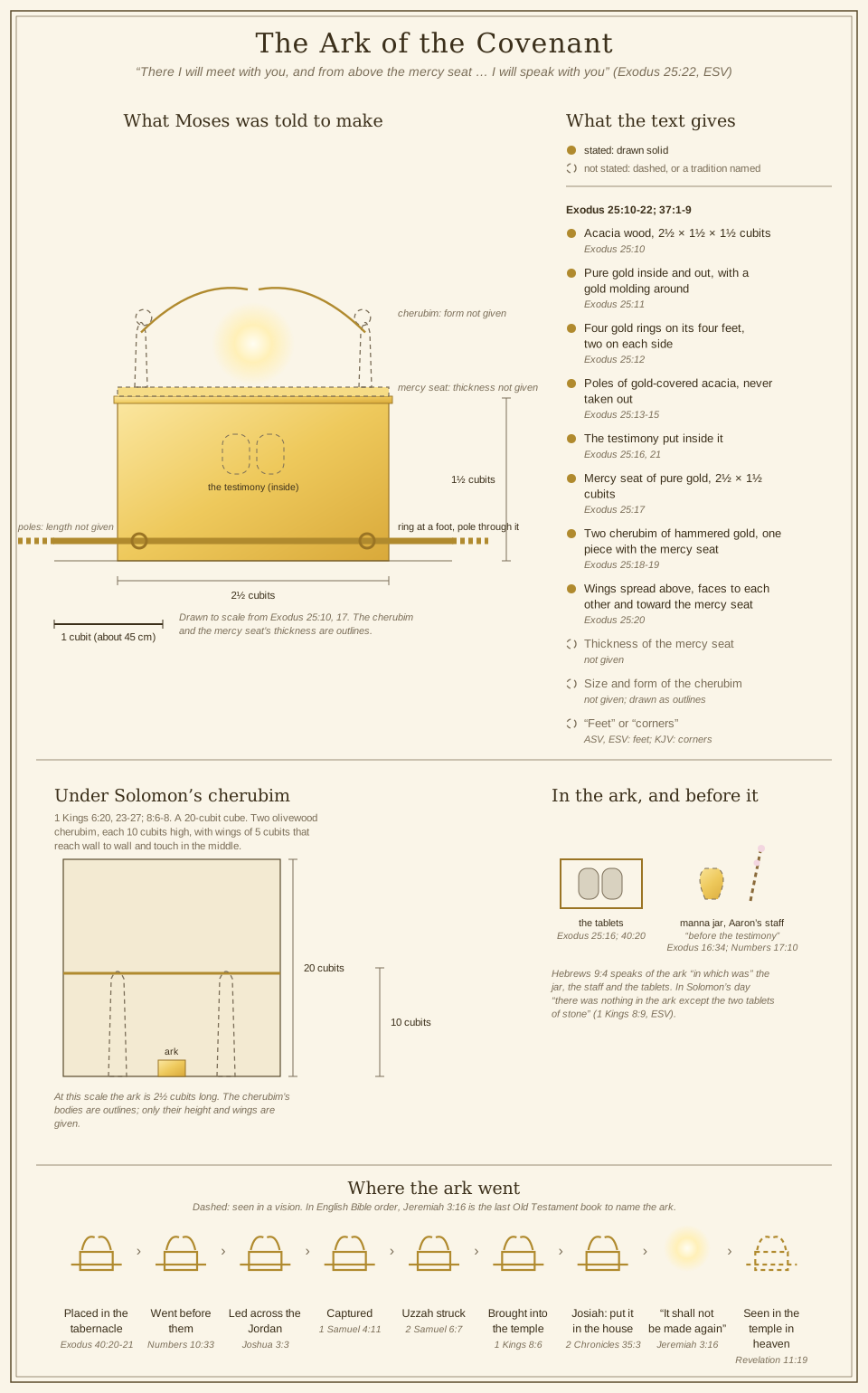
A chest
The Hebrew is אֲרוֹן (aron, ah-RONE, H727), the ordinary word for a box. It is Joseph's coffin in Egypt (Genesis 50:26) and the chest with a hole bored in its lid where Joash's priests collected money for the temple repairs (2 Kings 12:9). Noah's ark is a different word, תֵּבָה (tevah, H8392), which the Hebrew Bible uses only for Noah's vessel and the basket that carried the infant Moses (Exodus 2:3, 5). English uses "ark" for both, and so does the Greek, κιβωτός (kibōtos, G2787), which names Noah's ark four times in the New Testament and the covenant ark twice (Hebrews 9:4; Revelation 11:19).
Poles that never came out
"The poles shall remain in the rings of the ark; they shall not be taken from it" (Exodus 25:15, ESV). The ark was made to be carried by people, and it was never to be handled any other way. Centuries later, in Solomon's temple, the poles were still in place, so long "that the ends of the poles were seen from the Holy Place" (1 Kings 8:8, ESV).
The mercy seat and the cherubim
✝️ Exodus 25:17-21 (ESV)
17 "You shall make a mercy seat of pure gold. Two cubits and a half shall be its length, and a cubit and a half its breadth. 18 And you shall make two cherubim of gold; of hammered work shall you make them, on the two ends of the mercy seat. 19 Make one cherub on the one end, and one cherub on the other end. Of one piece with the mercy seat shall you make the cherubim on its two ends. 20 The cherubim shall spread out their wings above, overshadowing the mercy seat with their wings, their faces one to another; toward the mercy seat shall the faces of the cherubim be. 21 And you shall put the mercy seat on the top of the ark, and in the ark you shall put the testimony that I shall give you.
The word
"Mercy seat" is כַּפֹּרֶת (kapporet, kah-POH-ret, H3727). It occurs 27 times, all in Exodus, Leviticus 16, Numbers 7:89 and 1 Chronicles 28:11, and always of this lid. The Theological Wordbook of the Old Testament files it under the root of כִּפֶּר (kipper, H3722, "make atonement") and glosses it "propitiatory." The ESV Study Bible is more cautious: the noun "may be related" to kipper (note on Exodus 25:17-22). The Legacy Standard Bible footnotes it "Or propitiatory seat, place of atonement," and the NIV translates it "atonement cover." The Greek Old Testament rendered it ἱλαστήριον (hilastērion, hil-as-TAY-ree-on, G2435), and that word matters in Romans.
The voice from between the cherubim
God gave the lid its purpose: "There I will meet with you, and from above the mercy seat, from between the two cherubim that are on the ark of the testimony, I will speak with you" (Exodus 25:22, ESV). And He did. When Moses went into the tent, "he heard the voice speaking to him from above the mercy seat that was on the ark of the testimony, from between the two cherubim" (Numbers 7:89, ESV).
So Israel called the LORD the one "who is enthroned on the cherubim" (1 Samuel 4:4, ESV). "The LORD reigns; let the peoples tremble! He sits enthroned upon the cherubim" (Psalm 99:1, ESV). David called the ark "the footstool of our God" (1 Chronicles 28:2, ESV), and the psalm sings, "let us worship at his footstool!" (Psalm 132:7, ESV). Whether the ark was pictured as the throne itself or as the footstool beneath it is debated. The Cultural Backgrounds Study Bible notes that evidence from neighbouring cultures favours the footstool, with the cherubim's wings forming the seat (note on Exodus 25:16). Either way, God's throne was over the ark.
This shows that the holy God chose to meet His people and speak to them. His throne is in heaven, and He set its footstool in a tent among them.
Blood on the lid
No one could come to the mercy seat at will:
✝️ Leviticus 16:2 (ESV)
2 and the LORD said to Moses, "Tell Aaron your brother not to come at any time into the Holy Place inside the veil, before the mercy seat that is on the ark, so that he may not die. For I will appear in the cloud over the mercy seat.
Once a year the high priest went in, behind a cloud of incense "that the cloud of the incense may cover the mercy seat" (Leviticus 16:13, ESV). He sprinkled the bull's blood "on the front of the mercy seat on the east side, and in front of the mercy seat... seven times," then the goat's blood for the people (Leviticus 16:14-15, ESV). "Thus he shall make atonement for the Holy Place, because of the uncleannesses of the people of Israel and because of their transgressions, all their sins" (Leviticus 16:16, ESV). Hebrews sums it up: "into the second only the high priest goes, and he but once a year, and not without taking blood" (Hebrews 9:7, ESV).
The arrangement is in the text. The tablets of the covenant lay inside the ark (Exodus 25:16), and the blood went on the lid above them. It is natural to read that as God's law kept and its breaking covered by blood, but that meaning is an interpretation. The text gives the order of the objects and leaves the meaning unstated.
The ark on the move
The ark was built to travel, and its journeys show what it meant.
It went ahead. Leaving Sinai, "the ark of the covenant of the LORD went before them three days' journey, to seek out a resting place for them," and whenever it set out Moses said, "Arise, O LORD, and let your enemies be scattered" (Numbers 10:33, 35, ESV). At the Jordan the people followed it at a distance of "about 2,000 cubits" (Joshua 3:4, ESV).
It could not be used. After a defeat by the Philistines the elders said, "Let us bring the ark of the covenant of the LORD here from Shiloh, that it may come among us and save us" (1 Samuel 4:3, ESV). Israel lost again, "and the ark of God was captured" (1 Samuel 4:11, ESV). A dying mother named her son Ichabod, saying, "The glory has departed from Israel, for the ark of God has been captured" (1 Samuel 4:21-22, ESV). In the Philistine temple the idol Dagon fell "face downward on the ground before the ark of the LORD" twice, the second time with his head and hands broken off (1 Samuel 5:3-4, ESV). God defended His honour where His people had tried to use Him.
It was holy. When David moved it on a cart and the oxen stumbled, "Uzzah put out his hand to the ark of God and took hold of it... and God struck him down there because of his error" (2 Samuel 6:6-7, ESV). The law said the ark was carried on its poles (Exodus 25:14) and that those who carried the holy things must not touch them (Numbers 4:15; ESV Study Bible, note on 2 Samuel 6:6-11).
It came to rest. In Solomon's temple the priests set the ark "underneath the wings of the cherubim," two olivewood figures ten cubits high whose wings reached from wall to wall (1 Kings 8:6; 6:23-27, ESV). Then "the glory of the LORD filled the house of the LORD" (1 Kings 8:11, ESV).
This shows that God acts on His own terms. He went before His people. When Israel tried to use Him in battle, He let the ark be taken and defended His own name among the Philistines. And He filled the house where the ark rested.
What was in it
God told Moses to put "the testimony," the tablets of the covenant, inside the ark (Exodus 25:16; 40:20). Two other objects were kept "before the testimony": a jar of manna (Exodus 16:33-34) and Aaron's staff that budded (Numbers 17:10).
Two texts describe the contents differently:
- Hebrews speaks of "the ark of the covenant covered on all sides with gold, in which was a golden urn holding the manna, and Aaron's staff that budded, and the tablets of the covenant" (Hebrews 9:4, ESV).
- 1 Kings says that at Solomon's dedication "there was nothing in the ark except the two tablets of stone that Moses put there at Horeb" (1 Kings 8:9, ESV).
The ESV Study Bible reads the two as different times: the ark once held the jar and the staff, and by Solomon's day it held only the tablets (note on 1 Kings 8:9). Others read "before the testimony" as beside the ark, and Hebrews as describing the ark and what belonged with it. Both readings keep both texts true.
Lost
The last time the ark appears in Israel's history is in Josiah's reign, about 622 BC, when the king told the Levites, "Put the holy ark in the house that Solomon the son of David, king of Israel, built. You need not carry it on your shoulders" (2 Chronicles 35:3, ESV). The ESV Study Bible suggests it may have been moved out under Manasseh and Amon, or during Josiah's repairs (note on 2 Chronicles 35:3-6). A concordance search finds the Hebrew word for the ark nowhere in Ezra, Nehemiah or any of the prophetic books from Isaiah to Malachi, except one verse of Jeremiah. 2 Kings describes Babylon carrying off the temple's bronze and gold (2 Kings 25:13-17), and Jeremiah 52:17-23 lists the same spoil; neither names the ark.
That one verse of Jeremiah is a promise:
✝️ Jeremiah 3:16-17 (ESV)
16 And when you have multiplied and been fruitful in the land, in those days, declares the LORD, they shall no more say, "The ark of the covenant of the LORD." It shall not come to mind or be remembered or missed; it shall not be made again. 17 At that time Jerusalem shall be called the throne of the LORD, and all nations shall gather to it, to the presence of the LORD in Jerusalem, and they shall no more stubbornly follow their own evil heart.
Jeremiah looks past the ark to a day when the whole city is the LORD's throne and the nations come to it. On the dispensational reading of this site's statement of faith, that is Jerusalem in Christ's thousand-year reign, after Israel is regathered to the land. It fits that Ezekiel's temple has no ark: the word for it does not occur anywhere in Ezekiel. Jeremiah spoke in Josiah's reign (Jeremiah 3:6), and the NIV Biblical Theology Study Bible reads "nor will another be made" as a hint that the original ark was already gone (note on Jeremiah 3:16); how that fits 2 Chronicles 35:3 is not settled.
Jewish tradition filled the silence. 2 Maccabees 2:4-8 (KJV) says Jeremiah hid "the tabernacle, and the ark, and the altar of incense" in a cave on the mountain "where Moses climbed up, and saw the heritage of God," to stay unknown "until the time that God gather his people again together." That book is not Scripture, and this study cites it only as what some Jews believed. Scripture says what Jeremiah said: the ark will not be missed.
The mercy seat God put forward
Paul uses the mercy seat's word for Jesus:
✝️ Romans 3:23-26 (ESV)
23 for all have sinned and fall short of the glory of God, 24 and are justified by his grace as a gift, through the redemption that is in Christ Jesus, 25 whom God put forward as a propitiation by his blood, to be received by faith. This was to show God's righteousness, because in his divine forbearance he had passed over former sins. 26 It was to show his righteousness at the present time, so that he might be just and the justifier of the one who has faith in Jesus.
"Propitiation" is ἱλαστήριον. The New Testament uses it only here and at Hebrews 9:5, where it is the mercy seat. Most of its Greek Old Testament uses are the mercy seat too, though Ezekiel uses it for the ledges of his altar (Ezekiel 43:14, 17, 20). So what Paul means by it is debated:
- The mercy seat. The NIV Biblical Theology Study Bible reads Romans 3:25 as the atonement cover: Christ on the cross is "the final and definitive 'place' where God deals with the sins of his people" (note on Romans 3:25). The Cultural Backgrounds Study Bible agrees that Paul "speaks literally here of the mercy seat" (note on Romans 3:25).
- A means of propitiation. The translations quoted on this page offer this sense: the NIV text reads "sacrifice of atonement," the Legacy Standard Bible footnotes "Or propitiatory sacrifice," and the CSB footnotes "Or a propitiation, or a place of atonement."
This study takes the first as the probable reading, because the word's one other New Testament use is the mercy seat. Both readings put Jesus' blood where the ark's blood went.
This is propitiation: God's just wrath against sin satisfied, so that He forgives without ceasing to be just. Some scholars have argued for "expiation" instead, the wiping away of sin, without the thought of wrath turned aside. The ESV Study Bible answers that the word covers both, since Paul has just spoken of God's wrath (Romans 1:18), and the NIV Biblical Theology Study Bible says Christ's sacrifice satisfies God's wrath "among other things" (notes on Romans 3:25). Paul's own reason is in the text: "so that he might be just and the justifier of the one who has faith in Jesus."
"Put forward" is προέθετο (proetheto, G4388, "set forth" or "purpose"). It can mean "displayed publicly," a contrast with the mercy seat that only the high priest saw, once a year, behind a cloud. The Greek Old Testament uses the verb for setting out the bread of the Presence before God (Exodus 40:23; Leviticus 24:8), a cultic sense close to Romans 3. It can also mean "purposed": Paul uses it that way in Romans 1:13, where the ESV has "intended." Its third use, Ephesians 1:9, the ESV renders "set forth." Both readings are defended, and the doctrine stands on either one.
This shows that God provided what He requires. The mercy seat was God's idea, and so is Jesus. "Let us then with confidence draw near to the throne of grace, that we may receive mercy and find grace to help in time of need" (Hebrews 4:16, ESV).
Seen in heaven
John sees "the ark of his covenant" within God's temple in heaven (Revelation 11:19, ESV), with lightning, thunder and an earthquake around it; the Cultural Backgrounds Study Bible notes that they "may evoke" God's revelation at Sinai (note on Revelation 11:19; Exodus 19:16). The earthly ark was made after the pattern Moses was shown on the mountain (Exodus 25:9, 40), and Hebrews calls the earthly sanctuary "a copy and shadow of the heavenly things" (Hebrews 8:5, ESV). Revelation shows the ark in that heavenly sanctuary, and with it the covenant God keeps. The NIV Biblical Theology Study Bible reads it as God's "holy presence and covenant of mercy" (note on Revelation 11:19).
Then the city comes down, and "I saw no temple in the city, for its temple is the Lord God the Almighty and the Lamb" (Revelation 21:22, ESV). The New Jerusalem covers the city, whose shape is the cube of the Most Holy Place.
What the ark shows about God
This table sorts the study's connections by how directly Scripture makes each one.
| Connection | Where | How firm |
|---|---|---|
| Jesus is the hilastērion | Romans 3:25; Hebrews 9:5 | The word is stated; that it means the mercy seat itself is probable and debated |
| The ark is seen in the heavenly temple | Revelation 11:19 | Stated, in a vision |
| The ark will not be remade | Jeremiah 3:16 | Stated, as prophecy |
| The throne or its footstool | 1 Chronicles 28:2; Psalm 99:1 | Both stated; which picture governs is debated |
| "Put forward" means publicly displayed | Romans 3:25 | Contested; the verb can mean "set forth" or "purposed" |
| Blood over the tablets pictures the law's breaking covered | Exodus 25:16; Leviticus 16:14 | An interpretation of a stated arrangement |
| Jeremiah hid the ark | 2 Maccabees 2:4-8 | Tradition, outside Scripture |
God is holy. No one came near the mercy seat at will, and a man who touched the ark died. God is also the God who meets His people. He spoke from above the mercy seat, He went before them, and He accepted blood there once a year so that He could stay among a sinful people.
Then He did what the ark only pictured. He put forward His Son Jesus as the propitiation, by His blood, so that He is just and the justifier of everyone who has faith in Jesus. The ark is gone, and you have what it pictured. Come to God's throne through Jesus, with confidence and with reverence, and you will find mercy there.
Discussion Questions
- The language. Aron is Joseph's coffin (Genesis 50:26) and a collection box (2 Kings 12:9). What does that word say about the chest under God's throne?
- The text in its context. The elders fetched the ark "that it may come among us and save us" (1 Samuel 4:3). What did they think it was for?
- Christ. What does the high priest's yearly blood on the mercy seat (Leviticus 16:14-15) carry over to Jesus in Romans 3:25, and what does it leave behind?
- The hard part. Romans 3:25 calls Jesus ἱλαστήριον, Hebrews 9:5's word for the mercy seat; the NIV reads "sacrifice of atonement." What does each sense make the verse say?
- Be transformed. Hebrews 4:16 bids you "draw near to the throne of grace" with confidence. What would change in your prayers this week?
Group study sheet for a 40-minute group: two A4 sheets, or one with the guided path
The point, the passage, the questions and the response, from this study. Print on both sides of two A4 sheets, flipping on the long edge. While this block is open, printing the page prints the sheet; close it to print the study.
The Ark of the Covenant
Exodus 25:10-22The point The ark was God's footstool on earth, or His throne itself (Scripture uses both pictures), a gold chest holding His covenant under a lid of pure gold where the high priest sprinkled blood once a year and from above which God spoke; Israel lost it, and Scripture never says how, but Paul calls Jesus by the mercy seat's own word, hilastērion, the propitiation God put forward, and John sees the ark of God's covenant in the temple in heaven.
Ask: what comes to mind when you hear The Ark of the Covenant
? Hear a few answers before anyone reads.
Exodus 25:10-22 10And they are to construct an ark of acacia wood, two and a half cubits long, a cubit and a half wide, and a cubit and a half high. 11Overlay it with pure gold both inside and out, and make a gold molding around it. 12Cast four gold rings for it and fasten them to its four feet, two rings on one side and two on the other. 13And make poles of acacia wood and overlay them with gold. 14Insert the poles into the rings on the sides of the ark, in order to carry it. 15The poles are to remain in the rings of the ark; they must not be removed. 16And place inside the ark the Testimony, which I will give you. 17And you are to construct a mercy seat of pure gold, two and a half cubits long and a cubit and a half wide. 18Make two cherubim of hammered gold at the ends of the mercy seat, 19one cherub on one end and one on the other, all made from one piece of gold. 20And the cherubim are to have wings that spread upward, overshadowing the mercy seat. The cherubim are to face each other, looking toward the mercy seat. 21Set the mercy seat atop the ark and put the Testimony that I will give you into the ark. 22And I will meet with you there above the mercy seat, between the two cherubim that are over the ark of the Testimony; I will speak with you about all that I command you regarding the Israelites.
Also read:
The Ark of the Covenant
- Made after the pattern. Exodus 25:10-22: a gold chest, poles that never came out, and the word "ark." The plate draws it to scale.
- The mercy seat and the cherubim. The lid, the voice from above it, and the God enthroned on the cherubim.
- Blood on the lid. The Day of Atonement, the one day anyone went in.
- The ark on the move. The Jordan, the Philistines, Uzzah and Solomon's temple.
- What was in it. The tablets, the manna and Aaron's staff.
- Lost. The last mentions, Jeremiah's promise, and a tradition from 2 Maccabees.
- The mercy seat God put forward. Romans 3:25 and Hebrews 9:5.
- Seen in heaven. Revelation 11:19, and the city with no temple.
- What the ark shows about God. Each connection sorted by how firmly Scripture makes it.
- Discussion Questions. Five, for a group or on your own.
The Ark of the Covenant
1The language. Aron is Joseph's coffin (Genesis 50:26) and a collection box (2 Kings 12:9). What does that word say about the chest under God's throne?
2The text in its context. The elders fetched the ark "that it may come among us and save us" (1 Samuel 4:3). What did they think it was for?
3The hard part. Romans 3:25 calls Jesus ἱλαστήριον, Hebrews 9:5's word for the mercy seat; the NIV reads "sacrifice of atonement." What does each sense make the verse say?
4Christ. What does the high priest's yearly blood on the mercy seat (Leviticus 16:14-15) carry over to Jesus in Romans 3:25, and what does it leave behind?
The Ark of the Covenant
5Be transformed. Hebrews 4:16 bids you "draw near to the throne of grace" with confidence. What would change in your prayers this week?
- Think. God is as holy now as when Uzzah died, and He has provided the mercy seat Himself, in His Son Jesus.
- Attitude. Come to God with confidence and with reverence. The throne is a throne of grace, and it is still a throne.
- Do. Before you pray this week, read Romans 3:23-26 aloud and thank God by name for the propitiation He gave.
There I will meet with you, and from above the mercy seat, from between the two cherubim that are on the ark of the testimony, I will speak with you about all that I will give you in commandment for the people of Israel.
Exodus 25:22 (ESV)Holy Father, You sit enthroned above the cherubim, and no one may come near You on their own terms. Thank You that You met Your people over the mercy seat, and that You put forward Your Son Jesus as the propitiation for our sins, by His blood. We come to Your throne of grace with confidence because of Him. Keep us from treating You as a charm to carry into our battles, and teach us to fear You and to love You.
In Jesus' name. Amen.
The Ark of the Covenant
Exodus 25:10-22Open Ask: what comes to mind when you hear The Ark of the Covenant
? Hear a few answers before anyone reads.
Read it aloud Exodus 25:10-22
1The language. Aron is Joseph's coffin (Genesis 50:26) and a collection box (2 Kings 12:9). What does that word say about the chest under God's throne?
2The text in its context. The elders fetched the ark "that it may come among us and save us" (1 Samuel 4:3). What did they think it was for?
3The hard part. Romans 3:25 calls Jesus ἱλαστήριον, Hebrews 9:5's word for the mercy seat; the NIV reads "sacrifice of atonement." What does each sense make the verse say?
4Christ. What does the high priest's yearly blood on the mercy seat (Leviticus 16:14-15) carry over to Jesus in Romans 3:25, and what does it leave behind?
5Be transformed. Hebrews 4:16 bids you "draw near to the throne of grace" with confidence. What would change in your prayers this week?
- Think. God is as holy now as when Uzzah died, and He has provided the mercy seat Himself, in His Son Jesus.
- Attitude. Come to God with confidence and with reverence. The throne is a throne of grace, and it is still a throne.
- Do. Before you pray this week, read Romans 3:23-26 aloud and thank God by name for the propitiation He gave.
The Ark of the Covenant
The point The ark was God's footstool on earth, or His throne itself (Scripture uses both pictures), a gold chest holding His covenant under a lid of pure gold where the high priest sprinkled blood once a year and from above which God spoke; Israel lost it, and Scripture never says how, but Paul calls Jesus by the mercy seat's own word, hilastērion, the propitiation God put forward, and John sees the ark of God's covenant in the temple in heaven.
References & Recommended Reading
- ESV Study Bible (Crossway, 2016) — notes on Exodus 25:10-22 and 25:17-22, 1 Samuel 4:3-4 and 4:21-22, 2 Samuel 6:6-11, 1 Kings 8:9, Psalm 99:1, Jeremiah 3:16, Romans 3:25 and Revelation 11:19. ESV verse text throughout. Quoted briefly with attribution.
- NIV Biblical Theology Study Bible (Zondervan, 2018), gen. ed. D. A. Carson — notes on Exodus 25:10, Jeremiah 3:16, Romans 3:25, Hebrews 9:5 and Revelation 11:19.
- NIV Cultural Backgrounds Study Bible (Zondervan, 2016), eds. Craig S. Keener and John H. Walton — notes on Exodus 25:16 (throne or footstool), Romans 3:25 and Revelation 11:19.
- Theological Wordbook of the Old Testament, eds. R. Laird Harris, Gleason L. Archer Jr. and Bruce K. Waltke (Moody, 1980) — entry 1023c, kapporet.
- Legacy Standard Bible (Lockman, 2021) — footnotes on Exodus 25:17 and Romans 3:25. KJV and ASV compared at Exodus 25:12.
- 2 Maccabees 2:4-8, King James Version Apocrypha (public domain). Extra-biblical; cited as tradition, never as Scripture.
- Original-language data from this project's
bible-text.db— unfoldingWord interlinear (UHB/ULT/UGNT) for Exodus 25:12, 25:17, 25:22 and Romans 3:25; morphology concordance for אֲרוֹן, כַּפֹּרֶת, תֵּבָה, ἱλαστήριον, κιβωτός and προτίθημι; WEB verse text.
On this site
- The Heavenly Pattern — the series this page belongs to.
- The Golden Altar of Incense — the altar that stood in front of the mercy seat.
- The Almond — Aaron's staff that budded, kept before the testimony.
- The New Jerusalem — the city with no temple.
- Jesus, Priest in the Order of Melchizedek — the High Priest who entered heaven itself.