Saved as Through Fire
Week 9 of 9 in Saved: Salvation Foundations
New, published 14 October 2026. What else is new
You know people who say they are Christians and whose lives look like everyone else's. Some of them know very little of the Bible. Some have taken their beliefs about money, sex, success or truth straight from the culture and attached Jesus to them afterwards. You may wonder whether they are saved at all, or whether you should say anything.
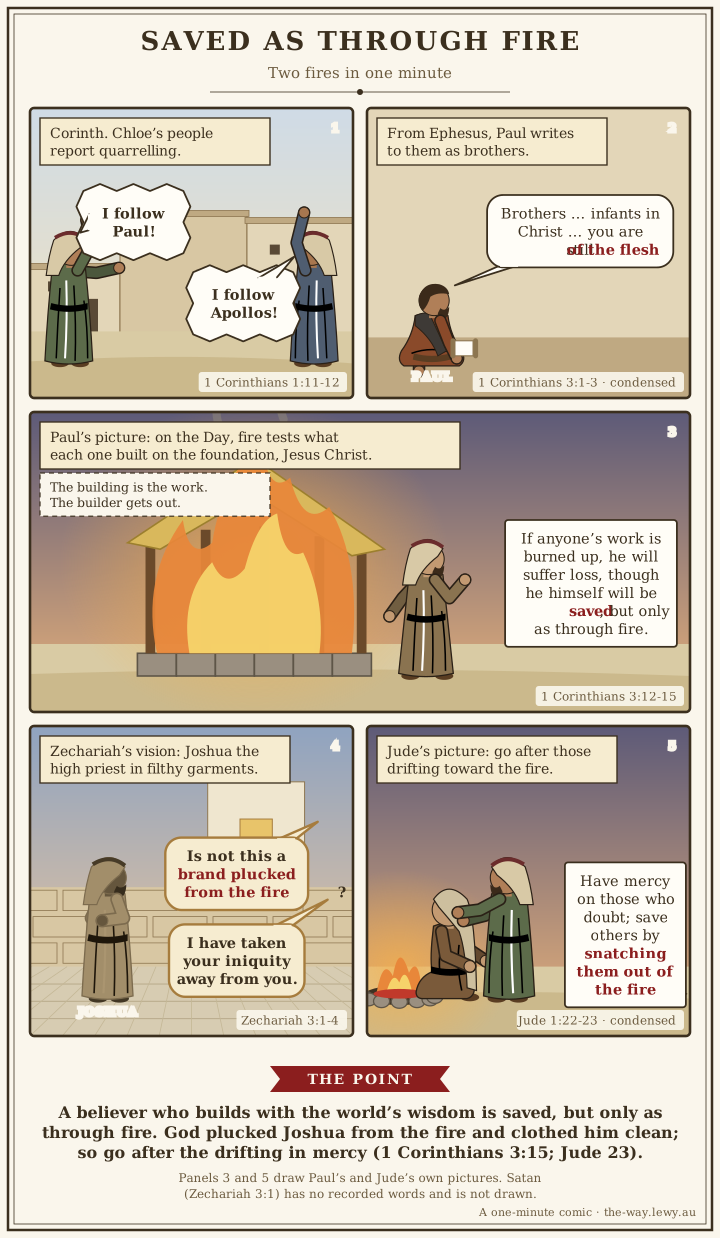
Paul wrote to a whole church like that. He called them brothers, told them they were thinking like the world, and said that on the Day some of them would be "saved, but only as through fire" (1 Corinthians 3:15, ESV). Jude, writing to churches unsettled by false teachers, told the faithful to "save others by snatching them out of the fire" (Jude 23, ESV). The two verses use two different pictures, and together they answer both of your questions.
In one sentence: A believer who builds with the world's wisdom is still saved, but only as one escaping through the flames with nothing in his hands; and God, who plucked Joshua from the fire and clothed him clean, sends you to pull drifting brothers and sisters back in mercy.
Key Takeaways
(This section follows the Key Takeaways format — see that page for what each part is for.)
Lessons about Jesus
- Jesus Christ is the one foundation, and nobody can lay another (1 Corinthians 3:11). Everything a believer builds stands or burns on Him, and the believer himself is kept because he stands on Him.
- The fire belongs to "the Day" (1 Corinthians 3:13), the day "the Lord comes" and brings hidden things to light (1 Corinthians 4:5). Jesus is the one who examines His people's work, and He ends the examination with "commendation from God" (1 Corinthians 4:5, ESV).
- Zechariah's vision of Joshua the high priest ends with "behold, I will bring my servant the Branch" and "I will remove the iniquity of this land in a single day" (Zechariah 3:8-9, ESV). The cleansing Joshua received in a vision, Jesus accomplished at the cross.
- Jesus keeps what is His: "no one will snatch them out of my hand" (John 10:28, ESV). Jude uses the same verb, ἁρπάζω (harpazō, G726), for the church snatching people out of the fire (Jude 23).
Memory verses
✝️ 1 Corinthians 3:11 (ESV)
11 For no one can lay a foundation other than that which is laid, which is Jesus Christ.
✝️ Jude 24 (ESV)
24 Now to him who is able to keep you from stumbling and to present you blameless before the presence of his glory with great joy,
Be Transformed
- Think. A Christian can think like the world for years and still be a Christian; the Corinthians did (1 Corinthians 3:1-3). Correct the instinct that writes such a person off, and the opposite instinct that says their thinking does not matter. On the Day it is the difference between reward and loss.
- Attitude. Go to the drifting the way God went to Joshua: with a rebuke for the accuser, clean clothes for the accused, and a hatred of the stain that does not reach the person wearing it.
- Do. Name one brother or sister whose beliefs have been shaped more by the world than by Scripture. This week, ask them one honest question about what they believe and why, and open the Bible with them on that one point, with the mercy Jude asks for (Jude 22-23).
Prayer
Father, you laid the foundation for me in your Son Jesus Christ, and nothing I build can move it. Show me where I have built with the wisdom of this age, and give me gold to build with instead. Thank you that you snatched me from the fire and took my filthy garments away. Give me your mercy for the friend who is drifting, the courage to go after them, and the fear that keeps me from their sin while I love them. Keep us both from stumbling, as you are able to do. In Jesus' name. Amen.
Study outline
- Two verses, two fires. What each fire is, and why the study reads both.
- Brothers who think like the world. Corinth's divisions, and Paul's two words for "unspiritual".
- The builder and the Day. 1 Corinthians 3:10-15 phrase by phrase, and who the builder is.
- What "saved as through fire" does not promise. The limits Paul sets in the same letter, and the contested "carnal Christian".
- Snatching them out of the fire. Jude 22-23, its three groups, and Zechariah 3 behind it.
- A brand plucked from the fire. What God did for Joshua, and what it means for the one you go after.
Two verses, two fires
The phrase many readers remember is the NIV's: the builder "will be saved—even though only as one escaping through the flames" (1 Corinthians 3:15, NIV). Paul's Greek is shorter: αὐτὸς δὲ σωθήσεται, οὕτως δὲ ὡς διὰ πυρός, "he himself will be saved, but so, as through fire." The ESV and NASB keep Paul's "as through fire"; the NIV and NLT ("like someone barely escaping through a wall of flames") spell out the picture, which is a man getting out of a building that is burning down around him.
In 1 Corinthians 3 the fire tests a believer's work. The building burns; the builder gets out. In Jude 23 the fire is judgment closing in on a person, the "punishment of eternal fire" Jude has already named (Jude 7, ESV), and someone else has to reach in and pull them out.
| 1 Corinthians 3:13-15 | Jude 23 | |
|---|---|---|
| The fire | The Day's fire, which tests (1 Corinthians 3:13) | Judgment, "eternal fire" (Jude 7) |
| What it reaches | The work a believer built on Christ | A person drifting toward it |
| Who acts | The builder escapes through it | Another believer snatches them out |
| The outcome | Reward lost; "he himself will be saved" | Rescued, with mercy |
| When | On the Day, when the Lord comes (1 Corinthians 4:5) | Now, before that Day |
The two verses belong in one study because they describe the same people from two sides. Paul shows what happens on the Day to a real believer who lived by the world's wisdom. Jude tells the church what to do now, before the Day, for those drifting that way.
Brothers who think like the world
What divided Corinth
Paul wrote 1 Corinthians from Ephesus, probably in the spring of AD 53-55 (1 Corinthians 16:8). The first thing he raises is a report from Chloe's people: "each one of you says, 'I follow Paul,' or 'I follow Apollos,' or 'I follow Cephas,' or 'I follow Christ'" (1 Corinthians 1:12, ESV). Greek cities prized eloquent teachers, and a man's standing rose with the reputation of the teacher he attached himself to. The Corinthians had brought that habit into the church. Paul answers it for three chapters with the cross: "Has not God made foolish the wisdom of the world?" (1 Corinthians 1:20, ESV).
Natural, and fleshly
Paul then uses two different words for people who do not think spiritually, and the difference between them is the difference you are asking about.
The first is ψυχικός (psychikos, G5591), "natural": "The natural person does not accept the things of the Spirit of God, for they are folly to him" (1 Corinthians 2:14, ESV). This is a person without the Spirit. Jude uses the same word for the false teachers: "worldly people, devoid of the Spirit" (Jude 19, ESV). The word occurs six times in the New Testament. Three describe the natural body (1 Corinthians 15:44, 46), one describes a wisdom that is "earthly, unspiritual, demonic" (James 3:15, ESV), and the two that describe people are 1 Corinthians 2:14 and Jude 19.
Then Paul turns to the Corinthians and changes the word:
✝️ 1 Corinthians 3:1-3 (ESV)
1 But I, brothers, could not address you as spiritual people, but as people of the flesh, as infants in Christ. 2 I fed you with milk, not solid food, for you were not ready for it. And even now you are not yet ready, 3 for you are still of the flesh. For while there is jealousy and strife among you, are you not of the flesh and behaving only in a human way?
"Of the flesh" is σάρκινος (sarkinos, G4560) in verse 1 and σαρκικός (sarkikos, G4559) twice in verse 3. "Behaving only in a human way" is κατὰ ἄνθρωπον περιπατεῖτε, "you walk according to man." Paul calls them brothers, places them "in Christ", and says their jealousy and quarrelling is the world's way of living. They have the Spirit; they are not living by Him.
This shows that God does not disown His children for being immature. Paul keeps feeding them, milk because they cannot yet take more, and he writes them a long letter to bring them on. The worldly believer is a real category in Scripture, and Paul's response to it is patient teaching with a warning in it.
The builder and the Day
✝️ 1 Corinthians 3:10-15 (ESV)
10 According to the grace of God given to me, like a skilled master builder I laid a foundation, and someone else is building upon it. Let each one take care how he builds upon it. 11 For no one can lay a foundation other than that which is laid, which is Jesus Christ. 12 Now if anyone builds on the foundation with gold, silver, precious stones, wood, hay, straw— 13 each one's work will become manifest, for the Day will disclose it, because it will be revealed by fire, and the fire will test what sort of work each one has done. 14 If the work that anyone has built on the foundation survives, he will receive a reward. 15 If anyone's work is burned up, he will suffer loss, though he himself will be saved, but only as through fire.
Who is building
Paul has just called himself and Apollos "servants through whom you believed" (1 Corinthians 3:5, ESV): one planted, the other watered, and "you are God's field, God's building" (1 Corinthians 3:9, ESV). The building is the church. Paul laid the foundation when he preached Christ in Corinth; "someone else is building upon it" (1 Corinthians 3:10, ESV). So the builders in the first instance are those who teach and lead the church, and the materials are what they build into it.
The ESV Study Bible widens this to "anyone who contributes in any way to building up the church," and the letter supports that: every believer is given a gift "for the common good" (1 Corinthians 12:7, ESV) and told to "strive to excel in building up the church" (1 Corinthians 14:12, ESV). Applying the passage to every believer's whole life, as this site's statement of faith does, is a further step. It is a fair one, since Paul goes on to call each body a temple of the Spirit (1 Corinthians 6:19), but it is application of the passage rather than its first meaning.
Gold or straw
Gold, silver and precious stones survive fire. Wood, hay and straw feed it. The Old Testament used both pictures: metal refined in fire for God's people tested (Zechariah 13:9; Malachi 3:2-3), and stubble burnt for the wicked consumed (Isaiah 33:11-12). In context the straw is the Corinthians' own building material: the world's wisdom, boasting in men, rivalry over teachers. Paul says so three verses later: "the wisdom of this world is folly with God" (1 Corinthians 3:19, ESV).
The fire of the Day
"The Day" is the day of the Lord's coming (1 Corinthians 1:8; 4:5). The verb for the fire's work is δοκιμάζω (dokimazō, G1381), the word for assaying gold, which Test the Spirits studies. The fire tests and reveals. It does not punish the builder, and it does not purify him; it shows "what sort of work each one has done" (1 Corinthians 3:13, ESV). The setting is the judgment seat of Christ, where "we must all appear" (2 Corinthians 5:10, ESV). This site places that judgment at Christ's coming for His church (The judgments), and its statement of faith calls it "a son's work being assessed, not a trial to determine whether he is a son."
Loss, and saved
"He will suffer loss" is ζημιωθήσεται (zēmiōthēsetai, from ζημιόω, zēmioō, G2210), the verb Jesus uses for a man who gains the world and "forfeits his soul" (Matthew 16:26, ESV) and Paul for counting everything "loss" for Christ (Philippians 3:8). Here what is lost is the reward the work would have earned (1 Corinthians 3:14). The man is not lost: αὐτὸς δὲ σωθήσεται, "he himself will be saved."
The picture is a builder standing on a solid foundation while everything he put up over it burns. He walks out with his life and nothing else. A whole lifetime of building is gone, and he is saved. The Amos 4:11 "brand plucked out of the burning" image is close to this, and the Greek of Amos 4:11 shares Paul's ὡς ("as", G5613) and πυρός ("fire", G4442). Paul may have had it in mind; the verse is not quoted, so treat the link as possible.
Peter describes the other end of the scale. For the believer who grows in faith, virtue and the rest of his list, "there will be richly provided for you an entrance into the eternal kingdom of our Lord and Savior Jesus Christ" (2 Peter 1:11, ESV). Whether "richly" measures reward is contested, and if it does, the two pictures face each other: a rich welcome, and a builder walking out of the fire with nothing. Partakers of the Divine Nature works through Peter's list.
This shows that God's salvation of His children rests on the foundation He laid in Christ, and on nothing the believer built. It also shows that God takes what you build seriously enough to test every piece of it by fire. You may lose your whole life's work and still be saved. Build so that you do not.
What "saved as through fire" does not promise
The limits Paul sets
1 Corinthians 3:15 describes a person on the foundation. Paul sets three limits around it in the same letter.
The one who tears the church down. The next sentence reads: "If anyone destroys God's temple, God will destroy him" (1 Corinthians 3:17, ESV). The builder of verse 15 built badly on the foundation; the person of verse 17 attacks the building itself, and his end is destruction, with no "saved" after it.
The life that is simply the world's. "Do not be deceived: neither the sexually immoral, nor idolaters... nor the greedy, nor drunkards... will inherit the kingdom of God. And such were some of you. But you were washed, you were sanctified, you were justified in the name of the Lord Jesus Christ and by the Spirit of our God" (1 Corinthians 6:9-11, ESV). Paul's word to the Corinthians is that they were these things and were washed. A profession of faith over an unwashed life is the deception he warns against.
The professing brother who will not repent. Paul tells the church "not to associate with anyone who bears the name of brother" while living in open sin (1 Corinthians 5:11, ESV), and to put one such man out "so that his spirit may be saved in the day of the Lord" (1 Corinthians 5:5, ESV). Even the hardest step Paul commands aims at the same Day and the same salvation.
So 1 Corinthians 3:15 gives assurance to a believer whose thinking and building have been poor. It gives none to someone whose faith never reached the foundation, which is the case Assurance of Salvation takes up from 1 John 2:19. Which of the two a particular friend is, you usually cannot see. Paul tells the Corinthians not to "pronounce judgment before the time" (1 Corinthians 4:5, ESV), and he still warns them plainly. You can do both.
The "carnal Christian": a contested reading
Lewis Sperry Chafer, the dispensational theologian who founded Dallas Theological Seminary, built three classes of person on 1 Corinthians 2:14-3:3 in He That Is Spiritual (1918): the natural man (psychikos), the carnal man (sarkikos), and the spiritual man (pneumatikos). Reformed critics, starting with B. B. Warfield's 1919 review, argued that this makes a permanent class out of a stage Paul rebukes.
The case for the category is in the text. Paul calls the sarkikoi brothers and "infants in Christ", distinguishes them from the psychikos by word, and 1 Corinthians 3:15 has a real believer lose a whole life's work and still be saved.
The case against it is also in the text. Paul's words are "not yet ready" and "still" (1 Corinthians 3:2-3), the language of a stage a child is expected to grow out of, and he writes to move them on. He warns in the same letter that a life entirely given over to the flesh does not inherit the kingdom (1 Corinthians 6:9-10; compare Galatians 5:19-21). Critics fear that "carnal Christian" taught as a settled class tells an unrepentant person they are safe.
Both sides agree on what this study needs: a Christian can live for a time by the world's thinking, the state is real and serious, and the right response is to teach, warn and bring them on.
Snatching them out of the fire
Jude's three groups
Jude meant to write "about our common salvation", and wrote instead to urge his readers "to contend for the faith" because false teachers "have crept in unnoticed... who pervert the grace of our God into sensuality" (Jude 3-4, ESV). Having exposed them, he turns to the faithful. They are to keep themselves in the love of God (When Love Grows Cold covers Jude 20-21), and then go to the people the false teaching has touched:
✝️ Jude 22-23 (ESV)
22 And have mercy on those who doubt; 23 save others by snatching them out of the fire; to others show mercy with fear, hating even the garment stained by the flesh.
The Greek repeats οὓς μὲν... οὓς δὲ... οὓς δὲ, "some... others... others", which most modern translations read as three groups:
- Those who doubt (διακρινομένους, diakrinomenous, G1252), wavering under the false teachers' influence. They receive mercy. Jude uses the same verb in verse 9 for Michael "disputing" with the devil, so some read this group as those who argue. The NLT's footnote also records a manuscript reading "must reprove" here.
- Those already near the fire. These are to be saved by being snatched, ἁρπάζοντες (harpazontes, G726), a verb of sudden force.
- Those stained by the flesh. They also receive mercy, but "with fear", because their sin can draw in the one who goes to help them.
Some manuscripts have only two groups (the NLT notes this at Jude 23). The shape of the command holds either way: mercy first, rescue for those in danger, and caution for the one who rescues.
Are these believers?
Jude places the false teachers outside: "devoid of the Spirit" (Jude 19, ESV), "designated for this condemnation" (Jude 4, ESV). The people in verses 22-23 are inside the congregation and are being pulled toward the outsiders' thinking. Some of them may be believers whose beliefs have drifted; some may have professed faith without having it. Jude does not ask the church to sort them first. He tells it to go.
Paul gives the same commission in gentler words: "you who are spiritual should restore him in a spirit of gentleness. Keep watch on yourself, lest you too be tempted" (Galatians 6:1, ESV). James adds that "whoever brings back a sinner from his wandering will save his soul from death" (James 5:20, ESV). When Love Grows Cold takes these passages up in full.
A brand plucked from the fire
Jude reads Zechariah 3 twice
Jude has Michael say "The Lord rebuke you" to the devil (Jude 9, ESV). Those are the first words of Zechariah 3:2. The rest of that verse, and the two after it, give Jude 23 its fire and its garment:
✝️ Zechariah 3:1-4 (ESV)
1 Then he showed me Joshua the high priest standing before the angel of the LORD, and Satan standing at his right hand to accuse him. 2 And the LORD said to Satan, "The LORD rebuke you, O Satan! The LORD who has chosen Jerusalem rebuke you! Is not this a brand plucked from the fire?" 3 Now Joshua was standing before the angel, clothed with filthy garments. 4 And the angel said to those who were standing before him, "Remove the filthy garments from him." And to him he said, "Behold, I have taken your iniquity away from you, and I will clothe you with pure vestments."
"A brand plucked from the fire" is אוּד מֻצָּל מֵאֵשׁ (ud mutsal me'esh, H181), a stick pulled half-burnt out of the fire. The Greek Old Testament renders it ὡς δαλὸς ἐξεσπασμένος ἐκ πυρός, and Jude's ἐκ πυρὸς ἁρπάζοντες ("snatching out of fire") takes up its last words. Joshua stood for a people just brought back from exile, scorched by judgment they had deserved.
What God did for Joshua
Joshua has an accuser at his right hand and filthy clothes on his back. He says nothing in his own defence. The LORD rebukes the accuser, has the filthy garments taken off, says "I have taken your iniquity away from you", and clothes him clean (Zechariah 3:4, ESV). Then He points past Joshua: "behold, I will bring my servant the Branch... and I will remove the iniquity of this land in a single day" (Zechariah 3:8-9, ESV).
This shows that God rescues before He reforms. He pulls the brand out while it is still smoking, silences the accuser, and then deals with the clothes. The single day of Zechariah 3:9 came at Calvary, where your Son Jesus bore iniquity once for all, and it is why a believer standing on Him can be saved even through fire. That is grace: favour given to people with nothing to stand on but God's choice of them.
The rescuer was rescued first
So when Jude tells you to snatch others out of the fire, he is asking you to do for them what God did for Joshua, and for you. Hate the garment; Zechariah's angel did not leave Joshua in it. Rebuke the lie that has dressed your friend's thinking; the LORD rebuked the accuser. And go to your friend as someone who was a brand from the fire yourself, with the Galatians 6:1 watch on your own heart.
You are not the one who keeps them. Jude ends with the One who does: "him who is able to keep you from stumbling and to present you blameless before the presence of his glory with great joy" (Jude 24, ESV). He is able to keep your friend, and He has chosen to use you to reach them.
Discussion questions
- The language. Paul calls the person without the Spirit psychikos (1 Corinthians 2:14) and the quarrelling Corinthians sarkikoi (1 Corinthians 3:3), and calls the second group "brothers". What changes in how you think about a worldly Christian once you see that Paul keeps those two words apart?
- The text in its context. The straw in 1 Corinthians 3:12 is the Corinthians' own boasting in teachers and the world's idea of wisdom (1 Corinthians 1:12, 20; 3:19). What would the equivalent straw be in a church today?
- Christ. Zechariah's vision moves from Joshua's clean clothes to "my servant the Branch" and iniquity removed "in a single day" (Zechariah 3:8-9). How does the cross make it possible for a believer to be "saved, but only as through fire"?
- The hard part. Paul assures the badly-building believer that he will be saved (1 Corinthians 3:15), and warns the Corinthians "Do not be deceived" about a life that is simply the world's (1 Corinthians 6:9-11). How do you hold both when you think about someone you love?
- Be transformed. Jude's three commands begin and end with mercy (Jude 22-23). Who is the one person you would most like to see snatched out of the fire, and what would mercy with fear look like in your next conversation with them?
Group study sheet for a 40-minute group: two A4 sheets, or one with the guided path
The point, the passage, the questions and the response, from this study. Print on both sides of two A4 sheets, flipping on the long edge. While this block is open, printing the page prints the sheet; close it to print the study.
Saved as Through Fire
1 Corinthians 3:10-15; Jude 1:22-23The point A believer who builds with the world's wisdom is still saved, but only as one escaping through the flames with nothing in his hands; and God, who plucked Joshua from the fire and clothed him clean, sends you to pull drifting brothers and sisters back in mercy.
Ask: What does 'saved as through fire' mean in 1 Corinthians 3:15?
Hear a few answers before anyone reads.
1 Corinthians 3:10-15 10By the grace God has given me, I laid a foundation as an expert builder, and someone else is building on it. But each one must be careful how he builds. 11For no one can lay a foundation other than the one already laid, which is Jesus Christ. 12If anyone builds on this foundation using gold, silver, precious stones, wood, hay, or straw, 13his workmanship will be evident, because the Day will bring it to light. It will be revealed with fire, and the fire will prove the quality of each man’s work. 14If what he has built survives, he will receive a reward. 15If it is burned up, he will suffer loss. He himself will be saved, but only as if through the flames.
Jude 1:22-23 22And indeed, have mercy on those who doubt; 23save others by snatching them from the fire; and to still others show mercy tempered with fear, hating even the clothing stained by the flesh.
Also read:
Saved as Through Fire
- Two verses, two fires. What each fire is, and why the study reads both.
- Brothers who think like the world. Corinth's divisions, and Paul's two words for "unspiritual".
- The builder and the Day. 1 Corinthians 3:10-15 phrase by phrase, and who the builder is.
- What "saved as through fire" does not promise. The limits Paul sets in the same letter, and the contested "carnal Christian".
- Snatching them out of the fire. Jude 22-23, its three groups, and Zechariah 3 behind it.
- A brand plucked from the fire. What God did for Joshua, and what it means for the one you go after.
Saved as Through Fire
1The text in its context. The straw in 1 Corinthians 3:12 is the Corinthians' own boasting in teachers and the world's idea of wisdom (1 Corinthians 1:12, 20; 3:19). What would the equivalent straw be in a church today?
2The language. Paul calls the person without the Spirit psychikos (1 Corinthians 2:14) and the quarrelling Corinthians sarkikoi (1 Corinthians 3:3), and calls the second group "brothers". What changes in how you think about a worldly Christian once you see that Paul keeps those two words apart?
3The hard part. Paul assures the badly-building believer that he will be saved (1 Corinthians 3:15), and warns the Corinthians "Do not be deceived" about a life that is simply the world's (1 Corinthians 6:9-11). How do you hold both when you think about someone you love?
4Christ. Zechariah's vision moves from Joshua's clean clothes to "my servant the Branch" and iniquity removed "in a single day" (Zechariah 3:8-9). How does the cross make it possible for a believer to be "saved, but only as through fire"?
Saved as Through Fire
5Be transformed. Jude's three commands begin and end with mercy (Jude 22-23). Who is the one person you would most like to see snatched out of the fire, and what would mercy with fear look like in your next conversation with them?
- Think. A Christian can think like the world for years and still be a Christian; the Corinthians did (1 Corinthians 3:1-3). Correct the instinct that writes such a person off, and the opposite instinct that says their thinking does not matter. On the Day it is the difference between reward and loss.
- Attitude. Go to the drifting the way God went to Joshua: with a rebuke for the accuser, clean clothes for the accused, and a hatred of the stain that does not reach the person wearing it.
- Do. Name one brother or sister whose beliefs have been shaped more by the world than by Scripture. This week, ask them one honest question about what they believe and why, and open the Bible with them on that one point, with the mercy Jude asks for (Jude 22-23).
For no one can lay a foundation other than that which is laid, which is Jesus Christ.
1 Corinthians 3:11 (ESV)Father, you laid the foundation for me in your Son Jesus Christ, and nothing I build can move it. Show me where I have built with the wisdom of this age, and give me gold to build with instead. Thank you that you snatched me from the fire and took my filthy garments away. Give me your mercy for the friend who is drifting, the courage to go after them, and the fear that keeps me from their sin while I love them. Keep us both from stumbling, as you are able to do. In Jesus' name. Amen.
Saved as Through Fire
1 Corinthians 3:10-15; Jude 1:22-23Open Ask: What does 'saved as through fire' mean in 1 Corinthians 3:15?
Hear a few answers before anyone reads.
Read it aloud 1 Corinthians 3:10-15; Jude 1:22-23
1The text in its context. The straw in 1 Corinthians 3:12 is the Corinthians' own boasting in teachers and the world's idea of wisdom (1 Corinthians 1:12, 20; 3:19). What would the equivalent straw be in a church today?
2The language. Paul calls the person without the Spirit psychikos (1 Corinthians 2:14) and the quarrelling Corinthians sarkikoi (1 Corinthians 3:3), and calls the second group "brothers". What changes in how you think about a worldly Christian once you see that Paul keeps those two words apart?
3The hard part. Paul assures the badly-building believer that he will be saved (1 Corinthians 3:15), and warns the Corinthians "Do not be deceived" about a life that is simply the world's (1 Corinthians 6:9-11). How do you hold both when you think about someone you love?
4Christ. Zechariah's vision moves from Joshua's clean clothes to "my servant the Branch" and iniquity removed "in a single day" (Zechariah 3:8-9). How does the cross make it possible for a believer to be "saved, but only as through fire"?
5Be transformed. Jude's three commands begin and end with mercy (Jude 22-23). Who is the one person you would most like to see snatched out of the fire, and what would mercy with fear look like in your next conversation with them?
- Think. A Christian can think like the world for years and still be a Christian; the Corinthians did (1 Corinthians 3:1-3). Correct the instinct that writes such a person off, and the opposite instinct that says their thinking does not matter. On the Day it is the difference between reward and loss.
- Attitude. Go to the drifting the way God went to Joshua: with a rebuke for the accuser, clean clothes for the accused, and a hatred of the stain that does not reach the person wearing it.
- Do. Name one brother or sister whose beliefs have been shaped more by the world than by Scripture. This week, ask them one honest question about what they believe and why, and open the Bible with them on that one point, with the mercy Jude asks for (Jude 22-23).
Saved as Through Fire
The point A believer who builds with the world's wisdom is still saved, but only as one escaping through the flames with nothing in his hands; and God, who plucked Joshua from the fire and clothed him clean, sends you to pull drifting brothers and sisters back in mercy.
References & Recommended Reading
- ESV Study Bible (Crossway), introduction to 1 Corinthians and study notes on 1 Corinthians 3:1-3, 3:14-15, 3:17 and Jude 17-25, 22-23, 23. Quoted briefly with attribution per this site's copyright policy; ESV Bible text quoted under Crossway's stated permissions.
- NIV Biblical Theology Study Bible (Zondervan), notes on 1 Corinthians 3:1-23, 3:13, 3:15 and Jude 22-23. NIV text of 1 Corinthians 3:15 quoted from this edition.
- NIV and NKJV Cultural Backgrounds Study Bibles (Zondervan), notes on 1 Corinthians 3:1, 3:13, 3:17 and Jude 23, for the refining and straw imagery and for Zechariah 3 behind Jude 9 and 23.
- NLT Christian Basics Bible and NLT Life Application Study Bible (Tyndale), footnotes on Jude 22-23 recording the "reprove" reading and the two-group manuscripts; NLT text of 1 Corinthians 3:15.
- NASB 1995 and 2020 (The Lockman Foundation), consulted for 1 Corinthians 3:15 and Jude 22-23.
- Novum Testamentum Graece, 28th edition (Deutsche Bibelgesellschaft), for the Greek of 1 Corinthians 3:1-3, 13, 15 and Jude 22-23.
- MACULA Greek Linguistic Datasets and the SBL Greek New Testament (CC BY 4.0), for the occurrence counts of psychikos, sarkinos, sarkikos, zēmioō, harpazō and diakrinomai.
- Brenton's Septuagint (public domain) and the Westminster Leningrad Codex via MACULA Hebrew, for Zechariah 3:2 and Amos 4:11.
- Lewis Sperry Chafer, He That Is Spiritual (1918); B. B. Warfield, review of He That Is Spiritual, Princeton Theological Review 17, no. 2 (1919): 322-327.