What Literary Criticism Declares: Many Writers, One Story
New, published 4 November 2026. What else is new
For two hundred years literary criticism has read the Bible the way a geologist reads a cliff: layer by layer, source by source, hand by hand. It took Moses' five books apart into sources finished in the fifth century BC. It gave Isaiah three authors and moved Daniel four centuries later. It said Paul did not write three of the letters that carry his name. Each step multiplied the writers.
Scripture had already said there were many. "Long ago, at many times and in many ways, God spoke to our fathers by the prophets" (Hebrews 1:1, ESV). This study takes the critics' count at its word, measures what those many writers produced, and asks what the result declares.
In one sentence: By literary criticism's own count the Bible is the work of many writers across more than eight centuries, and the measurements show one connected story whose prophecies were written, and survive in copies, before the events they name, which is what Scripture says of itself: God spoke "at many times and in many ways", declaring the end from the beginning, and has now spoken to us by His Son.
Key Takeaways
(This section follows the Key Takeaways format — see that page for what each part is for.)
Types & Prophecy
- Prophecy as God's own test. The LORD challenges the idols: "Tell us what is to come hereafter, that we may know that you are gods" (Isaiah 41:23, ESV). He stakes His claim to be God on declaring events before they happen (Isaiah 46:10).
- Thirteen prophecies of Jesus pass the hardest test. Each was written before the latest date any critic assigns it, and the Greek translation of the Prophets existed by about 132 BC. Three survive in the Great Isaiah Scroll, copied about 125 BC.
Lessons about Jesus
- Jesus is God's last word. God spoke by many prophets, and "in these last days he has spoken to us by his Son" (Hebrews 1:2, ESV).
- Jesus is what the whole story is about. He taught that "everything written about me in the Law of Moses and the Prophets and the Psalms must be fulfilled" (Luke 24:44, ESV).
- The Spirit of Christ spoke through the prophets. They "searched and inquired carefully" what their own words meant (1 Peter 1:10-11, ESV).
Memory verses
✝️ Hebrews 1:1-2 (ESV)
1 Long ago, at many times and in many ways, God spoke to our fathers by the prophets, 2 but in these last days he has spoken to us by his Son, whom he appointed the heir of all things, through whom also he created the world.
✝️ Isaiah 46:9-10 (ESV)
9 remember the former things of old; for I am God, and there is no other; I am God, and there is none like me, 10 declaring the end from the beginning and from ancient times things not yet done, saying, 'My counsel shall stand, and I will accomplish all my purpose,'
Be Transformed
- Think. The Bible has one Author behind its many writers. God "spoke … by the prophets", and "men spoke from God as they were carried along by the Holy Spirit" (Hebrews 1:1; 2 Peter 1:21, ESV). Read any page of it as part of one story about His Son.
- Attitude. Rest your future on the God who has already kept His word on the record: "I declared them to you from of old, before they came to pass" (Isaiah 48:5, ESV).
- Do. This week, read Luke 24:13-35 and then Isaiah 53 with someone, and ask together what Jesus meant when He began "with Moses and all the Prophets" (Luke 24:27, ESV).
Prayer
Father, you are God and there is no other. You spoke to our fathers at many times and in many ways, by shepherds and kings, priests and fishermen, over more centuries than we can hold in our minds, and you said one thing. You declared the end from the beginning, and you kept your word. Thank you that in these last days you have spoken to us by your Son Jesus, who suffered as the prophets wrote and entered His glory. Open our minds to understand the Scriptures, as He opened the minds of His disciples. Make us people who trust the God who keeps His word.
In Jesus' name. Amen.
Study outline
- Part one: what Scripture says. Hebrews 1:1-2, the prophets who did not see the whole, and God's own test of prophecy.
- Part two: what literary criticism says. The method in brief, and what its own count gives.
- Part three: what the measurements say. Writers, dates and languages; a web of cross-references; the two ends of the Bible; the writers' styles; a control.
- Part four: prophecy, a test of its own. Twenty prophecies put to the date of writing, the critics' latest date, and the oldest surviving copy.
- Where this argument is weak. Five limits, stated.
- Part five: what literary criticism declares.
- Discussion questions. Six, for a group or on your own.
- Annex: how the measurements were made.
Part one: what Scripture says
Many times, many ways, one Speaker
Hebrews opens with two Greek words found nowhere else in the New Testament: πολυμερῶς (polymerōs, pol-oo-meh-ROCE, G4181), "in many parts", and πολυτρόπως (polytropōs, pol-oo-TROP-oce, G4187), "in many ways". The ESV Study Bible notes that "prophets" here takes in the writers of the historical books as well, Moses and David among them (note on Hebrews 1:1).
The sentence has one subject. "God spoke." The parts were many and the ways were many: law, history, song, proverb, vision. The Speaker was one, and the sentence runs on to its goal: "in these last days he has spoken to us by his Son" (Hebrews 1:2, ESV). This shows that God has been saying one thing through every writer, and that the thing He was saying is His Son.
Writers who did not see the whole
The writers themselves did not always know where their words were going. Peter says the prophets "searched and inquired carefully, inquiring what person or time the Spirit of Christ in them was indicating when he predicted the sufferings of Christ and the subsequent glories" (1 Peter 1:10-11, ESV). The verbs are ἐξεζήτησαν (exezētēsan, G1567), "sought out", and ἐξηραύνησαν (exēraunēsan, G1830), "searched out". They studied their own prophecies. "It was revealed to them that they were serving not themselves but you" (1 Peter 1:12, ESV).
Peter gives the reason in his second letter: "no prophecy was ever produced by the will of man, but men spoke from God as they were carried along by the Holy Spirit" (2 Peter 1:21, ESV). That is inspiration, and it explains a story whose writers could not have planned it between them. Paul names it in one word: "All Scripture is breathed out by God" (2 Timothy 3:16, ESV).
Declaring the end from the beginning
Isaiah 40-48 puts the LORD on trial against the gods of Babylon, and the test is prediction:
✝️ Isaiah 41:22-23 (ESV)
22 Let them bring them, and tell us what is to happen. Tell us the former things, what they are, that we may consider them, that we may know their outcome; or declare to us the things to come. 23 Tell us what is to come hereafter, that we may know that you are gods; do good, or do harm, that we may be dismayed and terrified.
The LORD answers with His own claim: "I am God, and there is none like me, declaring the end from the beginning and from ancient times things not yet done" (Isaiah 46:9-10, ESV). "Declaring" is מַגִּיד (maggid), from נָגַד (nagad, nah-GAHD, H5046), "to tell, make known". Isaiah uses the verb 32 times. It is the word this series is named for.
He gives the reason He spoke early: "I declared them to you from of old, before they came to pass I announced them to you, lest you should say, 'My idol did them'" (Isaiah 48:5, ESV). The law gave Israel the same test for any prophet: "if the word does not come to pass or come true, that is a word that the LORD has not spoken" (Deuteronomy 18:22, ESV). Scripture invites the test that Part four applies.
One story, about one person
On the road to Emmaus, "beginning with Moses and all the Prophets, he interpreted to them in all the Scriptures the things concerning himself" (Luke 24:27, ESV). That evening He named the three parts of the Hebrew Bible: "everything written about me in the Law of Moses and the Prophets and the Psalms must be fulfilled" (Luke 24:44, ESV). Jesus claimed the whole as one book about Him. What the Scripture Links Reveal measured how the New Testament quotes the Old. This study measures the claim behind it.
Part two: what literary criticism says
The method
Literary criticism, in the sense used here, is the study of how a biblical book came to be: its sources, the forms its material took, and the editors who put it together. The ESV Study Bible's introductions report its main conclusions where they differ from the traditional view:
- The Pentateuch was "composed over a long period of time" and "reached their final form in the fifth century B.C." (introduction to Genesis). Deuteronomy belongs to the time of King Josiah or the exile.
- Isaiah is three books: First Isaiah (chapters 1-39) from the late eighth century, Second Isaiah (40-55) from the middle of the sixth, Third Isaiah (56-66) from the fifth.
- Daniel is "a second-century document" from the persecution under Antiochus IV (175-164 BC).
- Several letters were written in an apostle's name by a later hand: the Pastoral Letters, Ephesians, 2 Thessalonians and 1 Peter, by the reckoning of "many" or "some" scholars.
The same introductions argue for the traditional view in each case, and the study notes that "in recent decades … scholars have become increasingly uncertain" about the Pentateuch's late sources (introduction to Genesis). This study leaves those questions open. It takes the critical view at its strongest and runs every measure on its dates as well.
What its own count gives
The traditional view gives the Bible 38 writers: 27 named, 11 anonymous. The critical view gives 44, because Isaiah becomes three, Daniel passes to an unknown writer of the second century, and six letters pass to four unnamed writers. The critical view adds writers. It removes none.
On dates, the critical view itself places First Isaiah in the late eighth century BC and its latest New Testament date, for 1 Peter, under Trajan (to AD 117). Even using only the dates the critics state, the writing spans at least 856 years. On the traditional dates, from Moses to John, it spans 1,545 years (1446 BC to AD 100).
Part three: what the measurements say
Many hands
Every number here comes from a table of all 66 books, built for this study from the ESV Study Bible and CSB Ancient Faith Study Bible introductions (the Annex has the details).
| Traditional view | Critical view | |
|---|---|---|
| Writers | 38 (27 named) | 44 (26 named) |
| Span of writing | 1,545 years | at least 856 years |
| Languages | Hebrew (39 books), Greek (27), Aramaic portions | the same |
| Places of writing | Asia, Europe, Africa | the same |
The Aramaic is counted from the Hebrew text's own tagging: 2,172 words of Daniel (2:4b-7:28), 1,149 of Ezra (4:8-6:18; 7:12-26), one verse of Jeremiah (10:11) and two words of Genesis (31:47). Africa is Egypt, where Jeremiah gave his last oracles at Tahpanhes (Jeremiah 43:8-44:30). Europe is Corinth, Macedonia and Rome, where Paul wrote nine of his thirteen letters and Peter wrote both of his.
The writers were a shepherd (Amos 7:14), kings, priests, a tax collector and fishermen. Several never met another. None had the finished book.
One web
OpenBible.info's cross-references record which verses readers find speak to each other, each with a count of the people who endorsed it. Taking only links at least ten people endorsed, there are 72,094 between different books.
- Every book is joined to the whole. The 66 books form one connected web. 1,431 of the 2,145 possible pairs of books are linked directly; any book reaches any other in 1.33 steps on average. The least connected book, Philemon, still links to six others.
- Every writer is joined to every other. 519 of the 703 possible pairs of writers are linked directly, and the rest within two steps. On the critical view's 44 writers the figure is 697 of 946, the same 74%.
- The links cross between writers. 86% join one writer to another (91% on the critical view).
The chart draws each of those links as an arc between the dates its two books were written. Red arcs span a thousand years or more. On the critical view's dates the arcs shorten, and the web holds.
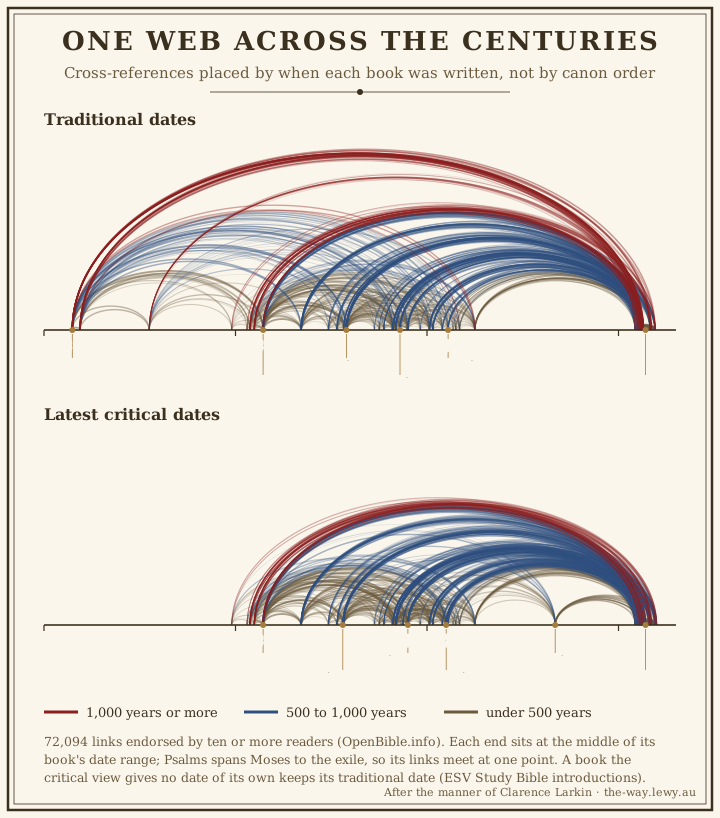
Cross-references are a reader's judgment. Quotations are a textual fact. The site's derived links find 5,407 places where the Greek New Testament shares a quoted run of words with the Greek Old Testament, by the method What the Scripture Links Reveal sets out.
| Greek quotations | Traditional dates | Critical dates |
|---|---|---|
| Median distance between writing of the two books | 988 years | 633 years |
| Quotations reaching back more than 500 years | 92% | 88% |
| Quotations reaching back more than 1,000 years | 45% | 16% |
A writer who quotes an earlier one chooses to. What this measures is the length of the reach: New Testament writers took their words from books written six to ten centuries before them, and found those books saying what they had seen happen.
The two ends meet
The Bible's first three chapters and its last three were written, on any dating, many centuries apart. Readers have connected them 50 times on OpenBible, with 614 endorsements between them. The wording shows why. Comparing the Greek of Genesis 1-3 (the Septuagint) with the Greek of Revelation 20-22, these words occur in both, though each is rare in the New Testament:
| Greek | Meaning | Genesis 1-3 | Revelation 20-22 | NT uses |
|---|---|---|---|---|
| ξύλον (xylon, G3586) | tree | 2:9; 3:22, 24 | 22:2, 14, 19 | 20 |
| ποταμός (potamos, G4215) | river | 2:10, 13 | 22:1, 2 | 17 |
| ὄφις (ophis, G3789) | serpent | 3:1, 13 | 20:2 | 14 |
| πηγή (pēgē, G4077) | spring | 2:6 | 21:6 | 11 |
| χρυσίον (chrysion, G5553) | gold | 2:11, 12 | 21:18, 21 | 12 |
| φύλλον (phyllon, G5444) | leaf | 3:7 | 22:2 | 6 |
| φωστήρ (phōstēr, G5458) | light, radiance | 1:14, 16 | 21:11 | 2 |
The story opens with a river flowing out of Eden and "the tree of life … in the midst of the garden" (Genesis 2:9-10, ESV). It closes with "the river of the water of life … flowing from the throne of God and of the Lamb" and, on either side, "the tree of life" (Revelation 22:1-2, ESV). Between them stands the curse: "cursed is the ground because of you" (Genesis 3:17, ESV). At the end, "No longer will there be anything accursed" (Revelation 22:3, ESV), and "that ancient serpent" is bound (Revelation 20:2, ESV). This shows that God finishes what He begins. The garden man was driven from, guarded "to guard the way to the tree of life" (Genesis 3:24, ESV), is open again at the end, through the Lamb.
Different voices
Literary critics use a writer's habits with small words, "and", "for", "the", "not", to tell writers apart, because those habits are hard to imitate. The same method, applied here to the 60 most common words in each Testament, confirms that the Bible's writers are different people:
- In the New Testament, a 1,500-word passage's nearest match in another book is by the same writer 44% of the time, against 17% by chance.
- In the Old Testament, with 2,500-word passages, the figure is 35% against 10%.
The method detects writers. The Bible's many hands are real, and the critics were right to see them.
The same measure, applied to Isaiah, does not divide it. The distance between Isaiah 1-39 and 40-66 is 0.71. The two halves of Exodus are 1.14 apart, of 2 Kings 1.12, of 1 Chronicles 0.97 and of 1 Samuel 0.77. Isaiah's halves sit in the middle of ordinary single books (fifth of thirteen splits measured), and well below the 1.14 typical between two different books. This does not prove Isaiah wrote both halves: a measure of common words is blunt, and genre moves it. It does show that on this evidence the case for dividing Isaiah rests on its content, chiefly its predictions, and its style gives that case nothing.
A control: books outside the canon
The books outside the 66 that the Septuagint carries (Wisdom, Sirach, Tobit, Judith, the Maccabees and others) come from the same people and the same centuries. If later writers simply quoted whatever Jewish books they knew, the New Testament should reach them about as often.
Run the same test both ways, a run of five words in the same order with at least three content words, and the New Testament reaches 101 of the 22,310 verses of the canonical Septuagint (4.5 per thousand) and 6 of the 6,311 verses outside it (1.0 per thousand), all in 2 and 4 Maccabees. The New Testament writers quote the books that are in the canon about four and a half times as densely as the books from the same era that are not.
Part four: prophecy, a test of its own
The test
Cross-references show connection. Prophecy can show something the critics' model cannot absorb: a text that names an event before it happens. The test has three dates.
- When it was written, on the traditional view.
- The latest date any critic gives it. This is the date chosen to make the prophecy as late as possible. Critics place Daniel in 167-164 BC and Isaiah 40-55 in the middle of the sixth century.
- The oldest surviving witness to the text, a date no theory of authorship can move. The prologue to Sirach, written "in the thirty-eighth year of King Euergetes" (about 132 BC), says that "the law itself, and the prophecies, and the rest of the books" were already read in Greek (Sirach, prologue; this study's translation of Brenton's Greek, αὐτὸς ὁ νόμος, καὶ αἱ προφητεῖαι, καὶ τὰ λοιπὰ τῶν βιβλίων). Ben Sira himself, a generation or two earlier, names "the twelve prophets" as a set (Sirach 49:10). The Great Isaiah Scroll from Qumran was copied about 125 BC, and every Qumran scroll was hidden before the site fell in AD 68.
Twenty prophecies that Scripture itself says were fulfilled go through all three. One more is set aside before the test begins: 1 Kings 13:2 names Josiah three centuries ahead, but the book that records it was finished after Josiah lived, so it cannot count here.
Fulfilled in Jesus
| Prophecy | What it names | Fulfilled | Latest critical date | Years ahead | Oldest witness |
|---|---|---|---|---|---|
| Micah 5:2 | Bethlehem | c. 5 BC | c. 700 BC | 695 | Greek, by 132 BC; Qumran |
| Isaiah 7:14 † | a virgin's son | c. 5 BC | c. 700 BC | 695 | Great Isaiah Scroll, 125 BC |
| Isaiah 9:1-2 | Galilee | AD 29 | c. 700 BC | 729 | Great Isaiah Scroll, 125 BC |
| Malachi 3:1 | the forerunner | AD 29 | c. 430 BC | 459 | Greek, by 132 BC; Qumran |
| Zechariah 9:9 | the king on a donkey | AD 33 | c. 450 BC | 483 | Greek, by 132 BC |
| Zechariah 11:12-13 | thirty pieces of silver | AD 33 | c. 450 BC | 483 | Greek, by 132 BC |
| Psalm 22:18 | lots for his clothing | AD 33 | collection closed c. 450 BC | 483 | Greek, by 132 BC |
| Psalm 22:16 † | hands and feet | AD 33 | the same | 483 | Greek, by 132 BC; Qumran |
| Exodus 12:46; Psalm 34:20 | no bone broken | AD 33 | the same | 483 | Greek, by 132 BC; Qumran |
| Zechariah 12:10 | the pierced one | AD 33 | c. 450 BC | 483 | Greek, by 132 BC; Qumran |
| Isaiah 53:5, 9, 12 | the servant pierced, with the rich in death | AD 33 | c. 540 BC | 573 | Great Isaiah Scroll, 125 BC |
| Psalm 16:10 | not abandoned to the grave | AD 33 | the psalter's c. 450 BC | 483 | Greek, by 132 BC; Qumran |
| Daniel 9:25-26 † | the anointed one cut off | AD 33 | 164 BC | 197 | Greek, by 132 BC |
† contested, as explained below. The years ahead are measured from the latest critical date, or from the latest date of the book where critics give none.
All thirteen were written before the event on the critics' own dates. All thirteen were in Greek before Jesus was born, on the prologue's witness. Three can be held in the hand: the Great Isaiah Scroll contains Isaiah 7:14, 9:1-2 and the whole of Isaiah 53, copied more than a century and a half before the cross. "He was pierced for our transgressions; he was crushed for our iniquities" (Isaiah 53:5, ESV) was on that scroll in Qumran's caves when Jesus was born.
Three readings are contested, and the case on each side belongs on the page.
- Isaiah 7:14. עַלְמָה (almah, H5959) means a young woman of marriageable age; the Septuagint, in Greek before Jesus was born, renders it παρθένος (parthenos, G3933), "virgin", the word Matthew quotes (Matthew 1:23). Those who read Isaiah 7:14 of a birth in Ahaz's own day point to the sign's timing in 7:15-16; those who read it of Jesus point to 9:6-7, where the child carries the names of God.
- Psalm 22:16. The Masoretic Text reads כָּאֲרִי (ka'ari), "like a lion", my hands and feet. The Septuagint reads ὤρυξαν, "they dug", and a psalms scroll from Nahal Hever reads a verb from כרה, "to dig", with five words of the verse surviving. The ESV, NASB, CSB and NIV all print "pierced". No New Testament writer quotes this line, so the table counts it last.
- Daniel 9:25-26. The text sets out weeks of years, but where they begin and how they are counted is disputed. The site's chronology follows Harold Hoehner, counting from Artaxerxes' decree in 444 BC to AD 33; others count from 538 or 457 BC. Even on the critics' date of 164 BC, the anointed one is "cut off" two centuries later.
Fulfilled in Old Testament history
| Prophecy | What it names | Fulfilled | Years ahead, traditional | Years ahead, critical |
|---|---|---|---|---|
| Isaiah 44:28; 45:1 | Cyrus, by name | 538 BC | 143 | 2 |
| Isaiah 13:17-19 | the Medes against Babylon | 539 BC | 142 | 161 |
| Micah 3:12 | Zion plowed like a field | 586 BC | 114 | 114 |
| Jeremiah 25:11-12 | seventy years, then Babylon judged | 539 BC | 11 | 11 |
| Daniel 8:20-22 | Greece breaks Persia; four kingdoms | 331 BC | 220 | −167 |
This group is where the critics' dates do their work. Second Isaiah, on their reckoning, wrote as Cyrus was rising, two years before his decree. Daniel, on theirs, wrote after Alexander. That is the reason for those dates: the ESV Study Bible's introduction to Daniel notes that the late date is argued "because of its detailed prophecies" of the second century. A prophecy fulfilled before its oldest surviving copy cannot settle the argument, because the date of writing is the thing in dispute.
Micah 3:12 stands on any date. Jeremiah 26:18 quotes it by name, a century after Micah and before Jerusalem fell, so a second book attests the prophecy before the event. The Medes are named against Babylon in Isaiah 13, inside First Isaiah, which the critical view describes as "largely the work of Isaiah" (introduction to Isaiah, ESV Study Bible); on that view it stands too, though "largely" leaves room to date this oracle later.
After the Old Testament closed
Daniel 9:26 says that after the anointed one is cut off, "the people of the prince who is to come shall destroy the city and the sanctuary" (ESV). On the critics' own date of 164 BC that is 234 years before Rome burned the temple in AD 70. The reading is contested: critics take the verse of the high priest Onias III, deposed in 171 BC and later killed (2 Maccabees 4:33-34), and of Antiochus IV. Antiochus desecrated the temple; he destroyed neither the city nor the sanctuary. Jesus applied Daniel's desolation to Jerusalem's coming fall (Luke 21:20-24; Matthew 24:15).
Jesus' own word, "There will not be left here one stone upon another" (Mark 13:2, ESV), was fulfilled in AD 70 too. It cannot count against a critic, because critics who date the Gospels after AD 70 do so partly because of it (introduction to Matthew, ESV Study Bible). It is listed and not counted.
Israel's return to the land in 1948 is left out of the test. Ezekiel 36:24 promises "I will take you from the nations and gather you from all the countries and bring you into your own land" (ESV), and the date it was written is not in doubt. What no text supplies is the year of its fulfilment. Israel's Regathering and Refining weighs 1948 as a stage toward that promise and gives the views on both sides.
What the test shows
The test asks one thing: was it written down, and does it survive, before it happened? For the thirteen prophecies of Jesus, yes, on every date anyone gives, and for three of them a manuscript you can stand in front of says so. This shows that God does what He said in Isaiah 46:10. He declared the end from the beginning, and He declared it in public, in writing, centuries ahead, so that no one could say "My idol did them".
Where this argument is weak
- Writers chose to quote. The New Testament's reach back into the Old is deliberate. Part three's quotation figures measure how far the later writers reached, and the prophecy test is the measure that does not depend on their choices.
- The canon was chosen. The church kept the books that fit. The control in Part three tests this, and the canon wins by about four and a half to one, but the numbers are small (101 verses against 6) and a stricter or looser test would move them.
- Editors explain some unity. A redactor can make one book consistent. No editor joined Genesis to Revelation, and no editor could place Isaiah 53 in a scroll before the events it describes.
- Fulfilment is the New Testament's claim. A critic can say the Gospel writers shaped their stories to match the prophecies. Several of these events were in other hands: Jesus did not choose where He was born, the priests set the price of thirty pieces of silver, and Roman soldiers cast lots for His clothes and left His legs unbroken (John 19:23-24, 32-36).
- No number measures a miracle. This study gives no odds. Probabilities multiplied across prophecies assume the prophecies are independent and that only fulfilled ones were counted, and neither holds. What can be measured is structure and dates, and the inference to an Author is a conclusion from them, which Part five draws.
Part five: what literary criticism declares
Literary criticism set out to show that the Bible came from many hands, and it did. It found more writers than the church had counted, writing in three languages on three continents, across more than eight centuries on the critics' own dates. Its own tools confirm that those writers wrote differently.
Then the measurements show what those writers made. Their books form one web in which every writer is joined to every other. The story ends where it began, with a river and the tree of life, the curse lifted and the serpent bound. Its prophecies of Jesus were written before He came, translated into Greek before He was born, and copied onto a scroll that still survives.
Many writers who did not know each other, did not see the whole and did not finish the story could not have planned this between them. Scripture names the One who did: "God spoke to our fathers by the prophets" (Hebrews 1:1, ESV), and "men spoke from God as they were carried along by the Holy Spirit" (2 Peter 1:21, ESV). This is the doctrine of inspiration, and the data fit it. One Author wrote through many hands, and He wrote about His Son.
So you may read the Bible as one book. When you read Isaiah, you are reading about the same Jesus the Gospels show you. When you wonder whether God will keep His word to you, look at the record: He declared the end from the beginning, and He has never yet failed to do what He said.
Discussion questions
- The language. Hebrews 1:1 uses πολυμερῶς and πολυτρόπως, "many parts" and "many ways", words found nowhere else in the New Testament. What does it add that the writer stresses the variety of God's speaking before he names the Son?
- The text in its context. Isaiah 41-48 sets the LORD against Babylon's gods, and the test is prediction (Isaiah 41:22-23; 48:5). Why would that test matter to exiles living among those gods?
- Christ. Jesus said that "everything written about me in the Law of Moses and the Prophets and the Psalms must be fulfilled" (Luke 24:44, ESV). Which Old Testament passage would you most like to have heard Him explain on the road to Emmaus, and why?
- The hard part. Critics date Daniel to 164 BC partly because its prophecies of the second century are so exact (Daniel 8:20-22). How much weight should a dating argument carry when it rests partly on the view that detailed prediction cannot happen?
- The text in its context. Peter says the prophets "searched and inquired carefully" about what their own words meant (1 Peter 1:10-11, ESV). What does that tell you about how much one writer of Scripture understood of the whole?
- Be transformed. God declared His acts "before they came to pass … lest you should say, 'My idol did them'" (Isaiah 48:5, ESV). What promise of His are you finding it hard to trust this week, and what in His record would you set against your doubt?
Group study sheet for a 40-minute group: two A4 sheets, or one with the guided path
The point, the passage, the questions and the response, from this study. Print on both sides of two A4 sheets, flipping on the long edge. While this block is open, printing the page prints the sheet; close it to print the study.
What Literary Criticism Declares: Many Writers, One Story
Hebrews 1:1-2The point By literary criticism's own count the Bible is the work of many writers across more than eight centuries, and the measurements show one connected story whose prophecies were written, and survive in copies, before the events they name, which is what Scripture says of itself: God spoke "at many times and in many ways", declaring the end from the beginning, and has now spoken to us by His Son.
Ask: what comes to mind when you hear What Literary Criticism Declares
? Hear a few answers before anyone reads.
Hebrews 1:1-2 1On many past occasions and in many different ways, God spoke to our fathers through the prophets. 2But in these last days He has spoken to us by His Son, whom He appointed heir of all things, and through whom He made the universe.
Also read:
What Literary Criticism Declares: Many Writers, One Story
- Part one: what Scripture says. Hebrews 1:1-2, the prophets who did not see the whole, and God's own test of prophecy.
- Part two: what literary criticism says. The method in brief, and what its own count gives.
- Part three: what the measurements say. Writers, dates and languages; a web of cross-references; the two ends of the Bible; the writers' styles; a control.
- Part four: prophecy, a test of its own. Twenty prophecies put to the date of writing, the critics' latest date, and the oldest surviving copy.
- Where this argument is weak. Five limits, stated.
- Part five: what literary criticism declares.
- Annex: how the measurements were made.
What Literary Criticism Declares: Many Writers, One Story
1The language. Hebrews 1:1 uses πολυμερῶς and πολυτρόπως, "many parts" and "many ways", words found nowhere else in the New Testament. What does it add that the writer stresses the variety of God's speaking before he names the Son?
2The text in its context. Isaiah 41-48 sets the LORD against Babylon's gods, and the test is prediction (Isaiah 41:22-23; 48:5). Why would that test matter to exiles living among those gods?
3Christ. Jesus said that "everything written about me in the Law of Moses and the Prophets and the Psalms must be fulfilled" (Luke 24:44, ESV). Which Old Testament passage would you most like to have heard Him explain on the road to Emmaus, and why?
4The text in its context. Peter says the prophets "searched and inquired carefully" about what their own words meant (1 Peter 1:10-11, ESV). What does that tell you about how much one writer of Scripture understood of the whole?
5The hard part. Critics date Daniel to 164 BC partly because its prophecies of the second century are so exact (Daniel 8:20-22). How much weight should a dating argument carry when it rests partly on the view that detailed prediction cannot happen?
What Literary Criticism Declares: Many Writers, One Story
6Be transformed. God declared His acts "before they came to pass … lest you should say, 'My idol did them'" (Isaiah 48:5, ESV). What promise of His are you finding it hard to trust this week, and what in His record would you set against your doubt?
- Think. The Bible has one Author behind its many writers. God "spoke … by the prophets", and "men spoke from God as they were carried along by the Holy Spirit" (Hebrews 1:1; 2 Peter 1:21, ESV). Read any page of it as part of one story about His Son.
- Attitude. Rest your future on the God who has already kept His word on the record: "I declared them to you from of old, before they came to pass" (Isaiah 48:5, ESV).
- Do. This week, read Luke 24:13-35 and then Isaiah 53 with someone, and ask together what Jesus meant when He began "with Moses and all the Prophets" (Luke 24:27, ESV).
Long ago, at many times and in many ways, God spoke to our fathers by the prophets, but in these last days he has spoken to us by his Son, whom he appointed the heir of all things, through whom also he created the world.
Hebrews 1:1-2 (ESV)Father, you are God and there is no other. You spoke to our fathers at many times and in many ways, by shepherds and kings, priests and fishermen, over more centuries than we can hold in our minds, and you said one thing. You declared the end from the beginning, and you kept your word. Thank you that in these last days you have spoken to us by your Son Jesus, who suffered as the prophets wrote and entered His glory. Open our minds to understand the Scriptures, as He opened the minds of His disciples. Make us people who trust the God who keeps His word.
In Jesus' name. Amen.
What Literary Criticism Declares: Many Writers, One Story
Hebrews 1:1-2Open Ask: what comes to mind when you hear What Literary Criticism Declares
? Hear a few answers before anyone reads.
Read it aloud Hebrews 1:1-2
1The language. Hebrews 1:1 uses πολυμερῶς and πολυτρόπως, "many parts" and "many ways", words found nowhere else in the New Testament. What does it add that the writer stresses the variety of God's speaking before he names the Son?
2The text in its context. Isaiah 41-48 sets the LORD against Babylon's gods, and the test is prediction (Isaiah 41:22-23; 48:5). Why would that test matter to exiles living among those gods?
3Christ. Jesus said that "everything written about me in the Law of Moses and the Prophets and the Psalms must be fulfilled" (Luke 24:44, ESV). Which Old Testament passage would you most like to have heard Him explain on the road to Emmaus, and why?
4The text in its context. Peter says the prophets "searched and inquired carefully" about what their own words meant (1 Peter 1:10-11, ESV). What does that tell you about how much one writer of Scripture understood of the whole?
5The hard part. Critics date Daniel to 164 BC partly because its prophecies of the second century are so exact (Daniel 8:20-22). How much weight should a dating argument carry when it rests partly on the view that detailed prediction cannot happen?
6Be transformed. God declared His acts "before they came to pass … lest you should say, 'My idol did them'" (Isaiah 48:5, ESV). What promise of His are you finding it hard to trust this week, and what in His record would you set against your doubt?
- Think. The Bible has one Author behind its many writers. God "spoke … by the prophets", and "men spoke from God as they were carried along by the Holy Spirit" (Hebrews 1:1; 2 Peter 1:21, ESV). Read any page of it as part of one story about His Son.
- Attitude. Rest your future on the God who has already kept His word on the record: "I declared them to you from of old, before they came to pass" (Isaiah 48:5, ESV).
- Do. This week, read Luke 24:13-35 and then Isaiah 53 with someone, and ask together what Jesus meant when He began "with Moses and all the Prophets" (Luke 24:27, ESV).
What Literary Criticism Declares: Many Writers, One Story
The point By literary criticism's own count the Bible is the work of many writers across more than eight centuries, and the measurements show one connected story whose prophecies were written, and survive in copies, before the events they name, which is what Scripture says of itself: God spoke "at many times and in many ways", declaring the end from the beginning, and has now spoken to us by His Son.
Annex: how the measurements were made
- Authorship table.
docs/data/book-authorship.tomlgives each book's writer, date, place and language, with the traditional date from the ESV Study Bible introductions (book and section introductions; Psalms, Song of Songs and Revelation from its section introductions, with the CSB Ancient Faith Study Bible for Psalms' date range). A critical date is entered only where the source states one. Anonymous books count as one writer each, the choice that gives fewer writers. - Cross-references. OpenBible.info, 865,898 links, endorsed by at least ten readers for the network figures. Until 2026-11-03 the site's copy had silently dropped Revelation's 35,032 links; the figures here include them.
- Quotations. The site's derived links (
quotation-greek, 5,407 links): Greek New Testament against the Septuagint, same words in the same language. - Bookends. Septuagint lemmas (Open Scriptures) for Genesis 1-3 against MACULA Greek lemmas for Revelation 20-22; New Testament counts from MACULA.
- Style. Burrows' Delta on the 60 most common lemmas per Testament (MACULA Greek and Hebrew), in 1,500-word (Greek) and 2,500-word (Hebrew) passages. Isaiah's halves are compared with the halves of twelve other long books.
- Control. Five-lemma runs with three or more content words, NT against the Septuagint, canon and non-canon scored by the same rule. Duplicate recensions (Old Greek Daniel, Tobit's second text) are left out.
- Prophecy.
docs/data/fulfilled-prophecy.toml; fulfilment years from the site's chronology (docs/data/chronology.json); Qumran copies from the Dead Sea Scrolls morphology (caves 1-11 only). The Great Isaiah Scroll's date, about 125 BC, is the one recorded on Ancient Texts and Manuscripts. - Re-running.
uv run python unity_measures.pyinreferences/build/writes every figure todocs/data/unity-measures.json.
References & Recommended Reading
- English Standard Version (Crossway), the study's quotation text; CSB, NASB, NIV compared at Psalm 22:16.
- ESV Study Bible (Crossway): book and section introductions for every book; notes on Hebrews 1:1 and 1 Peter 1:10-11.
- CSB Ancient Faith Study Bible (Holman): introductions to Psalms, Song of Songs and Revelation.
- SBLGNT and MACULA Greek and Hebrew (Clear Bible); Westminster Leningrad Codex (morphhb); Brenton's Septuagint, including the prologue to Sirach and Sirach 49:10; Septuagint lemmas (Open Scriptures).
- ETCBC Dead Sea Scrolls morphology (restricted, non-commercial licence), for Qumran attestation and the Nahal Hever reading of Psalm 22:16.
- OpenBible.info cross-references (CC BY).
- Chris Harrison and Christoph Römhild's 2007 arc diagram of the Bible's cross-references, drawn in canon order; the chart in Part three redraws the same kind of links by date of writing.
- STEP Bible's list of New Testament quotations of the Old Testament (Tyndale House, CC BY).
- Harold W. Hoehner, Chronological Aspects of the Life of Christ (Zondervan, 1977), for the reckoning of Daniel 9 the site's chronology follows.
- John Burrows, "'Delta': a Measure of Stylistic Difference and a Guide to Likely Authorship," Literary and Linguistic Computing 17 (2002), for the style measure.
On this site
- What the Scripture Links Reveal — how the quotation links are found.
- Ancient Texts and Manuscripts — the Dead Sea Scrolls and other witnesses.
- Israel's Regathering and Refining — the regathering promises and 1948.
- What Creation Declares, What World Population Declares and What Languages Declare — the rest of the series.